The highly acclaimed Israeli television series Timrot ʿAshan (Pillars of Smoke) tells the story of a fictitious kibbutz in the Golan Heights, which is inhabited by a peculiar cult until one day its members collectively disappear without leaving a trace.Footnote 1 The series follows the adventures of two police officers in their search for the vanished community. Throughout the series the officers believe that the members of the kibbutz, which had been built directly above the defunct Trans-Arabian Pipeline (Tapline), were embroiled in its reactivation for the purpose of illegally selling its oil. Only in the last episode of the series is it revealed that in fact the pipeline had become a dumping site for radioactive waste and that the highest echelons of the government were involved in this affair. The kibbutz members used the underground pipeline's trans-Arabian function to clandestinely cross the border between the Israeli-controlled Golan Heights and Syria, without alerting the powers that be.
Despite the centrality of Tapline in Timrot ʿAshan, this once politically, economically, and technically ambitious project is now all but forgotten. In Israel and elsewhere in the Middle East next to nothing is known about Tapline during the years in which it was operational as an oleoduct. Although many Israelis may be familiar with the “oil route”—the road that cuts through the Golan Heights from southeast to northwest, running parallel to the pipeline—they would not associate it with a fascinating, related story about the Arab–Israeli conflict and Tapline. Indeed, only a few know that from June 1967 until 1982 Saudi oil ran through Israeli-controlled parts of the Golan Heights with the consent and cooperation of Syria, Lebanon, Jordan, and Egypt, or that since 1984 water rather than oil has been flowing in the Golan Heights’ portion of Tapline.
Setting aside the fictitious plot of Timrot ʿAshan, this article proceeds to analyze Tapline in the context of the Arab–Israeli conflict with two major objectives. First, Tapline provides us an opportunity to analyze oil pipelines that since the 1930s have crisscrossed the Middle East, creating an interconnected region that defies common wisdom about state sovereignty or the function of interstate boundaries. Second, Tapline demonstrates how this interconnected network created possibilities for Arab–Israeli cooperation that might have seemed inconceivable initially, given the hostile and violent dynamics of the Arab–Israeli conflict.
In his recent book, Timothy Mitchell analyzes the relations between fossil fuels and democracy.Footnote 2 Mitchell argues that to study these relations, “the carbon itself must to be transformed, beginning with the work done by those who bring it out of the ground. The transformations involve establishing connections and building alliances—connections and alliances that do not respect and divide between material and ideal, economic and political, natural and social, human and non-human or violence and representation.”Footnote 3 In this article, I apply Mitchell's insight to one important dimension of the carbon world that he uncovers, that of oil pipelines. I am not concerned with the question of democracy per se but rather with the connections, alliances, and “political possibilities [that] were opened up or narrowed down by different ways of organizing the flow and concentration of energy. . . . These possibilities were enhanced or limited by arrangements of people, finance, expertise and violence that were assembled in relationship to the distribution and control of energy.”Footnote 4
The oil (and gas) pipelines that have traversed the Middle East,Footnote 5 connecting producers and clients, demand and supply, oil producing and transit states, allies and adversaries, reveal a world whose fragments are physically tied to each other, where one event across the network could affect all its parts. In such a network, oil is not only a commodity to extract, transport, and consume or a source of pollution, but also a literal as well as symbolic link, reflecting the interconnected nature of our world. It is a world where hard political borders become permeable lines, easily crossed by the pipelines, by the oil that flows inside them, and by the teams of experts and workers who build and then maintain them, thereby defying modern perceptions of state borders as impregnable lines; it is a world where state sovereignty is willingly relinquished by governments so as to establish ex-territorial strips of land where the pipelines are laid down, land that is often controlled by foreign oil companies and their governments. Because of its interconnectedness it is also a vulnerable world, exposed not only to ebbs and flows in the oil market but also to intentional acts of sabotage.
Tapline exemplifies this interconnectedness and its vulnerabilities. It connected Riyadh, Washington DC, Damascus, Amman, Beirut, Tel-Aviv, and western European capitals. It also linked workers along its 1706-km length; observers of the United Nations Truce Supervision Organization (UNTSO) along the Israeli–Lebanese and Israeli–Syrian armistice lines; Syrian, Lebanese, and Israeli militaries; and farmers whose agricultural land the pipeline traversed. Furthermore, it tied together Tehran, Cairo, and Baghdad, as well as the Palestinian Liberation Organization (PLO), which though not physically part of the project were greatly affected by it, including through Saudi subsidies to frontline states and the PLO and through competition as oil-producing states with their own export venues, including pipelines.
Exploring this network allows us to differently conceptualize political borders in general and Arab–Israeli borders in particular. When one considers the political boundaries that separate Israel from its Arab neighbors, images of sealed and impregnable lines come to mind. Although the Egyptian and Jordanian peace accords with Israel may have slightly changed these images, the political borderlands of the Arab–Israeli conflict still resonate strongly with what Oscar Martínez has defined as “alienated borders.” According to Martínez, alienated borderlands exist “where cross-boundary interchange is practically nonexistent owing to extremely unfavorable conditions. Warfare, political disputes, intense nationalism, ideological animosity, religious enmity, cultural dissimilarity, and ethnic rivalry constitute major causes of such alienation.”Footnote 6 As I show in this article, Tapline's history demonstrates that even in an atmosphere of harsh conflict, if the political and economic interests of hostile states converge, then their shared boundary might be less impregnable than presumed.
Martínez’ typology, which border scholars have used extensively,Footnote 7 offers three border typologies in addition to “alienated borders”: coexistent (marked by minimal cross-border interaction, as in the Egyptian-Israeli case before the recent escalation); interdependent (involving cross-border networks and cooperation, as in the U.S.–Mexico borderlands); and integrated (economic and political barriers having been eliminated, as in the European Union). Although these typologies are useful in broadly categorizing the hundreds of interstate borderlands across the world, they fail to describe the numerous intermediary cases, where alienated, sealed borders become porous not as a result of cross-border military confrontation but because political and economic interests combine to yield unexpected alliances requiring cross-border cooperation. Tapline provides us with such an example.
The article is divided into three sections. In the first section I follow the construction of the pipeline and the efforts invested by the Tapline Company and Saudi Arabia in 1945 to circumvent Palestine, even before Israel was established. The second section follows the fate of Tapline after the Israeli occupation of the Golan Heights in the 1967 war. My main aim here is to demonstrate how Tapline continued to operate despite an atmosphere of conflict when all transit states (as well as Egypt) acquiesced to Israel becoming a partner in the project. Moreover, Israel was not a passive participant but an active protector of its own political interests. The result was a unique form of Arab–Israeli cooperation that lasted until 1982. The third section discusses the closing of the project that year and the subsequent transformation of the Golan Heights portion of the pipeline from an oleoduct to an aqueduct. The article concludes with observations about border dynamics in general and in the context of the Arab–Israeli conflict in particular. It also speculates about the possibility of reopening the pipeline and renewing the cross-border cooperation that Tapline facilitated during its years of operation.
CIRCUMVENTING PALESTINE
The Trans-Arabian Pipeline extended from Dhahran in Saudi Arabia to the port of Zahrani in Sidon in southern Lebanon, crossing Jordan and Syria's Golan Heights along its 1706-km route.Footnote 8 It was first conceived by the Arabian American Oil Corporation, ARAMCO (comprising Standard Oil Company of New Jersey, Socony-Vacuum of Texas, and Standard Oil of California), which sought to find a cheap and efficient way to transport Saudi oil to the West, circumventing the services of expensive tankers and satisfying the growing need of the Saudi King, ʿAbd al-ʿAziz ibn Saʿud, for oil revenues. After World War II, ARAMCO found a trustworthy ally in the U.S. government, without which the project would not have seen the light of day. The latter sought to achieve two goals by cooperating with the giant oil corporation. First, American policymakers wanted to satisfy the growing need for oil in Europe without draining oil reserves in the United States. Second, they aspired to increase oil revenues in the Middle East in order to assist in the American-led modernization project in the region without using U.S. tax dollars. The converging interests of ARAMCO and the U.S. government enabled a remarkable alliance that began in the mid-1940s and continued until the final dissolution of Tapline in the early 1980s.Footnote 9
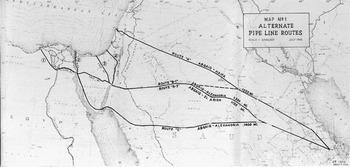
After the plan was announced, in February 1944, it took six years to complete the construction of a pipeline from Saudi Arabia to the Mediterranean, and on 2 December 1950 the first crude oil was loaded on a tanker in the port of Zahrani in Lebanon. First a route for the pipeline had to be chosen. Had topography been the only concern, it would have traversed Saudi Arabia, Jordan, and Palestine, reaching the terminus at the port of Haifa. But geopolitics played a far more significant role than topography in determining the route of Tapline. As early as November 1945, Ibn Saʿud objected to having the line pass through Palestine, perhaps foreseeing the potential volatility of the Jewish-Arab conflict over this piece of land. The U.S. State Department also believed it would “not make good political sense that the terminal of an Arabian-American pipeline be built in what may for at least another generation be a land of bitter Arab-Jewish conflict.”Footnote 10 Eventually ARAMCO, which had initially sought the cheapest and shortest path, conceded, and the route through Saudi Arabia, Jordan, Syria, and Lebanon was selected (see Figure 1). Agreements with Lebanon (10 August 1946), Jordan (8 August 1946), and Saudi Arabia (11 July 1947) were concluded with relative ease, but reaching an agreement with Syria proved to be arduous.Footnote 11 Although Syria signed an agreement with Tapline on 1 September 1947, the Syrian parliament refused to ratify it.Footnote 12 Syria made certain financial demands from ARAMCO, but the most important bone of contention was Palestine. From the very beginning of the negotiations, the Syrian government conditioned its approval on a change in U.S. policy toward Palestine. As the prospects of Western endorsement of the establishment of a Jewish state increased, the Arab League also issued a statement prohibiting any oil concessions to the West as long as the Palestine issue remained unclear. President Truman's endorsement of a Jewish state in Palestine and the outbreak of the 1948 war initially appeared to strike the final blow to the Tapline project. Circumventing Palestine geographically proved easier than circumventing it politically.
The various routes that were considered before the final route circumventing Palestine was chosen in 1947. Map taken from http://almashriq.hiof.no/lebanon/300/380/388/tapline/reconnaissance/, reconnaissance of alternate routes for the proposed Trans-Arabian Pipeline, a report by Oscar Wolfe and S. P. Johnson, July 1936 (accessed 29 March 2012).

In order to neutralize Syria's objections and secure its ratification of the Tapline agreement, on 30 March 1949 the CIA supported a coup d’état led by Colonel Husni Zaʿim, who had been plotting this move with U.S. agents since early 1949.Footnote 13 Saudi King Ibn Saʿud, realizing that the last obstacle to construction of the pipeline had been removed, congratulated Zaʿim soon after the coup: “We are pleased that God has crowned your efforts to establish a new Syrian Government with success and in recognizing this government we extend to your Excellency our hearty and best wishes for your success and prosperity and happiness of the Syrian nation.”Footnote 14 Zaʿim was quick to deliver, promoting a pro-Western policy and issuing a legislative decree in mid-May granting Tapline its right-of-way in the Golan Heights.Footnote 15 This decree paved the way for the construction of the pipeline in Syria and Lebanon. The overthrow of Zaʿim in August did not derail the Tapline project, as the Truman administration conditioned its recognition of the new regime on continued adherence to the Tapline accord. The alliance between ARAMCO/Tapline and the U.S. government proved effective.
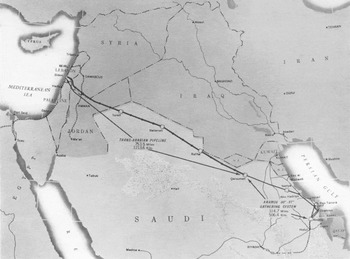
Before work on the ground could begin, Tapline had to obtain a thirty-meter-wide right-of-way from landowners along the entire extension of the planned route. The agreements with the respective governments stipulated that state-owned land would be leased to Tapline as long as it was operational, while privately owned land would be purchased by the company. If the owners were unwilling to sell their lands, the respective governments would expropriate them at Tapline's expense.Footnote 16 In Syria the government had to amend the Syrian Expropriation Law to facilitate construction of the pipeline.Footnote 17 The planned route also crossed the lands of forty-one Syrian villages in the Golan Heights, and Tapline was asked to prepare and submit to the Syrian Government forty-one folders with detailed cadastral maps in order to determine the company's right-of-way in Syria (see Figure 2).Footnote 18
Tapline's general route from Saudi Arabia to Lebanon. From http://almashriq.hiof.no/lebanon/300/380/388/tapline/map.html (accessed 29 March 2012).

The construction of the pipeline was one of the most ambitious technological projects of the time. Two American companies were hired for the mission; International Bechtel Inc. was in charge of the eastern division in Saudi Arabia, while Williams Brothers was responsible for the western section, covering Jordan, Syria, and Lebanon. The project involved the shipping of 265,000 tons of steel plate and thousands of pieces of heavy machinery from California to Dhahran and Beirut. It required the paving of an access road parallel to the pipeline, creating a transport route that had not previously existed. Sixteen thousand workers, mostly from the local population of the areas traversed by the route, were temporarily hired for the execution of the project. All in all, Tapline constituted the biggest transportation and trucking project of its time. Work was completed in April 1950 in Lebanon and in July in Syria. The section in the Golan Heights was described by Williams Brothers as “the most difficult they had encountered in the Company's history of pipeline construction,” taking twice as long to construct as all other parts of the pipeline combined.Footnote 19 On 25 September 1950, the eastern and western divisions met and were welded together at Angle Point near Tell Hibr in northwestern Saudi Arabia. “Its 30 and 31-inch pipeline traverses the hot gravel plains of northeastern Saudi Arabia, the lava beds of the Hashemite Kingdom of Jordan, the dusty, [sic] and plains of Syria and the rock-crested mountains of Lebanon,”Footnote 20 read an official brochure of Tapline. The first crude oil reached the Medreco oil refineries in Sidon on 10 November 1950, and on 2 December 1950 the first tanker made its way to Europe, transporting Saudi oil to the West. The maximum transferring capacity of the pipeline was 480,000 barrels per day, and at its peak Tapline transported about 30 percent of total Saudi oil production.Footnote 21
In retrospect, looking at the route of Tapline on maps and on the ground, it is remarkable how important it was for the company to circumvent Palestine. The pipeline crosses the Golan Heights from southeast to northwest, where in two locations its comes as close as 150 m to the Israel border: the first is next to the northeast tip of Israel and the second just above Metullah in the Galilee panhandle. It then makes a sharp north-northwest turn on its way to the port of Zahrani, south of Sidon (see Figure 3).
Tapline's route near the Israeli boundary. Note the proximity (about 150 m) to the Israeli boundary in two locations. Decimal file, 1950–1954, record group 59, box 5446, NACP.

Many years after the pipeline's completion, William R. Hellmann, an American surveyor who was involved in laying Tapline, commented on the process.Footnote 22 He recalled working with a team of Lebanese surveyors in order to identify Palestine's boundary with Syria and Lebanon. According to him, this task was easy because they used accurate French military maps and found the border markers on the ground without difficulty. Hellman's testimony is supported by reports by Williams Brothers, whose workers were careful not to cross the boundary into Palestine. Although the company subcontracted locals for clearing, grading, and ditching, while leaving the actual construction of the pipeline to its own workers, it assumed responsibility for the entire operation along the boundary with Israel in order to guarantee that the line remained exclusively within Syria and Lebanon.Footnote 23
Tapline had to locate the boundaries of all transit states, including those of Lebanon and Syria, so as to pay right-of-way fees to governments and landowners. But unlike the Palestine boundary, the Syria–Lebanon boundary proved to be particularly difficult to pinpointFootnote 24 because these two states had never signed a boundary treaty and because sovereignty over the area where Syria and Lebanon meet the Palestine/Israel boundary had been disputed from the 1930s (and, indeed, remains so to this day). Evidently this indeterminate boundary did not bother Tapline in 1950, as the pipeline was laid down there without interruption. The problem only surfaced when Tapline technicians had to maintain the pipeline precisely where the purported Syria–Lebanon borderline crossed the Hasbani River. Because of the proximity to the Israel boundary, they had to coordinate their work with the mixed-armistice commissions of Israel–Syria (ISMAC) and Israel–Lebanon (ILMAC), and it was not always clear which commission to approach for coordination of the maintenance work.Footnote 25 Apparently the pipeline's close proximity to Israel posed operational, though by no means insurmountable, problems for Tapline.
Tapline was a vital economic project for all parties involved: Saudi Arabia and the transit states, including their local populations, and the four American oil corporations that comprised the pipeline company, whose profits soared during the first two decades of its existence. Locally, Tapline hired most of its employees from the communities traversed by the pipeline, first to help construct it and, once completed, to maintain it.Footnote 26 The company ran its operations out of its headquarters on Hamra Street in Beirut and two smaller offices, in Sidon and New York City. It signed agreements with Syria, Lebanon, Jordan, and Saudi Arabia and paid them annual transit fees. In addition, it supplied oil to Jordan (through a refinery at al-Zarqaʾ built for this purpose) and to Lebanon, making the entire project absolutely vital for the economies of the two states.
The agreements with the transit states were renegotiated several times from 1950 through 1976 as the governments demanded—justifiably, one might add—increases in their transit revenues. Tapline officials agreed to renegotiate these terms time and again, as the continuation of the project was vital for the company as well, until the mid-1970s, when the transportation of oil by tankers became cheaper and when political obstacles, discussed below, disrupted the flow of oil.
ISRAEL COMES TO TAPLINE
Although Tapline made all possible efforts to avoid Palestine/Israel in 1949–50, Israel eventually came to Tapline in the June 1967 war. Furthermore, the occupation of the Sinai Peninsula by Israel and the closing of the Suez Canal had dramatic repercussions on the export of Gulf oil to the West. On June 7, Saudi Arabia closed down ARAMCO operations in Dhahran including the export of oil through Tapline. Other Arab oil producers followed suit, supported by a joint decision of Arab oil ministers to cease all oil exports to the West.Footnote 27 In addition, the Saudis had to decide what to do with Tapline now that about fifty kilometers of the pipeline were in territory occupied by Israel. The U.S. government and ARAMCO also expressed concern about the future of Tapline. Both thought that obtaining consent from Israel would be less of a problem than securing the agreement of the Arab transit states, particularly Syria, to resume oil export through the pipeline as long as Israel occupied the Golan Heights. Tapline's president, William R. Chandler, was concerned that the company's stockholders would not approve the construction of a pipeline designed to bypass the territories controlled by Israel and was pessimistic about the prospects of reopening the operation. Unless Egyptian president Jamal ʿAbd al-Nasir gave the green light, Chandler speculated, Tapline was likely to be shut down.Footnote 28
However, realpolitik soon prevailed. Arab oil-producing countries resumed exporting oil to the West within a month after the conclusion of the war.Footnote 29 By 1 September 1967 this practice became official Arab policy as the Khartoum Summit authorized the resumption of oil export in exchange for the financing of Arab states affected by Zionist “aggression.” Oil now became, as the Khartoum declaration stipulated, “a positive Arab resource that can be used in the service of Arab goals.”Footnote 30 Although the Saudi government approved the reopening of Tapline as early as July 3,Footnote 31 the pipeline resumed full operation only on September 16, with a formal announcement by the Saudi government. Between these dates Ahmad Zaki al-Yamani, the powerful Saudi minister of oil, ensured that Saudi nationals would not have to work in Israeli-controlled areas and successfully pressured ARAMCO to increase the price of oil exported through Tapline.Footnote 32 Not surprisingly, the new agreement between Aramco and Saudi Arabia on the reopening of Tapline did not mention or even hint that Israel had become a partner in this endeavor.Footnote 33
Israel, for its part, quietly approved the resumption of Tapline operations without demanding transit royalties from the company.Footnote 34 Neither oil nor financial profits motivated Israel, as in1967 its oil needs were met primarily by Iran through a covert alliance between the two countries.Footnote 35 Rather, Israel was interested in the political opportunities the pipeline itself provided, a point to which we will return. Thus, in a remarkable twist of history, Israel became a partner in this endeavor by allowing Tapline to resume its operations after the 1967 war.Footnote 36 Saudi oil now flowed through 50 km of Israeli-controlled territories, while Lebanon, Syria, Jordan, and Saudi Arabia continued to collect transit royalties from this endeavor. Furthermore, Arab frontline states and Palestinian guerillas received financial assistance from Saudi Arabia, which, in accordance with the resolutions of the Khartoum summit, used its oil revenues for this purpose.Footnote 37 Thus, not only did Israel join the Tapline project as a result of the 1967 war, but it also facilitated continuation of the project, indirectly supporting the economies of the transit states and Saudi Arabia's financial assistance to Palestinian guerillas and frontline countries.
This tacit cooperation created a twisted reality that better fits a satire than a tragic account of the Arab–Israeli conflict. For example, after the end of the war, the buffer zone between Syria and the Israeli-controlled Golan Heights became a site of border skirmishes and exchanges of fire. UNTSO observers were often busy defusing tension between the two armies along the ceasefire line.Footnote 38 However, when the Tapline control room in Beirut reported a leak in the pipeline precisely at the buffer zone, UNTSO observers facilitated tacit cooperation between Syria and Israel to allow Tapline technicians to enter what was otherwise a war zone and fix the problem.Footnote 39 Bluntly stated, at one spot along the ceasefire line, Israel and Syria would exchange fire while at another spot they would momentarily hold their fire to allow repairs to the pipeline.
This incident provided Israel's first opportunity to affirm its involvement in Tapline and underscore its control over the Golan Heights. It was the Syrian manager of Tapline who had approached UNTSO to seek UN assistance in coordinating the repairs with Israel. Israel's government, however, did not immediately agree to cooperate with UNTSO. Instead, it seized the opportunity to request that Tapline “recognize” Israel by demanding that the company contact the Israeli government directly or through the U.S. embassy.Footnote 40 Tapline was reluctant to do so, but as time passed and the leak persisted, the American embassy in Tel Aviv intervened and made an official request on behalf of Tapline. Israel approved the repairs on the condition that UNTSO observers enter the area from both the Syrian and the Israeli sides, accompanied by representatives of the Israel Defense Forces (IDF) and oil experts.Footnote 41 Syrian authorities approved Israel's conditions and the leak was finally fixed.Footnote 42
Unsurprisingly, Palestinian guerillas noticed this twisted reality. On 30 June 1969, a Palestinian commando unit belonging to the Popular Front for the Liberation of Palestine (PFLP) infiltrated Israel from the ʿArqub region in southern Lebanon (the area known in Israeli and Western media as Fatahland) and blew up the pipeline next to gate valve 530 (see location in Figure 3 above), in close proximity to the Banias Springs, one of the three sources of the Jordan River. Six to nine thousand tons of crude oil spilled out before the line was shut down, one to two thousand tons of which flowed to the Banias River and from there via the Jordan River to the Sea of Galilee.Footnote 43 One should not mix oil with water, goes the adage, especially not when it involves Israel's most important water sources.
The PFLP issued a customary communiqué assuming responsibility and explaining the motives behind the operation:
This operation is targeted against the imperialistic interests tied with Israel, most notably American interests. Tapline leads the monopolistic and exploitative American groups and is part of the hostile front against the Arab nation and the Palestinian people. Israel remains silent about the fact that the pipeline crosses the Golan Heights because it is in Israel's interest and in the interests of the countries that support it that oil keeps flowing. The Arab states need to know that Arab oil is at the mercy of their enemy. They should know that they would not be harmed by this operation that targets American imperialism and Israel.Footnote 44
Ghasan Kanafani, author and spokesman of the PFLP, further explained the motives and objectives underpinning this operation: blowing up Tapline was one of the most important strategic operations of the Palestinian armed struggle because it exposed the ties of the Zionist movement with imperialist interests in the Middle East. It also expanded the frontier between the progressive Palestinian revolution and Zionism to include American imperialism and reactionary Arab regimes as legitimate targets.Footnote 45 The language employed by Kanafani reflects the Zeitgeist of the time. The Palestinian revolution presented itself as a vanguard force that would lead not only Palestine but the entire Arab world to national and progressive liberation. Leftist Palestinian fronts, including the PFLP, became the spearhead of a struggle in which the raison de révolution of the Palestinian struggle challenged the Arab states’ raison d’état.Footnote 46 Coincidently or not, Tapline became another arena for this struggle.
As expected, Tapline's transit states responded angrily to the attack. In Lebanon, concern was raised about the devastating economic consequences of terminating Tapline's operation.Footnote 47 In addition to the right to purchase cheap oil, Lebanon received transit royalties from Tapline and commissions from tankers docking in the Zahrani port, all of which threatened to disappear. Even al-Ahram, the mouthpiece of the Egyptian government, criticized the action as a violation of the Khartoum Arab Summit resolution that obliged Saudi Arabia to support the frontline states financially through its immense oil profits.Footnote 48 Al-Nasir's government apparently feared that this money was in jeopardy.
Saudi Arabia was particularly upset. The year 1968 marked a record year in Tapline profits as a result of the Suez Canal's closure and the subsequent price increase of operating oil tankers.Footnote 49 Consequently, Saudi police arrested Palestinian workers suspected of supporting the PFLP. The kingdom was financially backing the PLO and saw this operation as blatant ingratitude. In an article in the Lebanese al-Anwar, the former Saudi oil minister, ʿAbd Allah al-Tariqi, explained his country's frustration cogently:
[T]he Saudi government and people are paying no less than 6o million sterling pounds a year to support the military efforts of Egypt and Jordan as well as to support the Fedayeen movement. . . . Harming the economic interests of one or more Arab countries just because this would also harm our enemy is an unsuccessful act.
He concluded his article with the suggestion that if the PFLP were really interested in harming Israel then it should have targeted the Elath-Ashkelon oil pipeline that was in the process of being built, not “an Arab pipeline owned by the Arab nation.”Footnote 50 These reactions compelled Yasir ʿArafat, who was concerned that he might lose Saudi financial assistance, to travel to Riyadh to mend fences with the Saudi leadership and clarify that the PLO had nothing to do with the operation.Footnote 51
The flow of crude oil to the Jordan River and from there to the Sea of Galilee was of foremost concern for Israel. The Palestinian commando unit that blew up the pipeline had chosen the Banias site precisely for this reason, and the risk of recurrence was not negligible. Two years after 1967, Israel and Tapline had to negotiate not only the repairs but also new safety measures that Israel demanded as a precondition for resumption of the pipeline's operation. As we have seen, after the 1967 war, Tapline officials made an effort to maintain secrecy around Israel becoming a “transit state.” In a meeting between Tapline and U.S. State Department officials two days after the explosion, it was clearly stated that “[t]he policy of Tapline's owner companies, until the May 30 explosion, had been to avoid any direct contact with the GOI [Government of Israel] because of fear of hostile reaction from the four Arab transit states.”Footnote 52 After the explosion, Tapline officials preferred to communicate with Israel through the American embassy, as they had done during the 1967 oil leak discussed above, but Israel demanded that, for once, Tapline “recognize” the state of Israel.Footnote 53 Eventually, in order to expedite the resumption of oil flow in the pipeline, Garry Owen, a retired ARAMCO vice president, was selected to represent Tapline in Israel, but not before receiving the consent of the Arab transit states.Footnote 54
Although the sabotage and the consequent oil spill may have caused an environmental hazard for Israel, they also provided political opportunities. Not only was it another occasion to demonstrate Jerusalem's commitment to American interests but it also obliged Tapline and the U.S. government to publicly acknowledge Israel's de facto control of the Golan Heights. The U.S. government was fully aware of this point, as the legal advisor to the State Department explained in a report on the judicial ramifications of the sabotage. He pointed out that the Israeli occupation of the Golan Heights falls within the parameters of the fourth Geneva Convention and that, consequently, Israel could seize or close the line, demand transit royalties, or seek compensation for the oil spill. If ARAMCO (and by extension the U.S.) was interested in reopening Tapline, direct negotiations with Israel would have to take place.Footnote 55
The Israeli government seized the opportunity. Three days after the sabotage operation, while the fate of Tapline seemed unclear, Prime Minister Golda Meir sent a letter to Deputy Minister of Finance Zvi Dinstein, who was in charge of oil affairs in the government. Titled “oil pipeline in the Golan Heights,” the letter explained that
Israel has a political interest in preventing any impression that it seeks to exploit the act of sabotage by Arab terrorists in order to harm legitimate American interests or those of oil companies or to embarrass them. We have a political interest, therefore, in quick resumption of flow of oil with minimal political complications.Footnote 56
Despite this clear instruction, it took almost a month before a contract was signed on 9 July 1969 between the government of Israel and Tapline, stipulating the conditions for resumption of the pipeline's operation. The contract required Tapline to pay $2,050,000 in compensation, repair the damaged site, and construct a new system of safety measures throughout the Golan Heights so as to prevent any future spillage. The contract was signed between Zvi Dinstein, representing the government of Israel, and Garry Owen on a letterhead of the company that read, “TRANS ARABIAN PIPELINE COMPANY, P. O. Box 1348, Beirut, Lebanon.” In any other political context this stationery would not deserve our attention, but in the context of the Arab–Israeli conflict it was exceptional. It is not often that the State of Israel openly exchanges official correspondence with an address in an Arab capital. A day after the signing, Tapline immediately sent a technical team from Lebanon into Israel to begin working on the repairs, apparently without prior coordination with Israel. Arriving at al-Naqurah, the team attempted to cross the border with the assistance of UN observers from ILMAC, but Israeli soldiers stationed at the border crossing had instructions to deny the team's entry. The following morning, the Lebanese representative at ILMAC approached his Israeli counterpart on behalf of Tapline, seeking permission for the team to cross the border, but once again the team was denied entry. The head of the Israeli technical team assigned to work with Tapline on the repairs argued that the pipeline company should coordinate its actions directly with Israel rather than the Lebanese army or UN observers. After a few days’ delay, they were finally allowed entry.Footnote 57 This was a small incident but it reflected Israel's insistence on public recognition by Tapline of its involvement in maintaining the oil pipeline and, by extension, its control of the Golan Heights.
While Prime Minister Golda Meir and the Ministry of Foreign Affairs continued to press for the reopening of the pipeline, the professional team responsible for the repairs emphasized the importance of completing the construction of the safety measures as a precondition for resumption of the pipeline's operation.Footnote 58 The U.S. embassy in Israel also urged that the pipeline be reopened before the works concluded.Footnote 59 Ultimately, an upcoming visit by the prime minister to the United States became the deadline for resumption of Tapline's operation. On August 15 the Israeli government issued a statement announcing that Tapline would become operational as a gesture to the U.S. government before Golda Meir's trip to Washington.Footnote 60 At 4:00 p.m. on August 16, Israel authorized Tapline to resume its operation. There were some delays in Syria, reported nonchalantly by Israeli officials, but by the end of the day the pipeline reached its full capacity, transporting 480,000 barrels of Saudi oil per day.Footnote 61
It took more than a year for all the new safety measures to be implemented. As stipulated in the contract between Tapline and the government of Israel, the company paid for the construction of a control room in Rosh Pinah in northern Israel to monitor the pipeline in its Golan Heights portion and to stay in daily radio communication with the company's headquarters in Beirut.Footnote 62 This control room was managed by Abu (Avinoam) Horowitz,Footnote 63 who contracted Kibbutz ʿEin Zivan in the Golan Heights to be responsible for routine patrols to inspect and maintain the pipeline and its safety measures.Footnote 64 From 1970 until the closing of Tapline in the early 1980s, the Pipeline Guard (mishmar ha-tzinor) conducted daily patrols along the new asphalt road that was paved parallel to the pipeline in accordance with the new safety measures. Thus, rather than terminating Tapline as an “imperialist project,” the Palestinian attack on the pipeline only strengthened the ties between Israel, Tapline, and the transit states. Daily radio communication now took place between Israel and Beirut, and an Israeli paramilitary unit on Tapline's payroll patrolled the line to guarantee its undisturbed operation; the unit did not face any military challenge during the decade of its operation.
As much as Tapline tried, it could not circumvent the Arab–Israeli conflict or inter-Arab state dynamics. On 3 May 1970, only nine months after Israel had authorized the resumption of oil flow, a Syrian bulldozer hit the pipeline next to Darʿa, close to the Jordanian–Syrian border, causing the operation to shut down once again. The break might have been an accident, but a Tapline spokesman acknowledged the possibility that the Syrian government had deliberately forced the closure of the pipeline as a political statement against American pro-Israel policies in the Middle East.Footnote 65
Syria may have targeted the United States, but the consequences of closing the pipeline were regional, illustrating the interconnected, transnational configuration of oil pipelines in general and Tapline in particular. Not only was much of Saudi Arabia's oil revenue threatened again, but as in the previous crisis, transit royalties for Lebanon, Jordan, and Syria also ceased. In order to pressure Syria, Saudi Arabia threatened to abandon the Tapline project in its entirety and seek alternative routes for exporting its petroleum.Footnote 66 It also closed its borders to Syrian cars and produce and charged Damascus with weakening the Saudi commitment to support “Arab steadfastness” (al-ṣumūd al-ʿarabī) as stipulated in the Khartoum summit.Footnote 67 In Arab parlance of the time, that meant Saudi financial assistance to the frontline states and to the PLO.Footnote 68 Saudi leaders clearly saw this incident as a direct Syrian offense against their country. Faisal, the Saudi king (1964–75), refused to allow Tapline to seek an agreement with Syria, arguing that this was a government matter between Saudi Arabia and Syria.Footnote 69 After Saudi Arabia announced it would cease its financial aid to frontline states,Footnote 70 Jordanian and Lebanese officials arrived in Damascus to try to convince the Syrian regime to allow Tapline to repair the pipeline, but to no avail. Syria was in the midst of an internal political struggle between two factions of the military junta in power. On the one side was Salah Jadid, who pursued a staunch Arab nationalist stance; on the other was Hafiz al-Asad, heading a more accommodating camp vis-à-vis the Arab world and the West. In this domestic struggle, President Jadid decided to pressure the three “reactionary” states—Saudi Arabia, Jordan, and Lebanon—thereby sending a message, domestically and regionally, of anti-Western posture. By early November, an American journalist reported, American Tapline workers in Beirut began speaking about their next trip home as their last, and Tapline President William Chandler was reported to be “making funeral arrangements for Tapline.”Footnote 71
However, Hafiz al-Asad's takeover on 21 November 1970 saved Tapline from obliteration, at least for a while. Al-Asad ushered in a change in Syrian foreign and regional politics toward a much more flexible stance. Consequently, he reduced anti-Western rhetoric and changed Syria's tone toward the “reactionary” Arab regimes. Apparently, American pro-Israel policies bothered him less, as he announced that he would allow Tapline to resume its operation should it accept Syria's demand of an increase in transit royalties and cash payment as indemnity for damage to crops and soil from oil spills, similar to the precedent created by Israel.Footnote 72 On 29 January 1971, after a new treaty was signed between Tapline and Syria and the green light was given, Tapline technicians repaired the damaged pipeline in a “lightning mission,” as they attested.Footnote 73
A great sigh of relief must have been heard in Tapline offices in Beirut as the cash registers resumed operation. But the relief was only temporary; Palestine continued to haunt Tapline. In Jordan, Palestinian guerillas targeted the pipeline several times, leading to its temporary closure.Footnote 74 In Lebanon, Palestinian guerillas sabotaged the pipeline and the Medreco refineries in response to Israeli raids and assassinations of PLO officials.Footnote 75 Interestingly, during the 1973 war, oil never fully stopped flowing through Tapline. Israel requested that the company reduce the flow by half, lest the pipeline be damaged in the fighting, and Tapline conceded with the full support of the U.S. administration.Footnote 76 One might have expected the Israeli government to halt the operation altogether given the high risks of spillage and pollution. But here too political considerations—addressing U.S. concerns about oil exportation from the Persian Gulf—may have trumped environmental considerations. One of the fiercest battles of that war occurred just above the southern section of the pipeline between Nafah and Jukhader. The battle destroyed the asphalt road and fences that had been built after the 1969 sabotage but did not harm the pipeline itself. At the end of the war, Tapline and Israeli officials worked together to repair the damage and bring the road and other safety measures back into full operation.Footnote 77
THE CLOSING OF THE PROJECT
Although Tapline continued operating after the conclusion of the 1973 war, it was no longer politically or economically viable. By 1975, transporting oil via supertankers had become more efficient and less expensive than pipelines. Oil companies began transporting Saudi crude oil on supertankers directly from the Persian Gulf, using the reopened Suez Canal, rather than paying the pipeline tariff and then picking up the oil in Lebanon. On 14 February 1975, Tapline owners announced the closing of the operation as an exporting venue. “Nobody wants Tapline,” said a company official explaining the reason for the closing.Footnote 78 He was wrong, as the transit states (as well as the communities situated along the line that were paid to maintain it) did want Tapline to continue its operation, but evidently they were not factored into the decision to end the pipeline's operation.
Israel was concerned about the future of Tapline. By 1975, Saudi Arabia was immersed in negotiations with ARAMCO over the nationalization of its oil industry, and as Tapline was a subsidiary company of ARAMCO, it could have become a Saudi-owned company.Footnote 79 It was one thing for Israel to collaborate with this inter-Arab enterprise as long as the United States provided the umbrella of sponsorship; it was another matter to work directly with Saudi Arabia. Israeli representatives raised this concern with Tapline officials,Footnote 80 but Israel's apprehension was unwarranted. Saudi Arabia was still interested in using Tapline to supply oil to Jordan and Lebanon but not in owning the pipeline. In a conversation between the Saudi minister of oil, Ahmad Zaki al-Yamani, and the U.S. ambassador to Saudi Arabia, Yamani was asked if they intended to nationalize Tapline. “Yamani laughed,” the ambassador reported, and answered, “No, we want the American flag to fly over Tapline forever.”Footnote 81 Yamani's remarks had a valid foundation. In July 1975, three months after this conversation, when an Israeli air strike targeting Palestinian guerillas hit Tapline facilities in Sidon for the first time, the American ambassador in Beirut asked the State Department to remind the Israeli government that Tapline installations are American property and that damaging them would harm Israeli–U.S. relations.Footnote 82
Tapline continued to transport oil on a much smaller scale, intermittently supplying some of the domestic needs of Lebanon until 1982Footnote 83 and Jordan until 1990.Footnote 84 Even then it continued to be haunted by the Arab–Israeli conflict. Israel hit the Medreco oil refineries in Zahrani twice, first in July 1981 during an intense artillery exchange between the PLO and the IDF,Footnote 85 and again during the Israeli invasion of Lebanon on 7 June 1982, when the refinery was not only severely damaged by Israeli bombs but also occupied by Israeli forces.Footnote 86 Adding insult to injury, Israel offered to fix the damage at Medreco's expense, arguing that the refinery was bombed because it served as base for PLO combatants.Footnote 87
Following the permanent closing of Medreco in 1982, Tapline abandoned its facilities in Lebanon and Syria. The ownership of the Golan Heights portion of the pipeline fell into the hands of the government of Israel. The Golan Water Cooperative, Mey Golan, a company in charge of supplying water for agricultural and domestic use in the Golan Heights, seized the opportunity and asked the Ministry of Energy, under whose authority the pipeline fell, to lease the pipeline and transform it from an oleoduct to an aqueduct. The ministry as well as the IDF contemplated various alternatives, from leaving the pipeline intact for future oil transportation or turning it into an underground emergency oil reservoir, to dismantling the pipes altogether, but eventually it decided to lease it to Mey Golan.Footnote 88 The pipeline was cut and sealed in the southern Golan Heights (south of Jukhader), about one kilometer north of the border, to prevent any connection with Syria, and since 1984 it has been used to transfer water across the Golan Heights. This sealed any option for reopening the Tapline project, which had tied together four Arab states, Israel, Palestinian politics, and above all, U.S. oil interests in the Middle East.
CONCLUSION
Tapline, as an underground oil pipeline, could serve as a metaphor for subterranean politics that can rarely be detected above ground. But Tapline is clearly more than a metaphor; it is a concrete example of the interconnected world of oil conduits that, as argued by Mitchell, provided political possibilities for cooperation among unexpected allies, defying common wisdom about relationships between bitter rivals. This oil system, as we have seen (and as Mitchell emphasizesFootnote 89), was also vulnerable to acts of sabotage that challenged the fossil-fuel world created by the oil companies and their local allies. As a cross-border enterprise, Tapline constitutes a unique case of Arab–Israeli cooperation that challenges conventional wisdom about political borders and about the level of hostility between Israel and its Arab neighbors. In June 1967, Israel and the Arab transit states had the option of ceasing the pipeline's operation.Footnote 90 For Israel, this would have disrupted the export of Saudi oil and would have damaged the economies of Lebanon, Syria, and Jordan. For the Arab states, it would have been a matter of principle. Acquiescing to the new geopolitical reality in which Israel became a “transit state,” particularly after the humiliating defeat of the 1967 war, would have added insult to injury. But all states ignored this awkward reality and in the name of cold political and economic interests allowed Tapline to remain operational. Moreover, Israel indirectly facilitated the implementation of the Khartoum Arab Summit's decision that called for Saudi Arabia to financially support the PLO and the Arab frontline states (and also called for the famous three no's: no peace, no recognition, and no negotiations with Israel). Arab states, including al-Nasir's Egypt, were fully aware of this fact but did not see it as a problem as long as this tacit cooperation with Israel remained concealed.
Israel sought to reap political dividends from Tapline. It was not only interested in demonstrating cooperation and shared interests with the United States but was also trying to gain de facto American recognition of its control of the Golan Heights. Although it had no legal or practical consequences, Tapline's “recognition” of Israel is still regarded by Golan Heights settlers as an indication of de facto U.S. admission of Israel's control of the Golan Heights.Footnote 91
Returning to the starting point of this article, the centrality of Tapline in the Israeli television series Timrot ʿAshan indicates that the oil pipeline has not been entirely forgotten, even if the plot of the series evokes pipe dreams about its reopening. Indeed, the reactivation of Tapline as told in Timrot ʿAshan is not as far-fetched as one might think, nor is the stealing of its oil, as Tapline officials feared in June 1967. (Incidentally, one of the subplots of Timrot ʿAshan has Israeli soldiers stealing from Tapline after the 1967 war.) After all, during the 1990s, when Israel was negotiating a peace deal with its Arab neighbors, it was periodically suggested that the pipeline be reopened for oil transport. For example, in August 1994, Israel's minister of energy suggested that following a Syrian-Israeli peace accord, Saudi Arabia could resume its use of Tapline to export oil.Footnote 92 In the same month, when Mey Golan applied to extend its lease to use the pipeline for ten more years, the deputy legal advisor of the Ministry of Energy replied that as a result of the changing political situation, the ministry could not extend the right to use the pipeline and that this request would need to be addressed within a larger framework that exceeded the ministry's responsibility. Following a harsh response from the director of Mey Golan, who read this letter as an Israeli recognition of an impending withdrawal from the Golan Heights, the legal advisor had to revoke his deputy's answer and apologize, stating that the “changing political situation” did not play a role in their decision concerning Tapline. Despite the denial, this exchange suggests that the idea of reopening Tapline as an oil pipeline following an Israeli–Syrian peace deal was indeed floating in the Ministry of Energy.Footnote 93 Four years later, the U.S. government also supported such a move, arguing that a comprehensive settlement of the Arab–Israeli conflict could affect Middle East oil flow and lead to the reopening of Tapline.Footnote 94 Recently, Tapline was even discussed as a possible avenue to transport Saudi oil should the Strait of Hormuz be closed down. The author, an Israeli scholar, wrote that the reactivation of Tapline is not possible as long as the conflict in Syria continues, not knowing (or ignoring the fact) that Israel cut off the pipeline where it enters the Golan Heights and that Mey Golan has been using it for water transportation since 1984.Footnote 95
Indeed, one can imagine the resumption of a similar cross-border project in the hypothetical era of a post Arab–Israeli peace agreement. It is also possible to imagine that the road that ran parallel to the pipeline from Dhahran in Saudi Arabia to Sidon in southern Lebanon might reopen not only as a trans-Arabian road but as one that includes Israel as well. And who knows, if and when the Arab–Israeli conflict no longer disrupts regional politics, perhaps the initial plan of using Palestine/Israel as the outlet for Tapline could be implemented.