Introduction
The radiocarbon (14C) concentration of carbon dioxide (CO2) provides valuable information that can be used to infer the age and source of this greenhouse gas and has become particularly useful in studies concerning the Earth’s carbon cycle (Wotte et al. Reference Wotte, Wordell-Dietrich, Wacker, Don and Rethemeyer2017b). For example, the contribution of fossil carbon sources (e.g., derived from fossil fuel combustion) to atmospheric CO2 can be quantified using 14CO2 analyses (e.g., Levin and Hesshaimer Reference Levin and Hesshaimer2000; Major et al. Reference Major, Haszpra, Rinyu, Futó, Bihari, Hammer, Jull and Molnár2018; Zhou et al. Reference Zhou, Niu, Wu, Xiong, Hou, Wang, Feng, Cheng, Du, Lu, An, Burr and Zhu2020). Measurements of 14C in soil CO2 emissions have been used to detect the release of aged carbon within the modern carbon cycle (Kwon et al. Reference Kwon, Natali, Hicks Pries, Schuur, Steinhof, Crummer, Zimov, Zimov, Heimann, Kolle and Göckede2019) and to explore the role of priming in the decomposition of organic matter (Hartley et al. Reference Hartley, Garnett, Sommerkorn, Hopkins, Fletcher, Sloan, Phoenix and Wookey2012; Street et al. Reference Street, Garnett, Subke, Baxter, Dean and Wookey2020). Radiocarbon analysis of CO2 evaded from water surfaces has indicated rapid cycling of aquatic carbon in some environments (e.g., Campeau et al. Reference Campeau, Bishop, Amvrosiadi, Billett, Garnett, Laudon, Öquist and Wallin2019; Dean et al. Reference Dean, Meisel, Martyn Rosco, Marchesini, Garnett, Lenderink, van Logtestijn, Borges, Bouillon, Lambert, Röckmann, Maximov, Petrov, Karsanaev, Aerts, van Huissteden, Vonk and Dolman2020), but slower turnover in others (e.g., Billett et al. Reference Billett, Garnett and Harvey2007).
Sample gases containing CO2 can be collected for 14C analysis using a variety of techniques. Glass flasks, metal canisters or gas sample bags, all provide relatively straightforward and portable methods for the collection of samples. However, at the relatively low CO2 concentrations (<0.1%) that are typically encountered in many field sampling situations (e.g., studies of soil respiration or aquatic CO2 evasion) the volume of the storage vessel must be sufficient (e.g., >1 L) to ensure that the sample requirements for 14C analysis are met (e.g., 1 mL CO2 for accelerator mass spectrometry). Therefore, these sampling methods, and others relying on absorption of CO2 in hydroxide solution (e.g., Molnár et al. Reference Molnár, Haszpra, Svingor, Major and Svetlik2010), are far from ideal for field campaigns in remote locations with poor accessibility, where transport of bulky equipment is challenging.
Cartridges containing zeolite molecular sieves provide an alternative sample CO2 storage medium which can overcome the limitations associated with other storage methods. Molecular sieves such as zeolite Type 13X are porous, have high CO2-adsorbing capacity (Breck Reference Breck1974), and enable enough gas for 14C analysis to be collected on just a few grams of zeolite (Garnett et al. Reference Garnett, Newton and Ascough2019). Sampling usually involves little more than pumping sample air through the molecular sieves using an air pump, although removal of water using a chemical trap (e.g., magnesium perchlorate) is recommended since water is also adsorbed by the zeolite and reduces the CO2 adsorption capacity of the sieve (Bol and Harkness Reference Bol and Harkness1995). Once trapped on the molecular sieve and isolated from the atmosphere the sample CO2 is stable and can be stored for many months before processing (Wotte et al. Reference Wotte, Wordell-Dietrich, Wacker, Don and Rethemeyer2017b; Garnett et al. Reference Garnett, Newton and Ascough2019). Several kits for the collection of samples for determining the 14C content of CO2 (14CO2) that incorporate molecular sieve cartridges have been reported in the literature (e.g., Gaudinski et al. Reference Gaudinski, Trumbore, Davidson and Zheng2000; Hardie et al. Reference Hardie, Garnett, Fallick, Rowland and Ostle2005; Hämäläinen et al. Reference Hämäläinen, Fritze, Jungner, Karhu, Oinonen, Sonninen, Spetz, Tuomi, Vanhala and Liski2010; Palonen Reference Palonen2015; Wotte et al. Reference Wotte, Wischhöfer, Wacker and Rethemeyer2017a). To ensure that enough CO2 has been collected for 14C analysis, these kits often include an instrument to monitor CO2 concentrations and, in most cases, an infrared gas analyser (IRGA) is used (e.g., PPsystems EGM4; Hardie et al. Reference Hardie, Garnett, Fallick, Rowland and Ostle2005; LI-COR Li-840A; Palonen Reference Palonen2015). While IRGAs can provide extremely accurate measurements of CO2 concentration, their power requirements and expense can pose limitations. Moreover, if the role of the instrument in a 14CO2 sampling kit is simply to ensure that enough sample has been trapped in a molecular sieve cartridge, then such a sensitive instrument may not be essential.
14CO2 measurements are increasingly utilized in ecological experiments which require multiple replicate measurements to detect statistical differences between control and treatment (Gavazov et al. Reference Gavazov, Albrecht, Buttler, Dorrepaal, Garnett, Gogo, Hagedorn, Mills, Robroek and Bragazza2018; Hartley et al. Reference Hartley, Garnett, Sommerkorn, Hopkins, Fletcher, Sloan, Phoenix and Wookey2012; Street et al. Reference Street, Garnett, Subke, Baxter, Dean and Wookey2020). In addition, researchers are actively encouraged to work in increasingly remote locations in order to increase the representativeness of their work (Metcalfe et al. Reference Metcalfe, Hermans, Ahlstrand, Becker, Berggren, Björk, Björkman, Blok, Chaudhary, Chisholm, Classen, Hasselquist, Jonsson, Kristensen, Kumordzi, Lee, Mayor, Prevéy, Pantazatou, Rousk, Sponseller, Sundqvist, Tang, Uddling, Wallin, Zhang, Ahlström, Tenenbaum and Abdi2018). These factors place pressure on the current CO2 collection technology in both their capacity to collect larger numbers of samples and their practicality in remote field locations.
Drawing upon recent innovations in small, low cost and low power CO2 sensors, and the open source electronics movement, we sought to build a molecular sieve 14CO2 sampling kit that would particularly benefit field sampling campaigns in remote locations and increase the capacity for replicate sampling. Here, we describe a new sampling system (“Mini kit”) for the collection of CO2 for 14C analysis which we have designed to be highly portable and affordable. We also report the results of laboratory and field experiments used to test the reliability of the kit.
Materials and methods
Description of the Sampling System
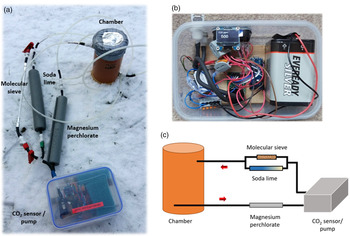
The Mini kit (Figure 1) consists of two main components: (1) a network of tubing that connects to the sampling vessel (e.g., respiration chamber or incubation jar) and includes cartridges for removing water and atmospheric CO2 in the chamber prior to sample CO2 accumulation, and to trap sample CO2 on molecular sieve, and (2) a unit housing a CO2 sensor and air pump that circulates the air from the sampling vessel through the traps and enables the operator to monitor the chamber CO2 concentration.
Mini kit for collecting carbon dioxide for radiocarbon analysis. Photographs show (a) the field deployment of the system to sample soil-respired CO2 and (b) an internal view of the CO2 sensor/pump unit. Schematic (c) showing the connections to a respiration chamber. Note that clips are used to direct the gas flow through either the soda lime or molecular sieve cartridges and that an empty cartridge replaces the molecular sieve trap when monitoring CO2 build-up in the chamber. Red arrows indicate the direction of gas flow.

As also used in an established sampling kit (Garnett et al. Reference Garnett, Newton and Ascough2019), water and atmospheric CO2 are removed from the air stream using cartridges containing magnesium perchlorate (Elemental Microanalysis, UK) and soda lime (Fisher Scientific, UK), respectively, held in place using quartz wool. These cartridges were made from quartz glass tube (OD 18 mm x 22 cm) which was stoppered at both ends using one-hole rubber bungs. A 5 cm length of OD 6 mm glass tube was inserted into the rubber bungs and a 5 cm length of Iso-versinic tubing (Saint-Gobain, France) pushed onto the glass tubing. The cartridges were completed by inserting couplings (CPC; Colder Products Company, USA) into the Iso-versinic tubing. The couplings automatically seal when disconnected, and we used them on all cartridges and throughout the sampling kit where connections were required.
The molecular sieve cartridges have previously been described (see Hardie et al. Reference Hardie, Garnett, Fallick, Rowland and Ostle2005; Garnett et al. Reference Garnett, Newton and Ascough2019). Briefly, they were composed of glass tubing with a central compartment containing 3–4 g of zeolite molecular sieve (Type 13X, 1.6 mm pellets, Sigma-Aldrich, UK) held in place using stainless steel wool. At either end of the cartridge were attached 5 cm lengths of Iso-versinic tubing and CPC couplings, enabling connection to the sampling kit.
The pump/sensor unit (Figure 1b) contained a small air pump (D220 BL, TCS micropumps Ltd, UK) and a SprintIR®-W CO2 sensor (0–5% with flow through adaptor; Gas Sensing Solutions, UK). We chose the SprintIR®-W, which is a non-dispersive infrared sensor, due to its low power requirements (35 mW; www.gassensing.co.uk), fast response time and because the flow through adaptor is convenient for creating air-tight connections to a network of tubing. The pump/sensor unit is controlled by an Arduino Nano microcontroller (Arduino, Italy; www.arduino.cc) which handles communication with the SprintIR®-W sensor and displays the CO2 concentration on an organic light-emitting diode (oled) display. We calibrate the SprintIR®-W CO2 sensor immediately before use by manually setting the 0–ppm point by circulating air through the pump/sensor unit and the cartridge of soda lime in a closed loop (alternatively, calibration can be performed using fresh air or using a gas with a known CO2 concentration; www.gassensing.co.uk). A PP9 9v battery is used to provide power for all components of the pump/sensor unit, which results in a flow rate of ca. 400–450 mL/min for the D220 BL air pump. Full details of the pump/sensor unit, including parts, schematics, Arduino code and sampling procedures are presented in the Supplementary section.
To protect the CO2 sensor from damp air during operation the cartridge containing the desiccant was connected to the inlet of the pump/sensor unit (Figure 1c). After exiting the pump/sensor unit the air stream can either be directed through the soda lime cartridge to remove atmospheric CO2 from the system, or through an empty glass tube when measurement of CO2 concentrations are required; this empty tube was replaced by a molecular sieve cartridge when collecting a sample of CO2 for 14C analysis. Clips (WeLoc, Scandinavia Direct, UK) placed on the Iso-versinic tubing were used to direct sample gas and two ca. 2 m lengths of OD 6 mm nylon pneumatic air hose connected the Mini kit to sampling vessels.
Reliability for Measurement of CO2 Concentration
We tested the performance of the CO2 sensor in the Mini kit by comparison with an IRGA in both lab- and field-tests. In the lab test, the gas ports of the Mini-kit and an EGM4 IRGA were coupled together in series with the exhaust of the Mini kit being routed to the inlet of the EGM4. A manifold upstream of the Mini kit enabled the gas being analysed to be quickly swapped between 5 different sources: a. atmospheric air brought in from outside via a nylon hose, b. a 10 L foil gas bag (SKC Ltd, UK) containing pure N2 gas, c. a 10 L foil gas bag containing laboratory air (790 ppm, independently measured using an EGM5 IRGA; PPsystems, USA), d. CO2-free atmospheric air brought in from outside via a nylon tube and passed through a cartridge containing soda lime, e. a 10 L foil gas bag containing an elevated CO2 concentration (2200 ppm; independently measured using an EGM5 IRGA). The Mini kit SprintIR®-W CO2 sensor and EGM4 were both connected to a computer and their CO2 concentrations logged at 1 s intervals. The source gas was manually swapped every ca. 1 min and both the Mini kit SprintIR®-W CO2 sensor and EGM4 were zero-calibrated at the start. Manufacturer’s specifications state an accuracy of <1% for CO2 concentration measurements by the EGM4 and EGM5 IRGAs.
The field test, conducted in November 2018, involved coupling the gas ports of the Mini kit with an EGM5 IRGA and simultaneously logging the CO2 concentration of a soil respiration chamber installed on a grass lawn. The soil respiration chamber was constructed from 11 cm diameter plastic drainpipe, 22 cm high and inserted ca. 5 cm into the ground. Couplings installed in the chamber allowed connection of gas lines so that chamber air could be circulated in a closed loop through the Mini kit and the EGM5; the internal pump of the EGM5 was switched off and the Mini kit’s pump used to drive the air circulation. The SprintIR®-W CO2 sensor in the Mini kit was zero-calibrated at the start of the test only; the EGM5 was also zero-calibrated at the start and subsequently performed automatic zero-point calibrations every 30 minutes. Since the EGM5 calibration involves diverting the sample air through a soda lime column this caused a reduction in chamber CO2 concentration every 30 minutes. Flow rate of the air stream through the system was logged using the flow sensor of the EGM5.
We simulated the collection of a CO2 sample for radiocarbon analysis during the field test. This involved firstly passing chamber air through the soda lime cartridge in order to remove the contaminating influence of atmospheric CO2 (CO2 scrubbing). Scrubbing was performed for 20 min, after which CO2 build-up occurred in the chamber by diverting the air flow through the empty glass tube instead of soda lime. The Mini kit and EGM5 monitored the CO2 build-up in the chamber for over 200 minutes whereupon the empty glass tube was replaced with a molecular sieve cartridge and chamber CO2 was collected. Air temperature was ca. 5oC.
Reliability for Measurement of Radiocarbon Concentration of CO2
The reliability of the Mini-kit for collecting CO2 samples for radiocarbon analysis was tested using two approaches. First, the Mini kit was used to sample CO2 standards of known 14C concentration. The CO2 standards were provided in OD 6 mm flame-sealed glass tubes after being generated from the following reference materials: barley mash from the Third International Radiocarbon Intercomparison (TIRI; 116.35 ± 0.0084 pMC; Gulliksen and Scott Reference Gulliksen and Scott1995), Belfast cellulose from the Fourth International Radiocarbon Intercomparison (FIRI; 57.22 ± 0.04 pMC; Boaretto et al. Reference Boaretto, Bryant, Carmi, Cook, Gulliksen, Harkness, Heinemeier, McClure, McGee, Naysmith, Possnert, Scott, van der Plicht and van Strydonck2002) and Iceland spar calcite (laboratory internal 14C background standard). The glass tube containing the standard was scored and placed inside a strong glass vessel (an empty standard wine bottle cleaned using carbon-free detergent; Decon90®, Decon Laboratories Limited, UK) which acted as a chamber. The bottle was sealed with a 2-hole rubber bung which contained two stainless steel gas sampling ports with couplings that enabled connection to the Mini kit in a closed loop. Atmospheric CO2 was first scrubbed from the chamber by circulating the air via the soda lime cartridge. The CO2 standard was then released by smashing the glass tube against the wall of the wine bottle and then collected onto a molecular sieve cartridge.
The second approach involved soil incubations and the collection of respired CO2 using the Mini kit and an established approach based around an EGM4 (Hardie et al. Reference Hardie, Garnett, Fallick, Rowland and Ostle2005; Garnett et al. Reference Garnett, Newton and Ascough2019). Six incubation vessels were produced using 1 L Schott bottles. Commercially available peat-based compost (Verve sowing & cutting compost, B&Q, UK; 75.6% moisture), was homogenized, and 100 g placed into each incubation vessel. A glass fibre filter (GF/A, Whatman, UK) was placed over the bottle opening to exclude atmospheric particulates. After storage in the dark at room temperature for 2 d, the glass fibre filters were replaced with 2-hole rubber bungs that had stainless steel gas sampling ports with couplings, making the vessels air-tight. The headspace of the vessels was scrubbed using soda lime to remove atmospheric CO2 and the vessels left overnight to allow CO2 to accumulate.
On the first sampling occasion we collected CO2 from the headspace of 3 of the incubation vessels with the Mini kit and the remaining 3 vessels with the EGM4-based kit. We then resealed vessels 2, 3, and 6 and sampled them for a second time 24 h later using the alternative sampling method so that these three vessels were sampled using both sampling systems (e.g., vessel 2 was sampled with the EGM4 system first and subsequently using the Mini kit on the second occasion).
Sample CO2 was recovered from molecular sieve cartridges using routine methods at the NEIF Radiocarbon Laboratory (Garnett et al. Reference Garnett, Newton and Ascough2019). This involved purging the molecular sieve with high purity N2 (Research Grade 5.0, BOC, UK) for 15 minutes while heating at 425oC, followed by cryogenic collection and purification of the evolved CO2. The amount of CO2 recovered was determined using a pressure transducer on a calibrated volume and the sample split into aliquots for δ13C and 14C measurement. Isotope ratio mass spectrometry was used to determine the δ13C of the sample CO2 using a Delta V (Thermo-Fisher, Germany). The 14C aliquot was converted to graphite using Fe:Zn reduction (Slota et al. Reference Slota, Jull, Linick and Toolin1987) and measured using accelerator mass spectrometry (AMS) at the Scottish Universities Environmental Research Centre. Following convention (Stuiver and Polach Reference Stuiver and Polach1977), all 14C results were corrected for isotopic fractionation by normalising to a δ13C of –25‰ using the measured δ13C values and expressed as %modern carbon (pMC). Statistical tests were performed using Minitab (version 19).
Results
Reliability for Measurement of CO2 Concentration
The laboratory test of CO2 measurements by the Mini kit showed a high level of agreement with the EGM4 and EGM5 IRGA values for the same gas (Figure 2). On average, the Mini kit reported a CO2 concentration 39 ppm higher than the EGM4, which represented an average difference of 7% of the gas concentration. The differences for individual reference gases A, C and E were 8%, 4%, and 7%, respectively. Although Figure 2 shows that the Mini kit CO2 concentration measurements were relatively noisy compared to the EGM4, the close tracking of the curves indicates that the instruments responded very similarly to changes in the CO2 concentration of the source gas.
Carbon dioxide concentration measurements made on the same gas stream using the SprintIR®-W CO2 sensor of the Mini kit and the EGM4 IRGA used in the Hardie et al. (Reference Hardie, Garnett, Fallick, Rowland and Ostle2005) sampling system. The source gas was cycled three times in the order: outside air (A), pure nitrogen (B), a 10 L foil gas bag containing lab air (ca. 790 ppm; C), outside air passed through soda lime to remove CO2 (D) and a second 10 L foil gas bag containing an elevated CO2 concentration (ca. 2200 ppm; E). An EGM5 IRGA was used to provide an independent measurement of CO2 concentration in the gas bags.

In the field test, the Mini kit usually reported a slightly lower CO2 concentration for the chamber air compared to the EGM5, although the overall pattern of CO2 concentration during the scrubbing, CO2 build-up and collection phases was very similar (Figure 3). On average, the offset between the Mini kit and EGM5 CO2 measurements was 62 ppm, however, the agreement was closer (49 ppm) in the first 200 minutes. During CO2 collection the fall in chamber CO2 concentration, which corresponds to the volume of CO2 collected in the molecular sieve trap, was very similar for both instruments (Mini kit = 1150 ppm, EGM5 = 1132 ppm). Flow rate decreased from ca. 400 mL/min at the start of the sampling to 380 mL/min after over 4 hr.
Field collection of respired CO2 from a grassland soil using a closed chamber and the Mini kit sampling system. The graph shows the CO2 concentration of the chamber measured by the SprintIR®-W CO2 sensor of the Mini kit and an EGM5 IRGA during scrubbing (removal of atmospheric CO2), CO2 build-up and CO2 collection. Note that auto-calibration of the EGM5 every 30 minutes removed CO2 from the chamber causing small step changes in chamber CO2 concentration. The flow rate of the Mini kit sampling system was monitored using the flow sensor of the EGM5 (the EGM5 internal pump was disabled).

Reliability for Measurement of CO2 Radiocarbon Concentration
A total of 8 radiocarbon CO2 standards were processed in the laboratory test of the Mini kit, ranging in CO2 volume from 2.90 to 8.74 mL (Table 1). Background CO2 derived from Iceland spar calcite ranged from 0.50 to 0.76 pMC which is below the long-term 14C background for these molecular sieve cartridges (1.0 ± 0.5 (SD) pMC based on n = 15 measurements between 2010 and 2015 processed using an earlier EGM4-based sampling kit; Hardie et al. Reference Hardie, Garnett, Fallick, Rowland and Ostle2005; Garnett et al. Reference Garnett, Newton and Ascough2019). Both 14C measurements of CO2 derived from FIRI Belfast cellulose were within measurement uncertainty (<2 σ) of the consensus value. For the three TIRI barley mash CO2 standards, two were within measurements uncertainty (<2 σ) of the consensus value, and one was slightly outside (2.3 σ). However, the latter had a CO2 volume below that currently recommended by the lab for molecular sieve CO2 samples (Garnett et al. Reference Garnett, Newton and Ascough2019). With one exception, the δ13C values for the standards were within measurement uncertainty (<2 σ) of the reference value.
Results for carbon dioxide derived from radiocarbon reference materials collected using the Mini kit sampling system. Reference values for radiocarbon standards: aGulliksen and Scott (Reference Gulliksen and Scott1995), bBoaretto et al. (2002). STP = standard temperature and pressure. Mean pMC ± SD: 116.30 ± 1.12 (TIRI barley mash) and 0.65 ± 0.13 (Iceland spar calcite).

The 9 samples of respired CO2 collected from the replicated soil incubations spanned from 89.83 ± 0.42 to 90.98 ± 0.40 pMC, a range of 1.15 pMC (Table 2). Samples collected using the Mini kit had an average 14C content of 90.53 ± 0.47 (SD) pMC which was very similar to the samples collected using the EGM4 system (average 90.63 ± 0.40 (SD) pMC). The δ13C values of respired CO2 were also in close agreement, with averages of –25.3 ± 0.2 (SD) and –25.2 ± 0.5 (SD) for the Mini kit and EGM4 system, respectively. For the 3 incubation vessels that were sampled using both systems, 14C measurements differed by between 0.1 and 0.55 pMC, and therefore, measurements on the same sample by the two sampling systems were easily within measurement uncertainty. A 2-sample t-test confirmed that there were no statistical differences between the Mini-kit and EGM4 system for both 14C (p = 0.752) and δ13C (p = 0.591) measurements.
Carbon isotopic composition of respired CO2 from replicated incubations of a peat-based compost. Samples were collected using the new Mini kit sampling system and the established EGM4-based system described by Hardie et al. (Reference Hardie, Garnett, Fallick, Rowland and Ostle2005). Incubation vessels marked (a) were sampled using both systems. STP = standard temperature and pressure. Mean pMC ± SD: 90.53 ± 0.47 (Mini kit) and 90.63 ± 0.40 (EGM4 system).

Discussion
Performance of the Mini Kit for Collecting CO2 Samples for Radiocarbon Analysis
The molecular sieve cartridges used in the Mini kit have previously been shown to perform reliably when used with an earlier sampling kit built around an EGM4 IRGA (Hardie et al. Reference Hardie, Garnett, Fallick, Rowland and Ostle2005; Garnett and Murray Reference Garnett and Murray2013; Garnett et al. Reference Garnett, Newton and Ascough2019). The 14C results of standard gases when collected using the Mini kit are at least as good and potentially better. For example, the long-term background for the molecular sieve cartridges using the EGM4 sampling kit is 1.0 ± 0.5 pMC (Garnett et al. Reference Garnett, Newton and Ascough2019) but all three background standards tested using the Mini kit had lower 14C contents (0.50 to 0.76 pMC). This lower background may reflect the simpler design of the Mini kit, with fewer connections and smaller internal surface area, reducing the opportunity for leaks and carry-over of CO2 between samples (the results in Table 1 confirm the absence of significant memory effects as previously reported for this molecular sieve cartridge; Garnett and Murray Reference Garnett and Murray2013; Garnett et al. Reference Garnett, Newton and Ascough2019). Although a 14C result for one TIRI barley mash CO2 standard was just outside the 2 σ measurement uncertainty, this was for a CO2 volume below the minimum recommended for these molecular sieve cartridges (3 mL; Garnett et al. Reference Garnett, Newton and Ascough2019) and may reflect the performance of the cartridges rather than the sampling kit.
We performed a soil incubation study to provide a test of the Mini kit for the collection of CO2 under conditions that are more representative of those for which the kit is designed. Use of a homogenized compost in a sealed incubation vessel allowed us to reduce the effects of natural variability that might have been more significant if we had chosen to perform the test using field-based chambers. Additionally, the peat-based compost produced CO2 that was 14C-depleted relative to the contemporary atmosphere, and therefore, made our test sensitive to contamination from atmospheric CO2. The results from this test strongly support the reliability of the Mini kit since (1) there was no significant difference in 14C concentration between samples collected with the Mini kit and those from an established EGM4-based system, and (2) all nine CO2 samples had 14C contents that agreed within 2-σ measurement uncertainty.
Measurement of CO2 Concentration and Requirements for Collection of 14CO2 Samples
The ability to monitor CO2 concentrations in molecular sieve sampling systems is extremely useful for several reasons. Firstly, it provides key information to estimate whether enough CO2 has been collected for the 14C and 13C measurements. We use two approaches to estimating the volume of CO2 collected during sampling. In situations where CO2 is recovered from a chamber or vessel of known volume, we use:
 $${\rm{V}} = (({\rm{Cs}} - {\rm{Ce}})/(1 \times {10^6})) \times {\rm{Vc}}$$
Where V is the volume (mL) of sample CO2 trapped in the molecular sieve cartridge (mL), Vc is the chamber volume (mL), and Cs and Ce are the measured CO2 concentrations (ppm) in the chamber at the start and end of the CO2 collection, respectively. If substantial CO2 production in the chamber is still occurring (e.g., due to respiration or evasion), this calculation would provide a minimum estimate for CO2 collected.
When sampling from an unenclosed volume (e.g., when collecting atmospheric CO2) the volume of CO2 trapped can be calculated using:
 $${\rm{V}} = ({\rm{Ca}}/(1 \times {10^6})) \times {\rm{F}} \times {\rm{T}}$$
Where Ca is the average CO2 concentration (ppm) measured during sampling time T (min), assuming a flow rate F (mL/min).
The measurement of CO2 concentration of the gas being sampled is common to both approaches, and hence the requirement for an instrument to measure CO2 concentration. However, the molecular sieve cartridges that we use typically have an operating range in respect to the volume of CO2 in the order of 3 mL to 10 mL (the latter being the volume at which the molecular sieve starts to become saturated and not trap all the CO2 in the gas stream). Inaccuracies in measurements of CO2 concentration of ca. 100 ppm usually make little difference to the estimates of CO2 volume trapped given typical chamber volumes (e.g., 1 to 5 L). Our results show that the performance of the SprintIR®-W CO2 sensor in the Mini kit is more than adequate for ensuring that enough sample CO2 has been collected (our results are also consistent with the manufacturer’s specifications for the SprintIR®-W CO2 sensor of an accuracy of ±70 ppm + 5% of reading; www.gassensing.co.uk).
Measurement of CO2 concentration can also be useful to ensure that scrubbing with soda lime has removed the contaminating influence of atmospheric CO2 from chambers and incubation vessels, prior to sample CO2 build-up. The high sensitivity of IRGAs is an advantage here because they provide the ability to detect in the order of microlitres of CO2 remaining in, for example, a 1 L vessel, which would not be detectable using the SprintIR®-W CO2 sensor. However, in most situations, such as in sampling soil respiration or aquatic CO2 evasion, CO2 accumulation inside the chambers would continue throughout the CO2 scrubbing phase, and therefore, the chamber CO2 concentration would never reach 0 ppm anyway. A more suitable approach to ensuring complete removal of atmospheric CO2 from a chamber is to quantify the volume of air scrubbed, in terms of the equivalent chamber volumes (e.g., Kwon et al. Reference Kwon, Natali, Hicks Pries, Schuur, Steinhof, Crummer, Zimov, Zimov, Heimann, Kolle and Göckede2019), which is based on pump speed and not CO2 concentration (as a rule we aim to scrub a volume equivalent to at least 5 times the chamber volume).
An instrument that measures CO2 concentration is useful in a molecular sieve sampling kit for leak testing. Leak testing can be performed by removing all the CO2 in a sampling system (e.g., Mini kit and chambers) when set in a closed loop configuration (Palonen Reference Palonen2015). Once the CO2 in the system has been removed (or at least reduced significantly below that of the surrounding air), by continuing to pump the air inside the system, but not through soda lime or molecular sieve, any leaks should be detectable from the ingress of atmospheric CO2. Clearly detection of leaks will depend on the rate of atmospheric ingress and the sensitivity of the instrument performing the CO2 measurements, with the higher sensitivity of an IRGA being an advantage. To compensate for the lower sensitivity of the Mini kit CO2 sensor, leak testing can be performed over a longer period. We also periodically perform leak tests by coupling the Mini kit to an IRGA.
In our view, the lower sensitivity of the Mini kit’s CO2 sensor compared to an IRGA is not a major disadvantage and is more than compensated by advantages of increased portability, lower power requirements and cost.
Expanding the Potential for 14CO2 Methodology in Experiments and around the World
14CO2 approaches offer unique insight into soil C cycling rates and partitioning of biogeochemical fluxes of C (Levin and Hessheimer Reference Levin and Hesshaimer2000; Wotte et al. Reference Wotte, Wordell-Dietrich, Wacker, Don and Rethemeyer2017b), however, current collection methodologies limit their potential going forward. The expanded use of 14CO2 approaches calls for increased replicates to detect statistically meaningful effects (Hartley et al. Reference Hartley, Garnett, Sommerkorn, Hopkins, Fletcher, Sloan, Phoenix and Wookey2012; Gavazov et al. Reference Gavazov, Albrecht, Buttler, Dorrepaal, Garnett, Gogo, Hagedorn, Mills, Robroek and Bragazza2018; Street et al. Reference Street, Garnett, Subke, Baxter, Dean and Wookey2020). The size and cost of the Mini kit will allow 14CO2 methods to rise to the challenge of increased sampling intensity for two reasons: (1) its low cost means that multiple systems can be used in tandem (potentially measuring from control and treatment in parallel) and (2) the reduced size allows for ease of use in more challenging environments. Additionally, the system requires little maintenance other than renewal of chemical absorbents and the battery (daily/weekly, depending on use). In the Arctic, the research community is calling for an expansion of field study locations to more generally understand the response of these carbon-rich ecosystems to climate change (Metcalfe et al. Reference Metcalfe, Hermans, Ahlstrand, Becker, Berggren, Björk, Björkman, Blok, Chaudhary, Chisholm, Classen, Hasselquist, Jonsson, Kristensen, Kumordzi, Lee, Mayor, Prevéy, Pantazatou, Rousk, Sponseller, Sundqvist, Tang, Uddling, Wallin, Zhang, Ahlström, Tenenbaum and Abdi2018). A low cost, low tech system will enable researchers to answer this call when 14CO2 methodologies are appropriate.
Conclusions
We conclude that the Mini kit molecular sieve sampling system is reliable for the collection of CO2 samples for 14C analysis and has a performance at least as good as an established system (Hardie et al. Reference Hardie, Garnett, Fallick, Rowland and Ostle2005; Garnett et al. Reference Garnett, Newton and Ascough2019). The Mini kit is highly portable (the pump/sensor unit including battery weighs only 650 g and can be contained within an 18 cm × 12 cm × 8 cm enclosure, such as a waterproof sandwich box) and has low power demands (we have found a single PP9 battery to provide at least 10 hr continuous use, potentially allowing for the collection of many samples per day) making it particularly useful for sampling in remote and inaccessible locations. The Mini kit is also relatively inexpensive with the pump/sensor unit costing ca. UK £300 and negating the need for a much more expensive IRGA. Recently, Metcalfe et al. (Reference Metcalfe, Hermans, Ahlstrand, Becker, Berggren, Björk, Björkman, Blok, Chaudhary, Chisholm, Classen, Hasselquist, Jonsson, Kristensen, Kumordzi, Lee, Mayor, Prevéy, Pantazatou, Rousk, Sponseller, Sundqvist, Tang, Uddling, Wallin, Zhang, Ahlström, Tenenbaum and Abdi2018) highlighted the poor spatial distribution of ecological studies in the Arctic, showing the bias towards sampling in relatively accessible locations. The Mini kit can aid efforts to overcome the challenges of field sampling of CO2 for 14C analysis and help address calls to reduce spatial bias in ecological studies through increased sampling of remote and inaccessible locations.
Acknowledgments
We thank staff at the National Environmental Isotope Facility (NEIF) Radiocarbon Laboratory and Scottish Universities Environmental Research Centre AMS Facility. We are grateful to the Natural Environmental Research Council for funding. TCP is funded by NERC numbers NE/P002722/1 and NE/P002722/2.
Supplementary Material
To view supplementary material (a list of components, schematic of electronics, Arduino code and sampling setups) for this article, please visithttps://doi.org/10.1017/RDC.2021.49