A new regional consciousness emerged across India in the nineteenth and early twentieth centuries. The conception of a region as a specific geographically bound space with shared cultural and linguistic features was articulated by educated urban elites in different parts of the subcontinent. This was due in part to the new standardized colonial education system introduced by the British government and to the growth of several literary and cultural organizations encouraged by British administrators, as well as to the increasing awareness among the Indian intelligentsia of similar developments around the world. As nationalist ideas also developed in this period, Indian elites expressed, and became invested in, certain notions of history, geography, and language that they came to regard as embodying their own particular regions. These elite-driven trends, while varying across the subcontinent, dominated the ways that many of the regions were conceived within preexisting and colonial administrative units.Footnote 1
Gujarat is a striking example of this process, and somewhat distinctive from other regions. Although a consciousness of this western Indian region had begun to develop in the late nineteenth century, unlike most other regions, the contemporary state was officially created relatively recently with the bifurcation of the bilingual Bombay State—over a decade after independence—in May 1960.Footnote 2 The dominant ideas that constituted this consciousness were primarily asserted in the writings of upper-caste Hindus and Jain intellectuals based in cities like Bombay, Surat, and Ahmadabad. For these men, “Gujarat” was to be unified by a standardized Gujarati, a form of the language that was spoken in North Gujarat and one that they considered to be “good” and “correct” (Isaka Reference Isaka2000, 138). They explicitly claimed that the local vocabularies in other areas or elements of Arabic and Persian in the language were “impure” accretions that needed to be cauterized; their criticism was directed particularly toward the Zoroastrian Parsi community, whose influence on the region was deep and whose spoken language was distinct from that of the Hindu literati (Isaka Reference Isaka2000, 138). In addition to the push for a standard Gujarati, it was through writing history and literature, including the creation of a normative literary canon for Gujarati, that this intelligentsia's ideas of regional consciousness were most assertively expressed. Spatially, Gujarat's regional consciousness subsumed other culturally and linguistically distinct areas within its ambit, particularly the peninsular regions of Saurashtra and Kachchh.Footnote 3 The distinctive histories and linguistic features of these areas thus became fused with this newly imagined Gujarat.
How did those who inhabited a marginalized space like Saurashtra grapple with the new notions of Gujarati regional identity? How did these spaces—often frontiers and hubs of trade routes with complex histories of human interaction and identities—fit into these ascendant ideas of modern regions that were emerging all over the subcontinent? This article addresses these questions by focusing on Jhaverchand Meghani's (1896–1947) writings on Saurashtra. Meghani was a litterateur, poet, writer, folklorist, and performer from the peninsular region; by the end of his short life, Meghani had published a wide range of works, including novels, poems, collections of essays, travel accounts, and folklore collections in Gujarati.Footnote 4 He had also worked as a successful journalist at two prominent Gujarati-language newspapers. Mahatma Gandhi, who, like Meghani, also belonged to the Saurashtra region, even referred to him as rāṣṭrīya śāyar, or “national poet.” Yet much of Meghani's oeuvre centered on the oral traditions and folklore of his home province, Saurashtra, and how Saurashtra was distinct from the broader region of Gujarat.
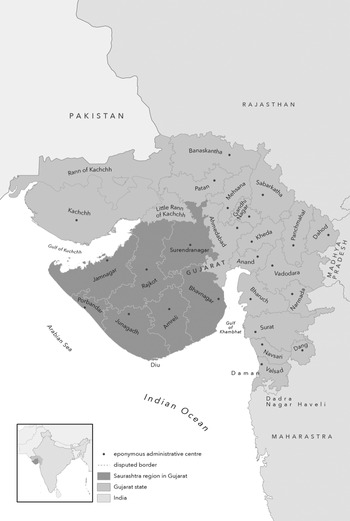
Saurashtra—also known as KathiawadFootnote 5—is part of the contemporary state of Gujarat (see figure 1). It is a peninsula that is contiguous with India's westernmost border and spans about 25,000 square miles. It is located at the confluence of three ecological zones: the 700-mile coastline in the south and west that has linked it to the Indian Ocean world for centuries; the semi-arid desert in the north, which connects it to land routes through Rajasthan, called Sindh in modern-day Pakistan and Afghanistan; and the agricultural zone in the east, where Saurashtra borders mainland Gujarat. Historically, this ecologically diverse area had always been a distinctive ethnolinguistic and cultural space—a land of mobile pastoralist warriors and traders—as opposed to the agriculturally oriented mainland's more settled populations. Saurashtra is remembered as the land of warriors and chieftains in contemporary Gujarat's popular imagination even today; the distinction, however, remains virtually unknown outside the region that is now referred to as Gujarat.
Saurashtra region in contemporary Gujarat. Cartography by Julie Witmer Custom Map Design. Boundary data “Map GujDist Saurastra.png” by Miljoshi licensed under CC BY-SA 3.0 Additional base map data © OpenStreetMap.org contributors.

Meghani chose to illuminate Saurashtra's distinctness from Gujarat in three ways. First, he foregrounded Saurashtra's fluid oral traditions and folklore as the central constituents of its culture: these were at the heart of his articulations of the region, and he viewed them, in contrast with the dominant view, as equal to formal written literary works. Second, for Meghani, Saurashtra's distinctiveness was not separated from Gujarat but resided within the broader region—he wrote about Saurashtra in modern Gujarati, rather than in the region's dialect; his intended audience was also Gujarati speakers in western Indian cities like Mumbai and Ahmadabad. Yet, even if Saurashtra was located within the emerging Greater Gujarat, Meghani sought to preserve its individuality in the wake of a monolingual regionalism, on one hand, and the rise of a multilingual nation, on the other. Third, Meghani's conceptualization of Saurashtra was rooted in both nineteenth-century regionalism and the more recent Gandhian nationalism that was evolving in western India specifically, and the subcontinent more broadly, in the early twentieth century.
Several historians have discussed the emergence of regional consciousness among elite Gujarati intellectuals during the nineteenth century.Footnote 6 The elements that make up the complex ideas of Gujarat's regional pride—the dominant concept of gujarāt nī asmitā (Gujarati consciousness)—are well-known.Footnote 7 But what is less clear is the impact such notions had on the geographical and cultural entities that were incorporated into the nascent modern state, and how their histories and languages were appended to the wider regional cause. I contend that Meghani's preservation and propagation of oral traditions and folklore, which remain unexplored in the contemporary scholarly discourse,Footnote 8 were also crucial ingredients in Gujarat's making. Meghani's provincialism was not entirely at odds with Gujarati regionalism, nor was it in conflict with the rapidly rising Indian nationalism. Yet, in bringing Saurashtra's uniqueness to light through its oral traditions and its itinerant society, Meghani strove to prevent its complete disappearance into Gujarat. Instead, his work inscribed Saurashtra as a distinct cultural space within the wider region. In the process, Meghani emerged a cultural broker: one who could bridge the gap between the upper-caste/upper-class world of the urban modern educated and those whom he considered the “real people” of Saurashtra, hailing largely from the countryside.
The pivotal elements in Meghani's focus on the oral traditions were Charans,Footnote 9 specialist poet-historians who, thanks to their administrative and ritual positions, were integral to Saurashtra's numerous indigenous courts. This role—like the courts themselves—did not fit well with what the colonial state held as valid notions of governance or history writing. Saurashtra was associated with the pastoralist-warrior traditions for centuries. Culturally closer to neighboring Rajasthan than mainland Gujarat, Saurashtra was shaped by the martial ethos of its vast array of kingdoms and chiefdoms. The traditional poet-historians played a vital role in shaping and enhancing these warlike mores.Footnote 10 By the early decades of the nineteenth century, however, the East India Company's dispensation had curbed the power that these rulers and chieftains held, and it had established political control over the region. The Company administration also deemed the Charans, their tales of war and valor, and their violent sociocultural practices—particularly female infanticide and self-harm—dangerous. The colonial intervention in western India, and most specifically in Saurashtra, was thus aimed at rendering the Charans’ position redundant (Rabitoy Reference Rabitoy1974). A close reading of Meghani's writings reveals a deep concern for the Charans’ rapidly vanishing traditions. Meghani was committed to preserving their disappearing narratives and other forms of folklore. Yet Meghani's preservation efforts were not direct transcriptions. Rather, he reconstituted aspects of the Charans’ histories in less “dangerous” forms, sometimes omitting their violent practices and at other times recasting them as stories of courage and sacrifice.
I investigate aspects of a significant portion of Meghani's output—two of his travel accounts—which combine his ethnographic and literary interests in Saurashtra. The first of these, published in 1928, is Sauraṣṭranā Khanḍeroṃā, or Amidst Saurashtra's Ruins (Meghani [Reference Meghani1928, 1935] 1994), while the second, published in 1933, is Soraṭhne Tīre, or On Sorath's Shores (Meghani [Reference Meghani1933] 1994).Footnote 11 Meghani categorizes the two works as pravās varṇan, or “descriptions of travel.” These travel accounts are a key to Meghani's method. He wrote them at a time when he was already well established as a writer and a recognized authority on Saurashtra's folk traditions. The popularity of his publications set the stage for Meghani not just to convey Saurashtra's literary traditions to his readers, but also to guide them through its physical and human landscapes—landscapes that were fast getting fused into what was emerging as the umbrella region now called Gujarat.
Centuries before the encounter with the East India Company, travel for trade and pilgrimage had been integral to the Saurashtra peninsula and Gujarat.Footnote 12 However, the vagaries of premodern travel—nonmotorized transport and concerns with physical safety, for instance—meant that such trips usually involved traveling in large groups. In the mid-nineteenth century, the arrival of the steamship and the railways ensured speedier and safer movement. Just as in other parts of South Asia, far more elite and middle-class people from these western Indian regions began traveling across the globe in their individual capacities; many of these travelers penned and published their observations.Footnote 13 Particularly prolific in this regard were the Zoroastrian Parsis, who had been writing of their journeys in Persian and Gujarati since the late eighteenth century.Footnote 14
While travel writing was a well-established genre among those who wrote in Gujarati, what made Meghani's travelogues distinct from those of his predecessors and contemporaries were their scale and scope: Meghani's travels were fervently local. Through his travels, Meghani sought to master, and, in turn, to teach, his readers solely about Saurashtra and its constituent parts. “I experience surplus even in Saurashtra's ‘smallness,’” he wrote in Amidst Saurashtra's Ruins (Meghani [Reference Meghani1928, 1935] 1994, 4). Though he had received a formal education and a university degree in English and Sanskrit, he was convinced that the modern social sciences lacked the ability to fully capture the soul of a place. His approach was more literary: it foregrounded the lived experience of the Charans’ fast-disappearing oral traditions, the fluid stories of the places he traveled to, and the songs and poetry embedded in the minds of Saurashtra's moving people. It is these that made Saurashtra distinct from Gujarat for Meghani.
Jhaverchand Meghani (1896–1947)
Jhaverchand Meghani was born into a Jain family in 1896 in Chotila, a town in central Saurashtra. His father, Kalidas Meghani, was a minor officer in the Kathiawar Agency Police, therefore part of the growing Indian service gentry of the time. The Meghanis were regularly transferred to different, often remote, parts of Saurashtra throughout Kalidas's career. Many of the small police stations where he was based were outposts in dense forests, in rugged mountains, and near raging rivers—Meghani attributes his familiarity with the region's varied landscape to these childhood relocations. He later noted, “It was through these that I became familiar with weapons, horse-riding, travels in villages, the dreadfulness of nature and [its] beauty, solitude, village folk etc.” (Shelat and Meghani [Reference Shelat and Meghani1998] 2003, 1–2).
One of the main tasks that Agency police officers had to perform in those days was to subjugate the bahārvaṭiyā, or outlaws. Meghani's father was often in charge of capturing these men who were deemed “dangerous” and a threat to the “peace and stability” that the colonial state and its allies, such as the Princely states—in this case, Baroda's Gaekwad ruler—were attempting to bestow on an otherwise feral region. Meghani's recollections of these assignments combine his admiration for his father with a parallel admiration for his father's adversaries—the outlaws—some of whose names were said to send chills down peoples’ spines (Varma and Parmar [Reference Varma and Parmar1947] 2005, 40).
By the late nineteenth century, access to British-established schools was available even in rural areas. Meghani was educated in the colonial system and went on to obtain an undergraduate degree in English and Sanskrit. “I consider myself as suckled by the earth and nurtured in the lap of the university,” he later wrote (Varma and Parmar [Reference Varma and Parmar1947] 2005, 49). As a graduate student in the late 1910s, he was drawn to Annie Besant's and Mahatma Gandhi's ideas and went on to participate in the propagation of nationalist ideals during those years. His nationalist passion would also pervade some of his most important writings in genres other than folklore, including his novels and poems.
In 1918, family circumstances led him to seek employment in Calcutta, where he spent nearly four years, until 1922, working as a manager in a fellow Saurashtrian's factory. During this period, Meghani also traveled to England with his employer, but no correspondence or writings from this trip survive.Footnote 15 In Calcutta, Meghani soon learned Bengali and read prominent Bengali writers, particularly Rabindranath Tagore (1861–1941), in the original language (cf. Gopalan Reference Gopalan1976, 55–56). Educationist Dineshchandra Sen's 1920 publication Folk Literature of Bengal particularly fostered his enthusiasm for collecting Saurashtra's folklore (Gopalan Reference Gopalan1976, 55). Bengal was one of the earliest regions in the subcontinent to experience colonial rule, and by 1900, the region had become a center of nationalistic activity. This gained momentum with the British attempts at partitioning Bengal in 1905. One significant expression of this growing nationalism was that scholars and writers began articulating a self-conscious sense of Bengali-ness. The creation of a Bengali literary canon was a significant part of this process, with folklore playing a role in Bengali nationalism (R. Chatterjee Reference Chatterjee2016).
Tagore, who had inaugurated a fervent folklore movement in the late nineteenth century, was a prominent figure in this regard; his ardent espousal of vernacular languages as integral components of nationalism would have been well-known when Meghani lived in the city (Korom Reference Korom, Sen and Gupta2006, 34–58). In what is the only academically researched biography of Meghani in English, Gopalan V. Gopalan (Reference Gopalan1976) notes that Meghani was deeply influenced by Tagore's writing and paid several visits to Shantiniketan during his time in the city. He also regularly attended Brahmo Samaj lectures on Hindu philosophy, religion, and mythology and gained an awareness of the elite intellectuals’ interest in their own literary and oral traditions (Gopalan Reference Gopalan1976, 55).
Although he had immersed himself in Calcutta life, the young Meghani was restless and keen to return to his homeland. Much of Meghani's correspondence with friends and family during this stint is suffused with a sense of nostalgia and yearning for the idyllic Saurashtra he had left behind. Being away from home also appears to have inculcated a sense of regional consciousness in him—a pride and desire to revitalize the land of his birth. It was his duty and the duty of others from there, he felt, to free Saurashtra—here he refers to the region by its alternate name, Kathiawad—from outside influences. He wrote to a friend, Shobhagchand Motichand Doshi, in June 1921: “Sooner or later there is a necessity to create a life in Kathiawad, and it will be created, such that the youth of Kathiawad will not have to be left to the mercy of people from other regions. We should also join in to create such a situation” (Meghani and Shelat [Reference Meghani and Shelat1988] 2003, 9).
In 1922, despite friends’ warnings about the dearth of lucrative employment back home, Meghani left the bustling city and returned to Saurashtra's rural setting. Here, after first trying his hand at agriculture, then being asked by fellow trading-caste members to enter business, and later searching for employment in one of the many Princely states in the region, Meghani finally found his calling as a journalist in a newly established weekly called Sauraṣṭra. This was where he published one of his earliest works, a translation of Tagore's short stories, Kathā o Kāhīnī (Lores and legends), which was serialized as Kurbānīnī Kathāo (Tales of sacrifice). Meghani's writings impressed the paper's publisher, Amrutlal Sheth. Sheth was particularly taken with two essays that Meghani submitted to the weekly in the same year: “Motīnī Ḍhagalio” (Tiny pearl heaps) and “Corāno Pokār” (The village square's cry). Both of these were observational pieces on the lives of Saurashtra's people.
With secure employment at the weekly, Meghani was able to further his interest in Saurashtra's folklore, its oral traditions, and its people. From that point on, he made regular trips to the interior to collect his materials. In his writings about his collection method, Meghani often said that he would work at the newspaper from Monday to Thursday and then, leaving his wife and young child behind, travel to different parts of Saurashtra on the weekends (Meghani [Reference Meghani1946, 1947] 1981, 14). It was this complete immersion in the region's life that informed all his writings. From Calcutta, he often wrote to friends about how he felt his homeland was calling out to him. The response to this call manifested itself, by his own admission, from 1922 to the 1930s in the prolific collection of folklore. In the first decade of his return, it also resulted in the publication of five volumes of folklore collections titled Sauraṣṭranī Rasdhāra (Saurashtra's aesthetic flow), three volumes on Saurashtra's outlaws titled Soraṭhi Bahārvaṭīyā (Sorath's outlaws), and Soraṭhī Gītakathāo (Sorath's song-tales). Starting from the early 1930s, his writings and speeches also reflect a broader interest in methodical and theoretical aspects of folklore studies. During his twenty-five-year career, Meghani published a hundred works including folklore collections, novels, poems, and essays (Gopalan Reference Gopalan1976, 340–45).
The Nineteenth-Century Imagination of Gujarat
When Meghani began writing about Saurashtra's oral traditions in the 1920s, a dominant idea of a geographically, culturally, and linguistically coherent Gujarat—one that incorporated Saurashtra and Kachchh—was widely recognized in elite intellectual circles. Along with the new education system—which was regularized from the primary school to the university levels—other colonial institutions like the civil service or the British-style courts played a vital role in the ways that Indians would perceive themselves during the nineteenth and early twentieth centuries. Consequently, from the late nineteenth century onward, city-based Gujarati writers—predominantly upper-caste Hindu and Jain products of the colonial educational system—came to articulate their regionalism in terms of a singular Greater Gujarat. Their common experience engendered a sense of fellowship among these men (Isaka Reference Isaka2002b, 8–9). They also participated in the print culture and voluntary organizations that had sprung up all over the Bombay Presidency, but especially in Bombay City. These combined influences facilitated the elites’ claims to be representatives of the region as they began to identify Gujarat and Gujaratis and define their history, language, and culture.
In western India, as in other parts of the subcontinent, British administrators encouraged Indians to write regional histories and promoted the study of the vernacular. An influential figure in this regard was Alexander Kinloch Forbes (1821–65), a colonial judge of Scottish descent who set up the Gujarat Vernacular Society in 1848 to promote “Gujarati literature, the propagation of useful knowledge and the increase of general education” (Parekh [Reference Parekh1932] 2010, 9).Footnote 16 The society invited Indians to participate in essay competitions, winners of which would be rewarded with generous prizes and an opportunity to get published. The first Gujarati-language history of Gujarat, written by Edalji Dosabhai, Gujaratāno itihās, was the result of such a competition in Reference Dosabhai1850; it was also translated into English as A History of Gujrat: From the Earliest Period to the Present Times in 1894 (Dosabhai [Reference Dosabhai1894] 1986). But even before then, a number of colonial histories and translations of historical works by colonial scholars had been published in which the idea of a region called Gujarat was articulated. Dosabhai and others like him largely drew on these works to write their histories of Gujarat. Nevertheless, while these histories were mediated through a colonial lens, as Riho Isaka (Reference Isaka2002a, 4867–68) has argued, many of these authors did not always accept the British interpretations of the region's history and often chose to shape their narratives with their own sense of regional pride.
In addition to history writing, the Gujarat Vernacular Society, run primarily by Indians soon after its inception, was also engaged in collecting literary works and creating a classical literature for the Gujarati language. Just like other regions in the subcontinent, and encouraged by the colonial preference for standardization, urban Gujarati elites began debating the question of establishing a literary language for the region; this harked back to the idea that many centuries ago the language was the same, devoid of local or other variances (Isaka Reference Isaka2002b, 10–13). These developments had the consequence of edging out several historical elements in Gujarat's spoken and written linguistic traditions. For instance, from the fifteenth century onward, a predominant language used in Gujarat's courts was Persian. Professional administrators at these courts, irrespective of their socioreligious affiliations, including the prominent Nagar Brahmins, wrote in Persian. A rich history-writing tradition in Persian had also existed in Gujarat since the time of the Muzaffarid sultans, who had ruled the region from the fifteenth century. This tradition continued until the late nineteenth century, as reflected in Junagadh prime minister Ranchodji Amarji's Ta'rīkh-i Soraṭh (Reference Amarji and Burgess1882), a Persian account of the contemporary political situation in his state published in 1825.Footnote 17 Similarly, Perso-Arabic elements were integral to the Gujarati spoken among the Parsis. Despite the Parsis’ predominance in Bombay's public culture and printing industry in the nineteenth century, Gujarat's language in the Hindu and Jain elites’ imagination came to be seen as “impure” (Isaka Reference Isaka2000, Reference Isaka2002a).
Just as the Perso-Arabic elements in Gujarati were sidelined, Saurashtra's language—which was not quite like the literary Gujarati preferred by the dominant colonial Gujarati literati—was also marginalized in this growing modern consciousness. By the early twentieth century, G. A. Grierson's Linguistic Survey of India reinforced the idea of a great integrated Gujarat as it included Kathiawad (Saurashtra) as a primarily Gujarati-speaking region (Grierson Reference Grierson1908, 323). Even though Forbes's writings on Gujarat had included the works of bards—the Bhats and Charans—members of the Gujarat Vernacular Society saw the “folk” and oral traditions as outside the classical language and literature they were imagining. Most surveys or histories of Gujarati literature that were composed during the nineteenth century included a section on this literature merely as an addition for the end of the volume, even though some attempts had been made by scholars in Saurashtra to collect these traditions. Meghani's drive to preserve Saurashtra's folk literature and make the region widely accessible outside Saurashtra must be viewed in this context of a strong tide toward diminishing this linguistic tradition that was set in motion in the mid-nineteenth century. In Meghani's own time, Gandhi's popularity incentivized the turn toward this dominant strand of a standardized Gujarati as the appropriate language for the region even further.
Although he hailed from Saurashtra, Gandhi was an advocate of a standardized form of regional languages; this was particularly true of his stance on Gujarati. Gandhi reflected the ideas of this earlier generation of Brahmin and Jain intellectuals by emphasizing the “purity” of vernacular languages and a preference for the language spoken in North Gujarat (Isaka Reference Isaka2000, 132–45). In his imagination, however, the communities and places that did not use this standardized form were not left out; instead, by encouraging them to adopt the standardized form, Gandhi sought to include them in the broader idea of Gujarat and India. Gandhian nationalism, which had a profound influence on Gujarat and Bombay, sought to anchor its interests in the “common people” at its core, and it was manifest in various ways in the work of writers, social workers, and political leaders during the early decades of the twentieth century.Footnote 18
While working at Sauraṣṭra, Meghani closely observed, his employer, Amrutlal Sheth, and his involvement in the Gandhian freedom movement. Meghani also became acquainted with other nationalists and writers, including Gandhi's close companion Kakasaheb Kalelkar and the social worker Amrutlal Thakkar, better known as Thakkarbapa. In the 1920s and 1930s, Meghani himself began to participate in the Gandhian movement. His patriotic songs and poems—including a poem dedicated to Gandhi before the latter departed for the Round Table Conference in 1931—gained immense popularity at the time and still remain well-known. It was the poem dedicated to Gandhi that earned him the honorific of “national poet” from Gandhi himself. The poem addressed Gandhi directly, calling on him to gulp down the proverbial “poisoned chalice.” The line chello kaṭoro jherno ā pī jajo, bāpu (drink the poisoned chalice, o bāpu) recasts Gandhi as a warrior-ascetic; the imagery evokes both the memory of Saurashtra's ascetic-like martial heroes, lone warriors ready to sacrifice their own life for the good of others, and that of Shiva, the ascetic deity who held poison in his throat to save humanity.
A significant feature of Meghani's body of work is that it combined the dominant form of Gujarati—which was fast becoming the language of administration and modern education in the region—with Kathiawadi, the dialect spoken in Saurashtra. He wrote all his essays, travel accounts, and many of his novels, poems, and songs in modern Gujarati; even if the poems were sometimes composed in the meters Charan poets used, they were composed in modern Gujarati. Similarly, the prefaces to his folklore collections are also in Gujarati. However, in his folklore collections, Meghani included Kathiawadi more freely, especially when reporting direct conversations between people, or when a story was interspersed with traditional verses or duhās, even though on many occasions he also translated these into Gujarati. This approach indicates Meghani's quest to translate and communicate Saurashtra's culture and literature to the newly emerging urban regional audiences, and to the cultural and intellectual centers where the regional consciousness of Gujarat had first emerged.
It was not long before Meghani's popularity among this segment of society was reflected in tangible ways. In 1928, he received the Ranjitram Gold Medal for recognition of his research and contribution to folklore. By 1929, the Gujarat Literary Conference named him among the leading upcoming writers of the region (Fakir Reference Fakir1929, 352–53). In the 1930s and early 1940s, he was invited to speak about folklore at various academic and literary venues, including the prestigious Thakkar Madhavji Vassanji lecture at the Bombay University in 1943; Meghani came to stand in for Saurashtra and its folklore within the Gujarati literary canon.
With the rise of the imagination of Gujarat with a coherent past and language, Saurashtra was marginalized during the early twentieth century. Meghani's endeavors to seek out Saurashtra's folk traditions and bardic literature fit in this wider context of trends where particular ideas of region and language were merging. While nineteenth-century intellectuals emphasized a “pure” standardized Gujarati, Meghani's project foregrounded the language of the people—especially Saurashtra's people and their oral traditions—as a crucial ingredient in the making of a region—a fact that Gandhi seems to have clearly understood and also supported. In his foreword to Munshi's Gujarat and Its Literature, a tome primarily arguing for the Sanskritic and “Aryan” elements in the Gujarati language, Gandhi notes that “Meghani of the Saurashtra school has done folklore research in Kathiawar. His researches show a gulf that exists between the language of the people and ours” (Munshi Reference Munshi1935, Gandhi's foreword).
Furthermore, while Meghani attained the urban elite's acceptance and respect, he also won the confidence of “the people” he wanted to listen to and whose stories he wanted to collect. During his travels across Saurashtra, Meghani was often joined and guided by members of the Charan community with whom he would spend time, write down their verses, and, in turn, compose and sing verses with them; while others had collected folk narratives before him, it was Meghani who developed an immersive collection style.Footnote 19 Not only did he write and publish his folklore collections and other writings based on them, but he also performed many of the Charani compositions he had learned. These performances made him exceedingly popular with urban middle-class Gujaratis. But more significantly, they earned him immense regard from the Charans themselves.
It is at this confluence of nineteenth-century developments and Gandhi's rising popularity in western India, as well as across the subcontinent, that Meghani's work can be located. Meghani's endeavors to seek out Saurashtra's folk traditions and bardic literature stand in this wider context of trends where region and language were merging. With the rise of the imagination of Gujarat with a coherent past and language, Saurashtra was marginalized during the early twentieth century. Moreover, it was the oral and so-called underdeveloped traditions as well as its folklore that distinguished Saurashtra from Gujarat. Meghani did not entirely agree with Gandhi's conceptualization of an integrated Gujarat. He did, however, follow Gandhi's call to unite the language of the common people with the language of the intellectuals. In fact, Meghani highlighted as much in an essay published in the Gujarati journal Kaumudī in 1929, one that is worth quoting at some length:
Once upon a time, an island named Saurashtra was floating near the coast of Hind. The Ocean's huge bejeweled waves surrounded it, decorating its hand and feet. Nature was resting on its heart and playing games.
One day Nature built a bridge between Saurashtra and Gujarat. Soaking up the Ocean it opened up the routes to travel from Sindh and Kachchh to Saurashtra. Many victors arrived here from ten directions. On arriving, they dedicated their swords to this land's feet. Incensed, they stayed here. Everyone offered the gift of their culture here. Weaving those different strands together, Saurashtra created its own new culture. (Meghani [Reference Meghani1929] 1997, 355)
For Meghani, Saurashtra was not only different from Gujarat, but Gujarat had in fact appropriated many of Saurashtra's cultural elements as its own. Meghani's articulation, cited above, contains hints of resentment at Gujarat's takeover of Saurashtra's literary traditions. Even though Meghani accepted Saurashtra's geographical position as linked to Gujarat, it is clear in these words that he wanted to reinscribe a distinct identity for it. It is this quest that shapes much of Meghani's oeuvre, including the travel accounts that he wrote when he was already well-known in the 1930s.
Travel Narratives as Narratives of Saurashtra
In recent decades, the historiography of South Asian travel writing has focused on two broad themes. On the one hand, scholars have studied travelogues as a way to explore global cultural connections in early modern and modern times (see, e.g., Alam and Subrahmanyam Reference Alam and Subrahmanyam2007; Green Reference Green2018; Micallef and Sharma Reference Micallef and Sharma2013). Others—specifically with regard to Indians’ travel narratives about their journeys across the subcontinent or abroad in the nineteenth and early twentieth centuries—view such accounts as crucial components in the complex processes by which Indians came to articulate their own ideas of nationhood in colonial times (K. Chatterjee Reference Chatterjee1995). Meghani's writings about his peregrinations within Saurashtra's limited contours, however, reflect yet another facet of how travelogues can be a means to understand the Indian literati's efforts to produce regional and provincial imaginaries.
While travel was integral to Meghani's collection project, it is two of his short works— Sauraṣṭranā Khanḍeroṃā, or Amidst Saurashtra's Ruins, and Soraṭhne Tīre Tīre, or On Sorath's Shores—that are specifically identified as descriptions of travel. Both works take the form of a series of short chapters on Meghani's journeys: one through the Gir region and the other around the Gulf of Cambay. We are not told, however, about the length of the journey or the time period during which these were undertaken. A map was posthumously added in the third reprint of these works.
In his introduction to On Saurashtra's Shores, an account of his travels in coastal Saurashtra, Meghani spoke of the region as an experience and claimed that a region is something that has a soul or spirit that goes beyond just its physical features. To truly know the region, a traveler must experience it, merge with its spirit, and achieve oneness with it. This, according to Meghani, was not possible for just any traveler but only for someone who is committed to “capturing the region's soul,” one such as himself. Meghani ([Reference Meghani1933] 1994, 61) notes,
Every region has its own abiding soul (mukarar ātmā). A traveler who is not able to become one (ekākār) with that, will see all this as being filled with mere stones, water, dust, and worse than just dust [as] a place filled with stacks of humans (mānav-māḷkham). But for the capturer of the soul it is important for days on end to just collect reminiscences . . . only then does the true “soul” (prāṇ) begin to emerge.
In another part of the text, he asserts that it was his duty to write about this experience and “unite it with the imagination of people” (Meghani [Reference Meghani1933] 1994, 60). This idea of Saurashtra as an experience and his own role in conveying the experience to modern readers frames most of Meghani's literary oeuvre.
In the travel accounts, Meghani ([Reference Meghani1928, 1935] 1994, 5) begins with reflections on their role and purpose. He writes,
These [descriptions of travel] are not formal history, nor formal geography, nor a formal exposition of society or literature; yet, they are an intelligent collection of all these different elements: not like the careful coloring by a painter, but like the haphazard streaks of color that are spilt all over the sky at dawn or dusk: haphazard, yet likeable.Footnote 20
And the journey through Saurashtra that we make with the author is precisely in the form of such haphazard literary streaks.
The potential readers of these travel descriptions are already consumers of Meghani's other writings published in the Gujarati-language newspapers or monthlies or as compilations of folklore. Meghani is also conscious of who his readers are and addresses them directly in the opening pieces of both works.Footnote 21 By 1933, when On Sorath's Shores was published, Meghani had also published Sauraṣtranī Rasdhāra, or Saurashtra's Aesthetic Flow, his very popular five-volume collection of folklore. As Meghani writes in On Sorath's Shores, these readers have been demanding that he show them the Saurashtra he knows. He quotes them as saying,
“We wish to see Saurashtra. How should we see it?”
“Your books have made us eager to travel through Sorath. Could you suggest places we should go to?”
“We want to listen to the songs you have collected from the mouths [of those who sing them], see the rāsaḍās being danced in person, enjoy the cāraṇs’stories, want to see Gir, see the lions. Get us a guide for this, or come with us!” (Meghani [Reference Meghani1933] 1994, 59)
But even if the travelers’ desire to know Saurashtra or Kathiawad is sincere, according to Meghani, they are constricted by their modern lives and education. The modern schooling system separates history, geography, and social studies into watertight compartments, and those who are trained in that method are not able to experience the true love for their homeland (vatan) (Meghani [Reference Meghani1928, 1935] 1994, 5; [Reference Meghani1933] 1994, 61). Descriptions of travel combine all these disciplines and more for Meghani. Since lived experience rather than unidimensional academic knowledge is central to travel, these descriptions and their dual role as guidebooks have the ability to take the reader on a “multihued journey through imagination (manōvihār)” (Meghani [Reference Meghani1928, 1935] 1994, 5).
With the rapidly modernizing urban society of the early twentieth century, Meghani's audiences—residents of cities like Ahmadabad and Bombay—seem to yearn for closer links to their more rural homeland, Saurashtra. Meghani's urban patrons were speakers of the standardized Gujarati and English. Proximity to the “true” language and literary traditions that they had lost, and which circulated in the ephemeral oral realm through Meghani as the conduit, appears to have created a sense of belonging for those who felt “removed” from their heritage or traditional homelands. Estranged from the land and its language, they sought to know it in an authentic way—a way that only someone like Meghani, who could traverse both their worlds and the world of Saurashtra's people, was able to facilitate.
A further critique of modern changes is found in the mode of travel. According to Meghani, the existence and popularity of trains rendered the meaning of travel as being restricted to the four major train stations in Saurashtra (Meghani [Reference Meghani1928, 1935] 1994, 6). He laments the fact that no one considers traveling to the interior, where the trains do not reach, since everyone is in a hurry and only interested in a superficial experience of travel (Meghani [Reference Meghani1928, 1935] 1994, 5). He is also disheartened that modern families are constrained in their thinking about travel by school holidays and that the desire for group holidays makes their experience even more superficial. The railways only enhance this by serving up itineraries that render the experience of travel as mere “sight-seeing” (Meghani ([Reference Meghani1933] 1994, 59).Footnote 22 Instead, he encourages his readers to go beyond the routes offered by the railways, and asserts,
It is the duty of those who have concentrated on one fixed area (cokkas kṣetra), to see their region themselves, write and unite it with the imagination of people. Considering this duty, I too am drawing pictures of my small travels in Sorath [Saurashtra]. (Meghani [Reference Meghani1933] 1994, 60)
As a knower of Saurashtra, these lines suggest, Meghani views himself as its legitimate voice—one that could convey its mysteries and intricacies to the curious yet deracinated modern reader. As someone who had longed for his home in the modern urban setting of Calcutta and returned to master and simultaneously salvage Saurashtra's disappearing cultural traditions, Meghani was uniquely positioned to make the region accessible to those outside it.
In both Amidst Saurashtra's Ruins and On Sorath's Shores, Meghani aims to illuminate Saurashtra's true heart and soul—a soul that lies buried in the wake of the modern changes that its people are going through. As someone who has dedicated himself to knowing the region, Meghani considers himself the one who truly uncovers this hidden spirit.Footnote 23
Multiple Ecologies and Mobilities
Saurashtra is a region composed of several ecological zones, including the semi-arid Thar desert, the forested hills of Gir, and the long Arabian Sea coast in the south and southwest that connects Saurashtra to the Indian Ocean networks. These different ecologies also made it a land of mobility and migration for centuries, with itinerant merchants, pilgrims, pastoralists, and warriors who were always on the move. A significant aspect of Meghani's travel accounts is the engagement with Saurashtra's diverse landscapes and how they shape the nature of the region. The landscapes traversed in the two travelogues differ from one another, as do the sources from which he draws his information. Amidst Saurashtra's Ruins focuses on the rugged, hilly, forested geography of Gir, its pastoralist and Rajput populations, and the tales of the Charans, while On Sorath's Shores, as the name suggests, navigates Saurashtra's littoral and its traditional fisherfolk and sailors.
Movement was also integral to the work of the Charans, who emerged as the preservers of Rajput culture and served various administrative and diplomatic functions. Viewed as bards, Charans traveled with their patrons to battlegrounds, singing of their valor and victories. They also often acted as guides and protectors to travelers and merchant caravans (Rabitoy Reference Rabitoy1974; Shah and Shroff Reference Shah, Shroff and Singer1975, 40–70). In Amidst Saurashtra's Ruins, Meghani is traveling with a group of Charan friends, who on several occasions help to identify the places where legends were known to have originated from or create verses about the sites they see along the way. The group moves on foot or on camelback. On Sorath's Shores, on the other hand, involves conversations with fisherfolk and sailors, primarily the Kharva, who have lived by and off the Arabian Sea for centuries. Here, Meghani spends time on their fishing boats and encourages the Kharva women to sing their traditional songs about love and separation and courage at sea. While the landscapes and sources explored are thus different, Meghani's concern with the region's oral traditions remains the same. For him, the landscapes shape the human experience and hence the lore and social relations of the region.
While traveling through a village named Saviyana, for example, Meghani reflects on how so many heart-wrenching legends of lovers who were separated from one another could only have taken place in the rugged and forested landscape of Gir (Meghani [Reference Meghani1928, 1935] 1994, 8). As he steps away from his companions, Meghani's mind wanders to the story of the Ahir or pastoralist damsel Nāgamde, who once lived in the temporary dwelling around this lake, and her beloved Nāgwāḷo, a warrior or a town dweller. He writes,
I kept staring at Saviyāṇā town's earth. The imagination galloped. . . . It was as if the āyar kumārī was in the market selling the ghee from her pot. Just as she starts pouring it out in the merchant's vessel with her beautiful hands: suddenly the rider goes by: Nāgamde's eyes turn in that direction: the merchant teasingly draws her attention (to the ghee that is falling out of the vessel): the words pour out of Nāgamde's mouth—
Pour away oh ghee; today, it matters not,
Hail the wind, hail the day: (my) eyes have seen Nāg. (Meghani [Reference Meghani1928, 1935] 1994, 8)
Meghani continues the tale of the lovers who become passionately attached through the mere exchange of glances. But the Ahirs must leave the town in search of new pastures. When Nāgwāḷo returns another day, their encampment is gone, as is his beloved. Geographies have separated the lovers forever. All that remains is the loss inscribed on a note in verse that she leaves for him around the neck of a three-legged buffalo (Meghani [Reference Meghani1928, 1935] 1994, 8). The story of the impossible love between Nāgamde the pastoralist and Nāgwāḷo the town dweller characterizes Saurashtra's multiple ecologies for Meghani: in narrating their story, he gives us the impression that he is literally stepping into such tales in the places he visits. This is the experience of its nomadic people, the pain and pathos of their interactions with settled people, and the fluid, oral nature of their traditional tales.
Weaving in the Oral Traditions
As Meghani travels with the Charans in Amidst Saurashtra's Ruins, he marvels at how they are adept at composing verses about the most quotidian subjects, seamlessly interspersing these new compositions with older, well-known legends. This way of traveling with the Charans allows the traveler to experience Saurashtra's past as well as its true character that endures in their poetry. Through this method, Meghani once again acts as a mediator between his readers and the Charans, giving the readers an intimate glimpse into the Charani compositions’ spontaneity, and its loss in a modernizing physical and social landscape.
The loss we sense as we travel through Saurashtra with Meghani is a loss not only of love, but also of Saurashtra's oral traditions. One aspect of this loss is the decline of the region's Charans in the wake of the decline of their traditional patrons. Yet in modern times, this tradition is rapidly dying along with those who were once its repositories, a complication that Meghani ([Reference Meghani1928, 1935] 1994, 33) foregrounds: “The cāraṇ institution that can serenade the poorest pastoralist, and even animals, is disappearing today. On the other hand, the composers of these songs, those cāraṇs and chieftains who kept these historical legends in their throats, those treasures of facts are rapidly dying.” Meghani laments how the new patrons, namely the modern literary societies that transact in millions of rupees, have no place for these oral traditions. Such institutions have not even bothered to find out the price of this invaluable treasure; Meghani speaks of how the awareness of its loss scorches his insides as he writes (Meghani [Reference Meghani1928, 1935] 1994, 33).
Significantly, Meghani critiques the “weak sweetness” of the Gujarati language as compared with Saurashtra's patois in his communication with N. C. Mehta: “What is a word's worth if it doesn't fill up your cheeks with air or make your throat boom” (Meghani [Reference Meghani1928, 1935] 1994, 9). Here he appears to evoke Gujarati's inability to capture the essence of Saurashtra's martial past: Gujarati, he claims, would be fatal to “our tales of courage.” At a few different points, he also mentions other distinguishing features of Saurashtra's language, including its apparent roughness or harshness and its idiomatic nature, both of which are more suited to its rugged landscape and literary traditions. He notes how “Gujarati intellectuals,” who prefer to “use comparisons from European languages,” often frown upon this language (Meghani [Reference Meghani1928, 1935] 1994, 10). He believes, however, that there is growing interest in Saurashtra among the Gujarati youth: “But the Gujarati youths’ hearts are bigger, less restricted. They are embracing our strong traditions” (Meghani [Reference Meghani1928, 1935] 1994, 14). Meghani underscores his concerns about the dominant idea of a Greater Gujarat overshadowing his homeland's unique nature, but also remains hopeful that a new generation would be interested in Saurashtra's cultural past. To convey this past to them, he deploys the very form of Gujarati that he critiques.
In On Saurashtra's Shores, Meghani is similarly cut up about the loss of songs and stories of the Kharvas in the wake of the industrialization of the ports and rise of commercialized shipping. Once feared as pirates, the Kharvas, according to Meghani have been reduced to being seen as mere criminals, the derogatory label masking the history of their courage (Meghani [Reference Meghani1933] 1994, 59–65). Brave seafarers are forced to become laborers as their traditional livelihoods vanish. Through his journeys with them, Meghani attempts to recover their lost tales, cajoling their women to sing songs of their bygone lives, assuring them, “I am not here to enjoy these songs as indulgences, I am here to capture the true pain and hopes of your lives” (Meghani [Reference Meghani1933] 1994, 113).
Thus, while Meghani asks his readers to give up travel for mere colorless “sight-seeing” and instead experience the region through its fluid oral traditions, he simultaneously emphasizes the decline of the very element that he considered to be its essence. On the one hand, the loss is connected to Saurashtra's integration into the more dominant Gujarat; on the other hand, it is the voice of its people, their songs, stories and folklore that are being erased in the wake of all things modern.
Reinscribing Violence
As we have seen, in his mission to capture the Saurashtra's soul, Meghani found that the formal disciplines were not adequate. This emphasis on an aesthetic or experiential approach elided key historical elements that shaped the region. In the travelogues, one of the most poignant omissions is any engagement with violence—be it the battles between chieftains or ritualized violence that were historically endemic to the frontier region's warrior ethos. In Amidst Saurashtra's Ruins, Meghani idealized Saurashtra's oral traditions and the Charans as their repositories. But the violence that was once integral to Charani identity and that of their Rajput patrons was not described or discussed. Instead, for Meghani in his journey, the experience of the vīrbhūmi, or heroic land, that is Saurashtra was centered only on the stories, poetry, and nostalgia for former, more idyllic glory.
Historically, violence was fundamental to Charans’ preservation of their sacred and ethical authority. From about the thirteenth century, Charans had served various bureaucratic functions for their patrons, including as security for private or government transactions; they also accompanied their patrons during battles and kindled their fighting spirit through their stories and songs. Their ethical and moral power in these instances was also enhanced by their willingness to perform trāgā, or self-harm, which sometimes included self-immolation, suicide, or the murder of a female relative to force compliance to an agreement. Shedding a Charan's blood was viewed as accruing great misfortune on the person responsible, as it was believed that they were mother goddess worshippers and, in fact, the goddess's kin. This symbolic but very real power allowed Charans—both men and women—to play key roles in Saurashtra society (and western Indian society, for that matter) until the early nineteenth century. The clusters of pāḷīyā, or memorial stones, that can still be found dotting the landscape bear testimony to the extent to which violence and death were central to the region's identity. Another clear evidence of this legacy is how the British wasted little time wresting the chieftains of their power through a variety of indirect controls and eliminating Charans’ role as part of their attempts to “regulate” and “settle” this frontier region once these territories were ceded to the Bombay Presidency and came under the colonial state's control.
By the time Meghani published his travelogues (as well as his earlier writings), the crucial bureaucratic role of the bardic communities of Saurashtra had become redundant, and their patrons—warrior chieftains known as Rajputs—were brought under indirect British rule for over a century. Meghani is deeply conscious of this loss, as I have already discussed. In a section entitled kāḷmukho kasumbo, or “death-faced opium,” he laments the state of Saurashtra's Rajputs, who had become victims of opium addiction; having lost their traditional occupations and former vigor, they were no longer concerned for their surroundings and hygiene. He also reflects somewhat hesitantly on whether these new proclivities were indicative of the inevitable decline of the “warrior castes” (vīr jātio), a decline he had heard “was inevitable”: “their usefulness is now finished” (Meghani [Reference Meghani1928, 1935] 1994, 12). But, he continues, “No, no! These ominous words do not suit my mouth. May formal education and cultural improvement reach here as soon as possible, that is the only prayer” (11). In much of his travels, Meghani laments modernity's negative effects on a pristine land, but here he yearns for it as means to improve his subjects’ situation.
Meghani thus engaged with Saurashtra's “disappearing spirit” through a contradictory modern lens. Himself a product of the colonial educational system and a part of the now well-established literati, Meghani yearned for the fading past but was also critical of its remnants. In doing this, he obscured the violence that had once shaped the region, recasting Saurashtra in literary terms instead. This omission also elided the caste and religious diversities that were a part of Charan and Kharva communities: throughout the travel accounts, Meghani does not engage with their lower-caste status or the fact that many members of these communities were Muslims as well as Hindus.Footnote 24 The literary lens instead reinforced the dominant upper-caste Hindu and Jain values, especially the idealization of nonviolence that had taken root in Gujarat by the early twentieth century—values that also shaped the cultural and political imagination of the wider Gujarat region.
As we travel with Meghani and his Charan or Kharva companions, the places they visit come alive through the imagery in their compositions. The Charans sometimes recall a verse or create verses on the spot, and the seafarers and fisherfolk remember their forgotten songs of love and separation on Meghani's beseeching. Traveling across Saurashtra's “ruins,” then, is not a journey through a physical space, material remains, or historical monuments. Instead, we travel across a Saurashtra that is a romanticized place of memory and nostalgia brought into being by Meghani's endeavors—travels and folklore collections—a space whose distinctiveness, he hoped, would outlast its absorption into a wider Gujarat.
Fashioning Himself as the “Charan of Charans”
What allowed Meghani to form these bonds with the preservers of Saurashtra's oral traditions, gain their confidence, and also attain popularity among the educated urban elite? It is worth exploring this question further to better understand Meghani's positionality within the specific conjunction of Saurashtra and Gujarat's changing society and his own social status.
Let us consider the Charan poet Dula Bhaya Kag's description of one of Meghani's public performances in an essay titled “Cāraṇmitra Meghāṇībhāi” (Charan friend Meghani), published soon after Meghani's death in 1947:
Nine years ago, an All-India Charan Conference was held in Rajkot. Great poets and storytellers from Kachchh, Kathiawad (Saurashtra), Gujarat, Sindh, Tharad, Malwa, Mewad, Marwad and the Central States gathered. Even if one cāraṇ is performing an ordinary person would hesitate to speak. Instead, here two thousand such cāraṇs had gathered. Many among them were kavīrāja [poet laureates]. From their midst on everyone's request he [Meghani], short yet colossal rose on the podium. Looking over every corner of the crowd with his flaming . . . eyes [he] started with a Marwadi song. . . . Rajkot turned into the court of celestial musicians. . . . For two hours and forty-five minutes no one even took one drag of the hokā [hookah/waterpipe]. Hokās went off. Limbdi's royal poet, Shankardanji was so overwhelmed he got up and hugged him. He laughed, “Meghani, it looks like kaljuga [kaliyuga] has come! Else how can it be possible that a vāṇiyo [trader] sings and two thousand cāraṇs sit quietly like sheep and listen to him?” (Varma and Parmar [Reference Varma and Parmar1947] 2005, 87)
This account illuminates Meghani's life mission clearly: to become the Charan of Charans, to preserve and spread their culture, which was to him Saurashtra's true culture. By the end of his short life (he died at the age of fifty), with his extensive literary output and performances, Meghani appears to have succeeded in this mission. As the foregoing quote suggests, the Charans themselves were aware and accepting of this transformation: the overwhelmed poet of the quote evokes the kaliyuga, the powerful and recurrent age of dystopia where the Hindu caste order is revoked. He also goes on, perhaps half seriously, to imply that this age allows even a merchant like Meghani to inhabit the role of the bard who would once have held a higher position in the traditional caste hierarchy.
Dula Bhaya Kag's description is an affectionate remembrance published to commemorate a friend. It is also indicative of a historical process that had accelerated in Saurashtra since the nineteenth century. This was a process by which the cultural values of the merchant communities were gradually overpowering the region's once-dominant martial Rajput political ethos, a process that anthropologist Harald Tambs-Lyche (Reference Tambs-Lyche1982, Reference Tambs-Lyche2011) refers to as “merchantization.” Several warrior chieftains known as Rajputs had ruled Saurashtra since at least the thirteenth century: while some chieftains were Muslims, it was the Hindu Rajput ethos of constant warfare, celebration of valor, and goddess worship through animal sacrifice that dominated the region's mores. Charans, low on the caste spectrum because of their traditional occupations as pastoralists, were deeply linked with the higher-ranking Rajputs: they were keepers of Rajput genealogies and histories and were considered the goddess's kin in the two groups’ shared mythology. Through this divine kinship, Charans were also seen as serving a function parallel to that of the goddess as guardian of honor and dharma (Tambs-Lyche Reference Tambs-Lyche1997, 197); despite their lower-caste status, they held a ritually and socially high position.
By the nineteenth century, however, Saurashtra's political landscape was changing. We know that the colonial, primarily indirect rule in Saurashtra had rendered the chieftains and their Charans devoid of their traditional powers: even as administrator-historians like Alexander Kinloch Forbes acknowledged their literary traditions, they wrote of the Rajputs’ declining political and social situations. Even prior to colonial rule, however, the region's power balance was changing. Merchants with Jain and Vaishnava leanings and the followers of the more recently popular Swaminarayan sect gained a higher status, gradually becoming “an alternate locus of power, influence and prestige, located in the cities” (Tambs-Lyche Reference Tambs-Lyche2011, 342). These devotional sects with nonviolent principles became viable alternatives to the violent Shaktist, or goddess worship, “values that had sustained royalty and which had continued for a long time to dominate the countryside” (342).
The predominance of Jain and Hindu mercantile groups was already integral to the mainland Gujarat, and their norms were well established in Saurashtra by the time Gandhi returned home in 1915 and the time Meghani began writing. These values also shaped the Gujarati elite's articulation of the region's history and its emerging literary canon. What we might also read in Dula Bhaya Kag's words, then, is the acceptance, albeit at once appreciative and resentful, of this altered sociopolitical scenario: in the early twentieth century kaliyuga, Meghani's Jain vaniya status gave him the advantage over the Charans themselves to salvage, translate, and make the Charans’ diminishing world acceptable to others in his social milieu.
Dula Bhaya Kag's memorial is also the manifestation of another crucial aspect of Meghani's work as a folklorist, writer, poet, and performer—the interface between the written literary tradition advocated by the urban intelligentsia based in print media and the work of literary societies and the oral traditions grounded in the work and lives of specialized castes like the Charans as well as the rural nonliterate masses. In doing this, Meghani was transforming Saurashtra's oral traditions into literary texts with the help of an artistically adept hand, and then disseminating them in published form (Korom Reference Korom, Sen and Gupta2006, 49).Footnote 25 Saurashtra's oral traditions were now standardized and recorded in written form.
However, through the additional element of his own performances, often conducted in spaces where Charans themselves performed, Meghani returned their narratives to the oral realm, albeit in a new form. In this form, with Meghani—not a traditional Charan himself—as the performer, these oral traditions succeeded in evoking the urban intelligentsia's regional pride and also added to their sense of belonging. However, they also served the purpose of generating a semblance of rejuvenation among the Charans, whose profession and erstwhile crucial role as diplomats and guarantors was on the decline in the wake of the colonial administrative changes. Meghani traversed the breach between these two social groups and in the process also fashioned himself in a novel way as Saurashtra's leading spokesman-poet and the “Charan of Charans.”
Conclusion
Meghani's travel accounts illuminate how established modern Indian linguistic regions, which appear to be stable and neatly demarcated entities today, were not shaped without dissidence. Meghani's work proposed a distinctive discourse of “provincial” nationalism within those of the region and the nation. Meghani sought to both produce and preserve Saurashtra through his interactions with the Charans and other common people. In doing this, he foregrounded an idea of a region conceived more in romantic literary terms over any appeals to conventional history or administrative and political realities. The emphasis on folklore and the unprecedented scale of his research on Saurashtra, set Meghani's method apart from the previous generation of “regionalists.” Yet, in his understanding of Saurashtra, Meghani did not propose separation from the wider Gujarat region. Instead, he accepted Saurashtra's geographical and administrative integration into Gujarat. At the same time, he continued to underscore the cultural and linguistic literary differences between the two by calling attention to its folklore.
In recovering what he considered popular voices and bringing them to the urban middle classes, Meghani's work on Saurashtra dovetailed with Gandhian nationalism: the merging of the language of the people with that of the regional elites that Gandhi viewed as an important component of nation building; Gandhi, too, acknowledged Meghani's work as such. Be it the railways or the modern education system, Meghani appears to be very much in sync with Gandhi's own critique of modern civilization particularly in his 1909 work Hindswaraj (Indian home rule). Meghani believed that a deep sense of cultural alienation was widespread in the rapidly growing cities of colonial western India and felt that the only solution was to guide their educated residents back to their local ancestral roots. He argued forcefully that folklore and the nostalgia it solicited functioned as means to restoring Saurashtra's true soul and character: it was this belief that added Meghani's own distinctive layer to Gandhi's call against colonial rule and modernity.
Meghani was also uniquely positioned as a Gujarati and English-speaking upper-caste/Jain intellectual to bring the voices of Charans and others from the countryside to the urban middle class. He had mastered the Charans’ literary traditions and had also won their trust. He garnered this position to actively link the two worlds of the rural storytellers and the urban middle class: both, as the travel accounts show, were experiencing adverse effects of colonial modernization. Meghani's particular response, as I have argued, was to recuperate and reconnect with Saurashtra's fading oral poetic traditions. What was also different was his approach to recovering these through extensive travel in Saurashtra's interiors. At a time when elite and middle-class Indians were journeying around the subcontinent and the globe, and writing of their various sojourns, Meghani chose to travel locally and across a relatively small area. Just like his folklore collections (and because of them), his travel accounts—written in the later part of his career—were popular and were republished in several editions. Through these, Meghani fashioned a fast-disappearing Saurashtra—a region that in his view was defined by its jeopardized oral traditions, folklore, and courageous rulers and people throughout its history.
In the years after Meghani's death, Saurashtra officially became part of the modern state of Gujarat, and it was no longer a distinct administrative unit. In Meghani's lifetime, his work was well recognized among Gujarati intellectuals and scholars. Since then, it has been alive in the popular imagination, and its popularity has only grown in recent times. Meghani's verses have been adopted as the Gujarat State's official promotional songs; the state government also announced the allocation of five crore rupees (more than US$600,000) to build a museum commemorating his 125th birth anniversary in 2021, and the “historical sights” of Saurashtra, including Gir, Somannath, Dwarka, and the famous Junagadh rock inscription, all hold a place of pride in Gujarat Tourism Development Corporation's advertising campaigns. Meghani's popularity as a nationalist poet and preserver of folk traditions has also seen a revival in more recent years through Bollywood films, theater performances, and on mainstream Gujarati media platforms: in 2021, a Gujarati media streaming platform, OHO Gujarati, that wanted to revive the “stories and folklore of Gujarati culture” saw producing a five-part series on Meghani's writings as the “natural” choice (Cinestaan 2021).
While Saurashtra's boundaries disappeared from the geographic map, Meghani's literary reinventions have ensured that Saurashtra, unlike other similarly less dominant but historically distinct regions, has not entirely vanished; it continues to be recalled in the public memory through Meghani's songs, poems, and other literary creations. This legacy is complex because Meghani's process of reinvention and his particular transcriptions of Saurashtra's oral traditions have come to be a part of the larger Gujarati identity. And it is Meghani the reinventor who is better known today than Saurashtra, the subject of his reinvention.
Acknowledgments
I wish to thank the anonymous reviewers for The Journal of Asian Studies whose insightful comments contributed immensely to the development of this article. I am particularly grateful to Prashant Kidambi for mentoring this project and to Samir Patil for suggestions with regard to revisions for publication. The late Jayant Meghani kindly facilitated access to Jhaverchand Meghani's writings. All translations from Gujarati are my own.
Author Bio
Aparna Kapadia is Associate Professor of History at Williams College.