INTRODUCTION
The bias toward ingroups and against outgroups is well established and likely a fundamental aspect of human nature (Brewer, Reference Brewer2007; Rawlins and Kessler, Reference Rawlins and Kessler1986; Tajfel et al., Reference Tajfel, Billig, Bundy and Flament1971). Although ingroup bias may serve as a glue that binds people together, it has an ugly side, motivating prejudice and ethnocentrism (Allport, Reference Allport1954). In large-scale heterogeneous societies, ingroup bias undermines support for welfare programs (Wright et al., Reference Wright, Citrin and Wand2012), especially if people perceive that those programs primarily benefit outgroups (Gilens, Reference Gilens1999).
This paper investigates the role that human empathy plays in people's decisions to help others. Empathy, deeply rooted in human nature, emerged in our primate ancestors (Premack and Woodruff, Reference Premack and Woodruff1978) and inscribed in our neural architecture (de Waal, Reference de Waal2008). Despite its centrality in motivating people to help others (Dovidio et al., Reference Dovidio, Piliavin, Schroeder and Penner2006), political psychologists have mostly just begun to theorize about the role human empathy plays in political attitude formation (for exceptions, see Feldman and Steenbergen, Reference Feldman and Steenbergen2001; Feldman et al., Reference Feldman, Huddy, Wronski and Lown2013; Sirin et al., Reference Sirin, Villalobos and Valentino2016). Scholarship in neuroscience demonstrates that people are more likely to take the perspective of individuals who are part of their ingroup than they are from those who come from outgroups (Adams et al., Reference Adams, Rule, Franklin, Wang, Stevenson, Yoshikawa, Nomura, Sato, Kveraga and Ambady2010; de Waal, Reference de Waal2008). I argue that while this gap in empathic capacity motivates and maintains ingroup bias in helping behavior, it need not be an ever-present feature of intergroup relations. Because the outgroup empathy gap likely emerged early in the course of human evolution as a way to regulate intergroup relations, it should be sensitive to contextual cues about the presence or absence of external threats (Gray, Reference Gray1987; McDermott, Reference McDermott2004). In particular, evolved psychological mechanisms designed to alert individuals to threat, particularly anxiety, should trigger and exacerbate the outgroup empathy gap.
I empirically evaluate this thesis with three randomized experiments. Study 1 employs a novel experimental design to unobtrusively measure the outgroup empathy gap and demonstrates that anxiety triggers a gap in empathy between ingroup and outgroup members. I replicate these findings with an explicit measure of outgroup empathy in Study 2. In Study 3, I extend these findings to a political setting and show that anxiety reduces white participants’ willingness to help alleviate homelessness among African Americans.
THE OUTGROUP EMPATHY GAP
Empathy entails the ability to experience the mental states of others, and is something that most humans do automatically and effortlessly (Premack and Woodruff, Reference Premack and Woodruff1978; Preston and De Waal, Reference Preston and de Waal2002). An empathic response allows individuals to see the world from another's perspective and motivates people to help strangers (de Waal, Reference de Waal2008). Like ingroup bias, the capacity for empathy in humans is universal across cultures and has deep roots in our evolutionary history. Being sensitive to the emotions of others helped early humans (and our primate ancestors) live in social arrangements. At its most basic, it impels parents to care for their helpless infants (MacLean, Reference MacLean1985), but the advantages of empathy go beyond motivating prosocial behavior toward kin. It also facilitates communication and cooperation within larger groups (Buck, Reference Buck2002).
Almost all humans possess empathic capacity.Footnote 1 Nonetheless, individuals differ from each other, with some individuals who are highly in tune with the emotions of others, some individuals who are almost oblivious to others’ feelings, and many who fall in between (Baron Cohen, Reference Baron Cohen2004). The same individual's empathic responses also vary across evaluative targets. Of particular interest here, people tend to exhibit more empathy toward those who are more similar to them than they do toward those who are dissimilar (Adams et al., Reference Adams, Rule, Franklin, Wang, Stevenson, Yoshikawa, Nomura, Sato, Kveraga and Ambady2010; de Waal, Reference de Waal2008; Preston and de Waal, Reference Preston and de Waal2002). The gap in empathy between ingroup and outgroup members (henceforth, the outgroup empathy gap) facilitates ingroup favoritism, because individuals are more likely to take the perspective of ingroup members (see Leyens et al., Reference Leyens, Paladino, Rodriguez-Torres, Vaes, Demoulin, Rodriguez-Perez and Gaunt2000). It may have arisen in the course of human evolution as a way to regulate cooperation with outgroups by making it easier for people to punish outgroup members who fail to reciprocate (Batson and Ahmad, Reference Batson and Ahmad2001; Orbell et al., Reference Orbell, Morikawa, Hartwig, Hanley and Allen2004). Because empathy motivates helping behavior, the outgroup empathy gap decreases the likelihood that individuals offer aid to members of outgroups when they are in distress (Cuddy et al., Reference Cuddy, Rock and Norton2007; Dovidio and Gaertner, Reference Dovidio and Gaertner2004).
However, it is unclear that people should always exhibit less empathy toward outgroup members. The archeological record is replete with evidence that intergroup interactions fluctuated between peaceful coexistence (e.g., trade) and violent conflict (e.g., war) (Petersen, Reference Petersen2015), suggesting that the outgroup empathy gap may be contextually sensitive. In particular, it may serve as a protective measure during times of threat. It turns out that extant evidence supports the contention that the social and political context influences the level of outgroup hostility. External threats — or at least a perceived ones — trigger ingroup favoritism (Hopkins, Reference Hopkins2010; Kam and Kinder, Reference Kam and Kinder2007; Sniderman et al., Reference Sniderman, Hagendoorn and Prior2004). At the psychological level, emotions channel contextual influences (Cosmides and Tooby, Reference Cosmides, Tooby, Lewis and Haviland-Jones2004). Anxiety alerts individuals to threats in the environment, and redirects cognitive resources toward avoiding those threats (Gray, Reference Gray1987; McDermott, Reference McDermott2004). These threats could come directly from outgroups or some other vexing phenomenon, such as food shortages or pervasive pestilence (see Cosmides and Tooby, Reference Cosmides, Tooby, Lewis and Haviland-Jones2004). Moreover, even if ougroups do not propose a direct threat, people may remain wary of outgroup members in the face of threatening conditions, such as those that require competition over scarce resources. Accordingly, previous research demonstrates that anxiety — whether directly from an outgroup or some other cause — triggers outgroup bias as a protective measure (Brader et al., Reference Brader, Valentino and Suhay2008; Cottrell and Neuberg, Reference Cottrell and Neuberg2005; Hatemi et al., Reference Hatemi, McDermott, Eaves, Kendler and Neale2013).Footnote 2
The implications of the outgroup empathy gap and its sensitivity to cues of external threat go beyond interpersonal relations. The politics of welfare provides an example. Despite the large-scale nature of the welfare state, individuals evaluate welfare policies, particularly the beneficiaries of those policies, in the same way they evaluate interpersonal requests for help (Lopez and McDermott, Reference Lopez and McDermott2012; Petersen, Reference Petersen2012). Accordingly, support for welfare programs draws on prosocial orientations rooted in human empathy (Feldman and Steenbergen, Reference Feldman and Steenbergen2001; Johnson et al., Reference Johnson, Olivo, Gibson, Reed and Ashburn-Nardo2009). Because the outgroup empathy gap shapes helping behavior in interpersonal settings, it should also influence how people evaluate public programs aimed (or perceived to be aimed) at largely helping outgroups. We know that many white Americans oppose welfare programs because they perceive these programs mostly benefit African Americans who refuse to work as hard as other groups (e.g., Gilens, Reference Gilens1999; Kuklinski et al., Reference Kuklinski, Quirk, Jerit, Schwieder and Rich2000) Footnote 3 and that Americans’ welfare attitudes reflect a preference for helping ingroup members (Winter, Reference Winter2006; see also Kinder and Drake, Reference Kinder and Drake2009), rather than simply a cultural preference for rugged individualism (cf. Sniderman and Hagen, Reference Sniderman and Hagen1985). The psychology of the outgroup empathy gap may offer some insight into the dynamics of welfare attitudes.
In sum, I advance the thesis that the outgroup empathy gap triggers outgroup bias and motivates some individuals to oppose helping outgroup members. Because situational context influences empathic responses, I anticipate that when individuals experience anxiety state, they will exhibit less empathy toward outgroup members than they do toward members of their ingroup and, as a result less, willing help outgroup members relative to those that help ingroup members.
STUDY 1: THE INFLUENCE OF ANXIETY ON THE OUTGROUP EMPATHY GAP
Procedures
In spring 2011, I recruited 238 white participants living in the United States through Amazon Mechanical Turk (see Supporting Materials, Sections A1 and A2, for details about recruitment and sample). I measure empathic capacity toward ingroup and outgroup members using seven images drawn from the Reading the Mind in the Eyes Test (RMET), which is an unobtrusive measure of mindreading ability, a central element of empathic capacity (Baron-Cohen et al., Reference Baron-Cohen, Wheelwright, Hill, Raste and Plumb2001). The test focuses on people's ability to read people's mental states from the expression around their eyes, which provide a wealth of information about mental states, and correlates with empathic ability (Baron-Cohen, Reference Baron Cohen2004; Rule et al., Reference Rule, Ambady, Adams and Macrae2008; Vinette et al., Reference Vinette, Gosselin and Schyns2004).
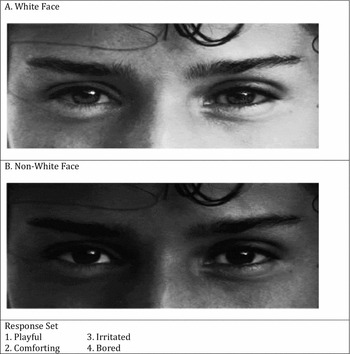
The survey that participants completed included a 2 × 2 experimental design in which (1) participants were induced to feel anxiety or happiness and (2) the skin tone of the faces in the RMET was randomly manipulated to be white or non-white.Footnote 4 After answering demographic questions, participants were asked to provide descriptive tags for three validated affect-inducing images (Lang et al. Reference Lang, Bradley and Cuthbert2008) — one group (n = 111) saw anxiety-inducing images and the other (n = 127) saw happiness-inducing images (see Supporting Materials, Section A4, for details). After viewing the emotion-inducing images, participants completed the modified RMET.Footnote 5 For each RMET image, participants were randomly assigned to view either a white face or a non-white face and identify the person's emotional state (see Figure 1 for an example and Supporting Materials, Section A3, for details).Footnote 6
Example of skin-tone manipulation in the Modified Reading the Mind in the Eyes Test. Note: See Supporting Materials, Figure S1, for all photos.

Results
Because all of the subjects in Study 1 are white, an outgroup empathy gap implies that the mental states of white faces are more likely to be correctly identified relative to non-white faces. The evidence supports the thesis that anxiety exacerbates the outgroup empathy gap. Relative to participants assigned to the happy condition, participants in the anxiety condition exhibited less empathic capacity on outgroup photos (non-whites) than on ingroup photos (whites). Individuals in the anxiety condition offered less accurate responses on the outgroup photos by 7.7 percentage points (M ingroup = 0.696, M outgroup = 0.619, SEdifference = 0.047, p = 0.05, one-tailed).Footnote 7 In contrast, subjects assigned to the happy condition were less accurate on the emotional states of outgroup photos by only 1 percentage points (M ingroup = 0.668, M outgroup = 0.658, SEdifference = 0.032, p = 0.763). The difference between the effects observed in the anxiety condition and the happy condition (i.e., the interaction between the skin-tone and anxiety manipulations) is statistically significant (p = 0.05, one-tailed). See Supporting Material, Section A6, for full statistical results.
STUDY 2: REPLICATION OF OUTGROUP EMPATHY GAP USING EXPLICIT MEASURES
Study 1 supports the paper's central thesis. Mindreading forms the basis of human empathy, and when people are anxious, they are less adroit at reading the mental state of outgroup members than they are of ingroup members. Like all studies, it has limitations. Empathic capacity includes a cognitive component, which mindreading captures, and an affective component (e.g., sympathy and compassion) (Davis, Reference Davis1983). Study 1 does not tap the affective component of empathy, making it unclear whether anxiety reduces people's willingness to help outgroup members, on average. After all, if anxiety only diminishes the perspective-taking ability of individuals who do not sympathize with outgroup members even when they accurately intuit outgroup members’ emotional state, then the results in Study 1 may not have important social implications. Another limitation is that happiness may induce individuals to be more empathetic toward outgroups (Johnson and Fredrickson, Reference Johnson and Fredrickson2005). Consequently, the results above may not show the effects of anxiety, but the effects of happiness.
Procedures
In fall 2016, I recruited 588 white participants from Survey Sampling International's Internet panel (see Supporting Materials, Sections A1 and A2, for details about recruitment and sample). To address the limitations above, participants completed a nearly identical emotion induction task as participants in Study 1. Those assigned to the anxiety condition saw the same images (n = 303), but participants assigned to the control condition saw three neutral images (e.g., a spoon) drawn from the same validated source (n = 285; see Supporting Materials, Section A4, for details). This experimental design enables estimating the effects of anxiety relative to people's resting emotional state.Footnote 8 After completing the emotion-induction task, participants answered the 14-item Group Empathy Index developed by Sirin et al. (Reference Sirin, Villalobos and Valentino2016). This index measures people's empathic capacity (both affective and cognitive dimensions) toward outgroups with questions like “I often have tender, concerned feelings for people from another racial or ethnic group who are less fortunate than me.” The responses were combined into a single index where higher values indicate higher levels of outgroup empathy using factor analysis (see Supporting Materials, Section A3, for details).Footnote 9 Using an explicit measure of group empathy presented a harder test for the paper's thesis because it introduces the issue of social desirability bias. If people are motivated to appear open-minded toward outgroups, they may provide a more rosy assessment of their empathy toward other groups, which would bias the effects of the anxiety manipulation downward.
Results
Participants assigned to the anxiety condition expressed lower levels of empathy toward outgroups than those assigned to the neutral condition (M anxiety = −0.065, M neutral = 0.071, SEdifference = 0.079, p = 0.04, one-tailed). The anxiety treatment had similar effects on the affective component of group empathy (M anxiety = −0.06, M neutral = 0.058, SEdifference = 0.078, p = 0.06, one-tailed) and the cognitive component M anxiety = −0.039, M neutral = 0.04, SEdifference = 0.046, p = 0.04, one-tailed). It is worth nothing that while the effect of anxiety on self-reported outgroup empathy is modest, it is comparable in magnitude to gender and socioeconomic status. See Supporting Material, Section A6, for full statistical results.
STUDY 3: THE OUTGROUP EMPATHY GAP AND WILLINGNESS TO HELP
Studies 1 and 2 provide compelling evidence that anxiety diminishes people's empathic capacity toward outgroup members, on average. Study 3 investigates whether this anxiety-induced outgroup empathy gap shapes political attitudes — particularly attitudes toward helping social groups in need.
Procedures
In early 2013, I recruited 1,264 white participants living in the United States via Amazon Mechanical Turk (see Supporting Materials, Sections A1 and A2, for details about recruitment and sample). This study asked participants to express their opinions about a large-scale social problem — homelessness among youth. It featured a 2 × 2 experimental design that (1) used the same emotion induction protocol described in Study 2 to vary feelings of anxiety (n anxiety = 623; n neutral = 641)Footnote 10 and (2) manipulated whether the homeless problem had an African American face (n = 642) or not (n = 622). After completing the emotion-induction protocol, participants in the control condition read the following statement: “According to the New York Times, homelessness has been on the rise among young adults.” Participants in the outgroup condition read a nearly identical statement; save for the rise in homelessness was attributed to “young African American adults.” Because young adults are expected to work irrespective of their ingroup status (Petersen et al. Reference Petersen, Slothuus, Stubager and Togeby2010), this example neutralizes differential considerations about the deservingness of groups as potential welfare beneficiaries.Footnote 11
After participants read the statement about youth homelessness, they answered two questions. One was designed to measure participants’ empathic response by asking them to agree or disagree with the statement, “My heart goes out to young adults who live on the street.” The second measured participants’ willingness to help by asking them to agree or disagree with the statement, “We should do more to help the homeless.” Participants placed their answers on a seven-point scale.
Results
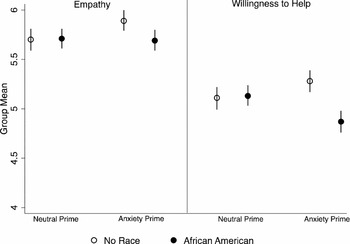
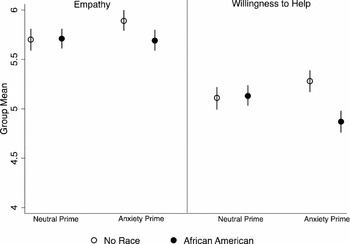
Figure 2 displays the effects of the race of beneficiary manipulation by affect inducement conditions. In the neutral condition, the race of the beneficiary had no substantive effects on empathic response or willingness to help the homeless (p = 0.93 and p = 0.84, respectively). In contrast, participants in the anxiety condition exhibited less empathy toward young African Americans who live on the street (p = 0.03, one-tailed), and were less likely to express a willingness to help the homeless if target beneficiaries were explicitly described as African Americans (p < 0.01). The effects of the race prime on empathic response and willingness to help in the anxiety condition were significantly different from the null effects observed in the neutral condition (p = 0.08, one-tailed and p <0.01, respectively).Footnote 12 In substantive terms, if we categorize responses above the scale midpoint as support for helping the homeless and responses at or below the midpoint as opposition, the anxiety prime reduces willingness to help homeless African American youth by nearly 8 percentage points (p = 0.02, one-tailed). See Supporting Material, Section A6, for full statistical results.
The Effects of Anxiety on Ingroup Bias in Empathy and Willingness to Help, Study 2. Note: The dots represent group means and the vertical lines represent the 84% confidence interval. The more common 95% confidence intervals of two means drawn from different distributions overlap more than 5% of the time and produces a Type I error rate at approximately the 0.006 level and not the often incorrectly presumed 0.05 level. If one wishes to infer the two-tailed level of statistical significance at the 0.05 alpha level from the overlap of confidence intervals, it is more appropriate to specify 84% confidence intervals (Goldstein and Healy, Reference Goldstein and Healy1995).
DISCUSSION
Ingroup bias is a pervasive aspect of human relations. The evidence presented here supports the notion that ingroup bias is partially rooted in differences in empathic capacity for ingroup and outgroup members and illustrates the analytical value of evolutionary informed theories of political psychology (cf. Lopez and McDermott, Reference Lopez and McDermott2012). The need to form boundaries around ingroups also creates a need to regulate to whom we extend trust and aid. The outgroup empathy gap provides a psychological mechanism that enables people to withhold aid from outgroup members while giving it to ingroup members who find themselves in the same predicament. At the same time, humans evolved to be sensitive to the external environment. In threatening environments, ingroup bias offers individuals protective benefits. Consistent with the sociofunctional perspective (Cottrell and Neuberg, Reference Cottrell and Neuberg2005) that discrete emotions help activate evolved mechanisms (Cosmides and Tooby, Reference Cosmides, Tooby, Lewis and Haviland-Jones2004), I find that anxiety can cause individuals to be less understanding of individuals different from them, and exacerbate ingroup bias in people's willingness to help those who are different from them.Footnote 13
These results suggest that opposition to public assistance for members of outgroups need not spring solely from prejudice. The outgroup empathy gap may lead some people to be less likely to understand outgroup members and their motivations. Nonetheless, just because people's diminished willingness to help others arises from something other than animus is not a reason to celebrate. From a normative perspective, it may be more troubling that a deep-seated psychological mechanism underlies opposition to welfare programs, since it could be more difficult to condition automatic psychological processes than to combat socially instilled prejudice.
If we extrapolate a bit further, these findings may explain why anxiety-inducing social phenomena, such as wars or economic downturns, often lead to jingoism (Brewer, Reference Brewer1999) or why people more likely to express a preference for draconian punishments, such as the death penalty, when individuals from outgroups commit crimes (Peffley and Hurwitz, Reference Peffley and Hurwitz2007). It also provides some insight into how seemingly “normal” people can participate in mass scale atrocities, such as ethnic cleansing, toward outgroup individuals and why such appalling behavior is most likely to occur in high anxiety contexts (Staub, Reference Staub2003).
SUPPLEMENTARY MATERIAL
To view supplementary material for this article, please visit https://doi.org/10.1017/XPS.2017.12