IntroductionFootnote 1
Citizenship is about legal membership and belonging to a particular political community. This relationship brings forth rights, duties, and collective identity toward that polity (Bloemraad et al. Reference Bloemraad, Korteweg and Yurdakul2008). Historically, individuals were expected to express loyalty exclusively to a single sovereign and thereby possess only a single citizenship. States believed that multiple citizenships would result in divergent political allegiances, threaten the sovereign authority of the state, and dissipate patriotism (Blatter Reference Blatter2011; Pogonyi Reference Pogonyi2011). However, in the post–World War II period, the professionalization of militaries, reduction of interstate conflicts, exponential increase in migration, spread of human rights norms, economic interdependence, and decolonization have changed the idea of citizenship (Dahlin and Hironaka Reference Dahlin and Hironaka2008; Hailbronner Reference Hailbronner, Martin and Hailbronner2003; Howard Reference Howard2005; Pogonyi Reference Pogonyi2011). Furthermore, these changes have fostered greater acceptance of dual citizenship.
During the last three decades, the percentage of UN member states that allows multiple citizenships has increased from 43 percent (67 out of 156) in 1985 to 73 percent (142 out of 194) in 2015 (UN DESA 2013; Vink et al. Reference Vink, De Groot and Luk2015). One explanation for this increased acceptance has been growing cross-border migration, resulting in diaspora populations (Blatter Reference Blatter2011; Glazer Reference Glazer2010; Howard Reference Howard2005; Wallbott Reference Wallbott2014). Another reason is a variation in citizenship identity; states with a civic citizenship identity that is not tied to the notion of nationhood are more likely to have favorable dual citizenship policies when compared to states with an ethnicized citizenship identity (Dahlin and Hironaka Reference Dahlin and Hironaka2008, 68).Footnote 2
Despite the extensive number of studies on dual citizenship, limited research has been conducted on dual citizenship in de facto states. An evaluation of the studies that examine dual citizenship in de facto states (such as Artman Reference Artman2011; Clogg Reference Clogg2008; Grossman Reference Grossman2001) shows that while de facto states allow dual citizenship (in varying degrees), the factors that influence de facto states to adopt dual citizenship can go beyond those of recognized states. Furthermore, such research has been written from the perspective of extraterritorial citizenship and passportization policies of the patron/titular state (see Agarin Reference Agarin, Agarin and Karolewski2015; Ghazaryan Reference Ghazaryan, Agarin and Karolewski2015; Traunmüller and Agarin Reference Traunmüller, Agarin, Agarin and Karolewski2015). This article, in contrast, will analyze dual citizenship from the perspective of the de facto states. Additionally, in the context of this article, citizenship is taken to mean “the legal status of belonging bestowed upon an individual by a polity”; thus an institutional standpoint will be taken when analyzing dual citizenship policies.
This exploratory research article begins by defining the de facto state, conceptualizing dual citizenship in de facto states, and discussing the complex nature of dual citizenship in these polities. To explore the reasons behind the divergent policies, this study uses the Most Similar Systems Design (MSSD) methodology to compare the citizenship policies of the Republic of Abkhazia and the Pridnestrovian Moldavian Republic (PMR/Transnistria). To conduct this analysis, this article analyzes national legislature, and uses academic literature on de facto states and citizenship to identify factors that can influence citizenship policy. This research also utilizes media reports and data from six semistructured interviews with government officials, academics, and a lawyer to get a deeper understanding of the status of dual citizenship in the two republics.Footnote 3
Based on the case analysis, it is argued that individuals living in de facto states can possess multiple citizenship statuses due to the overlap of citizenship regimes. Following, the article argues that in addition to the influence from migration (primarily diaspora politics) and national identity politics, dual citizenship policies of de facto states are influenced by pragmatic concerns and the relationship with their patron and parent states.Footnote 4 Even though both de facto states allow some form of dual citizenship out of necessity, this research shows that an ethnicized national identity, in contrast to a civic national identity, can produce citizenship laws that give preferential treatment to a particular titular/ethnic group and its diaspora. This is the case in Abkhazia, where the AbkhazFootnote 5 have a privileged position. Furthermore, the respective relationship with the patron (Russia) and parent states (Georgia/Moldova) influences the exclusiveness of dual citizenship policies. In Abkhazia, nontitular groups can only hold Abkhazian and Russian citizenships, while in Transnistria citizens can hold multiple citizenships regardless of their ethnic background. Thus, based on the above factors, it is concluded that Abkhazian citizenship law is less inclusive compared to Transnistrian citizenship law.
The De Facto State
Under the declarative theory of statehood, for a polity to gain a legal personality it must have “a) a permanent population; b) a defined territory; c) a government; and d) the capacity to enter into relations with other states” (Montevideo Convention 1933). Furthermore, Article 3 of the Montevideo Convention (1933) asserts that a state’s political existence is independent of its recognition by other states. This said, under the constitutive theory of statehood, recognition by other states has become an additional criterion. In this view, only the widespread recognition of a “state” by other states results in it acquiring an international legal personality, with UN membership being considered the pinnacle of international recognition. As a result, recognized states have used withholding/granting of recognition as a geopolitical tool in the pursuit of domestic and foreign policy interests (Riegl Reference Riegl2014, 20). As a consequence, any polity without external recognition will find it difficult to effectively engage in the international system.
Despite the lack of external sovereignty, polities can still achieve de facto statehood. A “de facto state” can be defined as a polity that has achieved de facto independence through effective self-government and control over a (significant) part of claimed territory; has a leadership that seeks to build state structures to demonstrate legitimacy; aspires to gain full-fledged sovereign-state status; has yet to gain widespread international recognition; and has continuously existed for a (significant) period of time (Caspersen Reference Caspersen2012, 11; Kolstø Reference Kolstø2006, 725–726; Riegl Reference Riegl2014). It also follows that lack of recognition, despite meeting the criteria of the Montevideo Convention, means that de facto states are “perceived as illegitimate in the eyes of [the] international community” (Riegl Reference Riegl2014, 21), which affects their economic and political prosperity.
The event that resulted in the creation of the greatest number of recognized and de facto states following decolonization was the fall of Communism (1989–1992). The Soviet Union, Yugoslavia, and Czechoslovakia all split into their constituent republics. The newly acquired sovereignty was largely framed in ethno-national terms, with independent statehood meant to achieve the sovereignty of the core (titular) group (Pogonyi Reference Pogonyi2017a, 243). In the post-Soviet space, Chechnya, Crimea, the Donetsk and Luhansk People’s Republics, Gagauzia, Tatarstan, Abkhazia, South Ossetia, Transnistria, and Nagorno-Karabakh were threatened by the ethno-national mobilization at the center of their parent republic, which in turn influenced their demands for self-determination (Agarin Reference Agarin, Agarin and Karolewski2015). That said, only the latter four secessionist republics have achieved de facto statehood.Footnote 6 In the former Yugoslavia, the Dubrovnik Republic, Kosovo, Republika Srpska, Republika Srpska Krajina, and Western Bosnia all declared independence, of which Kosovo is the only de facto state persistently in existence.Footnote 7 In addition, there are several de facto states scattered across the globe (Northern Cyprus, Somaliland, and Taiwan), each having its own citizenship regime. This said, the disputed nature of these territories results in complex citizenship constellations, causing the citizenship(s) of individuals from de facto states to be highly contested, thus warranting greater attention.
Citizenship Constellations in De Facto States
All de facto states allow dual citizenship. However, due to the absence of a universal standard on citizenship laws, the overlapping of state jurisdictions, and the supreme authority of each state to formulate its laws, individuals can come to possess multiple citizenship statuses (see Table 1). In other words, this results in citizenship constellations where “individuals are simultaneously linked to several such [territorial] political entities, so that their legal rights and duties are determined not by one political authority, but by several” (Bauböck Reference Bauböck2010, 848).
Citizenship constellations in de facto states.

The concept of citizenship is largely linked to territory (Krasniqi Reference Krasniqi2012, 361) and the recognition of state sovereignty (Grossman Reference Grossman2001, 853). Thus, under customary international law, only sovereign states can confer citizenship. As a result, the lack of recognition of de facto states and their inability to enforce independent citizenship regimes results in an overlap and a “de facto condominium like citizenship constellation” (Krasniqi Reference Krasniqi2012, 363). The first type of citizenship constellation comes about as a result of the reluctance of states to recognize de facto state citizenship, which results in citizens occasionally being considered as stateless persons with a right of return to a particular place of origin (Grossman Reference Grossman2001, 874).
At the same time, de facto state citizens can be unwillingly subjected to the citizenship laws of the parent state (Grossman Reference Grossman2001, 870). One example is the case of a Taiwanese passport holder being classified as “Chinese” on a residence permit in Iceland. Following a complaint, her citizenship was changed from Chinese to stateless, because the Icelandic government does not recognize Taiwan as a sovereign state (Gerber Reference Gerber2016). This brings us to the Type II citizenship constellation, where citizens of de facto states, rather than being considered stateless, are considered to maintain the citizenship of the parent state, even if they refuse to accept its authority (Littlefield Reference Littlefield2009, 1471).
The Type III citizenship constellation occurs as a result of citizens of de facto states legally acquiring the citizenship of a recognized third country. Since the citizenship granted by the de facto state is not recognized by most states, individuals can simultaneously have two statuses. States that recognize the de facto state would label them as dual citizens, while states that do not will only acknowledge them as citizens of the recognized state whose citizenship they possess.
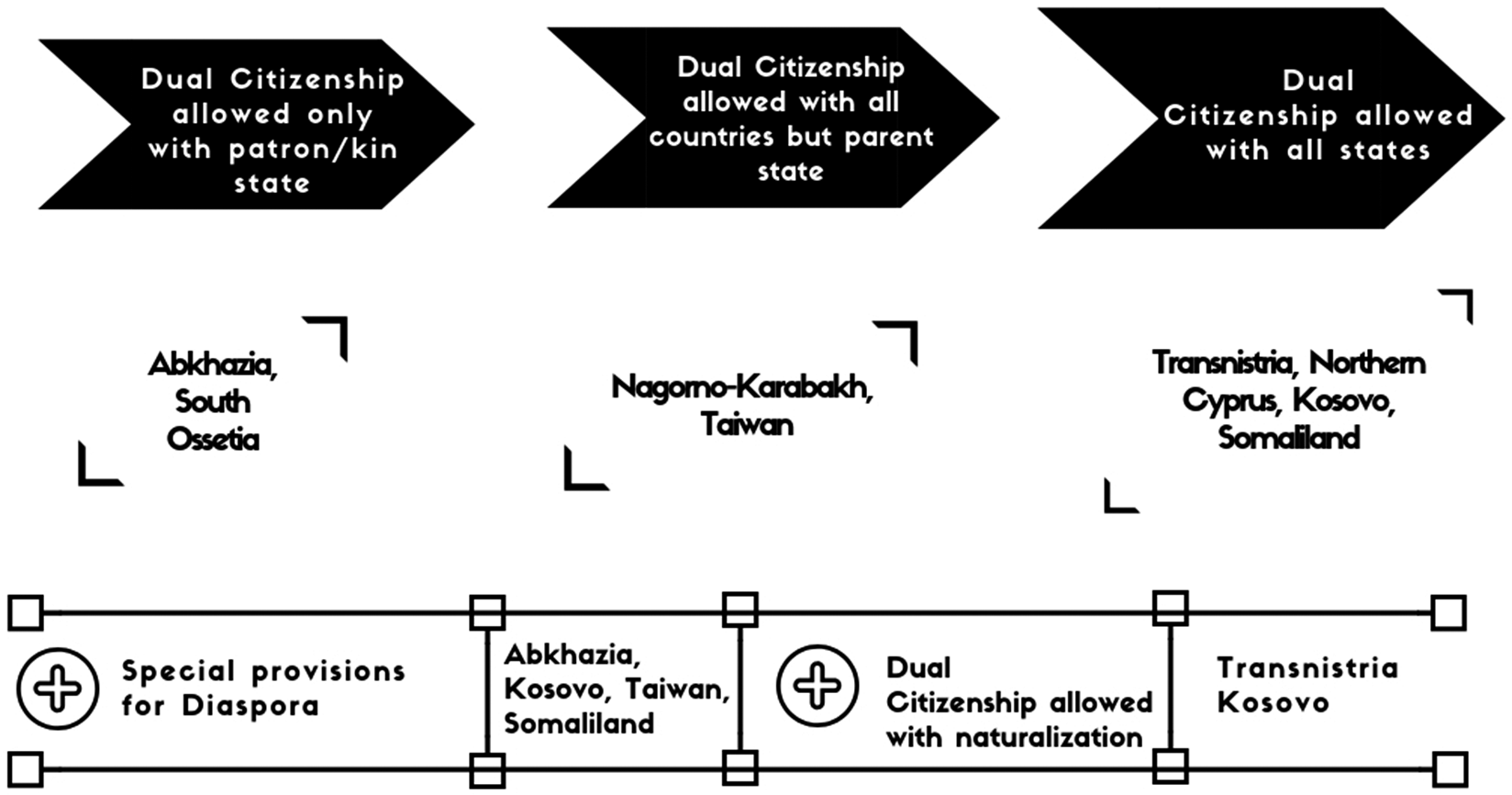
Despite the above categories, what remains constant is that dual citizenship is allowed under the domestic law of the de facto states, albeit in varying degrees. This results in a three-level scale (see Figure 1), ranging from dual citizenship being allowed only with a particular state (conditional dual citizenship) to being allowed with any state. If a state falls at the beginning of the scale, its citizenship regime is more exclusive, since individuals have more restrictions on possessing dual citizenship. In addition, if dual citizenship is granted to a diaspora (extraterritorial citizenship) and is allowed with naturalization, then the polity can be said to be more inclusive compared to those that lack such provisions.Footnote 8 This said, it must be noted that these two conditions are independent of a de facto state’s position on the three-level scale, and would rather only shift the positions of the polities within each level. For example, while both Somaliland and Kosovo allow dual citizenship with any state, Kosovo’s citizenship policy can be said to be more inclusive since it allows dual citizenship with naturalization, while Somaliland does not.
Dual citizenship in de facto states.

In order to identify which variables affect the level of acceptance of dual citizenship in de facto states, this article uses the MSSD methodology to control for and disregard common factors in the compared cases. The variables that have different values across the cases can explain the variation in the dependent variable (acceptance of dual citizenship) (Meckstroth Reference Meckstroth1975, 133). Thus, having emerged in a similar fashion during the collapse of the Soviet Union,Footnote 9 Abkhazia and Transnistria are ideal for a MSSD comparative case study as they diverge in the dependent variable.Footnote 10
Having broadly discussed dual citizenship in de facto states, using the cases of Abkhazia and Transnistria, the subsequent sections discuss factors that influence their dual citizenship policies.
Dual Citizenship: A Pragmatic Move
A physical symbol or manifestation of a state’s sovereignty and individual’s citizenship is the passport. However, passports are not equal in value; some are more powerful and beneficial, and thus more desired, than others. Therefore, it is useful to discuss how the utility of the passport and associated citizenship is linked to the acceptance of dual citizenship.
The notion that only recognized sovereign states can confer passports (and citizenship) has been gradually changing. The West Bank (Palestine) and Kosovar cases show that citizenship can be “divorced from sovereignty and recognition” (Grossman Reference Grossman2001, 860). Furthermore, the acceptance of a passport as a valid travel document does not need to be dependent on the recognition of the issuing polity’s sovereignty (Grossman Reference Grossman2001, 861). The clearest example is Taiwan, whose passport is accepted as a travel document in over 180 UN member states, while being diplomatically recognized by less than 20. A more recent example is Russia’s recognition of the Donetsk and Luhansk People’s Republics’ passports as valid travel documents without any formal recognition of sovereignty (RT 2017). That said, a passport is still a symbol of sovereignty and one of the most common documents used to prove one’s citizenship. Since recognition of the validity of the travel document increases the legitimacy of the issuing entity, de facto states strive to increase the document’s level of acceptance around the world.
Abkhazia issues both internal (green) and external (blue) passports. Internal passports are used as personal identification documents, and external passports facilitate international travel. Following the dissolution of the USSR, many Abkhazian residents continued using Soviet passports. Only in 2006 did Abkhazia begin issuing its own internal passports (1tv.ru 2006). External passports have been distributed since 2010 (Lenta.ru 2010). However, despite efforts by the Abkhazian government, they have been recognized only by Russia, Nicaragua, Venezuela, Nauru, Syria, Nagorno-Karabakh, South Ossetia, Transnistria, and the Cayman Islands.
Transnistria began issuing internal (red) passports in 2001 (Presidential Decree № 227 on the Passport of the PMR Citizen 2001). Prior to this, Transnistrians used either old Soviet passports or a passport of another government with an insert (Malaev Reference Malaev2017). Unlike Abkhazia, Transnistria has refrained from distributing its own external (blue) passports under the Law on the Passport of the PMR Citizen (2002) due to their lack of recognition. Transnistrian (internal) passports are recognized as travel documents by Abkhazia, Nagorno-Karabakh, and South Ossetia, as well as being recognized as valid internal documents in Moldova (Protocol on Mutual Recognition in the Territory of Transnistria and Moldova of Documents Issued by the Relevant Bodies of Both Parties 2001). Similarly, passports of South Ossetia, Nagorno-Karabakh, Northern Cyprus, and Somaliland have limited international acceptance, and thus have limited power and value.
The limited recognition of Abkhazian and Transnistrian passports contributed to their governments’ desire to ensure that citizens can easily engage in international travel. Thus, allowing dual citizenship with an internationally recognized state is seen as a way to “escape the impact of non-recognition” (Agarin Reference Agarin, Agarin and Karolewski2015, 127), and to provide de facto state citizens a legal status that is internationally accepted (Ghazaryan Reference Ghazaryan, Agarin and Karolewski2015, 114). For similar pragmatic reasons, possessing a recognized country’s citizenship allows an individual to receive its diplomatic protection and socio-economic benefits (such as higher pensions, and access to education, job-markets, and healthcare). This secondary citizenship can also be described using Harpaz’s (Reference Harpaz2019) term of compensatory citizenship, where individuals acquire the secondary citizenship to make up for limitations of one’s primary citizenship.
While it is clear that there are numerous advantages of possessing dual citizenship, there can be several disadvantages, such as questions on judicial authority over citizens and issues relating to military service, taxation, and working for foreign governments (Luzhansky and Lysenko Reference Luzhansky and Vladlena2017; Zavodskaya Reference Zavodskaya2017). Overall however, interviewees had trouble identifying any prominent and often-occurring problems resulting from dual citizenship. Based on the above, it is clear that the benefits of dual citizenship outweigh the disadvantages. It can be thus postulated that a de facto state’s main reason for allowing dual citizenship is based on the necessity of compensating for the lack of utility of its passport, and thus acceptance of dual citizenship is the norm rather than the exception. That said, despite de facto states’ acceptance of dual citizenship, the following section demonstrates that there are still significant differences.
Dual Citizenship in Abkhazia and TransnistriaFootnote 11
The disintegration of the USSR resulted in millions of Soviet citizens becoming eligible for the citizenship of one of the successor republics. In other words, a “new” citizenship associated with each post-Soviet state was created in order to accommodate and provide a legal status to millions of Soviet citizens. However, the question of who was eligible for a republic’s citizenship has been contentious, and the way new states formulated their citizenship rules varied from the older states (Shevel Reference Shevel, Shachar, Bauböck, Bloemraad and Vink2017). While in older states the “demos is a given” and is based on established citizenship attribution policies, in new post-Soviet states there was no preexisting rule that defined the core nation (Pogonyi Reference Pogonyi2017b, 12–13). As a result, the initial construction of citizenry can become an “ideologically tinted project” (Pogonyi Reference Pogonyi2017b, 13), with citizenship laws being used as an “instrument to attain and defend state sovereignty” (Shevel Reference Shevel, Shachar, Bauböck, Bloemraad and Vink2017, 408) and thus exclude undesirable groups from the core nation. This links to Shevel’s second difference: while older states formulated citizenship policies in response to immigration, successor states formulated policies to define who of the former (Soviet) citizens residing in their territory were eligible for citizenship. Some states granted citizenship to only the titular group that they represented (for example Estonia and Latvia) and gave preferential treatment to co-ethnics living abroad (Armenia for example). Other states (such as Georgia and Moldova) followed the new state model of citizenship, which defines their initial body of citizens as those permanently residing in their territory, without any ethnic criteria (Brubaker Reference Brubaker1992, 277–279). These differences show that states adopt citizenship policies with varying degrees of ethnicization, either by granting preferential treatment to co-ethnics or being discriminatory toward nontitular minorities (Shevel Reference Shevel, Shachar, Bauböck, Bloemraad and Vink2017, 415–420).
Similar to the 15 republics, the de facto separation of Abkhazia and Transnistria made it necessary to define a citizenry eligible for citizenship. The formation of the initial citizenship laws of Abkhazia in 1993 and Transnistria in 1992 were thus the result of the de facto independent status achieved following the secessionist conflict.
Abkhazia has two primary documents that discuss citizenship, namely the Law on Citizenship of RA (1993) and the Law on Citizenship of RA (2005).Footnote 12 As in most citizenship laws, there are multiple paths to citizenship. Both versions have allowed ethnic Abkhaz, regardless of place of residence or other citizenship(s), to acquire Citizenship (Law on Citizenship of RA 1993, Art.15; Law on Citizenship of RA 2005, Art.5§a). This provision, which provides preferential treatment to the titular group, is a clear example of ethnicization of citizenship. Another pathway, according to the 1993 Law on Citizenship of RA, was for an individual to acquire citizenship if they had at least one grandparent who was born in the territory of Abkhazia (Art.11) or a parent who is a citizen of Abkhazia (Art.12–13); however, in 2005 the former provision was removed. That said, it is important to note that this change only affected nontitular groups, since ethnic Abkhaz could still acquire citizenship under Article 5§a of the 2005 Law. However, the 2005 Law (Art.5§b) also adopted a clause that stated that all individuals who were permanent residents of Abkhazia for at least “5 years by the time of adoption of the Act of state independence of RA on the 12th of October 1999” were eligible for citizenship. While on the surface this retroactive policy may seem to follow the new state model, in reality it makes it difficult for non-Abkhaz minorities (primarily Georgians) who fled during the conflict to acquire Abkhazian citizenship. Thus, it can be concluded that Abkhazia primarily follows the jus sanguinis principle, and that there is a level of ethnicization of citizenship, since ethnic-Abkhaz can more easily claim Abkhazian citizenship compared to other minorities.
Transnistria, in addition to the Constitution of the PMR (1996, Art.3), has three documents that discuss citizenship: the Law on Citizenship of PMR (1992), Law on Citizenship of PMR (2002), and Law on Citizenship of PMR (2017). At birth, individuals can acquire citizenship in Transnistria via both the jus sanguinis and jus soli principles. Furthermore, all three laws followed the new state model of citizenship: according to the Law on Citizenship of PMR (1992, Art.1), all former Soviet citizens who resided in the territory of the PMR on the day of its formation in September 1990 were eligible for Transnistrian citizenship.
Having discussed the basic foundations of citizenship in both republics, the remainder of this section focuses on the relevant clauses that deal with dual citizenship (Law on Citizenship of RA, 2005, Art.6; Law on Citizenship of PMR, 2017, Art.6§2). In Abkhazia, the most significant change in the legislation was the restriction placed on the nontitular groups, who, based on the new Law on Citizenship of RA (2005, Art.6), could only hold dual citizenship with Russia. Furthermore, under the 1993 Law it was possible to maintain both Abkhazian and Georgian citizenship despite the ongoing conflict; however, with the 2005 Law (Art.5–6), this issue was eliminated. By comparing the two laws, it is clear that the 2005 change was envisaged to “clarify the issue of citizenship” (Clogg Reference Clogg2008, 312) by addressing the loopholes of the 1993 Law. Thus based on these new restrictions, it may be stated the present law falls closer to the exclusive end of the dual citizenship scale.
In Transnistria, on the other hand, dual citizenship legislation has remained largely unchanged. Under the 1992 Law on Citizenship of PMR (Art.5&18), citizens could only hold dual citizenship if the other state allowed it. However, in the 2002 Law (Art.5) and 2017 Law (Art.6), the right to acquire multiple citizenships is emphasized. The above point was repeatedly stressed during interviews in Tiraspol, where it was stated that Transnistria does not allow dual citizenship, but rather multiple citizenships, and in effect places no regulations to limit multiple citizenships (Luzhansky and Lysenko Reference Luzhansky and Vladlena2017). This demonstrates that Transnistria’s citizenship policy falls toward the inclusive end of the dual citizenship scale. Having given a brief comparison of legislation, subsequent sections of this article discuss the factors that contribute to these differences.
Dual Citizenship, Identity, and Diaspora
As previously discussed, establishing citizenship policies that dictate who can be considered a citizen is an integral component of functioning states. Conventionally, “notions of citizenship delineate national identity and membership in a single ethno-cultural or national community” (Dahlin and Hironaka Reference Dahlin and Hironaka2008, 55). To be a citizen, a person must have a strong ethno-cultural connection to the nation-state. Such states (such as Estonia) follow the jus sanguinis principle, where individuals can become citizens only if a parent is a citizen of that state. On the other hand, some states (such as the USA) take a more inclusive policy by following the jus soli principle, and consider all individuals born in their territory as their citizens.Footnote 13 These differences are significant because they can promote the inclusion or exclusion of a group of people based on their ethnic, cultural, or religious identity.
The Soviet Union’s ethno-federal system created republics based on the ethnic majority of a particular region. This was the basis of the formation of the Abkhaz ASSR in 1931. Following the USSR’s demise, this idea was maintained across the region (Pogonyi Reference Pogonyi2017b, 18), and political authority was formed along ethno-national lines (Brubaker Reference Brubaker1996, 3). In Abkhazia, statehood was demanded in order to protect its titular group from Georgian influence. This shows that there is an ethno-national dimension in Abkhazia’s foundations, with ethnic Abkhaz being in a privileged position compared to other minorities.Footnote 14 As a result, we see clauses in the Law on Citizenship of RA (2005) that privilege the titular group and grant citizenship based on the jus sanguinis principle. This provision seems to fit Brubaker’s (Reference Brubaker1996) triadic nexusFootnote 15 present in new post-Communist states, with the nationalizing nationalism of the new state defining its core nation along ethno-cultural lines. Since Abkhazia is considered to be the only homeland of the Abkhaz, it seems logical to give preferential treatment to this group.
Based on the above statement, one may get the impression that Abkhazian Citizenship Law is exclusive. Interviewees, however, argued that the Abkhazian government strives to promote a civic identity over an ethno-national one (Taniya Reference Taniya2017). Taniya highlighted the importance of differentiating between the ethnicized term “Abkhaz” and the term “Abkhazian,” which has a civic connotation. Taniya further stressed the multicultural makeup of Abkhazia and the efforts undertaken to promote national unity while simultaneously protecting the ethnic identity of all peoples in Abkhazia. According to a 2011 census, Abkhaz comprised just over 50 percent of the population, while Georgians, Armenians, and Russians made up 19 percent, 17 percent, and 9 percent of the population, respectively (Naseleniye Abkhazii Reference Abkhaziin.d.). Additionally, smaller groups of Ukrainians, Greeks, Ossetians, and Turks also live there, which contribute to Abkhazia’s multi-ethnic society. Taniya (Reference Taniya2017) further highlighted that a mono-ethnic Abkhazia would not be able to survive in the 21st century, making it important to promote multiculturalism and peaceful relations with all peoples of Abkhazia. Such reasoning falls within the liberal-democratic discourse, which stresses the importance of consolidating all the ethnic groups of Abkhazia (Clogg Reference Clogg2008, 324), and demonstrates the desire to move Abkhazia’s identity from an ethnic to a civic national identity.Footnote 16
Despite this rhetoric of multiculturalism, legislation that addresses minority rights is still limited (Clogg Reference Clogg2008, 311). Furthermore, there is even an opposing nationalist discourse among a section of society that emphasizes the importance of preserving the Abkhaz nation and preventing its assimilation (Clogg Reference Clogg2008, 318–319). Thus, while there seems to be a change toward adopting a more inclusive identity, more time is needed for this idea to be accepted across Abkhazia.
Unlike Abkhazia, Transnistria’s claims for self-determination were based on the need to protect itself from Moldova’s ethnicization policies. The Transnistrian identity is an offshoot of the Soviet identity and is based on territory (jus soli), as well as the historically multicultural and multiethnic composition of the region (see Solonari Reference Solonari2003). Because of this, it can be stated that Transnistria has a civic identity because its foundations are not based on ethnic nationalism. Remaining relatively unchanged from the previous census, in 2015 Russians constituted 29.1 percent, Moldovans 28.6 percent, Ukrainians 22.9 percent, Transnistrians 0.2 percent (first recorded instance), other ethnicities 5.6 percent, and undeclared 13.8 percent (Mashke.org n.d.; Tynyaev Reference Tynyaev2017). Furthermore, having been a separate region from the rest of Moldova/Romania through much of history, Transnistria has created a separate and distinctly non-Moldovan/Romanian identity (Galinsky Reference Galinsky2017). This, combined with Transnistrians’ identity as Russian speakers, has also strengthened their connection with the Russian Federation (Kolstø Reference Kolstø2014).
Due to the above factors, ethnicity plays no direct role in Transnistrian citizenship law (Luzhansky and Lysenko Reference Luzhansky and Vladlena2017).Footnote 17 Additionally, the master nationality rule was stressed on several occasions, which implies that an individual is always first a Transnistrian, and only then a citizen of the other state(s) of citizenship (Anonymous1 2017; Law on Citizenship of PMR 2002, 2017). Hence it is often echoed that the secondary citizenship has less to do with identity, but is rather a compensatory citizenship acquired to make life easier. As a result, the acquisition of a secondary citizenship is not seen to undermine the patriotism of Transnistrians (Galinsky Reference Galinsky2017).
A further argument in favor of dual citizenship is the opportunity it provides to maintain ties with kin across the border (Artman Reference Artman2011, 690–691; Chirikba Reference Chirikba2017; Galinsky Reference Galinsky2017; Mühlfried Reference Mühlfried2010, 9–10). This argument was put forward in Transnistria for its preference of unrestricted dual citizenship, as it would provide an opportunity for Moldovans, Russians, Ukrainians, and other ethnic minorities to maintain ties with their external national homelands (Luzhansky and Lysenko Reference Luzhansky and Vladlena2017). Similarly, Krasniqi (Reference Krasniqi2012, 357) states that Kosovo accommodates the needs of the Serb minority who primarily live along the border with Serbia by allowing them to have dual citizenship. Such reasoning was not cited in Abkhazia, most likely because ethnic Russians make up less than 10 percent of the population (Naseleniye Abkhazii Reference Abkhaziin.d.).
Another factor that influences dual citizenship policies is the desire for a state to maintain ties with its diaspora. States like Armenia, Hungary, and Bulgaria apply preferential citizenship rules for their coethnics (diaspora). This homeland nationalism component of Brubaker’s (Reference Brubaker1996) triadic nexus can also be present in de facto states which adopt policies that promote the interests of their extraterritorial kin. Under Abkhazia’s 2005 Law on Citizenship, the Abkhaz diaspora has the right of return to their ancestral homeland (Preamble 3), and regardless of their place of birth/residence, are entitled to Abkhazian citizenship without having to give up their previous citizenship(s) (Art.5§a). A further argument is that since historically the Abkhaz were forced to flee their land, they should be given the opportunity to return to their homeland (Clogg Reference Clogg2008, 319; Khashig Reference Khashig2005). In practice, this has convinced some Turkish-Abkhaz and Syrian-Abkhaz to move to Abkhazia (Begunov Reference Begunov2016; Clogg Reference Clogg2008, 309).
Anonymous2 (2017) also suggested that, by allowing extraterritorial citizenship, Abkhazia is promoting the return of the Abkhaz diaspora to prevent the Abkhaz from (once again) becoming a minority in their homeland. This argument seems in line with Pogonyi’s (Reference Pogonyi2017b, 39) general statement that, in the post-Communist space, states adopt such policies to assure the political dominance of the titular group. Despite the freedom the Abkhaz enjoy with regard to their second citizenship, there is one caveat. If desired, it is possible to prevent ethnic Abkhaz from simultaneously having Abkhazian and Georgian citizenship by citing Art.5§a, which prevents individuals who work against the sovereignty of the Republic of Abkhazia from acquiring its citizenship. That said, overall, there is special treatment of ethnic Abkhaz under the naturalization laws of Abkhazia, but once individuals gain citizenship they largely have equal rights as any other (nontitular) citizen. Transnistria, on the other hand, lacks true extraterritorial kin, as it is not the ancestral homeland of a particular ethnic group. Thus, it is quite logical that Transnistrian law lacks any reference to a diaspora. Based on the above analysis, it can be stated that the existence of a diaspora causes a government to adopt (preferential/exclusive) extraterritorial citizenship policies toward its co-ethnics.
It must also be noted that the naturalization laws of both countries differ. If we compare the naturalization laws by exclusivity, Transnistrian naturalization laws emerge as less exclusive. In Transnistria, immigrants do not need to renounce their former citizenship and need to only fulfill a one-year residency requirement (Law on Citizenship of PMR 2017, Art.13–14).Footnote 18 In Abkhazia, individuals of non-Abkhaz ethnicity must meet stricter requirements. For example, they have to have continuously lived in Abkhazia for ten years, be able to communicate in Abkhaz, and would need to renounce any other citizenship (Law on Citizenship of RA 1993, Art.16; Law on Citizenship of RA 2005, Art.13).
Consequently, it is possible to conclude that a state (like Abkhazia) whose foundations are ethno-national will have citizenship policies that favor the titular group and its diaspora, while a state (like Transnistria) that has civic (state-centered) foundations will not have ethnicized citizenship policies. This, once again, places Transnistria closer toward the inclusive end of the dual citizenship scale.
Dual Citizenship, Passportization, and Patron State Influence
Another powerful factor affecting citizenship policies has been the influence of the patron state. Due to a “heavy-handed approach” by the parent state, Abkhazia, South Ossetia, and Transnistria have turned to Russia for political, economic, and social support (Agarin Reference Agarin, Agarin and Karolewski2015). Russia, in turn, has continued the Soviet divide and rule policy for geopolitical control in its sphere of influence, and has supported these polities to varying degrees (Kolstø Reference Kolstø2006, 733; Littlefield Reference Littlefield2009, 1464; Pogonyi Reference Pogonyi2017a, 244).
Until 2008, Russia subscribed to a policy of defending without recognizing (Kobrinskaya Reference Kobrinskaya2008, 2), but this changed when Russia recognized Abkhazia and South Ossetia as sovereign states. Following that move, the Russian government has invested heavily in ensuring the (political) survival of the two polities. However, Russia has maintained the defending without recognizing policy toward Transnistria by retaining a strong military/peacekeeping presence and providing economic support. Similarly, Nagorno-Karabakh, although not recognized by its patron state, has been able to survive due to economic and military support from Armenia (Ghazaryan Reference Ghazaryan, Agarin and Karolewski2015; Kolstø Reference Kolstø2006, 733). This makes it clear that patron state support is a fundamental reason for the continued existence of these de facto states. Because of this, de facto states have been able to establish and maintain symbols of statehood, including citizenship policies.
One characteristic feature of patron state support has been easy access to its citizenship. Russia has used passportization as a soft power tool and has conferred citizenship en masse to ex-USSR citizens living in the near abroad (European Court of Human Rights 2009, 18).Footnote 19 Russia’s homeland nationalism (Brubaker Reference Brubaker1996, 107–147) has also contributed to favorable citizenship policies toward its compatriots. The Federal Law on Citizenship of the Russian Federation (2002, Art.14) paved the way for simplified procedures for ex-Soviet citizens to acquire citizenship. Under this law, former USSR citizens not possessing citizenship of a successor Soviet Republic could acquire Russian citizenship. This law was exploited to increase the bestowment of citizenships to residents in Abkhazia (International Crisis Group 2006, 18). From June 2002, the Congress of Russian Communities of Abkhazia collected Soviet documents and took them to Sochi to swap for Russian passports (Artman Reference Artman2014; Khashig Reference Khashig2002). Since Abkhazians still carried outdated Soviet passports and refused to accept Georgian passports (Littlefield Reference Littlefield2009, 1471–1472), the Sukhum government encouraged this activity. Furthermore the government saw this as a guarantee of protection in case Georgia was to engage militarily in the future (Artman Reference Artman2011, 690; Mühlfried Reference Mühlfried2010, 10; Taniya Reference Taniya2017). In other words, Abkhazia had no choice but to accept Russia’s passportization policy, as it was the only readily available option (Anonymous2 2017). Gaining Russian passports further served as a symbol of “un-belonging” from Georgia (Artman Reference Artman2011, 695). Similar policies were implemented in South Ossetia and Crimea, and in Abkhazia and South Ossetia over 80 percent and 90 percent of the populations, respectively, have come to possess Russian citizenship (Littlefield Reference Littlefield2009, 1473; Malaev Reference Malaev2017; South Ossetia Today 2016).
The international community and the parent states have criticized this policy, as they perceive it as a threat to state sovereignty (Pogonyi Reference Pogonyi2011, 696). Notwithstanding such criticism, Russia has continued this process for nearly two decades. Russia justifies its passportization policy based on the argument that it is duty-bound to protect individual rights and ensure that all people (particularly ethnic Russians) living in the post-Soviet space have access to a citizenship that guarantees them basic rights (Brubaker Reference Brubaker1996; Littlefield Reference Littlefield2009, 1473; Pogonyi Reference Pogonyi2017a, 244). That said, there is an ethnic tint in Russia’s citizenship policy, as individuals having a close relationship with Russian culture and fluent in Russian have easier access to citizenship (Shevel Reference Shevel, Shachar, Bauböck, Bloemraad and Vink2017). Furthermore, Russia has used this tool to “create “Russian spaces” within the internationally recognized borders” (Artman Reference Artman2011, 122), maintain regional hegemonic control, and justify recent interventions in the near abroad (Constitution of the Russian Federation 1993, Art.61; Littlefield Reference Littlefield2009, 1478; Mühlfried Reference Mühlfried2010, 13). Interestingly, the two polities (Abkhazia and South Ossetia) that are most influenced by the patron state allow dual citizenship only with Russia. One must thus wonder if there is a relationship between the level of passportization and the conditional dual citizenship policy of the de facto state.
As previously discussed, in Abkhazia, the most significant change in the legislation was the restriction placed on Abkhazians, who after 2005 could only maintain dual citizenship with the Russian Federation. Taniya (Reference Taniya2017) and Anonymous2 (2017) suggested that the change was simply the act of codifying the de facto reality of Abkhazia, since by this time the majority of Abkhazians had acquired Russian citizenship, which was, for many, the only option. This new legal restriction was thus of little significance for the Abkhaz, Russians, and Armenians (Clogg Reference Clogg2008, 312).
The passportization policy was active until the country’s recognition by Russia in 2008. Following recognition, those who had yet to acquire Russian citizenship became ineligible, as all individuals applying for naturalization in Russia have to renounce any other citizenship (Federal Law on Citizenship of the Russian Federation 2002, Art.14§2.1c; Zavodskaya Reference Zavodskaya2017). Prior to this, the regulation did not apply to Abkhazians because Abkhazia was not recognized by Russia, meaning that their citizenship was also not recognized. Those who had applied for Russian citizenship before 2008 had been considered stateless persons by the Russian Federation (Littlefield Reference Littlefield2009, 1473). This is an example of a Type I citizenship constellation, since the de facto states’ citizenship was not recognized by the international community. This phenomenon would apply to most other de facto states, including Transnistria, where individuals who possess only a de facto state’s citizenship would not be required to renounce it when acquiring citizenship of a country that does not recognize the de facto state.
Despite the post-2008 restriction, Abkhazians can still gain Russian citizenship under jus sanguinis law. Since over 80 percent of the population already holds Russian citizenship, with time this proportion would only increase. That said, the Agreement between the Russian Federation and the Republic of Abkhazia on Alliance and Strategic Partnership (2014, Art.13) pledged to take steps to simplify the procedures for Abkhazians to gain Russian citizenship by naturalization without renouncing their Abkhazian citizenship. Currently the governments are drafting a bilateral agreement on dual citizenship, which upon ratification would provide a pathway for approximately 5,000 Abkhazian citizens to acquire Russian citizenship (Zavodskaya Reference Zavodskaya2017).
By contrast, Russia’s passportization policy in Transnistria has been minimal, which is shown by the variety of secondary citizenships that Transnistrians possess. Approximately 300,000 Transnistrians hold Moldovan passports, while over 200,000 and 100,000 hold Russian and Ukrainian passports, respectively, with many citizens holding more than two citizenships (Kolstø Reference Kolstø2014; Luzhansky and Lysenko Reference Luzhansky and Vladlena2017). Luzhansky and Lysenko (Reference Luzhansky and Vladlena2017) and Galinsky (Reference Galinsky2017) refuted the existence of any specific passportization policy, arguing that it was not easy for Transnistrians to acquire Russian passports following the breakup of the USSR, and for many the easiest option was to acquire a Moldovan passport for international travel. Only when Russia simplified its citizenship policy in 2002 were Transnistrians able to easily acquire Russian citizenship. Those who apply through the simplified procedures are required to prove that they do not have Moldovan citizenship (Federal Law on Citizenship of the Russian Federation 2002, Art.14§2.1в). However, as discussed in the next section, this has proven difficult for many Transnistrians. As a result, Tiraspol has been working with Moscow to further simplify the procedures for the acquisition of Russian citizenship (Supreme Council of the PMR 2017). Also, the July 2017 amendment to Art.14§2.1в of the Russian Citizenship Law (which states that naturalizing Ukrainian citizens do not need official documentation from Kiev) could pave way for Transnistrians to acquire Russian citizenship without needing any Moldovan documents.
Despite the lack of a clearly visible passportization policy in Transnistria, strong ties have been promoted through Russia’s policies, which facilitate cultural, social, and political interactions with its compatriots, and assist their education and resettlement in Russia (Federal Law on Russian Compatriots 1999, Art.13&17§6; Galinsky Reference Galinsky2017; Luzhansky and Lysenko Reference Luzhansky and Vladlena2017). Furthermore, based on the interviews, it seems that there is an unwritten directive where Transnistrians are encouraged to acquire Russian citizenship, as it would further strengthen ties with Russia.
It has been feared that Russia’s actions, including passportization, could result in the full integration of Abkhazia and South Ossetia into the Russian Federation. However, in the case of Abkhazia at least, Russia’s actions should be seen in a positive light, since they strengthen Abkhazia’s position vis-à-vis Georgia (Taniya Reference Taniya2017). Furthermore, according to Toal and O’Loughlin (Reference Toal and O’Loughlin2014), over 60 percent of Abkhazians oppose unification with Russia. This goes to show that acceptance of Russian citizenship in Abkhazia does not necessarily correlate with a desire to unite with one’s patron state, and instead occurred out of pragmatism. Furthermore, under Abkhazian law, there can be no discussion of integration with Russia, as this is prohibited by the Law on Voting (Referendums) (1996, Art.4). A contrasting situation is that of South Ossetia, where the majority of the population desires to unite with their kin in North Ossetia, and thus in effect with the Russian Federation (Toal and O’Loughlin Reference Toal and O’Loughlin2014). As a result, the passportization process and association agreements have put South Ossetia on its desired path to eventually unite with North Ossetia (Agarin Reference Agarin, Agarin and Karolewski2015, 118–119).
Based on the above analysis, it is possible to argue that Russia’s passportization policy contributed to Abkhazia’s decision to make dual citizenship conditional through the 2005 Law. Conversely, in Transnistria, despite the absence of a visible passportization policy, Russian influence has resulted in a de facto preference for citizens to hold Russian citizenship as their secondary citizenship. Therefore, the above discussion shows that strong influence from the patron state can drive a de facto state’s decision-making process, including that of citizenship policy.
Dual Citizenship and Parent State Influence
A further component that contributes to a de facto state’s citizenship policy is its relationship with the parent state. Following the USSR breakup, Georgia and Moldova followed the new state model of citizenship. Both states consider all people born in their de jure territory or permanently residing in the territory at the time of dissolution to be their citizens (Littlefield Reference Littlefield2009, 1471; Luzhansky and Lysenko Reference Luzhansky and Vladlena2017; Mühlfried Reference Mühlfried2010, 9; Supreme Council of the PMR 2017). Therefore, according to Georgian law, all Abkhazian residents are its citizens (Organic Law of Georgia on Georgian Citizenship 1993, Art.3; Organic Law of Georgia on Georgian Citizenship 2014, Art.10&30), and in Moldova many Transnistrian residents are eligible for, and thus are considered to be, Moldovan citizens (Law No. 596-XII on Citizenship of the Republic of Moldova 1991, Art.2; Law No. 1024 Citizenship of the Republic of Moldova 2000, Art.11-12). The only way to not be considered a Georgian/Moldovan citizen is to officially renounce the citizenship (Organic Law of Georgia on Georgian Citizenship 1993, Art.31–32 & Chapter IV; Organic Law of Georgia on Georgian Citizenship 2014, Art.20–21 & Chapter IV; Law No. 1024 Citizenship of the Republic of Moldova 2000, Art.33, 37–38). This position is widely accepted internationally, and not having a Georgian/Moldovan passport does not prove that an Abkhazian, South Ossetian, or Transnistrian is not a citizen of the parent state. Because of this, it has been argued that, under international law, Abkhazian, South Ossetian, and Transnistrian citizens should not be considered as stateless, as they were never denied citizenship, but rather intentionally refused the citizenship of the parent state (Littlefield Reference Littlefield2009, 1471–1473). Thus, this is an example of a Type II citizenship constellation, where citizens of de facto states are forcefully labeled as citizens of the parent state.
One difference between Abkhazia and Transnistria is that the former does not allow dual citizenship with its parent state while the latter does. This reasoning is related to the ethnic composition of the territory. In 1897, the Abkhaz and Georgians, respectively, made up 55 percent and 24 percent of the population. By 1959, the percentage of Abkhaz had decreased to 15 percent while Georgians made up 39 percent of the population, and by 1989 this number had climbed to 46 percent (Naseleniye Abkhazii Reference Abkhaziin.d.). The Georgification (nationalizing nationalism), along with the limiting of rights and political power in their own homeland, led the Abkhaz to fear cultural extinction (Coppieters Reference Coppieters and Cohen1999, 16–17). This resulted in a desire to protect their nation and became a root cause for the Abkhaz–Georgian conflict. This animosity and fear of (future) transborder nationalism (Brubaker Reference Brubaker1996) by Georgia toward ethnic Georgians in Abkhazia has clearly influenced the exclusion of this minority from its citizenry.
That said, this restriction was codified only in the 2005 Citizenship Law, as previously it was legally possible to have Abkhazian–Georgian citizenship, despite the ongoing conflict. This was seen as a loophole, and, according to Taniya (Reference Taniya2017) and Anonymous2 (2017), was a reason behind making dual citizenship conditional by allowing only Abkhazian-Russian dual citizenship. This change meant that ethnic Georgians living in Abkhazia and possessing Georgian citizenship now had to renounce their Georgian citizenship if they desired Abkhazian citizenship (Clogg Reference Clogg2008, 312).Footnote 20 This conditionality seems logical due the continuance of the conflict between the parent state and the state seeking secession. The Abkhazia–Georgia conflict has been more violent than the Transnistria–Moldova conflict. Not only were more people killed, injured, and displaced during the 1992–1993 war, but, following this period, cooperation has been limited if not nonexistent. These factors, together with the historic grievances of the Abkhaz, make it reasonable for Abkhazia to prevent the existence of Abkhazian–Georgian citizens by adopting exclusive dual citizenship laws. Similarly, the situation in South Ossetia (Agarin Reference Agarin, Agarin and Karolewski2015) and Nagorno-Karabakh (Ghazaryan Reference Ghazaryan, Agarin and Karolewski2015) de facto make it impossible/undisirable for these citizens to acquire the citizenship of their parent state.
In Transnistria, on the other hand, there is no restriction on maintaining the citizenship of the parent state. Following the collapse of the USSR, its passport gradually fell into disuse, and Transnistrians had to acquire the passport of a recognized state. For many, the easiest option was to apply for Moldovan citizenship (Anonymous1 2017). Additionally, according to Galinsky (Reference Galinsky2017), there is no ethnic animosity toward the Moldovan people; the conflict is rather about the “character” (political identity) of Transnistria. The government therefore has no reason to prevent its citizens from acquiring Moldovan citizenship in order to improve their welfare. This also makes the Transnistrian citizenship policy more inclusive than that of Abkhazia (and South Ossetia). Thus, based on this comparison, it is possible to argue that the severity of the conflict has an influence on the exclusiveness of the dual citizenship policies of the de facto state toward the parent state.
Conclusion
This article has identified three types of citizenship constellations in de facto states (see Table 1). Since de facto states are not recognized by the majority of the international community, neither is their citizenship. As a result, individuals of these states can be labeled as stateless persons (Type I citizenship constellation). However, since the de facto state is still claimed by a recognized state, so are its citizens. Therefore, individuals falling into the Type II citizenship constellation are labeled as citizens of the parent state, even if they refuse to accept its authority. However, aided by the passportization policy of the patron state, individuals have come to hold a citizenship of a recognized state, thus creating a third type of citizenship constellation. States that recognize the de facto state would consider these individuals to hold dual citizenship, and states that do not recognize it only acknowledge them as citizens of the recognized state whose citizenship they possess.
Following, the article delineated that several factors (pragmatic concerns, diaspora politics, national identity politics, influence from patron/parent state) can influence a de facto state’s dual citizenship policy. This shows that the factors that influence dual citizenship policies in de facto states go beyond those of recognized states, with the most important factor being the pragmatic benefits that the compensatory citizenship provides.
Using the MSSD method, it is possible to identify the contributory factors to the divergences in their citizenship policies. It was found that the existence of a diaspora and the level of ethnicization of the national identity can lead to a preferential treatment of a particular ethnic group (the Abkhaz). Additionally, increasing influence exerted by the patron state though homeland nationalism policies (Russia) and the severity of the conflict with the parent state (Georgian/Moldova) seems to contribute to the level of exclusiveness of the polities’ dual citizenship policies. It was further shown that Abkhazia’s Law on Citizenship has ethnicized elements (preferential treatment of ethnic Abkhaz) along with civic notions of citizenship, while Transnistrian citizenship law does not provide special treatment to any particular group. This, tied to the fact that Abkhazians can only hold Abkhazian and Russian citizenship, makes Abkhazia’s citizenship law exclusive (conditional) compared to Transnistrian citizenship law.
I believe that the above findings show that the acceptance of dual citizenship in de facto states is not binary (allowed/non-allowed), but rather exists on a three-level scale. Where a polity’s dual citizenship policy falls will be dependent on the contributory factors mentioned above. Also, since all de facto states allow dual citizenship in some form, it can be concluded that dual citizenship is the norm rather than the exception. Furthermore, upon reflection, the citizenship policy of Abkhazia and Transnistria is not so different from the kin-state citizenship policies of recognized post-Communist states (see Agarin and Karolewski Reference Agarin and Karolewski2015; Pogonyi Reference Pogonyi2017a, Reference Pogonyi2017b). This said, the similarity needs to be further explored, and, if confirmed, may show that de facto state citizenship policies are similar to those of recognized states. Furthermore, the author envisages that the findings of this exploratory study can be further tested and used as a first step toward comparative research (for example, using Qualitative Comparative Analysis) of dual citizenship in all de facto states.
Acknowledgments.
The author wishes to thank the anonymous reviewers and his colleagues at Leiden University, particularly Jaroslaw Kantorowicz, for providing comments and inputs on earlier drafts.
Disclosure.
Author has nothing to disclose.