Welfare programs are one of the largest and most controversial policy areas within the United States (US). Accounting for federal, state, and local spending, billions of dollars each year are allocated to welfare programs across the nation; in 2017 alone, nearly $729 billion dollars were allocated to social welfare services by the federal government (Desilver Reference Desilver2017). Indeed, few issues in American politics are more polarising than social welfare policy, whereby state and national resources are redistributed to the poor. Across nearly all western democracies, popular support for welfare varies significantly over time and social context (Cook and Barrett Reference Cook and Barrett1994; Gilens Reference Gilens1999; Schmidt-Catran and Spies Reference Schmidt-Catran and Spies2016). Recently, immigration debate in many western European countries has led to renewed interest in public attitudes towards welfare programs (Häusermann et al. Reference Häusermann, Kurer and Schwander2015, Reference Häusermann, Kurer and Schwander2016; Kevins Reference Kevins2018). Scholars have found that when individuals believe that their own ability to benefit from social safety net programs is threatened by rising immigration, they become less supportive of expanding both the scope of social programs and government spending (Rueda Reference Rueda2005; Mau and Burkhardt Reference Mau and Burkhardt2009; Blomberg et al. Reference Blomberg, Kallio, Kangas, Kroll and Niemela2012). While support for welfare in the US fluctuates as well, it has never been exceedingly high (Hochschild Reference Hochschild1981; Feldman and Zaller Reference Feldman and Zaller1992).
Support for the American welfare system has been tumultuous, plummeting in the 1990s during the “welfare to work” debate only to rebound back by the early 2000s economic dotcom boom (Schneider and Jacoby Reference Schneider and Jacoby2005). In 1987, about 53% of Americans said that government should take an active role in assisting needy people, even if doing so would increase the national debt. By 1994, that number had declined to 41% of Americans, but by 2007 had risen to over 54% (Morin and Neidorf Reference Morin and Neidorf2007). In fact, federal spending on entitlement programs was credited as one of the primary reasons for the 2013 government shutdown (Weisman and Peters Reference Weisman and Peters2013). Both sides of the political aisle saw entitlement spending as a key issue for their electoral base, with Republicans insisting on entitlement reform and Democrats holding strongly to current levels of spending for programs such as food stamps, Medicare and unemployment benefits (Bendersky Reference Bendersky2014). Opinion regarding matters of “more or less government” is shown to strongly influence policy outputs from government (Stimson Reference Stimson2004). That is, public preferences with regard to how government should be spending Americans’ tax dollars have at least some impact on public policy. Across the 50 states, there are sizable differences in per capita welfare spending. For instance, as of 2015, Massachusetts spends approximately $2,739 per capita on public welfare expenditures, while the state of Georgia spends only $1,177 per capita (Tax Policy Center 2017). Coincidentally, public support for welfare spending tends to be much higher in northeastern states, such as Massachusetts, than in southern states, such as Georgia (Lauter Reference Lauter2016).
Given the potentially influential role that opinion plays in shaping policy, it is important that we understand what shapes the public’s desire for “more or less government” – particularly for controversial policy areas such as social welfare. Unfortunately, the literature presents disparate findings. Some authors have claimed that when the economy is in a downturn, popular opinion in support for welfare is likely to suffer (Heclo Reference Heclo2001; Stevenson Reference Stevenson2001), while others have noted that the increase in personal risk and the potential need of welfare programs during economically hard times will actually produce increased levels of support for the programs (Kam and Nam Reference Kam and Simas2008; Margalit Reference Margalit2013). For instance, after surveying individuals residing in European Union (EU) member states, scholars have found that part-time and temporary employment increases individuals’ economic insecurity and increases support for social welfare policies (Burgoon and Dekker Reference Burgoon and Dekker2010; Häusermann et al. Reference Häusermann, Kurer and Schwander2015).
It is our belief, however, that the disparity in results in the literature may in part be attributed to the lack of attention given to the role of risk perception. That is, because individuals have imperfect perceptions of their own exposure to risk, actual macroeconomic conditions (i.e. actual risk exposure) are imperfect indicators of how at risk individuals perceive themselves to be. This article will provide evidence that the perception of risk exposure strongly influences an individual’s acceptance towards or support for welfare policies and programs. Moreover, we use a nationally representative survey to show that one’s risk orientation conditions the relationship between perceived risk exposure and attitudes towards welfare spending. In sum, we argue that support for welfare is rooted in the individual’s perception of risk exposure conditional on his or her propensity to tolerate that risk (i.e. risk orientation).
Dispositional effects on welfare opinion
There has been increased interest in the impact of dispositional factors in recent years with the growing attention to biological influences and particularly the impact of personality, for example, across the “Big Five” trait dimensions. In this article, we focus on another commonly studied dispositional trait: risk orientation (e.g. Tomz and Van Houweling Reference Tomz and Van Houweling2009; Kam Reference Kam2012). Risk orientation refers to an individual’s propensity to accept risk – that is, their preference for certain or probabilistic outcomes (Ehrlich and Maestas Reference Ehrlich and Maestas2010). Most studies agree that one’s risk orientation remains relatively stable throughout one’s life (Bromiley and Curley Reference Bromiley and Curley1992; Nicholson et al. Reference Nicholson, Soane, Fenton-O’Creevy and William2005).
Although risk orientation has been studied for some time, its application to the formation of public opinion and policy preferences is a new development (e.g. Ehrlich and Maestas Reference Ehrlich and Maestas2010). As Kam and Simas (Reference Kam and Nam2010) demonstrate, risk averse individuals prefer certain outcomes regardless of the loss/gain frame of the outcome. Welfare programs, often referred to as “the social safety net,” provide risk averse individuals with a certain lower bound of economic hardship in the face of an uncertain future. Notably, in US, partisan attachments are typically seen as the best predictor of welfare attitudes (Schneider and Jacoby Reference Schneider and Jacoby2005) and we do not challenge that finding. We simply note, as other scholars have, that partisanship is not a perfect predictor of attitudes towards welfare, and that risk orientation likely influences individuals’ support for the social safety net.Footnote 1
Situational effects on welfare opinion
Distinct from the dispositional trait of risk orientation, recent studies emphasised the importance of a key situational factor, risk exposure, in the formation of policy attitudes (Kam and Nam Reference Kam and Simas2008; Ehrlich and Maestas Reference Ehrlich and Maestas2010; Margalit Reference Margalit2013). Conceptually, risk exposure is the extent to which an individual is subject to potential gains or losses including financial or economic losses such as experiencing financial insecurity or poor macroeconomic conditions. Risk exposure has been found to strongly influence policy attitudes, particularly those concerning social welfare programs. For instance, national unemployment (Kam and Nam Reference Kam and Simas2008), inflation, the personal experience of losing a job (Margalit Reference Margalit2013) or belonging to an industry that is losing jobs (Scheve and Slaughter Reference Scheve and Slaughter2004) have all been shown to impact public support for welfare. In other words, individuals are more inclined to support spending on welfare if they believe that they or someone they know will benefit from these programs (Stevenson Reference Stevenson2001; Mughan Reference Mughan2009; Häusermann et al. Reference Häusermann, Kurer and Schwander2016).
Each of these studies relies upon objective indicators of risk exposure such as inflation or job loss. However, when individuals face identical exposure to risk, they will not all perceive the same degree of risk exposure. Therefore, we argue that these traditional indicators of risk exposure are potentially problematic. These objective measures implicitly assume individuals accurately perceive the extent to which they are exposed to risk based on the average unemployment rate within their industry or profession – a tenuous assumption given, many Americans have low levels of knowledge about the state of the economy (Carpini and Keeter Reference Carpini and Keeter1997). Thus, when considering the role of risk exposure in support for welfare spending, we must differentiate between actual and perceived risk exposure.
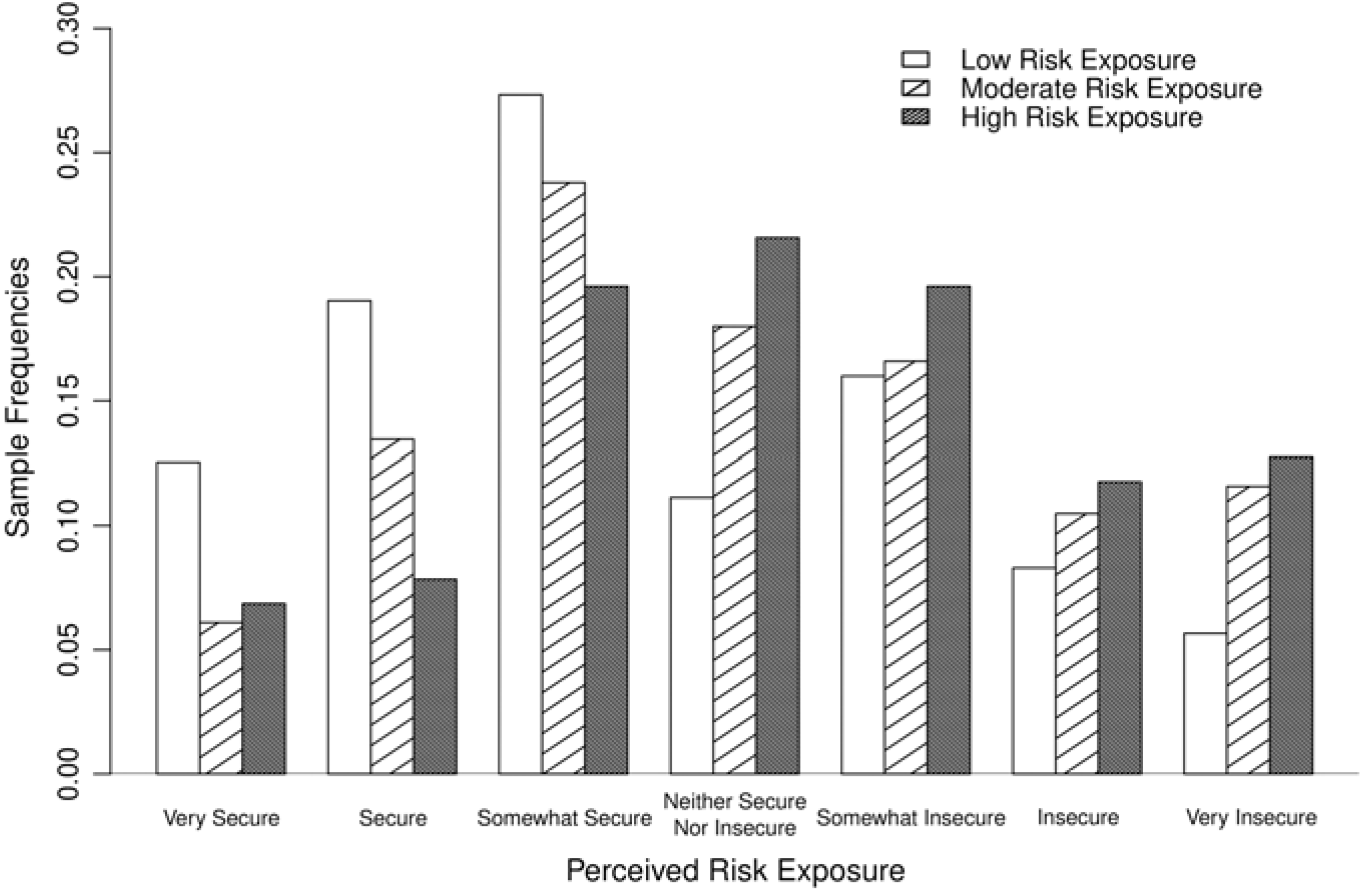
While actual and perceived risk exposure should correlate with one another, each one is by no means a perfect proxy for the other – an argument that we find strong support for in Figure 1. The figure is based on the survey responses of a nationally representative sample recruited through Survey Sampling International (SSI) in July 2014.Footnote 2 Figure 1 maps an individual’s actual financial risk exposure (measured by the average unemployment rate given an individual’s educational attainment and gender) onto her perceived risk exposure (measured by the extent to which the individual believes herself to be financially secure). Notably, “low risk exposure” denotes an average unemployment rate, given one’s education and gender, of 3.6–5.0%, whereas individuals with “moderate” and “high” risk exposure face typical unemployment rates of 5.1–7.0% and 7.1–13.0% or higher, respectively.Footnote 3
Individuals’ actual and perceived risk exposure.
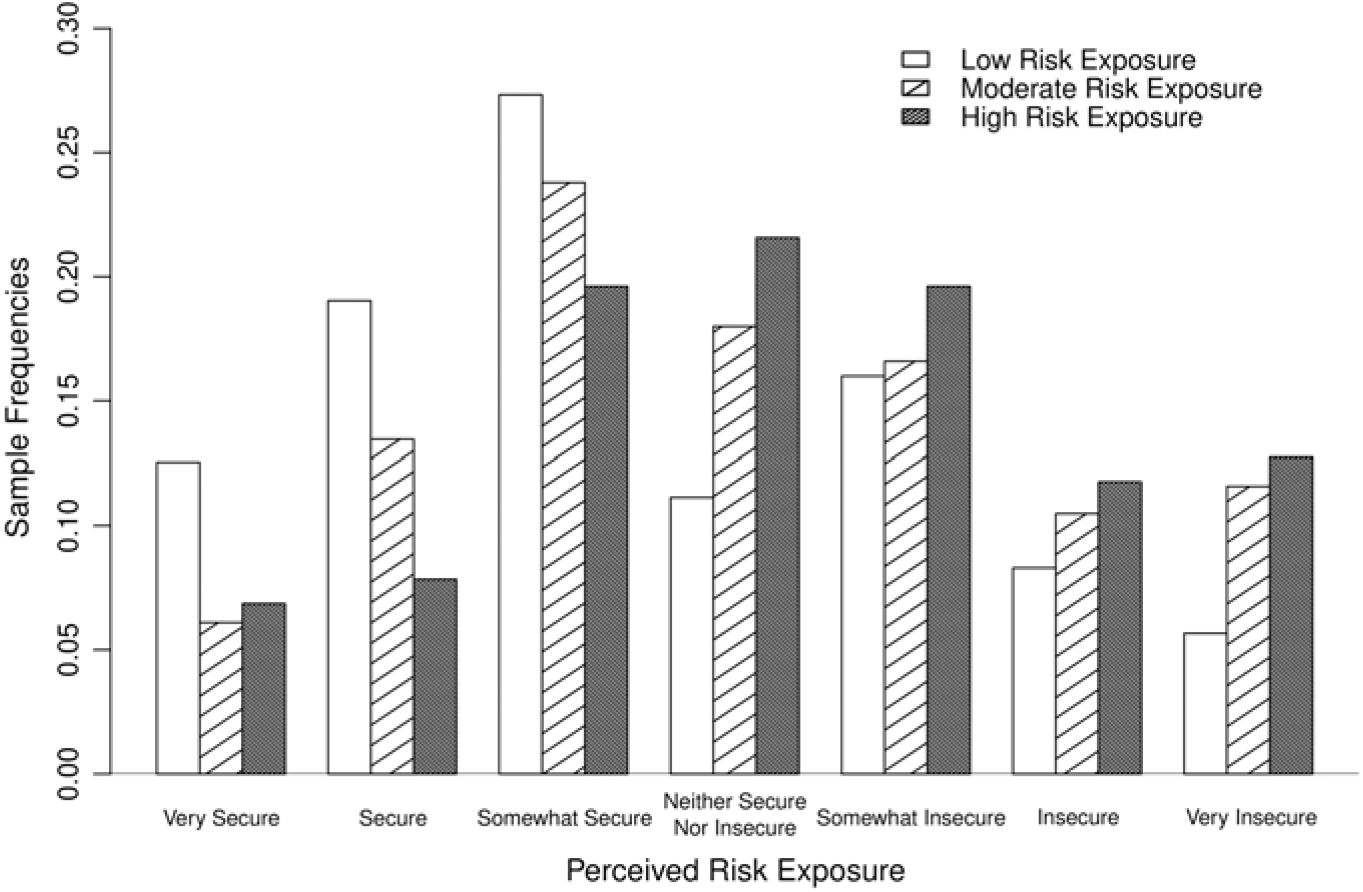
Actual and perceived risk exposures, as conceptualised in Figure 1, are positively correlated, as expected (r = .20). However, there are substantial discrepancies between individuals’ actual and perceived risk exposures. For instance, individuals with low risk exposure, with an average unemployment rate of 3.6–5.0%, express about the same perceived risk exposure as those with moderate risk exposure, with an average unemployment rate of 5.1–7.0%. Moreover, most individuals with high risk exposure tend to report feeling neither secure nor insecure about their finances, despite an average unemployment rate well above the national average (7.1–13.0%). As Figure 1 suggests that actual and perceived risk exposures are, at best, imperfect proxies for one another.
Of the numerous studies that explore the relationship between risk exposure and policy attitudes, few distinguish between an individual’s actual and perceived risk exposure. This discrepancy between actual and perceived risk exposure likely featured in the 2016 presidential election of Donald Trump (Elliot and Kalish Reference Elliot and Kalish2016). Democratic candidate Hillary Clinton emphasised the relatively positive objective economic indicators at the time (e.g. low unemployment). In contrast, the Trump campaign played to the financial insecurities of voters who, despite strong economic indicators, reported feeling strong fear and uncertainty concerning their financial futures (Ball Reference Ball2016). Thus, we posit that perceived risk exposure exerts a strong influence on policy attitudes, a tenet we test using public support for welfare.
Specifically, we question how support for welfare spending will shift when an individual’s perception of risk increases. Recent works have found that during economic downturns, individuals are likely to “reach out” and express increased support for welfare programs (Kam and Nam Reference Kam and Simas2008; Margalit Reference Margalit2013). We argue, however, that these studies overlook two potentially important caveats: first, it is one’s perceived risk exposure, not their actual exposure to risk, that shapes support for welfare; and second, perceived risk exposure influences welfare support conditional on one’s propensity to tolerate that perceived risk (i.e. risk orientation).
When situational meets dispositional
We argue that the situational element of risk exposure is largely moderated by a dispositional element of the personality trait of risk orientation. Similar to the way in which individuals respond to social and political events, whether it is a campaign rally, a natural disaster, or an economic downturn, responses cannot be determined by the context of the event alone. Rather, an individual’s response to an event is shaped by characteristics of the respondent, such as income or educational attainment, and by stable aspects of her personality (Borghans et al. Reference Borghans, Heckman, Golsteyn and Meijers2009; Gerber et al. Reference Gerber, Huber, Doherty, Dowling and Ha2010; Mondak et al. Reference Mondak, Hibbing, Canache, Seligson and Anderson2010). For example, an individual’s response to a free trade agreement is partly influenced by the extent to which she believes she will be personally harmed or helped by the policy, a situational factor conditioned by her propensity to accept that risk, a relatively stable personality trait (Ehrlich and Maestas Reference Ehrlich and Maestas2010). In this way, we depart from previous studies that treat events and personality traits as factors that have independent and additive, as opposed to conditional, influences on policy opinion (Svallfors et al. Reference Svallfors, Kulin and Schnabel2012; Gadarian and Albertson Reference Gadarian and Albertson2014; Friesen and Ksiazkiewicz Reference Friesen and Ksiazkiewicz2015).
In assessing the desirability of welfare programs, individuals will encounter many instances of uncertainty – some will have doubts over the extent to which they believe they will need to rely upon the social safety net while others may express uncertainty over their beliefs about future financial or economic prospects. Thus, in examining how an individual’s perceived risk exposure shapes her opinion on welfare, we argue that it is critical to also consider an individual’s propensity to tolerate that risk. This moderating relationship between risk exposure and risk orientation is captured in Hypotheses 1 and 2.
Hypothesis 1 When an individual is risk acceptant, an increase in perceived risk exposure will be associated with reduced support for welfare spending.
Hypothesis 2 When an individual is risk averse, an increase in perceived risk exposure will be associated with increased support for welfare spending.
These hypotheses address the two ends of the risk orientation spectrum, risk aversion and risk acceptance. When individuals are risk averse, they should be more resistant to facing conditions of uncertainty. When individuals perceive themselves as exposed to risky economic conditions, their response should be conditional on their tolerance of that risk. If an individual is risk averse, we expect the previously observed “reaching out” through increased support for welfare services and spending (Kam and Nam Reference Kam and Simas2008). Risk averse individuals are likely concerned about their own potential need for welfare services, and as they increasingly believe themselves to be exposed to risk, the perceived need for welfare services should also grow. Thus, risk averse individuals should be more likely to support welfare spending as their perceived risk exposure increases.
However, risk averse individuals are quick to believe that “it could happen to them,” (“it” being a need to rely on the social safety net), risk acceptant individuals tend to be economically optimistic (Grable Reference Grable2000; Weyland Reference Weyland2003; Soroka et al. Reference Soroka, Stecula and Wlezien2015). That is, even when a risk acceptant individual believes that they have been exposed to (financial) risk, they are unlikely to believe that they will need to rely on welfare to make ends meet. It is important to note that an increase in one’s perceived risk exposure (e.g. the individual is worried about their personal finances taking a hit) does not necessarily mean that said individual is in immediate danger of poverty; it simply means that the individual has registered exposure to risk. Increased spending on welfare services is often associated with higher taxes; that is, with more money being taken out of an individual’s paycheck. Therefore, when risk acceptant individuals perceive exposure to financial risk, they become less supportive of a costly program that they do not believe will benefit them; whereas risk averse individuals are happy to accept an additional financial hit and see more of their tax dollars going to increased welfare spending in order to reduce uncertainty.
In sum, we argue that the risk averse and risk acceptant differ in their response to taking a perceived financial hit. Less optimistic risk averse individuals seek to minimise risk and uncertainty via a more inclusive social safety net, fearing they might one day need to rely upon it. In contrast, the economically optimistic risk acceptants, who do not believe that “it could happen to them,” seek to minimise the financial bleed or to support their tax dollars going to other government programs they view as more important.
Broadly, our hypotheses predict individuals’ propensity to “reach out” or “pull back” during adverse economic times. Because there is uncertainty surrounding the impact of poor economic conditions, both personal and macroconditions as perceived by the individual, risk orientation should strongly moderate the relationship between perceived risk exposure and support for increased welfare spending. Some individuals may interpret poor economic conditions to mean that they will one day need to employ welfare services. These risk averse individuals subscribe to the mantra that “it could happen to you,” whereas others are more willing to tolerate that uncertainty. These risk acceptant individuals tolerate the uncertainty of tough times better than the risk averse, producing disparate outcomes.
Data and analysis
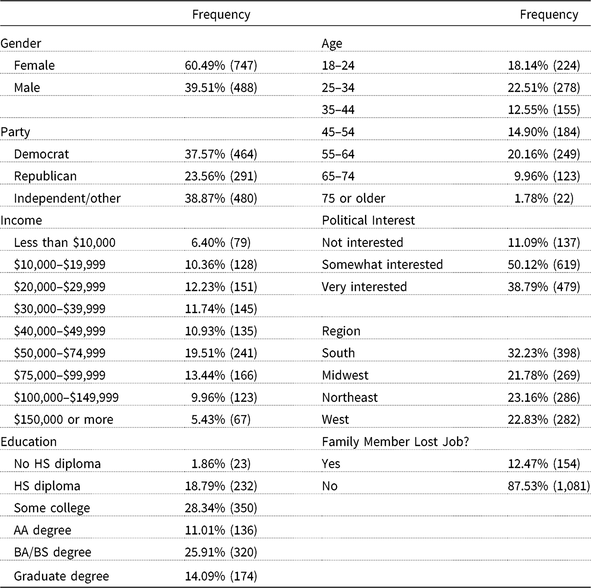
Participants were recruited through Survey Sampling International (SSI) in July 2014, with completed interviews matched along key demographic characteristics (e.g. age and gender) and census region to produce a nationally representative sample. SSI has generated samples that closely matched the characteristics of other national samples (e.g. ANES, YouGov and Knowledge Networks) and has been used in numerous publications (e.g. Berinsky et al. Reference Berinsky, Margolis and Sances2014; Klar and Krupnikov Reference Klar and Krupnikov2016). A total of 1,235 participants completed the survey.Footnote 4 Table 1 reports key summary information for the sample’s demographics. There are two notable demographics that are over/under sampled: gender and education. Our sample is comprised of a greater percentage of females than the total US population (60% sample versus 51% population), and we undersample those individuals without a high school diploma (1.86% in sample versus 11.6% in 2014 population). This undersampling is somewhat expected given our online survey recruitment method, as many of these individuals in the lowest education category likely overlap with the estimated 6–11% of the US population that lacks internet access (Federal Communications Commission 2018). As Table 1 shows, our sample is otherwise well balanced and generally representative of the total US population. We have no reason to believe that these particular sample imbalances should systematically bias or impact the findings.
Sample population demographics
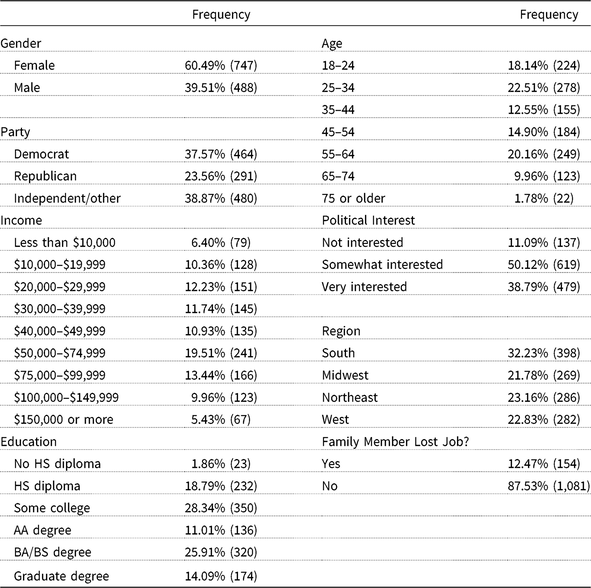
Note: Table contains frequency and percentage of respondents in each demographic category. Respondents were recruited through Survey Sampling International (SSI) in July 2014 to produce a nationally representative sample.
Measuring the dependent variable: welfare support
The dependent variable is binary and reflects whether individuals believe that federal spending on welfare programs should be increased. Individuals who believe welfare spending should be increased are assigned a value of “1,” while those that say welfare spending should be decreased or kept about the same are denoted by a value of “0.” In total, about 26% of the sample expressed a desire to see welfare spending increased, while a supermajority of respondents reported that welfare spending should be decreased (35%) or kept about the same (39%).Footnote 5
Measuring the independent variables: perceived risk exposure and risk orientation
Our key independent variables are an individual’s perception of risk exposure and his or her risk orientation. Individuals assess risk exposure from a perspective that is either egocentric (i.e. one’s own pocketbook) or sociotropic (e.g. national economic health) (Kinder and Kiewet Reference Kinder and Kiewet1981; Abramowitz et al. Reference Abramowitz, Lanoue and Ramesh1988). Accordingly, we offer two measurement strategies for capturing an individual’s perceived exposure to risk.
First, we asked respondents about their perceived financial security (i.e. how comfortable an individual is with the state of their current finances) denoted as financial security. An individual’s financial security is intended to capture his or her egocentric perception of risk. Second, we query participants on how healthy they perceive the national economy to be (i.e. whether they believe the economy is going to get better, worse or stay the same) denoted as macroeconomic health. An individual’s rating of the nation’s macroeconomic health is intended to capture their sociotropic perception of risk. At the time of this survey, most respondents reported feeling relatively neutral about the economic state of things. Most said that they expected their personal finances and the general economy to “stay the same” in the near future, about 45% and 40%, respectively.
We believe that risk orientation will moderate one’s risk perception and in turn impact their welfare opinions. We measure risk orientation by asking respondents how comfortable (or uncomfortable) they are in taking risks when making financial, career or other life decisions denoted as risk orientation (Maestas and Pollock Reference Maestas and Pollock2010). The variable uses a seven-point ordinal scale, where one end represents extreme risk acceptance and the opposite pole represents extreme risk aversion.Footnote 6 On average, individuals scored 3.66 out of 7, indicating that they were in between slight risk acceptance and risk neutrality (i.e. “neither comfortable nor uncomfortable taking risks”). As a whole, respondents were more risk acceptant than risk averse. In order to facilitate our main analysis, we split the single risk orientation scale into two variables: risk aversion and risk acceptance (see Ehrlich and Maestas Reference Ehrlich and Maestas2010). Individuals with risk orientation values between “1” and “3” are considered to be risk acceptant, while those with values between “5” and “7” are risk averse. Individuals scoring “4” are classified as risk neutral. We reverse code the risk acceptance scale so that lower values of risk orientation (i.e. 1, 2 and 3) equals greater values of risk acceptance (i.e. 1=3, 2=2 and 3=1). Risk acceptance ranges from 0 to 3, with higher values denoting increased risk acceptance and zero indicating that the individual is either risk averse or risk neutral. Similarly, risk aversion also ranges from 0 to 3, where higher values indicate increased aversion to risk, while zero denotes that the individual is either risk acceptant or risk neutral.
Control variables
We control for seven additional factors that should affect an individual’s support for increased welfare spending:
-
Actual risk exposure: We measure an individual’s actual exposure to risk through four variables. First, as shown in Figure 1, we calculate an individual’s average unemployment rate given his or her educational attainment and gender.Footnote 7 We also include average unemployment by an individual’s region of residence and average unemployment by an age group. Finally, we include a dummy variable denoting whether or not an individual has had an immediate family member, defined as a parent, spouse or sibling, lose a job since the Great Recession began. As the average unemployment rate increases, this denotes an increase in the individual’s exposure to risk and the likelihood that he or she will need to rely upon the social safety net (Kam and Nam Reference Kam and Simas2008).Footnote 8 Similarly, individuals with immediate family members that have lost their jobs are also likely to be more directly exposed to economic risk than individuals whose family members have remained employed throughout the Great Recession.Footnote 9 Notably, we use the average unemployment rate by several demographics (e.g. region and age) because we do not have access to individual-level data that capture the individuals’ actual level of risk exposure.
-
Party ID: We include two dummy variables indicating whether a respondent identifies as a Republican or Democratic (with self-identifying independents and third party members serving as the omitted term). Democrats are viewed as more likely to support social welfare spending, while Republicans tend to oppose it (Luttmer Reference Luttmer2001; Franko et al. Reference Franko, Tolbert and Witko2013).
-
Gender: Because there is some evidence that women are more supportive of welfare spending than men (Reingold and Smith Reference Reingold and Smith2012), we include a dummy variable for each respondent’s gender, indicating whether a respondent is female.
-
Education: We include a six-point variable that indicates the level of educational attainment for each individual respondent at the time of the survey. The variable ranges from an individual having “no high school diploma” to having a “graduate or professional degree.” Studies indicate that individuals with higher education may also be more supportive of welfare spending as well as less exposed to risk, as the unemployment rate in the years following the Great Recession was considerably lower for individuals with a college degree (Luttmer Reference Luttmer2001; Scheve and Slaughter Reference Scheve and Slaughter2004).Footnote 10
-
Age: There is evidence that an individual’s age may affect his or her propensity to support welfare spending. On one hand, younger individuals tend to be more liberal than older adults; thus, younger cohorts should be relatively supportive of entitlement spending (Mughan and Lacy Reference Mughan and Lacy2002).
-
Income: Wealthy individuals should be less likely to perceive themselves at risk than individuals from a lower socioeconomic status; similarly, wealthy individuals may also be less supportive of welfare services than poorer individuals. Income is represented by a nine-point incremental scale ranging from wages of “$10,000/year” to “greater than $150,000/year” (Luttmer Reference Luttmer2001).
-
Political interest: Individuals who are interested in politics may hold different policy beliefs than those who are relatively uninterested (Voogt and Saris Reference Voogt and Saris2003). We ask respondents whether they are very interested, somewhat interested, or not at all interested in politics.
Results
We test our hypotheses of public support for increased welfare spending using logit regression. For the most thorough testing of our hypotheses, we have two measurement strategies for an individual’s perceived risk exposure: egocentric and sociotropic (Abramowitz et al. Reference Abramowitz, Lanoue and Ramesh1988). The difference in these two types of perspectives is whether the individual is considering financial stability from the perspective of their own personal pocketbook or from the perspective of their national economy.
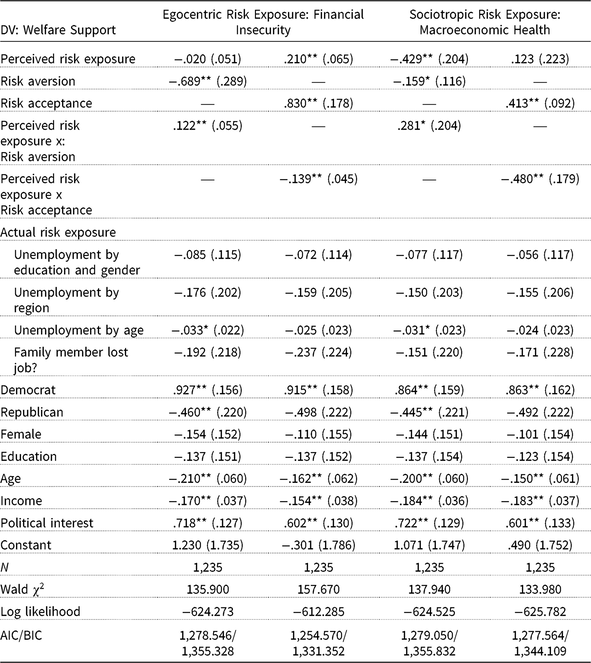
Table 2 presents the output from our models. In Columns 1–2, an individual’s perceived risk exposure is represented by his or her perceived financial security, and in Columns 3–4, it is represented by his or her assessment of macroeconomic health (i.e. whether an individual believes the national economy will worsen in the coming months). Columns 1 and 3 contain the results from the risk aversion models, while Columns 2 and 4 include risk acceptance. Our predictions informing both Hypotheses 1 and 2 anticipate a statistically significant interaction between risk perception (financial insecurity) and one’s risk orientation, which is supported across all four models. As the findings in both Columns 2 and 4 indicate, when an individual is risk acceptant, an increase in Perceived Risk Exposure, both egocentric and sociotropic, is associated with a significant decrease in an individual’s propensity to support welfare spending, as proposed in Hypothesis 1. Similarly, in Columns 1 and 3, we see that when individuals are risk averse there is a general tendency to be more supportive of welfare.
Individual-level support for increased welfare spending
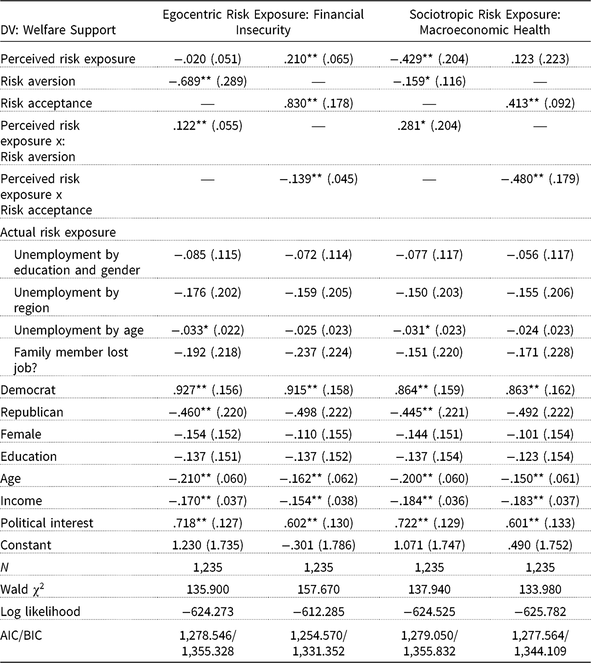
Note: Cell entries are logit coefficients with robust standard errors in parentheses.
* denotes p < .10, ** denotes p < .05 (one-tailed test)
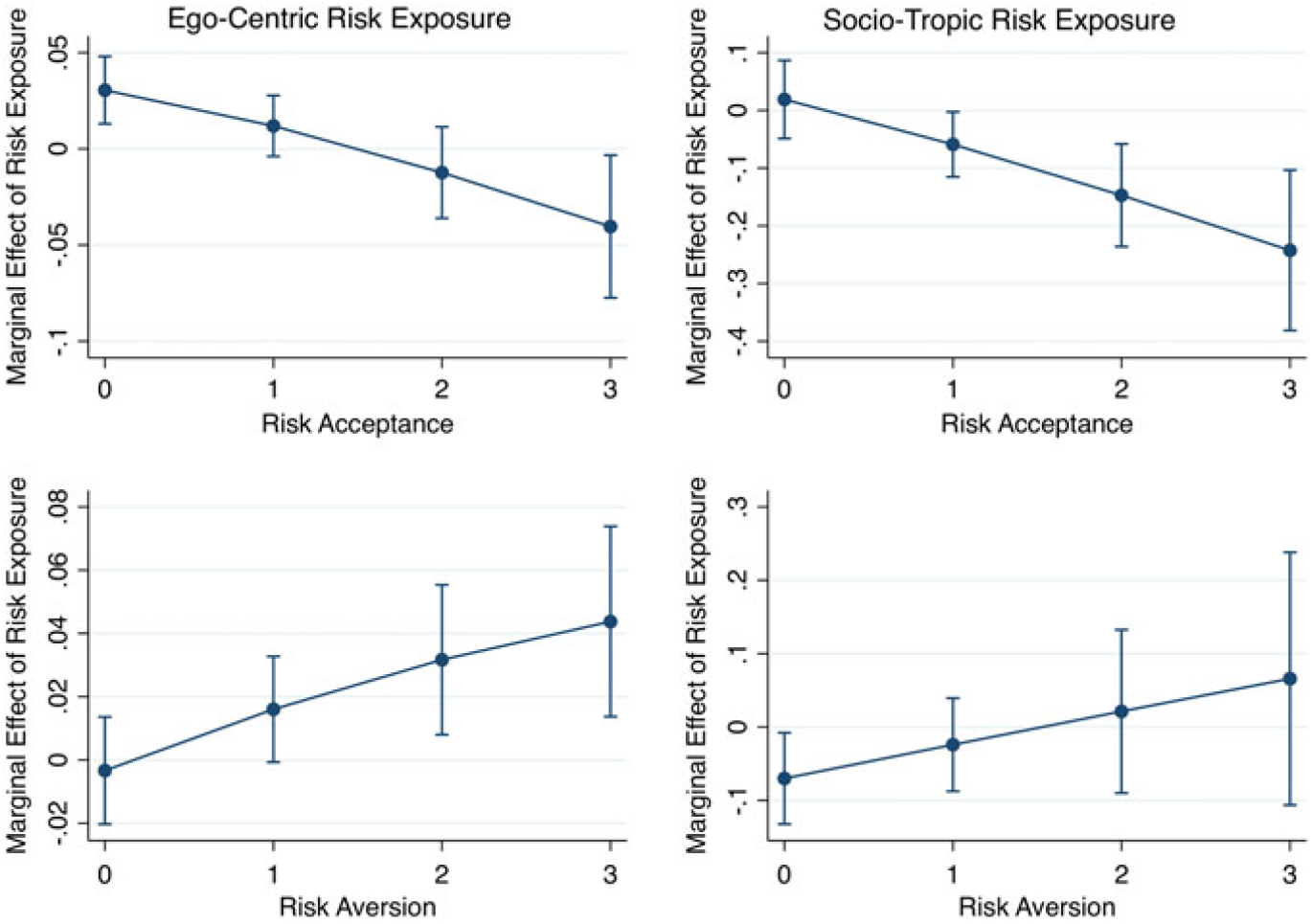
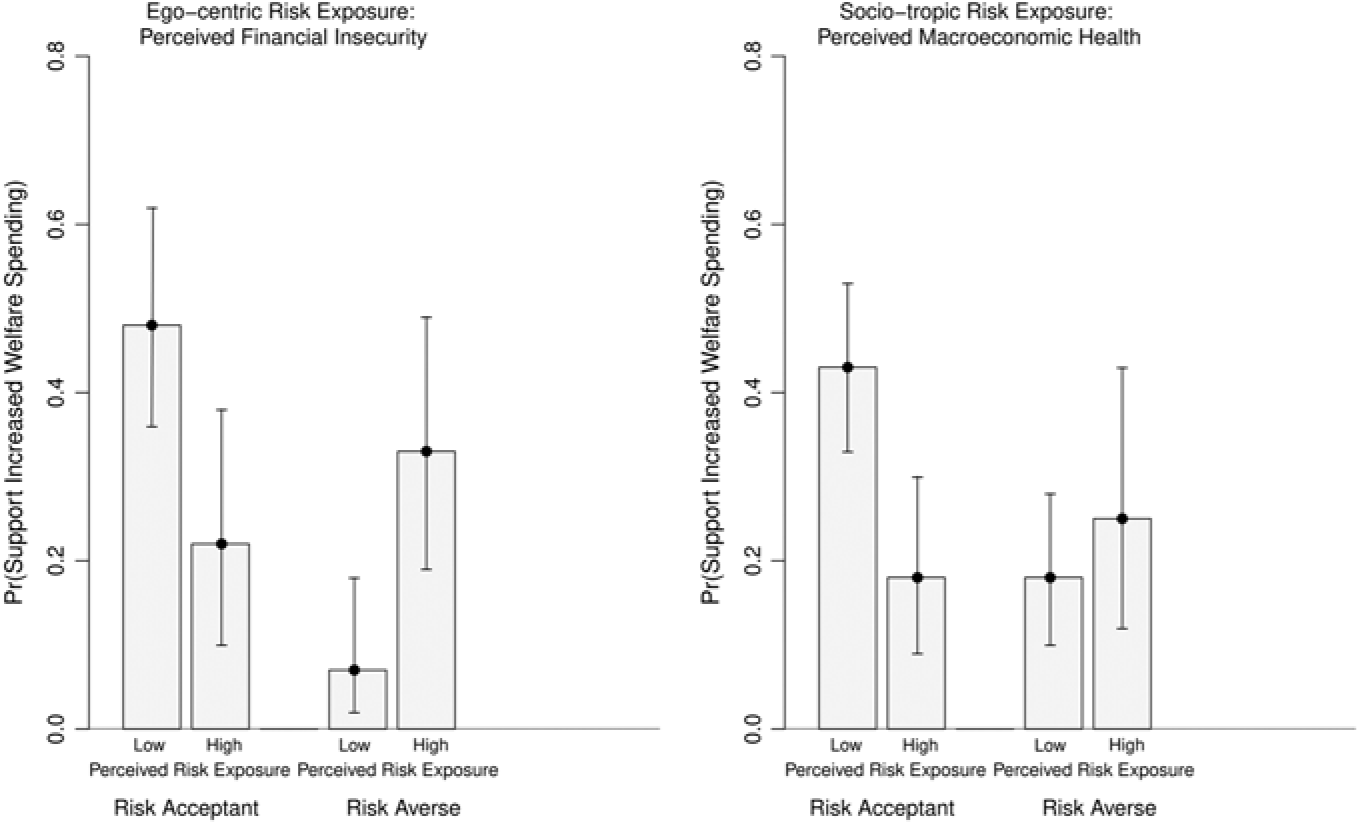
The results in Table 2 are broadly supportive of Hypotheses 1 and 2. However, in order to better understand the conditional relationship between perceived risk exposure and one’s risk orientation, we examine the marginal effects of these variables in Figure 2. Figure 2 depicts the marginal effect of a one-unit increase of perceived risk exposure on an individual’s support for welfare spending across each value of risk acceptance and risk aversion. In the left two panels of Figure 2, perceived risk exposure is measured by an individual’s perception of his or her own pocketbook (i.e. financial instability). The right two panels of Figure 2 measure perceived risk exposure by how healthy or unhealthy an individual believes the national economy to be. Higher values of each risk orientation variable indicate that an individual is increasingly risk acceptant or risk averse.
The marginal effect of a one-unit increase in perceived risk exposure on an individual’s support for federal welfare spending.
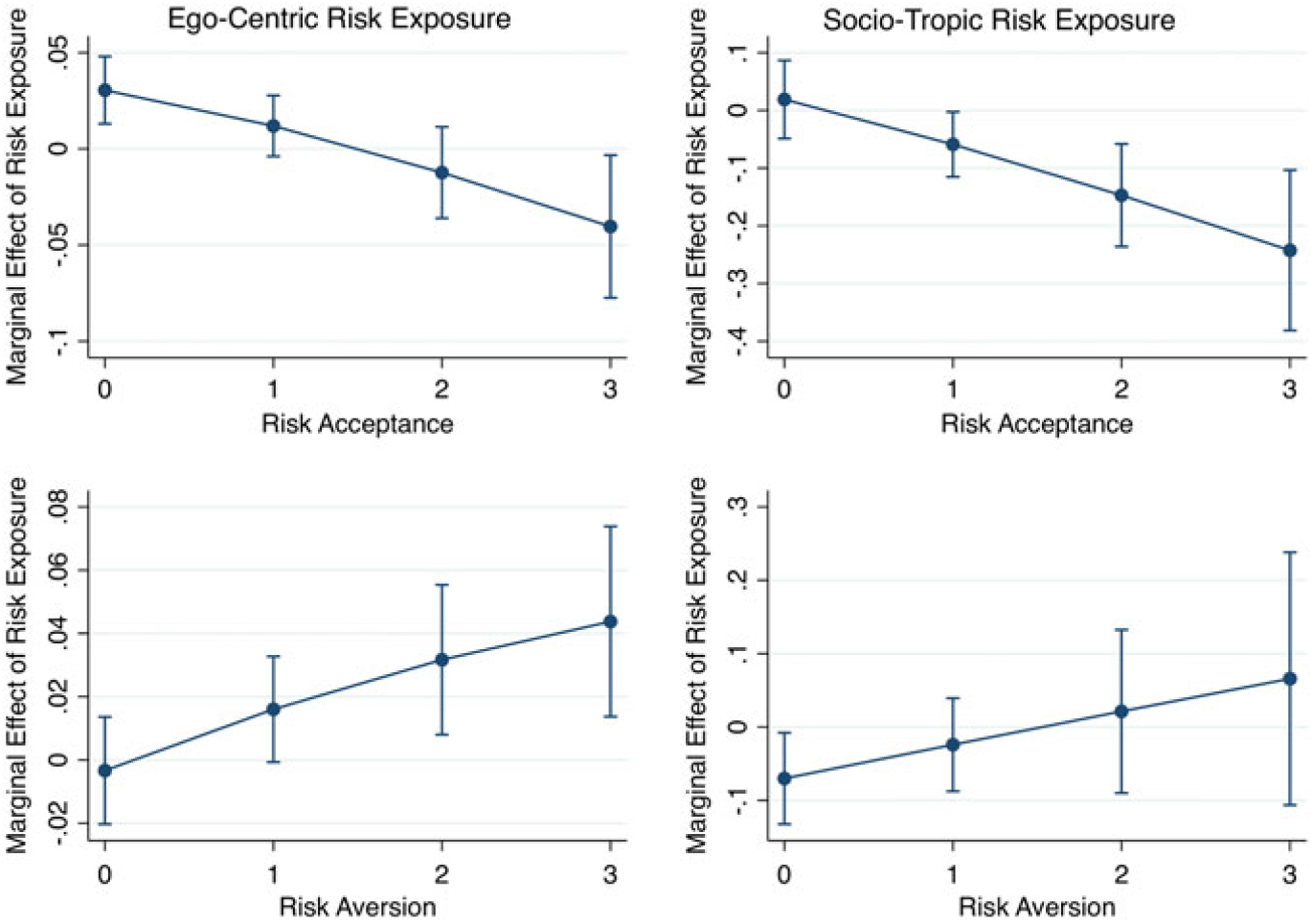
Hypothesis 1 (H1) argues that when individuals are risk acceptant, an increase in perceived risk exposure will lead them to be less supportive of welfare, as tough economic times lead these individuals to become increasingly protective over their own pocketbook rather than offer support to a program that they do not believe they will benefit from; the risk acceptant do appear to tolerate the uncertainty of perceived risk exposure better than the risk averse. Across both egocentric and sociotropic models, there is strong support for H1. It should be noted, however, that the substantive effects are notably stronger in the sociotropic (i.e. macroeconomic health) model than in the egocentric (i.e. financial instability) model. Curiously, for Hypothesis 2 (H2), we see that the opposite is true; for the risk averse, perceived financial instability has a stronger statistical relationship to one’s attitudes towards welfare than does perceived macroeconomic health, where there is limited support for H2.
Hypothesis 2 predicts that when individuals are highly risk averse, an increase in perceived risk exposure will beget greater support for welfare spending. As Figure 2 demonstrates, we find some support for H2. When risk averse individuals are confronted with uncertainty regarding their personal finances, they do appear to support increased welfare spending as a way to alleviate some of that uncertainty – that as a worst case scenario, they could rely on the social safety net if needed. We observe that as individuals become increasingly risk averse, their support for welfare tends to increase when they perceive their own personal finances as becoming more insecure, as expected.
To examine the substantive effects of risk exposure and risk orientation on welfare attitudes, Figure 3 presents the predicted probabilities that an individual supports an increase in federal welfare spending across both egocentric and sociotropic models. There is strong support for both H1 and modest support for H2. When a risk acceptant individual perceives their personal finances to be “very secure,” they will support welfare spending with a .48 probability in the egocentric model and with .43 probability in the sociotropic model. However, a risk acceptant individual that perceives their finances to be “very insecure” supports welfare with a probability of only .22 in the egocentric model and .18 in the sociotropic model, a significant opinion gap.
Predicted probability of supporting increased welfare spending.
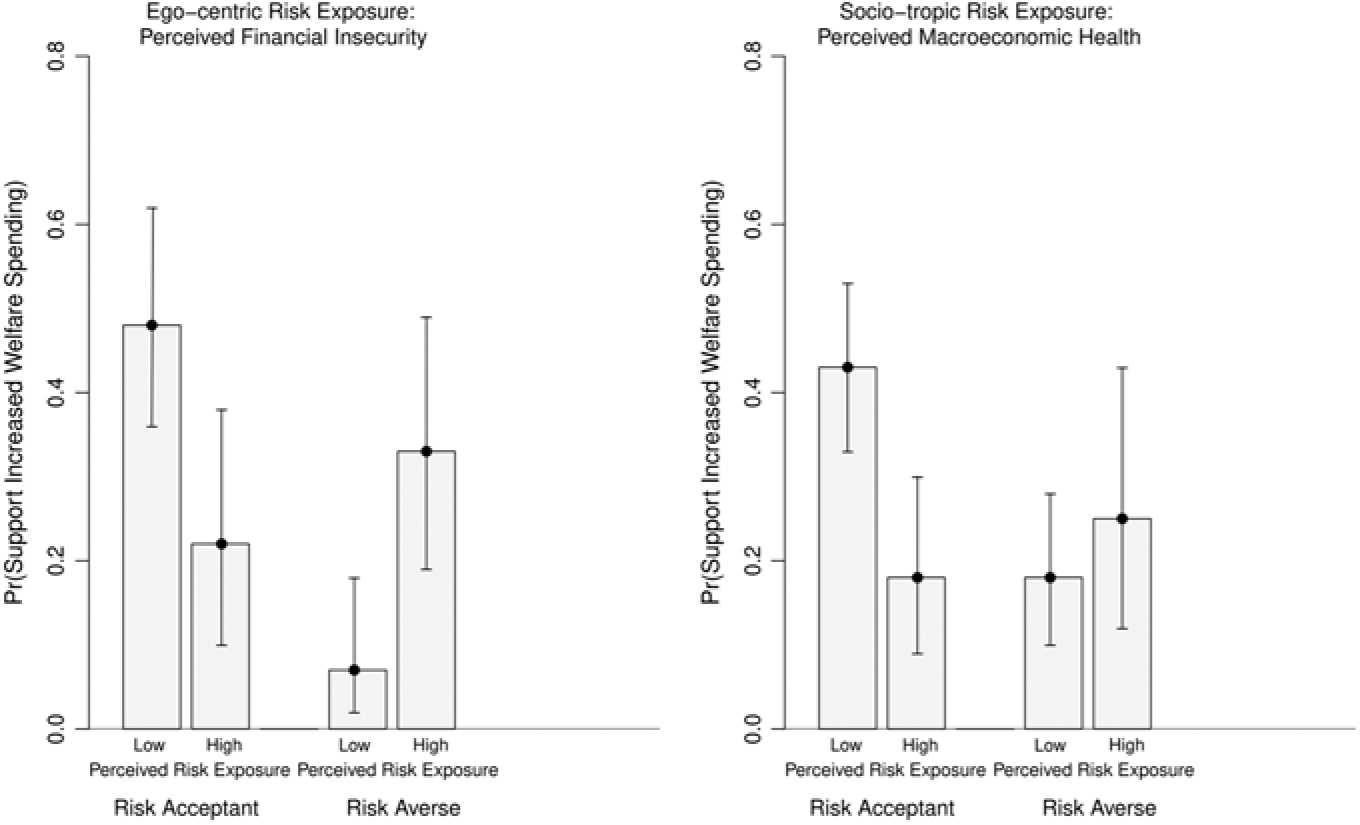
For risk averse individuals in the egocentric model, the probability of supporting welfare increases by .26 as perceived risk exposure increases (from “very secure” to “very insecure”). In the sociotropic model, there is a modest increase in the probability of welfare support (.07) for risk averse individuals. However, the change in probability is not statistically significant, offering limited support for H2.
In sum, the results presented here offer support for both hypotheses. There is strong evidence that an increase in perceived risk exposure is associated with a significant decrease in support for welfare spending among risk acceptant individuals and an increase in welfare support for the risk averse. Moreover, these results largely appear to hold for both egocentric and sociotropic risk exposure models. In short, public support for welfare spending in the US is strongly contingent on whether or not individuals believe that they will likely benefit from the program personally, relative to their propensity to tolerate uncertainty.
Conclusion
In this study, we find evidence that an individual’s support for welfare is tied to his or her perceived exposure to risk. Moreover, we show that the influence of this perception on an individual’s attitude towards welfare is conditioned by his or her risk orientation, which is a relatively fixed personality trait. We examine how individuals’ stable, underlying traits (dispositional) condition and how events (situational) affect their policy opinions towards social welfare. By exploring the relationship between an individual’s perception of risk exposure (e.g. perceived financial instability/macroeconomic health) and his or her support for federal welfare spending, we offer evidence that risk orientation, a relatively fixed dimension of personality, moderates the relationship between risk exposure and welfare support. Because risk acceptance is associated with strong economic optimism, an increase in perceived risk exposure appears to reduce support for welfare spending. In the face of increased risk exposure, risk averse individuals tend to believe that they may need to rely upon the social safety net themselves (i.e. that “it could happen to [them]”) and become increasingly supportive of welfare spending.
We find support for both hypotheses. Broadly, these results suggest two major conclusions. First, an individual’s perception of risk exposure will not necessarily map onto his or her actual risk exposure (e.g. employment or income); importantly, previous works largely conflate the two. Intuitively, actual risk exposure is a function of demographic predictors such as educational attainment, income, race and age. In contrast, it is likely that perceived risk exposure is heavily influenced by internal psychological factors. Controlling for both actual and perceived risk exposure, it is perceived risk exposure that appears to be the strongest and most consistent predictor of individuals’ policy attitudes. Future research should consider further exploring this relationship in order to illustrate the causal story between these variables.
The second major conclusion of this study is that individuals’ underlying personality traits (dispositional factors) do seem to condition the way in which social or political events (situational factors) shape their policy opinions. Here, we see that risk orientation moderates the relationship between perceived risk exposure and support for welfare spending. It is easy to conceive of how this relationship between risk orientation and risk exposure may translate to other key policy areas. For instance, on issues of foreign policy, individuals’ support for domestic surveillance and warrantless wiretapping or use of combat drones may be attributed to the extent to which individuals perceive themselves at risk from terrorism and their propensity to tolerate that risk (Albertson and Gadarian Reference Albertson and Gadarian2015).
Future works should consider the factors that shape the extent to which individuals perceive themselves as exposed to risk. As noted above, perceived risk exposure may be partly a function of objective risk indicators (e.g. unemployment and income) that are conditioned by potentially malleable situational and psychological factors such as media exposure or risk orientation (Burgoon and Dekker Reference Burgoon and Dekker2010). It is also important to examine the extent to which the findings presented here generalise to other policy areas. For instance, it is possible that the conditional relationship between perceived risk exposure and risk orientation shapes policy attitudes in general whenever there is explicit personal risk involved such as gun control, global warming, free trade or even pension reform. In short, public policy involves assessing social problems and mitigating risk. It follows that individuals’ perceptions of said risk shape their attitudes towards policy. That is, to better understand public support for (or opposition to) public policy, we may need to look beyond traditional markers of support, such as party ID or ideology, and explore the interactive relationship between policy outputs and perceptions of risk exposure.
Finally, scholars may wish to examine potential downstream effects of support for welfare on political participation or attitudes towards government. For instance, by using several waves of the European Social Survey, Kevins (Reference Kevins2018) finds that individuals’ risk exposure interacts with welfare policy to shape trust in government. It is conceivable that when the policy status quo is not aligned with an individual’s policy preference that individuals perceiving themselves to be exposed to risk may activate and increase their political participation, while those that do not perceive themselves as being exposed to risk may not experience an increased incentive to participate politically (Schmidt-Catran and Spies Reference Schmidt-Catran and Spies2016). These potential externalities underscore the importance of understanding the relationship between individuals’ risk exposure, their policy attitudes and the policy status quo.
Supplementary material
To view supplementary material for this article, please visit https://doi.org/10.1017/S0143814X19000138
Acknowledgement
The authors wish to thank Yanna Krupnikov for including our battery in her survey and John Barry Ryan for his feedback on the project.
Data availability statement
Replication materials are available at https://dataverse.harvard.edu/dataset.xhtml?persistentId=doi:10.7910/DVN/1VDZE9.