On the morning of October 30, 2007, Hillary Clinton led Barack Obama, her closest challenger for the Democratic presidential nomination, by a comfortable margin in every significant national poll. That night, however, Senator Clinton, debating in Philadelphia, wandered into an ambush. Asked for her opinion of then-New York Governor Eliot Spitzer's plan to allow illegal immigrants to apply for driver's licenses, she first seemed to support the idea and then, under withering attack from Connecticut Senator Chris Dodd, almost immediately backed away from her tepid endorsement. Writing shortly after the debate, Mark Halperin (Reference Halperin2007) of Time magazine opined that “[i]f [Clinton] loses the nomination, tonight will go down in history as the first step to her defeat.”
Sure enough, Clinton's equivocal remarks dominated the subsequent news cycle and the following weeks saw her aura of inevitability gradually collapse, as Obama built the momentum that would ultimately lead him to victory in the Iowa Caucuses and beyond. While nobody can be certain what role the October 30 debate played in Senator Clinton's eventual difficulties, it does point to the potential power of debates to change the national conversation, often to the disadvantage of candidates who appear to falter. That lesson will almost certainly be on the minds of the Democratic and Republican presidential nominees when they meet for their head-to-head encounters later this year.
Perhaps the most overused sports analogy in all of political journalism is the treatment of presidential debates as boxing matches. Indeed, a quick search of Google in February 2008, combining the terms “presidential debate” and “knockout,” provided 12,400 results. If the word “presidential” is omitted, that number balloons all the way to 331,000.
Despite its popularity, however, it is in the main a poor metaphor. The winner of a championship prizefight immediately captures the title and all the riches that go with it. The winner of a presidential debate, on the other hand, may very well (and often does) lose on Election Day. Moreover, despite the promiscuous use of the word, no presidential debate has ever resulted in a knockout. Even the worst performers go the distance.
Nevertheless, the comparisons between debating and boxing do serve to point out the importance of the concept of the winner. Immediately after each debate concludes, the first question on the lips of almost every viewer is, “Who won?” That is also among first questions asked by the major polling organizations, some drawing their samples within minutes of the candidates' closing statements.
Early studies of presidential debates showed relatively limited effects (see, e.g., Katz and Feldman Reference Katz, Feldman and Kraus1962; Sears and Chaffee Reference Sears, Chaffee and Kraus1979; see also Yawn et al. Reference Yawn, Ellsworth, Beatty and Kahn1998, 155–6), with debates largely reinforcing pre-existing candidate preferences. Other scholars, however, have argued that many of these studies failed to account for the variety of factors and influences that come into play when viewers watch candidates on television. Pfau (Reference Pfau2002), for example, finds that most traditional debate analyses neglect the subtle effects of “relational messages,” including various non-verbal cues that trigger positive and negative reactions in voters. He claims that by ignoring such messages, the effects of which may take some time to become apparent, many early scholars underestimated the impact of debates on voters. Benoit and Wells (Reference Benoit and Wells1996) further suggest that the importance of any given debate will depend on the electoral context (e.g., how many ill-informed or undecided voters are in the electorate) and also on the rhetorical strategies employed by the candidates.
As students of political communication have become more sensitive to these factors, they have increasingly found that the effects of presidential debates are not so limited after all. Lanoue (Reference Lanoue1992), for example, demonstrates that the 1980 debate between Ronald Reagan and Jimmy Carter had a measurable impact on the outcome of the election, in Reagan's favor. Hillygus and Jackman (Reference Hillygus and Jackman2003) similarly document a positive impact of the 2000 debates on the fortunes of George W. Bush. Holbrook (Reference Holbrook1996) finds that debaters' “net performance” ratings explain 75% of the variance in the aggregate change in post-debate vote intentions between 1960 and 1992 (see also Geer Reference Geer1988).
Despite both the interest in, and apparent importance of, debate performance, it is surprising how little is actually known about how the press and public arrive at their judgments about winning and losing. Pundits emphasize transcendent sound bites (Ronald Reagan chiding Jimmy Carter with, “There you go again” in 1980, or Gerald Ford bizarrely claiming that Eastern Europe was free of Soviet domination in 1976), but they tend to treat debates as discrete, non-comparable events. Journalists provide information on post-debate polls, but the numbers are rarely placed in any usable context.
This article suggests a different method for understanding voters' assessments of debate performance. First, we discuss the proper interpretation of polling results. Second, we use these results to identify the most, and least, successful debaters since 1960. Finally, we argue that most debates are, in fact, lost rather than won.
Before delving into our analysis, we should make one critical point. In this paper, we are interested in the winning and losing of presidential debates themselves, as opposed to the link between winning and losing and the outcome of the election. It should be clear that the impact of a debate on a presidential election will depend on a number of contextual factors that are out of the hands of the participants. In 1980, for example, it is likely that one of the reasons the Carter-Reagan debate significantly influenced the final result was that it was held just one week prior to Election Day (Lanoue Reference Lanoue1992). In addition, we know that debates are most likely to be influential when the race is close, when there are large numbers of undecided voters, and when support for the candidates is “soft” (Lanoue and Schrott Reference Lanoue and Schrott1991).
To borrow an entirely different sports analogy, consider the softball player who hits three home runs in a game that her team loses 10-3. Although her performance was outstanding, it did not have a meaningful impact on the outcome of the game because of the context in which she was operating. Likewise, a candidate (say, Walter Mondale in 1984) who trails by a wide margin in the polls against a well-known incumbent is very unlikely to alter his fate regardless of how well he fares in any given encounter. Nevertheless, it is still important to consider winning and losing in all their various contexts because we know that winning can improve a candidate's odds of success at the polling place (just as home runs can increase a softball team's chance of victory), and it is therefore valuable to learn as much as possible about how debate performances are evaluated.
Interpreting Debate Results
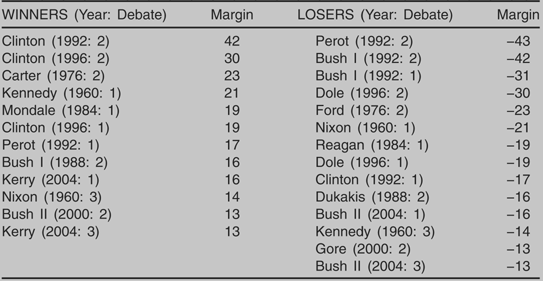
What does it mean to win and lose a presidential debate?Footnote 1 Table 1 lists all candidates who won or lost their debates by 10 points or more, according to the first available post-debate Gallup poll.Footnote 2 In nearly every case, of course, the winner's and loser's numbers are mirror images. If one candidate wins the debate by 15 points, his opponent, by definition, loses by 15. The one exception is the three-candidate debates of 1992 between Bill Clinton, George H. W. Bush, and Ross Perot. In that case, the winner's margin of victory is measured as the amount by which he beat the second place finisher; the losers' margins are calculated as the distance behind the winner, regardless of whether the candidate in question finished in second or third place.
Candidate Who Won and Lost Debates by at Least Ten Percent

While these figures give us some idea of which presidential candidates have been the most and least successful debaters, they ignore one of the critical issues of context discussed above. In 1984, for example, according to the polls, Walter Mondale won his first debate with Ronald Reagan by 19 percentage points. A dozen years later, Bill Clinton defeated Bob Dole in their first meeting by an identical margin. These 19-point victories are, in fact, among the most lopsided in the history of televised debating, having only been exceeded four times over the course of 23 debates held between 1960 and 2004.
Nevertheless, while Mondale and Clinton may have enjoyed the same margin of victory over their opponents, that does not necessarily mean that they should be seen as equally successful. We know from individual-level research that viewers' assessments of debate performances are heavily filtered by party loyalty and candidate preferences (see, e.g., Hagner and Rieselbach Reference Hagner, Rieselbach, Bishop, Meadow and Jackson-Beeck1978; and Lanoue and Schrott Reference Lanoue and Schrott1989; Reference Lanoue and Schrott1991). The best predictor of which candidate a voter will select as the debate winner is the candidate favored by that voter's prior attitudes. An underdog, therefore, faces an uphill climb in convincing voters to set aside their pre-existing biases and give credit for an outstanding performance to their least preferred candidate.
In 1984, Mondale trailed Reagan in the race for the presidency by 16 points, according to the final pre-debate “horse race” poll. Clinton, on the other hand, led Dole by a 20-point margin. Indeed, the percentage of voters naming Clinton as the winner of the debate (51) actually fell four points below the proportion favoring him in the race for president (55). By contrast, Mondale, who had the support of only 39% of the electorate in the battle for the White House, was named as the victorious debater by 54% of all respondents. Clearly, Mondale's was the more impressive accomplishment.
Another way to think about debating success, then, is to consider the extent to which each candidate over- or under-performs relative to his position in the horse race polls. In the example above, Mondale over-performed by 15%, while Clinton, though the winner of the debate, actually under-performed, if only slightly. It may be helpful here to think, as journalists often do, of over- and under-performers as those candidates who have either exceeded or fallen short of expectations.
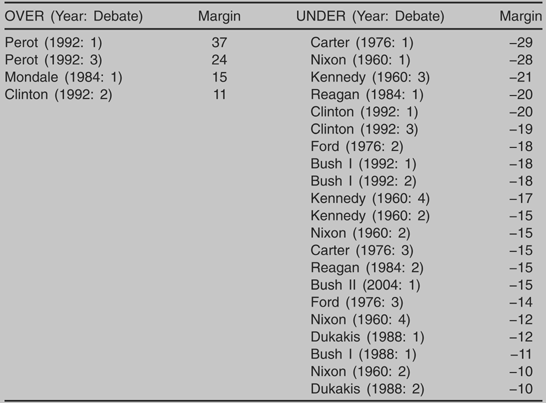
Table 2 lists all the candidates who have either over- or under-performed by at least ten points. While these lists may correspond reasonably well with our recollections of which debaters have been the most and least successful over the years, several points deserve mention. First, there is an obvious bias in favor of candidates whose pre-debate horse race numbers were especially low, and against those whose numbers were particularly high. By definition, the former have more to “gain,” and the latter more to “lose.” This effect may also be a byproduct of the pre-debate expectations game played by both camps in a presidential debate, in which they downplay their own chances for success while setting an impossibly lofty standard for their opponents'. It is, in general, almost certainly easier to set unreasonably high expectations for a frontrunner than for an underdog.
Candidate Who Over-Performed and Under-Performed by at Least Ten Points

Second, candidates from the early years (especially 1960 and 1976) seem, in general, to under-perform relative to their more recent counterparts. This is largely because voters in the 1960s and 1970s were more likely to rate each debate as a draw. After the first John F. Kennedy-Richard Nixon debate in 1960, only 67% of Gallup respondents named either candidate as the winner; in 1976, only 56% selected either Jimmy Carter or Gerald Ford as the strongest performer in their first televised encounter. By contrast, the corresponding numbers for the first George W. Bush-Al Gore debate in 2000 and the first George W. Bush-John Kerry debate in 2004 were, respectively, 89% and 90%. Obviously, when fewer voters are willing to name a debate winner, it is more likely that one or both candidates will under-perform vis-à-vis their horse race numbers.
Finally, it is clear from this table that, in terms of our performance measure, there are more big losers than big winners. While 20 candidates under-performed by 10% or more, only four over-performed by a similar amount. We will explore this issue in greater detail below.
Before we move on, however, it may be useful to correct for the distortion in our figures caused by the fact that candidates who are far ahead in the polls are more likely to be extreme under-performers, regardless of their debating skills, while those who trail badly in the horse race are better situated to be strong over-performers. To do this, we will recalculate our measure of relative performance by dividing our current variable by the candidate's share of the horse race “vote.” The resulting figure will define over- and under-performance as a percentage of each candidate's support in the pre-debate polls.
Thus, if a politician stands at 60% in the horse race and under-performs by 15 points (i.e., is seen as the debate winner by 45% of respondents), his new score will be recorded as −25% (15/60). A candidate with a pre-debate vote share of 45% who under-performs by the same amount will receive a score of −33% (15/45). This new measure corresponds with the commonsensical notion that under-performance by an underdog is more potentially devastating than the same degree of under-performance by a frontrunner.
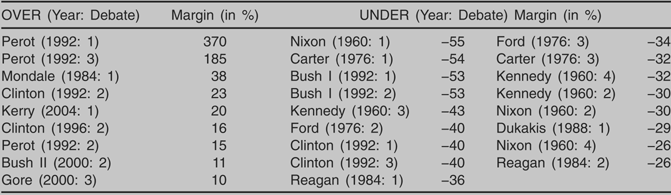
Using this new variable, Table 3 lists candidates who significantly over- and under-performed relative to their position in the pre-debate horse race polls. Because the number of under-performers once again greatly exceeds the number of over-performers, we will set different cut-off points for each group. The table, then, lists all candidates who have over-performed by at least 10% and all who have under-performed by at least 25%.
Candidate Who Over-Performed and Under-Performed Performance Relative to Horse Race Standing (Cut-Off of 10% for Over-Performers and 25% for Under-Performers)

For the most part, the winners and losers who appear in Table 3 are the same ones whose names appear in Table 2, indicating that the distortion in our previous measure was relatively minor. Still, two differences bear mentioning. First, it is clear that this new variable, as desired, does far less to penalize strong front-runners. Second, Ross Perot's numbers for 1992 are extraordinarily high, primarily because our baseline measure, Perot's pre-debate share of vote intentions, never exceeded 13%, a figure 21 points below that of any other debater in history.
By considering the degree to which candidates meet—or fail to meet—expectations, we are able to put winning and losing in context. Nevertheless, in our efforts to identify the best and worst debaters since 1960, we should not lose sight of the fact that, even given our emphasis on over- and under-performing, it still matters who wins and loses in the traditional sense. By our measure, for example, Ronald Reagan under-performed during his second 1984 debate with Walter Mondale by 26%. Despite this fact, he actually “beat” Mondale by 3 points in the post-debate poll, making it difficult to argue that Reagan should be considered a loser in any meaningful sense of the word.
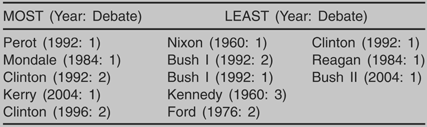
Our final exercise, then, will be to merge the data from Tables 1 and 3 in an effort to identify those candidates who fared particularly well or badly by both the traditional measure of winning and losing and by the measure of relative performance created above. These will be candidates who not only won or lost the debate by at least 10 points, but who also over- or under-performed expectations by a sizable margin (10% for winners, 25% for losers). Their identities can be found in Table 4.
Most and Least Successful Debate Performances, 1960–2004

Before considering the fate of the individual politicians, we should first consider what these results tell us about the overall impact of debates on viewers. Specifically, the findings in Table 4 appear to buttress the argument that debates help challengers more than incumbents. Of the five big winners named in this table, four represented the “out” party in the election (including, for our purposes, Ross Perot in 1992). Of the eight biggest losers, six were either serving as the sitting president or vice president at the time of their weak performance.Footnote 3
At the individual level, the results presented in Table 4 are generally consistent with conventional wisdom regarding which debaters have been the most and least successful over the years. Our list of big losers, for example, includes three performers whose failings have become the stuff of debating folklore: Richard Nixon in his first 1960 debate with John F. Kennedy, in which he appeared sickly, sweaty, and ill at ease; Gerald Ford in his second 1976 debate with Jimmy Carter, in which he committed his notorious “gaffe” about Eastern Europe; and President George H. W. Bush in 1992, who was caught by the cameras looking at his watch while his opponents were speaking, an iconic moment that came to symbolize his supposed discomfort and ineptitude as a debater.Footnote 4 Among those who follow politics closely, it would also come as no surprise to see that Ronald Reagan in 1984 and George W. Bush in 2004 are listed as big losers of their first debates.Footnote 5
The list of the biggest winners would also come as little shock to most long-time political observers. The performances of Ross Perot (1992), Walter Mondale (1984), and John Kerry (2004) in their first presidential debates were recognized at the time as solid victories.Footnote 6 The same is true of Bill Clinton's mastery of his second debate with Perot and George H. W. Bush in 1992, the first time the “town hall” format was employed.Footnote 7
The list of successful and unsuccessful debaters, however, also includes three surprises, mostly involving long-forgotten debates that provided no memorable sound bites or defining moments. For example, Bill Clinton's impressive triumph over Bob Dole in their second confrontation in 1996 has largely been lost to history. Similarly, few Americans recall John F. Kennedy's rather substantial loss to Richard Nixon in their now-obscure third presidential debate in 1960.Footnote 8 Finally, despite his own reputation for forensic excellence, Bill Clinton's first experience in a general election presidential debate, in 1992, was actually rather disappointing (though he may have benefited from the fact that, despite losing badly to Ross Perot, he finished well ahead of George H. W. Bush, his main rival for the White House).
Are Debates Won or Lost?
Because traditional measures of winning and losing typically represent a zero-sum game, it has generally been difficult to assess the degree to which one candidate wins a debate and the other loses. As noted above, in a two-candidate race, a 15-point victory for one debater automatically means a 15-point defeat for the other. Even in the three-way debates of 1992, winners' and losers' margins were strongly related.
By measuring over- and under-performance, however, we can determine whether voters' assessments of the candidates are driven more by the winner exceeding expectations or the loser failing to live up to them. In the analysis above, the findings are clear and persuasive. Debates are far more likely to be lost than to be won.
Indeed, there are only two debates, out of 23, in which the winner over-performed to a greater degree than the loser under-performed. In the first debate of 1992, Ross Perot emerged as the surprise victor, though the extent of his over-performance was largely a product of his third-party status and consequent low pre-debate standing in the polls. In addition, Walter Mondale not only beat Ronald Reagan in their first 1984 debate by 19 points, but his over-performance “score” was actually higher (in absolute value terms) than Reagan's under-performance “score.” It could be argued, therefore, that Perot and Mondale are the only two candidates ever to have truly “won” a presidential debate, though even Mondale's edge (38–36%) was slight.Footnote 9
Other than these two cases, however, the evidence tells a consistent tale. By any measure, the number of under-performers and the extent of their failure dwarfs the number of success stories. The unmistakable conclusion in these and most other cases is that failure is a far more common phenomenon in presidential debates than success, and that success and failure are not, in fact, mirror images of one another.
Along these same lines, it is interesting to note that, despite the discussions of charisma and forensic ability that so often dominate media coverage of presidential debates, this study suggests that context may matter at least as much as inherent skills. George H. W. Bush, who bested Michael Dukakis twice in 1988, lost badly in 1992. His son escaped the 2000 debates unscathed, but was clearly much less successful four years later. And even the Great Communicator himself, Ronald Reagan, followed up a relatively strong performance in 1980 with an overwhelming defeat in 1984, at least in the first debate. What all three of these candidates have in common, of course, is that their failures occurred when they debated as incumbent presidents (though it should be noted that President George H. W. Bush did represent the incumbent party as vice president in 1988). In short, our data suggest that incumbency may be as big a factor in debating success as any notion of oratorical eloquence or personal magnetism.
Once again, it is important to bear in mind that debating success is only one of many factors that influence the outcomes of presidential elections. Indeed, the two biggest debate winners identified above, Perot and Mondale, not only trailed badly before the debates, but also lost overwhelmingly on Election Day, despite their success in head-to-head encounters with their opponents. Nevertheless, research has shown that, under the right circumstances, debate performance can be electorally significant, even in cases (such as 1980) when the winner and loser are not separated by an especially wide gap.Footnote 10
Further, it is important to recognize that voters' debate assessments are a combination of their reactions to the candidates themselves, and also to the post-debate analysis that takes place in the media. There is some evidence, for example, that Gerald Ford's Eastern Europe blunder was not generally recognized by the electorate until it was dissected and replayed multiple times by newscasts in the days following the second Ford-Carter debate (Steeper Reference Steeper, Bishop, Meadow and Jackson-Beeck1978). Our decision rule was to analyze the first available Gallup Poll taken after each debate. Because of this, it is possible that we may have missed some of the post-debate media effects that were triggered by these events (although we do seem to have captured the devastating impact of Ford's debacle).Footnote 11
It is, of course, beyond the scope of this article to suggest strategies for debating candidates and their handlers. Nevertheless, if losing matters more than winning, it might (to reprise our sports analogy) be less important to hit a home run, and more important to avoid striking out. If that is the case, then a cautious, defensive strategy on the part of each campaign may be justified, regardless of how unsatisfying the result might be for viewers. Moreover, incumbents may be well advised to limit, as much as possible, their participation in debates, and to negotiate for the most restrictive ground rules possible. Although Bill Clinton proved in 1996 that the incumbent's lot is not inherently hopeless, the preponderance of evidence does not favor the current resident of the White House in any given year.
In the end, of course, no two debates are exactly alike. Indeed, in 2008, we will, for the first time, witness a series of general election debates lacking either a sitting president or vice president. Regardless, if history is any guide, when analyzing the debates and their potential impact, voters, scholars, and pundits should not be asking “Who won?” but rather, “Who lost?”