INTRODUCTION
The northern bottlenose whale (Hyperoodon ampullatus, Foster, 1770) is a 7–9 m long beaked whale found only in the northern parts of the North Atlantic Ocean. Its distribution extends from Canadian waters in the west to Norwegian waters in the east, particularly in areas of deep water (800–1800 m), often along the continental slope (Benjaminsen & Christensen, Reference Benjaminsen, Christensen, Winn and Olla1979; MacLeod et al., Reference MacLeod, Perrin, Pitman, Barlow, Ballanca, D'Amico, Gerrodette, Joyce, Mullin, Palkay and Waring2005; Whitehead & Hooker, Reference Whitehead and Hooker2012). There is a history of whaling targeting this species (see Reeves et al., Reference Reeves, Mitchell and Whitehead1993 for a review) and although its commercial exploitation stopped in 1977 (IWC, 1978), it was occasionally being hunted in the Faeroe Islands at least until 1993 (Bloch et al., Reference Bloch, Desportes, Zachariassen and Christensen1996). Most sub-populations of the species are probably still depleted, due to large kills in the past (Taylor et al., Reference Taylor, Baird, Barlow, Dawson, Ford, Mead, Notarbartolo di Sciara, Wade and Pitman2008). Despite it having being industrially exploited, our knowledge about the biology of northern bottlenose whales is still limited. Indeed, beaked whales (family Ziphiidae) are the least-known group of large mammalian species, which is mainly due to their offshore distribution and long dive duration (Hooker et al., Reference Hooker, Whitehead, Gowans and Baird2002).
Studies addressing diverse aspects of northern bottlenose whale ecology (i.e. distribution, behaviour, diving patterns, genetics, feeding ecology) have been conducted in the Gully submarine canyon (off Nova Scotia, Canada), a region of high density and a potential foraging ground for the species (Gowans et al., Reference Gowans, Whitehead, Arch and Hooler2000; Hooker et al., Reference Hooker, Whitehead, Gowans and Baird2002). Previous studies in the north-east Atlantic have provided some information on diet (e.g. Clarke & Kristensen, Reference Clarke and Kristensen1980; Lick & Piatkowski, Reference Lick and Piatkowski1998; Santos et al., Reference Santos, Pierce, Smeenk, Addink, Kinze, Tougaard and Herman2001), stranding patterns (MacLeod et al., Reference MacLeod, Pierce and Santos2004; Rogan & Hernández-Milián, Reference Rogan and Hernández-Milián2011) and habitat preferences (e.g. Weir et al., Reference Weir, Pollock, Cronin and Taylor2001). Previous stomach content analyses resulted in the classification of northern bottlenose whales as teuthophagous suction feeders, their feeding mechanism potentially limiting the size of the prey that can be consumed (Whitehead et al., Reference Whitehead, MacLeod and Rodhouse2003; MacLeod et al., Reference MacLeod, Santos, López and Pierce2006). Fish remains were also reported in the stomachs of northern bottlenose whales, both from stranded animals and those hunted commercially. However, in the north-east Atlantic, fish numbers in stomach contents have always been low when compared to cephalopod prey remains (Benjaminsen & Christensen, Reference Benjaminsen, Christensen, Winn and Olla1979; Santos et al., Reference Santos, Pierce, Smeenk, Addink, Kinze, Tougaard and Herman2001). Whitehead et al. (Reference Whitehead, MacLeod and Rodhouse2003) reported that the northern bottlenose whale shows a very low niche breadth when compared to other teuthivorous mesopelagic marine mammals such as the sperm whale (Physeter macrocephalus, Linnaeus, 1758), Cuvier's beaked whale (Ziphius cavirostris, Cuvier, 1823) and southern elephant seal (Mirounga leonina, Linnaeus, 1758), which was related to the high numbers of the prey species Gonatus spp. present in the samples.
In the north-east Atlantic, northern bottlenose whales are believed to travel towards the northern limits of their distribution range in the spring and return to their southern limits in the late summer, where they spend the autumn and winter (Øien & Hartvedt, Reference Øien and Hartvedt2011). Peaks in northern bottlenose whale strandings are found in the area during what is thought to be its southern movement between August and October (i.e. Bloch et al., Reference Bloch, Desportes, Zachariassen and Christensen1996; MacLeod et al., Reference MacLeod, Pierce and Santos2004; Rogan & Hernández-Milián, Reference Rogan and Hernández-Milián2011). However, this may not be the case for all northern bottlenose whales as, for example, small numbers of whales have been sighted year-round in offshore waters of the Norwegian Sea (Øien & Hartvedt, Reference Øien and Hartvedt2011) and during the summer in the Azores, the southern limit of their distribution range (Silva et al., Reference Silva, Prieto, Magalhães, Cabecinhas, Cruz, Gonçalves and Santos2003). These distribution patterns have been also hypothesised to represent a seasonal inshore–offshore movement following prey resources, rather than a north–south migration (Whitehead & Hooker, Reference Whitehead and Hooker2012).
Besides information on diet preferences, studies of marine top predator feeding ecology (especially those directed to deep diving cetaceans) can also provide insights into poorly-known faunal communities inhabiting oceanic deep waters. Therefore, it is useful to regularly update the available information with results of new analyses of stomach contents in order to provide a longer time series that may track potential changes in prey species availability.
In the present study, stomach contents from ten stranded northern bottlenose whales were analysed to provide new insights into its feeding preferences in the north-east Atlantic, including identification of prey species present, inferences about feeding areas and potential movement patterns, determination of relationships between diet and whale size, comparison of diets of males and females, and comparison of the amount of food in stomachs with estimated daily energy needs. We also summarize the information on the seasonality of strandings of this species in the United Kingdom (1989–2011) and The Netherlands (1584–1993).
MATERIALS AND METHODS
Strandings monitoring and sample collection
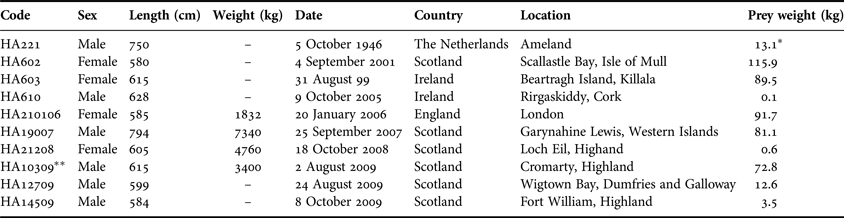
The stomach contents of ten northern bottlenose whales found along the coast of the UK, Ireland and The Netherlands between 1946 and 2009 were analysed (Table 1). One animal was sighted in the river Thames (UK) in January 2006 and was monitored by veterinary staff from the Institute of Zoology (Zoology Society of London). The attempts to rescue the whale were unsuccessful and the animal was finally euthanased. A full necropsy was performed by members of the Institute of Zoology.
Data on stranded Hyperoodon ampullatus (HA) included in the analysis. Reconstructed prey weight for each whale is given. *Denotes a stomach content that was only partially analysed. **Two individuals stranded together (mass stranding).

All other stomach contents were collected by regional strandings monitoring networks. Strandings in Scotland were attended by the Scottish Agricultural College Veterinary Services, which also carried out full necropsies. Specimens stranded in Ireland were sampled by the School of Biological, Earth and Environmental Sciences (University College Cork). The stomach contents of the animal stranded in the Netherlands was collected by Naturalis, Nederlands Centrum voor Biodiversiteit. From this latter individual, only a partial sample of the stomach contents was available.
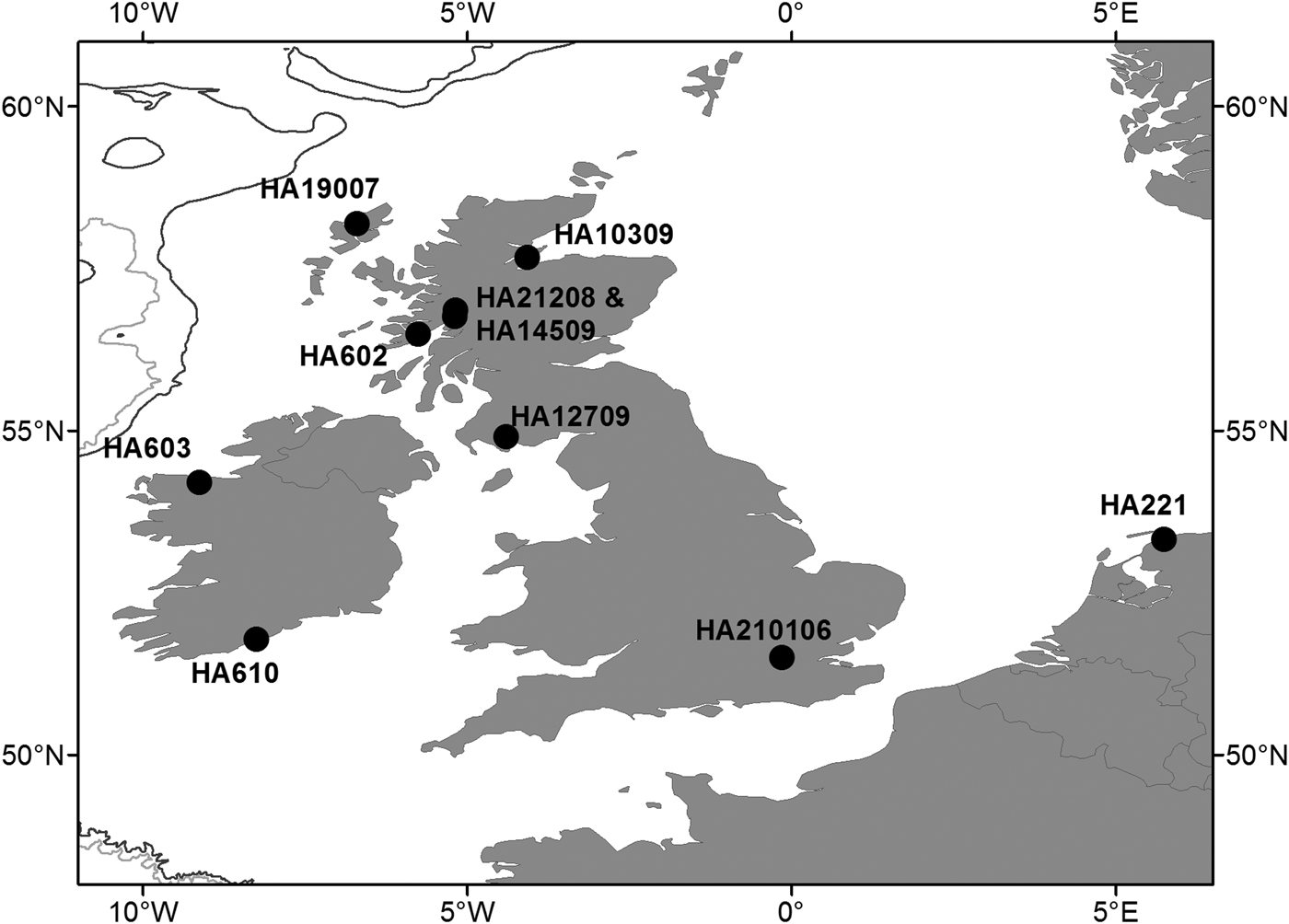
All animals were measured (body length) and sexed, and cause of death was determined when possible. Prey remains consisted principally of cephalopod mandibles (beaks). A crustacean skeleton was also found but species identification was not possible due to being heavily decomposed. Stomach contents were preserved in 70% ethanol. Stranding locations are shown in Figure 1.
Stranding locations of the ten northern bottlenose whales included in the present study. Contour lines represent the –2000 m (light grey) and –1000 m (dark grey) contours.
In addition, information on northern bottlenose whale strandings in the UK (1989–2011) and The Netherlands (1584–1993) was assembled to examine the frequency and seasonal distribution of strandings in this species. The majority of the whales included in the present dietary study (N = 7) come from the UK, and a detailed description of the decomposition state of the whales stranded in the area between 1989 and 2010 was available (see Table S1).
Sample analysis
Cephalopod beaks were identified using reference collections held at University of Aberdeen and published guides (e.g. Clarke, Reference Clarke1986). The numbers of cephalopods were estimated from the numbers of upper or lower beaks, whichever was higher. Cephalopod length and weight were calculated from standard measurements on lower beaks (rostral length is the usual measurement for squid beaks, Clarke, Reference Clarke1986) based on a compilation of published regressions (e.g. Clarke, Reference Clarke1986; Santos et al., Reference Santos, Pierce, García Hartmann, Smeenk, Addink, Kuiken, Reid, Patterson, Lordan, Rogan and Mente2002). For stomachs in which one cephalopod species/size class was represented by >100 beaks, a random sample of more than 100 beaks was measured. No published length–weight regressions were available for the taxa Vitreledonella sp. and Cirroteuthidae.
For each prey category, its relative importance in the diet was estimated using two standard indices: (a) contribution by number to the total number of prey; and (b) contribution by weight to the total prey weight.
Statistical analysis
A Spearman's rank correlation was used to assess correlations between whale and prey sizes. Prey-size/predator-size ratios were calculated by dividing the estimated length of each prey item by the total body length of the cetacean from which it was recovered, following MacLeod et al. (Reference MacLeod, Santos, López and Pierce2006). This allowed us to remove the effect of differences in body size between sexes and thus to compare prey sizes in males and females.
Mann–Whitney tests were carried out to determine possible differences in: (1) whale size in relation to whale sex; (2) prey size in relation to whale sex; and (3) prey-size/predator-size ratios in relation to whale sex.
RESULTS
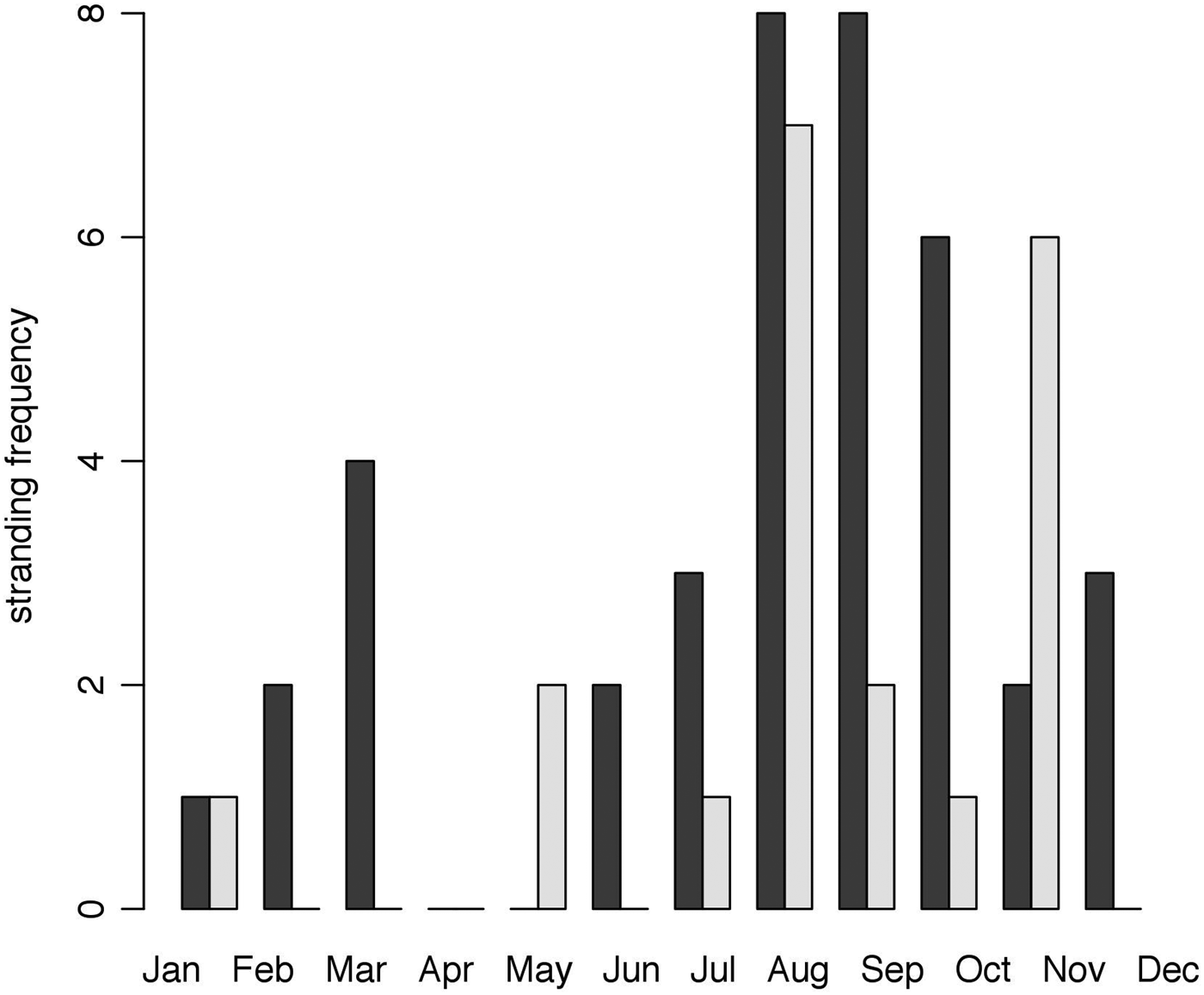
A total of 10,665 cetacean strandings was recorded in the UK between 1989 and 2011. From these, 39 correspond to northern bottlenose whales (0.37% of the total) and were distributed from January to December, with highest frequencies in August and September (Figure 2). Slightly more than half (14 out of 22) of the strandings of northern bottlenose whales registered in the UK between August and October corresponded to whales that stranded alive or were freshly dead. From those recorded between November and July, eight corresponded to individuals that were in a moderate to advanced decomposition state, four had stranded alive or were freshly dead while the preservation state of five animals was undetermined (Table S1). Twenty-one northern bottlenose whale strandings were registered in the Netherlands between 1584 and 1993. Most of the strandings took place between May and November, with the exception of one individual that stranded in January and one whale for which the stranding month was unknown. Peaks in frequency of strandings were recorded in August and November (Figure 2).
Seasonal distribution of Brittish (1989–2011; dark grey) and Dutch (1584–1993; light grey) northern bottlenose whale strandings. For one Dutch whale, no data on month of stranding was available (see Table S1) and it has not been incorporated in this figure.
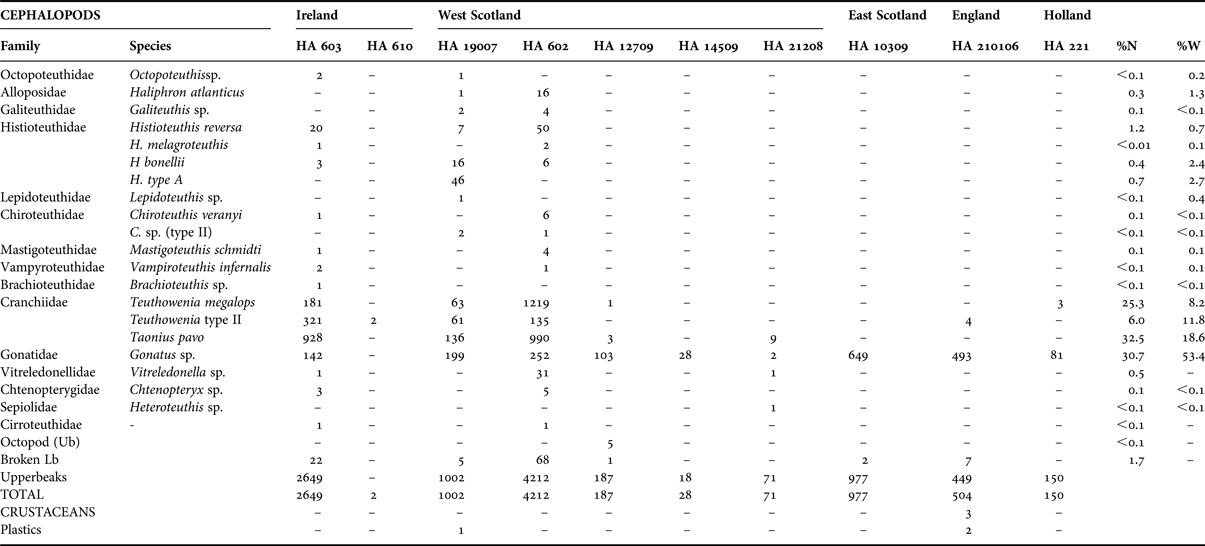
Numbers of prey items recorded in each stomach ranged between 2 and 4212 (Table 2). Prey remains consisted almost exclusively of cephalopod beaks and belonged to at least 21 different species (16 families), the most abundant taxa being Gonatus spp., Teuthowenia spp. and Taonius pavo (Lesueur, 1821), which together represented more than 90% of the total diet both by weight and number (Table 2). Gonatus spp. was the most important prey category by weight (53.4%), although Taonius pavo (present in high numbers in three of the whales) was the most important category in terms of prey numbers, contributing about 33% of the total diet (Table 2). A single crustacean exoskeleton was found in the whale stranded in the River Thames (HA210106). Among the whales, we can distinguish two dietary groupings: those dominated by species of the family Cranchiidae (HA602, HA603, HA19007; Table 2) and those dominated by Gonatus spp. (HA221, HA210106, H10309, HA12709, HA14509; Table 2). However, whales HA21208 and HA610 do not perfectly fit either pattern. The stomach contents of the former include more Cranchiidae than Gonatus spp. beaks but not a remarkable diversity of prey species, while the stomach contents of the latter consist exclusively on two beaks of Teuthowenia type II. We should highlight that while whales stranded in Ireland and the West of Scotland contained proportionally more T. pavo remains, the three whales stranded in the North Sea contained more Gonatus spp. beaks.
Prey species and number of plastic items found in the stomachs of northern bottlenose whales (HA). Numbers of beaks/other remains are indicated (lower beaks, Lb; upper beaks, Ub,). Overall prey species importance (%N, percentage by number; %W, percentage by weight) based on those lower beaks that were taxonomically identified is indicated. No published length–weight regressions were available for Vitreledonella sp. and Cirroteuthidae. The category Histioteuthis type A includes the species H arcturi Robson, 1948, H. corona Voss & Voss, 1962, H. meleagroteuthis Chun, 1910 and H. bonellii Clarke, 1980. The category Chirotheuthis type II includes beaks of the genus Chiroteuthis different from C. veranyi Ferussac, 1835 (Santos et al., Reference Santos, Pierce, Smeenk, Addink, Kinze, Tougaard and Herman2001).
Small pieces of plastic debris were found in two stomachs (HA19007 and HA210106; Table 2), although in small quantities unlikely to have represented a threat to the whales. The whale HA19007 contained an oval-shaped lid of plastic of about 13 × 8.5 cm. The stomach of the whale stranded in the river Thames (HA210106) contained two small pieces of plastic (of approximately 3 × 1 cm and 2 × 1.5 cm) and several other remains probably indicative of its presence and live stranding in the Thames, including a whole potato (Solanum tuberosum, Linnaeus, 1753), green algae and mollusc shell remains.
The main prey categories correspond to oceanic cephalopod species distributed in temperate to sub-polar regions. However, a few beaks of squid characteristic of tropical and warm temperate oceans were also identified (e.g. Vampyroteuthis infernalis, Chun 1903, Heteroteuthis sp.) in whales HA602, HA603 and HA21208 (Table 2), which would suggest that at least some of the whales were travelling north prior to stranding. No evidence of inshore feeding was found.
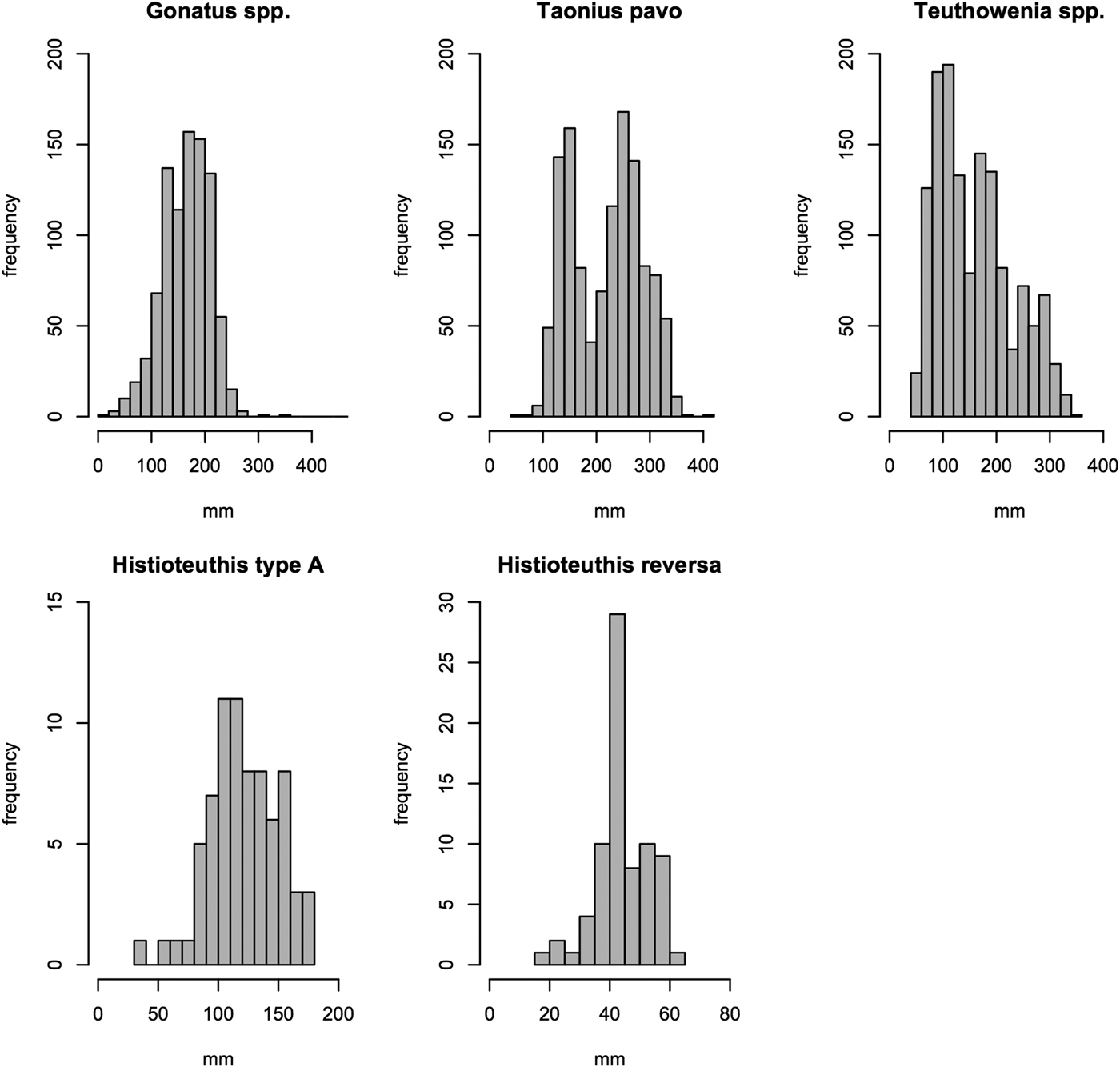
Estimated sizes (dorsal mantle length; DML) of Taonius pavo ranged from 52 to 418 mm, as compared to 18–341 mm for Gonatus spp., 48–352 mm for Teuthowenia spp., 39–172 mm for Histiotheuthis type A (this category includes H. arcturi, Robson, 1948, H. corona, Voss & Voss, 1962, H. meleagroteuthis, Chun, 1910 and H. bonellii, Clarke, 1980), and 19–61 mm for H. reversa, Verrill, 1880 (Figure 3). Length–frequency distributions are unimodal for Gonatus spp. (180 mm mode), Teuthowenia spp. (100 mm mode), H. reversa (40 mm) and H. type A (110 mm), while they are bimodal for Taonius pavo (modes at 150 and 250 mm).
Frequency distribution of estimated prey size (DML, dorsal mantle length) of the main prey taken by northern bottlenose whales.
Reconstructed squid weights give minimum figures of estimated food eaten by each whale of between 0.1 kg (for the stomach with just two squid beaks; HA610) to 115.7 kg (Table 1). Estimates of body weights were available for four individual whales, and in only one case (whale HA210106, weight ca 1,832 kg, prey weight ~92 kg) would the amount of prey represented by the stomach contents have met the whale's daily energy requirements (~4% body weight; Sergeant, Reference Sergeant1969).
There was a significant positive correlation between whale and prey sizes (Spearman's rank correlation; P < 0.001). Males were not significantly larger than females (Mann–Whitney test; P = 0.199). For the main prey species (Figure 3), males had eaten significantly larger Taonius pavo (P < 0.001), H. reversa (P < 0.003) and H. type A (P < 0.030) than females, while females had eaten significantly larger Teuthowenia spp. (P < 0.001) and Gonatus spp. (P < 0.001) than males. However, when comparing prey-size/predator-size ratios (obtained by dividing prey size by predator size; MacLeod et al., Reference MacLeod, Santos, López and Pierce2006), only the comparisons involving Taonius pavo and Gonatus spp. remained significant (P < 0.001 in both cases).
DISCUSSION
Two main feeding patterns were found in the whales analysed in the present study; those in which stomach contents were dominated by Gonatus spp. (HA221, HA210106, H10309, HA12709, HA14509) and those dominated by species of the family Cranchiidae (HA602, HA603, HA19007). Whale HA21208 had relatively few beaks in the stomach, but is more similar to the second group as Cranchiidae were most frequent. Whale HA610 was excluded from this classification since only two cephalopod beaks were recovered from its stomach content. The whales with prey items dominated by Gonatus spp., including the three whales stranded in the North Sea basin, were probably travelling south after feeding in higher latitudes, as suggested in previous studies (e.g. Lick & Piatkowski, Reference Lick and Piatkowski1998; Santos et al., Reference Santos, Pierce, Smeenk, Addink, Kinze, Tougaard and Herman2001) and consistent with the known distribution of Gonatus fabricii (Kristensen, Reference Kristensen and Boyle1983). On the other hand, the higher diversity of prey present in those stomachs dominated by species of the family Cranchiidae suggests that these individuals could have been feeding further south, in an environment characterized by higher cephalopod diversity (e.g. Spitz et al., Reference Spitz, Cherel, Bertin, Kiszka, Dewez and Ridoux2011), hence probably travelling north prior to stranding. Indeed, two of the latter whales, plus whale HA21208, had remains of cephalopods of tropical and warm temperate oceans (i.e. Vampyroteuthis infernalis, Heteroteuthis sp.) in their stomachs. It is possible that the Gonatus spp. remains found in the whales whose stomachs contents were dominated by Chranchiidae belong to Gonatus steenstrupi (Kristensen, 1981). This latter species has been identified as the main prey category for northern bottlenose whales off the Scotian Shelf (Hooker et al., Reference Hooker, Iverson, Ostrom and Smith2001). Although G. steenstrupi is generally present at lower latitudes than G. fabricii (Lichtenstein, 1818), there is also some overlap in their distribution ranges (see Hastie et al., Reference Hastie, Pierce, Wang, Bruno, Moreno, Piatkowski and Robin2009).
Our results show beaked whale strandings in almost all months of the year with higher numbers in August and November for the Dutch strandings and August and September in UK (Figure 2), fitting the general pattern already reported in the literature (Smeenk et al., Reference Smeenk, Addink and García Hartmann1994; MacLeod et al., Reference MacLeod, Pierce and Santos2004) of late summer and autumn stranding peaks around the North Sea. In addition, the majority of the animals examined in the present study that stranded in late summer–autumn were alive or freshly dead, whereas most of those recorded between November and July, and for which preservation state was known, correspond to individuals that were in a moderate to advanced decomposition state. Indeed, most of the stomach contents from northern bottlenose whales analysed to date correspond to individuals stranded between August and October (i.e. Clarke & Kristensen, Reference Clarke and Kristensen1980; Lick & Piatkowski, Reference Lick and Piatkowski1998; Hooker et al., Reference Hooker, Iverson, Ostrom and Smith2001; Santos et al., Reference Santos, Pierce, Smeenk, Addink, Kinze, Tougaard and Herman2001; Spitz et al., Reference Spitz, Cherel, Bertin, Kiszka, Dewez and Ridoux2011). It may be that the poor preservation state of whales stranded outside the peak season, as is the case for Scottish strandings, has resulted in an under-representation of those animals in studies in the north-east Atlantic. Significant seasonal patterns in strandings of Hyperoodon ampullatus were also found by MacLeod et al. (Reference MacLeod, Pierce and Santos2004) in their analysis of beaked whales strandings around the UK and Ireland from 1800 to 2002. The authors accounted for differences in effort (e.g. winter–summer) by looking at strandings of individual species relative to all beaked whale strandings, and suggested that this variation could be a reflection of north–south migrations and/or inshore–offshore movements of northern bottlenose whales in the region.
With the exception of the whale examined by Spitz et al. (Reference Spitz, Cherel, Bertin, Kiszka, Dewez and Ridoux2011), the stomach contents analyses of northern bottlenose whales in Europe recorded in the literature correspond to strandings at high latitudes (above 50°N). Studies of whales stranded at high latitudes and during what is believed to be the south migration period (August–October) agree on the dominance of Gonatus fabricii as the principal prey species. However, different patterns can be found for whales stranded at lower latitudes and outside the peak season: Spitz et al. (Reference Spitz, Cherel, Bertin, Kiszka, Dewez and Ridoux2011) found no Gonatus spp. remains in the stomach of an animal stranded in the Bay of Biscay. On the other hand, Santos et al. (Reference Santos, Pierce, Smeenk, Addink, Kinze, Tougaard and Herman2001) found a high diversity of prey in a male stranded in Denmark in February 1997, in which the contribution by number of squid of the family Cranchiidae was higher than that of the family Gonatidae.
Given that Gonatus spp. was not the dominant prey for all of the whales included in this study, three of the whales showed a high diversity of prey species (HA603, HA19007, HA602) and three whales had remains of warm-temperate water cephalopods among their prey (HA603, HA602, HA21208), we suggest that, despite being stranded during the hypothesized period of peak south migration, four of the animals (HA603, HA19007, HA602, HA21208) had been feeding in temperate latitudes prior to stranding.
Prey remains in the partial stomach sample from the whale stranded in the Netherlands in August 1946 were dominated by Gonatus spp. with a small number of Teuthowenia megalops (family Cranchiidae), which is in agreement with findings from other northern bottlenose whale strandings at similar times of the year and geographical area (Lick & Piatkowski, Reference Lick and Piatkowski1998; Santos et al., Reference Santos, Pierce, Smeenk, Addink, Kinze, Tougaard and Herman2001).
Considerably higher numbers of upper beaks than lower beaks were recorded in the present study, which indicates an accumulation of upper mandibles. This is a consequence of their shape, which facilitates the accumulation of upper beaks due to several beaks being nested inside each other, and this does not happen for lower beaks (Lick & Piatkowski, Reference Lick and Piatkowski1998).
No commercially important cephalopod species were recorded in the present study. However, as noted by Hastie et al. (Reference Hastie, Pierce, Wang, Bruno, Moreno, Piatkowski and Robin2009), given the high numbers of Gonatus fabricii in the north-east Atlantic, this species may be marketable in the future and it has attracted interest as a potential commercial resource in Norway and Greenland. Gonatus fabricii is an oceanic mesopelagic species of deep offshore waters of the Arctic and North Atlantic, the southern distribution limit of which is around 55°N in the north-east Atlantic (Roper et al., 1984). This cephalopod is an abundant food resource exploited by a variety of predators, including whales and seals (Globicephala melaena, Thomas 1898, Physeter macrocephalus, Phoca groenlandica, Erxleben 1777; Potelov et al., Reference Potelov, Nilssen, Svetochev and Haug1997; Bjørke, Reference Bjørke2001), birds (Fratercula arctica, Linnaeus 1758, Fulmarus glacialis, Linnaeus, 1761; Falk et al., Reference Falk, Jensen and Kampp1992; Garthe et al., Reference Garthe, Montevecchi, Ojowski and Stenhouse2004), fish (Coryphaenoides armatus, Hector, 1875, Histiobranchus bathybius, Günther, 1877, Seriola dumerili, Risso 1810; Martin & Christiansen, Reference Martin and Christiansen1997; Matallanas et al., Reference Matallanas, Casadevall, Carrasson, Boix and Fernandez1995) and other squid (Illex illecebrosus, Lesueur, 1821; Amaratunga, Reference Amaratunga and Caddy1983). Maturation of male Gonatus fabricii occurs at a length of about 200 mm, with maximum lengths being 350 and 380 mm for males and females, respectively (Hastie et al., Reference Hastie, Pierce, Wang, Bruno, Moreno, Piatkowski and Robin2009). No comparable information is available at present for Gonatus steenstrupi. The whales included in this study had most likely eaten mainly immature squid.
ACKNOWLEDGEMENTS
Many thanks to Chris Smeenk for suggestions concerning Dutch Hyperoodon strandings. Thanks to Guido Keijl for access to the Dutch stranding database.
FINANCIAL SUPPORT
Data and samples from the UK were provided by the UK Cetacean Strandings Investigation Programme, which is jointly funded by Defra (UK Department of Environment Fisheries and Rural Affairs) and the Devolved Administrations in Scotland and Wales. R.F. was supported during part of the research period through an AXA Postdoctoral Research Grant (grant number 32983). GJP acknowledges financial support from Caixa Geral de Depósitos (Portugal).
Supplementary materials and methods
The supplementary material referred to in this article can be found online at journals.cambridge.org/mbi.