Introduction
Lowbush blueberry is a native, rhizomatous perennial species in Nova Scotia. Commercial fields are developed from native blueberry stands that are managed primarily on a 2-yr production cycle. Fields are pruned to ground level in the first year (nonbearing year) by burning or flail mowing (Eaton et al. Reference Eaton, Glen and Wyllie2004) to promote vegetative growth and flower bud development (Percival et al. Reference Percival, Kaur, Hainstock and Privé2012). Fruit development and harvest occur in the second year (bearing year) (AAFC 2012), after which fields are once again pruned or, in some instances, prepared for an additional bearing year (Jordan and Eaton Reference Jordan and Eaton1995). Weed management options are limited, as the perennial nature of the crop precludes use of crop rotation or tillage. Weeds are therefore a major yield-limiting factor (Jensen Reference Jensen1985; McCully et al. Reference McCully, Sampson and Watson1991), with several species of perennial grasses commonly occurring in lowbush blueberry fields throughout eastern Canada (AAFC 2012; Anonymous 2011; Jensen and Yarborough Reference Jensen and Yarborough2004).
Hair fescue is a widespread, caespitose (tuft-forming) perennial grass weed in lowbush blueberry fields (Jensen and Yarborough Reference Jensen and Yarborough2004; White and Kumar Reference White and Kumar2017; Yarborough and Cote Reference Yarborough and Cote2014), likely due in part to secondary seed dispersal by farm machinery (Boyd and White Reference Boyd and White2009). Established hair fescue populations are maintained through seedling establishment from seeds produced by persistent established tufts (Stampfli and Zeiter Reference Stampfli and Zeiter1999; White Reference White2018). Seedbanks are generally transient (Pakeman and Hay Reference Pakeman and Hay1996; Piessens et al. Reference Piessens, Honnay and Hermy2005; Thompson and Grime Reference Thompson and Grime1979; Thompson Reference Thompson1986) due to lack of seed dormancy (Amen Reference Amen1966), though persistent seedbanks have been reported in some locations (Wilcox and Healy Reference Wilcox and Healy2016). Hair fescue forms seedbanks in lowbush blueberry fields (White Reference White2018), though persistence of this seedbank is unknown. Hair fescue seeds collected from lowbush blueberry fields lack primary dormancy (White Reference White2018), with new seedlings emerging in late summer and autumn following the seed rain (White Reference White2018). Hair fescue seedbanks in lowbush blueberry fields are therefore likely to be transient, with potential to reduce or eliminate the seedbank through management.
Management of hair fescue currently relies primarily on PRE applications of the herbicide pronamide due to limited efficacy of alternative herbicides (White and Kumar Reference White and Kumar2017; Yarborough and Cote Reference Yarborough and Cote2014; Zhang et al. Reference Zhang, White, Olson and Pruski2018). Although pronamide is effective, the lack of alternative control options increases the likelihood of selection for herbicide resistance due to overreliance on a single herbicide mechanism of action (Norsworthy et al. Reference Norsworthy, Ward, Shaw, Llewellyn, Nichols, Webster, Bradley, Frisvold, Powles, Burgos, Witt and Barrett2012). Pronamide is also expensive (>Can$500.00 ha−1) and difficult to use due to the requirement for cold air and soil temperatures at the time of application. Hair fescue seedlings are susceptible to several currently registered herbicides (White and Kumar Reference White and Kumar2017; White Reference White2018), though herbicide efficacy on established tufts is more variable. Established tufts can be suppressed with nonbearing-year foramsulfuron or glufosinate applications (White and Kumar Reference White and Kumar2017), but recovery occurs in the year following application. Inflorescence number and seed production are reduced on treated tufts, indicating potential for these herbicides to contribute to reduction of the seedbank if combined with other herbicides to improve suppression across the entire lowbush blueberry production cycle.
The objectives of this research were to determine (1) the effects of several herbicides currently registered in lowbush blueberry on suppression of established hair fescue tufts and (2) whether suppression of hair fescue with these herbicides reduces hair fescue seedbanks in lowbush blueberry fields. These objectives were based on the hypothesis that hair fescue seedbanks are transient in lowbush blueberry fields and that management of established populations with herbicides will reduce the seedbank.
Materials and Methods
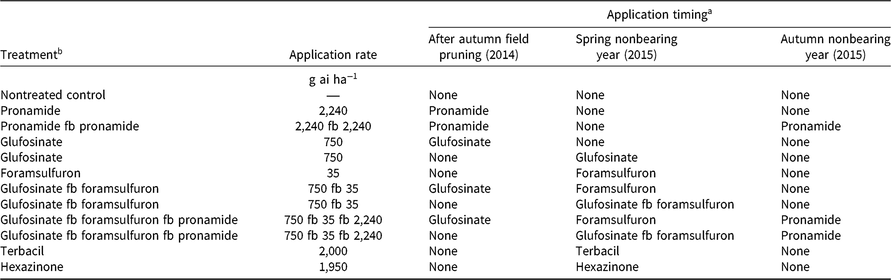
The experiment was arranged as a randomized complete block design with 4 blocks and 12 treatments (Table 1). Pronamide (Kerb® SC herbicide, Dow AgroSciences, Calgary, AB, Canada) was included as an industry standard treatment for hair fescue and is currently registered for applications in autumn of the bearing year following fruit harvest and in autumn of the nonbearing year. Terbacil (Sinbar® WDG herbicide, NovaSource, Phoenix, AZ) was included due to its traditional use for perennial grass control in lowbush blueberry and is currently registered for PRE nonbearing-year applications. Hexazinone (Velpar® DF herbicide, NovaSource) was included due to its traditional use for broad-spectrum PRE nonbearing-year weed control in lowbush blueberry. Foramsulfuron (Option® 2.25 OD herbicide, Bayer CropScience, Regina, SK, Canada) was included due to current registration for POST nonbearing-year suppression of hair fescue. Glufosinate (Ignite® SN herbicide, Bayer CropScience, Durham, NC) was included due to recent registration for use as an autumn bearing-year and spring nonbearing-year nonselective weed control treatment in lowbush blueberry. Sequential glufosinate and foramsulfuron treatments were included due to increased interest in this herbicide use pattern by growers, and sequential glufosinate and foramsulfuron treatments followed by pronamide were included to assess benefits of combining both nonbearing- and bearing-year hair fescue suppression. The experiment was conducted at two sites near Morell, Prince Edward Island (PE Site 1 [46.403161°N, 62.769718°W] and PE Site 2 [46.402632°N, 62.760979°W]) and one site at Salt Springs, NS (45.520527°N, 62.920403°W). Soil at the PE sites was an Orthic Humo-Ferric Podzol coarse loam (MacDougall et al. Reference MacDougall, Veer and Wilson1988). Soil pH and organic matter content at PE Site 1 were 4.7 and 2.7%, respectively. Soil pH and organic matter content at PE Site 2 were 4.8 and 4.3%, respectively. Soil at the Salt Springs site was a Millbrook gravelly sandy loam (Webb Reference Webb1990) with a 4.4 pH and 5% organic matter content. The experiment was established following field pruning in early November 2014 at each site. Plot size at each site was 2 by 6 m. Herbicides were applied at 207 kPa using a CO2-pressurized sprayer equipped with a 2-m-wide boom fitted with four TeeJet® XR 11002 nozzles (TeeJet Technologies, Spraying Systems, 440 Ridge Lane, Springfield, PA 19064) and was calibrated to deliver a spray volume of 300 L ha−1 for pronamide applications and 200 L ha−1 for all other herbicide applications. Pronamide was applied in a higher water volume than the other herbicides based on label guidelines for Kerb® SC herbicide (Anonymous 2012).
Herbicide treatments and application timings evaluated for management of hair fescue (Festuca filiformis) in lowbush blueberry at field sites near Morell, PE, and Salt Springs, NS, Canada.

a Application timing refers to time of year (autumn or spring) and whether bearing or nonbearing year for lowbush blueberry. Autumn herbicide treatments applied after field pruning were applied on November 25, 2014, at PE site 1 and PE site 2 and on November 26, 2014, at Salt Springs. Spring nonbearing-year glufosinate, terbacil, and hexazinone treatments were applied on May 21, 2015, at PE site 1 and PE site 2 and on May 18, 2015, at Salt Springs. Spring nonbearing-year foramsulfuron treatments were applied on June 4, 2015, at PE site 1, PE site 2, and Salt Springs. Autumn nonbearing-year pronamide treatments were applied on December 1, 2015, at PE site 1 and PE site 2 and on November 29, 2015, at Salt Springs.
b fb, followed by.
Data collection included hair fescue tuft density before all treatment applications, total tuft density (vegetative and flowering tufts) in summer of the nonbearing and bearing years, flowering tuft inflorescence number in the nonbearing and bearing years, blueberry stem density, stem height, and flower bud number per stem at the end of the nonbearing year, blueberry fruit yield at the end of the bearing year, and fescue germinable seedbank in each treatment at PE Site 1 and Salt Springs. Blueberry stem density, stem height, flower bud number, and fruit yield were not collected at PE Site 2 due to low blueberry populations in several plots. Hair fescue germinable seedbank was not determined at PE Site 2 due to lack of greenhouse space for the additional seedbank samples.
Hair fescue tuft counts were conducted in two 1-m2 quadrats in each plot, and the mean of the two counts was used in the analysis. Tuft inflorescence number was determined on 10 randomly selected tufts per plot using a line transect method (White and Kumar Reference White and Kumar2017). Mean inflorescence number from the 10 tufts was used in the analysis. Blueberry stem density was determined in three 0.09-m2 quadrats per plot, with the mean of the three counts used in the analysis. Blueberry stem height and flower bud number per stem were determined on 20 randomly selected stems per plot using a line transect method similar to that referred to earlier. Blueberry fruit yield was determined on a whole-plot basis by hand raking at each site. Nonbearing-year hair fescue tuft densities and flowering tuft inflorescence number were determined on July 16, 2015, and July 13, 2015, at PE and Salt Springs, respectively. Nonbearing-year blueberry stem density was determined at each site on September 2, 2015. Nonbearing-year blueberry stem height and floral bud number were determined on November 8, 2015, and October 15, 2015, at PE and Salt Springs, respectively. Bearing-year hair fescue tuft densities and flowering tuft inflorescence number were determined on July 20, 2016, and July 29, 2016, at PE and Salt Springs, respectively. Blueberries were harvested on August 23, 2016, and August 22, 2016, at PE site 1 and Salt Springs, respectively, with these dates corresponding to date of harvest by the growers managing the fields.
The effect of herbicide treatments on seed density in the seedbank was determined by collecting four 333-cm3 soil bulk-density core samples from each treatment plot at the beginning of the subsequent blueberry production cycle at each site. Cores from each plot were bulked to provide a composite sample for each plot and were collected on May 2, 2017, and April 28, 2017, at PE Site 1 and Salt Springs, respectively. Collected cores were placed in paper bags in the field and brought back to the lab, where they were sieved to remove large rocks and organic debris. Sieved samples were placed in plastic 2,997-cm−3 greenhouse trays (Veseys, 411 York Road, York, PE C0A 1P0, Canada) and placed in the greenhouse. Samples were watered daily. Emerging hair fescue seedlings were counted and pulled weekly until no new seedlings emerged, at which time samples were dried, sieved again, and subjected to an additional grow-out procedure. This was repeated until no new hair fescue seedlings emerged from the samples, and was similar to methodology reported by Thompson (Reference Thompson1986), Thompson and Grime (Reference Thompson and Grime1979), Wilcox and Healy (Reference Wilcox and Healy2016), and Pakeman and Hay (Reference Pakeman and Hay1996).
Statistical Analysis
Hair fescue tuft density, flowering tuft inflorescence number, blueberry stem density, stem height, flower bud number, blueberry fruit yield, and germinable hair fescue seedbank data were analyzed using ANOVA in PROC MIXED in SAS (SAS v. 9.4, SAS Institute, Cary, NC). The effects of site, herbicide treatment, and site by herbicide treatment interaction were modeled as fixed effects in the analysis. Blocks were modeled as a random effect in all analyses. Hair fescue tuft density, flowering tuft inflorescence number, germinable seed density, blueberry stem density, stem height, and flower bud number data were LOG(Y) or SQRT(Y) transformed before analysis to meet the assumptions of normality and constant variance. Means for all PROC MIXED–based ANOVA analyses were determined using the LSMEANS statement, and means separation, where necessary, was conducted using Tukey’s test at the 0.05 level of probability.
Results and Discussion
Hair Fescue
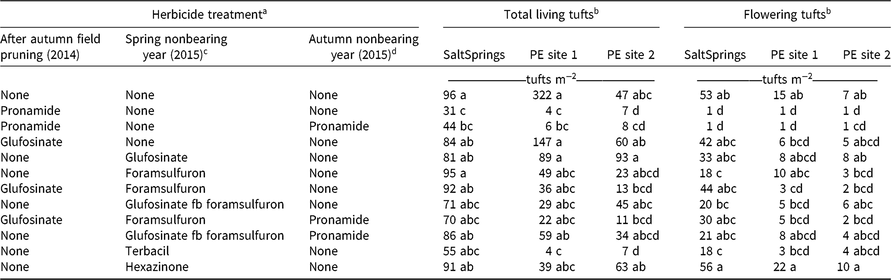
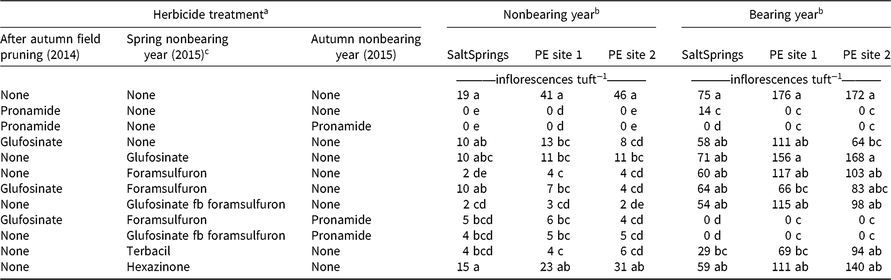
There was a significant site by herbicide treatment interaction effect (P < 0.0001) on hair fescue tuft density and flowering tuft inflorescence number. These data were therefore analyzed separately for each site. Initial hair fescue tuft density at the time of trial establishment in autumn 2014 did not vary significantly across treatments at any site and averaged 71 ± 3, 17 ± 2, and 11 ± 1 tufts m−2 at Salt Springs, PE Site 1, and PE Site 2, respectively. There was a significant effect of herbicide treatment on total and flowering tuft densities and flowering tuft inflorescence number at each site in the nonbearing year (P < 0.0001). Pronamide applications after autumn field pruning caused the greatest reduction in total and flowering tuft densities (Table 2) and flowering tuft inflorescence number (Table 3) at each site in the nonbearing year. Terbacil reduced total and flowering tuft densities in the nonbearing year, though reductions were more pronounced at the PE sites (Table 2). Terbacil also reduced flowering tuft inflorescence number (Table 3), further indicating that terbacil is effective at suppressing fescue grasses in nonbearing-year lowbush blueberry fields. Terbacil efficacy on fescues, however, is variable (Zhang et al. Reference Zhang, White, Olson and Pruski2018), and additional research should be done to determine terbacil efficacy across a wide range of sites. Nonetheless, growers should consider terbacil for hair fescue management in lowbush blueberry due to reduced cost relative to pronamide, but will need to base the decision to use this herbicide on past experience with terbacil efficacy in a specific field.
Total living and flowering hair fescue (Festuca filiformis) tuft density in the nonbearing year in various herbicide treatments evaluated for management of hair fescue in lowbush blueberry at field sites near Morell, PE, and Salt Springs, NS, Canada.

a Autumn herbicide treatments applied after field pruning were applied on November 25, 2014, at PE site 1 and PE site 2 and on November 26, 2014, at Salt Springs. Spring nonbearing-year glufosinate, terbacil, and hexazinone treatments were applied on May 21, 2015, at PE site 1 and PE site 2 and on May 18, 2015, at Salt Springs. Spring nonbearing-year foramsulfuron treatments were applied on June 4, 2015, at PE site 1, PE site 2, and Salt Springs. Autumn nonbearing-year pronamide treatments were applied on December 1, 2015, at PE site 1 and PE site 2 and on November 29, 2015, at Salt Springs.
b Total living tuft data for Salt Springs, PE Site 1, and PE Site 2 were SQRT(Y), LOG(Y), and LOG(Y) transformed, respectively, to meet the assumptions for the ANOVA. Flowering tuft data for Salt Springs, PE site 1, and PE site 2 were SQRT(Y) transformed to meet the assumptions for the ANOVA. Back-transformed means are provided. Means within the same column followed by the same letter are not significantly different according to Tukey’s multiple means comparison test at P < 0.05.
c fb, followed by.
d Autumn nonbearing-year pronamide applications were not made before collection of data presented.
Hair fescue (Festuca filiformis) flowering tuft inflorescence number in various herbicide treatments evaluated for management of hair fescue in lowbush blueberry at field sites near Morell, PE, and Salt Springs, NS, Canada.

a Autumn herbicide treatments applied after field pruning were applied on November 25, 2014, at PE site 1 and PE site 2 and on November 26, 2014, at Salt Springs. Spring nonbearing-year glufosinate, terbacil, and hexazinone treatments were applied on May 21, 2015, at PE site 1 and PE site 2 and on May 18, 2015, at Salt Springs. Spring nonbearing-year foramsulfuron treatments were applied on June 4, 2015, at PE site 1, PE site 2, and Salt Springs. Autumn nonbearing-year pronamide treatments were applied on December 1, 2015, at PE site 1 and PE site 2 and on November 29, 2015, at Salt Springs.
b Data at all sites were LOG(Y) transformed to meet the assumptions for the ANOVA. Back-transformed means are provided. Means within the same column followed by the same letter are not significantly different according to Tukey’s multiple means comparison test at P < 0.05.
c fb, followed by.
Glufosinate applications in autumn following pruning or in spring of the nonbearing year did not reduce total tuft density and only reduced flowering tuft density at PE Site 1 (Table 2). These treatments, however, did reduce flowering tuft inflorescence number in the nonbearing year at the PE sites (Table 3). Suppressive effects of glufosinate on hair fescue have been reported previously (White and Kumar Reference White and Kumar2017), and these results further support this finding. Nonbearing-year foramsulfuron applications did not reduce total tuft density at most sites, but tended to reduce flowering tuft density and flowering tuft inflorescence number in the nonbearing year at each site (Tables 2 and 3). Sequential glufosinate and foramsulfuron applications, regardless of glufosinate application timing, did not consistently reduce total or flowering tuft density or flowering tuft inflorescence number relative to foramsulfuron applications alone (Tables 2 and 3). Sequential glufosinate and foramsulfuron applications using 1,005 g glufosinate ha−1 improves suppression over foramsulfuron alone (White and Kumar Reference White and Kumar2017), indicating that the labeled glufosinate application rate used in the current study (750 g ai ha−1) may be inadequate for managing established hair fescue tufts. Glufosinate application at 750 g ai ha−1 does, however, kill hair fescue seedlings (White and Kumar Reference White and Kumar2017; White Reference White2018), and the effect of sequential treatments on hair fescue seedling recruitment should be determined before discounting use of these treatments for hair fescue management. Hair fescue seedlings are also susceptible to other currently registered herbicides in lowbush blueberry (White Reference White2018), and additional herbicide combinations could be evaluated to improve hair fescue control from sequential applications. Hexazinone did not reduce total or flowering tuft density at any sites (Table 2) and had minimal effects on flowering tuft inflorescence number (Table 3). Jensen and Yarborough (Reference Jensen and Yarborough2004) indicated that several Festuca spp. were suspected to have developed resistance to hexazinone, and these results further confirm the lack of hexazinone activity on fescue grasses in lowbush blueberry.
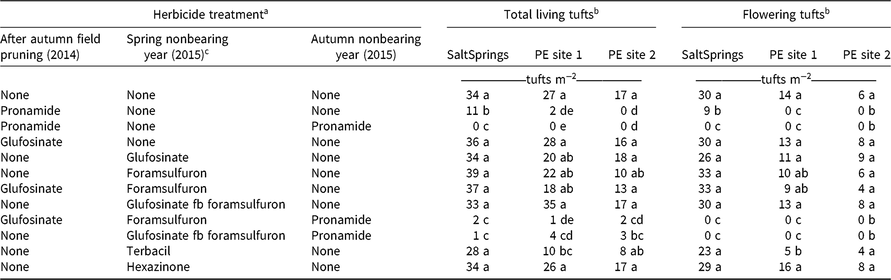
There was a significant effect of herbicide treatment on total and flowering tuft densities and flowering tuft inflorescence number at each site in the bearing year (P < 0.0001), though differences were limited primarily to treatments containing pronamide and terbacil. Total living and flowering tuft density remained low in plots treated with pronamide in the autumn following pruning (Table 4), though surviving tufts in this treatment flowered in the bearing year at Salt Springs (Tables 3 and 4). Growers should therefore monitor fields treated with a single pronamide application, as recovering flowering tufts could reestablish an infestation relatively quickly due to autumn seedling recruitment following seed rain (White Reference White2018). The application of pronamide in autumn following pruning and in autumn of the nonbearing year eliminated all vegetative and flowering tufts by the end of the bearing year at each site (Table 4). Hair fescue began to recover in the terbacil treatment in the bearing year, though total and flowering tuft densities remained low in this treatment at PE Site 1 (Table 4). In addition, flowering tuft inflorescence number was generally lower in the terbacil treatment relative to the nontreated control in the bearing year (Table 3). Terbacil therefore gave good nonbearing-year control, with some additional suppression in the bearing year, but will ultimately require use with other herbicides to provide complete control of hair fescue.
Total living and flowering hair fescue (Festuca filiformis) tufts in the bearing year in various herbicide treatments evaluated for management of hair fescue in lowbush blueberry at field sites near Morell, PE, and Salt Springs, NS, Canada.

a Autumn herbicide treatments applied after field pruning were applied on November 25, 2014, at PE site 1 and PE site 2 and on November 26, 2014, at Salt Springs. Spring nonbearing-year glufosinate, terbacil, and hexazinone treatments were applied on May 21, 2015, at PE site 1 and PE site 2 and on May 18, 2015, at Salt Springs. Spring nonbearing-year foramsulfuron treatments were applied on June 4, 2015, at PE site 1, PE site 2, and Salt Springs. Autumn nonbearing-year pronamide treatments were applied on December 1, 2015, at PE site 1 and PE site 2 and on November 29, 2015, at Salt Springs.
b Data at all sites were LOG(Y) transformed to meet the assumptions for the ANOVA. Back-transformed means are provided. Means within the same column followed by the same letter are not significantly different according to Tukey’s multiple means comparison test at P < 0.05.
c fb, followed by.
Glufosinate or foramsulfuron applications alone generally did not affect total or flowering tuft density or flowering tuft inflorescence number in the bearing year (Tables 3 and 4), indicating single-season hair fescue suppression from these herbicides. Similarly, sequential glufosinate and foramsulfuron applications, regardless of glufosinate application timing, did not reduce total or flowering tuft density in the bearing year (Table 4), further indicating single-season suppression from glufosinate and foramsulfuron. Glufosinate applications in the autumn following pruning, alone or before nonbearing-year foramsulfuron applications, did reduce bearing-year flowering tuft inflorescence number to some extent at the PE sites (Table 3). This observation was not consistent across sites, however, and overall effects of these treatments on hair fescue seem limited to the year of application. Autumn nonbearing-year pronamide applications following sequential glufosinate and foramsulfuron applications reduced total fescue tuft density and prevented flowering in the bearing year (Tables 3 and 4). These results indicate that use of glufosinate and/or foramsulfuron treatments to suppress hair fescue in the nonbearing year should be combined with autumn nonbearing-year pronamide applications to obtain acceptable hair fescue control in the bearing year. In addition, reducing reliance on pronamide in lowbush blueberry will require alternative autumn nonbearing-year treatments, or registration of additional treatments for the bearing year, to maintain hair fescue suppression over the entire lowbush blueberry production cycle.
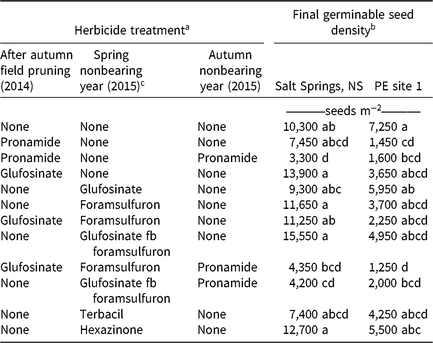
There was a significant effect of site (P < 0.0001), herbicide treatment (P < 0.0001), and the site by herbicide treatment interaction (P = 0.0325) on germinable hair fescue seed density. Germinable seed density data were therefore analyzed separately for each site. Germinable hair fescue seed density was affected by herbicide treatment at each site (P ≤ 0.0003). One pronamide application did not reduce the hair fescue seedbank at Salt Springs, though two applications reduced the seedbank by 68% at the start of the next production cycle (Table 5). In contrast, one and two pronamide applications reduced the hair fescue seedbank by 80% and 78%, respectively, at the start of the next production cycle at PE site 1 (Table 5). Initial tuft density was highest at Salt Springs, and these results indicate that two pronamide applications are likely required to reduce the hair fescue seedbank on heavily infested sites if other herbicides are not used. Recovering tufts also flowered in the bearing year in the pronamide treatment at Salt Springs (Table 4), likely contributing additional seeds to the seedbank and limiting the seedbank reduction. Nonetheless, results indicate that effective management of established hair fescue plants may contribute to seedbank reduction, similar to that reported for other weeds with transient seedbanks (Hacault and Van Acker Reference Hacault and Van Acker2006; Schwinghamer and Van Acker Reference Schwinghamer and Van Acker2008). Autumn and spring glufosinate applications, spring foramsulfuron applications, and autumn and spring glufosinate applications followed by foramsulfuron generally did not reduce the seedbank, though these treatments were more effective at PE site 1 than at Salt Springs (Table 5). Autumn and spring glufosinate applications, followed by both foramsulfuron and pronamide, however, consistently reduced the seedbank at each site (Table 5). Although no additional seedbank reduction was obtained in these treatments relative to a single pronamide application at PE site 1, results from Salt Springs indicate that pronamide use can be reduced if autumn nonbearing-year pronamide applications are used in combination with alternative herbicides for nonbearing-year hair fescue suppression. Future research should therefore focus on determining optimum nonbearing-year herbicide applications to use in combination with autumn nonbearing-year pronamide applications to ensure adequate production-cycle hair fescue suppression and seedbank reduction with reduced pronamide use. Although effective in the nonbearing year, recovering hair fescue tufts in the terbacil treatment flowered in the bearing year (Tables 3 and 4), and the seedbank was not reduced (Table 5). Similarly, hexazinone was ineffective at suppressing hair fescue (Tables 2–4) and did not reduce the seedbank (Table 5).
Effect of herbicide applications on hair fescue (Festuca filiformis) germinable seed density in lowbush blueberry at field sites near Morell, PE, and Salt Springs, NS, Canada.

a Autumn herbicide treatments applied after field pruning were applied on November 25, 2014, at PE site 1 and PE site 2 and on November 26, 2014, at Salt Springs. Spring nonbearing-year glufosinate, terbacil, and hexazinone treatments were applied on May 21, 2015, at PE site 1 and PE site 2 and on May 18, 2015, at Salt Springs. Spring nonbearing-year foramsulfuron treatments were applied on June 4, 2015, at PE site 1, PE site 2, and Salt Springs. Autumn nonbearing-year pronamide treatments were applied on December 1, 2015, at PE site 1 and PE site 2 and on November 29, 2015, at Salt Springs.
b Data for Salt Springs, NS, and PE Site 1 were LOG(Y) and SQRT(Y) transformed, respectively, before analysis to meet the assumptions of the ANOVA. Back-transformed means are provided. Means within the same column followed by the same letter are not significantly different according to Tukey’s multiple means comparison test at p < 0.05.
c fb, followed by.
Lowbush Blueberry
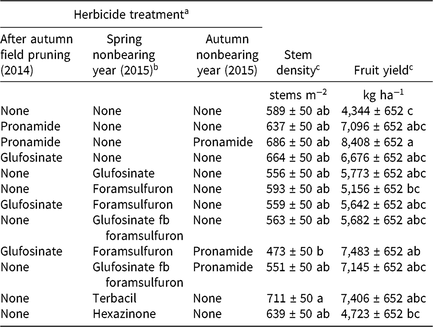
There was no significant effect of herbicide treatment (P ≥ 0.2421), site (P ≥ 0.3164), or the herbicide treatment by site interaction (P ≥ 0.5375) on blueberry stem height or flower bud number. There was a significant effect of herbicide treatment (P ≤ 0.0444) but no significant effect of site (P ≥ 0.0630) or the site by herbicide treatment interaction (P ≥ 0.2421) on blueberry stem density and fruit yield. All blueberry data were therefore combined across sites for analysis. There was no significant effect of herbicide treatment on blueberry stem height (P = 0.3217) or flower bud number per stem (P = 0.4212), with stems across sites having a mean height and bud number per stem of 13 ± 0.13 cm and 4.4 ± 0.1 buds stem−1, respectively. There was a significant herbicide treatment effect on blueberry stem density (P = 0.0346), due primarily to greater stem density in the terbacil treatment (Table 6).
Lowbush blueberry stem density and fruit yield in various herbicide treatments evaluated for management of hair fescue (Festuca filiformis) in lowbush blueberry at field sites near Morell, PE, and Salt Springs, NS, Canada.

a Autumn herbicide treatments applied after field pruning were applied on November 25, 2014, at PE site 1 and PE site 2 and on November 26, 2014, at Salt Springs. Spring nonbearing-year glufosinate, terbacil, and hexazinone treatments were applied on May 21, 2015, at PE site 1 and PE site 2 and on May 18, 2015, at Salt Springs. Spring nonbearing-year foramsulfuron treatments were applied on June 4, 2015, at PE site 1, PE site 2, and Salt Springs. Autumn nonbearing-year pronamide treatments were applied on December 1, 2015, at PE site 1 and PE site 2 and on November 29, 2015, at Salt Springs.
b fb, followed by.
c Means within the same column followed by the same letter are not significantly different according to Tukey’s multiple means comparison test at P < 0.05.
There was a significant herbicide treatment effect on blueberry fruit yield (P < 0.0001), with yield generally highest in treatments containing pronamide or terbacil (Table 6). Yields increased by 39% and 48% following one and two pronamide applications, respectively (Table 6). These data indicate that hair fescue is competitive with lowbush blueberry and reduces yields, though the mechanism of yield loss is unclear. Nonbearing-year control of winter bentgrass [Agrostis hyemalis (Walter) Britton, Sterns & Poggenb.] increased lowbush blueberry flower bud numbers per stem, which in turn tended to increase yield (Boyd et al. Reference Boyd, White and Rao2014). Blueberry stems were similar in density, height, and flower bud numbers in most treatments at each site at the end of the nonbearing year in the current study, however, indicating the yield increase was caused by an increase in flowers per stem, berries per stem, or harvestability of the crop. Red fescue (Festuca rubra L.) and winter bentgrass infestations reduce the number of blueberry flowers per stem (Boyd et al. Reference Boyd, White and Rao2014; Sikoriya Reference Sikoriya2014), and we observed significant difficulty harvesting plots with high hair fescue density. Additional research should be conducted to determine mechanisms of yield loss from hair fescue competition in lowbush blueberry.
Glufosinate and foramsulfuron, applied alone or in sequence, did not increase yields relative to the nontreated control (Table 6). Sequential applications of autumn glufosinate and spring foramsulfuron followed by pronamide, however, resulted in yields comparable to a single pronamide application (Table 6). This yield was, however, obtained with multiple herbicides as opposed to the single pronamide application. Although product costs associated with foramsulfuron and glufosinate are less than pronamide, growers would also have to consider costs associated with multiple applications. Sequential treatments will contribute to resistance management in lowbush blueberry, however, and our data suggest that hair fescue management with autumn glufosinate and spring foramsulfuron applications contributes to increased yield, provided these herbicides are used in combination with pronamide. Alternatives to pronamide for autumn nonbearing-year applications have also been identified (Zhang et al. Reference Zhang, White, Olson and Pruski2018), and additional work should continue in this area, as the need for both nonbearing- and bearing-year control of hair fescue represents a major challenge for reducing reliance on pronamide. A similar yield increase did not occur when spring glufosinate applications were used before foramsulfuron and pronamide (Table 6), likely due to generally higher living tuft density in this treatment during the nonbearing year (Table 2). Yields in this treatment were, however, >7,000 kg ha−1, indicating potential for hair fescue management with this treatment to increase yields. Results were similar in the terbacil treatment (Table 6), indicating that hair fescue management with this herbicide may contribute to increased yields if combined with additional bearing-year herbicide treatments. Hexazinone did not control hair fescue (Tables 2–4) and, as such, yields in this treatment were similar to those in the nontreated control (Table 6).
In conclusion, hair fescue was most effectively managed with pronamide. This herbicide suppressed hair fescue for the entire lowbush blueberry production cycle, though applications both in the autumn after field pruning and in the autumn of the nonbearing year were required to provide consistent suppression, seedbank reduction, and increased yield across sites. Hexazinone did not suppress hair fescue and did not reduce the seedbank. Terbacil suppressed hair fescue in the nonbearing year, but plants began to recover in the bearing year, and the seedbank was not reduced. Glufosinate and foramsulfuron, applied alone or in sequence, suppressed hair fescue in the nonbearing year, but plants recovered in the bearing year, and the seedbank was not reduced. Sequential glufosinate and foramsulfuron applications, followed by autumn nonbearing-year pronamide applications, suppressed hair fescue in both production years and reduced the seedbank. Glufosinate and foramsulfuron can therefore help reduce, but not eliminate, pronamide use for hair fescue management in lowbush blueberry.
Acknowledgments
The author acknowledges funding support for this research from the Prince Edward Island Wild Blueberry Growers Association, Bleuéts New Brunswick, and the Applied Research Subprogram of the Agriculture Research and Innovation Program under the Growing Forward 2 program. Field sites for this research were provided by David MacNearny (Morell, PE) and Brian McCormack (Salt Springs, NS). Assistance from Chris Jordan, Berry Crop Development Officer, PE Department of Agriculture, in locating field sites is acknowledged. The author would also like to acknowledge assistance with this research from Shanthanu Krishna Kumar, Linshan Zhang, Cody Webb, Qiming Lu, and Lienna Hoeg. No conflicts of interest have been declared.