Transcatheter perforation of the atretic pulmonary valve in neonates with pulmonary atresia and intact ventricular septum was first described in 1991.Reference Qureshi, Rosenthal, Tynan, Anjos and Baker 1 – Reference Parsons, Rees and Gibbs 3 In most cases, right ventricular decompression establishes a source of antegrade pulmonary blood flow, facilitates improvement in right ventricle systolic performance, and contributes to the development of a biventricular circulation – either immediately or in time. However, despite technological and procedural advancements in the approach to atretic pulmonary valve perforation, including the use of radiofrequency energy and specialised equipment, the risk of inadvertent cardiac or main pulmonary artery perforation remains a concern. In some series, this risk approaches 20% of all patients in whom transcatheter right ventricle decompression is attempted.Reference Hasan, Bautista-Hernandez and McElhinney 4 Meanwhile, even after successful right ventricle decompression, these patients are at risk for repeat intervention. The rate of repeat pulmonary valvuloplasty (BPV) approaches 50% within 3 years post right ventricle decompression. Particularly challenging is predicting which patients will develop recurrent right ventricle outflow tract obstruction and whether or not transcatheter re-interventions will be adequate for relief. In a recent multicentre publication from our group, a high rate of re-intervention on the right ventricle outflow tract was noted.Reference Petit, Glatz and Qureshi 5 In this report, patient-specific risk factors for right ventricle outflow tract re-intervention included a larger tricuspid valve annulus. However, technical factors at the initial right ventricle decompression procedure such as balloon selection, use of radiofrequency energy, and haemodynamic factors – for example, final post-intervention gradient – were not evaluated.
Using data from the four participating centres of the Congenital Catheterization Research Collaborative, we sought to identify risk factors forReference Qureshi, Rosenthal, Tynan, Anjos and Baker 1 procedural complications during transcatheter right ventricle decompression andReference Latson 2 recurrent right ventricle outflow tract obstruction necessitating either repeat BPV or surgical transannular patch.
Methods
A retrospective review was performed at the participating centres of the Congenital Catheterization Research Collaborative, as part of a broader study on outcomes in patients with pulmonary atresia and intact ventricular septum who underwent attempted right ventricle decompression.Reference Petit, Glatz and Qureshi 5 Institutional review board approval was obtained at all participating centres, with waiver of informed consent granted. Complete inclusion and exclusion criteria are available in the primary study report. In brief, all neonates presenting with pulmonary atresia and intact ventricular septum for transcatheter pulmonary valve perforation and right ventricle decompression between January 1, 2005 and May 31, 2015 were included. Patients were included in the current study if the baseline pre-intervention echocardiogram confirmed pulmonary valve atresia and intact ventricular septum based on the absence of antegrade or retrograde flow across the pulmonary valve by color Doppler. Patients who were subsequently found at catheterisation to have a tiny jet of antegrade pulmonary blood flow were classified as having “virtual atresia”. Baseline patient characteristics were recorded. Baseline (pre-intervention) echocardiograms were reviewed at each centre by a cardiologist with specialisation in non-invasive imaging who was blinded to patient and procedural outcomes, as described previously.Reference Petit, Glatz and Qureshi 5 Echocardiograms were reviewed for right ventricle parameters including tricuspid valve and pulmonary valve annulus diameter and z-score, right ventricle area (cm2), and length (mm).
Procedural details were reviewed for baseline haemodynamic data including right ventricle systolic and end-diastolic pressure before and after right ventricle decompression. Angiography of the right ventricle and pulmonary arteries was reviewed by investigators with specialisation in invasive procedures – C.J.P., A.M.Q., A.C.G., and B.H.G. – and the following measurements recorded before intervention: minimal infundibular diameter (mm), pulmonary valve annulus diameter (mm), main pulmonary artery diameter, and right pulmonary artery diameter 1 cm distal to the branch pulmonary artery bifurcation. Procedural data extracted included radiofrequency energy usage (yes/no), maximal radiofrequency energy (Joules), maximal radiofrequency energy duration at any single radiofrequency application (seconds), maximal balloon diameter (mm), maximal balloon inflation pressure (atmospheres), and maximal balloon-to-pulmonary valve annulus ratio. Procedural complications were recorded with particular focus on right ventricle or main pulmonary artery perforation, pericardial tamponade, cardiac arrest, arrhythmia requiring intervention, and vascular-access-related injury.
Repeat intervention data were also reviewed with a focus on repeat balloon pulmonary valvuloplasty (BPV2) or surgical transannular patch. The interval from index right ventricle decompression to BPV2 or transannular patch was noted. Procedural details for those patients undergoing BPV2 were reviewed, including right ventricle systolic pressure pre- and post-BPV2, balloon-to-pulmonary valve annulus ratio, reduction in pulmonary valve gradient, and procedural complications. A small cohort underwent a third balloon pulmonary valvuloplasty (BPV3) and the procedural details outlined above for BPV2 were similarly recorded for the patients undergoing BPV3.
Statistical methods
Statistical analyses were performed using SAS version 9.4 (Cary, North Carolina, United States of America). Statistical significance was assessed at the 0.05 level unless otherwise noted. Normality of continuous variables was assessed using histograms, normal probability plots, and the Anderson–Darling test for normality. Descriptive statistics were calculated for all variables of interest and included medians and 25th to 75th percentiles, and counts and percentages, when appropriate. Patient characteristics were compared between groups of patients using χ2 tests for categorical variables or Wilcoxon rank-sum tests for continuous variables. When expected cell counts were small (<5), a Fisher’s exact test was used. Comparison of era distribution between those who had an right ventricle/main pulmonary artery perforation complication and those who did not was made using a Cochran–Armitage test. The change in infundibular diameter was compared within the same subjects using Wilcoxon signed-rank tests. Kaplan–Meier survival curves stratified by patients’ 1-year post-initial right ventricle decompression catheter-based measurement of residual pulmonary valve gradient were generated to compare their 12-month freedom from re-intervention.
Results
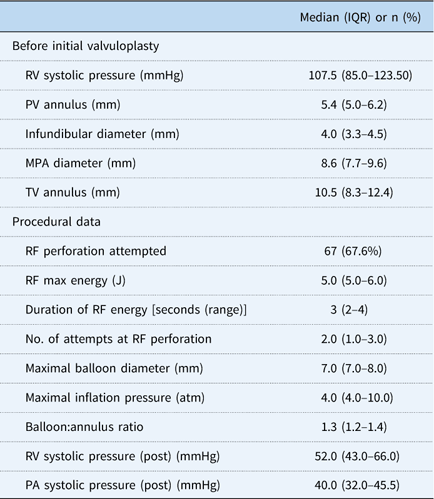
During the study period, 101 patients underwent right ventricle decompression for pulmonary atresia and intact ventricular septum, with 99 patients undergoing a catheter-based approach to decompression. The other two neonates underwent primary surgical right ventricle decompression. Among the 99 attempted transcatheter decompression patients, 28 (28.3%) were found to have virtual atresia of the pulmonary valve. For patients with virtual atresia, all underwent direct wire passage across the diminutive but native valve orifice at the time of BPV. For the remainder of the cohort, four underwent wire perforation of the atretic pulmonary valve, whereas 67 underwent radiofrequency energy perforation of the valve. The right ventricle systolic pressure dropped from 107 mmHg (25th–75th: 85–123) to 52 mmHg (25th–75th: 43–66) after BPV. The median balloon-to-annulus ratio was 1.3. See Table 1 for other procedural details.
Procedural characteristics.

IQR=interquartile range (25th–75th percentile); MPA=main pulmonary artery; PA=pulmonary atresia; PV=pulmonary valve; RF=radiofrequency; RV=right ventricle; TV=tricuspid valve
Cardiac perforation and other complications
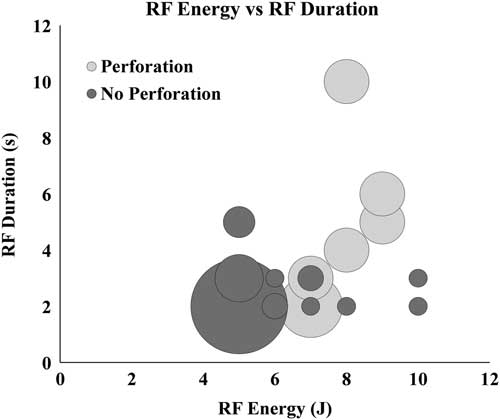
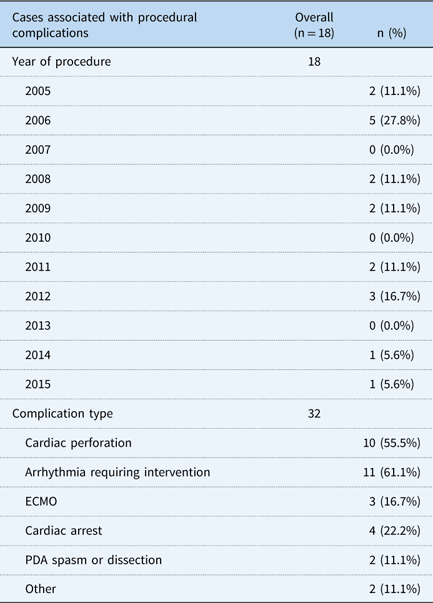
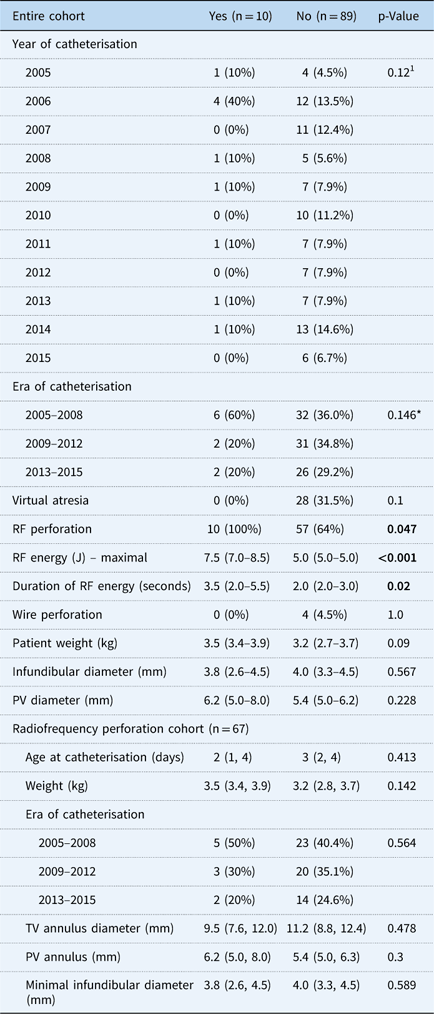
In total, 32 procedural complications occurred in 18 of the 99 patients (18.2%) undergoing attempted transcatheter right ventricle decompression (Table 2). Arrhythmias were the most common complications (n=11, 11%), whereas cardiac – either right ventricle outflow tract or main pulmonary artery – perforation occurred in 10 patients (10.5%). All 10 cardiac perforations occurred in the setting of radiofrequency energy pulmonary valve perforation, and none occurred in the setting of virtual atresia of the pulmonary valve. The cohort of patients who underwent radiofrequency perforation of the valve (n=67) were analysed separately for risk of cardiac perforation. In this subgroup analysis, there was no association of risk of cardiac perforation with era (p=0.564), patient weight (p=0.142), pulmonary valve annulus diameter (p=0.3), or infundibular diameter (p=0.589). Application of greater radiofrequency energy was associated with cardiac perforation (median 7.5 versus 5.0 J, p<0.001); longer duration of radiofrequency energy application was also associated with cardiac perforation (3.5 versus 2.0 s, p=0.02) (Fig 1). For every 1-J increase in radiofrequency energy, the odds of perforation complication increase by 116% (odds ratio [OR]=2.16, 95% confidence intervals [CI]: [1.46–3.19], p<0.001). Using logistic regression, every 1-second increase in radiofrequency duration increased the odds of cardiac perforation by 126%, although this association failed to reach statistical significance (OR=2.26, 95% CI: [0.90–5.68], p=0.084). Cardiac perforation was not related to patient size or to minimal infundibular diameter. More overall complications occurred in the first 5 years of the study period (18/32 occurred in the first 5 years, p=0.12). Although 60% of cardiac perforations occurred in the first 3 years of the study period (Table 3), this trend did not reach statistical significance (p=0.146).
Risk of Cardiac Perforation By Radiofrequency Energy and Duration. A boxplot demonstrates that the risk of cardiac perforation increases with increasing intensity of radiofrequency energy and increasing duration of radiofrequency energy application. The size of the circles indicates the number of patients with any given combination of time and energy.

Procedural complications.

ECMO=extracorporeal membrane oxygenation support; PDA=patent ductus arteriosus
Right ventricle (RV) or main pulmonary artery perforation complication.

PV=pulmonary valve; RF=radiofrequency; TV=tricuspid valve
* Cochran–Armitage trend test
Bold values indicate p-values which are <0.05
Among the 10 patients who experienced cardiac perforation, three had emergent pericardiocentesis followed by successful transcatheter valve perforation and BPV. One patient experienced no significant pericardial effusion, and after being observed for an hour underwent successful valve perforation and BPV. Two patients were discovered to have pericardial effusion and tamponade hours after unsuccessful attempts at radiofrequency-based right ventricle decompression and were therefore referred for emergent main pulmonary artery repair and surgical valvotomy. Two patients were noted to have cardiac perforation and were taken directly from the catheterisation laboratory to the operating room for urgent repair of cardiac perforation and subsequent valvotomy. Finally, two patients with main pulmonary artery perforation experienced cardiac tamponade and, despite emergent pericardiocentesis, were not able to be successfully resuscitated. Both of these deaths occurred during the first 4 years of the study period.
Re-intervention on the pulmonary valve
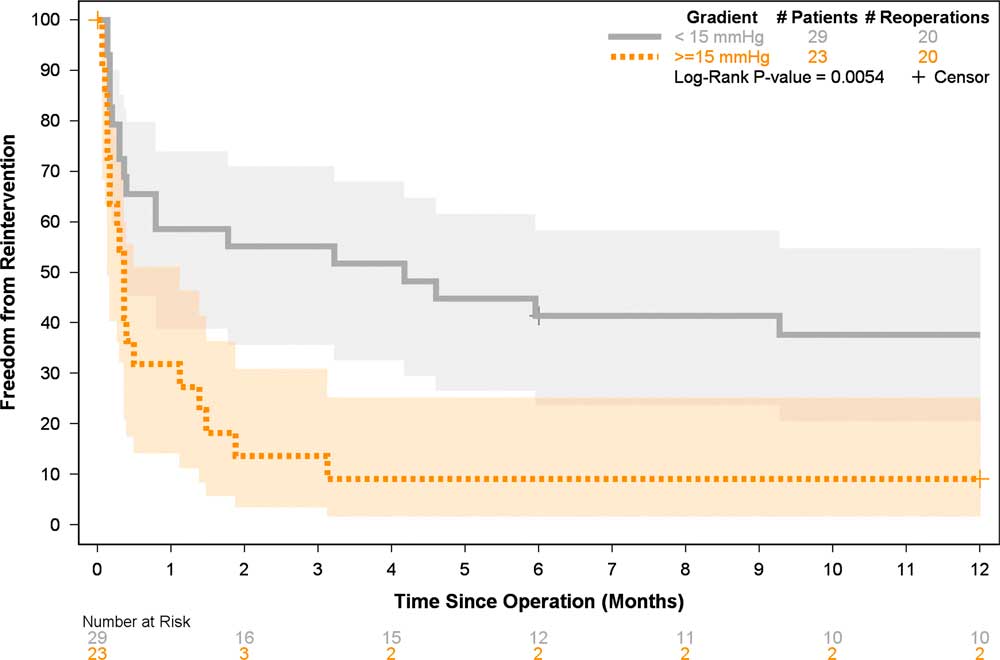
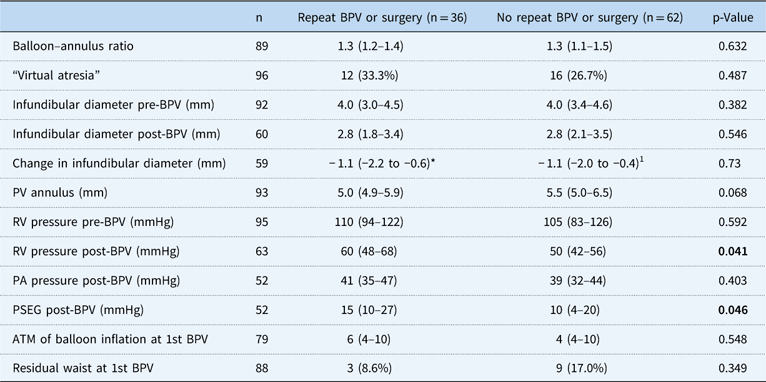
Repeat intervention was common in this pulmonary atresia and intact ventricular septum cohort, with 36/97 (37%) patients undergoing at least one repeat BPV (Table 4). When comparing the group that underwent repeat BPV with the group that did not, the baseline right ventricle systolic pressures were similar before initial valvuloplasty (p=0.59), but were higher following BPV (60 mmHg [25th–75th: 48–69] versus 50 mmHg [25th–75th: 42–56], p=0.041). The baseline right ventricle systolic pressure was higher in the repeat BPV cohort before initial valvuloplasty, and remained slightly higher after initial BPV (60 mmHg [25th–75th: 48–69] versus 50 mmHg [25th–75th: 42–56], p=0.041). In addition, the pulmonary valve peak systolic ejection gradient after initial BPV was slightly higher (15 mmHg [25th–75th: 10–27] versus 10 mmHg [25th–75th: 4–20], p=0.046) in the group that later underwent repeat BPV. Technical considerations such as balloon-to-pulmonary valve annulus ratio, maximal atmospheric pressure achieved during BPV, or the presence of a residual balloon waist during valvuloplasty were not different between the re-intervention and no re-intervention groups. Right ventricle anatomic characteristics, including pulmonary valve annulus, infundibular diameter, or change in infundibular diameter following initial BPV, also did not differ between groups. By 1 year post initial right ventricle decompression, the majority of the cohort had undergone repeat intervention to relieve recurrent right ventricle outflow tract obstruction, and patients with a residual pulmonary valve gradient at BPV1 ⩾15 mmHg had a higher risk of subsequent repeat BPV (log rank p=0.0054) (Fig 2).
Rate of Reintervention after Initial Pulmonary Valvuloplasty. A Kaplan-Meier curve demonstrates a higher risk of repeat balloon pulmonary valvuloplasty in neonates where the residual peak-to-peak catheter-derived gradient after initial valvuloplasty exceeded 15mmHg.

Re-intervention for recurrent pulmonary valve stenosis.

ATM=atmospheres; BPV=Balloon pulmonary valvuloplasty; PA=pulmonary atresia; PSEG=peak systolic ejection gradient; PV=pulmonary valve; RV=right ventricle
* Signed-rank test p<0.001
Bold values indicate p-values which are <0.05
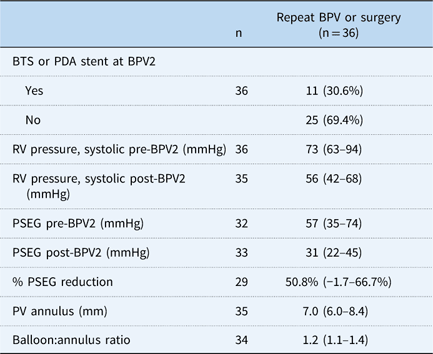
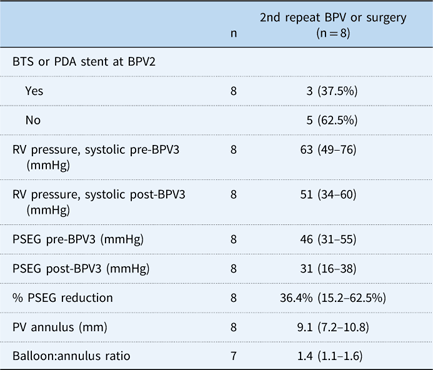
Results of repeat BPV are shown in Table 5. Right ventricle systolic pressure was decreased from a median of 73 mmHg (25th–75th: 63–94) to 56 mmHg (25th–75th: 42–68), with pulmonary valve peak systolic ejection gradient decreasing from 57 mmHg (25th–75th: 35–74) to 31 mmHg (25th–75th: 22–45), indicating a 50.8% reduction in peak gradient across the pulmonary valve. Following repeat BPV, eight patients went on to have a third BPV procedure, again for recurrent right ventricle outflow tract obstruction. The valve gradient was progressively lower at each subsequent valve re-intervention, as demonstrated in Table 6. There was a lower reduction in right ventricle systolic pressure (63 mmHg [25th–75th: 49–76] to 51 mmHg [25th–75th: 34–60]) and pulmonary valve peak systolic ejection gradient (46 mmHg [25th–75th: 31–55] to 31 mmHg [25th–75th: 16–38] or a 36.4% reduction) associated with BPV3.
Outcomes of repeat pulmonary valvuloplasty (BPV2 results).

BPV=balloon pulmonary valvuloplasty; BPV2=2nd balloon pulmonary valvuloplasty; BTS=Blalock–Taussig shunt; PDA=patent ductus arteriosus; PSEG=peak systolic ejection gradient; PV=pulmonary valve; RV=right ventricle
Outcomes of 2nd repeat pulmonary valvuloplasty (BPV3 results).

BPV=balloon pulmonary valvuloplasty; BPV2=2nd balloon pulmonary valvuloplasty; BTS=Blalock–Taussig shunt; PDA=patent ductus arteriosus; PSEG=peak systolic ejection gradient; PV=pulmonary valve; RV=right ventricle
Discussion
In this multicentre report, we found that technical factors relate to the risk of procedural complications during transcatheter right ventricle decompression in neonates with pulmonary atresia and intact ventricular septum. Specifically, exposure to higher intensity and greater duration of radiofrequency energy were each associated with a greater risk of cardiac perforation. Interestingly, patient characteristics such as low weight or small right ventricle infundibular diameter were not found to be associated with major procedural complications. Further, following successful right ventricle decompression in the neonate, the need for at least one re-intervention on the right ventricle outflow tract is common, occurring in more than one-third of the population. Haemodynamic measures, including higher right ventricle pressure and residual pulmonary valve peak gradient following neonatal right ventricle decompression, but not right ventricle anatomic characteristics or technical factors (e.g. balloon-to-pulmonary valve annulus ratio), were identified as predictors of re-intervention.
Transcatheter right ventricle decompression with pulmonary valve perforation was initially reported in 1991 by Parsons, Qureshi, and Latson.Reference Qureshi, Rosenthal, Tynan, Anjos and Baker 1 – Reference Parsons, Rees and Gibbs 3 Latson reported on a single case of wire perforation in a neonate with pulmonary atresia and intact ventricular septum using the stiff end of an 0.014″ wire, whereas Qureshi reported the use of laser wire to perforate the atretic pulmonary valve. In 1993, Rosenthal described the outcomes of the first 11 neonates to undergo right ventricle decompression with the laser-assisted technique.Reference Rosenthal, Qureshi, Kakadekar, Anjos, Baker and Tynan 6 Cumbersome, expensive, and hazardous to staff, laser-assisted valve perforation was also associated with a significant rate of cardiac and main pulmonary artery perforation with resultant pericardial tamponade. In 4/11 patients, perforation from the laser catheter resulted in cardiac tamponade and emergent pericardiocentesis (n=2) or death (n=2). Subsequent interest in the use of radiofrequency energy to perforate the pulmonary valve was reported and has subsequently persisted as a reliable method.Reference Alwi, Geetha and Bilkis 7 – Reference Rosenthal, Qureshi and Chan 9 Notably, Alwi et al demonstrated a significant survival benefit to the transcatheter approach to right ventricle decompression over surgical valvotomy. Yet, complications associated with pulmonary valve perforation in neonates with pulmonary atresia and intact ventricular septum have been reported in almost every series, and persist in the current era. Hasan reported main pulmonary artery or right ventricle perforation in 5/26 (19%) patients in their cohort.Reference Hasan, Bautista-Hernandez and McElhinney 4 In the largest published single-centre series of neonates undergoing radiofrequency perforation for pulmonary atresia and intact ventricular septum, Chubb also reported a 19% incidence of cardiac perforation with tamponade and haemodynamic instability or collapse, which resulted in two procedural deaths.Reference Chubb, Pesonen and Sivasubramanian 10 In neither the Chubb nor the Hasan series did the authors report factors associated with cardiac perforation.
In the present report, we found that cardiac perforation occurred in 10 of 65 (15.4%) patients where radiofrequency energy was used to perforate an atretic pulmonary valve. Importantly, the risk of cardiac perforation was associated with the use of higher intensity and/or greater duration of radiofrequency energy. Although early reports describing radiofrequency pulmonary valve perforation included energy usage across a broad energy spectrum of 5–25 J, a range much greater than the experience we report, even in the lower spectrum of radiofrequency energy use applied in the current report, subtly higher radiofrequency energy intensity or longer duration conferred a greater risk of cardiac perforation. This finding has not been reported previously. Given that radiofrequency perforation of the pulmonary valve may be necessary to achieve clinical success, the authors recommend utilisation of the lowest radiofrequency energy intensity and duration necessary to result in successful perforation of the membranous atresia valve plate. Doing so may limit the ability of the radiofrequency wire to traverse the thicker, yet still relatively thin, free wall of the right ventricle outflow tract or proximal main pulmonary artery, thus resulting in an unsuccessful valve perforation attempt rather than transmural perforation with resultant pericardial tamponade when the wire trajectory is imperfect. Even with this caution, cardiac perforation will likely remain an important risk attendant to radiofrequency energy perforation in this population. The persistent hazard of cardiac perforation across the entirety of the study period, independent of case year or era, further suggests that this is an inherent risk of the procedure, independent of a presumed procedural “learning curve”. This persistent concern related to radiofrequency technology has led to the pursuit of alternative and potentially safer techniques to perforate the atretic valve, such as the use of chronic thrombotic occlusion recanalisation coronary wires and even the adoption of a hybrid per-ventricular approach in some cases.Reference Alwi, Budi, Mood, Leong and Samion 11 – Reference Zampi, Hirsch-Romano, Goldstein, Shaya and Armstrong 13 The use of chronic thrombotic occlusion wires for perforation, which sport a mere 0.009″ to 0.014″ diameter at the tip, may offer the benefit of avoiding haemodynamically meaningful consequences even when unintentional cardiac or vascular perforation occurs.
Importantly, we did not identify a relationship between patient characteristics and risk of procedural adverse events. Lower patient weight, smaller right ventricle infundibular diameter, and pulmonary valve annulus were not associated with an increased risk of catheter-based complications. These findings affirm the clinical sense that pulmonary valve perforation and balloon dilation is safe even in small patients and small anatomic right ventricle outflow tracts. Thus, it is rather ideal for the interventionalist to be in control of the modifiable risk factors – for example, radiofrequency characteristics – and not face additional patient-level fixed risk factors.
The technical approach to BPV after a successful valve perforation can be demanding. Although there is widespread recognition of the ideal range of balloon-to-pulmonary valve annulus ratio for the neonate with critical pulmonary valve stenosis, the ideal balloon-to-pulmonary valve annulus ratio for neonates with pulmonary atresia and intact ventricular septum is less well defined.Reference McCrindle 14 In fact, Hasan reported a wide range of maximal balloon-to-pulmonary valve annulus ratio from 0.8 to 2.0.Reference Hasan, Bautista-Hernandez and McElhinney 4 Other authors have suggested the use of a balloon-to-pulmonary valve annulus ratio <0.9 in all cases.Reference Marasini, Gorrieri and Tuo 15 Choosing a maximal balloon diameter, and thus balloon-to-pulmonary valve annulus ratio, requires the interventionalist to appreciate the variable anatomy of the subvalvar, valvar, and supravalvar right ventricle outflow tract. For example, the subvalvar infundibular diameter may be much smaller than the valve annulus diameter, potentially limiting the effective balloon diameter achieved at initial valvuloplasty – or placing this region at risk for injury when using a balloon that is appropriately sized for the annulus itself. Moreover, subvalvar obstruction in neonates with pulmonary atresia and intact ventricular septum after BPV is frequently encountered and may be associated with a significant right ventricle outflow tract gradient, making delineation of residual valvular versus subvalvar obstruction difficult in the acute setting immediately after BPV. Further, the right ventricle systolic pressure may remain elevated after an effective BPV secondary to the presence of a significant patent ductus arteriosus, further complicating the assessment of post-BPV haemodynamics. Finally, caution in maximal balloon diameter selection is warranted in light of the long-term sequelae of high balloon-to-pulmonary valve annulus ratio on pulmonary insufficiency, right ventricle dilation, and exercise capacity.Reference Harrild, Powell and Tran 16 In our study, the median maximal balloon-to-pulmonary valve annulus ratio was >1.2, although balloon-to-pulmonary valve annulus ratio was not associated with resultant right ventricle systolic pressure or risk of re-intervention. Other key technical considerations during BPV, including maximal atmospheres achieved and the presence of a residual balloon waist, were also not found to be associated with the need for re-intervention. Taken as a whole, it may be the case that technical considerations during performance of BPV have less impact on the risk of right ventricle outflow tract re-intervention than do underlying right ventricle outflow tract and pulmonary valve characteristics and their impact on right ventricle haemodynamics.
Not surprisingly, we found that higher residual pulmonary valve peak systolic ejection gradient after initial valvuloplasty was associated with higher risk of repeat BPV. Previous studies have demonstrated a multitude of anatomic risk factors associated with increased risk of repeat intervention, including lesser tricuspid regurgitation and smaller tricuspid valve annulus.Reference Hasan, Bautista-Hernandez and McElhinney 4 , Reference Petit, Glatz and Qureshi 5 , Reference Chubb, Pesonen and Sivasubramanian 10 However, we found in the current study that there was no apparent relationship between any technical aspect of right ventricle decompression and the rate of repeat BPV. Those neonates who left the catheterisation laboratory with a gradient >15 mmHg were at a significantly higher risk of repeat BPV. The high re-intervention rate found in our multicentre cohort is consistent with other published reports. Interestingly, in the series reported by Hasan, 62% of patients underwent either surgical or catheter-based re-intervention for recurrent right ventricle outflow tract – valvar or subvalvar – obstruction,Reference Hasan, Bautista-Hernandez and McElhinney 4 whereas the rate in the present report approached 37%. Importantly, in the face of this high rate of re-intervention, the efficacy of repeat BPV declined with each repeat dilation, with a decrease in peak systolic ejection gradient of 51% at the first repeat valvuloplasty and only 36% at the second repeat valvuloplasty. Despite the relatively diminishing returns achieved with each subsequent BPV, modest gradient relief may still be impactful at the individual patient level.
This study has several important limitations. First, despite the large cohort assembled herein, this rare disease remains difficult to analyse with adequate statistical power to identify all potential factors associated with key clinical outcomes, such as cardiac perforation or need for re-intervention. Second, given the retrospective study design, certain data elements are at risk for error during collection. For example, accurate identification of radiofrequency energy duration depends upon accurate and complete data compilation within the medical record. Such granular details may not be recorded for each individual application of radiofrequency energy. Finally, we did not specifically review individual operator experience in this study.
In conclusion, in this large multicentre report on neonates with pulmonary atresia and intact ventricular septum who underwent attempted transcatheter right ventricle decompression, we found that technical factors were associated with risk of procedural adverse events. Specifically, radiofrequency energy-related characteristics were associated with an increased risk of cardiac or vascular perforation. Further, independent of identifiable characteristics of the underlying anatomic substrate, or technical considerations related to balloon selection or dilation, re-intervention for recurrent right ventricle outflow tract obstruction is common in this population and relates to residual right ventricle hypertension and pulmonary valve peak systolic ejection gradient after initial BPV.
Acknowledgements
This work was undertaken and completed by the Congenital Catheterization Research Collaborative (CCRC).
Financial Support
None
Conflicts of Interest
None.
Ethical Standards
This work is the result of full participation among all listed authors and was approved by institutional research boards of each member.