





Suicide remains a critical global public health challenge, with more than 720 000 deaths annually and ranking as the third leading cause of death among people aged 15–29 years. 1 Approximately 73% of these deaths occur in low- and middle-income countries, where access to mental health services is limited. Suicide results from a complex interaction of social, cultural, psychological, biological and environmental factors, emphasising the need for multisectoral, evidence-based interventions that extend beyond traditional clinical paradigms. 1
In the UK, suicide continues to represent a significant public health concern. In 2023, England and Wales recorded 6069 suicide deaths, the highest number since 1999, with an age-standardised mortality rate of 11.4 per 100 000. 2 Males consistently account for approximately three-quarters of these deaths. Importantly, 80% of individuals who die by suicide while in contact with mental health services are assessed as ‘low’ or ‘no’ risk at their final clinical interaction, illustrating the limitations of traditional risk prediction approaches and highlighting the need for relational, person-centred models of care. 3 The number of individuals experiencing suicidal distress is substantially greater than the number who die by suicide or present to services, with many remaining unsupported within the community. Reference Saini, Kullu, Mullin, Boland and Taylor4 A suicidal crisis can be understood as a transient yet acute state of overwhelming psychological distress, characterised by unbearable emotional pain and heightened vulnerability, during which suicide may be perceived as the only solution, necessitating timely and targeted intervention. Reference Saini, Kullu, Mullin, Boland and Taylor4
The UK Government’s Suicide Prevention Strategy (2023–2028) emphasises collaborative safety planning, therapeutic alliance and flexible consideration of psychosocial risk. 5 Within this policy landscape, peer support and lived experience initiatives have gained increasing recognition. Recovery Support Services (RSS) and Lived Experience Recovery Organisations (LEROs) offer practical and emotional support to individuals and families, strengthen resilience and foster connections with wider recovery communities. 6 Community-based suicide crisis services play an important role within suicide prevention systems by providing accessible, person-centred support that complements clinical care and expands the range of options available to individuals experiencing crisis. Evidence indicates that these services reduce barriers to care, enhance engagement and provide safe, non-clinical environments that support recovery. Reference Saini, Chopra, Hanlon, Boland, Harrison and Timpson7–Reference Sambrook, Balmer, Tait, Ashley-Mudie, McIntyre and Shetty10 Sambrook et al Reference Sambrook, Balmer, Tait, Ashley-Mudie, McIntyre and Shetty10 found that crisis cafés and third-sector collaborations were described by service users as lifesaving because of their out-of-hours availability, rapid access and continuity of care, an especially valuable resource given long National Health Service (NHS) waiting times. Service users also valued holistic support that extended beyond diagnosis and promoted hope through community engagement. Reference Saini, Hanlon, Chopra and Boland9,Reference Sambrook, Balmer, Tait, Ashley-Mudie, McIntyre and Shetty10 However, services such as crisis cafés have also identified challenges in accessing and integrating with clinical care pathways. For younger people, peer support has similarly been identified as a key component of responsive suicide prevention and may offer a more accessible form of support. Reference Saini, Hendriks and Foster8
An effective community-based intervention is James’ Place, a service in England that provides therapy for men experiencing suicidal crisis. Reference Saini, Chopra, Hanlon, Boland, Harrison and Timpson7,Reference Saini, Hanlon, Chopra and Boland9,Reference Saini, Chopra, Hanlon, Boland and O’Donaghue11 Its model draws on the Interpersonal Theory of Suicide (ITS), Reference Joiner, Van Orden, Witte and Rudd12 the Collaborative Assessment and Management of Suicidality (CAMS) Reference Jobes13 and the Integrated Motivational-Volitional Theory of Suicide (IMV). Reference O’Connor and Kirtley14,Reference OConnor15 The service engages clients in co-produced safety plans and accepts referrals through multiple pathways. Both in-person and remote delivery, introduced during the COVID-19 pandemic, reduced psychological distress and improved recognition of warning signs. Remote delivery also increased access for individuals facing practical barriers. Limitations of these studies include single-site design, reliance on one outcome measure and lack of long-term follow-up, but findings demonstrate the value and scalability of flexible community-based interventions. Reference Saini, Hanlon, Chopra and Boland9
Peer-led and community-based approaches are equally important in suicide bereavement care. Group programmes combining creative, recreational and emotional-support elements reduce loneliness, strengthen peer and caregiver relationships and provide age-appropriate opportunities for connection. Reference Saini, Hendriks and Foster8 Such approaches address needs that are frequently overlooked by clinical models and foster social connectedness and coping capacity. Reference Sambrook, McIntyre, Nathan, Tait, Ashley-Mudie and Humphreys16,Reference Hanlon, McIlroy, Poole, Chopra and Saini17 However, consistent limitations include the absence of routine data collection, limited longitudinal evidence and reliance on qualitative feedback. Greater integration of evaluation processes and stronger alignment with broader community care systems are essential to ensure sustainability and maximise impact.
The Martin Gallier Project (MGP) is a prominent example of an innovative, community-based, non-clinical suicide intervention model delivered in partnership with Cheshire and Wirral Partnership (CWP) NHS Foundation Trust. The MGP provides rapid-access, barrier-free support delivered by suicide intervention specialists using the Pathway for Assisting Life (PAL), which is derived from Applied Suicide Intervention Skills Training (ASIST). 18 This model emphasises emotionally attuned, person-centred support focused on crisis resolution, safety planning and postvention, effectively bridging gaps between NHS services and community resources. Reference Samartzis and Talias19,Reference van Hoof, Knispel, Aagaard, Schneider, Beeley and Keet20
The sustainability of such services depends on stable funding, workforce capacity and integration within local systems. High-quality service delivery requires ongoing investment in staff training, technology and clinical supervision, 5 while effective referral pathways depend on strong partnerships with primary care, emergency departments, universities and voluntary organisations. 2 Systematic evaluation of outcomes, including long-term psychological impact, engagement metrics and client satisfaction, is essential to adapt services to changing needs. Reference Samartzis and Talias19 Government commitment through policy and funding plays a pivotal role in strengthening community-based models and is much needed. Reference van Hoof, Knispel, Aagaard, Schneider, Beeley and Keet20 Without coordinated planning and investment, the reach and impact of these services may be compromised. Reference Kiima and Jenkins21,Reference Vähäniemi, Warwick-Smith, Hätönen and Välimäki22
This mixed-methods study aimed to examine outcomes of a community-based suicide intervention supporting individuals experiencing suicidal crisis, with particular attention to differences in outcomes across NHS and non-NHS/self-referral pathways.
The primary objectives were to:
-
(a) assess differences in client outcomes between NHS-referred and non-NHS/self-referred individuals accessing MGP services;
-
(b) evaluate the impact of MGP interventions on outcomes among NHS-referred individuals, generating evidence to inform service improvement and policy development;
-
(c) examine the effectiveness of the MGP service model, including the contribution of peer support and lived experience within a community-based, recovery-oriented approach to suicidal crisis care.
Method
Design
A mixed-methods explanatory sequential design was used Reference Kasakewitch, Coelho and Lima23 to assess MGP’s service impact and client outcomes. This approach integrates quantitative and qualitative data to enable triangulation and strengthen the robustness of the findings. Reference Cohen, Manion and Morrison24 Quantitative data were collected and analysed first, followed by a qualitative semi-structured purposive sample of interviews to contextualise and elaborate on initial results. Preliminary quantitative findings informed the development of the interview schedule, enabling the qualitative phase to explore and contextualise key patterns identified in the data. This design facilitated the identification of patterns and associations in service delivery alongside in-depth insights into client and stakeholder experiences, supporting a comprehensive evaluation of service effectiveness.
Sample
Participants were individuals aged 16 years and over who accessed MGP services through NHS referrals (NHS subcontract status) or non-NHS pathways (self-referral or voluntary/community pathways). Quantitative data were drawn from anonymised, routinely collected client records for all individuals accessing MGP services between 23 February 2019 and 5 August 2025, comprising 9801 clients over a 6-year period. Fifty interviews were conducted with clients (n = 20), carers (n = 10), staff members (employees or volunteers; n = 10) and practitioners/referrers (n = 10). Interviews were conducted between 3 March and 26 May 2025.
Measures
Quantitative data
The quantitative data-set comprised records from 9801 clients, of whom 2550 had structured outcome data collected using the validated Mental Health Recovery Star Outcome Tool (Recovery Star). Reference Dickens, Weleminsky, Onifade and Sugarman25 The Recovery Star assesses progress across ten well-being domains, including mental health, social networks and daily living skills, 26 and is based on a five-stage ‘ladder of change’: being stuck, accepting help, believing, learning and self-reliance. Data for this study were collected at four stages of support – crisis, post crisis, interim and final – using the Recovery Star at each stage, with intervention workers recording outcome measures as individuals progressed through the service pathway. Although widely used in UK mental health services, Reference Dickens, Weleminsky, Onifade and Sugarman25 limitations in available psychometric evidence have been noted. Reference Burgess, Pirkis, Coombs and Rosen27 The Recovery Star was used to assess recovery-oriented changes in psychosocial well-being, reflecting its widespread use in community mental health settings and its alignment with person-centred approaches. Although it is not a measure of acute suicide risk, it was used alongside safety planning to support structured suicide risk discussions, providing complementary insights into both safety and broader recovery outcomes.
Key variables included referral source (NHS, self-referral, community/other), presence of a mental health diagnosis (yes/no/unknown), age group (16–24, 25–44, 45–64, 65+), gender (self-reported) and a composite Recovery Star progress score. Data were fully anonymised before receipt and screened for duplicates, outliers and inconsistencies. Missing data were handled using imputation or case-wise exclusion as appropriate. Referral sources were grouped into three categories and Recovery Star scores were standardised to enable comparisons across demographic groups and time periods.
Qualitative data
Eligible participants (n = 50) were identified by the MGP through advisory groups comprising former clients and stakeholders. Informed consent was obtained using written or audio-recorded procedures. Verbal consent was witnessed and formally recorded. An interview schedule was co-developed with input from the research team and the advisory group. Interviews explored experiences of accessing the service and the support received, perceived outcomes, carers’ perspectives on service impact, staff experiences of service delivery and referrers’ understanding of the service and its outcomes. One-to-one interviews were conducted by A.G. either in person at MGP sites or online via Microsoft Teams and lasted approximately 30–45 min. Participant comfort and confidentiality were prioritised throughout.
Data analysis
Quantitative analysis
Quantitative data were analysed using R and RStudio 2024.12.0 (‘Kousa Dogwood’) on a Windows platform (R Foundation for Statistical Computing, Vienna, Austria; https://www.r-project.org/). Descriptive statistics summarised demographic characteristics, referral pathways and service engagement. Comparative analyses examined outcome differences across referral sources and demographic groups, with data normalisation applied where required. Data visualisations were produced to illustrate trends. Changes in recovery trajectories were assessed using paired t-tests on Recovery Star outcome scores across key time points (initial crisis contact, interim, post crisis and final stages), enabling evaluation of statistically significant within-subject changes over time.
Qualitative analysis
Interviews were audio-recorded with participants’ consent, transcribed verbatim and checked for accuracy by the interviewer (A.G.). Data were analysed using reflective thematic analysis. Reference Braun and Clarke28 A hybrid coding approach combined iterative codes informed by quantitative findings with inductive codes derived from the data. Coding decisions were reviewed through iterative discussion within the research team to ensure interpretive consistency. A critical reflexive stance was adopted, recognising the influence of societal norms on behaviour and perception. Reference Braun and Clarke28
Quantitative and qualitative findings were integrated, with quantitative trends informing interview focus and qualitative insights contextualising and explaining outcomes. Analysis was iterative and inductive, supported by regular meetings between the research team (A.G., P.S. and L.M.S.). Procedural reliability and conceptual credibility were enhanced through independent review of a subset of transcripts by team members experienced in qualitative methods. Transcripts were hand-coded line by line, with data collection and analysis conducted concurrently to capture both individual perspectives and shared themes across participants.
Public and patient involvement
The research question was developed collaboratively by local health service providers, public advisors and researchers. Public advisors, who had lived experience and knowledge of the MGP and its delivery context, played an active role throughout the study. They contributed to shaping the research focus, informing the planned analyses through a series of meetings and ensuring the relevance of the research to service users. Public advisors (J.G.B. and D.B.) are co-authors of this paper and were involved in both the interpretation of the findings and the drafting of the manuscript.
Ethics
Ethical approval was obtained from Liverpool John Moores University Ethics Committee (reference number: 25/PSY/019). All data were managed in accordance with UK General Data Protection Regulation (UK GDPR) requirements. Only anonymised quantitative data were shared with the research team and no personally identifiable information was accessible to the researchers. Personal data of participants were securely stored and handled by the service in line with data protection regulations, with appropriate safeguards in place to ensure confidentiality. For the interviews, all participants were recruited through a community-based service (MGP) and not via NHS services and, therefore, NHS Research Ethics Committee approval was not required. Given the sensitive nature of the research, appropriate measures were taken throughout the study to safeguard both participants and researchers.
Results
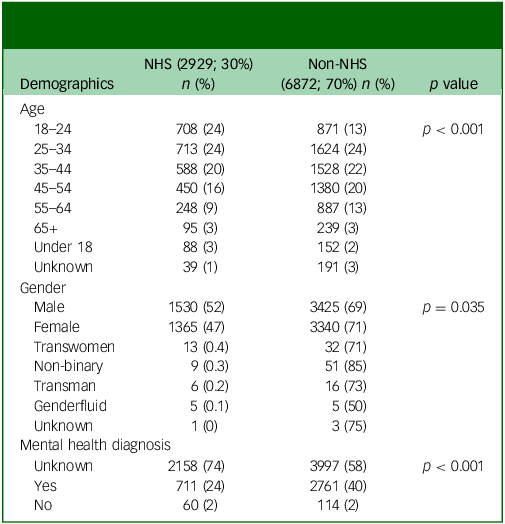
A total of 9801 individuals accessed the MGP between 2019 and 2025. The MGP provided an open-access referral pathway characterised by multiple entry routes, including self-referral, third-party referral and referrals from NHS crisis and liaison services. Individuals were typically contacted by a suicide intervention worker within 24 h of referral, enabling rapid triage and the development of an immediate safety plan. The absence of waiting lists or eligibility criteria facilitated timely engagement during periods of acute need, while integration with statutory services enabled onward referral where clinical intervention was required. This pathway supported a continuum of care from crisis intervention to longer-term, prevention-focused support. Table 1 summarises the distribution of clients across the NHS and non-NHS referral pathways and differences across age groups, gender identity and mental health diagnosis.
Participant demographic overview for NHS and non-NHS referral pathways

Table 1 Long description
A table comparing participant demographics across NHS and non-NHS referral pathways. The table has 12 rows and 5 columns. The columns are labeled Age, Gender, and Mental health diagnosis. The table compares the number and percentage of participants in each category for NHS and non-NHS referral pathways. Row 1: Age 18-24, NHS 708 (24 percent), Non-NHS 871 (13 percent). Row 2: Age 25-34, NHS 713 (24 percent), Non-NHS 1624 (24 percent). Row 3: Age 35-44, NHS 588 (20 percent), Non-NHS 1528 (22 percent). Row 4: Age 45-54, NHS 450 (16 percent), Non-NHS 1380 (20 percent). Row 5: Age 55-64, NHS 248 (9 percent), Non-NHS 887 (13 percent). Row 6: Age 65+, NHS 95 (3 percent), Non-NHS 239 (3 percent). Row 7: Age Under 18, NHS 88 (3 percent), Non-NHS 152 (2 percent). Row 8: Age Unknown, NHS 39 (1 percent), Non-NHS 191 (3 percent). Row 9: Gender Male, NHS 1530 (52 percent), Non-NHS 3425 (69 percent). Row 10: Gender Female, NHS 1365 (47 percent), Non-NHS 3340 (71 percent). Row 11: Gender Transwomen, NHS 13 (0.4 percent), Non-NHS 32 (71 percent). Row 12: Gender Non-binary, NHS 9 (0.3 percent), Non-NHS 51 (85 percent). Row 13: Gender Transman, NHS 6 (0.2 percent), Non-NHS 16 (73 percent). Row 14: Gender Genderfluid, NHS 5 (0.1 percent), Non-NHS 5 (50 percent). Row 15: Gender Unknown, NHS 1 (0 percent), Non-NHS 3 (75 percent). Row 16: Mental health diagnosis Unknown, NHS 2158 (74 percent), Non-NHS 3997 (58 percent). Row 17: Mental health diagnosis Yes, NHS 711 (24 percent), Non-NHS 2761 (40 percent). Row 18: Mental health diagnosis No, NHS 60 (2 percent), Non-NHS 114 (2 percent).
NHS, National Health Service.
Comparison between groups revealed significant associations with gender, age and mental health diagnosis. Although gender showed a statistically significant but very weak association (Cramer’s V = 0.036, p = 0.035), both age (Cramer’s V = 0.162, p < 0.001) and mental health diagnosis (Cramer’s V = 0.152, p < 0.00000495) showed moderate associations, indicating meaningful differences in their distributions across referral pathways. Standardised residuals suggested that the association between age and NHS referral was primarily driven by the 18–24 and 45–64 year age groups, with other age categories showing minimal deviations. Gender distributions differed overall (Fisher’s Exact Test, p = 0.035), although no individual category remained significant after Bonferroni correction. Post hoc analyses of mental health diagnosis indicated significant differences in the proportions of individuals reporting ‘Yes’ and ‘Unknown’ for having a mental health diagnosis between NHS and non-NHS groups (adjusted p < 0.001), compared with those reporting no mental health diagnosis.
Referral sources
Referral pathways were diverse, spanning self-referrals, NHS services (including mental health services, primary care and community services), third-sector organisations and statutory agencies. Figure 1 summarises the most frequent sources. Self-referral was the single largest pathway (37%), illustrating strong community awareness and accessibility. At the same time, structured NHS pathways (e.g. liaison psychiatry, home treatment teams and crisis lines) collectively accounted for 30% of referrals, demonstrating integration with statutory crisis services.
Client referral pathway distribution chart. CWP, Cheshire and Wirral Partnership; NHS, National Health Service; TTW, NHS Wirral Talking Therapies; HTT, Home Treatment Team; GP, general practitioner; CAB, Citizen Advice Bureau.

Subanalysis of clients completing Recovery Star outcome measures
Total Recovery Star scores were compared across age group, referral source, diagnosis and gender. Age group had a significant effect (F(7, 2342) = 3.09, p = 0.003), with adults aged 65 years and over scoring higher than younger age groups. No significant differences were found by diagnosis (F(2, 2347) = 0.65, p = 0.52) or gender (F(5, 2344) = 1.32, p = 0.25). Scores differed by referral source (F(66, 2283) = 2.38, p < 0.001), with NHS referrals averaging 6.7 points lower than non-NHS referrals, although both groups converged by the final assessment (see Fig. 2). Paired t-tests demonstrated significant improvements across all domains (p < 0.05), providing strong evidence of intervention effectiveness.
Average recovery star score for NHS and non-NHS referrals. NHS, National Health Service.

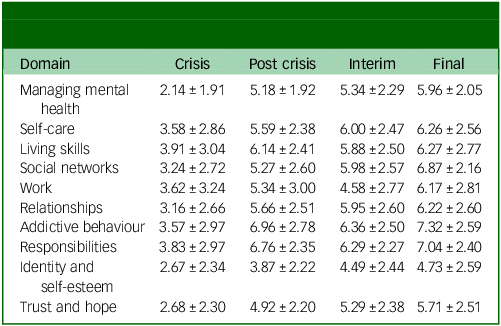
The Recovery Star was completed at up to four stages of support: Crisis (n = 1360; 58%), Post crisis (n = 768; 33%), Interim (n = 119; 5%) and Final (n = 114; 5%), with most assessments completed at the initial Crisis stage. Mean scores across the 10 domains are presented in Table 2 for 2361 client entries (24%). Scores showed steady improvement across all domains, with the greatest gains observed in addictive behaviour and responsibilities. Identity and self-esteem, together with trust and hope, also improved but remained comparatively lower.
Recovery Star domain scores (mean ± s.d.) by stage (n = 2361)

Table 2 Long description
A table titled Recovery Star domain scores (mean ± SD) by stage (n=2361) presents mean scores and standard deviations across 10 domains at four stages of support: Crisis, Post-crisis, Interim, and Final. The table has 10 rows and 5 columns. The columns are labeled Domain, Crisis, Post-crisis, Interim, and Final. The rows are labeled with the domains: Managing mental health, Self-care, Living skills, Social networks, Work, Relationships, Addictive behaviour, Responsibilities, Identity and self-esteem, and Trust and hope. Each cell contains the mean score and standard deviation for the respective domain and stage. Row 1: Managing mental health, Crisis: 2.14 ± 1.91, Post-crisis: 5.18 ± 1.92, Interim: 5.34 ± 2.29, Final: 5.96 ± 2.05. Row 2: Self-care, Crisis: 3.58 ± 2.86, Post-crisis: 5.59 ± 2.38, Interim: 6.00 ± 2.47, Final: 6.26 ± 2.56. Row 3: Living skills, Crisis: 3.91 ± 3.04, Post-crisis: 6.14 ± 2.41, Interim: 5.88 ± 2.50, Final: 6.27 ± 2.77. Row 4: Social networks, Crisis: 3.24 ± 2.72, Post-crisis: 5.27 ± 2.60, Interim: 5.98 ± 2.57, Final: 6.87 ± 2.16. Row 5: Work, Crisis: 3.62 ± 3.24, Post-crisis: 5.34 ± 3.00, Interim: 4.58 ± 2.77, Final: 6.17 ± 2.81. Row 6: Relationships, Crisis: 3.16 ± 2.66, Post-crisis: 5.66 ± 2.51, Interim: 5.95 ± 2.60, Final: 6.22 ± 2.60. Row 7: Addictive behaviour, Crisis: 3.57 ± 2.97, Post-crisis: 6.96 ± 2.78, Interim: 6.36 ± 2.50, Final: 7.32 ± 2.59. Row 8: Responsibilities, Crisis: 3.83 ± 2.97, Post-crisis: 6.76 ± 2.35, Interim: 6.29 ± 2.27, Final: 7.04 ± 2.40. Row 9: Identity and self-esteem, Crisis: 2.67 ± 2.34, Post-crisis: 3.87 ± 2.22, Interim: 4.49 ± 2.44, Final: 4.73 ± 2.59. Row 10: Trust and hope, Crisis: 2.68 ± 2.30, Post-crisis: 4.92 ± 2.20, Interim: 5.29 ± 2.38, Final: 5.71 ± 2.51.
The radar chart in Fig. 3 illustrates significant improvements across key well-being domains from the Crisis to the Post-crisis stage for all clients (n = 2361; 24%). These findings suggest that the intervention contributes to reducing immediate suicide risk while strengthening protective factors associated with longer-term well-being. Overall, the results highlight multidimensional recovery: although substantial gains were observed in behavioural stability and daily functioning, improvements in deeper psychological domains were more modest, suggesting that these areas may require ongoing support.
Recovery star scores from the Crisis stage to the Post-crisis stage.

Longitudinal analysis (n = 112; 1%)
Among 112 individuals with data from both the Crisis and Final stages, 95% (n = 106) showed improvement (see Fig. 4). Average scores increased from 35 at the Crisis stage to 63 at the Final assessment, indicating substantial improvement over time. The predominance of positive trajectories supports the effectiveness of MGP in facilitating recovery, although these outcomes should be interpreted as proxy indicators of change in domains associated with suicidality. Variability in rates of improvement further suggests the importance of tailoring interventions to individuals’ initial levels of need.
Progression of average scores across stages (for participants with Final stage).

Missing data
Missing data were concentrated in early years and primarily reflected the service’s initial low-barrier model, which did not require disclosure of demographic or clinical information. Over time, data completeness improved markedly, with only minimal missing data in recent records. This demonstrates strengthened monitoring capacity while retaining a client-centred ethos that prioritises accessibility over administrative burden.
Interview findings
Fifty semi-structured interviews were conducted with key stakeholder groups, including clients (n = 20), carers (n = 10), staff members (n = 10) and practitioners/referrers (n = 10). These interviews provided contextual and experiential insights into engagement with MGP services, complementing the quantitative findings and enabling triangulation of results. Thematic analysis identified three key themes reflecting shared experiences across stakeholder groups and providing insight into how the service facilitates engagement and recovery. These themes were: (a) rapid access, continuity and immediate support, (b) bridging the gap between crisis and longer-term care and (c) the value of lived experience and relatable staff. Together, they highlight the importance of accessible, relational and person-centred approaches in shaping service impact beyond quantitative outcomes and are explored in greater detail in the following sections.
Rapid access, continuity and immediate support
Across all groups, participants consistently highlighted the critical importance of rapid, seamless access to suicide-specific support. Minimising delays was described as potentially lifesaving, particularly during acute periods of crisis when individuals were most vulnerable. Continuity of care, and knowing that support would be consistent, reliable and uninterrupted, helped foster trust, reduce anxiety and prevent individuals from feeling lost within fragmented systems. Immediate responses were perceived not only as a practical intervention but also as a powerful affirmation that individuals were heard, valued and not facing their distress alone.
Communication and collaboration between the MGP and referrers were described as highly responsive and reciprocal. This dynamic interaction enabled flexible safety planning that adapted to the rapidly changing needs of individuals at risk. The ability to make referrals or initiate contact within 24 h, together with the option for walk-ins during opening hours, removed common barriers, such as lengthy waiting lists, that often intensify suicidal distress:
‘If someone’s in crisis, then they need help now. Especially when it comes to suicidal crisis, this person is considering ending their life… we’re like, “Right, come and see us now.’” Employee or volunteer (EV) 3
The organisational culture further reinforced psychological safety and openness, with staff encouraged to share ideas and contribute meaningfully to service development:
‘It doesn’t matter what role you’re in; you are listened to and supported. If you have an idea and it’s going to work or people think it’s good, they will promote that idea.’ EV5
A central aspect of rapid support involved empowering individuals to build sustainable coping strategies. This proactive focus on self-reliance was viewed as crucial for long-term recovery, enabling clients to regain a sense of agency and resilience beyond the immediate crisis:
‘Supporting clients to be independent and support themselves.’ EV1
Carers also emphasised the significance of timely access, often describing it as the decisive factor in managing acute episodes of distress in their loved ones. One participant reflected on how exceptionally prompt the process felt:
‘They were quick on the referral. I think I had a phone call the same day to get me booked in, and when I went to see them, they were just fantastic. They were very, very quick.’ Client (CL) 16
This contrasted sharply with experiences of statutory services, where long waiting times are common, underscoring the unique value of responsive community-based support. For both individuals in crisis and those supporting them, knowing that help is available without delay created a profound sense of safety, reassurance and validation. Professionals from statutory services echoed this view. A clinical lead in liaison psychiatry described the MGP as integral to their post-crisis safety planning:
‘The Martin Gallier Project is very much part of our safety plans if we can signpost anyone to there.’ Practitioner/referrer (PR) 1
The speed of the MGP’s response was frequently highlighted by staff as a defining feature of the service:
‘The fact that we don’t have a waiting list, people can walk in through the front door, they can phone us within our opening hours, they can make a referral, and they’re contacted within a 24-hour timeframe.’ EV8
This capacity for rapid, continuous support offered reassurance not only to those experiencing crisis, but also to practitioners responsible for safeguarding them, ensuring that timely intervention was always accessible when it mattered most.
Bridging the gap: transitional support between crisis and longer-term care
Participants emphasised the essential role of services that provide support during the transitional period between immediate crisis intervention and access to longer-term mental health care. This ‘in-between’ phase often marked by delays, rigid thresholds or a lack of available statutory provision was described as a particularly vulnerable time when individuals are at heightened risk of deterioration or disengagement. Services that can offer continuity during these gaps were seen as crucial in preventing people from falling through systemic cracks and in reducing the fragmentation commonly experienced across mental health pathways. The significance of such transitional support was sharply illustrated by one participant who reflected on the absence of alternatives:
‘I’ve no idea to be fair. I probably wouldn’t be here to be fair.’ CL4
This powerful expression conveys the potentially life-saving impact of having a dedicated service capable of holding individuals through acute distress when other parts of the system may be unable to respond. Across interviews, participants consistently reinforced that without these bridging supports, many people would have lacked direction, hope or the stability required to move towards recovery. Ensuring that no one is left to navigate the aftermath of crisis alone was seen as essential for promoting resilience, sustaining engagement and supporting longer-term recovery trajectories.
Carers voiced frustration with the limited, delayed or inconsistent support available through statutory services alone, highlighting the importance of collaborative partnerships across statutory and voluntary sectors. One client described the unwavering, non-judgemental support they received:
‘They never judge anyone. They’re always there for you. No matter what you say or what you do, they try and help. They, in fact, pursued the NHS and they got me an appointment with a consultant psychiatrist.’ CL3
This account illustrates how community-interest organisations and charitable services are often more accessible and responsive during urgent situations. Their capacity to act quickly and advocate for service users not only fills critical gaps but helps restore dignity, confidence and a sense of being genuinely cared for. As another participant succinctly stated:
‘It is important, like where you can just go and have someone to talk to instantly.’ CL11
Despite the value of these services, participants also acknowledged broader systemic challenges. Particularly the shortage of mental health professionals, long waiting lists and overstretched statutory services. The MGP’s role in ‘filling that gap’ was widely recognised, especially when individuals required specialised suicide support that neither primary care nor secondary services could immediately provide. This positioning underscores the vital function of the voluntary sector in supporting families during times when statutory systems become oversubscribed, overwhelmed or constrained by eligibility criteria. One carer noted that while the MGP was highly effective in meeting immediate needs, improvements were needed at a system-wide level to ensure mental health provision could meet growing demand and reduce the pressure placed on crisis services and carers themselves. Professionals echoed this perspective and spoke of how an accessible service like the MGP was ‘helping them to sleep better’. One practitioner described how the MGP mitigates delays in accessing psychological therapies by providing support in the interim:
‘We’re in a difficult period where sometimes psychological therapy has got a bit of a waiting list.’ PR7
By offering accessible suicide interventions and emotional support during these waiting periods, the MGP bridges the gap between crisis response and longer-term therapeutic engagement. Additionally, the service supports individuals who do not meet thresholds for secondary mental health care yet require more urgent input than primary care can provide. Through this bridging function, the MGP ensures that people receive timely, appropriate support without unnecessary delay, reducing risk and sustaining momentum towards recovery.
Lived experience and relatable staff
Participants consistently emphasised the profound value of receiving support from staff with lived experience of suicide, mental health difficulties or caring for someone in crisis. This personal connection humanised the support and enabled a deeper relational bond that extended beyond formal clinical roles. Staff relatability was repeatedly described as a key factor in building trust, reducing stigma and helping individuals feel understood in ways that traditional services often cannot offer. Reflecting on this relational strength, one carer explained:
‘Their lived experience, the fact that they understand from personal experience, whether that is they have lived experience of severe mental health difficulties, or suicide, or as a carer themselves. You know, friend or family member or just being immersed in the community of experience. It’s very different to clinical training and it allows that human contact, it’s the human nature of them.’ Carer (CA) 2
This authentic understanding offered a sense of comfort and validation at times when individuals felt most vulnerable, reinforcing that they were not alone in their experiences. In acute moments of distress, carers described frontline crisis workers as a crucial source of calm and reassurance. One parent recalled feeling ‘a bit all over the place’ during a period of heightened worry, yet the response from staff was grounding and compassionate:
‘They just reassured me, calmed me down, said, ‘We’ll get her some help, don’t worry.” CA9
The worker’s calm presence and confidence helped restore a sense of control in an otherwise frightening situation. Importantly, staff also shared elements of their own lived experience when appropriate, which the parent described as particularly comforting:
‘It wasn’t just me.’ CA9
This brief but powerful expression highlights the meaningful impact of shared understanding, helping carers feel held, supported and emotionally steadied during moments of crisis.
A defining feature of MGP is its deeply human approach, shaped by staff who are personally connected to suicide and mental health challenges. As one participant reflected:
‘It’s people who have all been affected by suicide, even partners, family. It’s all passionate people… they’re all doing it because they are passionate about it.’ CA5
This passion translates into support that feels sincere rather than detached or procedural. Drawing from diverse backgrounds and experiences, staff offer a relatability that clients find grounding and accessible:
‘They all come from different backgrounds, all have different stories. It’s all more relatable.’ CL15
This relatability is central to building trust, enabling people to speak openly about distress without fear of judgement. Participants also noted the charity’s ability to provide rapid, face-to-face and compassionate care as a distinctive strength. The MGP’s person-centred ethos was repeatedly highlighted:
‘They make it personal, not in a bad way. They want to help. They want to get to know you. They want you to get better.’ CL12
Such experiences contributed to feelings of safety and acceptance within the service:
‘I felt very supported. They [MGP] were very emphatic, caring and I’ve never felt stigmatised by these people.’ CL17
Together, these accounts illustrate how lived experience forms the backbone of the MGP’s relational model of crisis support. By offering authentic understanding, emotional presence and non-judgemental care, staff help dismantle stigma, foster meaningful engagement and provide a compassionate bridge through moments of intense distress.
Discussion
The findings of this study demonstrate that the MGP offers an accessible, community-based model for suicidal crisis intervention with positive outcomes across diverse client groups. Consistent with global and UK evidence, the service effectively engages adults in early and middle adulthood, who remain at highest risk of suicidal crisis. 1,2 Distinct referral patterns indicate that non-NHS pathways predominantly reach middle-aged and older adults, while NHS pathways engage more younger clients, reflecting the complementary roles of community and statutory services in extending the reach of suicide prevention interventions. Reference Saini, Hendriks and Foster8,Reference Joiner, Van Orden, Witte and Rudd12 The relatively balanced gender distribution challenges assumptions that women are more likely than men to seek crisis support. Instead, the non-clinical, welcoming model appears to facilitate men’s engagement, addressing longstanding barriers to accessing mental health services. Reference Saini, Chopra, Hanlon, Boland, Harrison and Timpson7–Reference Saini, Hanlon, Chopra and Boland9,Reference Cleary29 Representation of gender-diverse clients further demonstrates the inclusive nature of the service.
The service’s low-barrier, open-access model is a notable strength. Clients are not required to have or disclose a psychiatric diagnosis, reflecting evidence that suicidal crises frequently occur independently of formal clinical classifications. Reference Saini, Hendriks and Foster8,Reference Joiner, Van Orden, Witte and Rudd12 A substantial proportion of clients had no recorded diagnosis, aligning with other UK community-based crisis services and reinforcing the need for models that prioritise immediate care over diagnostic status. Reference Sambrook, McIntyre, Nathan, Tait, Ashley-Mudie and Humphreys16 Referral data also highlighted strong community awareness: self-referrals accounted for 37% of all clients, while NHS referrals collectively constituted a further 30%, demonstrating effective integration with statutory systems. Similar patterns have been reported in other community-based models, including James’ Place, where multi-source referral routes were key to effective engagement. Reference Saini, Chopra, Hanlon, Boland, Harrison and Timpson7–Reference Saini, Hanlon, Chopra and Boland9 This dual structure of combining open self-referral with formal NHS referral pathways positions the service as both a community resource and a partner within wider mental health provision.
Longitudinal analysis showed significant improvements from the Crisis to the Post-crisis stage, with initial differences between NHS and non-NHS referral pathways converging at follow-up, suggesting equitable effectiveness across pathways. These findings echo wider research demonstrating that person-centred, trauma-informed crisis interventions can reduce suicidal ideation and improve coping and psychosocial functioning. Reference Saini, Chopra, Hanlon, Boland, Harrison and Timpson7–Reference Sambrook, Balmer, Tait, Ashley-Mudie, McIntyre and Shetty10,Reference Joiner, Van Orden, Witte and Rudd12 Improvements in behavioural stability and daily functioning also align with outcomes observed in peer-led recovery programmes, which reduce isolation and enhance emotional regulation. Reference Saini, Hendriks and Foster8 Collectively, this suggests that community-based, person-centred interventions can produce measurable improvements in both immediate crisis resolution and in strengthening of protective factors associated with longer-term recovery.
Qualitative findings highlighted rapid access, continuity of care and support from staff with lived experience as key mechanisms facilitating engagement and recovery. Timely support reduced distress and fostered trust, while continuous relational care helped bridge gaps between crisis response and longer-term support. These mechanisms align with national policy recommendations that emphasise relational, holistic approaches to crisis support 2,3 The involvement of staff with lived experience enhanced relatability and reduced stigma, consistent with evidence that peer involvement strengthens engagement and supports recovery. 6,18 These themes also reflect key principles in established theoretical frameworks such as the ITS Reference Joiner, Van Orden, Witte and Rudd12 and CAMS, Reference Jobes13 both of which emphasise collaborative assessment, relational connection and safety planning.
Strengths and limitations
This study benefits from a large sample size (over 9800 clients), longitudinal measurement and a mixed-methods design that enabled the triangulation of quantitative and qualitative data. Reference Cohen, Manion and Morrison24 A further strength of this study was the inclusion of 50 interviews across 4 stakeholder groups, allowing for the capture of diverse perspectives and enhancing the richness of the data. Reference Guest, Bunce and Johnson30 However, the smaller sample sizes within individual groups may have limited the identification of less common experiences. In addition, the voluntary nature of participation introduces the possibility of self-selection bias and the findings may not be transferable beyond the study setting. Triangulation was undertaken at the interpretation stage, where quantitative findings, such as changes in Recovery Star domains and referral characteristics, were examined alongside qualitative accounts to identify areas of convergence, complementarity and divergence. The qualitative data provided important contextual insights into participants’ experiences of suicidality, self-harm and crisis support, thereby deepening and informing interpretation of the quantitative results. This integrative approach strengthens the overall conclusions by demonstrating how service outcomes are reflected in both measured change and lived experience. Reference Cohen, Manion and Morrison24
However, the study also has several limitations. It relied on routinely collected service data, which contained missing or incomplete fields, and on self-report measures that may be subject to bias. Qualitative participants were those who remained engaged with the service, potentially introducing positive bias. This is a recognised challenge noted in other suicide prevention evaluations, where clients avoid completing final outcome measures to keep the relationship with services open. Reference Saini, Hanlon, Chopra and Boland9 In addition, findings from a single regional service may limit generalisability, consistent with previous evaluations of community-based interventions. Reference Saini, Chopra, Hanlon, Boland, Harrison and Timpson7,Reference Jobes13 Another limitation relates to the study timeframe, which included the COVID-19 pandemic. This period may have influenced patterns of service use, referral pathways and the nature and severity of suicidality, as well as necessitating adaptations in service delivery. Consequently, the findings should be interpreted with consideration of the unique social and healthcare context during this time. Reference Pierce, Hope, Ford, Hatch, Hotopf and John31
Future implications for policy and practice
Future research should examine long-term outcomes for larger samples, differences across demographic groups and the mechanisms underpinning change. Comparative studies of community-based models could identify the factors that support scalability and effectiveness. Strengthening NHS partnerships, enhancing data quality through improved monitoring and follow-up and using outcome data to support advocacy would strengthen sustainability and facilitate broader system integration. Economic evaluation alongside long-term outcomes will be essential to assess effectiveness, scalability and value across wider mental health pathways.
Overall implications
This evaluation demonstrates the important role of community-based crisis services within broader suicide prevention systems. The MGP provides rapid, accessible and sustained support, with consistent improvements in mental health and social functioning. Mechanisms such as rapid access, continuity, lived experience expertise, bridging service gaps, ongoing follow-up and group interventions underscore the holistic, flexible approach endorsed in recent government guidance. 3 The inclusion of carers offers further emotional and practical support, reducing caregiving burden. Embedding this model more firmly within health and community systems could enhance impact, expand reach and support the development of equitable, person-centred suicide prevention pathways.
Supplementary material
The supplementary material is available online at https://doi.org/10.1192/bjo.2026.12088
Data availability
The data supporting the findings of this study are available upon reasonable request by submitting an application to the correspondence directly. However, interview transcripts cannot be shared due to the nature and content that may cause others distress.
Acknowledgements
The authors thank the service users, carers and staff who generously shared their experiences through participation in interviews. The authors used CoPilot for grammar review and linguistic refinement. No content generation or data interpretation was performed by the tool.
Author contributions
P.S. conceived the study, formulated the research questions, developed the methodology, supervised the project, validated the findings and contributed to writing the manuscript. A.G. administered the project, collected and analysed the data, prepared the original draft and contributed to writing the manuscript. E.M. curated the data. P.S., L.M.S., E.M., D.B. and J.G.B. reviewed and edited the manuscript.
Funding
This research received funding from The Martin Gallier Project that was commissioned by Cheshire and Wirral Partnership NHS Foundation Trust.
Declaration of interest
None.
Ethical standards
The authors assert that all procedures contributing to this work comply with the ethical standards of the relevant national and institutional committees on human experimentation and with the Helsinki Declaration of 1975, as revised in 2013. All procedures involving human subjects/patients were approved by the Liverpool John Moores Research Ethics Committee (25/PSY/019).
Transparency declaration
The manuscript is an honest, accurate and transparent account of the study being reported; no important aspects of the study have been omitted.




 Open access


eLetters
No eLetters have been published for this article.