Introduction
Olfactory dysfunction (OD) markedly affects patients’ quality of life and safety. Major causes include chronic rhinosinusitis (CRS), viral infection and head trauma, among which post-traumatic olfactory dysfunction (PTOD) has the poorest prognosis, with spontaneous recovery rates around 10 percent.Reference Hummel, Whitcroft, Andrews, Altundag, Cinghi and Costanzo1–Reference Reden, Mueller, Mueller, Konstantinidis, Frasnelli and Landis3 Pharmacotherapy such as tokishakuyakusan (a traditional Japanese herbal medicine), zinc supplementation and vitamin B12 has been shown to provide some benefit, yet the outcomes remain limited.Reference Miwa, Ikeda, Ishibashi, Kobayashi, Kondo and Matsuwaki4, Reference Kobayashi, Miwa, Mori, Shiga, Tsuzuki and Okutani5
Olfactory training (OT), first reported in 2009 as a non-invasive form of sensory rehabilitation, promotes recovery of olfactory function through repeated exposure to odorants.Reference Hummel, Rissom, Reden, Hähner, Weidenbecher and Hüttenbrink6 Although both pharmacotherapy and OT have demonstrated efficacy individually, evidence regarding their combined use for PTOD remains limited. This study aimed to evaluate whether combining OT with medication enhances recovery outcomes in patients with PTOD.
Materials and methods
Study design and patients
We retrospectively reviewed 108 consecutive patients diagnosed with PTOD at Mie University Hospital between 2003 and 2022. The causes of trauma included traffic accidents, falls and blunt head injuries. Patients who underwent both pre- and post-treatment olfactory testing were included, and 2 patients with normal T&T olfactometry scores were excluded, leaving 51 patients for analysis. Patients treated from 2003 to 2017 received medication only (n = 33), whereas those treated after 2017 additionally underwent OT (n = 18).
Treatment protocol
All patients received a combination of tokishakuyakusan (7.5 g/day), zinc preparation (150 mg/day) and methylcobalamin (1500 µg/day). Olfactory training was performed according to our hospital’s protocol, with slight modifications to previously reported methods.Reference Hummel, Rissom, Reden, Hähner, Weidenbecher and Hüttenbrink6 Patients were instructed to perform OT twice daily using four self-selected familiar odorants (e.g. coffee, perfume, curry, soy sauce) and to continue training for at least three months or as long as they remained under treatment.
Olfactory function assessment
Olfactory function was evaluated by T&T olfactometry, according to the criteria of the Japanese Rhinologic Society, using five standard odorants (β-phenylethyl alcohol, methyl cyclopentenolone, isovaleric acid, γ-undecalactone and skatole).Reference Miwa, Ikeda, Ishibashi, Kobayashi, Kondo and Matsuwaki4 A recognition threshold score of less than or equal to 1.0 was considered normal, whereas 5.6–5.8 indicated anosmia. Improvement was defined as a reduction by greater than or equal to 1.0 in recognition threshold score; ‘cure’ was defined as a recognition threshold score of less than or equal to 2.0, reflecting a clinically meaningful endpoint in the management of OD in clinical practice. This definition is based on the criteria proposed by the Japanese Rhinologic Society using T&T olfactometry, as also reflected in clinical guidelines.Reference Miwa, Ikeda, Ishibashi, Kobayashi, Kondo and Matsuwaki4
Statistical analysis
Values are presented as mean ± standard error. Continuous variables were analysed using the Mann–Whitney U test, and categorical variables using Fisher’s exact test. Time to improvement and cure were assessed using the Kaplan–Meier method and compared by log-rank test. A p-value of less than 0.05 was considered statistically significant. All analyses were conducted using JMP Pro 17 (SAS Institute, Cary, North Carolina, USA).
Ethical approval
This study was approved by the Clinical Research Ethics Review Committee of Mie University Hospital (approval no. H2020-171). The requirement for written informed consent was waived due to the retrospective nature of the study.
Results
Patient characteristics
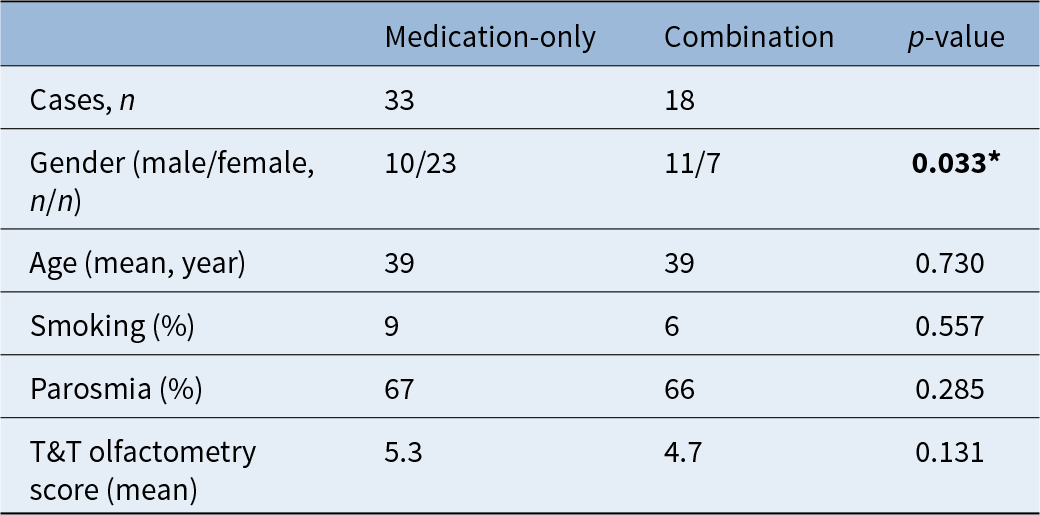
Among 51 patients (21 men, 30 women; mean age = 39 ± 15 years), 33 received medication only, and 18 received combination therapy. No significant differences were observed between the groups in terms of age, smoking history, parosmia and baseline T&T olfactometry scores (Table 1).
Baseline characteristics of patients with post-traumatic olfactory dysfunction

Table 1 Long description
Baseline characteristics are compared between a medication-only group of 33 patients and a combination-treatment group of 18 patients with post-traumatic smell dysfunction. The only statistically significant difference is gender distribution: medication-only includes 10 males and 23 females, while combination includes 11 males and 7 females, with a reported p-value of 0.033. Mean age is the same in both groups at 39 years, with no meaningful difference by the reported p-value. Smoking prevalence is similar, at 9 percent in medication-only and 6 percent in combination. Parosmia rates are also similar, at 67 percent versus 66 percent. Mean T&T olfactometry scores are close, at 5.3 for medication-only and 4.7 for combination, without a statistically significant difference. Values are presented as means or percentages, and p-values reflect group comparisons, so small sample sizes may limit detection of differences beyond gender.
†Values are presented as mean values or percentages. P-values were calculated using the Fisher’s exact test or Mann–Whitney U test, as appropriate.
Treatment outcomes
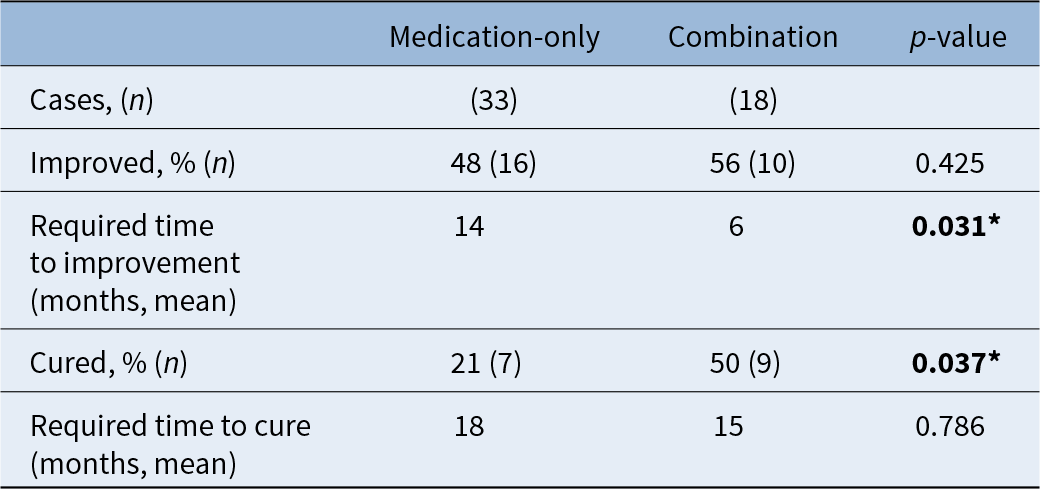
After treatment, the improvement rate was 48 per cent (16/33) in the medication-only group and 56 percent (10/18) in the combination group (p = 0.425, Table 2). However, the cure rate was significantly higher in the combination group (50 percent, 9/18) than in the medication-only group (21 percent, 7/33; p = 0.037). The mean time to improvement was shorter in the combination group (6 ± 3 months) than in the medication-only group (14 ± 7 months, p = 0.031). The mean time to cure was also shorter (15 ± 6 months vs 18 ± 8 months), although this difference was not statistically significant.
Treatment outcomes in all patients with post-traumatic olfactory dysfunction

Table 2 Long description
Outcomes for post-traumatic smell dysfunction are compared between a medication-only group (33 patients) and a combination-therapy group (18 patients). Improvement occurred in 48 percent (16 patients) with medication only and 56 percent (10 patients) with combination therapy, and this difference was not statistically significant (p = 0.425). Time to improvement averaged 14 months with medication only versus 6 months with combination therapy, a statistically significant difference (p = 0.031). Cure occurred in 21 percent (7 patients) with medication only versus 50 percent (9 patients) with combination therapy, also statistically significant (p = 0.037). Time to cure averaged 18 months for medication only and 15 months for combination therapy, with no statistically significant difference (p = 0.786). Results suggest combination therapy is associated with a higher likelihood of cure and quicker improvement, while acknowledging the smaller sample size in the combination group.
†‘Improved’ indicates ≥1.0-point improvement in T&T olfactometry. ‘Cured’ indicates return to T&T olfactometry score ≤ 2.0. P-values were determined using Fisher’s exact test for categorical variables and Mann–Whitney U test for continuous variables. P < 0.05 was considered statistically significant (*).
Age-specific analysis
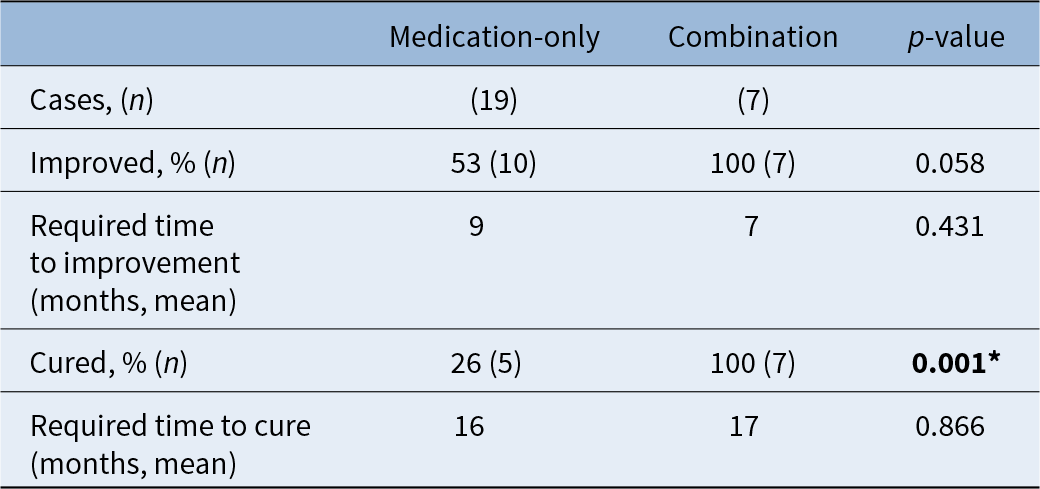
In patients aged less than or equal to 35 years, the cure rate in the combination group reached 100 per cent (7/7), compared with 26 per cent (5/19) in the medication-only group (p = 0.001). The mean time to improvement did not differ significantly (7 ± 3 months vs 9 ± 5 months). Detailed results are shown in Table 3.
Treatment outcomes in patients aged 35 years or younger

Table 3 Long description
Treatment outcomes are compared between medication-only and combination therapy in patients aged 35 years or younger, including improvement and cure rates and average time to reach each outcome. There were 19 cases in the medication-only group and 7 in the combination group. Improvement occurred in 53 percent (10 of 19) with medication only and 100 percent (7 of 7) with combination therapy; the p-value of 0.058 suggests this difference did not meet the studys threshold for statistical significance. Average time to improvement was 9 months for medication only and 7 months for combination therapy, with p-value 0.431. Cure occurred in 26 percent (5 of 19) with medication only and 100 percent (7 of 7) with combination therapy; the p-value of 0.001 indicates a statistically significant difference. Average time to cure was similar at 16 months for medication only and 17 months for combination therapy, with p-value 0.866. Results should be interpreted cautiously because the combination group is small.
†Analysis limited to patients aged ≤35 years old. ‘Improved’ and ‘Cured’ were defined as in Table 2. An asterisk (*) indicates p < 0.05.
Kaplan–Meier analysis
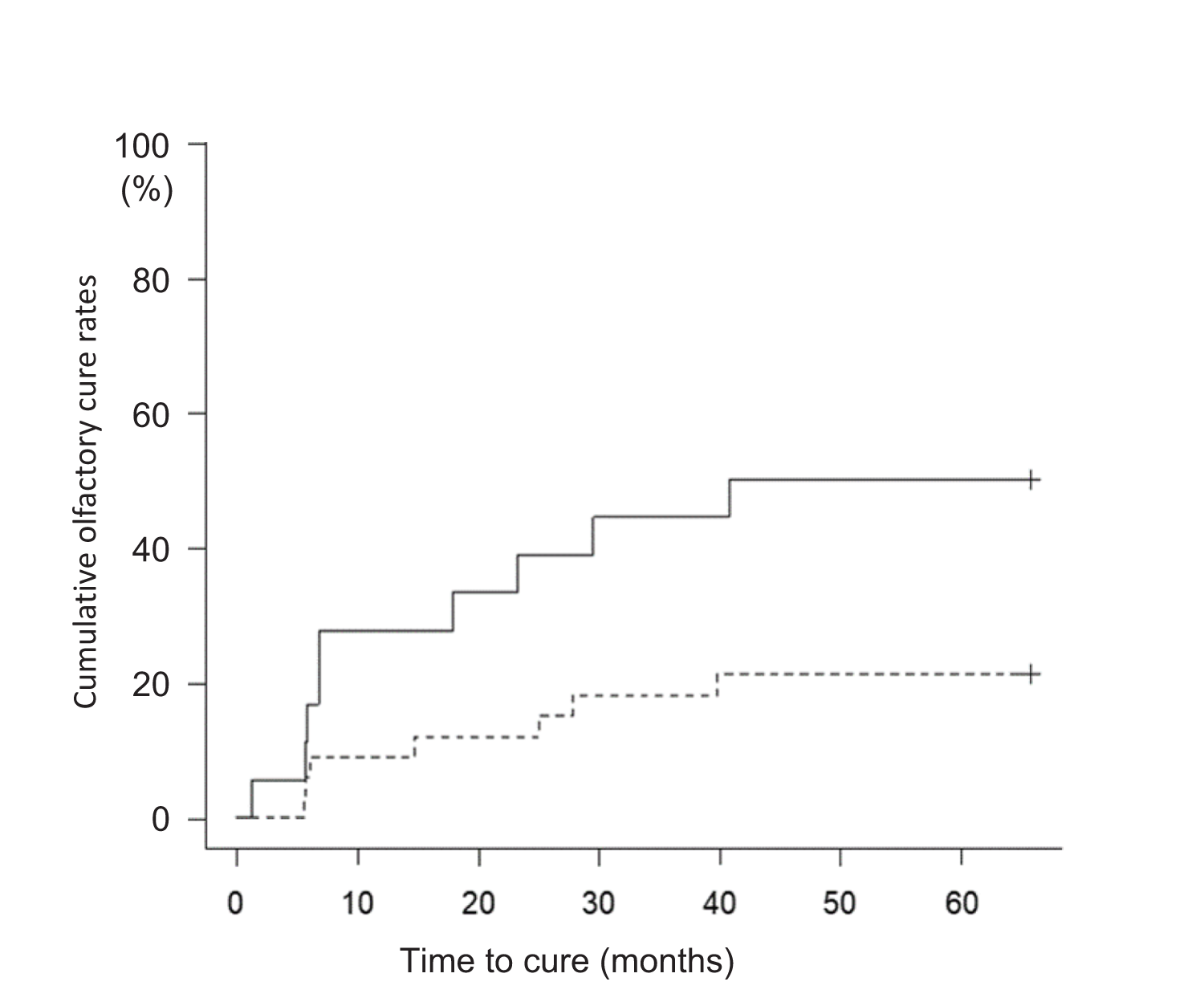
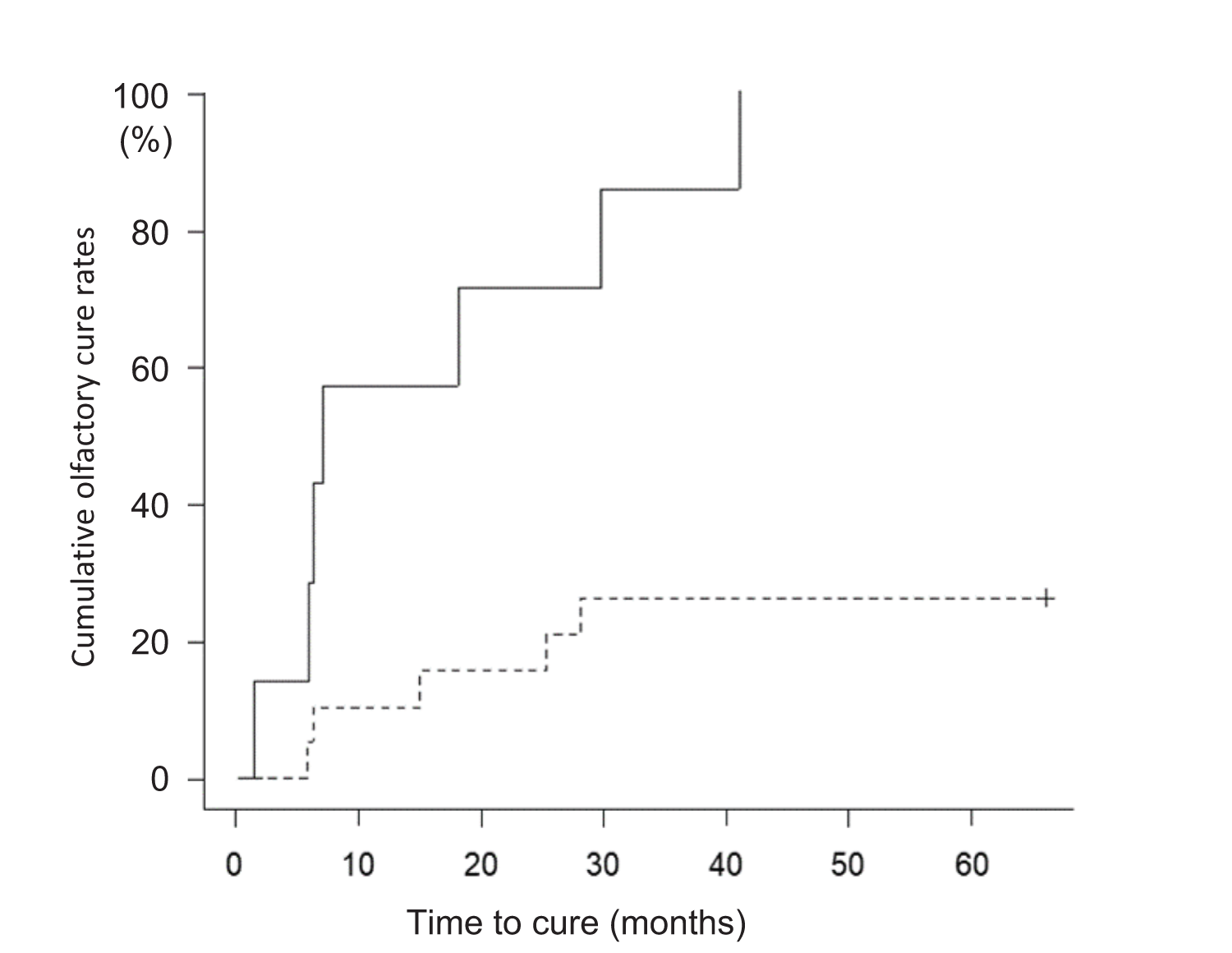
Kaplan–Meier curves demonstrated a higher cumulative cure rate in the combination group compared with the medication-only group (log-rank test, p = 0.031; Figure 1). In patients aged less than or equal to 35 years, the difference was even more pronounced (p < 0.001; Figure 2).
Comparison of cumulative olfactory cure rates between the medication-only group and the combination group across all ages. Kaplan–Meier analysis demonstrated a significantly higher cumulative cure rate in the combination group (solid line) than in the medication-only group (dashed line) (log-rank test, p = 0.031).

Comparison of cumulative olfactory cure rates between the medication-only group and the combination group in patients aged 35 years or younger. Kaplan–Meier analysis demonstrated a significantly higher cumulative cure rate in the combination group (solid line) than in the medication-only group (dashed line) (log-rank test, p < 0.001).

Discussion
The present study demonstrated that combining pharmacotherapy with OT markedly improved the recovery rate in patients with PTOD. Various pharmacological and non-pharmacological treatments have been attempted, with mixed results. Tokishakuyakusan, a traditional Japanese herbal medicine, enhances cholinergic neuronal activity,Reference Egashira, Akiyoshi, Iba, Arai, Hatip-Al-Khatib and Mishima7 while vitamin B12 promotes axonal growth in neuronal cells.Reference Wu, Xu, Liu, Zhang, Xia and Zhang8 A multicentre randomised clinical trial reported that the combination of tokishakuyakusan and vitamin B12 is effective for post-infectious OD.Reference Kobayashi, Miwa, Mori, Shiga, Tsuzuki and Okutani5 Zinc deficiency delays regeneration of the olfactory epithelium,Reference Ikushima, Suzuki, Hemmi, Ikeda, Kobayashi and Ohta9 and zinc supplementation has been shown to improve PTOD.Reference Aiba, Sugiura, Mori, Matsumoto, Tomiyama and Okuda10 Using these 3 medications, however, the cure rate for PTOD at our institution was only 21 percent, indicating that pharmacotherapy alone has limited efficacy. This modest outcome suggests that, although these agents may contribute to neuronal recovery, additional interventions are required to achieve a clinically meaningful improvement.
Olfactory training has been reported to be effective for PTOD,Reference Hummel, Rissom, Reden, Hähner, Weidenbecher and Hüttenbrink6, Reference Pellegrino, Han, Reither and Hummel11 possibly by promoting olfactory receptor cell regeneration, as demonstrated in animal models.Reference Kikuta, Sakamoto, Nagayama, Kanaya, Kinoshita and Kondo12 A similar regenerative mechanism may operate in humans. Previous reports indicate that OT was effective when introduced following the administration of steroids or zinc supplements to patients with PTOD.Reference Jiang, Twu and Liang13, Reference Jiang, Wu and Liang14 In the present study, the concurrent combination of medication and OT achieved a cure rate of 50 percent, more than twice that of medication only, indicating a clear additive effect. In addition to the neurobiological impact of OT, the daily habit of sniffing may have improved treatment adherence and medication compliance.
Younger patients in our study exhibited particularly favourable outcomes. This trend is consistent with the concept that age influences olfactory neuroregeneration after injury. Experimental studies have demonstrated that ageing impairs olfactory neurogenesis and axonal reinnervation of the olfactory bulb, leading to delayed or incomplete recovery of olfactory function.Reference Kobayashi, Nishida, Yamakata and Takeuchi15 In addition, age-related reductions in basal cell proliferation and increased apoptosis within the olfactory epithelium have been shown to attenuate neuronal turnover.Reference Suzukawa, Kondo, Kanaya, Sakamoto, Watanabe and Ushio16 Furthermore, human studies have revealed that the aged olfactory mucosa exhibits a marked decline in proliferating olfactory cells and downregulation of extracellular matrix-related genes, indicating reduced tissue plasticity.Reference Ueha, Shichino, Ueha, Kondo, Kikuta and Nishijima17 These age-related declines in neurogenic potential and regenerative capacity likely contribute to the poorer recovery observed in elderly patients with PTOD.
We initially hypothesised that combining OT with medication would shorten the treatment period. In our cohort, overall time to improvement was reduced; however, treatment duration did not differ significantly, and younger patients (≤35 years) tended to remain on therapy longer. Because adherence and discontinuation criteria were neither standardised nor objectively monitored, the reasons for this pattern are uncertain. These findings underscore the need for prospective studies with predefined stopping rules and adherence monitoring. In addition, the relatively small sample size, particularly in subgroup analyses, may limit the generalisability of our findings.
An advantage of these treatments is their simplicity. They require no special equipment, are inexpensive and have minimal side effects. In particular, OT can be implemented by any patient at home; thus, accessibility is high even in outpatient settings. In this study, patients were allowed to select odorants freely from familiar items such as coffee, perfume or curry, rather than being restricted to a fixed set of standardised odorants. This free-choice approach may improve motivation and adherence by incorporating emotionally meaningful and culturally relevant odours. Moreover, functional imaging studies have shown that even sniffing without odorants increases blood oxygenation in the piriform and orbitofrontal cortices,Reference Sobel, Prabhakaran, Desmond, Glover, Goode and Sullivan18 suggesting that the act of sniffing itself may enhance cerebral activation and facilitate olfactory rehabilitation. While OT can be self-administered, accurate assessment of olfactory function and long-term follow-up still require controlled testing environments. Collaboration with specialised centres is therefore desirable to ensure standardised evaluation and to guide patients in evidence-based therapy.
Because PTOD is often considered intractable, these findings are clinically important. The combination of pharmacotherapy and OT significantly improved the cure rate, demonstrating that PTOD is indeed treatable. Olfaction plays a crucial role in both safety and quality of life. Otolaryngologists should actively inform patients that PTOD is not hopeless and can be improved with proper management.
Conclusions
Combining pharmacotherapy with OT significantly improved the cure rate for PTOD, particularly in younger patients. This combination potentiates the therapeutic efficacy of medication and should be recommended as a first-line approach for PTOD, which is often difficult to treat. Although the high cure rate among younger patients is noteworthy, further research is needed to enhance recovery in all age groups and to elucidate the mechanisms underlying olfactory neuroregeneration.
CRediT authorship contribution statement
Kento Takeichi: Data curation; Formal analysis; Investigation; Resources; Visualisation; Writing – original draft.
Masayoshi Kobayashi: Conceptualisation; Funding acquisition; Investigation; Methodology; Project administration; Resources; Supervision; Validation; Writing – review and editing.
Kohei Nishida: Investigation; Resources; Writing – review and editing.
Hiroyuki Morishita: Investigation; Resources; Writing – review and editing.
Eisuke Ishigami: Investigation; Resources; Writing – review and editing.
Misato Suzumura: Investigation; Resources; Writing – review and editing.
Funding
This research was funded by the Department of Otorhinolaryngology-Head and Neck Surgery, Mie University Graduate School of Medicine.
Competing interests
The authors declare none.
Ethical statement and informed consent
This study was approved by the Clinical Research Ethics Review Committee of Mie University Hospital (approval no. H2020-171). The requirement for informed consent was waived because of the retrospective design.