Introduction
School choice has come to encompass a wide variety of policies that provide parents with a range of options to educate their children outside the common school. These include but are not limited to policies expanding choice in private educational opportunities, such as home and independent schooling; government funding for education in the private sphere; and, increasingly, policies providing additional choice within public education systems. The proliferation of school choice since the 1980s has generated a growing body of research (Bernal, Reference Bernal2006; Busemeyer, Reference Busemeyer2007; Busemeyer and Jensen, Reference Busemeyer and Jensen2012; Malmberg et al., Reference Malmberg, Andersson and Bergsten2013; Fleming, Reference Fleming2014; Gingrich, Reference Gingrich2019). One of the key findings of this literature is that an increasingly competitive and globalizing economy, in which knowledge drives economic success, has been an influential driver of the expansion of choice in education systems (Ansell, Reference Ansell2010; Busemeyer, Reference Busemeyer2015). In part as a response to the economic anxiety of parents and fears that public education systems alone do not adequately prepare children for the highly competitive modern economy, demands for the expansion of opportunities in schooling—including supplementary education and enrichment—have risen over the past several decades (Aurini et al., Reference Aurini, Davies and Dierkes2013; Kornrich and Furstenberg, Reference Kornrich and Furstenberg2013; Kornrich, Reference Kornrich2016; Lunn and Kornrich, Reference Lunn and Kornrich2018; Schneider et al., Reference Schneider, Hastings and LaBriola2018; Grusky et al., Reference Grusky, Hall and Markus2019). Another key finding of the literature relates to the role of religious, linguistic and other forms of demographic diversity in fuelling demands for choice in education (Castles, Reference Castles1989; Betts and Fairlie, Reference Betts and Fairlie2003; Gerdes, Reference Gerdes2013; Malmberg et al., Reference Malmberg, Andersson and Bergsten2013; Rowe and Lubienski, Reference Rowe and Lubienski2017). As societies become more diverse, this branch of the literature suggests, demand for an increase in school choice rises as the number of groups and identities seeking specific accommodations in the system grows.
While there is some research examining the development of school choice policies in Canada (Bosetti, Reference Bosetti2004; Bosetti and Gereluk, Reference Bosetti and Gereluk2016; Bosetti et al., Reference Bosetti, Van Pelt and Allison2017; Bosetti and Pyryt, Reference Bosetti and Pyryt2007; Davies and Aurini, Reference Davies and Aurini2011; Lubienski and Yoon, Reference Lubienski and Yoon2017), the Canadian case remains understudied, especially by political scientists. Three aspects of the Canadian system make it particularly interesting and worthy of additional attention. First, because education policy in Canada is left entirely to the discretion of individual provinces rather than to the federal government, the country as a whole exhibits high levels of variation in its provincial responses to the implementation of school choice policies over time. Second, Canada has embraced neoliberal policies since the 1980s and has also experienced the development of an increasingly competitive economy and rising levels of income inequality (Stabile and Isabelle, Reference Stabile and Isabelle2018; Banting and Myles, Reference Banting, Myles, Banting and Myles2013; Bartels, Reference Bartels2017). Lastly, Canada has experienced a significant increase in its levels of immigration and subsequent ethnic, racial and religious diversity (Banting and Kymlicka, Reference Banting and Kymlicka2013; Reitz, Reference Reitz2012). Thus, Canada has been subject to both of the major pressures that have been linked to increasing demands for school choice: profound transformations in the macro economy and a simultaneous increase in the degree and pace of pluralization driven by immigration.
School choice is a complex and multidimensional concept that includes a range of programs and regulatory frameworks. We conceptualize choice in terms of policies that provide families with schooling options outside of the common public school system. In the Canadian case, we contend that any educational options provided to parents beyond that of the local public school in their catchment area is indicative of expanding choice. Building on this conception of choice, we constructed an original index of school choice policies in Canada—the first of its kind—that measures the development of school choice policies for each province from 1980 to 2020 using eight indicators of choice. The indicators in the Canada School Choice Policy Index (CSCPI) are as follows:
1) homeschool
2) independent school
3) state-delivered religious education
4) state-delivered minority language education
5) Indigenous education
6) charter school
7) choice within public education system
8) accredited international schoolFootnote 1
The aim of this article is to present and discuss the findings of the CSCPI. Not only does the period covered by the index encompass the highly accelerated transition from a Keynesian to a neoliberal macroeconomic paradigm, marked by increasing levels of income inequality and economic competition, it also encompasses a period of time during which Canada has become an increasingly diverse, multicultural country. The index thus allows us to track the development of school choice policies across Canada during a period in which the country has witnessed large-scale economic and demographic changes. Here, it is important to note that the aim of the index is not to empirically (in)validate the major findings of the literature on the proliferation of school choice. Our index does not assess the empirical validity of the income inequality and diversity hypotheses as factors fuelling the rise of school choice. Rather, the index aims to build an empirical understanding of the range of choice in education as well as track the development of school choice policies in Canada over time to situate the Canadian case within this broader literature. Its findings provide an overview of how these policies have unfolded over the past four decades across each province. In doing so, the index points the way for researchers to further study some of the unique elements of the Canadian case in its development of school choice over time.
Our index demonstrates that there has been a greater expansion of choice within the public education system relative to choice in private educational opportunities such as home and independent schooling. Although the growth of school choice is not a trend that is unique to Canada, our index reveals that one unique aspect of the Canadian case is that a significant expansion of choice within public education systems has not been accompanied by a simultaneous expansion of choice in private systems, as has been the case elsewhere in countries such as the United States. Thus, the findings of our index raise an interesting question: to the degree that choice has become more common in Canada, why has it been predominantly contained to choice within public school systems? This question brings special attention to the need to incorporate increasing choice within the public education system as an important piece of the puzzle for any study examining the proliferation of school choice in the Canadian context.
School Choice over Time and across Countries
While state-financed and state-provided education emerged historically as part of nation-building and as part of secularization trends to displace the authority of the church (Ansell and Lindvall, Reference Ansell and Lindvall2021; Katznelson and Weir, Reference Katznelson and Weir1985), in several countries, primary and secondary education governance was and remains delegated to various third-sector organizations, including churches (Ansell and Lindvall, Reference Ansell and Lindvall2021). Countries vary, therefore, in terms of public delivery of education, as opposed to simply public financing (Ansell and Lindvall, Reference Ansell and Lindvall2021), with many governments subsidizing the provision of private education, often religiously based, and others permitting a parallel privately financed and delivered education system. The result, over time and comparatively, has been quite varied forms of public subsidization of educational services delivered through various delivery agents, including religious authorities. Interestingly, liberal market economies in North America (that is, the United States and Canada) developed rather weak welfare states comparatively but developed a stronger common school system (Mosher, Reference Mosher2005). Indeed, a single common school system was more pervasive in the United States and some Canadian provinces than in many European countries (Ansell and Lindvall, Reference Ansell and Lindvall2021).
Those particular features of education systems created in the nineteenth and early twentieth centuries create institutional path dependencies that are still structuring important aspects of education governance today. Institutional path dependencies can reinforce quality education systems, such as setting high educational standards through standardized teacher training and professional development and a centralized curriculum. But that institutionalization can also cause rigidities, such as lack of choice in curriculum content that is not responsive to student learning styles or diversifying student populations. Governments in several Organisation for Economic Co-operation and Development (OECD) countries have thus started to experiment with arrangements that either embed mechanisms of choice within public education or that sever responsibility for public funding from delivery and management. School choice includes a number of policy instruments, ranging from, as Pattillo (Reference Pattillo2015: 43) notes,
mandates that allow families to opt out of failing public schools and enroll in other public schools; inter and intra-district open enrolment plans that allow students to attend public schools outside of their designated attendance areas; charter schools that are funded by public dollars but governed and administered by non-profit or for-profit organizations and are given greater flexibility in hiring, operations, and curricula; monetary vouchers (or scholarships or tax-credits) for families to send their children to private schools; and an innumerable list of alternative public school designations (for example magnet schools, options schools, and innovation schools) that require some parental or student purposeful action for enrolment.
While Pattillo's (Reference Pattillo2015) list of school choice options refers specifically to the US context, choice in education is growing throughout OECD countries (OECD, 2017). For example, legislative changes in England in the 1980s and 1990s directed school funding based on student enrolments and allowed parents to indicate school preferences. Along with the publication of examination results and “league tables,” schools are under pressure to perform well and attract students. The British government has thus supported the creation of several “specialist” schools and academies that are permitted to vary their curriculum as well as staff terms and conditions (West, Reference West2014; West and Nikolai, Reference West and Nikolai2017). In Sweden, too, the desire to increase choice drove a series of controversial reforms including permitting for-profit entities to deliver education, albeit under a fairly robust system of public regulation and management (West and Bailey, Reference West and Bailey2013). The United States has also seen experiments in charter schools (Hackett, Reference Hackett2016) and an explosive growth in vouchers (Hackett, Reference Hackett2020), although as Zehavi (Reference Zehavi2012) notes, direct public finance of private schools has not expanded in the United States to the same extent as it has in other liberal welfare states such as Australia and New Zealand where governments direct a significant portion of public finances to private schools.
In Canada, primary and secondary education is publicly funded and delivered in all provinces and territories, with a high degree of government regulation (Wallner, Reference Wallner2014). Several Canadian provinces have long supported separate (Catholic/Protestant) systems that are constitutionally protected. Although Quebec and Newfoundland and Labrador pursued constitutional changes in the 1990s to close their respective religious separate systems, Catholic separate systems remain in Alberta, Saskatchewan and Ontario. Non-kindergarten preschool and childcare services are almost completely provided through markets (both for-profit as well as not-for-profit), with varying levels of government regulation depending on whether the care is centre-based or home-based (Varmuza et al., Reference Varmuza, Perlman and White2019). Colleges and universities, however, operate as not-for-profit entities with an ever shrinking share of government funding but with a high degree of government regulation (Noumi and Jones, Reference Noumi, Jones, Joshi and Paivandi2015).
Canadian provinces have experienced growth in school choice at the kindergarten to grade 12 level in two ways. Most visible has been the emergence of systems that are distinct from the public system but that still receive government support. Minority language school systems, which emerged in every province during the 1970s and 1980s, are the most substantial of these systems (Behiels, Reference Behiels2003). The extension of qualified public funding for independent schools in British Columbia began in the 1970s and was taken up by Alberta, Saskatchewan, Manitoba and Quebec in subsequent years. Since the 1980s, all provinces have recognized homeschooling as a legitimate option, and some have experimented with charter schools and tuition tax credits at various points in time (Bosetti and Gereluk, Reference Bosetti and Gereluk2016). These schools do not receive the same level of government support as public schools and often charge tuition, while more or less adhering to standard provincial curricula. These choice mechanisms have been visible and often politically salient. Perhaps even more importantly, many large cities have introduced significant degrees of choice within public systems, as schools specialize and curriculums become more heavily streamed. Sometimes these changes have seen the growth of distinctive programs and schools, featuring French immersion, Afrocentric foci (Thompson and Wallner Reference Thompson and Wallner2011), the arts and athletics. At other times, the growth of choice has happened within public schools as programs have been streamed and high school curricula have become more flexible. The growth of school choice in Canada, then, has taken place in diffuse ways that vary from province to province and across time. We have turned to an indexing methodology as our strategy for capturing this complexity.
Research Methodology
Indices enable researchers to follow policy trends over time and, in so doing, judge whether the findings of small-N analyses hold for a broader range of cases. One of the first indices developed in the area of migration studies took its cue from Rogers Brubaker's (Reference Brubaker1992) seminal book Citizenship and Nationhood in France and Germany. Brubaker suggested that nations with civic republican traditions of nationhood, such as France, tend to be more inclusive (with regard to citizenship) than countries such as Germany that have ethnic traditions of nationhood. In The Politics of Citizenship in Europe, Marc Howard (Reference Howard2009) tests this and other arguments concerning citizenship across a larger number of European countries, comparing policies in 1980 and 2008. Howard found that Brubaker's argument held in some cases but not others. Perhaps most interestingly, Germany had experienced a significant liberalization of its citizenship policies, driven in part by political debates over nationhood in the 1990s and 2000s.
The logic underlying Howard's Citizenship Policy Index and most other indices is straightforward: decide on the range of cases included in the study, determine the indicators to be measured, develop a scoring system for measuring those indicators and specify a periodization strategy for the analysis. In cases where a policy area already has an index, scholars must also offer an argument for why their index is superior to those already available. Indices now explore trends in immigrant integration policy, naturalization and multiculturalism.
The CSCPI is the first attempt to capture the development of school choice policies throughout the Canadian provinces over a 40-year time period from 1980 to 2020. It has been developed in a manner consistent with other indices examining a diverse set of policy outcomes across different cases (Helbling, Reference Helbling2013; Goodman, Reference Goodman2015; Rudra, Reference Rudra2007), especially the Multiculturalism Policy Index (MPI) (Tolley, Reference Tolley2011). Like the MPI, the CSCPI employs eight indicators of policy change over several decades. These indicators have been selected for two reasons. First, they encompass the range of schooling options (both public and private) that have been made available to families across Canada during the period under study. Second, they enable comparisons of Canadian school choice indicators with those of other OECD countries as the index is expanded. The index covers a broad set of indicators that can facilitate such cross-national comparison while simultaneously paying attention to capturing elements unique to the Canadian case (for example, minority language education and Indigenous education).
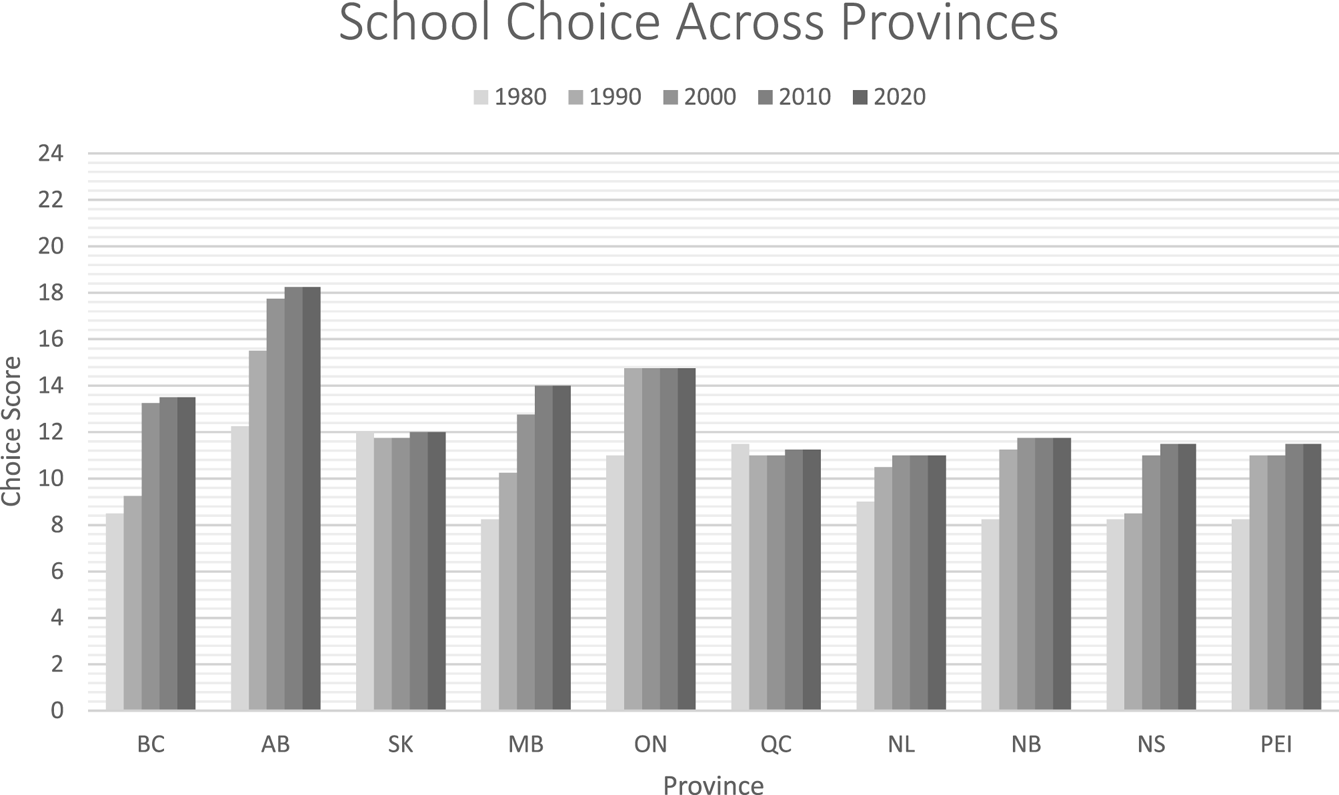
Each indicator is scored out of a possible total of three points (representing three specific measures for each indicator), where 0 represents the lowest score and 1 the highest for each measure. Gradations in the weighing of indicators are captured through “in-between” scores, with 0.25 (minimal), 0.50 (partial) and 0.75 (high). Each decade between 1980 and 2020 is given a score for each indicator between 0 and 3 for every province. Each province is also given a total “school choice” score that is the sum of the scores for all of the indicators for a given decade (Figure 1).
In order to better facilitate the potential of the index for cross-national comparison, as well as to develop a scoring scheme that allows for enough gradations to capture nuances within each indicator but is also simple enough to be used by researchers, we have weighed each indicator out of a total of three points and have also used the same scoring system for each. Using the same scoring system for each indicator from the outset was important to avoid making prejudgments about the importance of one indicator over another. The scorecard for the index can be found in the online appendix.
Although all indicators share some of the same measures, these are not uniform across each indicator. Specifically, the homeschool, independent school and charter school indicators are scored on the same three measures, which include whether the indicator is permitted, funded and regulated. Because funding is provided by the government, the state-delivered religious education indicator uses the permitted and regulated measures but replaces the funded measure with one examining religious observance within schools. The same also applies for the state-delivered minority language education indicator, which uses the permitted and regulated measures but replaces the funded measure with one indicating whether such programs have separate school boards. The Indigenous education indicator uses the permitted, funded and separate board measures. The choice within the public education system indicator is measured using the open enrolment, optional attendance with selective admission, and specialty programs/schools measures. Finally, the accredited international school indicator uses the permitted, regulated and school credential obtainable measures.
The maximum score possible for any province over any of the decades across all eight indicators is 24. Although no province receives the maximum score, Alberta as of 2020 provides the highest levels of school choice in Canada, with a score of 18.25. Given the emphasis on the development of personal freedom that has historically defined that province, one would expect that Alberta would be the province to offer the most choice in educational opportunities. However, it is also important to note that every province has witnessed rising levels of choice during the period of time under study, with some provinces experiencing relative stability in choice since the 1990s and others rising levels of choice into the 2010s.
The data used to score each indicator for a given province have been collected by a team of research assistants that included two undergraduate students and one graduate student. Relevant data from as many sources of information as possible (both academic and non-academic), with particular emphasis on legislative data that provincial governments make publicly available through Ministry of Education websites were used in the construction of the index in an attempt to create the most comprehensive overview of school choice developments in each province since 1980. Although there are certain indicators (for example, homeschool and Indigenous education before the 1990s, in particular) for which data are sparse relative to others for a given decade, significant effort has been made to gather as much information as possible for every indicator covered in the index. Additional sources of data included academic research; parliamentary debates and speeches; historical news and media reports retrieved in particular from the LexisNexis archives; and research reports conducted by third-party organizations, think tanks and advocacy groups.
Following the data-collection process, the scoring of each indicator for each decade and province was conducted by a single research assistant in consultation with members of the core research team, which included all research assistants and principal investigators. This was done to ensure that a consistent scoring method was developed and used for each indicator across every province and decade. Although there is an inherent degree of subjectivity in the scoring of the indicators given the nature of indices as a method of investigation, it is important to note that the scoring process, although conducted by a single research assistant, was pursued through an iterative process with the entire research team in order to both guide the assessment of the available data for each indicator and its associated measures and also verify that a similar coding scheme was being used across each indicator and province. A detailed breakdown of how each indicator has been scored and the evidence used to score them can be found in the full index document in the online appendix. In order to demonstrate how judgments between partial scores have been made in the scoring of specific indicators and the differences between scores of 0 and 1, we include a discussion of the logic and methodology behind the scoring system used for each indicator and its associated measures here.
The “permitted” measure that is shared by all indicators is scored based on whether provincial legislation permits the indicator in question in a province. Thus, legislation that explicitly permits or prohibits the establishment of a given indicator determines whether the indicator in question is given a score of 0 (not permitted) or 1 (permitted). In-between scores are not used for this measure. The “funded” and “regulated” measures do draw on partial scores and require certain thresholds to be met before a score is assigned. For instance, educational programs of choice that are not funded by the provincial government receive scores of 0 (not funded), those provided with up to 25 per cent of the funding given by provincial governments to schools in the public system are given a score of 0.25 (minimally funded), those given up to 50 per cent funding are given a score of 0.50 (partially funded), those provided with up to 75 per cent funding are given a score of 0.75 (highly funded) and those beyond 75 per cent are considered fully funded and are given a score of 1.
The regulated measure is scored in a similar fashion but is dependent on the passage of new legislation and amendments to previous legislation that increase or decrease the degree to which families are provided with educational choice. However, because higher scores are meant to reflect more choice for parents, this measure is scored in an inverse fashion relative to the funded measure. Namely, a score of 0 on this measure would imply that the indicator in question is fully regulated by the provincial government, thus indicating the least consumer choice, whereas a score of 1 implies that the indicator is fully unregulated by the government, thus indicating the most consumer choice.
Finally, there are other measures that are specific to some indicators: these include “religious observance” for the state-delivered religious education indicator, “separate board” for the state-delivered minority language education and Indigenous education indicators, the “open enrolment,” “optional attendance with selective admission” and “specialty programs/schools” measures for the choice within the public education system indicator, and the “school credential obtainable” measure for the accredited international school indicator. Similar to the permitted measure, the religious observance measure is scored with either a 0 or a 1 depending on whether religious schools permit faith-based practices during the school day. As well, the separate board measure is scored with a 0 or a 1 depending on whether minority language schools or Indigenous schools operate their own independent school boards. All three measures for the choice within the public education systems indicator are scored between a 0 and a 1 based on whether the province has implemented an official policy of open enrolment, educational programs can establish their own admission criteria that are tailored to unique parental demands, and specialized programs and schools are permitted to operate in the province (these include but are not limited to AP/IB programs, arts, athletics, and STEM programs, and Montessori education). Lastly, the credential obtainable measure for the accredited international school indicator is scored with either a 0 or a 1 based on whether or not students who graduate from such programs can be given a provincially certified degree upon completion.
CSCPI Total School Choice Scores by Decade
Note: Figure includes choice scores for all eight indicators.

Overview of Index Findings
Homeschool
For the majority of the provinces, the early periods of the 1980s were characterized by a relative absence of regulations that dictated the conditions under which home-education programs could operate. Homeschooling during this period generally took place at a local level and outside of an explicit agreement with provincial governments (French, Reference French1989). Enforcement of compulsory public education and truancy laws also varied by jurisdiction. In Alberta, for instance, parents who enrolled their children in education programs without governmental approval were potentially subject to significant penalties, which could include imprisonment (Strauss, Reference Strauss1981). It was not until the end of the decade and into the 1990s that all of the provinces had officially acknowledged and established legislation governing the operation of home-education programs. Since then, there has been relative stability across the provinces in the degree of choice offered to parents who homeschool their children. No province offers substantial funding opportunities to parents who wish to enrol their children in home-education programs, though British Columbia, Alberta and Saskatchewan do provide some limited financial assistance. Although no province permits students enrolled in home-education programs to obtain certified high school diplomas upon completion of their programs, all provinces offer some means of allowing homeschooled students to fulfill the public education system's graduation requirements. These include but are not limited to allowing pupils to enrol in distance-education courses, to take provincial exams, and/or adopt the public school curriculum for use in their home-education programs. The same period has also seen a growth in distance-education options within the public system, through which students study the regular curriculum at home but with public school teachers providing instruction (often in a technologically mediated way) (Barbour and LaBonte, Reference Barbour and LaBonte2019).
Independent school
Although independent schools have operated in all provinces over the past four decades, the extent to which they have been regulated and funded by provincial governments has generally increased over time. Alberta has remained most consistent in its efforts to support multiple forms of choice via independent schools and provides high levels of funding to its independent schools (Harrison and Kachur, Reference Harrison and Kachur1999). Today, Saskatchewan's Associate Independent Schools are the most generously funded independent schools in the country, receiving 80 per cent of the funds given to public schools in the province (Van Pelt et al., Reference Van Pelt, Sazid and Allison2017). British Columbia has established an extensive system of regulations for each of its four categories of independent schools and provides partial funding to a subset of these schools (schools designated as Group 1 and Group 2 schools). Ontario has maintained low levels of regulations for independent schools, enabling autonomy, but does not provide any funding to such schools. The province of Quebec currently provides substantial funding to certain independent schools, though not as much as it did in the 1980s when such funding could be as high as 85 per cent (Bayefsky and Waldman, Reference Bayefsky and Waldman2007). It has also developed a highly regulated independent school system since the 1980s. Prior to 1997, the Newfoundland and Labrador school system was, in one sense, entirely composed of independent schools, as the province had no public system and, instead, depended on seven networks of church schools to delivery K–12 education throughout the province. Since the amalgamation of these schools into a single public system in 1997, there have only been a handful of independent schools in the province that do not receive any government support. The provinces of New Brunswick, Nova Scotia and Prince Edward Island have consistently maintained similarly light levels of regulation and have not provided funding to independent schools throughout the period reviewed here.
State-delivered religious education
Currently, Alberta, Saskatchewan and Ontario are the only provinces that have separate Catholic school boards that are fully funded and operated by the respective provincial governments in each case. In each of these provinces, there is a single Protestant board covering only a small area, meaning that the separate system is de facto a Roman Catholic one. Since 1998, Quebec has replaced its denominational public education system with a linguistic system divided between French- and English-language schools (Freeland, Reference Freeland1999). Since 2008, religious instruction has existed in the public school system, taught from a neutral “social scientific” perspective (Farney, Reference Farney2017). Similarly, prior to the 1990s, Newfoundland and Labrador had a multidenominational school system that was replaced with a linguistically based public education system in 1997. Religious courses have been offered in the provincial public education system since then. British Columbia, Manitoba, New Brunswick, Nova Scotia and Prince Edward Island have not developed publicly funded separate religious education programs and/or school boards during the period of time studied in the index. Rather, religious education programs in these provinces must operate through independent schools. Though an important topic, the index does not capture local or episodic accommodation of religious practice, such as rooms being set aside for Friday prayer for Muslims or public schools continuing to use the Lord's prayer during the school day in areas with large Evangelical Christian populations.
State-delivered minority language education
The development of minority language education and the establishment of public francophone education systems, in particular, since the 1980s have unfolded in a nearly universal manner across the provinces. With the exception of New Brunswick, which was the first province to establish a separate French-language school board, all provinces officially established separate francophone school boards in the 1990s. Prior to this period, French-education programs were offered in public education systems across the country, but it was not until the mid-1990s, in response to a series of court cases (in particular the Mahe v. Alberta case of 1990), that provincial governments officially permitted the establishment of separate French-language school boards, and an English-language school board in the case of Quebec. Since then, independent francophone school boards have operated in all provinces and have been governed in a manner similar to that of any other school in the public system.
Indigenous education
Another key similarity experienced in every province over the past four decades has been the ongoing struggle of Indigenous people to gain control over their own education programs and to establish separate Indigenous school boards. Although band-operated schools have historically been permitted across the provinces and Indigenous education programs have been steadily integrated into the curricula of public schools since the 1980s in most provinces, Manitoba was the first and currently the only province to officially establish a separate Indigenous school board in 2017. One of the key issues shared cross-provincially during this period of time has been that of funding for Indigenous education programs. Although the funding and operation of band- operated Indigenous schools is the responsibility of the federal government, provincial governments have, through a series of negotiations with their respective Indigenous communities as well as with the federal government, agreed to provide additional funding opportunities for the development of Indigenous education programs. The levels of funding offered in these agreements differ widely across provincial jurisdictions, with some provinces (namely British Columbia) providing more opportunities than others to fund these programs at the provincial level.
Charter school
Since 1994, Alberta has been the only province to permit the establishment and operation of charter schools. Charter schools operate on agreements (known as “charters”) between these schools and the provincial government; the charters allow the schools to teach a curriculum that is unique to the school's educational approach so long as such charters are approved by the provincial government and are broadly consistent with the education programs of other schools in the public system (Thompson et al., Reference Thompson, Kowch and Gereluk2016). Because charter schools are public schools, they are entitled to the same per-pupil funding provided to schools in the public system and have been funded entirely by the provincial government since their establishment in the mid-1990s. These schools have relatively high levels of autonomy to devise and deliver their own educational programs. Although the establishment of faith-based charter schools is not permitted, these schools are allowed to provide religious instruction, as is the case with any school in the public education system (Bosetti and Butterfield, Reference Bosetti and Butterfield2016). The presence of charter schools is one of the key reasons why the province of Alberta has the highest levels of choice available to parents in the education of their children (especially in the public education system). There are currently 13 charter school authorities operating in Alberta that offer a variety of educational programs and methods of instruction (Mindzak, Reference Mindzak2020).
Choice within the public education system
Beginning largely in the 1990s, every province has taken steps to expand choice beyond private alternatives such as home and independent schooling into the public education system itself. The most common indicators of this expansion have been the implementation of open enrolment policies, optional attendance with selective admission, and specialty schools and programs (for example, schools for elite athletes, schools for students with an aptitude for the arts, schools featuring an Afrocentric curriculum, etc.). British Columbia, Alberta and Quebec have arguably led the other provinces on the expansion of choice within the public school system by offering a range of educational opportunities as well as implementing open enrolment policies that allow students to enrol in schools outside of their catchment areas, though the remaining provinces have not lagged far behind. In fact, it is this indicator that has consistently scored highest in the index relative to others cross-provincially and over time. All provinces provide for optional attendance with selective admission, as well as specialty schools and programs inside their respective public education systems. The main source of difference cross-provincially on this indicator is whether or not provincial governments have implemented official open enrolment policies. Although British Columbia, Alberta, Manitoba and Quebec have established such policies, the remaining provinces that have not still permit parents to enrol their children in public schools outside of their catchment areas on a district-by-district basis and upon approval from the school(s) to which they are applying to enrol.
Accredited international school
Additional choice in the public education system through provincial government agreements with schools overseas is a more recent phenomenon in several provinces that has allowed public schools in these provinces to teach their curricula to students enrolled in schools abroad. This is an important indicator to consider given that a key aim of the CSCPI is to allow for a broad baseline for future research and cross-national comparisons. In particular, as the experience of postsecondary education over the past 20 years has demonstrated, education should no longer be understood as a solely domestic policy area. Currently, British Columbia, Alberta, Manitoba, Ontario, New Brunswick, Nova Scotia and Prince Edward Island have established accredited international schools. Ontario, New Brunswick and Prince Edward Island were the first to establish such programs in the 1990s, and the other provinces followed in the early 2000s. Each of these programs share similarities in their adherence to a set of regulations that mainly require partner schools to employ certified teachers, to undergo inspections by the province and to teach the respective province's public education curriculum. These programs also allow for students enrolled in them overseas to obtain certified high school diplomas from the province with which they have an agreement upon graduation. Accredited international schools can therefore be seen as an expansion of the Canadian public education system by providing students in other countries the opportunity to essentially enrol in Canadian schools from abroad.
Discussion of Results
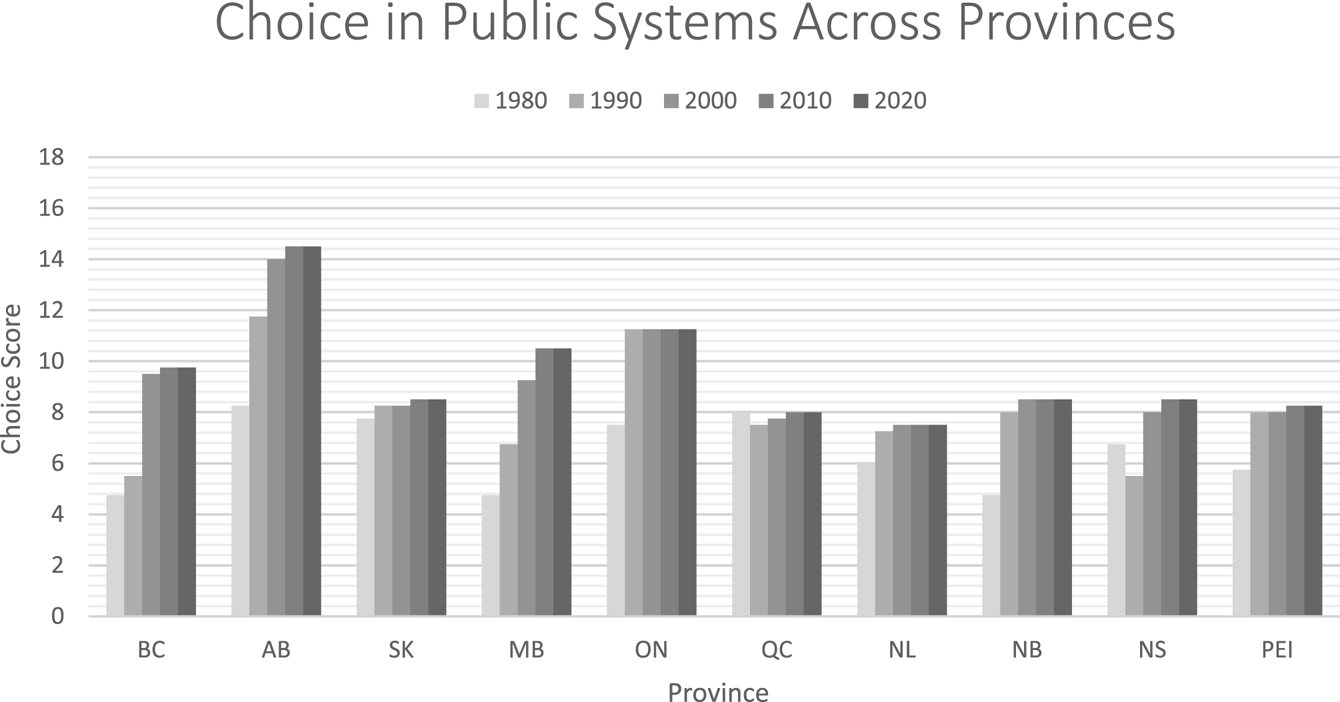
An initial analysis of the findings of the index reveals that to the extent that choice in the private sphere has expanded, it has done so in a surprisingly similar manner across the provinces over the past four decades. This is reflected in the similar scores over time in both the home and independent school indicators in each province. In contrast, the expansion of choice within public education systems through the establishment of charter schools in Alberta and such policies as open enrolment, selective admission and specialty schools, as well as through the establishment of accredited international schools across provinces, have significantly contributed to the proliferation of school choice throughout the country since the 1980s (Figure 2). Although private alternatives to public education have also become more common over the past several decades, the expansion of choice inside the public education system has arguably grown at a faster rate and has thus played a larger role in the expansion of choice in education than initially anticipated.
CSCPI Total Choice Scores in Public Systems by Decade
Note: Figure includes choice scores in state-delivered religious and minority language education, Indigenous education, charter school, choice within the public education system, and accredited international school indicators.

Although choice within the public education system has increased over time cross-provincially, the provinces of Ontario and Quebec demonstrate some unique elements in that the former has witnessed a very high degree of stability since the 1990s and the latter is the only province that had slightly higher levels of choice overall in the 1980s relative to subsequent decades. One of the key reasons why Ontario has been very stable in the degree of choice offered to parents in the public system is that both state-delivered religious and minority language education largely predate the 1980s and have also remained very stable in terms of the regulations they have been subjected to over time. For instance, state-provided Catholic education has been offered in the province for many decades and was explicitly recognized in legislation in the Education Act (1974). Similarly, francophone education programs have been in operation in the province since the late 1960s, though it was not until 1997 that French-language schools were permitted to operate their own separate school boards (Barber and Sylvestre, Reference Barber and Sylvestre2006). This, alongside the establishment of accredited international schools in the 1990s, accounts for the upward spike between the 1980s and subsequent decades. Lastly, the province does not have an official policy of open enrolment that also reduces its levels of choice offered in the public system relative to several provinces that do have such a policy and thus accounts for part of the stability in choice within the public system in Ontario.
The key reason why Quebec scores slightly higher on choice in the public system overall during the 1980s before taking a slight dip and stabilizing again around similar levels of choice is that prior to 1998, the provincial school system was organized along religious denominational lines, with the province offering both Catholic and Protestant education and significantly lower regulatory barriers for religious education. With the transition toward a school system organized along linguistic lines in 1998, religiously based education has not been offered in the public system and has instead been relegated to the private sphere (Mager, Reference Mager2002; Robson, Reference Robson2013). However, as noted previously, mandatory religious instruction within the public system has been implemented since 2008 (Farney, Reference Farney2017). Lastly, the province lags behind several others in that it has not implemented accredited international schools during the period of time studied by the CSCPI, thus contributing to its comparatively lower levels of choice in the public system relative to other provinces.
With regard to private schooling options, the index reveals that although some of the most diverse provinces, such as British Columbia, Ontario and Quebec, differ in their respective policies toward home and independent schooling (especially as they relate to funding levels for independent schools), the scores for the home and independent school indicators for each of these provinces are quite close and have developed in a similar fashion over time. This finding is counterintuitive, as it does not conform to the expectation that increasing levels of ethnic and racial diversity should result in both higher demand for and implementation of policies offering greater choice in private education. This is especially important given that previous studies have found that increasing levels of immigration can lead to a so-called native flight from public schools toward private schools (Betts and Fairlie, Reference Betts and Fairlie2003; Gerdes, Reference Gerdes2013). Contrary to our initial expectations, expansion of choice in public education systems has been a more influential driver of increasing school choice than the expansion of choice in the private sphere in the most diverse provinces in the country. In addition, some of the least diverse provinces have actually witnessed the highest levels of choice in private education relative to the most diverse provinces.
Specifically, both Alberta and Manitoba offer more choice in independent schooling—a finding that also seems to run counter to the diversity school choice hypothesis. Rather, we would expect provinces such as British Columbia, Ontario and Quebec to have greater levels of choice in independent schooling relative to provinces such as Alberta and Manitoba. In addition to expanding choice in the public education system, the establishment of accredited international schools, though a more recent phenomenon for most provinces, has allowed for the further expansion of choice in the public sphere for the provinces that have established such schools.
A way in which diversity has led to an increase in school choice is the greater provision of self-governing schools to linguistic minorities and Indigenous communities. In both cases, these are understood as self-governing public schools in legislation and, in isolated communities, are in fact the local public school. But in more populated areas, they function as schools of choice. Neither linguistic minorities nor Indigenous communities were new features of Canadian society during the period under study. The significant increase in population diversity in Canada, alternatively, was largely driven by international migration. However, both Indigenous peoples and francophone minorities are more generally recognized today than they were in 1980. It is this enhanced recognition, rather than simply their presence in the population, that is captured by the CSCPI.
This pattern does not preclude explanations rooted in economic inequality. Canada's provinces have roughly the same levels of economic inequality and have seen that inequality grow at roughly the same rate over the last 40 years. Although much of the existing literature, informed by the UK and US examples, assumes that the demands for choice resulting from increasing economic inequality should lead to pressures for exit from the public system, the Canadian example suggests that this might not necessarily be true and requires further study. Instead, demands for school choice can be played out within the public system as families mobilize for greater choice within it and as the public system pursues a strategy that seeks to limit the movement of its students toward private alternatives.
Conclusion and Agenda for Future Research
The CSCPI was developed to chart the expansion of school choice policies in Canada. Our findings reveal a striking degree of similarity in school choice policies across Canadian provinces, with a significant growth of choice options within public systems. This has been driven by increasing recognition of Indigenous and francophone communities and demands for more specialized programs on the part of parents who would prefer to reshape public education rather than abandon it altogether.
Our findings point to some important questions that should attract the attention of students of Canadian politics and public policy. Most obviously, what accounts for the continuing popularity of public schools, on the one hand, and simultaneous demands for changes within them, on the other? The answers might lie in the relative success of Canadian public schools, with respect to educational attainment, as demonstrated by Canadian students’ performance in cross-national testing programs such as the OECD Programme for International Student Assessment (PISA). Although Canadian students’ results have slipped over time, Canada still stands among the top countries in the PISA rankings (OECD 2019a, 2019b, 2019c, 2019d). Survey research could assist us in determining whether relative satisfaction with a school system that apparently works well for most students has left parents generally satisfied with public schools and therefore not particularly interested in exploring private options.
Generalized support for public school systems need not inhibit demands for choice among families who would prefer specialized programs for their children, free of charge and delivered through publicly funded schools. Indeed, this makes perfect sense from a basic rational choice perspective. And, indeed, the COVID-19 pandemic highlights many of the factors that might drive parents to make choices to pull their child from the local public school in favour of what might be perceived as safer options from a public health perspective or a better learning environment. It is too soon to tell whether shifts in parental preferences during the COVID-19 pandemic are temporary or will portend more fundamental shifts in education choice. The index provides an excellent baseline against which to analyze future patterns.
Explanations for choice within public systems will need to employ differing methods of analysis. For one, we still do not have a clear sense of the overall range of such options in individual school boards, let alone across all of Canada's provinces. A key task for researchers moving forward, then, is to take an inventory of schooling options within public systems. We might then explore the motivations of parents demanding specialized programs, through analyses of the existing literature, focus groups and ethnography.
Such demand-side explanations should be complemented by careful considerations of the supply side: To what degree do public policies in Canada dampen demand for private options, such as independent schools, in Canadian provinces? Such work has been pursued, but there is more to be done. In particular, the variation in support for ethno-religious groups’ demands for publicly funded independent schools is puzzling: one would expect the most change in Ontario, the province that has been most profoundly transformed by immigration. Yet Ontario governments have thus far resisted demands for expanding public support for all independent schools (White, Reference White2003; Bayefsky and Waldman, Reference Bayefsky and Waldman2007). How do policies feedback to influence policymaking in Canadian provinces, enabling the expansion of choice in some contexts (for example, Alberta) while hampering it in others (for example, Ontario)? Here the method of choice would be comparative historical analysis and process tracing.
In conclusion, indices such as the CSCPI help build the infrastructure that allows researchers to test assumptions and points us toward more fully developed explanations of prevailing trends. While the choice available to parents in Canada with regard to schooling has increased since the 1980s, the direction of change does not align neatly with what one would expect given prevailing arguments in the academic literature. We hope our development of the CSCPI will catalyze the development of a research agenda that helps us make sense of policy trends in Canada. An expanded version of the CSCPI, along the lines of the MPI and other cross-national policy indices, could also help us place Canada in comparative perspective and further explore the drivers of school choice across a broader range of political jurisdictions. This article, then, is very much a preliminary salvo in what we hope will be an expanding and intensifying research program on an important topic in political science and policy studies.
Supplementary Material
To view supplementary material for this article, please visit https://doi.org/10.1017/S0008423921000901.
Acknowledgments
This project was funded by Social Sciences and Humanities Research Council of Canada (SSHRC) Fund #435-2016-0629. We are grateful for the excellent research assistance of Adarsh Addepalli, Anoushka Lad and Katelynn Kowalchuk.