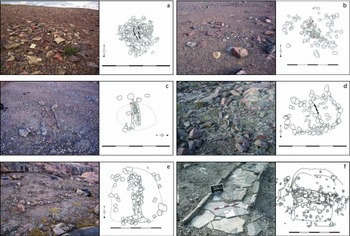
The midpassage structure is one of the most recognized architectural features constructed by Arctic Small Tool tradition (ASTt) peoples during their 4,000-year occupation of the Canadian and Greenlandic Arctic (2800 BC–AD 1400). Although constructed of different building materials—flat slabs, cobbles, fire-cracked rock, and gravel—all midpassages are axial features that bisect the dwelling structure either perpendicular or parallel to the long axis (Figure 1). They are most commonly part of tent rings constructed of cobble-sized rocks or raised gravel berms, but they are also associated with Dorset cultural complex (ca. 500 BC–AD 1400) semisubterranean structures. They are invariably described as rectangular or subrectangular in shape throughout the eastern Arctic (Figure 1).
Examples of ASTt midpassages: (a) Independence I (ca. 2000 BC), Cape Grinnell, Inglefield Land, Greenland; (b) early ASTt (ca. 2000–1000 BC), Marshall Bay, Inglefield Land; (c) Pre-Dorset (ca. 1800–1200 BC), Jens Jarl Fjord, Inglefield Land; (d) Early ASTt (ca. 1000–500 BC), Jens Jarl Fjord; (e) Late Dorset (cal AD 1043–1262), Glacier Bay, Inglefield Land; (f) Late Dorset (AD 800–1200), Little Cornwallis Island, Canada, All scales are 5 m long. All photographs taken by paper authors and all rings illustrated by John Darwent except f, which was illustrated by Don Hanna.

Most functional interpretations of midpassages are that they served as dividers to organize domestic activities within a dwelling, simultaneously providing a work surface and central cooking/lighting area (McGhee Reference McGhee1981; Plumet Reference Plumet1985). Their configurations varied due to cultural differences (Knuth Reference Knuth1967; McGhee Reference McGhee and Maxwell1976), local geographic conditions (Sutherland Reference Sutherland2003:208), and available construction materials. The bisection may also have been a sociological or ideological one denoting divisions in gender roles and possibly cultural worldview (LeMoine Reference LeMoine2003).
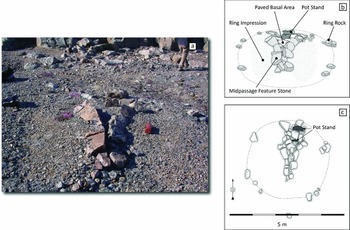
Here, we discuss a rare set of midpassages—triangular midpassages (TMP; Figure 2)—associated with the Late Dorset (AD 400–1400), the last complex of the ASTt. TMPs were not reported in the archaeological literature until recently by us, working separately in two distant regions (Darwent et al. Reference Darwent, Darwent, LeMoine and Lange2007; Dyke et al. Reference Dyke, Savelle and Johnson2011; Savelle and Dyke Reference Savelle and Dyke2009). Here, we document 52 known TMPs from a wide geographic expanse, extending from Melville Island to Inglefield Land. Construction of the features began as early as AD 400 in the Boothia Peninsula region of the central Canadian Arctic and continued to AD 1200. Subsequently, they dispersed across the Canadian High Arctic to Inglefield Land after AD 800. Here, we present the morphological, spatial, and temporal aspects of TMPs and explore the implications of TMPs for our understanding of the enigmatic Late Dorset.
Attributes of a triangular midpassage, Jens Jarl Fjord, Inglefield Land: (a) photo image, (b) oblique drawing, (c) plan view drawing. Photograph taken by Trine Johansen; illustrations by John Darwent.

Triangular Midpassages
We became aware of TMPs in two different regions of the Arctic during two unrelated projects in the 2000s—the Inglefield Land Archaeology Project (ILAP; C. Darwent, J. Darwent, LeMoine, Lange) and the Paleoeskimo Demography Project (Dyke, Savelle).
In Inglefield Land, ILAP recorded 640 ASTt features over five seasons of survey between 2004 and 2012. Initial recognition of TMPs occurred during pedestrian surveys in 2004, and when continuing survey in 2005, we encountered one that we could not dismiss (Figure 2; Darwent et al. Reference Darwent, Darwent, LeMoine and Lange2007).
The Paleoeskimo Demography Project conducted extensive ATV-based regional surveys, covering 950 km of coastline and recording 3,451 ASTt features in the central Canadian Arctic between 1999 and 2008. We first noted the unusual triangular shape of several midpassages in the western Boothia Peninsula, by coincidence with ILAP, in 2004 and reported on them separately (Dyke et al. Reference Dyke, Savelle and Johnson2011; Savelle and Dyke Reference Savelle and Dyke2009:276).
Only two TMPs have been excavated, both by authors of this article: one (JL2B4-5) by ILAP and the second (OfTb-88) during an unrelated mitigation project in Steensby Inlet, Baffin Island (Pinard Reference Pinard2011, Reference Pinard2012).
TMP Distribution
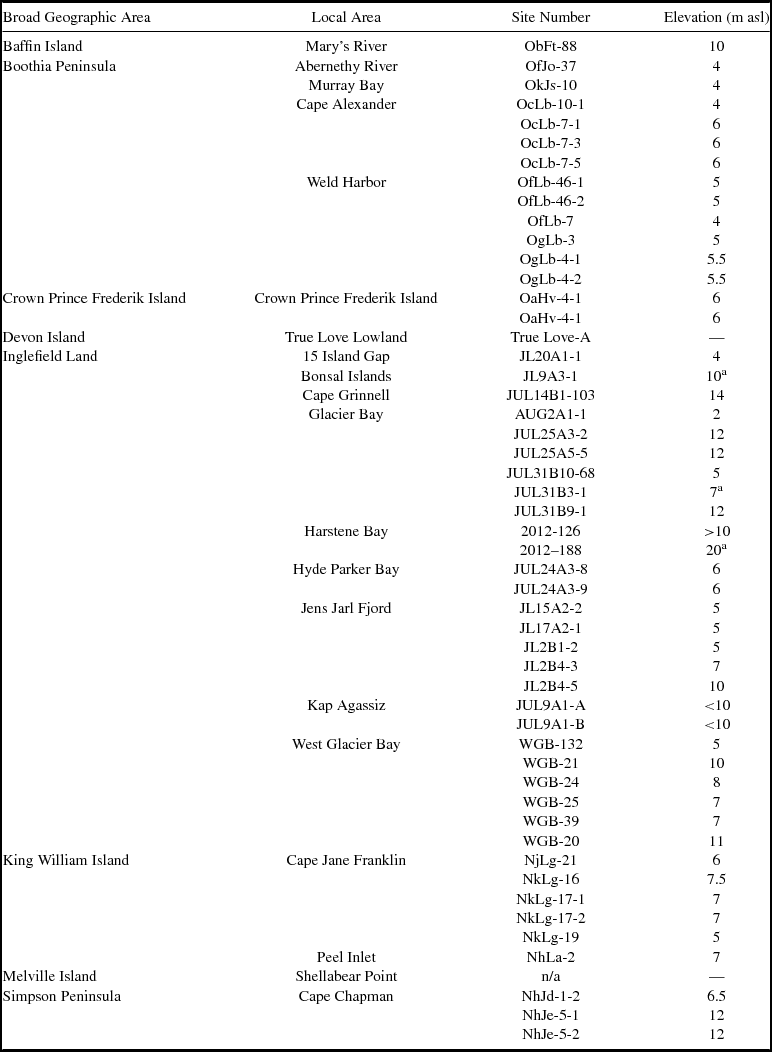
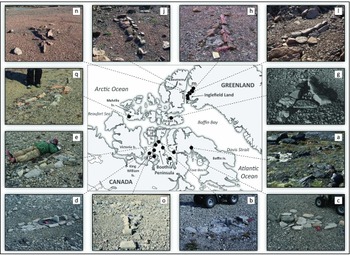
TMPs are rare. After soliciting other Arctic researchers, we are aware of only 52 TMPs of thousands of midpassage structures across the North American Arctic (Table 1; Figure 3; Darwent et al. Reference Darwent, Savelle, Darwent, Dyke, Lange, LeMoine and Pinard2017; LeMoine et al. Reference LeMoine, Darwent, Darwent and Lange2006). Areas that have noted concentrations of Late Dorset features—Little Cornwallis Island (LeMoine et al. Reference LeMoine, Helmer and Grønnow2003), Port Refuge (McGhee Reference McGhee1979, Reference McGhee1981), the Bache Peninsula (Schledermann Reference Schledermann1990), Hatherton Bay (Appelt and Gulløv 1999; Appelt et al. Reference Appelt and Gulløv1998), Victoria Island (Savelle and Dyke Reference Savelle and Dyke2002), and the Foxe Basin (Savelle and Dyke Reference Savelle and Dyke2014)—seemingly do not have TMPs. Furthermore, Ryan (Reference Ryan2003) did not include them in her review of ASTt structures south of Parry Channel, Sutherland (Reference Sutherland2003) did not note them in her summary of ASTt architecture across the Canadian High Arctic islands, and Cox (Reference Cox2003) makes no mention of them in Labrador. Given the extensive spatial coverage and detail of our own surveys (Supplemental Table 1; Supplemental Figure 1; see Supplemental Text 1 for all supplemental figure captions), and the fact they are not reported elsewhere, TMPs most likely have limited distribution.
Location of Triangular Midpassages in the Canadian Arctic and Greenland.

a Estimated
Locations of triangular midpassages in the Canadian and Greenlandic Arctic: (a) Steensby Inlet, (b) Abernathy River, (c) Murray Bay, (d) Cape Alexander, (e) Weld Harbor, (f) Crown Prince Frederik Island, (g) True Love Lowland, (h) 15 Islands Gap and Bonsal Islands, (i) Cape Grinnell, (j) Glacier Bay, (k) Harstene Bay, (l) Jens Jarl Fjord, (m) Kap Agassiz, (n) West Glacier Bay, (o) Cape Jane Franklin, (p) Peel Inlet, (q) Shellabear Point, and (r) Cape Chapman. Letters correspond to Supplemental Table 2. Photo from Devon Island (g) is courtesy of Spencer Apollonio. Photo from Melville Island (q) courtesy of Scott Lamoureux. Remaining photographs were taken by the paper authors. Map drawn by John Darwent.

TMP Attributes
The universal trait of TMPs is the presence of a midpassage that is wide at one end and tapers to a point on the other—in other words, triangular shaped—in tent rings or pads (see Figure 2). They average 2.9 m in length (ranging 1.5–5 m) and 1 m in width (ranging 0.6–1.5 m; Supplemental Table 2). There are two shape variants: 16 had inwardly curved or “pinched” margins, and 12 had “straight” sides (12 were damaged). Both configurations were intentionally produced as the feature stones were either chosen or shaped for their position in the midpassage.
The wide ends of most TMPs were paved with flat stones set slightly lower between the margin stones. All but one TMP had, minimally, one sizeable flat stone lining this area; most had multiple stones. Of those not disturbed (n = 34), 27 (79%) had a pot/lampstand present, and four (12%) had a cooking stone. Only three (9%) did not have any form of hearth feature. Most of the lampstands consisted of two upright stones, with chipped V-shaped grooves, spaced 0.5 m apart (n = 22; 81% of 27).
Artifacts Associated with TMPs
Few artifacts are visible on the surface of TMPs. Of 42 with recorded information, artifacts were observed with nine (21%)—mostly debitage, and only one diagnostic artifact, a Late Dorset-style asymmetrical flaked knife (Supplemental Figure 2). There is nothing to suggest a ritual use for TMPs.
Excavated TMPs
J. Darwent excavated one TMP, JL2B4-5, in Jens Jarl Fjord in 2009. No surface artifacts were visible, but excavation of six 1 × 1 m units using ⅛-inch (3.2 mm) screens produced 31 pieces of debitage, three flake tools, one piece of worked wood, and five pieces of unmodified wood. If this TMP is indicative of others, this low occurrence of artifacts (5.6 artifacts/m2) suggests TMPs were short-term structures.
The nature of the lithic assemblage also suggests possibly a hunter or small group of people passing through the area. Twenty of the 31 pieces of the debitage were small pressure flakes of chert and quartz, with most bearing acute platforms indicative of maintenance or sharpening of bifacial tools. The remaining 11 pieces were larger flakes of local granite and quartzite likely produced during shaping of feature stones and/or three expediently manufactured flake tools. During the excavation of JL2B4-5, flaking was noted on many of the feature stones where people modified stones to fit specific locations. Also, larger stones were shimmed with smaller stones to secure their positions. Faunal remains from the excavation of JL2B4-5 were equally meager, consisting of 68 unidentified burned mammal-bone fragments (<5 mm) and two unburned sea-mammal–bone fragments (likely seal), mainly from the area surrounding the lampstand. While preservation could be a factor, the limited faunal remains support the notion that occupations of TMPs were brief. Despite the short duration suggested by the artifacts and fauna, however, the TMPs themselves were well built.
The Steensby Inlet TMP had an even lower recovery rate (1.9 artifacts/m2) using the same screen size (Pinard Reference Pinard2012:169). Nine pieces of quartz shatter, 15 pieces of chert debitage, one core of poor quality chert, and no faunal remains were recovered. Although fewer retouch flakes were recovered, overall the assemblages of the two excavated TMPs are comparable, suggesting limited tool maintenance and expedient tool manufacture here as well.
There was a similar midpassage robustness to the Steensby Inlet TMP (Pinard Reference Pinard2012:90) as to the one from Inglefield Land. The Steensby midpassage was embedded into an underlying sand layer and appears designed to support heavy weight. Thus, this feature too suggests that TMPs were not expedient but rather planned structures, conceivably made for multiple reuses instead of single occupations (similar to modern hunter cabins). However, these uses would have been brief.
TMP Dates
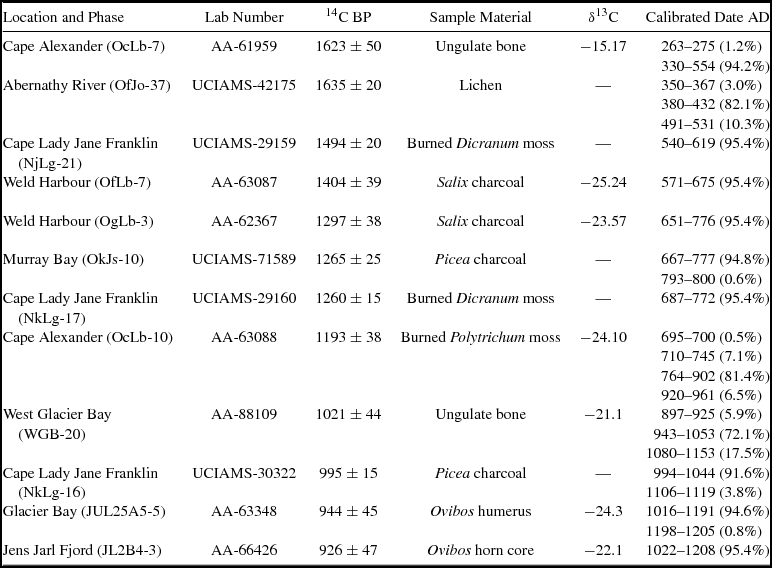
Radiocarbon dating in the Arctic is problematic because of the marine reservoir effect and old wood (see Arundale [Reference Arundale1981] and Morrison [Reference Morrison1989] for discussion). Fortunately, suitable samples were associated with 12 TMPs (Table 2) consisting of terrestrial animal bone and short-lived vegetation. Marine mammal bone was not selected for dating.
Radiocarbon Dates Associated with TMPs.

Note: Calibrated with Reimer et al. Reference Reimer, Bard, Warren Beck, Blackwell, Ramsey, Buck, Lawrence Edwards, Friedrich, Grootes, Guilderson, Haflidason, Hajdas, Hatté, Heaton, Hoffmann, Hogg, Hughen, Kaiser, Kromer, Manning, Niu, Reimer, Richards, Scott, Southon, Staff, Turney and van der Plicht2013.
The earliest TMP dates are from the Boothia Peninsula region—1635 ± 20 BP 14C BP at Abernethy River (OfJo-37) and 1623 ± 50 BP 14C BP at Cape Alexander (OcLb-7). The youngest dates come from Inglefield Land, where JUL25A5-5 in Glacier Bay dates to 944 ± 45 BP 14C BP and JL2B5-3 in Jens Jarl Fjord dates to 926 ± 47 14C BP. Based on the overlap of the dates at two standard deviations, construction of TMPs possibly occurred over an unbroken 800-year period (Supplemental Figure 3).
TMP Dates in the Boothia Peninsula Region
The 3,800-year ASTt occupation of the Boothia area was a cycle of “boom-and-bust” occupations of intensive use followed by virtual abandonment (Dyke and Savelle Reference Dyke and Savelle2009; Dyke et al. Reference Dyke, Savelle and Johnson2011; Savelle and Dyke Reference Savelle and Dyke2009). The Late Dorset period in the region represents resurgence in population around AD 400 after limited use of the area during the Middle Dorset period (500 BC–AD 400, locally). Late Dorset features are located on beaches that isostatically rose above sea level in the region after the Middle Dorset period.
Based on our current dates, the Boothia region was the developmental center of TMPs between AD 400 and 800. Although the Late Dorset evolved out of the Middle Dorset, there is no evidence for an earlier Middle Dorset progenitor in this area or to the east. Similarly, there does not appear to be any connection with the Taltheilei tradition in the subarctic mainland (Gordon Reference Gordon1996) or other coeval cultures to the west (e.g., Norton, Ipiutak).
Populations rapidly declined throughout the Boothia region beginning approximately AD 800, and ASTt occupation of this area was curtailed (Savelle and Dyke Reference Savelle and Dyke2009:280). However, a date of 995 ± 15 14C BP from a TMP at Cape Lady Jane Franklin suggests construction of the TMPs continued through to terminal Late Dorset, despite dwindling populations. However, it is clear that people constructing TMPs migrated to other areas in the Arctic, minimally after AD 800.
TMP Dates in Inglefield Land
When Late Dorset migrants arrived in Inglefield Land, they moved into an unoccupied area that the Early Dorset peoples had abandoned by AD 200 (Andreasen Reference Andreasen, Appelt, Berglund and Gulløv2000:82). Based on radiocarbon dates (Supplemental Figure 4), Late Dorset entry into the area occurred between AD 750 and 800 (Appelt and Gulløv Reference Appelt and Gulløv1999:69). The radiocarbon dates from Late Dorset features in Inglefield Land roughly fall into three groups—AD 750–950, AD 1000–1200, and AD 1225–1400. If radiocarbon dates can serve as proxies for population, then the Late Dorset population was largest between AD 1000 and 1200.
We do not believe that TMPs were built in Inglefield Land by the first Late Dorset migrants to the region. The oldest TMP in Inglefield Land is from Glacier Bay (WGB-20; 1021 ± 44 14C BP). This date calibrates to AD 897–1153—approximately 150 years after the first Late Dorset migrants to the area and is more in line with a likely larger population between AD 1000 and 1200. The other two dated TMPs from Inglefield Land, JUL25A5-5 and JL2B4-3, fall into this period as well. At present, there is no evidence for the construction of TMPs during the last 150 years of the Late Dorset occupation of Inglefield Land, as both of the upper ranges of the two latest TMPs are approximately AD 1200.
There are relatively few dated Late Dorset tent rings with any midpassage configuration from Inglefield Land. Of particular note is that TMPs were not the only style of Late Dorset midpassage constructed in Inglefield Land. Two typical or standard “rectangular” midpassages were also dated. One located in Force Bay dated to 972 ± 45 14C BP, and a second in the Glacier Bay region (JUL31-B7-1; Figure 1e) had an associated date of 860 ± 45 14C BP. The dates from both of these standard midpassages suggest they are contemporary with TMPs.
Historical Implications
The term “Late Dorset complex” has become synonymous with a specific group of people sharing material culture between AD 400 and 1400. It is discernable from the preceding Middle Dorset and very distinct from the subsequent Thule culture (Friesen Reference Friesen2007). Once established, Late Dorset material culture is remarkably homogeneous, with little regional variation outside their “core area” in the Foxe Basin (Friesen Reference Friesen2007; McGhee Reference McGhee1996). TMPs could be an exception.
Based on the information currently available, we suggest the following spatiotemporal inferences:
(1) Initial construction of TMPs coincides with initial development and population growth of the Late Dorset in the Boothia Peninsula area after AD 400 and appears to be endemic to this region.
(2) In areas where TMPs occur, they are not the sole form of midpassage constructed, as the building of standard “rectangular” midpassages took place at the same time. This co-occurrence is present in both the Boothia and Inglefield Land regions.
(3) TMPs persisted, remarkably unchanged in form, for approximately 800 years and were not a short-term stylistic manifestation such as a horizon style (Willey and Phillips Reference Willey and Phillips1958).
(4) TMP-building groups probably moved north at the same time as the Late Dorset diaspora—the expansion of Late Dorset populations into the High Arctic—which occurred after AD 800 (Supplemental Figure 5; Friesen Reference Friesen2007:200; McGhee Reference McGhee and Maxwell1976). Presumably, TMPs spread to Devon and Melville Islands at this time. Based on detailed foot survey, they appear to be rare features on Devon Island (Helmer Reference Helmer1991). Little archaeological work has been conducted on Melville Island, and thus how TMPs relate to other Late Dorset features in this area is unknown.
(5) Radiocarbon dates suggest TMPs did not appear in Inglefield Land until after AD 900.
(6) Construction of TMPs ceased by AD 1200 based on the youngest dated TMPs in Inglefield Land.
(7) The results from two excavated TMPs suggest they, and by extension, most TMPs, were occupied for short durations; however, their well-constructed nature (i.e., selective stone choice, shaped and shimmed feature stones) possibly suggests TMPs were made for multiple reoccupations.
Based on these apparent facts, we suggest several hypotheses to explain what TMPs imply for our understanding of the Late Dorset. First, TMPs merely represent an occasionally used regional Late Dorset architectural style that moved northward with the Late Dorset diaspora after AD 800. This conjecture assumes that TMPs are geographically restricted. We consider this the conservative hypothesis but believe it is simplistic as it overlooks their unique characteristics. Second, TMPs represent a regional architectural style built by a distinct subgroup within the Late Dorset complex. Friesen (Reference Friesen2007) has noted little intragroup difference in Late Dorset sites across the Arctic; however, TMPs stand out as distinctive from other Late Dorset midpassages, which in combination with their peculiar geographical distribution and persistence through time, suggests that they might be more than a regional style.
Identifying specific “ethnic” groups is a difficult and sometimes impossible objective (Emberling Reference Emberling1997). Although theoretical approaches differ, the underlying method is to recognize traits, artifacts, or architectures diagnostic of geographically restricted groups in the archaeological record. These can be characteristics based on symbols that denote identity (e.g., Hodder Reference Hodder1982, Reference Hodder2012), style frequencies within seriation orders denoting interaction groups (e.g., Lipo et al. Reference Lipo, Madsen, Robert and Dunnell1997), or distinctive economic forms (e.g., Bettinger and Baumhoff Reference Bettinger and Baumhoff1982).
Although we do not go so far as to state that TMPs are some sort of conscious emblematic or unconscious isochrestic style (e.g., Sackett Reference Sackett, Conkey and Hastorf1990; Shennan Reference Shennan and Shennan1989; Wiessner Reference Wiessner1983) made to signal to other groups of their constructors’ identity—though, in a world of rectangular midpassages, these triangular ones do stand out—it is possible that architecture reflects group membership because it consists of unique combinations of stylistic and functional components that are unlikely to reoccur spontaneously without transmission. While this transmission could happen horizontally, such as in the case of highly adaptive or functional technological innovations (e.g., spread of the bow and arrow across North America), in situations where architectural configurations are more stylistic in nature, transmission is more likely to be heritable (i.e., group member to group member; Dunnell Reference Dunnell1978; O'Brien and Lyman Reference O'Brien and Lyman2000). TMPs could be such structures. Third, a null hypothesis of sorts, is that TMPs are not as geographically restricted as our data suggest, and the distribution we have is a factor of nonrecognition of the feature style in other areas. However, that these features are now well-known to the Arctic archaeological community through conference presentations and publications and yet additional examples have not been reported suggests they are as rare and restricted as our data suggest.
Conclusion
Even without any new finds or dates, TMPs are clearly a feature form constructed by the peoples of the Late Dorset complex over an 800-year period in a remarkably unvarying configuration. This long-term similarity bespeaks of a tremendous conservatism in Late Dorset material culture similar to that of the earlier Saqqaq complex (2500–800 BC)—an ASTt culture that occupied western Greenland with a virtually unchanged material culture for 2,000 years (see Gotfredsen and Møbjerg Reference Gotfredsen and Møbjerg2004). Perhaps resistance to technological change by Late Dorset populations played a role in their eventual extirpation after AD 1350. However, from the current evidence, construction of TMPs had ceased before the Thule culture arrived.
Acknowledgments
Investigations by C. Darwent, J. Darwent, LeMoine, and Lange in Greenland were funded through National Science Foundation Polar Programs Grants #0330981, #1134977, and #0732850. Thanks are extended to Spencer Apollonio for reporting the Devon Island TMP to us, as well as Tim Rast for connecting us with Pinard's work. Thanks to our Greenland field crews in 2004–2006, 2008–2009, and 2012, and the support of the Nunatta Katersugaasivia Allagaateqarfialu (Greenland National Museum). Savelle and Dyke's research was supported by a Social Sciences and Humanities Research Council of Canada grant; by an International Polar Year project organized and led by Max Friesen, University of Toronto; and by the Geological Survey of Canada (GSC) Climate Change Geoscience Programme. Arctic logistics were provided by the Polar Continental Shelf Project of Natural Resources Canada. Scott Lamoureux, Queen's University, provided information on the Melville Island TMP. Thank you to Nicolas Zwyns for the French abstract translation.
Data Availability Statement
Feature locations and notes from the Inglefield Land surveys, as well as the artifacts collected from the excavation of JL2B4-5, are housed at the Nunatta Katersugaasivia Allagaateqarfialu (Greenland National Museum). Data from the Canadian research is on file with the Inuit Heritage Trust, Government of Nunavut, Iqaluit, Canada.
Supplemental Materials
For supplementary material accompanying this article, visit https://doi.org/10.1017/aaq.2018.18.
Supplemental Text 1. Supplemental Figure Captions.
Supplemental Table 1. Location of Triangular Midpassages in the Canadian Arctic and Greenland.
Supplemental Table 2. Triangular Midpassage Feature Attributes.
Supplemental Figure 1. Surveys of Areas with Concentrations of Late Dorset Features.
Supplemental Figure 2. Artifacts Observed in Association with Late Dorset Triangular Midpassages.
Supplemental Figure 3. Ranges of 14C Dates Associated with Late Dorset Triangular Midpassages.
Supplemental Figure 4. 14C Dates from Late Dorset Sites in Inglefield Land, Greenland.
Supplemental Figure 5. Proposed Movement of Triangular Midpassages from the Boothia Peninsula Region to Other High Arctic Regions.