Introduction
Although the James Ross Basin is well known for its extensive Cretaceous and early Tertiary sedimentary record, there are also important small, isolated exposures of late Miocene to Pliocene sedimentary rocks associated with the James Ross Island Volcanic Group (e.g. Sykes Reference Sykes1989, Pirrie et al. Reference Pirrie, Crame, Riding, Butcher and Taylor1997, Jonkers et al. Reference Jonkers, Lirio, del Valle and Kelley2002, Smellie et al. Reference Smellie, McArthur, McIntosh and Esser2006, Hambrey et al. Reference Hambrey, Smellie, Nelson and Johnson2008, Nelson et al. Reference Nelson, Smellie, Hambrey, Willaims, Vautravers, Salzmann, McArthur and Regelous2009). Together with the volcanic rocks, these sedimentary rocks and their associated fauna provide important palaeoenvironmental data for the northern Antarctic Peninsula region during the late Miocene and Pliocene epochs (e.g. Smellie et al. Reference Smellie, McArthur, McIntosh and Esser2006, Reference Smellie, Johnson, McIntosh, Esser, Gudmundsson, Hambrey and van Wyk de Vries2008, Reference Smellie, Haywood, Hillenbrand, Lunt and Valdes2009, Nelson et al. Reference Nelson, Smellie, Williams and Zalasiewicz2008, Williams et al. Reference Williams, Nelson, Smellie, Leng, Johnson, Jarram, Haywood, Peck, Zalsiewicz, Bennett and Schöne2010). One important component of the fauna associated with these sedimentary rocks are pectinid bivalves, first described from Cockburn Island by Andersson (Reference Andersson1906). These bivalves, which are assigned to Austrochlamys anderssoni, were originally thought to indicate interglacial conditions but have also been described from glaciomarine strata (Jonkers et al. Reference Jonkers, Lirio, del Valle and Kelley2002). In this paper the presence of reworked Austrochlamys anderssoni in modern day periglacial sediments on northern James Ross Island is described. The occurrence of these bivalves is interpreted as reflecting periglacial reworking of late Miocene to late Pliocene sedimentary units initially deposited on northern James Ross Island. Fossiliferous Neogene outcrops are uncommon in the region, and in Antarctica generally, but the discovery of the Brandy Bay outcrop is evidence that these fossiliferous outcrops are more widely distributed than was once thought. They are a potentially rich, but as yet under-utilized, resource of past climatic and palaeoenvironmental conditions (e.g. Williams et al. Reference Williams, Nelson, Smellie, Leng, Johnson, Jarram, Haywood, Peck, Zalsiewicz, Bennett and Schöne2010).
Field setting and stratigraphy
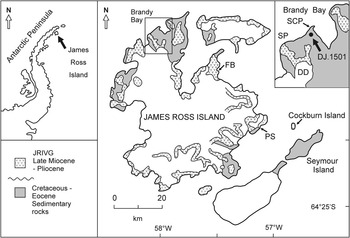
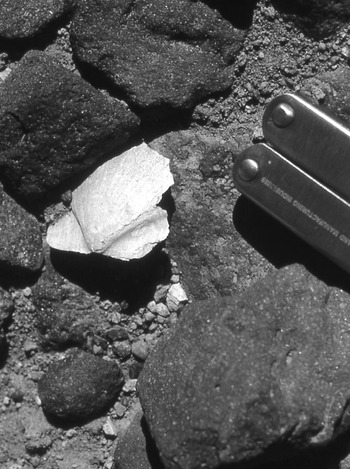
Abundant specimens of Austrochlamys anderssoni were collected from a 30 m2 area of modern periglacial active layer sediments at locality DJ.1501 (63°50.64′S, 58°01.57′W) south-west of San Carlos Point, Brandy Bay, northern James Ross Island at an altitude of c. 75 m (Fig. 1). The geomorphological setting is a low-gradient slope with well developed patterned ground (Bibby Reference Bibby1965, Lundqvist et al. Reference Lundqvist, Lilliesköld and Östmark1995, Björck et al. Reference Björck, Olsson, Ellis-Evans, Håkansson, Humlum and Lirio1996). Bibby (Reference Bibby1965) recognized a number of such low-gradient terrace-like surfaces around James Ross Island and interpreted them in terms of marine erosion surfaces (cf. Strelin & Malagnino Reference Strelin and Malagnino1992). The bivalve specimens were vertically to sub-vertically oriented within the active layer sediments (Fig. 2) and, commonly, concentrated within fractures defining the patterned ground. The thin-shelled bivalves are disarticulated, but show little abrasion. Larger clasts within the active layer sediments at the sample site are mainly basaltic rock fragments derived from the James Ross Island Volcanic Group, along with clasts of granite and metasedimentary rocks comparable with Trinity Peninsula Group lithologies exposed in the northern Antarctic Peninsula region (cf. Pirrie et al. Reference Pirrie, Crame, Riding, Butcher and Taylor1997, Smellie et al. Reference Smellie, McArthur, McIntosh and Esser2006, Nelson et al. Reference Nelson, Smellie, Hambrey, Willaims, Vautravers, Salzmann, McArthur and Regelous2009). Clasts interpreted as derived from the Trinity Peninsula Group also occur throughout the underlying Cretaceous sedimentary succession on James Ross Island (Ineson Reference Ineson1989, Pirrie Reference Pirrie1991), together with rare granitic clasts. Both clast types are present within the late Miocene to Pliocene glacial sedimentary units associated with the James Ross Island Volcanic Group (Pirrie et al. Reference Pirrie, Crame, Riding, Butcher and Taylor1997). However, clasts reworked from the Cretaceous strata on James Ross Island are typically rounded or well rounded and can usually be easily distinguished from the characteristically angular clasts derived directly from the Antarctic Peninsula (Smellie et al. Reference Smellie, McArthur, McIntosh and Esser2006, Hambrey et al. Reference Hambrey, Smellie, Nelson and Johnson2008, Nelson et al. Reference Nelson, Smellie, Hambrey, Willaims, Vautravers, Salzmann, McArthur and Regelous2009).
Sketch geological map of James Ross Island. Previously documented localities where Austrochlamys anderssoni has been collected are highlighted. FB = fiorda Belén, PS = Pecten Spur, SCP = San Carlos Point, SP = Stoneley Point, DD = Davis Dome.

Field photograph showing a sub-vertically aligned specimen of Austrochlamys anderssoni within the surface sediments. Coarse grained clasts surrounding the bivalve are basalts derived from the James Ross Island Volcanic Group. Width of “leatherman” ; tool is 3 cm.

Austrochlamys anderssoni has previously been described from both the late Pliocene Cockburn Island Formation (Jonkers Reference Jonkers1998a) and from a number of late Miocene to possibly late Pliocene sedimentary units associated with the James Ross Island Volcanic Group (Smellie et al. Reference Smellie, McArthur, McIntosh and Esser2006, Nelson et al. Reference Nelson, Smellie, Hambrey, Willaims, Vautravers, Salzmann, McArthur and Regelous2009, Williams et al. Reference Williams, Nelson, Smellie, Leng, Johnson, Jarram, Haywood, Peck, Zalsiewicz, Bennett and Schöne2010). The Hobbs Glacier Formation was originally described from southern James Ross Island where it is late Miocene in age, unconformably overlies Cretaceous sedimentary units and in turn is overlain by the James Ross Island Volcanic Group (Pirrie et al. Reference Pirrie, Crame, Riding, Butcher and Taylor1997). In its type area, the formation is a laterally extensive, but thin (few to several metres), diamictite-dominated unit which was sourced from the Antarctic Peninsula, along with clasts derived from older or even potentially contemporaneous parts of the James Ross Island Volcanic Group (Pirrie et al. Reference Pirrie, Crame, Riding, Butcher and Taylor1997). Subsequently, Jonkers et al. (Reference Jonkers, Lirio, del Valle and Kelley2002), Smellie et al. (Reference Smellie, McArthur, McIntosh and Esser2006), Hambrey et al. (Reference Hambrey, Smellie, Nelson and Johnson2008) and Nelson et al. (Reference Nelson, Smellie, Hambrey, Willaims, Vautravers, Salzmann, McArthur and Regelous2009) described the presence of sedimentary rocks (mainly diamictites and conglomeratic sediment gravity flow deposits) interbedded with the James Ross Island Volcanic Group from numerous localities on James Ross Island. These exposures are late Miocene to late Pliocene in age (Smellie et al. Reference Smellie, McArthur, McIntosh and Esser2006, Nelson et al. Reference Nelson, Smellie, Hambrey, Willaims, Vautravers, Salzmann, McArthur and Regelous2009) and Jonkers et al. (Reference Jonkers, Lirio, del Valle and Kelley2002) suggested that they should be included within the Hobbs Glacier Formation, a practice we also adopt here for convenience of description only. Thicknesses of 64–150 m are reached in a few outcrops, and many of the stratigraphically higher deposits interbedded with the volcanic units on James Ross Island lack Peninsula-derived erratics (Nelson et al. Reference Nelson, Smellie, Hambrey, Willaims, Vautravers, Salzmann, McArthur and Regelous2009, Smellie et al. Reference Smellie, Haywood, Hillenbrand, Lunt and Valdes2009).
The Cockburn Island Formation, defined by Jonkers (Reference Jonkers1998a), is only known to crop out on Cockburn Island. The formation comprises sandstones, pebbly sandstones and conglomerates, which overlie volcanic rocks of the James Ross Island Volcanic Group. It has yielded a molluscan fauna including very abundant specimens of Austrochlamys anderssoni, along with the bivalves Adamussium colbecki cockburnensis Jonkers, Reference Jonkers2003, Laternula elliptica (King & Broderip, 1832), and a species of Hiatella (DJ.854.39; HAJ previously unpublished information), and the gastropods Nacella concinna (Strebel, 1908), and Trophon sp. Other macrofossils include the barnacle Fosterella hennigi Newman, 1979, brachiopods, a cidarid echinoid (Jonkers Reference Jonkers1998a) and an extensive assemblage of encrusting bryozoans (U. Hara, personal communication 2003). A similar biota also occurs in fossiliferous outcrops of the Hobbs Glacier Formation (Jonkers et al. Reference Jonkers, Lirio, del Valle and Kelley2002, Williams et al. Reference Williams, Nelson, Smellie, Leng, Johnson, Jarram, Haywood, Peck, Zalsiewicz, Bennett and Schöne2010). The Cockburn Island Formation has been interpreted as reflecting a transition from a rocky shoreline environment down to water depths of approximately 100 m (Jonkers Reference Jonkers1998a). An essentially sea ice-free setting was also inferred principally based on a virtual absence of ice-rafted debris derived from the Antarctic Peninsula, which contrasts with many of the outcrops of the Hobbs Glacier Formation (Jonkers Reference Jonkers1998a, see also Jonkers & Kelley Reference Jonkers and Kelley1998). Dating of the Cockburn Island Formation was initially controversial, with a mean Sr isotope date reported in Dingle et al. (Reference Dingle, McArthur and Vroon1997) of 4.7 Ma (+0.6/-1.2), based on the V3:10/99 look-up table of Howarth and McArthur (Reference Howarth and McArthur1997), being in conflict with an age, based on diatom biostratigraphy, that is close to 3 Ma (Jonkers & Kelley Reference Jonkers and Kelley1998). 40Ar/39Ar dating of one of the lavas underlying the Cockburn Island Formation yielded an age of c. 4.8 Ma, providing a maximum age for the formation (Jonkers & Kelley Reference Jonkers and Kelley1998). A depositional age of 4.66 (+0.17/-0.24) Ma (indistinguishable from that suggested by Dingle et al. Reference Dingle, McArthur and Vroon1997) was established by McArthur et al. (Reference McArthur, Rio, Massari, Castradori, Bailey, Thirlwall and Houghton2006), based on further Sr isotopic analyses of multiple pectinid shells.
There are several sedimentary outcrops associated with the James Ross Island Volcanic Group relatively close to the fossil locality reported herein. These sedimentary rocks occur in, and at the base of, the volcanic cliffs on the north side of Davis Dome (Fig. 1) and they also form a large outlier of sedimentary rock, at least 20 m thick and 500 m in extent, situated near (east of) Stoneley Point (Smellie et al. Reference Smellie, McArthur, McIntosh and Esser2006, Reference Smellie, Johnson, McIntosh, Esser, Gudmundsson, Hambrey and van Wyk de Vries2008). Four volcanic units have been distinguished in the James Ross Island Volcanic Group at Davis Dome. The oldest (at Stoneley Point) is a tuff cone remnant whilst the younger units represent different phases of effusion as lava-fed deltas (Skilling Reference Skilling2002, Smellie Reference Smellie2006). A single thick volcanic delta formed of lava and hyaloclastite breccia unit dominates the outcrop (Smellie et al. Reference Smellie, Johnson, McIntosh, Esser, Gudmundsson, Hambrey and van Wyk de Vries2008). Discontinuous sedimentary beds typically 1–1.5 m thick separate each of the volcanic phases, but the deposits thicken to 10 and 18 m at two places. Most are dominated by massive to crudely bedded, pale grey to dark brown diamictite with abundant silty to fine sandy matrix (typically 60–70%), and granules to boulders of basalt derived from the James Ross Island Volcanic Group, less common hyaloclastite breccia and a distinctive but minor population (few %) of quartz-veined phyllite and fine sandstone, granitoids, and altered intermediate to evolved lavas derived from the Antarctic Peninsula. Pale green Cretaceous siltstone/fine sandstone pebbles derived from James Ross Island are also present. Many of the larger clasts are facetted and a few in each outcrop are striated. Fossils have only been found in the large sedimentary outlier east of Stoneley Point but are scarce and highly fragmented (Nelson et al. Reference Nelson, Smellie, Hambrey, Willaims, Vautravers, Salzmann, McArthur and Regelous2009). The field relationships strongly suggest that deposition of these sedimentary beds was coeval with their immediately overlying volcanic units, which yielded 40Ar/39Ar ages of 5.64 ± 0.25, 5.36 ± 0.05 and 4.74 ± 0.03 Ma (Smellie et al. Reference Smellie, Johnson, McIntosh, Esser, Gudmundsson, Hambrey and van Wyk de Vries2008; all errors are 2σ).
Palaeontology
The c. 100 collected pectinid fossils (DJ.1501.1-61, lodged in the collections of the British Antarctic Survey, Cambridge, UK) are fragmented and abraded to varying degrees, but are nonetheless clearly recognizable as belonging to a single species. Fifty-six fragments are identifiable to right or left valve type, most consisting of the dorsal part of the shell with either the complete hinge preserved or with just one of the auricles present. Right valves are dominant, only seven left valves were collected. Several specimens have encrusting bryozoa and serpulids on the outer shell margins.
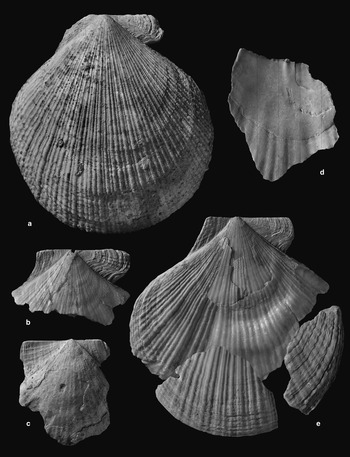
Ribbing on right valves is formed by a pattern of bifurcating and intercalated ribs: primary ribs bifurcate in early ontogeny, with addition of secondary ribs between the main pairs further away from the umbo (Fig. 3). Costation in the few left valve fragments is less clear, but seems to be made up of ribs that increase in number by intercalation only. Prominent commarginal lirae are present on both rib crests and in interspaces, but are visible only near the anterior and posterior disc margins, where these have escaped abrasion (Fig. 3e).
Austrochlamys anderssoni, from a. Cockburn Island, and b–e. Brandy Bay, James Ross Island. a. DJ.851.2, almost complete right valve (topotype; VH 114.5 mm; UA 107°, UAA 55°, UAP 52°). b. DJ.1501.11, dorsal part of disc with hinge of right valve (computed valve height 106.4 mm). c. DJ.1501.18, dorsal part of disc with hinge of left valve (computed valve height 102.7 mm). d. DJ.1501.54, internal view of median part of right valve, showing medioventral part of disc outside pallial line and foliated calcite re-entry with part of adductor muscle scar (top right) and gill suspensor scars (valve height unknown). e. Right valve, reconstructed from DJ.1501.8/8a (ventral and posterior part of disc with posterior auricle, originally one specimen; VH 114.1 mm), DJ. 1501.3 (dorsal part of disc with hinge, largely hidden from view; computed valve height 101.2 mm), and DJ.1501.27 (anterior part of disc, valve height unknown). All specimens illustrated at natural size, coated with ammonium chloride. DJ.851.2 collected by H.A. Jonkers & S.L. White, 18 January 1996; all other specimens collected by D. Pirrie & J.A. Crame, 9 January 2002. Specimens are kept in the BAS collections.

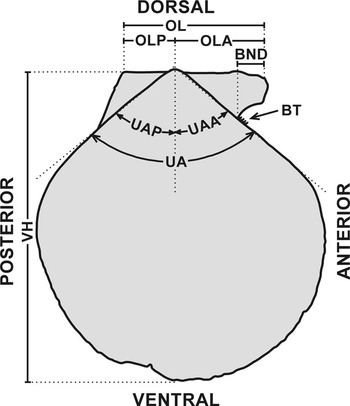
Ribbing pattern, dimensions of hinge and auricles, width of umbonal angle, and number of functional byssal teeth (Table I) confirm that the Brandy Bay pectinids can be assigned to Austrochlamys anderssoni. This species was first collected on Cockburn Island in 1903 by J.G. Andersson (Andersson Reference Andersson1906), and is known from several outcrops in the James Ross Island area (Jonkers et al. Reference Jonkers, Lirio, del Valle and Kelley2002, Smellie et al. Reference Smellie, McArthur, McIntosh and Esser2006), and also from the McMurdo Sound area of the Ross Sea (Speden Reference Speden1962). It has a late Miocene to late Pliocene (c. 7 to <3 Ma) age range. Austrochlamys anderssoni is a chlamydoid with a rather strongly prosocline shell (Fig. 3a; see also Jonkers Reference Jonkers2003, fig. 27), in which the anterior (partial) umbonal angle (UAA; Fig. 4) is wider than the posterior portion of that angle (UAP), but this is not well reflected in the Brandy Bay samples, possibly due to the low number of observations (Table I).
Means of selected parameters of Austrochlamys anderssoni from Brandy Bay and Cockburn Island (partly from Jonkers Reference Jonkers2003), with their respective standard errors. Number of observations in parentheses. VH, OL, OLA, OLP, BND in mm; UA, UAA, UAP in degrees; BT dimensionless. VH was computed using regression equations in Jonkers (Reference Jonkers2000), all other values from actual measurements and counts.

Right valve of Austrochlamys anderssoni (DJ.853.1 from Cockburn Island, valve height 100.2 mm) in exterior view, showing linear and angular parameters measured in Brandy Bay fossils; BT was counted. BND = depth of byssal notch, BT = number of functional byssal teeth, OL = length of outer ligament, OLA = length of anterior outer ligament, OLP = length of posterior outer ligament, UA = umbonal angle, UAA = anterior (partial) umbonal angle, UAP = posterior (partial) umbonal angle, VH = valve height.

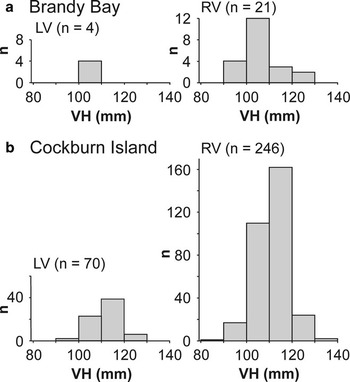
Valve height (VH; Fig. 4) of the shells from Brandy Bay could be determined by direct measurement in one specimen only (DJ.1501.8/8a; Fig. 3e; VH 114.1 mm). In another (DJ.1501.5; VH c. 125 mm) VH was estimated from projection onto a specimen with known valve height (DJ.851.4 from Cockburn Island). Valve height of other specimens was computed from the length of the outer ligament (OL, n = 5), length of the anterior outer ligament (OLA, n = 9), or length of the posterior outer ligament (OLP, n = 9), using the regression equations given for A. anderssoni by Jonkers (Reference Jonkers2000). It appears that the majority (64%, n = 25) of identifiable valves fall within a size range of VH 100–110 mm (Fig. 5a). On Cockburn Island 86% of all valves also fall within a narrow range of 100–120 mm (Fig. 5b; shell material only, internal and external moulds are excluded). Mean VH in the Brandy Bay and Cockburn Island samples is also remarkably similar: 105.6 ± 1.4 mm (n = 25) and 109.2 ± 1.7 mm (n = 264), respectively. Selective removal of most left valves and nearly all valves smaller than 100 mm at both Brandy Bay and on Cockburn Island, together with the disarticulated nature of the material, suggests that the assemblages were modified by a single process, i.e. the repeated freezing and thawing of a thin surface layer. On Cockburn Island articulated pairs (and small valves) have only been preserved as moulds. Only a single almost articulated pair with a collapsed left valve (DJ.851.6; VH 110.2 mm for right valve) was encountered among 316 shelly fossils examined (Jonkers Reference Jonkers2003).
Size frequency distribution of Austrochlamys anderssoni from a. Brandy Bay, and b. Cockburn Island. Valve height of shell fragments identifiable to valve type were computed with the regression equations given in Jonkers (Reference Jonkers2000). b. Adapted from Jonkers (2002). Note different scales.

Valves recovered from their original matrix elsewhere demonstrate that Austrochlamys anderssoni is essentially a thin-shelled species. The sharp cut-off in lower valve height of frost-heaved shells suggests that valve thickening was narrowly delineated, principally taking place during late ontogeny. Mature specimens exhibit extensive foliated calcite re-entry, which expands ventrally from the dorsal hinge region and occupies all of the area inside the pallial line (Fig. 3d). Such foliated calcite re-entry is particularly well developed in high latitude species (Waller Reference Waller1991). Preferential thickening of the right valve (the valve on which the animal rests, and usually the heavier of the two: in the Recent Austrochlamys natans (Philippi, 1845) by 14% (HAJ unpublished data)) may possibly help in maintaining life position, preventing the animals from being easily overturned by currents.
The relatively narrow umbonal angle (105–109°), the low contrast in convexity between the lower (right) and the upper (left) valve (see fig. 19a in Jonkers Reference Jonkers2003), the high auricular asymmetry (OLA/OLP 1.52 ± 0.05, n = 5; 1.53 ± 0.04, n = 29; in Cockburn Island shells), a byssal notch that is comparatively deep (Jonkers Reference Jonkers2003, fig. 19b), and the high mean number of functional byssal teeth (4.7) in Austrochlamys anderssoni, are all indicative of low motility. In addition the species’ close association with coarse-clastic lithofacies (conglomerate, diamictite) suggests that it may have lived attached to large clasts in water depths of <100 m (Jonkers Reference Jonkers1998a).
Antarctic chlamydoids, including Austrochlamys anderssoni, have until recently been placed in Zygochlamys Ihering, 1907, either at subgeneric (e.g. Fleming Reference Fleming1957) or at generic level (Jonkers Reference Jonkers1998a, Reference Jonkers1998b, Reference Jonkers2000). Because of this inclusion they have been thought of as indicators of interglacial episodes (see discussion in Jonkers Reference Jonkers1998a). However, evidence from outcrops on northern and eastern James Ross Island, in which articulated pairs of A. anderssoni occur within thick-bedded glaciomarine diamictite, was interpreted by Jonkers et al. (Reference Jonkers, Lirio, del Valle and Kelley2002) to suggest that the species is unreliable as an indicator of warmer climatic interludes. However, palaeotemperature information preserved in pectinids and bryozoans from the same stratum as discussed by Jonkers et al. (Reference Jonkers, Lirio, del Valle and Kelley2002) clearly indicate relatively warm “interglacial” conditions and not full glacials (i.e. δ18O values in pectinids suggest temperatures of c. +2.5 to -1.1°C (Williams et al. Reference Williams, Nelson, Smellie, Leng, Johnson, Jarram, Haywood, Peck, Zalsiewicz, Bennett and Schöne2010), with a greater temperature range (c. 5.6–7.7°C) suggested by MART (mean annual range of temperature) values in associated bryozoans (Clark et al. unpublished data; see also sedimentary evidence for “interglacial” conditions (Nelson et al. Reference Nelson, Smellie, Hambrey, Willaims, Vautravers, Salzmann, McArthur and Regelous2009). Austrochlamys anderssoni apparently favoured waters that were largely sea ice-free and it became extinct in Antarctica as sea ice extent expanded in response to climate cooling in the Late Pliocene (Williams et al. Reference Williams, Nelson, Smellie, Leng, Johnson, Jarram, Haywood, Peck, Zalsiewicz, Bennett and Schöne2010).
A revision of fossil and Recent pectinids of the Southern Ocean and neighbouring regions has demonstrated that the scallops now included in Austrochlamys are in fact not at all closely related to Zygochlamys (sensu lato), but instead have had a long evolutionary history in Antarctica. There are currently five other known species of Austrochlamys: A. gazdzickii Jonkers, Reference Jonkers2003, from outcrops of Oligocene rocks on King George Island, South Shetland Islands; A. marisrossensis Jonkers, Reference Jonkers2003, from Early Miocene cored rock in the Ross Sea; Late Miocene A. heardensis (Fleming Reference Fleming1957), from sub-Antarctic Heard Island; A. tuftsensis (Turner 1967), from the Pliocene of Wright Valley, Victoria Land, and the Vestfold Hills, Ingrid Christensen Coast; and the extant, relict species A. natans, which lives in a geographically limited area off southernmost South America.
Austrochlamys has retained a number of primitive characters, such as a prosocline shell, a deep byssal notch, several modes of rib introduction in the same shell, ribs consisting of simple crenulations, commarginal lirae present in rib interspaces, and antimarginal microsculpture (Waller Reference Waller1993). Shagreen microsculpture, which consists of a pattern with the appearance of a fine net, formed by the offset contacts of frilled commarginal lamellae (see Waller Reference Waller1991, pl. 1, figs 7 & 11), and which first appeared in primitive representatives of tribe Chlamydini (e.g. Zygochlamys), never developed in these Antarctic scallops and Austrochlamys is therefore placed in a tribe of its own (Austrochlamydini). Representatives of the South American late Eocene to Pliocene genus Zygochlamys, which have mostly acline shells, and of the South American and New Zealand genus Psychrochlamys Jonkers, Reference Jonkers2003, a Pliocene to Recent cold water genus with acline to strongly opisthocline shells, never occurred in Antarctica.
Discussion
Austrochlamys anderssoni is very abundant in the Cockburn Island Formation (Jonkers Reference Jonkers1998a) and is also locally abundant within the Hobbs Glacier Formation at, for example, Pecten Spur near Cape Gage (Jonkers et al. Reference Jonkers, Lirio, del Valle and Kelley2002, Nelson et al. Reference Nelson, Smellie, Hambrey, Willaims, Vautravers, Salzmann, McArthur and Regelous2009). Whilst glacial strata that could be assigned to the Hobbs Glacier Formation crop out throughout northern James Ross Island (e.g. Sykes Reference Sykes1989, Smellie et al. Reference Smellie, McArthur, McIntosh and Esser2006, Hambrey et al. Reference Hambrey, Smellie, Nelson and Johnson2008, Nelson et al. Reference Nelson, Smellie, Hambrey, Willaims, Vautravers, Salzmann, McArthur and Regelous2009), there are no known outcrops of the Cockburn Island Formation other than on Cockburn Island itself. When the Brandy Bay bivalves are compared with those from Cockburn Island, it is apparent that they are very similar in terms of both size and overall shell morphology, although the size distribution may be a function of the periglacial processes that have reworked the bivalves both at Brandy Bay and on Cockburn Island (Jonkers Reference Jonkers1998a). Based upon the abundance of bivalves, it is interpreted that they have been frost-heaved from a localized occurrence of late Neogene sediment originally deposited in the Brandy Bay area. It is possible that the fossils were derived from either the Cockburn Island or Hobbs Glacier formations, or their equivalents. In an attempt to try to resolve from which formation they were derived, two specimens (DJ.1501.8 and DJ.1501.11) were selected for Sr isotope analysis following the methodology presented in Dingle et al. (Reference Dingle, McArthur and Vroon1997) and McArthur et al. (Reference McArthur, Crame and Thirlwall2000). These specimens gave 87Sr/86Sr ratios of 0.709051 ± 0.000015 and 0.709049 ± 0.000015, respectively. The mean of 0.709050 ± 0.000011 (n = 2) is statistically indistinguishable from that of 0.709047 ± 0.000007 (n = 9) for samples of Austrochlamys from the Cockburn Island Formation on Cockburn Island (Dingle et al. Reference Dingle, McArthur and Vroon1997; reporting uncertainty as 2σ of the mean, rather than 2 SD of the data, as given by those authors). In contrast, both these mean values are distinctly different from 87Sr/86Sr ratios for fossils from the Hobbs Glacier Formation, except for a single deposit at Förster Cliffs (probable depositional age 2.5 Ma, Smellie et al. Reference Smellie, Johnson, McIntosh, Esser, Gudmundsson, Hambrey and van Wyk de Vries2008) that is characterized by reworked fossils (Dingle et al. Reference Dingle, McArthur and Vroon1997, Dingle & Lavelle Reference Dingle and Lavelle1998, McArthur et al. Reference McArthur, Rio, Massari, Castradori, Bailey, Thirlwall and Houghton2006, Smellie et al. Reference Smellie, McArthur, McIntosh and Esser2006, Nelson et al. Reference Nelson, Smellie, Hambrey, Willaims, Vautravers, Salzmann, McArthur and Regelous2009). Using the most recent Sr-isotope calibration curve for the interval, which includes new data for the Pliocene type-sections on Sicily (McArthur & Howarth Reference McArthur and Howarth2004, McArthur et al. Reference McArthur, Rio, Massari, Castradori, Bailey, Thirlwall and Houghton2006) the ratio 0.709050 ± 0.000011 equates to a numerical age of 4.33 +0.6/-1.3 Ma. The Brandy Bay deposit almost certainly overlies Cretaceous sediments, rather than being interbedded with volcanic strata. Outcrops of the Hobbs Glacier Formation that directly overlie Cretaceous strata are distinguished by conspicuous Peninsula-derived erratics, which are absent in the Brandy Bay outcrop. Given this observation, and the comparison in overall shell size and preservation, and similar Sr isotope composition, it is more probable that the bivalves were derived from a unit equivalent to the Cockburn Island Formation rather than from the Hobbs Glacier Formation. This would suggest that the Cockburn Island Formation may be more geographically widespread than previously known. The low-gradient surface the bivalves are resting upon may indeed, reflect a marine cut platform (cf. Bibby Reference Bibby1965, Strelin & Malagnino Reference Strelin and Malagnino1992) and thus conceivably is a very old feature (early Pliocene). The limited abrasion and their localized concentration is indicative that the bivalves have undergone minimal lateral reworking within the active layer, but these fossils are clearly no longer in their original stratigraphical context and they reflect reworking as a result of periglacial processes.
Acknowledgements
Fieldwork and Sr isotope analysis were funded through NERC-AFI research grant GR3/AFI2/38. Fieldwork would not have been possible without logistic support from HMS Endurance and Crispin Day. M.F. Thirlwall is thanked for access to mass spectrometric facilities at UCL for Sr isotopic analysis. We are grateful to A.G. Beu and T.R. Waller for their reviews; Alan Vaughan for his editorial comments and DP acknowledges the patience and perseverance of his co-authors for the time that this manuscript took to see the light of day!