Introduction
Hypochondriasis is common (Gureje et al. Reference Gureje, Ustun and Simon1997) and costly (Barsky et al. Reference Barsky, Ettner, Horsky and Bates2001). The application of cognitive behavioural theories of health anxiety has led to the development of cognitive behavioural therapy (CBT; Salkovskis et al. Reference Salkovskis, Warwick and Deale2003). Such treatment seems appropriate for this problem as hypochondriasis is a cognitive disorder, defined as a preoccupation with illness based on the person's misinterpretation of bodily sensations and other bodily variations (APA, 1995). Hypochondriacal patients can be reluctant to accept psychiatric treatment because they believe themselves to be physically ill, which makes the focus on misinterpretation a particularly useful strategy for engaging patients in treatment (Salkovskis & Warwick, 1986). This strategy has led to a well-defined cognitive behavioural treatment (Salkovskis et al. Reference Salkovskis, Warwick and Deale2003), which has been examined in case studies, uncontrolled trials, and in two controlled trials (Warwick & Marks, Reference Warwick and Marks1988; Warwick et al. Reference Warwick, Clark, Cobb and Salkovskis1996; Clark et al. Reference Clark, Salkovskis, Hackmann, Wells, Fennell, Ludgate, Ahmad, Richards and Gelder1998).
Barsky (Reference Barsky1996) developed a similar understanding of hypochondriasis as a self-perpetuating disorder of cognition and bodily perception with focus on the cognitive and behavioural amplification of benign bodily symptoms. A treatment model based on this understanding has been examined in two controlled designs. One study included only a few patients (Avia et al. Reference Avia, Ruiz, Olivares, Crespo, Guisado, Sanchez and Varela1996) with a waiting-list group as the control, and another large-scale randomized controlled trial had ‘usual medical care’ as the control (Barsky & Ahern, Reference Barsky and Ahern2004). A significant clinical treatment effect was found, but questions were raised about generalizability and the relationship between intervention and outcome. Other treatments for hypochondriasis, such as explanatory therapy (Fava et al. Reference Fava, Grandi, Rafanelli, Fabbri and Cazzaro2000), and a cognitive approach with a different treatment protocol have been examined to some degree (Visser & Bouman, Reference Visser and Bouman2001); the latter treatment was implemented in a randomized controlled trial with paroxetine and placebo (Greeven et al. Reference Greeven, van Balkom, Visser, Merkelbach, van Rood, van Dyck, Van der Does, Zitman and Spinhoven2007). In the intent-to-treat analysis, only CBT differed significantly from the placebo.
The present trial tests the treatment protocol devised by Salkovskis et al. (Reference Salkovskis, Warwick and Deale2003) at a clinical centre that was not involved in its development. A dissemination strategy with training and supervision was established in a previously reported pilot study (Wattar et al. Reference Wattar, Sorensen, Bueman, Birket-Smith and Salkovskis2005). The present trial tests the generalizability to a non-research setting of combining individualized and group CBT (to reduce the therapist time required) with the addition of mindfulness training. In a previous study Applied Stress Management (ASM) was used as the comparison condition (Clark et al. Reference Clark, Salkovskis, Hackmann, Wells, Fennell, Ludgate, Ahmad, Richards and Gelder1998). ASM was found to be more effective than the waiting-list control group but not as effective as misinterpretation-focused CBT. However, the researchers incorporated a range of CBT-based engagement strategies in the early stages of ASM to ensure low drop-out rates, thus diluting the distinctness of the comparison.
Psychodynamic psychotherapy is offered routinely to patients with hypochondriasis in Denmark. The aims of the present study were to evaluate the modified CBT programme developed by the Danish group in collaboration with Professor Salkovskis in a randomized controlled trial, comparing it with the psychological treatment most likely to be offered to such patients in Denmark; we were able to compare non-overlapping treatment methods and to benchmark these against a waiting-list comparison.
Method
Settings and participants
All patients referred consecutively to a liaison psychiatry unit in Copenhagen between August 2001 and January 2003 were evaluated for inclusion in the trial. Inclusion criteria were: (1) age between 18 and 65 years; (2) fluency in the Danish language; (3) meeting ICD-10 research criteria for hypochondriasis; and (4) experiencing significant levels of health anxiety, as indicated by a score of >17 on the 14-item version of the Health Anxiety Inventory (HAI; Salkovskis et al. Reference Salkovskis, Rimes, Warwick and Clark2002). Exclusion criteria were: (1) the presence of a current psychotic condition, (2) current substance dependence, (3) the presence of another medical or psychiatric condition requiring immediate treatment, (4) psychopharmacological treatment initiated or increased 6 weeks prior to the assessment, and (5) previous adequate cognitive behavioural or psychodynamic treatment. The trial passed the Danish ethics committee and the patients gave their written consent to participate in the trial. The trial is registered at ClinicalTrials.gov as identifier: NCT00208247.
The initial psychiatric interviews included the Schedule for Clinical Assessment in Neuropsychiatry (SCAN; WHO, 2000). All of the interviews were conducted by an experienced psychiatrist trained in the use of SCAN and certified at the World Health Organization (WHO) Centre in Copenhagen. To examine the prevalence of psychiatric co-morbidity in the sample, the hierarchical rules for somatoform, anxiety, obsessive–compulsive and depressive disorders were not applied in the interview. As a specific treatment for hypochondriasis had not previously been available in Denmark, there were concerns about referral rates. General information about the trial was published on the radio and in newspapers, public meetings were held, and a leaflet describing the trial was distributed to potential sources of referrals. Potential participants were required to obtain a referral from their general practitioner (GP), a medical consultant, or a psychiatrist. A third of those referred had come forward as a result of the publicity; the remainder were routine referrals to the Liaison Psychiatry Unit. This unit employs three senior psychiatrists. The first author led the team, managed the trial and oversaw the data collection; he conducted the initial assessment interviews. The short-term psychodynamic psychotherapy (STPP) was conducted at the Liaison Psychiatry Unit. The CBT was conducted at the Cognitive Psychology Centre (KPC), a private clinic that provides CB-based psychotherapy for out-patients, mainly anxiety disorders. The Danish health-care system is free of charge, and the study was supported by grants from the Danish Ministry of Social Affairs.
Objectives
Our aim was to conduct a randomized controlled trial to compare (1) the effectiveness of CBT, STPP and a waiting list of the same duration in the treatment of hypochondriasis and (2) the long-term effectiveness of the two treatments. It was predicted that CBT and STPP would reduce hypochondriacal symptoms and general psychopathology significantly more than the waiting list; and that CBT would reduce hypochondriacal symptoms significantly more than STPP, but that both would produce similar changes in general psychopathology.
Design
Patients with severe health anxiety fulfilling diagnostic criteria for hypochondriasis according to ICD-10 and other trial criteria were randomized to CBT, STPP or a waiting list of the same duration as treatment (6 months). To increase the power of the between-treatment comparison for the two active treatments, waiting-list patients who met all inclusion criteria and no exclusion criteria at 6 months after the first randomization were randomized again to one of the two active treatments. Patients were followed up for 1 year after the end of active treatment.
Randomization
The randomized allocation sequence was computer generated in permuted blocks of eight. The block sizes were concealed until the end of the trial. The randomization was stratified according to gender and level of depression at baseline with a cut-off of 12 on the Hamilton Depression Rating Scale (HAMD). Concealment of allocation from the initial assessor was ensured by a procedure involving centralized telephone randomization at the Copenhagen Trials Unit (CTU). Patients were assigned initially to one of the three groups. After 6 months, those on the waiting list were randomized to either CBT or STPP using the same concealment strategy, but here the computer-generated block size was four.
Interventions
CBT
The cognitive behavioural treatment developed by Salkovskis, Warwick and co-workers (Salkovskis, Reference Salkovskis, Hawton, Salkovskis, Kirk and Clark1989; Warwick, Reference Warwick1989; Salkovskis et al. Reference Salkovskis, Warwick and Deale2003) was used, with adaptations for the specific setting. After eight individual sessions, patients joined a group (ranging in size from five to nine patients); this group continued with the CBT programme, with the addition of mindfulness training (Segal et al. Reference Segal, Williams and Teasdale2002). The same therapists conducted the individual and group sessions. The treatment consisted of 16 sessions and lasted up to 6 months. The individual sessions lasted 45 min, the group sessions 90 min. The mindfulness training was delivered in two 30-min group sessions. Treatment was delivered by six experienced therapists, qualified clinical psychologists and certified CBT therapists, with no previous experience of treating patients with hypochondriasis. They received an initial workshop with a follow-up session. Professor Salkovskis supervised treatment on a peer-group basis. At the start of this trial the therapists had treated a few patients with hypochondriasis, but the treatment was still novel for them.
The treatment involved working with the patients to develop a ‘shared understanding’ of their health anxiety (Salkovskis et al. Reference Salkovskis, Warwick and Deale2003). This required identification of a personalized version of the cognitive model of health anxiety. Therapy emphasized the idea that this was a less-threatening explanation of their problems, for example that the patient's problem is not that he/she is suffering from cancer, but from a fear of having cancer. As a crucial part of this reattribution process, the therapist helped the patients to carry out behavioural experiments to test the alternative cognitive account of their problems; for example, by asking the patient to repeatedly touch a lymph node at the neck, stimulating increasing tenderness and swelling, helping them to understand how the interaction between negative appraisals and safety-seeking behaviour can account for the symptoms that they worry about.
When the patients started the group treatment, they had been helped to derive an individualized alternative formulation of their health anxiety problems. For example, a patient who came into therapy believing that he had multiple sclerosis (MS) was, through the formulation process, introduced to the idea that he particularly fears having MS, inevitably resulting in increased focus of attention to sensations of numbness and other MS-consistent sensations, and therefore notices symptoms that he otherwise would not, increasing his illness belief further as one of several vicious circles, which means that he becomes increasingly preoccupied and more anxious.
The patients were encouraged to support each other in testing their alternative, non-catastrophic beliefs and making changes in the way they dealt with their health anxiety and other aspects of their life, for example refraining from safety-seeking behaviour such as reassurance seeking (replacing it with interpersonal support), with transient worsening of anxiety but longer-term reduction in health fears.
STPP
STPP consisted of 16 weekly sessions, each session with a duration of 50 min. The therapist was an experienced psychiatrist trained in psychoanalytical psychotherapy. STPP is based on the understanding that the unconscious constitutes elements that are not available for the conscious part of the psyche but have pervasive influence on the contents of the consciousness and the behaviour of the individual. The key therapeutic features are the therapeutic relationship, the patients' interpersonal interactions, and recognition of patterns or themes in the patients' functioning (Blagys & Hilsenroth, Reference Blagys and Hilsenroth2000). There is no consensus as to what constitutes appropriate short-term psychodynamic treatment for hypochondriasis, so a pragmatic decision was made with an individualized focus that was formulated in early sessions compatible with other models for STPP (Messer, Reference Messer2001). We decided on a relational approach instead of a drive/structural viewpoint, emphasizing psychodynamic principles such as free association and neutrality, and avoiding explicit and active challenge of patients' beliefs about health and disease. This method differentiates psychodynamic clarification and confrontation from cognitive discussion on health anxiety; for example, if a patient says that they would like to change the subject, try to clarify what made them try to do that, and if they are evasive confront them with the anxiety connected to this wish. Some transference interpretations were used.
Waiting list
Patients in the waiting-list group were asked to keep in touch with their GP, who had been informed of the trial in writing. The patients and their GPs were instructed not to begin any other treatment during the study period. After 6 months, the patients on the waiting list were re-evaluated for inclusion and exclusion criteria and, if they still met the criteria, re-randomized to CBT or STPP.
Therapy differences
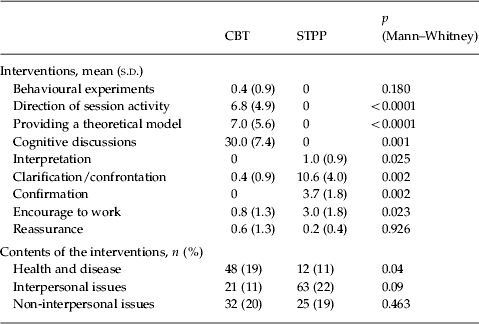
A Delphi technique (Jones & Hunter, Reference Jones and Hunter1995) was used to reach consensus on the extent of specific and non-specific components of treatment. This was operationalized in a rating instrument identifying the presence or absence of components unique to and shared by the two models of treatment. A list of definitions is available from the authors. We chose 24 audiotaped sessions at random, 12 from CBT and 12 from STPP. No patient provided more than one tape. The sessions were rated independently to evaluate the therapists' adherence to the treatment protocol. Assessors were blind to the origin of the tape. Each intervention was classified according to the items shown in Table 1, where the distribution of different types of intervention between CBT and STPP is presented. The statistical difference between the interventions made in sessions from the two models was tested using a non-parametric independent samples Mann–Whitney U test. Direction of the session activity, providing a theoretical model in the session and cognitive discussions are components specific for CBT, which were only found in the CBT sessions, whereas interpretation, clarification/confrontation and confirmation were found only in STPP sessions. It was possible to differentiate between psychodynamic interventions such as clarification/confrontation and cognitive discussions. ‘Encourage to work’, defined as interventions supporting patients' comments or behaviour, occurs more frequently in the psychodynamic treatment. The contents of health and disease were represented significantly more in CBT sessions than STPP and interpersonal issues significantly in STPP. These findings are consistent with the definition of the different interventions, and indicate good adherence to the specific treatment models in both types of psychotherapy.
Mean number of interventions per session (total number of sessions: 24)

CBT, Cognitive behavioural therapy; STPP, short-term psychodynamic psychotherapy; s.d., standard deviation.
Outcome measures
Two primary outcome measures were predefined to test for changes in specific and general psychopathology. The Health Anxiety Inventory (HAI) is a 14-item, self-report questionnaire with good reliability, validity and internal consistency (Salkovskis et al. Reference Salkovskis, Rimes, Warwick and Clark2002) and was used as the specific health anxiety measure. The HAI includes behavioural features of hypochondriasis. The Hamilton Anxiety Rating Scale (HAMA; Hamilton, Reference Hamilton1959) was used as the primary measure of general anxiety. Secondary outcome measures included the Beck Depression Inventory (BDI), the Beck Anxiety Inventory (BAI) and the HAMD. Experienced psychiatrists and psychologists reviewed two independent translations of the HAI, and a professional translator back-translated the final version into English; this back-translation was accepted by Professor Salkovskis. Validated versions in Danish of the remaining scales were available. Four experienced psychologists, independent of the study, assessed the patients with the HAMA and the HAMD. They received training in using the instruments and were blinded for the group assignment. The inter-rater reliability for the total score of the HAMA was 0.984 (Cronbach's α standardized) and for the total score of the HAMD 0.906 (Cronbach's α standardized).
Assessor blinding
It was not possible to blind the patients and therapists to the group allocation, but the raters assessing the outcome were blinded with respect to group assignment. The blinding was evaluated. The persons involved in encoding the data were blinded to the group allocation.
Statistical methods
We used a modified intention-to-treat (ITT) analysis with exclusion unrelated to non-compliance, withdrawal or losses to follow-up (Fergusson et al. Reference Fergusson, Aaron, Guyatt and Hebert2002). Missing data were imputed using the last-observation-carried-forward (LOCF) technique. The data analysis was divided into two parts: first, the three allocation groups (CBT, STPP and waiting list) were compared at the end of the intervention period on primary and secondary outcome variables using ANOVA. Second, the two treatment groups CBT and STPP (including those patients initially on the waiting list and subsequently allocated to the active treatments) were compared at the end of treatment and at the 6- and 12-month follow-up on primary and secondary outcome variables. The first analysis was a one-factor ANOVA with outcome variables as dependent variables and the three groups as independent variables. Where significant differences between the three groups were found, post-hoc tests were performed using Tukey LSD tests. The second analysis used a repeated-measure ANCOVA with outcome variables after treatment and at follow-up as the repeated-measure variables and end-of-treatment scores as covariates; treatment type (CBT v. STPP) was the grouping variable. For each analysis a 95% confidence interval was derived. Pearson's χ2 analysis was used for baseline data analysis where this was categorical. All tests of statistical significance were interpreted with an α level set to 0.05. A previous study (Wattar et al. Reference Wattar, Sorensen, Bueman, Birket-Smith and Salkovskis2005) indicated that CBT treatment would reduce health anxiety by a mean of 12 (s.d.=7) on the HAI. With a type II error level of 11%, an estimated mean difference between the two active intervention groups of 5 on the HAI would be detected as significant (p=0.05, two-sided), with 39 patients in each intervention group. It was therefore decided to include 20 patients in the CBT group, 20 patients in the STPP group and 40 patients on the waiting list, subsequently randomized and allocated to either CBT or STPP. No interim analyses were planned or conducted during the trial.
Results
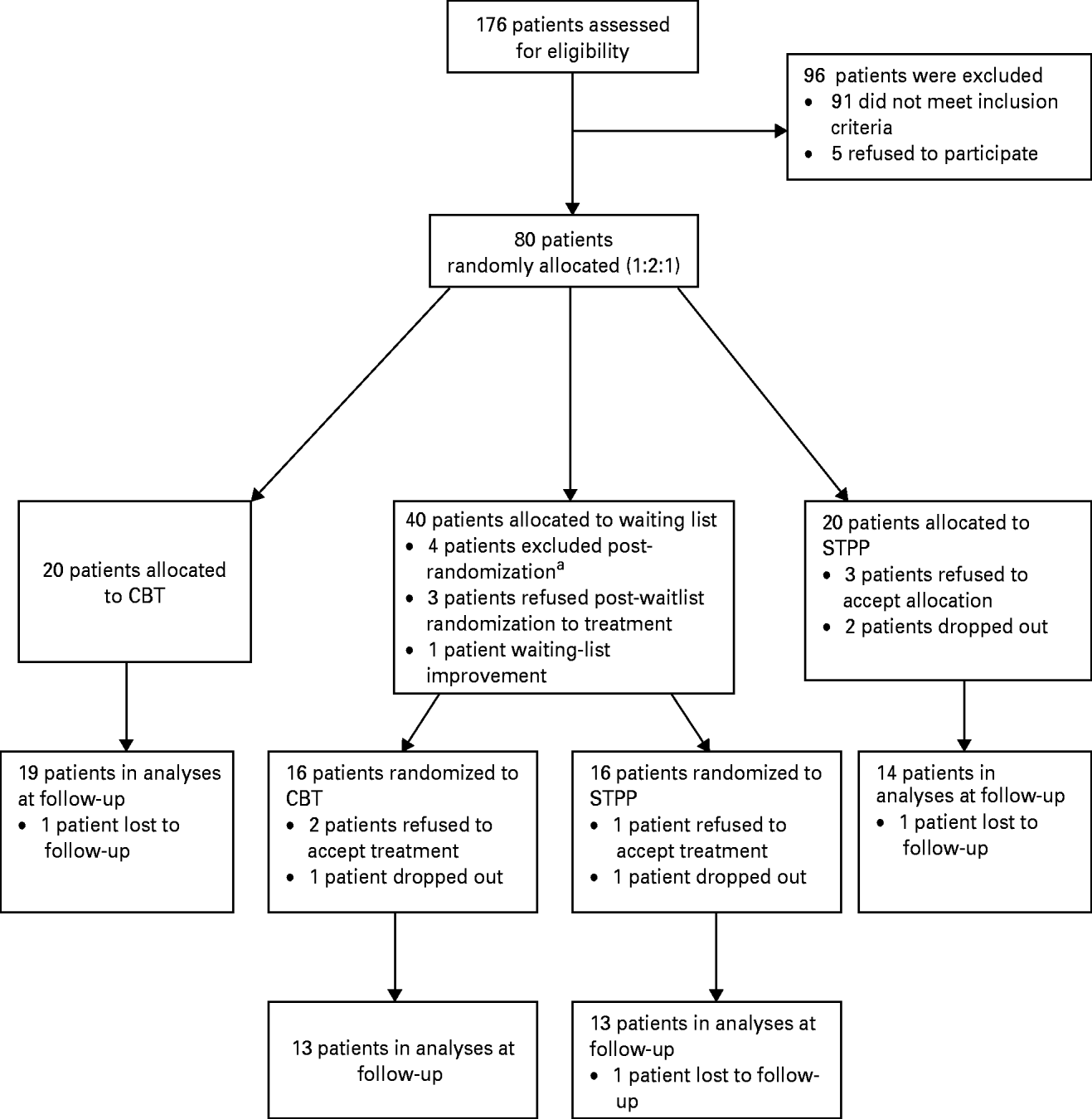
The participant flow is shown in Fig. 1. A total of 176 patients were assessed for eligibility; 91 patients did not meet the inclusion criteria. Of the 85 patients who fulfilled the inclusion criteria, five declined to participate. Hence, 80 patients were randomized. All patients included in the trial were considered by an adjudication committee blinded to the intervention. Four patients had initially been inappropriately included, with exclusions not being detected at assessment. Two had previously received CBT, and two were not diagnosed correctly: one patient was psychotic; the other had a severe personality disorder such that health anxiety was not his main problem. These patients were excluded and did not receive treatment and were excluded from the analyses. Thus, 76 patients were included in the three-group analysis. In the second stage of the analysis three patients refused randomization after the waiting period and one patient improved on the waiting list to the point that she no longer met the inclusion criterion, leaving 72 patients in the two-group analysis, with 36 patients in each group. Six patients refused to accept the proposed treatment: two (5.6%) in the CBT group and four (11.1%) in the STPP group. A total of 66 patients began treatment; 62 patients completed the treatment. Four patients dropped out during the course of the treatment itself: one (3%) in the CBT group and three (10.7%) in the STPP group.
Flow of participants through the randomized trial. a Two patients had previously received CBT, two patients were diagnosed wrongly at inclusion.

The blinded independent assessors were asked to guess the treatment the patient had received and were able to guess treatment allocation significantly better than expected by chance (χ2=25.1, p<0.0001).
Baseline data
Of the 76 patients included after randomization [mean age (s.d.)=37 (11) years], 63% were female. The mean Global Assessment of Functioning (GAF) score (s.d.) was 66 (7.0), 63% were cohabitating, and 74% were employed or receiving education. Sixty-five per cent had no previous experience with psychiatric treatment, 21% were currently receiving antidepressant medication, and 74% no psychopharmacological treatment. One patient had been on antipsychotic medication for more than 10 years. There was no information about psychotic episodes, and the patients were not psychotic during the trial. The mean score on the HAI (s.d.) was 27.6 (5.2), and on the HAMA 18.2 (6.8). There was evidence of substantial co-morbidity, 37% had panic disorder, 28% moderate depression, 17% somatoform disorder and 27% obsessive–compulsive disorder. This is consistent with previous findings (Barsky et al. Reference Barsky, Wyshak and Klerman1992), and in all instances health anxiety was the main complaint. The only significant difference between the three groups (CBT, STPP and waiting list) was in the HAI (s.d.) scores, which were lower in the waiting-list group [26.1 (5.0)] than the STPP [29.3 (4.3)] and CBT groups [28.8 (5.8); F(2, 73)=3.3, p=0.044].
Outcome measures
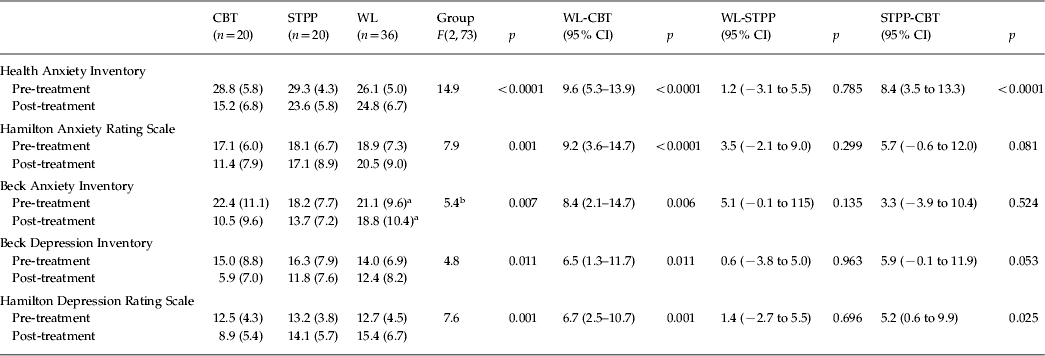
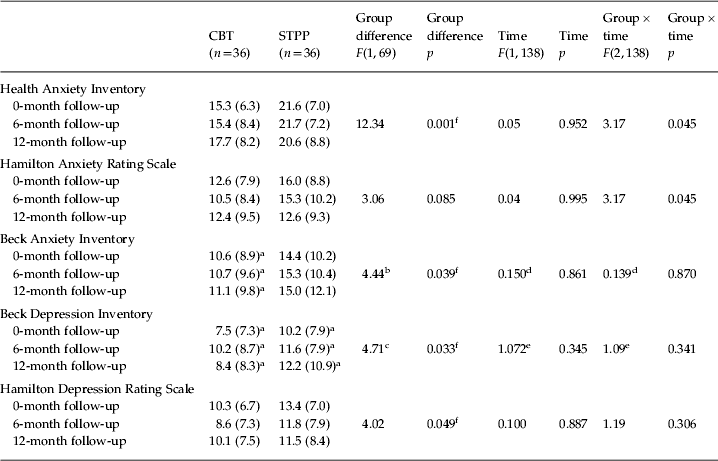
The ITT ANOVA detected significant group effects, with statistically significant main effects of group for all primary and secondary outcome measures. These were in the measure of health anxiety, HAI [F(2, 72)=17.6, p<0.0001], HAMA [F(2, 72)=7.6, p=0.001], BAI [F(2, 72)=7.3, p=0.001], HAMD [F(2, 72)=9.0, p<0.0001] and BDI [F(2, 72)=8.6, p<0.0001]. Table 2 shows the means and the results of an ANOVA that was used to derive Tukey LSD multiple comparisons. These results indicate that those who received CBT improved significantly compared with the waiting-list comparison group on both the primary and secondary outcome measures. There was no significant difference between the STPP and waiting list for any outcome measures. Comparison between the STPP and CBT treatment groups showed that the CBT group performed significantly better on the HAI and HAMD but not on the HAMA or the BAI, with the comparison on the BDI showing a trend for CBT to do better than STPP (p=0.053). Overall, CBT was thus found to be better than the waiting list on all measures, with STPP showing no significant differences relative to the waiting-list control on any measures. For the two-group comparison ANCOVA, between-treatments effects (Table 3) were present as a significant main effect of group for the HAI, BAI, HAMD and BDI. For the HAMA, the difference was not significant but revealed a trend (p=0.085). For the HAI and the HAMA the main treatment effect was modified by a significant group×time interaction.
Three-group analyses with mean measures by group pre- and post-treatment

CBT, Cognitive behavioural therapy; STPP, short-term psychodynamic psychotherapy; WL, waiting list; CI, confidence interval.
a n=35; b F(2, 72).
Two-group analyses with means for main measures by group at 0-, 6- and 12-month follow-up

CBT, Cognitive behavioural treatment; STPP, short-term psychodynamic psychotherapy.
a n=35; b F(1, 68); c F(1, 67); d F(2, 136); e F(2, 134); f F(2, 72).
These interactions were examined further using an ANOVA for the change scores relative to pre-treatment levels. For the HAI, the difference in change scores was significant for the end of treatment [F(1, 70)=14.2, p<0.0001] and the 6-month follow-up [F(1, 70)=10.8, p=0.002] but not for 12-month follow-up [F(1, 70)=1.9, p=0.17]. The same analysis of change scores for the HAMA indicated a trend only at the end of treatment [F(1, 70)=3.2, p=0.076] but a significant difference at 6 months [F(1, 70)=4.5, p<0.05]; there was no evidence of a difference at the 12-month follow-up [F(1, 70)=0.08, p=0.93].
In a within-group comparison the two primary outcome measures were compared pre- and post-treatment and at follow-up using an ANOVA. There was a significant difference for the HAI in the CBT group [F(2, 105)=40.3, p<0.0001] and the STPP group [F(2, 105)=14.5, p<0.0001], and for the HAMA in the CBT group [F(2, 105)=10.1, p<0.0001] and the STPP group [F(2, 105)=5.9, p=0.001]. A pairwise comparison adjusted for multiple comparisons with Bonferroni showed that the significant difference was between pre- and post-treatment scores, which confirms that patients maintained their gains in a within-group comparison during the follow-up period (data not included).
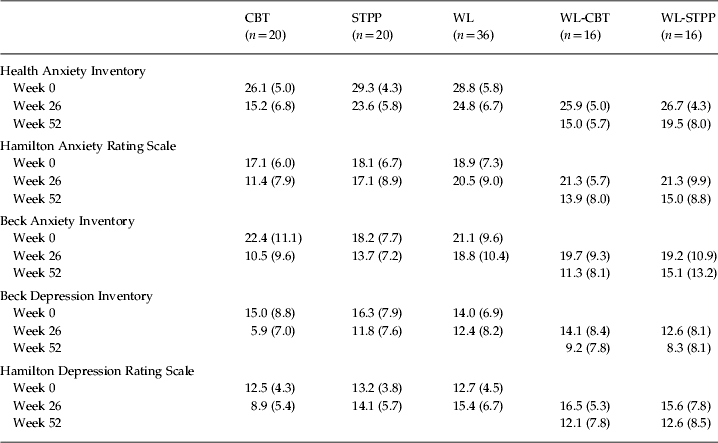
In Table 4 the mean outcome scores are shown for each of the three groups on the main ratings from weeks 0 to 26 and for the two post-waiting-list crossover groups from weeks 26 to 52.
Mean outcome scores of each of the three groups on the main ratings from week 0 to week 26 and the two post-waiting-list crossover from week 26 to week 52

CBT, cognitive behavioural treatment; STPP, short-term psychodynamic psychotherapy; WL, waiting list.
CBT, STPP and WL include the 76 patients from the three-group analysis, WL-CBT and WL-STPP include the 72 patients from the two-group analysis.
Discussion
The patients receiving CBT improved relative to the waiting-list patients on all measures and relative to the STPP group on health anxiety and depression measures. The STPP group did not show significant improvements relative to the waiting-list group on any measures, but HAI scores were significant lower at baseline for the waiting-list group; the difference between STPP and CBT at baseline was 0.5 points. At follow-up CBT did significantly better than STPP on all measures except the HAMA, where a significant interaction suggested that the difference in health anxiety was reduced at the final follow-up point. The evidence of a reduced level of difference in the longer term is a common finding in psychotherapy studies as life events impact the participants, resulting in differences being diluted.
In STPP, it would have been preferable to have several therapists but this was not possible. The lack of consensus for psychodynamic treatment for hypochondriasis was compensated for by using a relational approach to developing individual themes early in the therapy. This approach is less demanding as it does not challenge resistance and defences, but is less active and goal oriented and may need more than 16 sessions to be effective.
CBT was adapted by the use of group and mindfulness techniques. Through the cognitive reattribution process, patients are encouraged to abandon their usual safety-seeking behaviour; mindfulness was added as a specific way of helping patients manage their thoughts by improving attentional control. The transition from individual therapy to the CBT group format may have increased patients' sense of belonging, and offered an opportunity for participants to have their experiences of change validated.
Comparison with other trials
In a Cochrane review cognitive and behavioural therapies were shown to be effective in reducing symptoms of hypochondriasis (Thomson & Page, Reference Thomson and Page2007), but the small numbers of participants compromised the estimation of effect size and the comparison between different types of psychotherapy. The current trial confirms significant results for CBT and introduces short-term psychodynamic therapy, which has not been examined in a controlled study for hypochondriasis, even though psychological therapies in primary care are often psychodynamic or person-centred in approach.
It is possible that the improvements seen in the trials were due to non-specific factors such as expectation of improvement and regular contact with a therapist rather than specific properties of forms of psychotherapy. It is therefore important that controlled trials as comparison use different kinds of psychotherapy. There are three different treatment protocols available for CBT for hypochondriases that have been examined in controlled trials: the Visser and Bouman approach, the Barsky approach (Visser & Bouman, Reference Visser and Bouman2001; Barsky & Ahern, Reference Barsky and Ahern2004; Greeven et al. Reference Greeven, van Balkom, Visser, Merkelbach, van Rood, van Dyck, Van der Does, Zitman and Spinhoven2007), and the Salkovskis and Warwick approach. Including this trial, the Salkovskis and Warwick approach is the only treatment compared to two different kinds of psychotherapy; it is more time-consuming in the individual format but in the present trial individual and group CBT were combined to reduce the therapist time required.
Limitations
The sample was not severely disabled and may not be representative of hypochondrial patients in the clinic. A few patients refused randomization and there were drop-outs spread between the randomized groups. A small number of patients were excluded from the trial after randomization before active treatment started; the exclusion was unrelated to treatment response and other clinical evaluations. An additional ITT analysis without post-randomization exclusion did not differ from the findings presented (data not shown).
The blinding of the independent assessors was compromised in that the assessors, when asked to guess the treatment condition, gave responses that were correct at a level better than chance. The patients were instructed not to tell the assessor what treatment they received, but it seems that other clues may have been present for the assessors. This factor is seldom assessed in studies such as this. The reason for blinding having been compromised was probably that the patients revealed the treatment unwittingly by the way in which they answered the questions concerning different symptoms. It was not possible to blind the patients for the psychotherapeutic intervention they received. We were not able to examine whether assessors' guesses regarding treatment affected their judgement, as we have no systematic information about the patients' and raters' expectation to the allocated treatment.
Conclusions
We found a significant effect of the cognitive behavioural treatment that was still evident at follow-up on most measures. There is a structural difference between the two treatment formats that may have influenced the results (Baskin et al. Reference Baskin, Tierney, Minami and Wampold2003), but the psychodynamic treatment was not found to have any specific effects in the present study in comparison with waiting list or CBT. It is possible that the effectiveness of this treatment has been underestimated as it may not have been delivered in an optimal way; for example, treatments may have been too short or with too little emphasis on goal setting such as problem solving and symptom focus. Given the chronic nature of health anxiety, we should consider the possibility of offering maintenance sessions, for example on a 3- or 6-monthly basis during the immediate follow-up period.
Acknowledgements
This study was supported by grants from the Danish Ministry of Social Affairs. P. Salkovskis received support from the NIHR Biomedical Research Centre at the South London and Maudsley NHS Foundation Trust/Institute of Psychiatry (King's College London).
Declaration of Interest
None.