Introduction
In recent decades, research has highlighted strong relationships between the auditory environment and human health (Monti et al., Reference Monti, Agostini, Dellabartola, Neri, Bozicevic and Pocecco2012). Sound exceeding 50 dB(A) is known to cause annoyance, disturbed sleep, delirium, elevations in blood pressure and tachycardia and is possibly linked to ischemic heart disease in healthy populations (Choiniere, Reference Choiniere2010; Morrison et al., Reference Morrison, Haas, Shaffner, Garrett and Fackler2003). Auditory environments are made up by the whole of audible sounds in any certain place and time. Loud and unwanted sounds are usually regarded as noise.
In nursing homes, staff, household appliances and other residents shape the auditory environment. Staff may produce unexpected, repetitive, loud and droning sounds, which residents can experience as unpleasant, disturbing and even unsafe (van den Bosch et al., Reference van den Bosch, Andringa, Baskent and Vlaskamp2016). Furthermore, staff members tolerate (unconsciously) more and louder sounds since the nursing home is their workplace. As a result, staff might (unintentionally) contribute to an auditory environment that influences the mood and quality of life of the residents adversely (Sloane et al., Reference Sloane2003).
Residents with dementia, which make up the majority of nursing home population, are highly sensitive to detrimental sounds (Jao and Algase, Reference Jao and Algase2016; van Hoof et al., Reference van Hoof, Kort, Duijnstee, Rutten and Hensen2010). This increased sensitivity might arise from a reduced ability to consciously value sensory experiences (van Hoof et al., Reference van Hoof, Kort, Duijnstee, Rutten and Hensen2010). Research has found associations between noise and increased agitation and apathy, fewer social interactions, and sleep disturbance in nursing home residents (Garre-Olmo et al., Reference Garre-Olmo, López-Pousa, Turon-Estrada, Juvinyà, Ballester and Vilalta-Franch2012; Joosse, Reference Joosse2012; Meyer et al., Reference Meyer, Dorbacker, O’Rourke, Dowling, Jacques and Nicholas1992; Schnelle et al., Reference Schnelle, Cruise, Alessi, Ludlow, al-Samarrai and Ouslander1998; Southwell and Wistow, Reference Southwell and Wistow1995). On the other hand, natural sounds have been associated with a decrease in agitation and aggression (Whall et al., Reference Whall, Black, Groh, Yankou, Kupferschmid and Foster1997).
In addition, nursing home residents are often unable to adjust their situation to personal needs due to limited cognitive, sensory and verbal abilities. Residents with dementia depend on caregivers to acknowledge and satisfy their daily needs, shape their environment and make them feel secure. As suggested by Cadieux et al. (Reference Cadieux, Garcia and Patrick2013), there is a need to create the notion of home for this population. The auditory environment, however, does not only influence the well-being of the residents, but also affects the staff members who spend a considerable amount of time in these (work) environments (Aletta et al., Reference Aletta2018a).
Sound perception and the effects of sounds on health vary across individuals and situations. This variance can be researched with the acoustical approach, which focuses on the physical aspects of sound (e.g. intensity), or the soundscape approach, which focuses on the meaning people attribute to sounds. Both types of research have been performed in nursing homes. However, no previous review has examined the evidence on sounds in nursing homes and their influence of sounds on residents or caregivers. Furthermore, as the literature field is not yet densely populated with relevant studies, a review is required to guide future research in this area. The aim of this literature review was (1) to explore the (perceived) intensity and sources of sounds in nursing homes, and (2) to investigate the influence of sounds on health of residents (including behavioral problems in dementia) and staff.
Methods
Search strategy
The search was carried out according to guidelines of the Centre for Reviews and Dissemination for systematic reviews (Tacconelli, Reference Tacconelli2010). We used the following sources: PubMed (covering Embase and Medline), Scopus, Web of Science and trial registers (clinicaltrials.gov, controlledtrials.gov, trialregister.nl). The search was last updated in January 2019. The following text words were used: (sound* OR noise OR acoustic OR auditory OR music) AND (nursing home OR long-term care). The search strategy is shown in Table S1 as supplementary material online attached to the electronic version of this paper. The search was limited to studies published after January 1990, because prior reviews about sounds in hospitals show that the first sound studies were published in the 1990s (Iyendo, Reference Iyendo2016). The review protocol was registered in the International Prospective Register of Systematic Reviews, PROSPERO (CRD42018117962).
Two authors independently screened the titles and abstracts yielded by the search. Full reports were obtained for titles that appeared to meet the inclusion criteria and abstracts that could not be excluded definitively at that point. The reference management software Mendeley was used to de-duplicate references and share documents.
Study selection criteria
Two authors screened the full-text reports and decided whether these met the inclusion and exclusion criteria. Studies performed in nursing homes were included. Criteria for exclusion were a focus on hearing problems or music therapy, and poster abstracts. Studies using music interventions to improve the auditory environment, such as live music, would have been included but were not found. Disagreement was resolved through discussion.
Data extraction
Two authors extracted the data of each eligible study independently into the pre-created data extraction form. The general study characteristics included the number of residents, if applicable, setting, and study design. For observational studies, the sound intensity in dB(A) and descriptions of sound sources were extracted. For intervention studies, the design, description of the (sound) intervention and primary and secondary outcomes, as well as results, were extracted.
Two authors assessed study quality using the revised Mixed Methods Appraisal Tool for qualitative and quantitative research (Pace et al., Reference Pace2012; Pluye and Hong, Reference Pluye and Hong2014). The criteria used for appraisal can be found in Table S2 as Supplementary material online attached to the electronic version of this paper. Discrepancies were resolved by discussion. The results of the quality assessment process were taken into consideration during data interpretation.
Data analysis
Meta-analyses could not be executed due to the heterogeneity in characteristics of the interventions, health-care settings, outcome measures and residents. Therefore, we present the study characteristics and findings in descriptive tables and summarize the results in the text.
Results
Search results
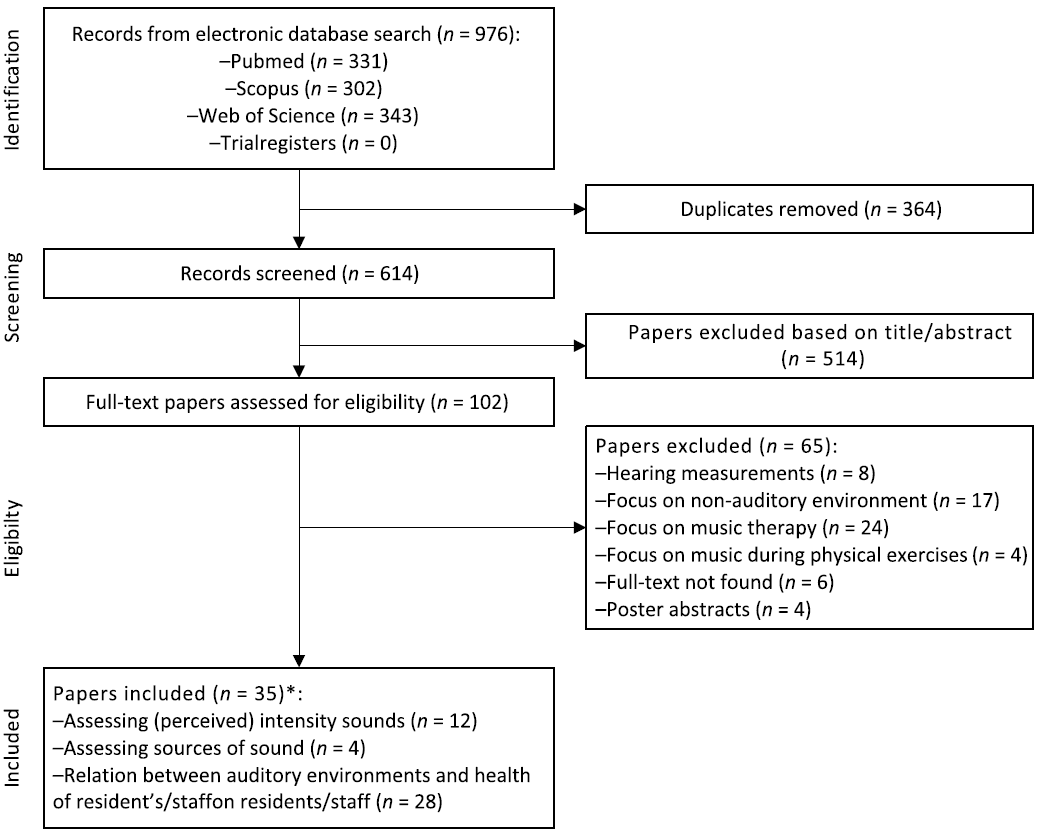
We identified 976 potentially relevant studies in electronic databases. We retrieved the full-text papers of 102 potentially eligible studies based on title and abstract. We identified 35 eligible studies. Figure 1 provides the results of the literature search. Of the included studies, 12 studies assessed the (perceived) intensity of sounds, 4 studies investigated sound sources and 28 studies determined the influence of sound on patient and staff behavior. Eight studies investigated more than one topic.
Flowchart of the selection process of paper; *some studies investigated >1 topic.

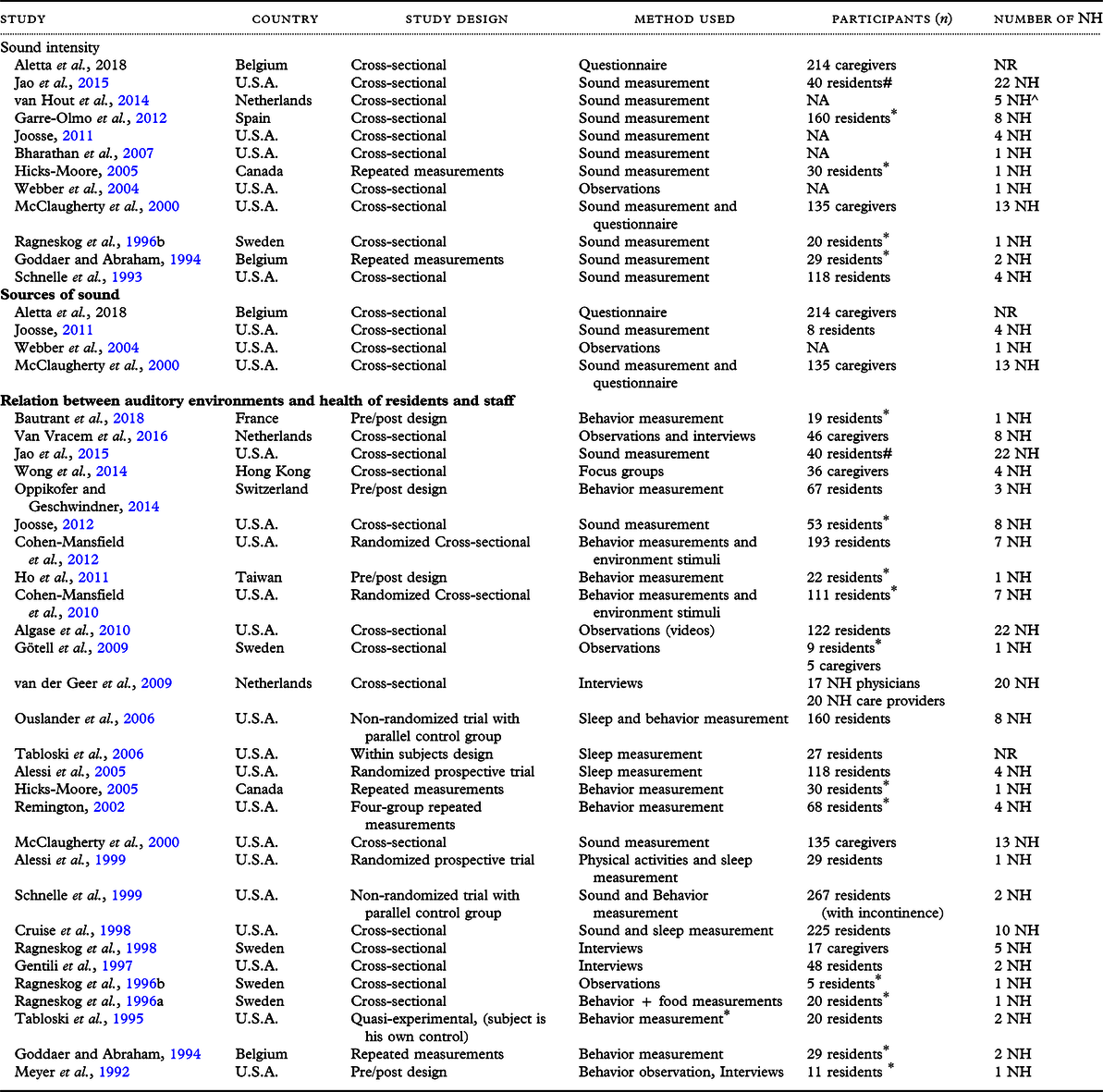
General study characteristics are summarized in Table 1. We found 4 randomized trials, 5 non-randomized trials, 20 quantitative descriptive studies and 7 qualitative studies. The majority of studies (n = 20) were conducted in the U.S.A. Five papers had been published by the same research group (Alessi et al., Reference Alessi, Martin, Webber, Cynthia Kim, Harker and Josephson2005; Cruise et al., Reference Cruise, Schnelle, Alessi, Simmons and Ouslander1998; Ouslander et al., Reference Ouslander2006; Schnelle et al., Reference Schnelle, Ouslander, Simmons, Alessi and Gravel1993, Reference Schnelle, Alessi, Al-Samarrai, Fricker and Ouslander1999). Nine studies conducted sound intensity measurements. In 22 studies, the participants were residents (n = 8–267) and in 5 studies, the participants were nurse(-assistant)s (n = 17–214).
General study characteristics

NA = not applicable, NH = nursing home, NR = not reported; * with dementia; # 3 videos per patient; ^5 common rooms and 5 bedrooms.
Quality assessment
The four randomized trials were of low quality (see Supplementary material S2) (Alessi et al., Reference Alessi, Yoon, Schnelle, Al-Samarrai and Cruise1999, Reference Alessi, Martin, Webber, Cynthia Kim, Harker and Josephson2005; Cohen-Mansfield et al., Reference Cohen-Mansfield, Thein, Marx, Dakheel-Ali, Murad and Freedman2012; Cohen-Mansfield et al., Reference Cohen-Mansfield, Marx, Dakheel-Ali, Regier, Thein and Freedman2010). The randomization procedure was unclear in all studies and only one study had comparable groups at baseline. The number of staff involved in the behavior modification program was not reported. No trial used blinded outcome assessors.
All five non-randomized prospective studies were of low quality too (Meyer et al., Reference Meyer, Dorbacker, O’Rourke, Dowling, Jacques and Nicholas1992; Oppikofe and Geschwindner, Reference Oppikofer and Geschwindner2014; Ouslander et al., Reference Ouslander2006; Schnelle et al., Reference Schnelle, Alessi, Al-Samarrai, Fricker and Ouslander1999; Tabloski et al., Reference Tabloski, Duffy and Kim2006). No study reported sufficient information about the participants’ representativeness to the target population. In two studies, the sample sizes were small (n = 11–27). Three studies did not use appropriate measurements (e.g. no blinding, intervention only reported if effective), and four studies had incomplete outcome data. Lastly, two studies did not take confounders into account in the analysis.
Four of the 19 quantitative descriptive cross-sectional studies fulfilled all of the identified methodological criteria (Garre-Olmo et al., Reference Garre-Olmo, López-Pousa, Turon-Estrada, Juvinyà, Ballester and Vilalta-Franch2012; Remington, Reference Remington2002; Gentili et al.; Reference Gentili, Weiner, Kuchibhatil and Edinger1997; Schnelle et al., Reference Schnelle, Ouslander, Simmons, Alessi and Gravel1993), but the other 15 studies were of varying quality (Algase et al., Reference Algase, Beattie, Antonakos, Beel-Bates and Yao2010; Aletta et al., Reference Aletta2018b; Bautrant et al., Reference Bautrant2018; Bharathan et al., Reference Bharathan2007; Cruise et al., Reference Cruise, Schnelle, Alessi, Simmons and Ouslander1998; Goddaer and Abraham, Reference Goddaer and Abraham1994; Ho et al., Reference Ho, Lai, Jeng, Tang, Sung and Chen2011; Hicks-Moore, Reference Hicks-Moore2005; Jao et al., Reference Jao, Algase, Specht and Williams2015; Joosse, Reference Joosse2011, Reference Joosse2012; McClaugherty et al., Reference McClaugherty, Valibhai, Womack and Desai2000; Ragneskog et al., Reference Ragneskog, Kihlgren, Karlsson and Norberg1996b; Tabloski et al., Reference Tabloski, Mckinnon-Howe and Remington1995; van Hout et al., Reference van Hout, Hak, Seuren and Kort2014; Webber et al., Reference Webber, Martin, Alessi, Josephson and Harker2004). A recurrent problem was a small and unrepresentative sample. Five studies did not report the number or location of the sound measurements clearly.
All six included qualitative studies were of good quality (Ragneskog et al., Reference Ragneskog, Bråne, Karlsson and Kihlgren1996a; Ragneskog et al., Reference Ragneskog, Gerdner, Josefsson and Kihlgren1998; Götell et al., Reference Götell, Brown and Ekman2009; van der Geer et al., Reference van der Geer, Vink, Schols and Slaets2009; Van Vracem et al., Reference van Vracem, Spruytte, Declercq and Van Audenhove2016; Wong et al., Reference Wong, Skitmore, Buys and Wang2014). Two met all quality criteria. One study did not provide sufficient data for the interpretation of results.
(Perceived) intensity of sounds
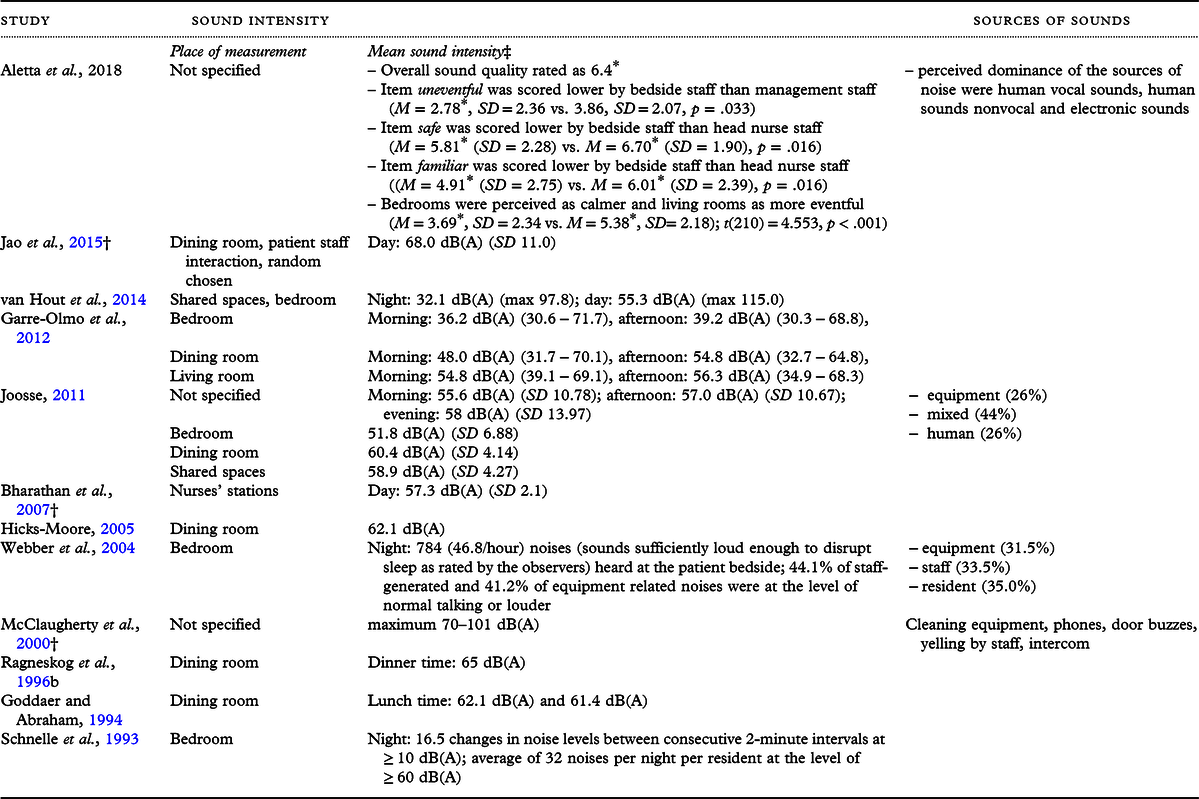
Twelve studies investigated sound intensity nursing homes, either using a digital sound level meter (n = 10; see Table 2) or rater observations (n = 2). Three studies conducted measurements during the night. One study reported an average of 32 noises per night per resident’s bedroom at the level of loud speech or above (60 dB) (Schnelle et al., Reference Schnelle, Ouslander, Simmons, Alessi and Gravel1993). The other study took measurements in five common rooms and five sleeping rooms and measured averaged intensity of 32.1 dB(A) as well as maximum peak intensity of 97.8 dB(A) (van Hout et al., Reference van Hout, Hak, Seuren and Kort2014). In the third study, a rater observed the noises during two consecutive nights in one nursing home, and reported 784 noises (sounds sufficiently loud enough to disrupt sleep as rated by the observers) at the patient bedside (46.8/hour) (Webber et al., Reference Webber, Martin, Alessi, Josephson and Harker2004).
Results of studies measuring the (perceived) intensity and sources of sounds

*Scored on a 10-point rating scale, very bad to very good; †studies reported results in dB, however, we assumed that results were measured in dB(A); ‡ points of reference: 0 dB(A) softest sound a person can hear, 30 dB(A) dB(A) soft whisper, 60 dB(A) normal conversation, 110 dB(A) shouting in ear (Center for Hearing and Communication, n.d.).
Ten studies performed measurements during the day (one study conducted measurements during the day and night). One study, in 13 nursing homes, conducted sound measurements spanning 12-hour intervals and reported sound intensity as high as 70–101 dB(A) (McClaugherty et al., Reference McClaugherty, Valibhai, Womack and Desai2000). One research group recorded sound intensity four times per day at the nurses’ stations and in the doorways of residents’ rooms of one nursing home and reported an average sound intensity of 57.3 ± 2.1 dB(A) (Bharathan et al., Reference Bharathan2007). The third and fourth study conducted sound measurements 8 and 10 times per day, respectively, in different rooms of 4 and 8 nursing homes respectively (Joosse, Reference Joosse2011; Garre-Olmo et al., Reference Garre-Olmo, López-Pousa, Turon-Estrada, Juvinyà, Ballester and Vilalta-Franch2012). The average morning sound intensity was the quietest and the average evening sound levels the loudest (Joosse, Reference Joosse2011). The bedroom space was the quietest space observed and the dining room was the loudest (Joosse, Reference Joosse2011). The mean sound intensity of all rooms was 48.5 ± 6.1 dB(A) (Garre-Olmo et al., Reference Garre-Olmo, López-Pousa, Turon-Estrada, Juvinyà, Ballester and Vilalta-Franch2012). The fifth study was based on measurements in the common rooms of five nursing homes (van Hout et al., Reference van Hout, Hak, Seuren and Kort2014). The mean daytime sound intensity was 55.3 dB(A) with a maximum of 115.0 dB(A). In the sixth study, three videos of each participating nursing homes resident (n = 40) were made. The sound intensity was measured at the same time and the average sound intensity was 68 dB(A) and the range of 51–124 dB(A) (Jao et al., Reference Jao, Algase, Specht and Williams2015). Another three studies measured sound intensity during lunch and dinner time in the eating areas (Goddaer and Abraham, Reference Goddaer and Abraham1994; Ragneskog, Reference Ragneskog, Kihlgren, Karlsson and Norberg1996b; Hicks-Moore, Reference Hicks-Moore2005). They measured sound intensities between 61.4 dB(A) and 65 dB(A). The final study used an online survey for staff exploring the personal experience of sound in the work environments (Aletta et al., Reference Aletta2018b). Nursing staff was rather positive about the auditory environment (M = 6.42, SD = not reported, 10-point rating scale, not at all completely). Bedside staff scored the items “uneventful” more negative than management staff, and the items “safe” and “familiar” lower than the head nurses.
Sources of sound
Four studies investigated sources of sound with measurements and surveys (see Table 2). One study first made sound recordings and analyzed the sources afterwards as mixed (44%), equipment related (26%), human (26%, staff talking to each other; 3%, staff talking near or directly to residents) and maintenance facility related (1%) (Joosse, Reference Joosse2011). In the second study, raters reported that 31% of the sounds were environmental (e.g. doors slamming and telephones ringing), 34% were staff-generated (e.g. nurses talking and staff pushing carts) and 35% were resident-generated (e.g. residents calling out) (Webber et al., Reference Webber, Martin, Alessi, Josephson and Harker2004). In the third study, the nurses reported that the primary sources of noise were alarms, vacuums and steam cleaners, but measurements indicated that a band, cleaning equipment and phones were the loudest (McClaugherty et al., Reference McClaugherty, Valibhai, Womack and Desai2000). Additionally, an online survey among staff found that human vocal and nonvocal sounds as well as electronic sounds were reported to be the most noticeable and dominant (Aletta et al., Reference Aletta2018b).
Associations between sounds and health of residents and staff
Thirteen studies investigated the association between the auditory environment and the health of residents with dementia using observations or interviews (see Table 3). Three studies specifically looked at sleeping problems. One of these studies found that 27% of waking episodes were associated with noise alone (Schnelle et al., Reference Schnelle, Alessi, Al-Samarrai, Fricker and Ouslander1999). In another study, of the 48 nursing home residents 17 (35%) reported that their sleep was disturbed by noise made by other residents (n = 5), by the nurses (n = 4) or both (n = 8) (Gentili et al., Reference Gentili, Weiner, Kuchibhatil and Edinger1997). Caregivers identified many possible causes in the third study (Van Vracem et al., Reference van Vracem, Spruytte, Declercq and Van Audenhove2016). Even though a “lot of light and noise” was prominent in the nursing homes, noise was rarely mentioned spontaneously, or identified as a cause for nighttime restlessness (Van Vracem et al., Reference van Vracem, Spruytte, Declercq and Van Audenhove2016).
Results of studies measuring the relation between auditory environments and health of residents/staff

*In residents, †in residents with dementia; NPS stands for neuropsychiatric symptoms.
Six studies looked at the association between noise and behavioral problems other than sleeping disorders. Two research groups analyzed videotapes of nursing home residents with dementia to identify the most probable antecedents to agitation and apathy (Jao et al., Reference Jao, Algase, Specht and Williams2015; Cohen-Mansfield et al., Reference Cohen-Mansfield, Thein, Marx, Dakheel-Ali, Murad and Freedman2012). Reactions to environmental noises or sound tend to influence expressed agitation but not apathy (Jao et al., Reference Jao, Algase, Specht and Williams2015). In addition, two studies examined the relationship between sound intensity, personal space and agitation by observing residents (Algase et al., Reference Algase, Beattie, Antonakos, Beel-Bates and Yao2010; Joosse, Reference Joosse2012). The accumulation of sound predicted agitated behavior and explained 16% of the variance (n = 53) (Joosse, Reference Joosse2012). By analyzing 20-minute observations (n = 122), another study also reported that the sound was significantly, yet not greatly, associated with wandering (Algase et al., Reference Algase, Beattie, Antonakos, Beel-Bates and Yao2010). In the fifth study, focus groups with caregivers and nurses indicated that the auditory environment, thermal comfort and indoor air quality are considered the most important factors influencing behavioral problems (Wong et al., Reference Wong, Skitmore, Buys and Wang2014). Sounds generated by electronic devices, such TV, air conditioners and announcement speakers, were thought to trigger behavioral problems in the residents. The final study investigated staff perceptions of noise and its physiological and psychological effects on themselves (McClaugherty et al., Reference McClaugherty, Valibhai, Womack and Desai2000). In a noisy environment, nurses felt irritable (67%), felt anxious (53%), had difficulties concentrating (64%) and were more likely to make errors (70%). The authors hypothesized that noise might cause workers to take out their frustrations on residents and other staff (McClaugherty et al., Reference McClaugherty, Valibhai, Womack and Desai2000).
Four studies specifically looked at the association between music and behavioral problems. One study looked at the moods of residents with severe dementia in the communication between caregivers during morning care sessions using qualitative content analysis. Compared to no music, the presence of background music and caregiver singing enhanced the presence of positive emotions and diminished aggressiveness (Götell et al., Reference Götell, Brown and Ekman2009). Van der Geer et al. (Reference van der Geer, Vink, Schols and Slaets2009) investigated the type of music being offered and the degree to which it corresponds to the preferences of residents with both dementia and agitation. Interviews with nursing home physicians (n = 17) and other nursing home care providers (n = 20) revealed that music was offered mostly in the communal living room during the mid-morning coffee and the afternoon tea. However, this music was not tailored to the preferences of the residents. Two studies by Ragneskog et al. (Reference Ragneskog, Kihlgren, Karlsson and Norberg1996a,b) investigated the influence of three different types of music (soothing music, Swedish music from the 1920/30s and pop music) played during dinner on time spent on dinner, food intake and neuropsychiatric symptoms. Video recordings showed that patients spent more time on dinner and food intake was higher and food intake was higher when music was played. In addition, irritability, fear, panic and depressed mood scores decreased compared to the control period (p < .05). The difference was most pronounced when soothing music was played.
Effects of sounds on health of residents
Eleven studies studied the effect of sound improving interventions on the environment and problem behavior prospectively but did not have a control group (see Table 3). One study focused specifically on noise reduction (Meyer et al., Reference Meyer, Dorbacker, O’Rourke, Dowling, Jacques and Nicholas1992), and in the other studies, noise reduction was part of a multicomponent intervention.
Three of the 11 studies investigated the effect on sleeping problems. One intervention consisted of providing feedback to the staff about noise intensity, and research staff implementing procedures to both abate noise (e.g. turn off unwatched TVs) and individualizing nighttime incontinence care routines, to make them less disruptive to sleep (Schnelle et al., Reference Schnelle, Alessi, Al-Samarrai, Fricker and Ouslander1999). Even though the intervention resulted in less noise, it did not lead to significant improvements in night or day sleep. Educating staff about improving sleep including strategies to reduce nighttime noise did not lead to differences in sleep quality either (Ouslander et al., Reference Ouslander2006). The third study used calming music at bedtime together with staff education about strategies to reduce noise and light (Tabloski et al., Reference Tabloski, Duffy and Kim2006). Post-measurements showed a reduction in sleep latency. Agitation was also measured, but background noise was not associated with it in the multivariate model.
Three non-controlled studies investigated noise and agitation in nursing home residents. One study implemented a “quiet week” in which nurses were obliged to lower their voices and reduce fast movements, the public entrance was relocated to a side door and residents were not allowed to watch television or play piano (Meyer et al., Reference Meyer, Dorbacker, O’Rourke, Dowling, Jacques and Nicholas1992). The intervention influenced the agitation levels of some but not all residents, and there was a decrease in agitated behaviors from 38 to 19 frantic/violent behaviors in the total sampled hourly behaviors. However, at the end of the week, some residents seemed to become more agitated than they usually were. In the other study, the frequency and circumstances of agitation before and after introducing a nursing intervention focused on person-centered care and activation were documented in diaries (Oppikofe and Geschwindner, Reference Oppikofer and Geschwindner2014). The most successful of 433 recorded care interventions were communication/validation related (25%), individualized care (17%) and avoiding noise (9%). The third study implemented environmental changes to the ward such as skylike ceiling tiles together with soothing music and compared neuropsychiatric symptoms before and after the intervention (Bautrant et al.; Reference Bautrant2018). No change in the number of residents showing agitation or physical aggression or the duration of this behavior was found, but the number of episodes (8.42 vs. 1.36) of agitation/physical decreased.
Two studies studied the effect of calming music on agitation. The results of the within subject design used by Tabloski et al. (Reference Tabloski, Mckinnon-Howe and Remington1995) indicated that a reduction in agitated behavior occurred both during and after the musical intervention. Remingtion (Reference Remington2002) compared 4 groups: a) calming music intervention, b) hand massage, c) calming music and hand massage simultaneously and d) control group. Residents who received either intervention, alone or in combination, exhibited significantly less agitation than the control group up to 1 hour after intervention.
Three studies investigated the effect of relaxing music played during dinnertime on the residents’ behavior (Goddaer et al., 1994; Hicks-Moore, Reference Hicks-Moore2005; Ho et al., Reference Ho, Lai, Jeng, Tang, Sung and Chen2011). All found a reduction on agitation during the intervention period in comparison with the baseline measurements.
Four studies used a randomized parallel-group design to study the effect of interventions improving the environment on behavioral problems in dementia (see Table 3). Again, noise was only one part of the multicomponent intervention in all studies. One study focused on sleeping problems. During the intervention period, staff was educated about how to reduce daytime in-bed time and to decrease nighttime noise and light, which led to a decrease in daytime sleeping and an increase in social/physical activities and social conversation (Alessi et al., Reference Alessi, Martin, Webber, Cynthia Kim, Harker and Josephson2005). Another study tested an intervention to improve physical activity in residents with dementia. Additionally, after the 14-weeks activity period, the researchers taught nursing staff strategies to reduce nighttime noise and sleep-disruptive nursing care practices, which were applied to the intervention and control groups (Alessi et al., Reference Alessi, Yoon, Schnelle, Al-Samarrai and Cruise1999). The combination of activity stimulation and noise reduction led to an increase in nighttime sleep (52–63%) compared to noise reduction only (67–66%, F = 4.42, p = .045, df = 27), to a decrease in daytime in-bed time (32% decrease vs. no change, F = 51, p = .029, df = 27) and to a decrease in agitation (7 out of 15 residents vs. 1 out of 14 residents, F = 7.86, p = .009, df = 27). The third study looked at the impact of environmental, personal and stimulus attributes on agitation and examined whether engagement to stimuli influenced levels of agitation (Cohen-Mansfield et al., Reference Cohen-Mansfield, Marx, Dakheel-Ali, Regier, Thein and Freedman2010). During the stimuli presentation, of which the order was randomized per participant, environmental attributes and direct observations of agitation were recorded. Live social stimuli (e.g. live dog) were associated with less agitation than music, self-identity (e.g. hobbies), work (e.g. folding towels, sorting envelopes), simulated social (e.g. doll) and manipulative stimulus (e.g. squeeze ball) categories. Music and self-identity stimuli were associated with less agitation than simulated social and manipulative stimuli. The fourth study used the same method (Cohen-Mansfield et al., Reference Cohen-Mansfield, Thein, Marx, Dakheel-Ali, Murad and Freedman2012). During the stimuli presentation, of which the order was randomized per participant, environmental attributes and direct observations of agitation were recorded. Background noise was, however, not associated with agitation.
Discussion and conclusions
We performed a literature review on sounds in nursing homes and their effect on health of residents and staff in nursing homes. Twelve studies investigating sound intensity reported high daytime and nighttime sound intensity. Four studies investigating sound sources reported human vocal and electronic sounds to be the most dominant. In addition, 13 cross-sectional, 11 interventional non-controlled and 4 randomized studies investigated the association between sounds and the health of nursing home residents and staff. Five studies focused on music interventions and reported positives effects on agitated behaviors. Three randomized controlled trials used noise reduction as part of the intervention. Methodological quality of the randomized controlled studies was low. Two studies reported positive effects on nighttime sleep and agitation, but the third study did not find an effect of noise on agitation. One randomized controlled trial used music as part of the intervention. Live social stimuli (e.g. live dog) were associated with less agitation than musical, recreational (e.g. hobbies) and work-related activities (e.g. folding towels and sorting envelopes) (Cohen-Mansfield et al., Reference Cohen-Mansfield, Marx, Dakheel-Ali, Regier, Thein and Freedman2010).
The studies reporting daytime sound intensity found average levels between 55–68 dB(A) and additional peaks of 70–110 dB(A) (Jao et al., Reference Jao, Algase, Specht and Williams2015; McClaugherty et al., Reference McClaugherty, Valibhai, Womack and Desai2000; van Hout et al., Reference van Hout, Hak, Seuren and Kort2014). The international standards for sound intensity in hospital rooms range between 35 and 45 dB(A) for daytime hours and 20 and 35 dB(A) for nighttime hours (Berglund et al., Reference Berglund, Lindvall and Schwela1999; EPA, 1974). The sound intensity values found in nursing homes are higher than those recommended and could have a detrimental effect on persons with dementia. Even in healthy populations, sound exceeding 50 dB(A) is known to cause annoyance, disturbed sleep, delirium, elevations in blood pressure and tachycardia and is possibly linked to ischemic heart disease (Choiniere et al., Reference Choiniere2010; Morrison et al., Reference Morrison, Haas, Shaffner, Garrett and Fackler2003).
We found three studies focusing on background music during dinnertime. Those studies reported positive effects of music, especially relaxing/soothing music. Less agitated behaviors and more food intake were measured (Goddaer et al., 1994; Hicks-Moore, Reference Hicks-Moore2005; Ho et al., Reference Ho, Lai, Jeng, Tang, Sung and Chen2011). We found one study that focused specifically on the effect of noise reduction on nursing home residents’ behavior (Meyer et al., Reference Meyer, Dorbacker, O’Rourke, Dowling, Jacques and Nicholas1992). Observations before and after the changes showed a decrease in frantic and violent behaviors. However, the study results are limited by several factors. A pre-post design was used instead of an experimental study design. Also, the sample size (n = 11) was too small for elaborate analysis and generalization of the results. In addition, the intervention itself was designed to reduce stimulation, but also prohibited pleasant activities, such as playing the piano. This might not be seen as patient-centered care and might have led to understimulation in a few residents that exhibited an increase in “non-calm” behaviors. Therefore, generalization of the results is not possible and more studies investigating the impact of noise on patient behavior are needed.
Three experimental studies showed that educational noise reduction programs for staff might be helpful for reducing noise (Alessi et al., Reference Alessi, Yoon, Schnelle, Al-Samarrai and Cruise1999, Reference Alessi, Martin, Webber, Cynthia Kim, Harker and Josephson2005; Cohen-Mansfield et al., Reference Cohen-Mansfield, Thein, Marx, Dakheel-Ali, Murad and Freedman2012). However, since noise sources in nursing homes varied widely, there can be no single solution to reduce sound intensity. Therefore, it is important that different noise reduction techniques are applied including behavior modification, reconstruction of units and reducing volume of TVs, telephones and doorbells.
Nursing staff was an important source of sound in nursing homes. However, the nurses themselves did not always report themselves as source. In the study by Van Vracem et al. (Reference van Vracem, Spruytte, Declercq and Van Audenhove2016), the nurses only reported mechanical noises. Communication between nursing staff and residents is an essential part of the work of a nurse and might therefore not be experienced as a sound source.
Our search revealed 13 studies specifically focusing on residents with dementia and 3 studies using health-care professionals as dementia proxies. Noise might be especially disturbing for people with cognitive impairment. Some researchers have claimed that auditory information contributes to forming a “sense of place” (van den Bosch et al., Reference van den Bosch, Andringa, Baskent and Vlaskamp2016). Sounds provide information about the location and activities to come, so that one can prepare for them. The absence of information can lead to uncertainty and it becomes difficult to respond situationally. The studies in our review showed that most sounds in nursing homes were related to staff activities, staff talking and electronics. Residents with dementia might have difficulties understanding those sounds since they are often unrelated to their own activities. The exposure of individuals with dementia to ambivalent sound sources is likely to increase confusion and trigger negative feelings. Observed reactions to noise were often neuropsychiatric symptoms (e.g. agitation, apathy and nighttime restlessness), which are common in people with dementia (Cruise et al., Reference Cruise, Schnelle, Alessi, Simmons and Ouslander1998; Jao et al., Reference Jao, Algase, Specht and Williams2015; Joosse, Reference Joosse2012). According to the person-centered model of care, these reactions could be a form of communication to a non-adapted environment, such as sensory overload (Garre-Olmo et al., Reference Garre-Olmo, López-Pousa, Turon-Estrada, Juvinyà, Ballester and Vilalta-Franch2012).
We found that sounds might influence not only residents but also staff members. A noisy environment seemed to have negative psychological effects on staff, which is likely to negatively affect the quality of care. Research in the hospital setting has shown that noise-induced stress correlates with predictors of burnout (Basner et al., Reference Basner2014). In the health-care environment, noise is evaluated as a potential contributor to medical errors and poor staff retention, which underlines the importance of a good auditory environment.
While sounds experienced as noise have been studied in nursing homes, positive auditory environments have received less attention. We found fives studies using music interventions to improve the auditory environment. However, these interventions are applied to all residents living on the ward. Residents in care facilities might be stimulated even more through technologies and “active” tools that are more person-centered. An example is the use of a parametric speaker, a high-directional loudspeaker transmitting sound in a narrow acoustic space, to create personal space in a common room (Nishiura et al., Reference Nishiura, Hoshiyama and Konagaya2018). Actively designing soundscapes, for instance, using the residents’ sensitivity and preference, might be another valuable approach. However, raising more awareness about the potential role of sound in nursing homes would be the first necessary step toward healthy and stimulating auditory environments that can promote better living and working conditions.
To our knowledge, this is the first review summarizing the so far accumulated knowledge regarding sound, noises and music in nursing homes and their effects on the residents. The strengths of this paper include a rigorous search strategy and study quality assessment of the included studies.
A limitation of this review is the small number of interventional studies. In addition, the studies had limitations themselves such as small sample sizes and a moderate quality of design. The studies investigating sound intensity varied in measurement of sound intensity with respect to locations, measurement moments and number of measurements (1× day vs. 8× per hour for a period of 12 hours). Some studies collected data for only one day, thus providing insufficient data for rigorous conclusions. The studies investigating the effect of sound on residents’ health and behavior used varying determinants and outcomes. Therefore, comparisons between different studies were difficult. Meta-analyses could not be executed; thus, overall estimates of effects could not be given. In many of the studies, the designs of the studies were often not reported completely, which means that those studies cannot easily be replicated. In addition, during the last two decades, a shift took place from shared rooms to single rooms. Nowadays, in newer small-scaled nursing homes, residents might be less likely to experience noise. Hence, the inclusion of studies conducted before the shift in the 1990s might have influenced the results.
This review shows that sound intensity in nursing homes are high during daytime and nighttime. Furthermore, there is a lack of intervention studies focusing specifically on noise reduction. As suggested in other recently published papers in International Psychogeriatrics (Buist et al., Reference Buist, Verbeek, de Boer and de Bruin2018; Jao et al., Reference Jao, Liu, Williams, Chaudhury and Parajuli2019), more studies investigating the relation between (auditory) environments are needed. Some nonexperimental studies suggested that music played during dinner had a positive effect on food intake. This might be easily applicable in clinical practice. However, we would first advocate the conduction of experimental studies exploring effects of sounds.
Conflict of interest
None.
Description of authors’ roles
S. Janus, J. Kosters and H. Luijendijk were responsible for study concept and design. S. Janus, J. Kosters and H. Luijendijk collected the data, and interpreted them. Drafting of the manuscript was done by S. Janus and J. Kosters. Critical revision of the manuscript for important intellectual content was done by H. Luijendijk, K. van den Bosch, T. Andringa and S. Zuidema.
Supplementary material
To view supplementary material for this paper, please visit https://doi.org/10.1017/S1041610220000952