

Communist Party of Vietnam (CPV) members won 96 percent of the seats in the 2016 National Assembly elections despite fielding only 89 percent of the candidates. Why did CPV members fare so much better than their non-party opponents, who represented eleven percent of total candidates but only won four percent of the seats? An understanding the basis of electoral support for candidates from regime parties can help to explain how both regimes and observers interpret electoral outcomes and whether strong electoral performance is a signal of legitimacy and confidence in the polity.Footnote 1 In this article, we argue that an important but overlooked reason why voters select candidates from the ruling party in single-party regimes, as well as in hybrid regimes with restrictions on campaigning, is very similar to the fundamental structural advantage that accrues to representatives of the incumbent party in democracies—the informational benefit of party label. Specifically, party labels in single-party regimes convey two pieces of critical information to constituents: 1) clear information about the policy positions of candidates; and 2) the ability of candidates to deliver resources to the constituents’ community.
In explaining the stellar performance of party-backed candidates in the 2016 elections, Vietnamese National Assembly election official Nguyễn Hạnh Phúc suggested that the high number of party-backed candidate victories was “the voters’ decision,” implying that voters simply prefer party-backed candidates.Footnote 2 In political science, there are two prevailing theories for explaining such overwhelming voter preference for regime parties in authoritarian elections. The first set argues that the support is either manipulated or falsified (Croke Reference Croke2017; Kuran Reference Kuran1991). The second set, which has been particularly popular in explaining public support in China and Singapore, is that party-backed delegates may win support due to genuine popularity or “performance legitimacy.” Scholars in this vein bolster their arguments by linking economic growth and rising welfare with regime support (Dimitrov Reference Dimitrov2009; Frye et al. Reference Frye, Gehlbach, Marquardt and Reuter2017; Dickson Reference Dickson2016; Thayer Reference Thayer2009).
While we agree that these theories help explain expressed support for authoritarian ruling parties, we suggest that there exists an additional set of factors that help authoritarian incumbents win sizeable shares of votes that are not falsified or fraudulent and can be therefore interpreted as sincere support.Footnote 3 Specifically, we use the term incumbency bias to broadly define two theoretical advantages of authoritarian incumbents that generate sincere voting for the regime. First, party-backed candidates may win support in heavily constrained contests because information on their policy preferences is assumed to be clear, while voters have only limited information on the preferences of non-party opponents (Larreguy, Marshall, and Snyder Reference Larreguy, Marshall and Snyder2016; Morgenstern and Zechmeister Reference Morgenstern and Zechmeister2001). Second, voters may feel that party members are uniquely able to deliver local benefits to them or their constituency if they vote in favor of the incumbent party (Blaydes Reference Blaydes2011; Lust-Okar Reference Lust-Okar2006; Magaloni Reference Magaloni2006; Slater Reference Slater2003; Croke Reference Croke2017). This organizational backing theory is distinct from performance legitimacy. In contrast to performance legitimacy, organizational backing theory is prospective, with voters making strategic calculations about what they are likely to receive, as opposed to retrospectively rewarding the party for good performance. Additionally, performance legitimacy theory posits that voters positively evaluate the party as a whole, while the organizational backing mechanism implies that the voter believes an individual, party-backed candidate can extract the most resources from the regime, regardless of whether they hold positive or negative views about the party generally.
Invoking scholarship from research on American politics and comparative democracies, we argue that national-level elections in single-party states should confer an extreme incumbency advantage for party members based on these two mechanisms. The lack of information on individual candidates, particularly non-party members, combined with the regime party's overwhelming dominance of the government means the benefits of incumbency effects should be outsized in single-party contexts. Both of these mechanisms are likely to persuade even the subset of voters that have no incentive to falsify their preferences to sincerely vote for regime party candidates.
To test our theory of extreme incumbency advantage, we rely on a conjoint survey experiment design, conducted on about 42,000 respondents in three consecutive years in Vietnam. The design is critical for shielding respondents, so that they can feel comfortable and safe in providing honest reflections on their vote choices. Our results, which are consistent over the three years of the survey, show that after minimizing preference falsification and controlling for performance legitimacy, respondents in the survey supported party-backed candidates between 10 and 15 percent more than non-party candidates—a nearly identical figure to the actual election results.
Probing these results for the causal mechanisms in 2018, with two embedded survey experiments, we find evidence that candidate party membership signals clearer policy preference and the ability to provide access to resources. We find that the effect of these mechanisms is strongest for those we identify as “non-falsifiers,” or those that state in response to direct questions that they are willing to consider non-party candidates for office. For these respondents, the party label conveys information about a candidate's likely policy positions and ability to deliver resources to constituencies. Taken together, these findings suggest that while preference falsification and performance legitimacy likely play an important role in driving support for the party, even those who do not falsify their preferences support the regime due to these extreme incumbency effects.
Our findings have important implications for work on authoritarian elections and highlight some similarities between single-party and hybrid regimes. Consistent with research on hybrid regimes, we show that increased campaign information disproportionately helps challengers achieve parity with incumbents (Larreguy, Marshall, and Snyder Reference Larreguy, Marshall and Snyder2016; Gonzalez and Prem Reference Gonzalez and Prem2018; Boas Reference Boas2015; Mann and Wolfinger Reference Mann and Wolfinger1980; Snyder and Stromberg Reference Snyder and Stromberg2010). Similarly, information about policy differences shifts support in Vietnam's single-party setting. Our results also shed light upon recent theories about managed democratic transitions from authoritarian rule and the effects of elections on policies. In their theory of “democratization from strength,” Slater and Wong (Reference Slater and Wong2013) argue that autocracies may allow democratic elections when they estimate that they are powerful enough to win, but that their future popularity is likely to decline. Similarly, others argue that authoritarian regimes calibrate their policies based on poor electoral performances (Miller Reference Miller2015). For both theories, elections are an important source of information about the legitimacy and popularity for such regimes. Our results, however, show only a weak effect of performance legitimacy, suggesting that the informational content from single-party elections is more limited when compared to those in hybrid elections.
VOTING IN THE DARK: EXTREME INCUMBENCY ADVANTAGE IN SINGLE-PARTY REGIMES
Two sets of arguments are primarily used to explain electoral support for autocrats. The first includes coercion, manipulation, and preference falsification, which leads voters to make insincere selections (Jiang and Yang Reference Jiang and Yang2016; Kuran Reference Kuran1991). Shows of coercive authority at the polls, fears of retribution by friends and neighbors, pre-electoral rigging and gerrymandering, and manipulation of ballots could all lead citizens to vote for the party member, even it was not their sincere preference to do so. By contrast, the second set of arguments argues that expressed support is sincere due to the legitimizing effects of economic and political performance (Dimitrov Reference Dimitrov2009; Frye et al. Reference Frye, Gehlbach, Marquardt and Reuter2017; Dickson Reference Dickson2016; Thayer Reference Thayer2009). Indeed, many autocrats are simply popular, and therefore may win support due to their historical performance in delivering growth, raising living standards, delivering vital services, or handling of ethnic tensions (Dimitrov Reference Dimitrov2009; Frye et al. Reference Frye, Gehlbach, Marquardt and Reuter2017; Dickson Reference Dickson2016; Thayer Reference Thayer2009).
We do not deny the importance of these factors. Indeed, our evidence suggests some support for both. However, we suggest that even those who do not falsify their preferences may also be induced to support the regime for other reasons. As Magaloni (Reference Magaloni2006) notes, autocrats often ride out poor policy performance. Furthermore, in the Vietnamese context, while the party may engage in some electioneering to benefit its preferred candidates, it does not seem to rely on fraud (Malesky and Schuler Reference Malesky and Schuler2009). This suggests that their vote totals may also derive from other more systematic advantages. Here we suggest the incumbency effect as a potential additional, if not alternative, explanation.
Incumbency advantage is an established phenomenon in democratic countries (Jacobson Reference Jacobson1989; Levitt and Wolfram Reference Levitt and Wolfram1997; Cox and Katz Reference Cox and Katz1996), where individual candidates enjoy a systemic advantage over a challenger independent of their party affiliation or ideology (Jacobson Reference Jacobson2015). We use the concept somewhat differently in explaining support for party-backed candidates in single-party regimes, where we suggest that the mechanisms underlying the advantage will accrue to the party rather than the individual. This is because individual candidates in single-party regimes often do not run in consecutive elections and, when they do, they are explicitly barred from “cultivating a personal vote” (Carey and Shugart Reference Carey and Shugart1995).
Despite the different object of the advantage, the mechanisms we use to explain support for party-backed candidates include established mechanisms in democracies such as certainty about ideological position (Shepsle Reference Shepsle1972; Enelow and Hinich Reference Enelow and Hinich1981; Bartels Reference Bartels1988; Kam and Zechmeister Reference Kam and Zechmeister2013) or established access to resources through seniority (McKelvey and Riezman Reference McKelvey and Riezman1992; Muthoo and Shepsle Reference Muthoo and Shepsle2014; Hall and Shepsle Reference Hall and Shepsle2013).Footnote 4 While these factors are present in all systems, they should be extreme in single-party regimes. Furthermore, much of the basis of this extreme advantage is based on the political environment particular to single-party rule, which undermines the ability of citizens to know how the regime would perform if underlying political institutions were altered.
Party Incumbency and Information on Candidate Policy Positions
Taking these mechanisms in turn, one advantage incumbents have relative to challengers is the certainty voters have about their ideological position. Voters in general (Shepsle Reference Shepsle1972; Enelow and Hinich Reference Enelow and Hinich1981; Bartels Reference Bartels1988), and risk averse voters in particular (Morgenstern and Zechmeister Reference Morgenstern and Zechmeister2001; Eckles et al. Reference Eckles, Kam, Maestas and Schaffner2014), are more likely to vote for candidates they know because of certainty about their ideological positions. Applied to single-party regimes, voters should be less willing to vote for non-party alternatives compared to the party-backed candidates if there is less information about the positions of the non-party candidates.
The institutional design of electoral campaigns in single-party regimes means this is likely the case. Campaign restrictions endemic to single-party elections should lead to higher levels of uncertainty for non-party candidates. Single-party regimes do not allow independent candidates to mount electoral campaigns on either a collective or individual level. In Vietnam, for example, the election law explicitly bars any candidates, whether party-backed or independent, from engaging in any kind of campaigning. Their ability to campaign is restricted to meetings with voters organized by the party-backed mass organizations or through party-run provincial newspapers.Footnote 5 In contrast, in even restrictive hybrid regimes, opposition parties are permitted to formulate a message. In Zimbabwe in 2000, for example, although Mugabe's ruling ZANU-PF party harassed the opposition MDC Party throughout the campaign, the opposition was nonetheless able to develop a campaign message: “The MDC focused its campaign on Zimbabwe's socio-economic collapse, highlighting Mugabe's role in mismanaging national affairs” (Makumbe Reference Makumbe2002, 90). By sharp contrast, in single-party regimes information on the policy positions of non-party candidates is minimal for most voters.
Party Incumbency and Access to Resources
A second component of incumbency advantage in democracies centers on access to resources. In democracies, seniority may give incumbents access to pork that is not available to junior members (McKelvey and Riezman Reference McKelvey and Riezman1992; Muthoo and Shepsle Reference Muthoo and Shepsle2014; Hall and Shepsle Reference Hall and Shepsle2013). As with ideological certainty, the effect of access to resources—what Slater calls infrastructural power (“the ability to get things done”)—should be stronger in single-party systems (Slater Reference Slater2003, 86). Single-party regimes, by definition, allow only one party to control government, and electoral rules are often structured in such a way that the party is guaranteed a legislative majority over the combined share of non-party candidates. Therefore, because of their outsider status and lack of organizational backing, non-party candidates might be perceived as less able to enact policies or deliver particularistic benefits, even if voters prefer their positions. Non-party members will not be able to attend party meetings that precede and parameterize legislative debates (Malesky, Schuler, and Tran Reference Malesky, Schuler and Tran2011). Furthermore, they lack viable connections to top leadership and have no connection to the party apparatus that penetrates all the way down to the local level. This mechanism aligns with a large literature on the importance of clientelism in elections in hybrid regimes (Lust-Okar Reference Lust-Okar2006; Blaydes Reference Blaydes2011; Magaloni Reference Magaloni2006; Greene Reference Greene2010). In a single-party setting, party membership may be an important sign of a candidate's ability to deliver rents and/or the locality from deleterious central policies, regardless of how citizens evaluate the past performance of the party overall.
In the context of Vietnam ahead of the most recent 2016 National Assembly election, focus group discussions suggested the plausibility of this mechanism at the national level (Nguyen Reference Nguyen2016). In those groups, participants rated party membership as one of the most important factors determining their vote choice. According to follow-up discussions, voters consistently echoed Slater (Reference Slater2003) in citing the perceived ability of party members to “get things done” as important. One respondent explained the value of party membership and having an official position in the state in her vote choice, which generally correlates with party membership, thusly: “Having a position means having an influential voice, being effective locally, and having a greater ability to get work done.”Footnote 6
TESTABLE HYPOTHESES AND EMPIRICAL STRATEGY
Our argument is that single-party regimes feature extreme incumbency bias based on perceptions of information about candidate positions and perceived access to resources. Therefore, we argue that after controlling for preference falsification, manipulation, and popularity based on performance, the effect of party on support for the candidate should diminish in relation to the amount of differentiating information we provide about these two factors. Starting with ideological uncertainty, if information about the challenger drives support for the non-party candidate, then more information provided about the policy positions of the candidates should provide a greater benefit for the non-party candidate. This follows the logic underlying the finding that increased media coverage in Mexico leads to support for challengers (Larreguy, Marshall, and Snyder 2015). This leads to the following hypothesis:
H1 (Information Mechanism): The more differentiating policy information between the candidates that is given to voters, the greater the support for the non-party candidate versus the party-backed candidate.
For the organizational backing mechanism, it is difficult to disentangle the party's infrastructure from its label. However, drawing on research from democracies, one potentially measurable component of organizational backing could be candidate experience. More experienced candidates should have greater seniority and therefore greater ability to provide resources for constituents. As Hall and Shepsle (Reference Hall and Shepsle2013, 100) note, “Seniority … is a summary statistic of member's potential to serve constituency interests. As a measure of experience, it calibrates a member's knowledge, involvement, and understanding of legislative issues and the nuances of the legislative process.” Similarly, in single-party regimes greater experience could signal greater ability to provide resources for constituents. Therefore, if perceived ability to deliver results for the district drives party support, then information about the experience of the candidate should also reduce the effect of the communist party's incumbency advantage:
H2 (Organizational Backing Mechanism): The more differentiating information between the candidates regarding experience that is given to voters, the greater the support for the non-party candidate versus the party-backed candidate.
RESEARCH DESIGN
To test these hypotheses and provide context for the case, the research design will first detail political institutions in Vietnam, the case used to test these hypotheses. In this discussion, we will also examine the impact of party membership on the 2016 election results to provide preliminary evidence for the plausibility of the first hypothesis using actual data. However, because these results suffer from endogeneity concerns and cannot rule out the competing explanations, we then shift to our main analysis, which uses an experiment embedded in a nationally representative survey.
The Case: Elections in Vietnam
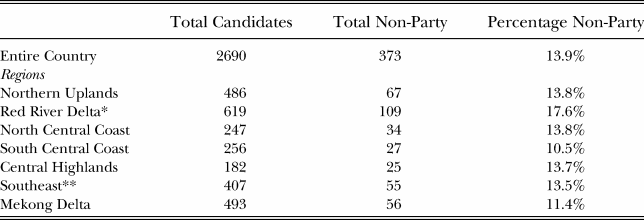
We test our argument in Vietnam, a single-party regime where the only legal party is the CPV. While the Vietnamese regime bans opposition parties, it allows non-party members to compete in direct elections for seats in the National Assembly.Footnote 7 As Table 1 shows, most voters in Vietnam have experienced elections with non-party candidates. In the three elections since 2007, nearly 14 percent of the candidates nationwide were independent, with each region in the country fielding at least 10 percent non-party members on the ballot (see Appendix A for a map of the distribution by province).
Non-Party Candidates in Vietnam from 2007–2016 (3 Elections)

* Hanoi is in the Red River Delta
** Ho Chi Minh City is in the Southeast
As discussed above, vetting and limits on campaigns are also central features to election campaigns. It is the case that high profile candidates are prevented from running for the National Assembly elections (Gainsborough Reference Gainsborough2005). In previous elections, several prominent non-party candidates were barred from competing, such as Lê Công Định, Cù Huy Hà Vũ, and Nguyễn Quang A. It is important to note that the restrictions on prominent personalities running are not limited to non-party members. In 2007, Đặng Hùng Võ, a vociferous party member and former deputy minister of environment and natural resources, was also barred (Malesky and Schuler Reference Malesky and Schuler2009). Given that the public knows that the independent and party-backed candidates are vetted in a similar fashion, this should reduce the perceived quality differences between party-backed and non-party backed candidates, aside from the critical policy and organizational mechanisms we discuss above.
Additionally, as discussed above, Vietnamese elections feature limits on campaigning. The electoral code explicitly bars individual candidates from raising money or organizing campaign rallies. This effectively means that the only candidates able to take advantage of any policy messaging are the party-backed candidates, who are implicitly associated with the ruling party's ubiquitous and constant public propaganda campaigns. Given the vetting and campaign restrictions on party and non-party candidates, this actually makes the hypothetical survey question more realistic than it might be in a context where campaigns were allowed.Footnote 8
2016 Election Results
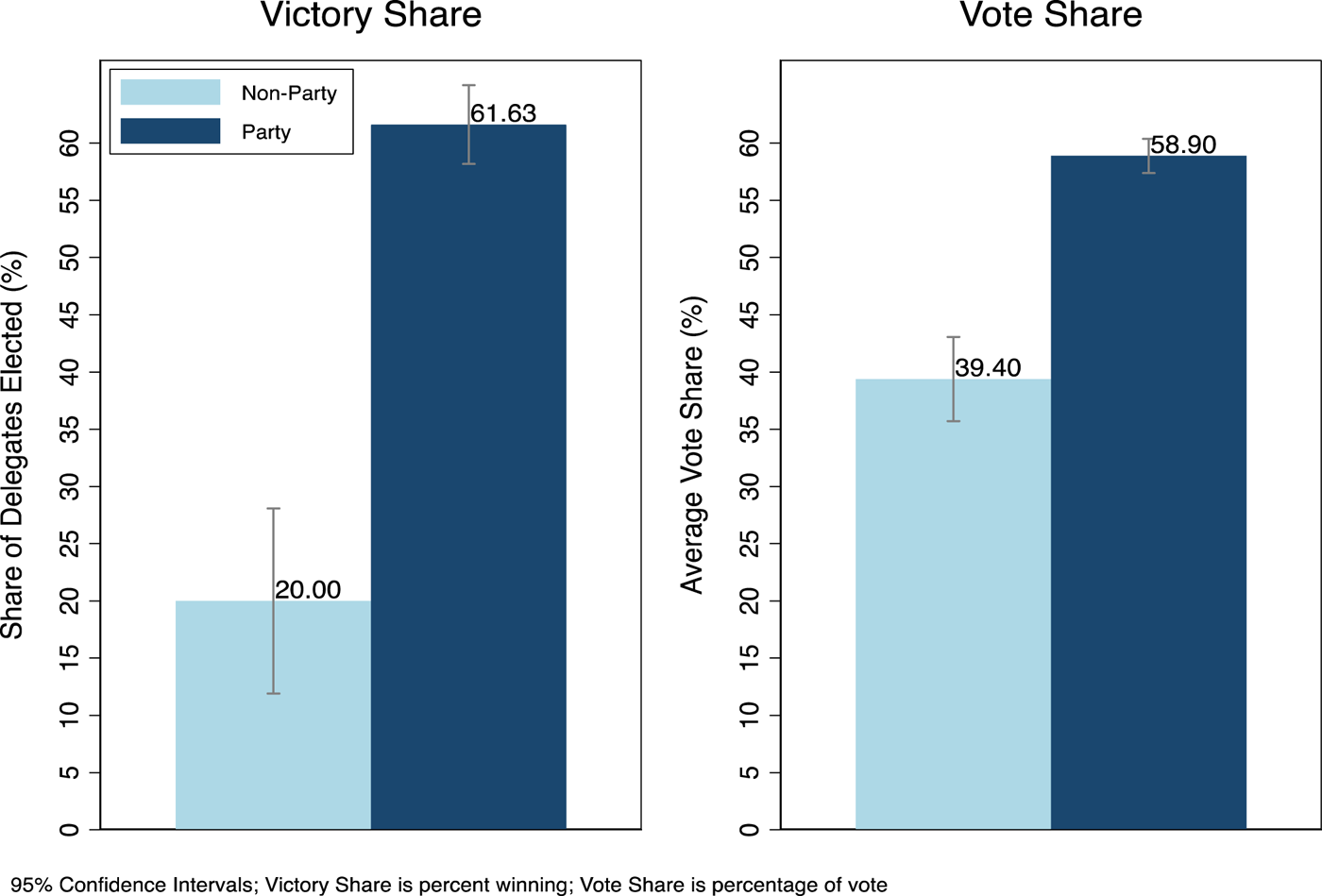
Observational data is consistent with our general argument. As Malesky and Schuler (Reference Malesky and Schuler2011) show, party members earned an electoral boost in the 2007 election even after controlling for other factors such as candidate quality and district competitiveness. Figure 1 demonstrates that this pattern held in the May 2016 contest, where 96 (11 percent) of the 870 candidates for the 500-seat legislature were non-party members. In the first panel, we report the unadjusted share of candidates that voters ultimately elected. In the second panel, we report the unadjusted average vote share received by party and non-party candidates. While 62 percent of party members won seats in the districts they contested, only 20 percent of non-party members were similarly fortunate with an average vote share of 39.4 percent. Consequently, non-party members make up only four percent seats in the current VNA.
May 2016 Election Results by Party Membership

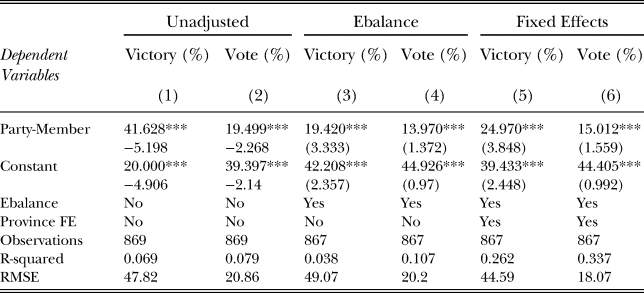
The poor performance of non-party candidates may be overstated in Figure 1, as it does not account for the fact that party members tend to be more highly educated, hold more prestigious occupations, and occupy more high profile and powerful positions in the Politburo, Central Committee, and local and central governments. To address this, in Table 2 we employ a variant of matching called entropy balancing (ebalance) (Hainmueller Reference Hainmueller2012). After re-weighting, party and non-party match directly in terms of average value, variation, and skew on candidate level qualifications,Footnote 9 allowing us to determine how much of the excess support for party members is due to the label itself and not to individual candidate features. Table 2 presents the results of our analysis in three models. First, we replicate the simple bivariate analysis displayed in Figure 1 without ebalance in Models 1 and 2 for share elected and vote share. Then, we employ ebalance weights in Models 3 and 4. Finally, we introduce provincial fixed effects to compare only candidates running within the same province, to account for local variation in voter preferences and party support in Models 5 and 6.
Performance of Party Members in May 2016 Election

Note: OLS, standard errors in parentheses (*** p < 0.01, ** p < 0.05, * p < 0.1)
In the fully specified models, which account for candidate and provincial level differences, we find that CPV candidates received 15 percent higher vote shares, leading to 25 percent more CPV candidates elected than non-party candidates. The bottom line is that party members enjoy a substantial unexplained level of support. Unfortunately, all of the theories discussed above (manipulation, preference falsification, performance legitimacy, and extreme incumbency advantage) are consistent with this result.
Conjoint Survey Experiment Design
Because the observational results are consistent with not only the advantages of incumbency bias, but also the preference falsification and performance legitimacy arguments, we designed a conjoint survey experiment that tests extreme incumbency advantage while reducing the confounding effects of manipulation, preference falsification, performance legitimacy, and candidate quality. Conjoint analysis allows researchers to design multidimensional treatments in survey designs and to evaluate which dimension has the most weight in determining the outcome (Hainmueller, Hopkins, and Yamamoto Reference Hainmueller, Hopkins and Yamamoto2014). This design is especially useful in determining the factors that influence voter decisions, because the object of the choice—the candidate—varies on a number of dimensions including policy position, gender, age, education, and party membership.
The conjoint design helps our analysis in three ways. First, and most obviously, the hypothetical nature of the question ensures that vote rigging is not a concern. While the abstract nature of the question may hinder generalizability, we take several measures to ensure that the hypothetical candidates match as nearly as possible the actual decisions voters face in the ballot box. Second, because a conjoint survey randomizes the features of the candidate, it can ensure that the party affiliation of a candidate is perfectly orthogonal to the features of candidate quality that are available to voters, something that was not fully achievable with the observational data above.
A third benefit is that the survey design provides shielding for respondents, such that it should reduce the role of preference falsification. Similar to a list experiment, respondents can select the non-party candidate without having to admit that that was the reason they did so (Coutts and Jann Reference Coutts and Jann2011). They can always attribute their choice to other innocuous features of the treatment. In this way, preference falsification should be limited by design. Indeed, as Hainmueller and his colleagues note: “conjoint analysis has the potential to reduce bias as compared to traditional survey experiments, because conjoint respondents are presented with various attributes and thus can often find multiple justifications for a given choice” (Hainmueller, Hopkins, and Yamamoto Reference Hainmueller, Hopkins and Yamamoto2014, 27). For this reason, conjoint analysis has been used to research sensitive topics such as HIV stigma (Schulte Reference Schulte2002). While we think the conjoint survey approach should reduce preference falsification in our tests, we take several additional steps to ensure that our results are not contaminated by preference falsification.
Data
Testing the conjoint survey responses on these different subgroups requires a large number of respondents, which we are able to obtain by including our instrument in a massive annual governance survey completed by roughly 14,000 respondents annually. The PAPI survey, conducted each year since 2011 by the United Nations Development Programme (UNDP), measures the perceived governance quality in Vietnam's 63 provinces. The survey is conducted on tablets through face-to-face interviews. Below the provincial level, sampling is clustered at the district, commune, and village levels using probability proportion to size selection procedures to select the units. In each province, 12 villages in six communes within three districts are chosen, with the goal of surveying 20 respondents per village.Footnote 10 Importantly for the purposes of this study, where interviewer effects could be a concern, PAPI interviewers are trained and managed by the Center for Community Support Development Studies, UNDP's local NGO partner, and are conducted without an official present.
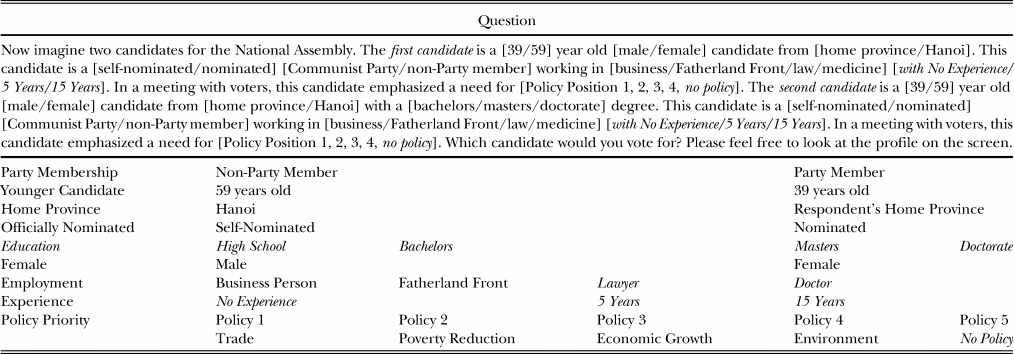
Our baseline survey question, which we asked each year from 2016, approximated the information available to Vietnamese voters as nearly as possible. The design is based on information published via candidate lists in public newspapers, along with a rudimentary policy position they may have been able to glean from mandated candidate–voter meetings in electoral districts (see Appendix C for an example of an electoral district and the information available to voters). Thus, in the survey experiment, PAPI asked respondents to select between two hypothetical candidates for the Vietnam National Assembly. It then randomly assigned the two candidates to possess the characteristics listed in Table 3.
Features of Candidates Varied in Conjoint Analysis in Multiple Years

Italicized items added in 2017 survey. In 2018, half of the respondents received the Employment information and half received the Experience information. Also in 2018, 20 percent of respondents saw candidate pairs with no policy positions.
Starting with the main theoretical variable, party membership, 50 percent of the hypothetical candidates were party members, while another 50 percent were not. We randomized the other features of the hypothetical candidates in a similar manner. As Table 3 shows, in addition to the straightforward categories of gender and age, we also included career. To make the analysis tractable, we divided the candidates’ professional experience into two categories. The first group includes members of the Fatherland Front, Vietnam's umbrella group of mass organizations (i.e. the peasant and women's unions) charged with representing mass stakeholder views in Vietnam's Leninist system, and the second group includes business candidates. In 2017 and 2018, the survey expanded the careers to doctors and lawyers. In practice, each employment category is associated with large shares of party and non-party members, so career is not correlated with party status in voters’ minds. Another feature varied was nomination status. Vietnam requires most candidates to be nominated by a provincial- or central-level political organization. However, a subset of candidates is allowed to self-nominate (Malesky and Schuler Reference Malesky and Schuler2009). In 2017 and 2018, education was included to better account for candidate quality, as qualitative evidence suggests that voters tend to cue on education level as a measure of talent. It is important to note that all combinations of features in the hypothetical candidates are possible and occur frequently in Vietnamese elections. Because party members are allowed in business, there are members of the business community that run for election who are also party members. There are also non-party members who are nominated by the state to run and party members who self-nominate.
The experiment also allowed the candidates to declare a policy priority. Although candidates cannot campaign, they are allowed to express priorities in meetings with voters during the 30-day period ahead of the election. The experiment varied among four different policy priorities that candidates might have emphasized in these meetings, including support for increased foreign trade, support for environmental protection, support for economic growth, and support for poverty reduction. With this set of baseline variables, we can estimate the degree of support for candidates based on their party status independent of other candidate qualities that might co-vary with party membership.
The 2018 Factorial Survey Experiment Design
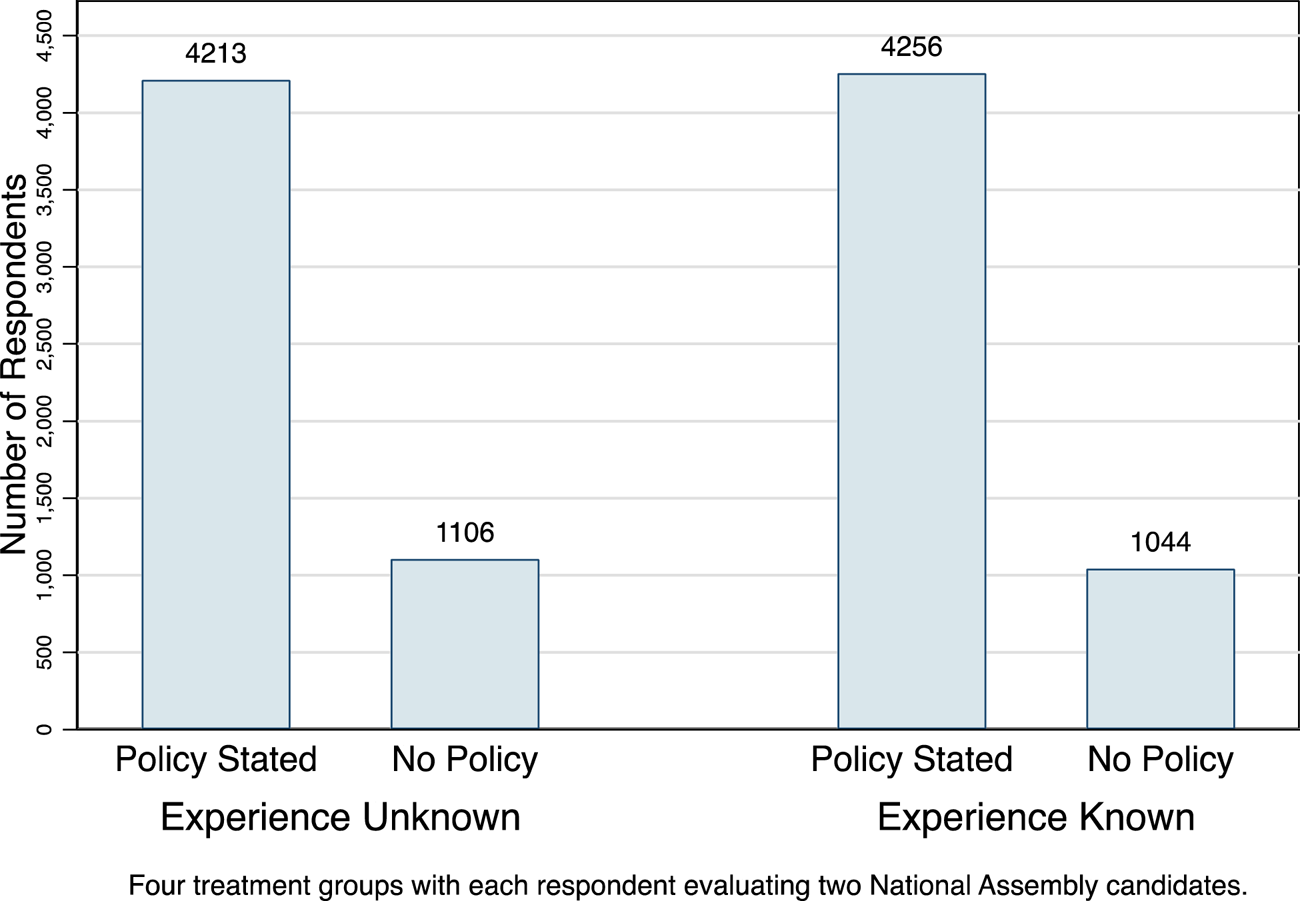
While the baseline survey allows us to measure support for the party, it is less able to directly analyze the specific mechanisms of incumbency bias. In particular, the baseline survey does not allow a test of how party support changes based on the informational environment or organizational backing. Therefore, in the 2018 iteration of the PAPI survey, we enhanced our research design to better test the informational (H1) and organization mechanisms (H2) for incumbency bias. To do this, we exposed randomly assigned respondents to small changes in the 2017 version of the conjoint instrument in order to better isolate their reactions to uncertainty in information about candidate policy and infrastructural power. These two experiments were administered in the form of the 2X2 factorial design shown in Figure 2.
Factorial Design to Test Incumbency Bias Mechanisms (2018)

In the first experiment, we randomly assigned 20 percent of respondents to “no policy” conditions, where neither candidate offered a policy priority. In line with H1, this experiment enhances uncertainty about candidates’ policy positions, so we expect that respondents with no information on policy positions will gravitate toward the party candidate. The delegates receiving the “no policy” treatment are compared to the counterfactual group that received the full set of four policy priorities in Table 3. In the second experiment we randomly assigned half the respondents to learn about the candidates’ experience in the VNA instead of the candidate's current career (business, lawyer, doctor, or VFF), varying whether they candidate had 0, 5, or 15 years of working experience in the government. Consistent with the literature on the US Congress, which equates seniority with the ability to access resources (Hall and Shepsle Reference Hall and Shepsle2013), our expectation is that respondents view experience in the government as similar to organizational power, and therefore would see non-party candidates with more experience as possessing infrastructural power. Consequently, if H2 is correct, respondents exposed to the experience treatments should be more likely to vote for non-party candidates.Footnote 11
Figure 2 shows our research design. The pure control is visible in the second bar. These are respondents that have been exposed to neither the candidates’ policy nor their experience. According to our theory, under this condition of high uncertainty, incumbency bias should be the highest, and non-falsifying voters should favor the party candidate at the highest level. By contrast, the third bar indicates the treatment group where respondents were exposed to both policy priorities and experience. According to our theory, incumbency bias is lowest under these conditions, and party candidates will receive the lowest support from non-falsifying voters. In designing the question, we had no expectations about which of the two treatments (information on policy or experience) would have the substantively larger effect on voting for party members.
Addressing Preference Falsification and Defining Non-Falsifiers
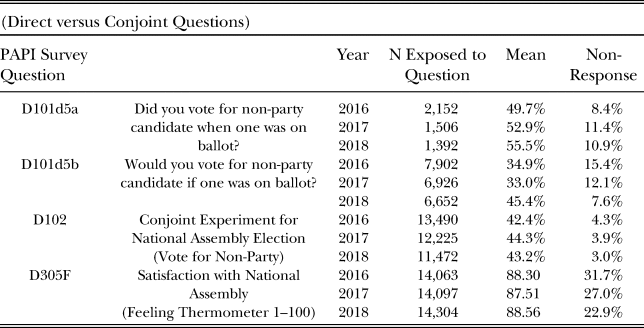
Two additional features of our research design are the ability of the conjoint instrument to reduce preference falsification and our ability to identify respondents who are not providing falsified support for the party. Starting with our evaluation of the ability of the experiment to shield the respondents, Table 4 shows the non-response rate for the conjoint survey compared to direct questions about voting behavior in the PAPI survey. The first question (D101d5a) asks, for those who remember there being a non-party member on the ballot in the 2016 election, whether they voted for the non-party member.Footnote 12 Less than 20 percent of the sample in all three years remembered (or admitted to remembering) there being a non-party member. The skip pattern of the survey therefore ensured that the 80 percent who did not remember a non-party candidate were presented with a hypothetical question that is the closest direct analogue to the conjoint question in the survey (D101d5b): “Would you vote for a non-party candidate if one were on the ballot?”
Average Support for Non-Party Candidate and Non-Response

Mean of D102 is calculated by running an OLS regression of vote choice on party and non-party while suppressing the constant.
The key thing to notice in Table 4 is the tremendous reduction in non-response from using the conjoint experiment (D102), which is shown in the third row.Footnote 13 Compared to its direct analogue (D101d5b), item non-response rates for the conjoint question were eleven percentage points lower in 2016 and eight percentage points lower in 2017 and 2018. We interpret this as additional evidence that respondents were more comfortable answering the conjoint question. Non-response leads to systematic measurement error, as respondents are not skipping questions randomly. When they refuse to answer, they clearly are trying to hide sensitive information or are frightened by the question.
Beyond the utility of the conjoint question in reducing measurement error, Table 4 offers another helpful remedy for skirting the preference falsification problem for those unconvinced that respondents answer the conjoint question honestly. Respondents who answered D101d5b affirmatively are clearly voters who are not afraid to admit their true views to authorities. We refer to these as the non-falsifiers. By limiting statistical analysis to their responses, we can capture the level of regime support from only the set of voters who are not afraid to admit their true preferences for non-party candidates. Therefore, while we might omit some non-falsifiers who are otherwise happy with the party, we can be confident that these non-falsifiers clearly are unafraid to say they would vote for a non-party candidate. Given their stated willingness to vote for a non-party candidate, any support for the party from these respondents should further bolster the argument that factors other than preference falsification underlie support for the party.
ESTIMATION STRATEGY AND RESULTS
Returning to the standard conjoint design from 2016–2018, because each trait was randomized we conducted a linear probability model, where we model the impact of a candidate's traits on the decision to choose that candidate. The model is as follows:
 $$vote_{i\comma j} = \beta _iP_{ij} + X_{i\comma j} + \varepsilon _{i\comma j}$$
where vote i,j is the decision by respondent i to choose candidate j, P is whether or not candidate j is a party member, and X is a matrix of all the other randomized traits for candidate j shown in Table 3. We use multiway clustering of standard errors at the district, commune, and village levels to account for non-independence of observations within those administrative units.Footnote 14 In addition, to ensure that the provincially representative sample is representative at the national level, we include provincial population as a post-stratification weight. We thus interpret the marginal probabilities based on the coefficients for each of the variables as the impact of that trait relative to the other traits in the likelihood of candidate selection.
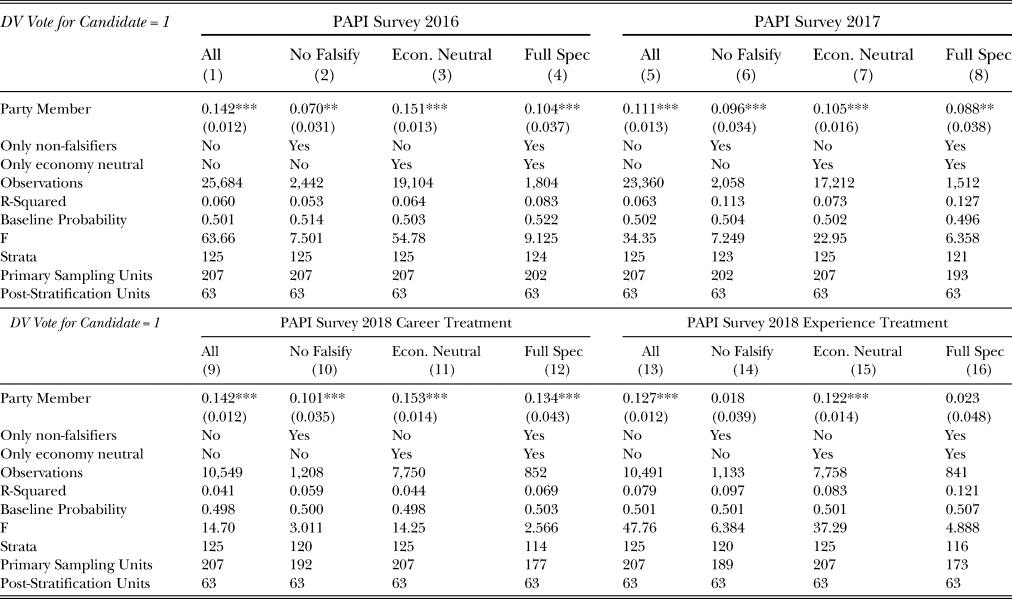
We proceed through the results in several steps. First, we show the main results of the conjoint analysis. In particular, we show the effect of party across each of the three years in four separate specifications. For each year, Model 1 (All) includes the effect of party for all respondents who were exposed to the question in order to provide an assessment of the overall impact of party membership for the entire population. Model 2 (No Falsification) then includes the effect only for respondents who answered that they would support a non-party member in the direct question discussed above (D101d5b). This model is extremely conservative as it rules out preference falsification at the expense of including only those who explicitly support the idea of voting for a non-party candidate in a hypothetical question.Footnote 15 In Model 3 (Econ Neutral): we include the effect only for respondents who said their current economic situation is neither good nor bad. This minimizes the role of performance legitimacy as an explanatory factor. Finally, Model 4 (Full Specification) includes the effect only for the non-falsifiers (Model 2) and those with neutral views on the economic situation (Model 4). This model is the effect of the party absent preference falsification and performance legitimacy. Note that for 2018 we present two separate panels with one set including the placebo information about the job, which was the same design used in 2017, and the other the experience treatment, which was new in 2018.
Regression Results
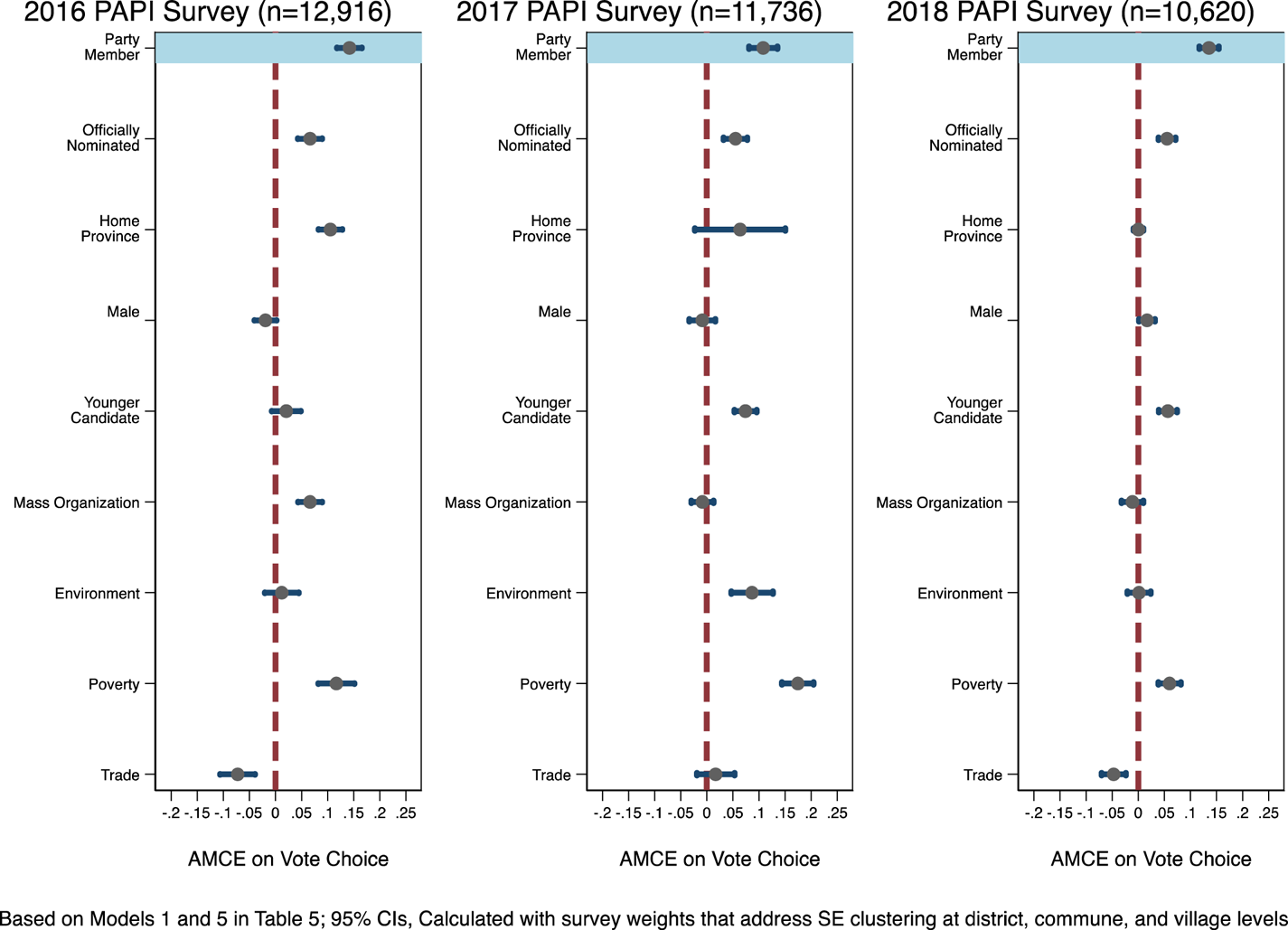
Figure 3 reports the results for all consistent covariates across the three survey waves among all the respondents exposed to the question.Footnote 16 We observe a consistently strong effect for party membership across the entire population and within the subpopulations. For the entire population, party membership increased the likelihood of selection above non-party membership by 14 percentage points in 2016, 11 percentage points in 2017, and 13 points in 2018. To put this figure in perspective, when all covariates are held at their mean level in 2016, respondents voted for party members 56.8 percent of the time and for non-party candidates 42.6 percent of the time (a 14.2-point advantage). Importantly, each of the iterations over the three years offer qualitatively similar results and are not statistically distinguishable from the 15-point party advantage we estimated from the actual vote data in Table 2 above, which is a strong indication of both the reliability and validity of our findings.
Marginal Effects of Candidate Characteristics on Vote Choice

In Table 5, we turn to the subpopulations analysis. For presentational purposes, we show the full conjoint results on all respondents in the first model for each wave. In the second model, we see a fascinating effect when include only those respondents that said in direct questions that they would support non-party members. As the results from 2016 and 2017 show, support for party members among this group drops but remains positive.Footnote 17 In other words, even those who say in direct questions they would be willing to vote for a non-party member still favor party members in the shielded, conjoint experiment.
Effect of Party Membership in Conjoint Survey Experiment

Linear probability with marginal probability of voting for party over non-party shown. Standard errors, clustered at province, district, and commune in parentheses (*** p < 0.01, ** p < 0.05, * p < 0.1). Full regression results are available in Appendix J. 2018 results are divided into two panels based on whether respondents was exposed to career or experience treatment. “No falsification” includes only the respondents who said in a direct question that they would vote for a non-party candidate (see Appendix G for the question). “Econ neutral” includes only those who were neither positive nor negative on current economic situation (see Appendix E). The full specification includes the subset that was both neutral and directly expressed willingness to support non-party candidate.
Looking at the 2018 results, however, we see a marked shift among the non-falsifying respondents. For the respondents who were provided information about the candidates’ job and not the candidate's experience, we see that even the non-falsifiers prefer party members to non-party members by about 10 percentage points. This is nearly identical to the 2017 and 2016 results. However, for the non-falsifier respondents given information about the candidates’ experience, the difference in the support for the party member versus the non-party member candidate disappears. The marginal effect is only 1.8 percentage points and is not statistically significant. As our analysis below shows, this suggests that once organizational backing is controlled for as a determinant of vote choice, non-falsifiers withdraw their support for the party. Other respondents, however, are less affected. We return to this when we explore sub-group effects below.
Alternative Levels of Performance Legitimacy
It is possible that the subsample of respondents expressing neither satisfaction nor dissatisfaction with their current economic situation does not fully account for the possible confounding effects of performance legitimacy. If those with neutral opinions of economic performance have a positive evaluation of the CPV's performance, the positive effect of party membership could reflect this performance legitimacy rather than incumbency advantage. This is especially important because there is some theoretical overlap between performance (which is retrospective) and organization capacity (which is prospective) when performance history shapes future expectations of service delivery. Additionally, we must distinguish the ability to extract resources from the party from the evaluation of party performance. To account for this fuzziness, we repeat our analysis on all the different subgroups of respondents depending on the different economic evaluations shown in Appendix E. If we limit our analysis to only those with low evaluations of the economy, this should limit the possibility that retrospective evaluations of performance of the party as a whole are responsible for party support.
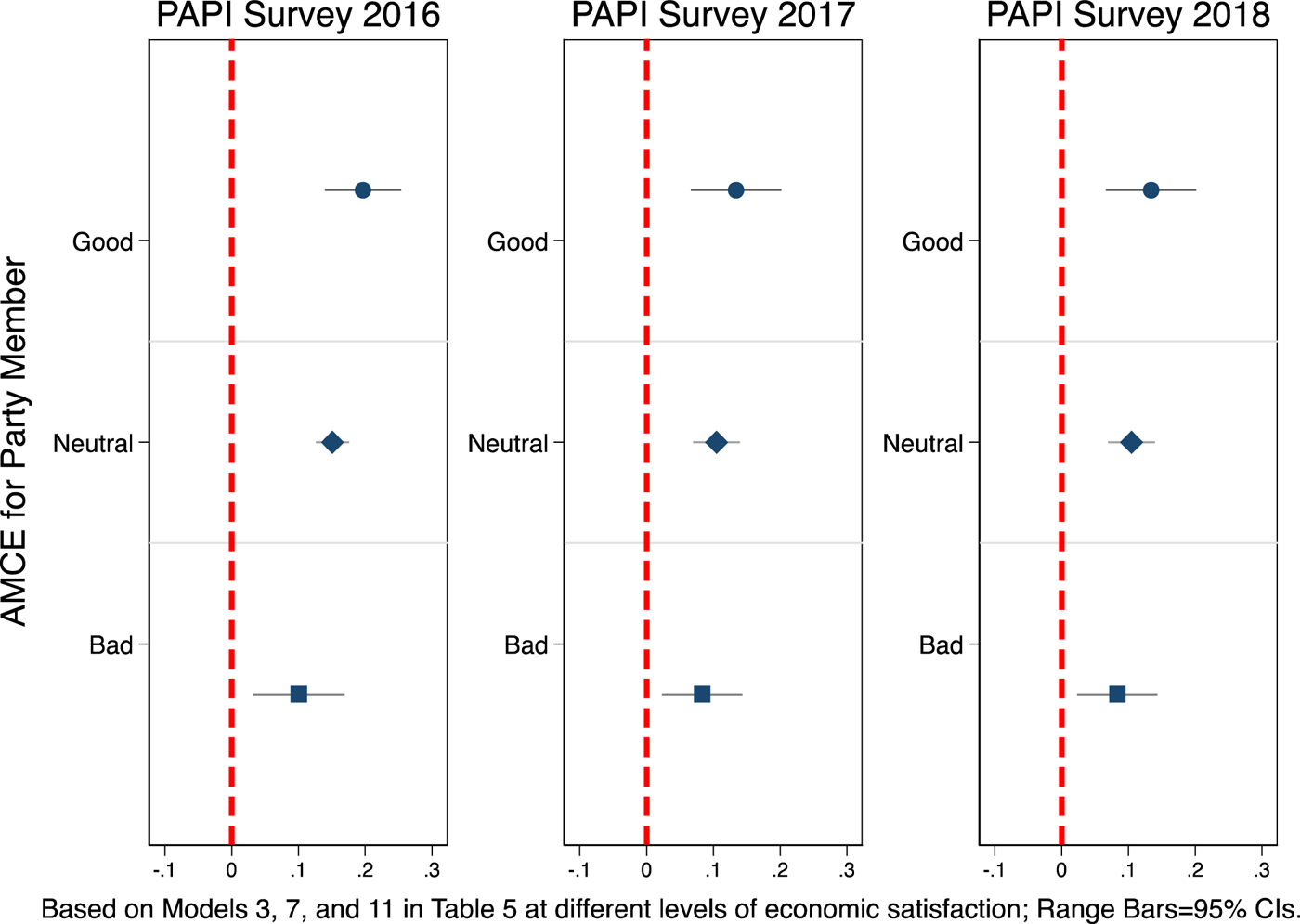
Figure 4 shows the results of a replication of Table 5 (Models 3, 7, 11, and 15), but at different levels of economic satisfaction. Not surprisingly, the results show some effect of performance legitimacy. In 2016, 2017, and 2018 the value of the party label declines based on the level of economic satisfaction. However, even at the lowest levels of economic satisfaction the party still receives a positive and statistically significant electoral boost. In 2016, among those who said their economic situation was bad, party members were 10 percentage points more likely to receive the vote than non-party members. Party support among this low group is eight percentage points in 2017 and 2018. This indicates that even at lower levels of economic satisfaction, party members have a sizable advantage, giving us reason to believe that factors additional to performance legitimacy and preference falsification must drive support for the party.
Effects of Party Membership at Different Economic Satisfaction Levels

SOURCES OF INCUMBENCY ADVANTAGE: POLICY OR RESOURCES
The previous section suggests the importance of the incumbency advantage in Vietnam. In this section, we adjudicate between the underlying mechanisms by testing H1 and H2 directly. We start with H1, which suggests that party members (P) should enjoy a greater advantage when information is low. In the 2018 survey, we directly test the policy certainty mechanism by assigning 20 percent of the hypothetical pairs of candidates to the “no policy priority” treatment (No Policy). If information is driving the findings, we should find that the presence of information benefits the non-party member candidate more than the non-party member. This suggests a positive interaction effect between the candidate pairs not stating a policy and the effect of party membership.
We next test the organizational backing argument (H2) by looking at differences between the effects of party membership, conditioned by the level of experience (Experience) possessed by the candidate. Consistent with H2, we assessed whether respondents receiving information about the experience level were less likely to reward the party members than those receiving information about the career of the candidate pairs. Given that we expect that experience corresponds with organizational backing, the effect of party membership should diminish when information about experience is provided.
Conditional Marginal Means
Two methodological concerns influence our choice of specification for the 2018 analysis. First, recent work on conjoint experiments highlights the need to consider the conditional marginal means (CMM) rather than just the average marginal component effect (AMCE). This is because the AMCE relies on an arbitrary base category (Leeper, Hobolt, and Tilley Reference Leeper, Hobolt and Tilley2019). Therefore, when comparing across subgroups, it is not immediately clear from the AMCE whether the difference is a result of a change in the value for the base category or changes in the categories that are presented. For this article, of concern is whether the policy conditions and organizational backing are changing how respondents view party members or non-party members.
An additional concern is that our factorial design had two treatments, as shown in Figure 2. Our first subset includes respondents that are given policy traits versus those that are not. The second subset includes respondents that are given the experience (organizational backing) versus the job background of the candidates. Not interacting these two treatments could potentially bias findings, given that treatments may work differently depending on which other treatment the respondent viewed (Muralidharan, Romero, and Wuthrich Reference Muralidharan, Romero and Wuthrich2019). The solution to both these problems is to present the CMM of the triple interaction. This not only solves some of the methodological concerns above, but also provides a clear visualization of the effects of the two treatment conditions on all respondents as well as the non-falsifiers. Models 4 and 8 of Table 6 therefore present the following specification. We run the following the model shown in the equation below in Table 6. To calculate the CMM in Figure 5, we suppress the constant and include all potential covariates values in the matrix X, so that the results are not dependent on the selection of base category:
 $$\eqalign{ vote_{i,j} &= \beta _0+\beta _1P_{i,j} + \beta _2Nopolicy_i + \beta _3Experience + \beta _4P_{i,j}\,\ast\, Nopolicy_i \cr & \quad + \beta _5P_{i,j}\,\ast\, Experience_i + \beta _6P_{i,j}\,\ast\, Nopolicy_i\,\ast\, Experience_i + X_{i\comma j} + \varepsilon _{i\comma j}} $$
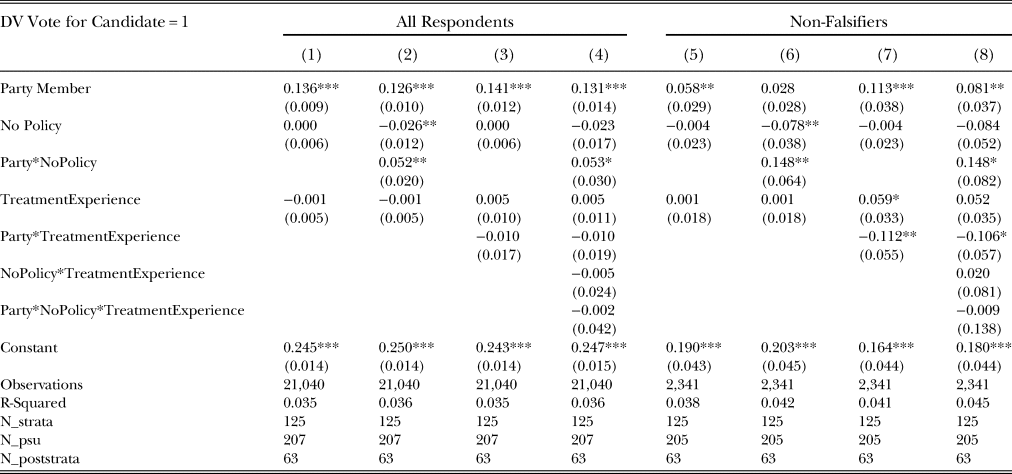
We present the results of the analysis in Table 6, which is divided into two panels for all respondents and non-falsifiers. Each panel contains four models, indicating the direct effects of the three component terms (Models 1 and 5), the interaction between Party and No-Policy (Models 2 and 6), the interaction between Party and Experience (Models 3 and 7), and the triple interaction (Models 4 and 8).
Impact of Party Status Conditional on Policy Information and Organizational Backing

Testing the Experience and Policy Uncertainty Mechanism (Randomized in 2018)

Linear probability model with marginal probabilities. Regressions include all conjoint control covariates. Standard errors, clustered at province, district, and commune in parentheses (*** p < 0.01, ** p < 0.05, * p < 0.1); No Policy indicates that the candidate pairs did not express a policy preference; Treatment Experience indicates respondents exposed to the experience covariates, as opposed to the job covariates. Non-falsifiers are those that answered in a direct question that they would vote for a non-party candidate if one was on the ballot.
Focusing on the fully specified Models 4 and 8, we see that when the policy is known and candidate experience is not stated, the preference for party members is 13 percentage points higher than non-party members among all respondents and 8 percentage points higher among non-falsifiers. However, when there is uncertainty about policy, all respondents (5.3 percentage points) and non-falsifiers (14.8 percentage points) shift their votes further toward party members. Informing voters about candidate experience also impacts support for the party, but only for the non-falsifiers. While the effect is insignificant for all respondents, it is a substantial 10.6 percentage points for non-falsifiers. Finally, the null effect on the triple interaction term illustrates that the “no policy” and “experience” treatments do not influence one another. Learning about policy and experience operate independently.
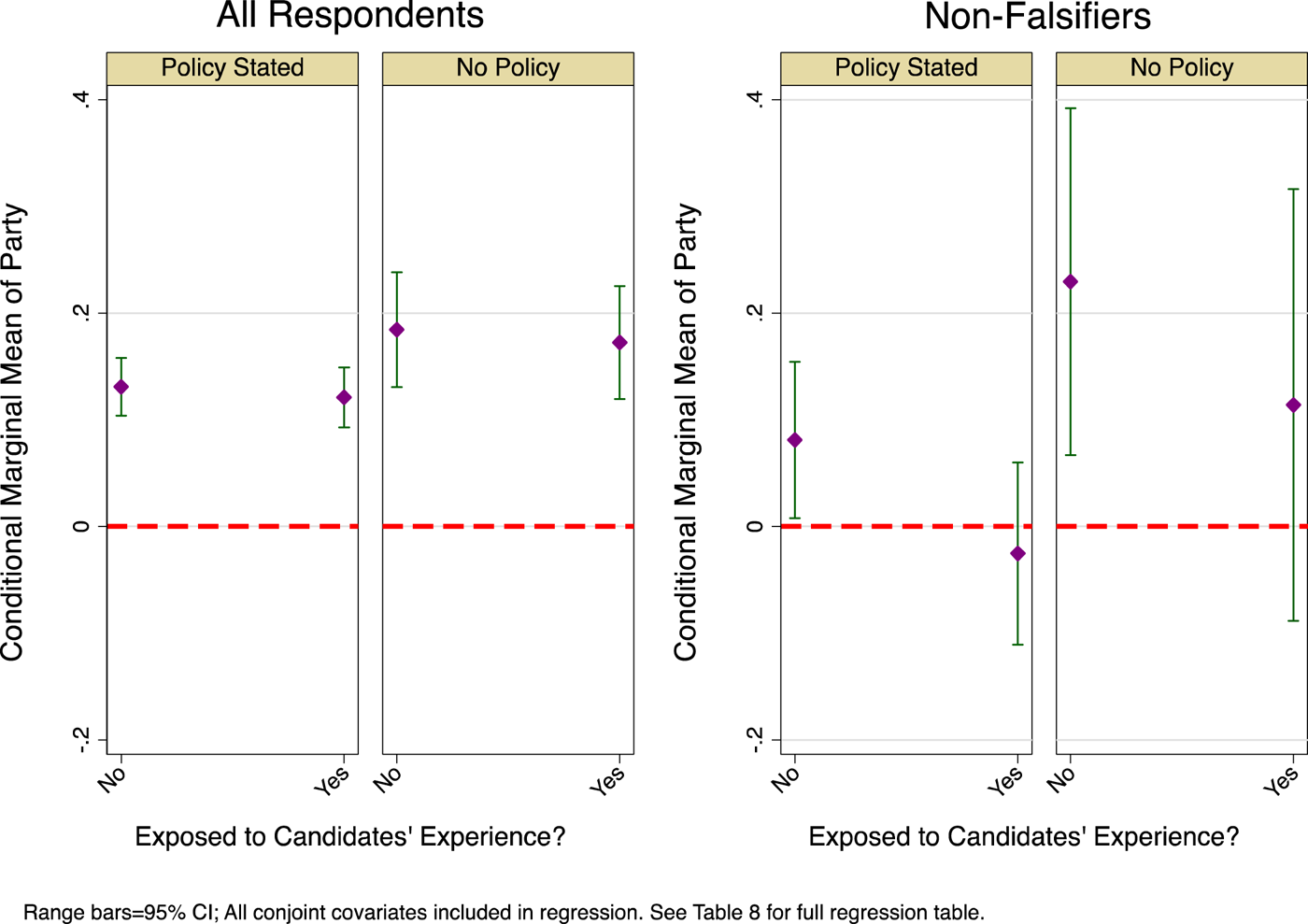
The net effect of the two experiments are illustrated in Figure 5, which shows the CMM of the triple interaction from Models 4 and 8 in Table 6 (Leeper, Hobolt, and Tilley Reference Leeper, Hobolt and Tilley2019). The range bars represent 95 percent confidence intervals around the probability of voting for the party under different conditions. In the first panel, which looks at all respondents, the probability of voting for the party is about 13 percent higher than for non-party members when policy differences are stated, The difference shifts to 18 percent when policies are not stated. There is little difference in the effect of party for the entire sample based on the experience treatment.
When we look at the at the second panel of the graph (non-falsifiers), we can see that the probability of voting for the CPV is sizable and positive (22 percentage points greater than the non-party candidate) when both candidates’ policy priorities and experience are unknown. In this scenario 60.5 percent of non-falsifiers select the party candidate versus 37.6 percent who vote for the non-party candidate. However, when non-falsifiers are provided with differentiating policy information and candidates’ experience, they are indifferent between the party and non-party member candidates. Consistent with our expectations in H1 and H2, the lowest preference for the party occurs when non-falsifiers are aware of both policy and experience (2.5 percentage points lower than non-party members). In this scenario the predicted vote for party members was 46.7 percent, but it was 51.25 percent for non-party members. Furthermore, unlike for all respondents, the organizational backing has an effect for the non-falsifiers. When no policy is stated, the effect of organizational backing drops the premium for party membership from 22 to 11 percentage points. When policies are stated, the effect of organizational backing drops support from an eight percentage points benefit to a two percentage point deficit vis-à-vis the non-party candidate. Thus, for the entire sample, information drives support for the party. However, for non-falsifiers, it is clear that party status signals clarity about both policy direction and organizational capacity.
FOLLOW-UP TEXT ANALYSIS ON “NON-FALSIFIERS”
The findings of the conjoint experiment above suggest that non-falsifiers, like all voters, support the party. However, for those that we define as “non-falsifiers,” policy information and organizational backing play an important role in their decision to vote for the party. However, for the other voters, while policy information matters, organizational backing does not have a strong effect. Furthermore, these voters express a high willingness to vote for the party regardless of the treatment. Put another way, the high level of support for these other voters is not entirely contingent on policy uncertainty or organizational backing. How do we explain these voters?
One explanation is that they are all falsifying their preferences. Despite our belief that the conjoint instrument mitigates this effect, this remains a possibility. Unfortunately we cannot disentangle preference falsification from a more general support for the party. It may be that for these voters, the party is a better indicator of policy information, organizational backing, or other factors correlated with party than the attributes we provide in the conjoint example. For these voters, perhaps similar to ideological voters in the US, party membership is so inextricably linked to these attributes that voters rely more on the party label than the attributes we provide.
One way to assess this possibility is to examine in a question why respondents chose one candidate over another. If voters selected a party member because of preference falsification, we would not expect them to say they voted for the party member because they are party members. Rather, we would expect them to invent another reason or decline to answer. This is because preference falsification implies that respondents should be unwilling to support the non-party candidate due to fear of retribution or sanctioning, but they should not falsely volunteer that they support a candidate for an insincere reason.
To address this, after the conjoint question the 2018 survey asked why respondents chose the candidate they did.Footnote 18 They were given seven options that included matching priorities, experience, leadership skills, the candidate represents the locality, the candidate works within the system, the candidate's education, and the candidate would not bring about change. Finally, respondents were allowed to choose “other” if they did not agree with the provided options and specify in an open-ended fashion why they chose the candidate. We intentionally did not include party membership as one of the options, given that our goal was to examine why the respondents chose the party members. However, using the “other” category, the respondents still had the ability to state that party membership was the reason.
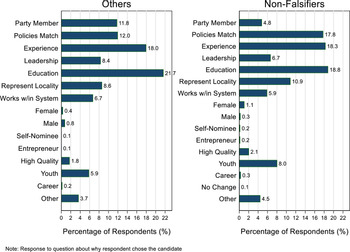
Strikingly, although we did not include party membership as an option, 6.8 percent of the total respondents selected “other” and stated party membership as the reason they chose the candidate. However, there are sharp differences between those we identified as non-falsifiers and the other respondents. For those that refused to vote for a hypothetical non-party candidate, 11.8 percent deliberately wrote in party membership, even though no party option was given. By contrast, only 4.8 percent of the non-falsifiers wrote in that party membership drove their decision (see Figure 6). Furthermore, we do not believe, given that the respondent had every opportunity to not state that the party was the reason for their vote, that preference falsification drove their responses. Much like the roots of party identification and ideology in the US, party membership is a better marker of a bundle of desirable qualities than it is of each of those qualities by themselves.
Why Respondents Chose Candidate

Additionally, this analysis reveals support for the information mechanism (H1). The second major difference between other voters and non-falsifiers is the importance of matching policy priorities in the section of candidates. Eighteen percent of non-falsifiers chose the policy match option compared to only twelve percent of other respondents. This lends additional support to our findings that a large subset of Vietnamese voters value clarity on policy objectives and that clear information about policy reduces support for the incumbent party.
CONCLUSION AND IMPLICATIONS
Machiavelli ([1532] Reference Machiavelli1998, 6–7) noted that princes inheriting political regimes can remain in power even with mediocre performance. We develop this intuition for single-party regimes, suggesting that they can enjoy an extreme form of incumbency advantage based on certainty about policy positions and access to resources. Based on our theory, single-party autocrats need not manipulate or perform particularly well in order to attract high levels of support in elections. Our findings show that policy information and organizational backing do matter, particular for non-falsifying respondents. Importantly, these are voters who are willing to vote for non-party candidates, but who choose not to do so because of the lack of policy information and organizational backing. For other voters, although policy information plays a role, they are either more susceptible to preference falsification or have support for the party so deeply ingrained that it is difficult to separate from the underlying factors that drive them to support the party in the first place.
What does this mean for the ability of single-party regimes to accurately gauge their own strength? The most striking finding from this article is the reluctance from all sub-groups in Vietnam—even those who express willingness to vote against the party—to back a non-party candidate for national office. This coheres with findings from Eastern Europe during the communist era that even defectors were likely to vote for the communists in a head-to-head match-up with hypothetical opposition parties (Kuran Reference Kuran1991, 31). The phenomenon suggests that the problem in single-party regimes is that respondents have little certainty about the policy positions of independents or their ability to deliver patronage.
Our findings have important implications for theories of democratic regime change that rely on elections and polls to provide information. The “democratization from strength” argument posits that autocrats can transition before collapsing if they can see that they are still in a position of strength, but that their popularity is on the wane (Slater and Wong Reference Slater and Wong2013). This suggests that single-party regimes may have a difficult time assessing when they will reach this “bittersweet zone,” where the legitimacy among the populace is high but on the verge of decline. The problem is not so much in assessing changes in their strength over time, as it is knowing how the regime will perform in a fair election against an opponent that the ruling regime will inevitably allow to stake out a policy position by allowing an opposition party to campaign. Allowing the opponent to campaign may generate increased confidence in the party's ability to rule or access resources, which could cause a dramatic, unforeseen swing in support for the incumbent. This suggests that single-party regimes such as China, Vietnam, and Cuba may not be able to transition from strength in the same manner as hegemonic regimes like Taiwan and Indonesia.
SUPPLEMENTAL MATERIAL
The supplementary material for this article can be found at https://doi.org/10.1017/jea.2019.40.
CONFLICT OF INTEREST STATEMENT
Both Edmund Malesky and Paul Schuler are paid consults to United Nations Development Program for their assistance on the annual Public Administrative Performance Index survey. They provide advice on questionnaire design, sampling strategies, as well as statistical analysis to generate the rankings and longitudinal analyses in the report. We have no conflicts of interest to report in this research.