Introduction
Free word association task (WAT) is commonly used to assess word knowledge and lexical-semantic organization among children (e.g., Entwisle, Reference Entwisle1966; Nelson, Reference Nelson1977; for a review, see Wojcik, Reference Wojcik2018) and adults (De Deyne, Navarro, Perfors, Brysbaert & Storms, Reference De Deyne, Navarro, Perfors, Brysbaert and Storms2019; Nelson, McEvoy & Schreiber, Reference Nelson, McEvoy and Schreiber2004). In a typical WAT, participants hear or read a lexical cue (e.g., CAT) and report the first word that comes to mind (e.g., DOG). Words are theorized to be stored as nodes in the mental lexicon that are interconnected as a network, within which activation of a node spreads to connected nodes automatically during lexical tasks or daily encounters (Anderson, Reference Anderson1983; Collins & Loftus, Reference Collins and Loftus1975; Steyvers & Tenenbaum, Reference Steyvers and Tenenbaum2005). During a WAT, the exposure to a cue activates connected neighbors that compete for production, and neighbors that exhibit stronger connectivity and faster activation would be more likely to be reported as the first word that comes to mind (Playfoot, Balint, Pandya, Parkes, Peters & Richards., Reference Playfoot, Balint, Pandya, Parkes, Peters and Richards2018). Participants take longer to produce associates that do not exhibit the strongest link to the cue in a WAT (Playfoot et al., Reference Playfoot, Balint, Pandya, Parkes, Peters and Richards2018), which suggests elevated challenges to suppress and not report the first word that comes to mind upon hearing the cue.
WAT performance thus indicates abilities in learning the lexical form of a word, its conceptual referent, and, importantly, the relationships among words. Significant discrepancies between children's and adults’ responses to WAT are expected (e.g., Entwisle, Reference Entwisle1966; Nelson, Reference Nelson1977) due to differences in conceptual organization and accumulated language experience. An examination of WAT performance would shed light on semantic convergence, a socially mediated process in which children learn to use words and their connotations in a way that mimics the use of adults from the same language community (Adams & Bullock, Reference Adams and Bullock1986). Previous work has demonstrated the significant influence of age on WAT performance (e.g., Cremer, Dingshoff, de Beer & Schoonen, Reference Cremer, Dingshoff, de Beer and Schoonen2011; Nelson, Reference Nelson1977; Spätgens & Schoonen, Reference Spätgens and Schoonen2020). Entwisle (Reference Entwisle1966) showed that older monolingual children (e.g., fifth grade) produced more responses commonly shared among group members than younger monolingual children (e.g., preschoolers), suggesting greater within-group homogeneity that characterizes the community. The effect of age on semantic convergence may reflect developmental changes in organizational principles of the mental lexicon (McNeill, Reference McNeill1963; Nelson, Reference Nelson1977; Nelson & Nelson, Reference Nelson and Nelson1990; Palermo, Reference Palermo1971; Smiley & Brown, Reference Smiley and Brown1979; Waxman & Namy, Reference Waxman and Namy1997). It has been shown that children between 6 and 9 produce more paradigmatic associations that belong to the same grammatical or taxonomic category (e.g., DOG–CAT) than younger children, whose responses are predominated by syntagmatic associations that are thematically related to or syntactically adjacent to the cues (e.g., DOG–BARK). Such developmental changes in WAT performance, also known as the syntagmatic-paradigmatic shift (Nelson, Reference Nelson1977; Perraudin & Mounoud, Reference Perraudin and Mounoud2009), indicate general changes in the guiding principles of conceptual organization (Keith & Nicoladis, Reference Keith and Nicoladis2013).
The age effect on semantic convergence may also indicate knowledge accumulation of word usage patterns based on exposure to language input. Compared to younger children, older children have lengthened exposure to statistical regularities embedded in the ambient language. Increased experience with words may lead to discoveries that word pairs differ in the rates of how often they appear in proximity (i.e., co-occurrence) in the same utterance. For example, “sing songs” has a much higher co-occurrence than “sing poems”, which may prompt children to intentionally explore the relationship between “SING” and “SONG”. Greater rates of co-occurrence also lead to increased opportunities for processing and producing selected words together, leading to further consolidation of the strength between words. Lengthened language exposures also may lead to discoveries that some words tend to occur in similar contexts despite being in different utterances (e.g., Broccoli is GOOD; chips are BAD; My dad is a DOCTOR and my mom is a LAWYER). The statistical regularities with which words occur in similar contexts and related themes may facilitate the development of taxonomic awareness (e.g., word class, semantic categories, etc.) and semantic relatedness between words.
In a similar vein, bilingualism should exert a significant impact on semantic convergence – the need to learn two languages would effectively limit the amount of language-specific input and thus slow down the rates of knowledge accumulation of word usage patterns. Bilingualism impacts lexical-semantic development (for a review, see Bialystok, Reference Bialystok2009) and language-specific performance on vocabulary assessment (for a review, see Bedore & Peña, Reference Bedore and Peña2008). Bilingual populations generally control a smaller language-specific vocabulary than monolinguals (e.g., Portocarrero, Burright & Donovick, Reference Portocarrero, Burright and Donovick2007), though the two language groups may perform comparably on dual-language measures that consider words known in either language (e.g., Anaya, Peña & Bedore, Reference Anaya, Peña and Bedore2018; Gross, Buac & Kaushanskaya, Reference Gross, Buac and Kaushanskaya2014). Divided language exposure reduces the amount of language-specific usage, which leads to weakened linkages between lexical forms and semantic representations that negatively impact word production in the testing language (Gollan, Montoya, Cera & Sandoval, Reference Gollan, Montoya, Cera and Sandoval2008; Sandoval, Gollan, Ferreira & Salmon, Reference Sandoval, Gollan, Ferreira and Salmon2010).
The impact of bilingualism on semantic convergence in children's WAT performance has received much less attention when compared to other semantic domains, such as picture identification and naming abilities that indicate vocabulary breadth. Notably, existing work on WAT in bilingual children has focused on analyzing qualitative aspects of responses, such as meaning-related versus form-based (Cremer et al., Reference Cremer, Dingshoff, de Beer and Schoonen2011), paradigmatic versus syntagmatic (Holmström, Salameh, Nettelbladt & Dahlgren-Sandberg, Reference Holmström, Salameh, Nettelbladt and Dahlgren-Sandberg2016; Namei, Reference Namei2004; Sheng, McGregor & Marian, Reference Sheng, McGregor and Marian2006), or context-independent versus context-dependent responses (Spätgens & Schoonen, Reference Spätgens and Schoonen2020). Results from these studies are far from conclusive. Previous work has found: subtle advantages in producing the more advanced paradigmatic associates in bilingual children (Holmström, Salameh, Nettelbladt & Dahlgren-Sandberg, Reference Holmström, Salameh, Nettelbladt and Dahlgren-Sandberg2016; Sheng et al., Reference Sheng, McGregor and Marian2006); subtle disadvantages in bilingual children (Namei, Reference Namei2004), though the effect of language backgrounds was more limited compared to the effect of age (e.g., Cremer et al., Reference Cremer, Dingshoff, de Beer and Schoonen2011); or comparable associative preferences between monolingual and bilingual children (Spätgens & Schoonen, Reference Spätgens and Schoonen2020). Highly diverse coding and classification systems (for a review, see Fitzpatrick & Thwaites, Reference Fitzpatrick and Thwaites2020) and differences in participant profiles across studies may have led to inconsistent results.
Descriptions of semantic convergence in WAT would be incomplete without considering the effects of word usage patterns in the ambient language on children's performance. Word usage patterns contribute to distributional properties of language input that may be quantified by co-occurrence and degrees of semantic relatedness of words. These parameters may influence the strength of connectivity between words in the mental lexicon – words that are co-activated frequently or share significant semantic features tend to exhibit strengthened connectivity and speeded activation (for a review, see Hutchison, Reference Hutchison2003). Co-occurrence, as introduced earlier, refers to the temporal contiguity between words in spoken language or texts. This distributional property of language use can be quantified by mutual information (M. I.) that compares the probability of co-occurrence of two words to the probability of their independent existence (Church & Hanks, Reference Church and Hanks1990). Thus, if two words have a substantially larger probability to co-occur than by chance (suggesting a large M.I.), the two words are likely to have some sorts of syntactic association (e.g., SING–SONG; DOG–BARK). Wettler, Rapp, and Sedlmeier (Reference Wettler, Rapp and Sedlmeier2005) derived co-occurrence information from the British National Corpus and demonstrated its correspondence to actual associates produced to selected cues by adult participants. Results have been argued to support paired associative learning of word pairs experienced in proximity (Wettler et al., Reference Wettler, Rapp and Sedlmeier2005). However, human associative behaviors cannot be fully explained by co-occurrence of words (Gruenenfelder, Recchia, Rubin & Jones, Reference Gruenenfelder, Recchia, Rubin and Jones2016). Semantic relatedness, which measures the similarity of contexts surrounding two words, may also explain the associative behaviors. Semantically related words (e.g., CAT and DOG) are connected to numerous shared features instantiated as nodes in the mental lexicon, such as “animals”, “pets”, “fur”, and “paws”. Activation of the node CAT during a WAT would spread out and activate connected nodes, which converge and speed up the activation of the node of DOG. As a result, both co-occurrence and semantic relatedness should predict children's likelihood to produce associates that mirror adults’ responses.
This study examined the effects of bilingualism on semantic convergence in children, specifically the extent to which monolingual and bilingual children produced the same responses reported in the “Small World of Words” association norm (De Deyne et al., Reference De Deyne, Navarro, Perfors, Brysbaert and Storms2019) collected from adult speakers. The study has two aims. The first aim focused on children's responses and addressed the extent to which word associates produced by monolingual and bilingual children are similar to adult responses using measures of stereotypy and association strength within cue-associate pairs. The study used three scoring methods that range from the crudest to the most fine-grained to assess the similarity between child and adult responses. Stereotypy analyses are common in WAT studies (for a review, see Fitzpatrick & Thwaites, Reference Fitzpatrick and Thwaites2020) and are typically classified as unweighted and weighted. Unweighted scoring evaluates whether participants’ responses appear in the norm list or not, providing a crude similarity measure. By contrast, weighted scoring additionally attends to the ranking of the selected response in the norm list, with more points allocated to responses that rank higher in the list (i.e., produced by more respondents in the norm). Finally, association strength within a cue-associate pair provides more detailed information about the number of adult participants giving a specific response when prompted with a cue. The information reflects the conditional probability with which a response is triggered by a cue (De Deyne et al., Reference De Deyne, Navarro, Perfors, Brysbaert and Storms2019). As a result, the scoring method based on association strength provides a much more fine-grained measure in assessing children's semantic convergence.
A smaller language-specific vocabulary (Bialystok, Reference Bialystok2009; Gross et al., Reference Gross, Buac and Kaushanskaya2014; Sandoval et al., Reference Sandoval, Gollan, Ferreira and Salmon2010) and divided language input associated with bilingualism should predict a monolingual-bilingual gap in converging to adult-like associative behavior in the target language, manifested as lowered unweighted and weighted stereotypy scores, and weaker associative strength for responses produced by bilingual children. The analyses would shed light on the extent to which the monolingual-bilingual gap in children, if found, applies across scoring systems that focus on matching at both a crude level (i.e., unweighted) and a fine-grained level by considering also prototypicality of adults’ responses (i.e., weighted scores and association strength). An interaction between age and bilingualism would indicate a widening or narrowing monolingual-bilingual gap in children's likelihood to produce adult-like associative behavior. Alternately, a stable monolingual-bilingual gap would suggest consistent effects of divided language input on the acquisition of word relationships in young children. This study focused on children of 4- to 7-year-olds because lexical-semantic organization develops rapidly at these ages (e.g., Nelson & Nelson, Reference Nelson and Nelson1990; Sheng, Bedore, Peña & Taliancich-Klinger, Reference Sheng, Bedore, Peña and Taliancich-Klinger2013; Sheng & Lam, Reference Sheng and Lam2015), which would allow us to examine the stability as opposed to changes in the monolingual-bilingual gap, if it exists.
The second aim followed up on the first question and addressed an under-examined issue in WAT studies – why are certain adult-like associates more likely to be produced by children? Compared to the first question and previous studies that focused on the responses produced by children, the second aim took a closer look at the associates commonly produced by adults. Based on the same association norm (De Deyne et al., Reference De Deyne, Navarro, Perfors, Brysbaert and Storms2019) used to address the previous aim, the analyses located the top three most predominant responses adults produced for selected cues and defined these responses as the targets. The second aim focused on the top three predominant responses adults produced because they have been used to define the primary responses when assessing stereotypy of WAT performance (see Fitzpatrick, Playfoot, Wray & Wright, Reference Fitzpatrick, Playfoot, Wray and Wright2015 and Fitzpatrick & Thwaites, Reference Fitzpatrick and Thwaites2020 for review). Little is known about factors that predict children's likelihood to produce these responses that define stereotypy and suggest semantic convergence to the adult norm. An examination of word association norms suggests that non-predominant responses usually show declines in the number of respondents producing the word, suggesting increasing idiosyncrasy that may not represent general patterns of lexical experience shared by a language community. For the second aim, the correspondence of co-occurrence in the ambient language to actual associates produced in WAT (Wettler et al., Reference Wettler, Rapp and Sedlmeier2005) and the significant role of semantic relatedness in the architecture of the mental lexicon (Collins & Loftus, Reference Collins and Loftus1975) predict that adult-like responses that exhibit a stronger relationship to the cue will be more likely elicited from children. Regarding the effects of bilingualism, divided language input may lead children to pay additional attention to word pairs that have a high co-occurrence rate or exhibit heightened semantic relatedness. Word pairs that co-occur infrequently may have a much reduced occurring rate in divided language input, leading to increased saliency for word pairs that co-occur more frequently. Furthermore, the challenges associated with learning two languages may drive children to focus on word pairs that occur in similar contexts and share a great number of semantic features than word pairs that relate remotely in order to catch up or assimilate to the norms of the dominant societal language. If so, distributional properties of word pairs may exhibit a stronger relationship with the likelihood to produce adult-like associates in bilingual children than in monolingual children. Alternately, both monolingual and bilingual children may show comparable performance in producing cue-associates pairs that exhibit a stronger relationship in the natural language environment because these word pairs are easier to learn for all learners. Addressing the second aim should also consider variables known to influence lexical access (Goh, Yap, Lau, Ng & Tan, Reference Goh, Yap, Lau, Ng and Tan2016) besides distributional properties of word relationships. We obtained measures of age of acquisition and word frequency for each adult target associate because these variables may influence semantic convergence in monolingual populations. Specifically, members from the same language community tend to produce associates that are acquired earlier in life (e.g., Brysbaert, Van Wijnendaele & De Deyne, Reference Brysbaert, Van Wijnendaele and De Deyne2000) or occur frequently in daily usage (e.g., Fitzpatrick, Reference Fitzpatrick2007; Meara, Reference Meara1983). These findings highlight the needs to consider age of acquisition and word frequency when examining children's likelihood to produce adult-like associates in WAT.
To examine the generalizability of the bilingual effect on WAT performance, we compared bilingual children who spoke language pairs that differ in language distance to the testing language (English). Mandarin is phonologically and morphologically distinct from Spanish and English (Sheng, Lam, Cruz & Fulton, Reference Sheng, Lam, Cruz and Fulton2016). Differences in cross-linguistic features influence language-specific vocabulary development. Young Spanish–English bilingual children exhibited sensitivities to cross-language cognates in vocabulary assessment (Sheng et al., Reference Sheng, Lam, Cruz and Fulton2016). Compared to Mandarin–English bilingual children, Spanish–English bilingual children exhibited improved awareness of certain English derivational word formation rules that were challenging and took extended time to develop as well (Lam & Sheng, Reference Lam and Sheng2016). However, studies also showed that Mandarin–English and Spanish–English bilingual children performed comparably on measures of vocabulary breadth (Sheng et al., Reference Sheng, Lam, Cruz and Fulton2016) and taxonomic awareness at the conceptual level (Lam & Sheng, Reference Lam and Sheng2020a). This study predicted that the monolingual-bilingual gap in WAT performance, if found, would generalize across bilingual groups because the task does not target specific linguistic features.
This study adopted the adult association norm compiled by De Deyne and colleagues (2019) as the reference model in comparing children's WAT responses. The norm is the latest and largest English association norm developed to-date, and expands on established association norms, such as the University of South Florida association norm (Nelson et al., Reference Nelson, McEvoy and Schreiber2004). The De Deyne et al. (Reference De Deyne, Navarro, Perfors, Brysbaert and Storms2019) norm included a relatively homogeneous adult sample as most participants had at least a college or master's degree. Furthermore, the norming procedure elicited three consecutive responses from each participant for each cue, with limited chaining effects from initial responses on subsequent associates produced (De Deyne et al., Reference De Deyne, Navarro, Perfors, Brysbaert and Storms2019). The current study adopted a similar procedure in eliciting children's responses because eliciting multiple responses provides more details on subjects’ semantic networks (Schmitt, Reference Schmitt1998; Spätgens & Schoonen, Reference Spätgens and Schoonen2020).
Methods
Participants
Forty-nine Mandarin–English bilingual children (23 females), 33 Spanish–English bilingual children (24 females), and 28 English-speaking monolingual children (10 females) between the ages of 4 and 7 years were recruited in the Austin area for the study. The procedures were approved by the Institutional Review Board at the University of Texas. No participants were reported to have any visual, audiologic, or neurologic deficits. Caregivers were interviewed about the children's language profiles that included parent-rated language proficiency and daily language use. The interview was conducted using a questionnaire based on Gutiérrez-Clellen and Kreiter (Reference Gutiérrez-Clellen and Kreiter2003) and Restrepo (Reference Restrepo1998). The questionnaire inquires about language usages on an hour-by-hour basis during the waking hours of a typical weekday and a typical weekend day. To ensure enough bilingual exposure, participants in the bilingual groups must have more than 20% daily exposure to each of their two languages at the time of testing. The criteria resulted in the exclusion of four Mandarin–English bilingual children and one Spanish–English bilingual child. To obtain an objective measure of English proficiency, participants completed a 50-item English picture naming task designed by the second author.
Analysis of Variance (ANOVA) confirmed that the three language groups did not differ in age (p = .37) (see Table 1). ANOVA indicated a language-group effect for maternal education: the Spanish–English bilingual children had fewer years than Mandarin–English bilingual children (F (2, 102) = 35.9, p < 0.001, η2 = 0.40; M.D. = –5.9, SE = 0.7, p < 0.001) and English-speaking monolingual children (M.D. = –4.1, SE = 0.8, p < 0.001). No difference in years of maternal education was found between Mandarin–English bilingual children and English-speaking monolingual children (p = 0.053).
Summary of the demographic background of child participants. Standard deviations are in the parenthesis.

1 Mono-English: English-speaking monolingual children
2 Bi-Man Eng: Mandarin-English bilingual children; Bi-Spa Eng = Spanish-English bilingual children
Materials and procedures
Picture Naming
A 50-item English picture naming task was used to measure vocabulary breadth of child participants in English. The task, which was described in detail in previous studies (e.g., Lam & Sheng, Reference Lam and Sheng2020a; Sheng et al., Reference Sheng, Lam, Cruz and Fulton2016), consisted of 50 concrete familiar nominal concepts derived from a number of semantic categories, such as people, animals, food, tools, and instruments. The 50 target items were represented as colored photographs selected from Google images. For each item, we used established corpus to obtain the frequency-of-occurrence values in oral contexts in English (Brysbaert & New, Reference Brysbaert and New2009). The average occurrences per million was 29.3 (SD = 38.3; range = 1.72 to 103.4 occurrences per million). We also obtained perceived age of acquisition of the item based on adults’ rating (c.f. Kuperman, Stadthagen-Gonzalez & Brysbaert, Reference Kuperman, Stadthagen-Gonzalez and Brysbaert2012). The average age of acquisition was 4.6 years old (SD = 1.3; range = 2.6 to 9.7). Internal consistency of the picture naming task was examined using Cronbach's alpha, which showed acceptable reliability for the task, α = 0.86.
Repeated Word Association Test
The stimuli in WAT consisted of 15 early-acquired English cues with 5 adjectives, 5 nouns, and 5 verbs (see Table 4 for full list of cues). The average age of acquisition of the cues was 4.0 (range = age 2.8 to 5.8; c.f., Kuperman, et al., Reference Kuperman, Stadthagen-Gonzalez and Brysbaert2012). We sampled early acquired cues from multiple word classes to avoid restricting results to specific word classes. Participants were tested by a native English speaker. The administration of WAT followed the procedure described in Sheng et al. (Reference Sheng, McGregor and Marian2006, Reference Sheng, Bedore, Peña and Taliancich-Klinger2013) with the following instructions given by a trained research assistant.
“When you hear a word, sometimes it makes you think of another word that goes with it. If you hear “MOM,” you might think of “DAD.” If you hear “BIRTHDAY,” you might think of “CAKE.” I am going to read a word out loud. Then I will ask you to tell me another word that goes with the word I said out loud. Are you ready?”
After the instructions, the trained research assistant prompted child participants to produce associates for “CAR” with the instruction “If I say CAR, you say____” in three elicitation trials, followed by another practice item “RUN.” Feedback was provided during practice. For responses semantically related to the cues (e.g., TRUCK), the research assistant said, “Yes, CAR goes with TRUCK”. For responses unrelated to the cues semantically (e.g., producing phonologically related words, such as CAR-BAR, or saying “I don't know”), the research assistant said, “A word that goes with CAR is TRUCK”. Children were reminded to say only one word at a time. Throughout practice and testing trials, the research assistant used fingers as visual cues to help the participants to keep track of three elicitation trials for each cue. No more feedback was provided during the testing trials.
In summary, the instructions and practice subtly guided children toward generating semantically related responses. Such decisions are based on the observation that adults predominantly produce semantically related associates in WAT, even for idiosyncratic responses that are rarely produced by adult participants. Furthermore, the proportion of non-semantically related responses (e.g., producing phonologically related associates) decreases with age (e.g., Namei, Reference Namei2004). These observations suggest inherent biases towards producing semantically related responses in WAT among adults. When provided with instructions and practice that subtly guide toward generating semantically related responses, failures to do so would shed light on the sophistication levels of the lexical-semantic system of children and their abilities to produce adult-like responses – that is, semantic convergence.
Scoring
For the picture naming task, items were scored as either 1 (correct) or 0 (incorrect). To address the first aim of the present study, children's WAT responses were compared to all responses produced by adults for the same cues using the “Small World of Words” Association Norm (De Deyne et al., Reference De Deyne, Navarro, Perfors, Brysbaert and Storms2019). Only data from adult speakers who were reportedly based in the United States and spoke English as the native language were utilized because these participants would be geographically similar to the child participants examined in the present study. Children's responses were scored (1) non-weighted, (2) weighted, and (3) using association strength within cue-associate pair. The scoring methods differ in the amount of information provided. Non-weighted scoring focuses simply on whether children produced adult-matching responses; weighted scoring and association strength provide added information about the prototypicality of a selected response according to the association norm.
In non-weighted scoring, children's responses were scored as 1 (match) or 0 (no match). For example, a child produced “GOOD, CRAZY, HAPPY” in the first, second, and third trial respectively for the cue “BAD”. According to the association norm, “GOOD” is among adults’ responses in the first trial, while “CRAZY” and “HAPPY” were not produced by adults in the respective trials. The child would, therefore, receive a score of 1, 0, and 0 for the first, second, and third trial respectively, and an average score of 0.33 for the cue “BAD” when aggregating over three trials. Higher non-weighted scores indicate that a child produces an increased number of adult-matching responses and, therefore, performs more similarly to adults.
In weighted scoring, responses were scored as 2 (match and among the top three most predominant responses among adults), 1 (match but not among the top three), and 0 (no match). For the same example above, “GOOD” was, in fact, the most common of the adults’ responses in the first trial. The child thus receives a score of 2, 0, and 0 for the first, second, and third trial respectively, with an average of 0.67 for the cue. In contrast, a child who produced “DOG, CRAZY, HAPPY” for “BAD” would receive a lowered score for the first trial (i.e., 1) and an average score of 0.33 for the cue because “DOG” is produced infrequently in adults.
Compared to weighted scoring that ranks adults’ responses in a relatively crude manner, association strength within cue-associate pair provides an even finer evaluation of the similarity between child and adult responses. The association strength informs on the number of adult participants producing a specific response when given a cue in three elicitation trials. For example, “GOOD” is produced by more adult participants than “DOG” as an associate in three elicitation trials combined when they are given the cue “BAD” (c.f. De Deyne et al., Reference De Deyne, Navarro, Perfors, Brysbaert and Storms2019). As a result, “GOOD” exhibits a much elevated conditional probability to be triggered by “BAD” than “DOG” does (0.155 vs 0.017), which indicates a stronger association for the “BAD-GOOD” cue-associate pair. Based on adults’ associative behavior, the average association strength for all responses produced in the three trials for one child could be compared to another child. Summarizing the three scoring methods, non-weighted and weighted stereotypy scoring is trial-specific; association strength speaks to children's performance according to the general conditional probability with which a cue triggers a selected response in adult participants when they are given three opportunities. Compared to non-weighted scoring, the weighted and associative strength scoring reward children for producing common associates that likely represent the shared behaviors of a language community.
Distributional properties of word relationships, data coding and statistical analyses
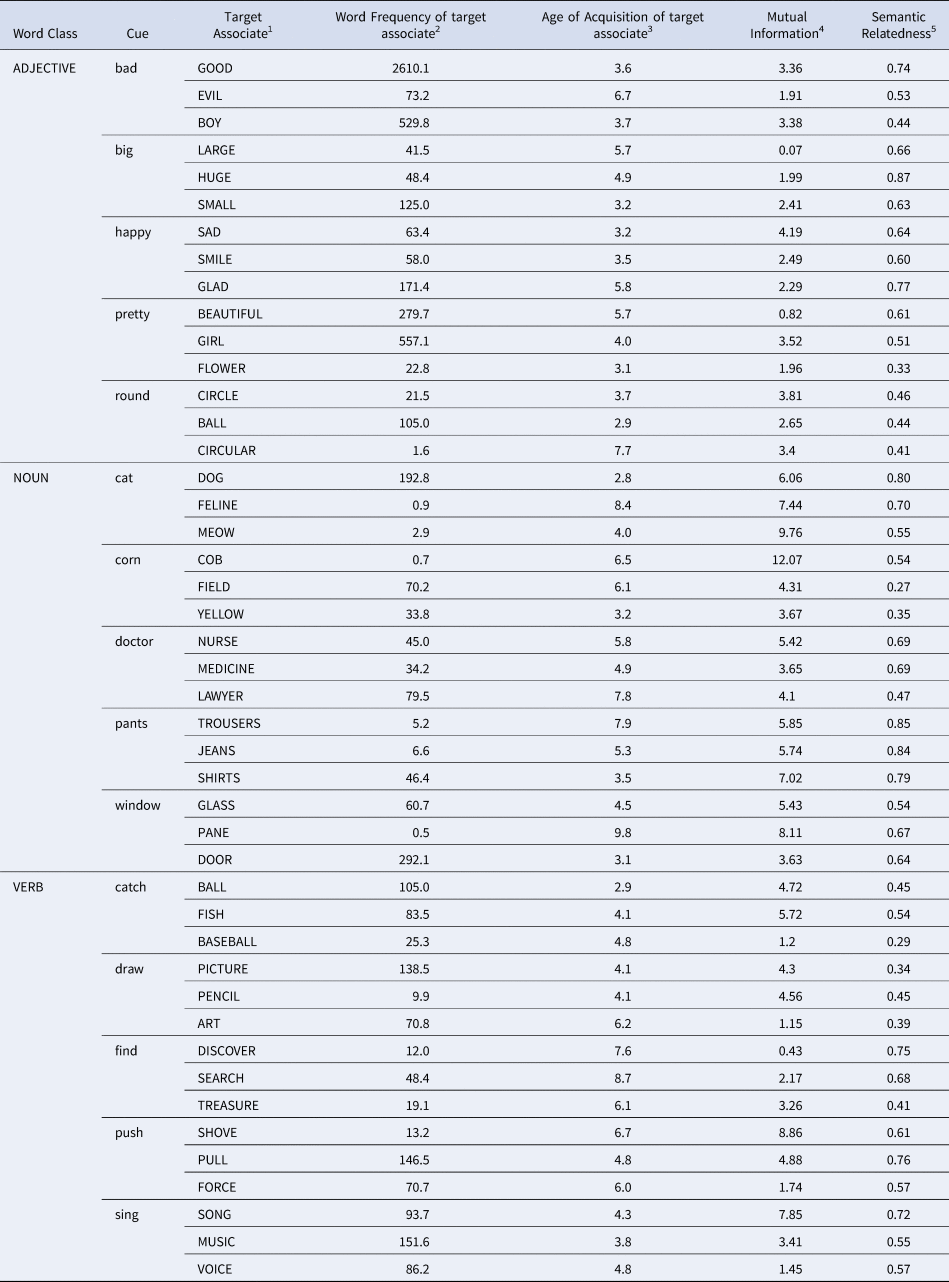
To address the second aim, the top three most predominant associates adults produced for each of the 15 cues for the “Small World of Words” Association Norm (De Deyne et al., Reference De Deyne, Navarro, Perfors, Brysbaert and Storms2019) were compiled as a list of target responses (15 stimulus cues X 3 target associates = 45 target associates in total). Focusing on the top three most predominant responses allows us to effectively achieve our goal of examining factors that predict convergence to associative behaviors that characterizes a language community. To illustrate, for the current cue words, the top three most predominant responses accounted for almost half of the responses produced by adult respondents in the first trial (46.5%), and 30% of the total responses aggregating over the three trials. The top three predominant associates have also been used to define stereotypy in WAT studies (for a review, see Fitzpatrick & Thwaites, Reference Fitzpatrick and Thwaites2020). In contrast, associates produced by few adult participants (e.g., saying “SANTA” for the cue “GOOD”) not only indicate idiosyncrasy but could be erroneous responses less relevant to the goal of the study. Furthermore, focusing on the top three most predominant responses limits the amount of missing data. Specifically, including responses with increasing idiosyncrasy would lead to elevated methodological challenges in locating variables relevant to the analyses, increasing the likelihood of missing data. For example, should we include “SANTA” in the analysis, which was produced by only one adult respondent for the cue “GOOD” according to De Deyne et al. (Reference De Deyne, Navarro, Perfors, Brysbaert and Storms2019), the target would be missing age of acquisition rating because the word was not sampled in the age of acquisition norm (c.f., Kuperman et al., Reference Kuperman, Stadthagen-Gonzalez and Brysbaert2012). Finally, focusing on the top three responses is more advantageous than restricting the analysis to the single, most predominant associates by adults – the latter approach may be too narrow in scope and fail to adequately reflect the breadth of semantic networks. Appendix S1 reported, for each target associate, the age of acquisition obtained from a corpus of 30, 000 English words (c.f., Kuperman et al., Reference Kuperman, Stadthagen-Gonzalez and Brysbaert2012) and word frequency based on 51 million English words (c.f., Brysbaert & New, Reference Brysbaert and New2009).
Appendix S1 also reported distributional properties of word relationships for each cue-associate pair, which were quantified as mutual information (M. I.) and semantic relatedness. M. I. measures the probability of a word pair appearing in proximity (i.e., co-occurrence) whereas semantic relatedness measures the probability of a word pair appearing in similar contexts. M. I. was calculated by log2(P(AB)/P(A)*P(B)), whereas P(AB) is the probability that word A and word B co-occur together in a corpus and P(A) and P(B) are the probabilities of observing A and B independently. The current study used Corpus of Contemporary American English (COCA, a large corpus with 1 billion word tokens; Davies, Reference Davies2008) to calculate M. I. indices of the target word pairs. Semantic relatedness was computed using the GloVe model (Pennington, Socher & Manning, Reference Pennington, Socher and Manning2014), a widely used semantic vector space computational model in natural language processing that measures semantic relatedness between words. GloVe generates word embeddings (i.e., vectors that store contextual information of words that allow computational models to evaluate whether two words appear in similar contexts) and uses a weighted log bilinear regression model to compute the probability that a word appears in the context of the target word (e.g., tea and coffee tend to have a higher semantic relatedness index because they share contexts such as “drink”, “have”, “like”, “hate”, “enjoy”, “a cup of”, “hot”, “ice”, etc. – for additional information about the GloVe model, please refer to Pennington et al., Reference Pennington, Socher and Manning2014). Thus, for the two measures of distributional properties of word relationships, co-occurrence took into account the syntactic association of the word pairs and semantic relatedness considered the contextual association of word pairs.
The 45 target cue-associate pairs were compared against the responses elicited from children. For each child, a target associate was coded as 1 if it was produced in any one of the elicitation trials for the selected cue. Targets not elicited in any of the trials were coded as 0. The coding system was dichotomous (match = 1; mismatch = 0). Repeated responses were counted once only. The analyses applied minimal lemmatization rule that concerned primarily inflectional morphemes that mark the plural forms of nouns (i.e., -s; e.g., gifts → gift).
Analyses
A generalized linear mixed model (GLMER) was conducted in R (R Core Team, Reference R Core2012) using the package lme4 (Bates, Mächler, Bolker & Walker, Reference Bates, Mächler, Bolker and Walker2015) for picture naming performance. The critical dependent variable was children's likelihood to name a target item. The analysis started with language group (English-speaking monolingual children vs. Mandarin–English bilingual children vs. Spanish–English bilingual children), age, and their interaction as fixed effects. English-speaking monolingual children were set as the reference group. Maternal education was included as a covariate.
For WAT, the critical dependent variables for the first aim were (1) non-weighted stereotypy scores, (2) weighted stereotypy scores, and (3) association strength within cue-associate pairs. All analyses used the average scores aggregating over the three elicitation trials because such scores spoke to general levels of WAT performance when multiple opportunities were provided for a cue. The analyses, using linear mixed model (LMER), started with language group, age, and their interaction as fixed effects, similar to the analysis of picture naming performance. Maternal education was included as a covariate. To address the second aim, the critical dependent variable was children's likelihood to produce the 45 target adults’ associates. GLMER analyses started with language group, age, and their interaction as fixed effects, similar to the analyses described above. Co-occurrence (i.e., M. I.) and semantic relatedness of target cue-associate pairs and their interactions with language group were included as fixed effects to examine the influence of distributional properties of word relationships on children's likelihood to produce adult-like responses. Word frequency and age of acquisition of target associates were included in the model to consider their influence on lexical access and convergence in WAT performance (Brysbaert et al., Reference Brysbaert, Van Wijnendaele and De Deyne2000; Fitzpatrick, Reference Fitzpatrick2007; Goh et al., Reference Goh, Yap, Lau, Ng and Tan2016; Meara, Reference Meara1983). Finally, maternal education was included as a covariate. An ad-hoc analysis was performed to examine whether English naming performance predicted children's likelihood to produce adult-like associates.
All continuous variables were centered for analyses. For all analyses, by-participant intercepts, by-item intercepts, and a by-item random slope for group were included in the model as random effects. Models were refined for parsimony by removing, one at a time, factors and interactions that exhibited the highest p-value, while retaining the hierarchical rule of interactions. Likelihood ratio comparisons were performed to confirm that including a given factor did not improve the amount of variance explained (Baayen, Davidson & Bates, Reference Baayen, Davidson and Bates2008). Post-hoc analyses with Tukey's procedure for multiple comparison correction were performed with version 2.3-00 of the lsmeans package (Lenth, Reference Lenth2016).
Results
Picture naming performance
GLMER indicated a language group effect [χ2 (2) = 14.37, p < .001], an age effect [χ2 (1) = 52.75, p < .001], and an effect of maternal education [χ2 (1) = 19.17, p < .001]. The language group X age interaction was not significant (p = 0.68) and was removed from the model. The language group effect showed that English-speaking monolingual children were more likely to name pictures accurately in English than Mandarin–English bilingual children (β = 0.61, SE = 0.18, p < .001) and Spanish–English bilingual children (β = 0.75, SE = 0.23, p < .001). No differences were found between Mandarin–English bilingual children and Spanish–English bilingual children (p = 0.53). The likelihood to name pictures accurately also increased with age (β = 0.05, SE = 0.01, p < .001) and more years of maternal education (β = 0.11, SE = 0.02, p < .001).
Monolingual-bilingual gap in producing adult-like associative behaviors based on non-weighted and weighted stereotypy, and association strength within cue-associate pairs
Non-weighted scores LMER indicated a language group effect [χ2 (2) = 22.85, p < 0.001], an age effect [χ2 (1) = 49.69, p < 0.001], and an effect of maternal education [χ2 (1) = 5.98, p < 0.001]. The language group X age interaction was non-significant (p = 0.25) and was removed from the model. Table 2 showed that English-speaking monolingual children produced more responses that matched with the adults’ association norm than Mandarin–English bilingual children and Spanish–English bilingual children, which was confirmed by the language group effect (English monolingual vs Mandarin–English: β = 0.10, SE = 0.02, p < 0.001; English monolingual vs Spanish–English: β = 0.12, SE = 0.03, p < 0.001). No differences were found between Mandarin–English bilingual children and Spanish–English bilingual children (p = 0.51). One unit increase in age predicts a 0.006 increase in scores (p < 0.001). The non-weighted scores were predicted by maternal education as well – one unit increase in maternal education predicts a 0.007 increase in scores (p < 0.001).
Measures of stereotypy and association strength within cue-associate pair. The measures are derived by comparing child responses to the full set of adult responses to the same cues reported in the “Small World of Words” Association Norm. The scores are derived by aggregating over all responses elicited in three trials. Standard deviations are in the parenthesis.

1 Mono-English: English-speaking monolingual children
2 Bi-Man Eng: Mandarin-English bilingual children; Bi-Spa Eng = Spanish-English bilingual children
3 Non-weighted stereotypy scores are derived by matching child responses against adult responses reported in the “Small World of Words” Association Norm. Responses are scored as “1” (match) or “0” (non-match). An average score of “1” (i.e., score maximum possible) would indicate that all responses produced could be found in the norms list; an average score of “0” indicates none of the responses matches.
4 Weighted stereotypy scores are derived by matching child responses against adult responses reported in the “Small World of Words” Association Norm. Responses are scored as “2” (match and among the top three most predominant response in the norms list), “1” (match but out of the top three most predominant response in the norms list), and “0” (non-match). An average score of “2” (i.e., score maximum possible) would indicate a participant produces only the most predominant responses found in the norms list.
5 Association strength of cue-associate pair is obtained from the “Small World of Words” Association Norm. The measure provides detailed information about the number of adult participants giving a specific response when prompted with a cue and thus the conditional probability with which a response is triggered by a selected cue.
Weighted scores
LMER indicated a language group effect [χ2 (2) = 13.55, p = 0.001], an age effect [χ2 (1) = 34.56, p < 0.001], and an effect of maternal education [χ2 (1) = 4.51, p = 0.034]. The language group X age interaction was non-significant (p = 0.36) and was removed from the model. The language group effect showed that English-speaking monolingual children produced more responses that matched with the adults’ association norm than Mandarin–English bilingual children (β = 0.15, SE = 0.05, p = 0.005) and Spanish–English bilingual children (β = 0.12, SE = 0.04, p = .009) when prototypicality was considered as well. No differences were found between Mandarin–English bilingual children and Spanish–English bilingual children (p = 0.56). One unit increase in age predicts a 0.011 increase in scores (p < 0.001). The weighted scores were predicted by maternal education as well – one unit increase in maternal education predicts a 0.012 increase in scores (p = 0.038).
Association strength within cue-associate pairs
LMER indicated a language group effect [χ2 (2) = 10.67, p < 0.001], an age effect [χ2 (1) = 46.19, p < 0.001], and a marginal effect of maternal education [χ2 (1) = 3.73, p = 0.054]. The language group X age interaction was non-significant (p = 0.47) and was removed from the model. The language group effect showed that English-speaking monolingual children produced stronger cue-associate pairs than Mandarin–English bilingual children (β = 0.006, SE = 0.002, p = 0.001) and Spanish–English bilingual children (β = 0.008, SE = 0.003, p = .001). No differences were found between Mandarin–English bilingual children and Spanish–English bilingual children (p = 0.30). One unit increase in age predicts an 0.0004 increase in association strength within a cue-associate pair (p < 0.001). The marginal effect of maternal education suggests more years of maternal education would predict the production of associate with stronger association strength as well (β = 0.0006, SE = 0.0002, p = 0.059).
Monolingual-bilingual gap in producing the top three more predominant associates of the “Small World of Words” Association Norm
Table 3 showed that 15.1% of monolingual children's responses matched with the adult-like target associates, which were numerically greater than both Mandarin–English bilingual children (12.4%) and Spanish–English bilingual children (9.4%). Table 3 additionally reported percentage match of children and adult responses separated by word classes, which showed that monolingual children produced more target associates than bilingual children for all word classes.
Percentage of child word association responses matching the top three most predominant associates adults produced to the same cues reported in the “Small World of Words” Association Norm. Number of matching responses and total number of responses are presented in parentheses.

1 Mono-English: English-speaking monolingual children
2 Bi-Man Eng: Mandarin-English bilingual children; Bi-Spa Eng = Spanish-English bilingual children
Note: The total number of responses is different between groups due to different number of participants in each group.
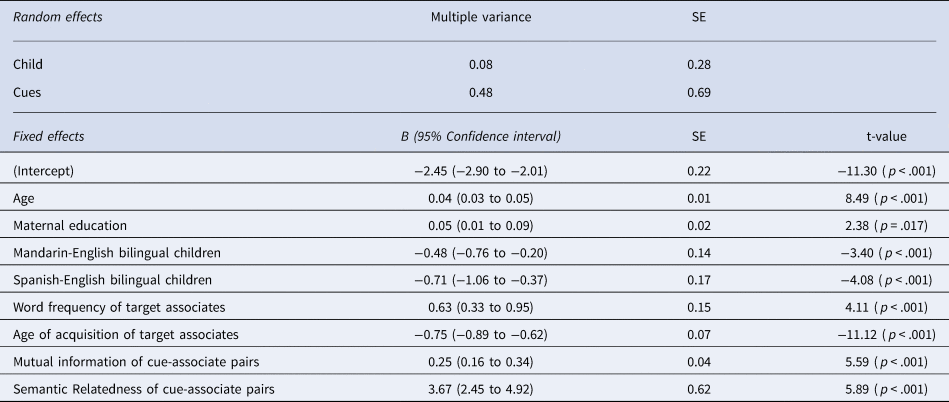
Model comparison confirmed a language group effect [χ2 (2) = 19.05, p < 0.001] and an age effect [χ2 (1) = 58.67, p < 0.001]. The language group X age interaction was not significant (p >0.90) and was removed from the model. The monolingual children were more likely to produce adult-like target associates than Mandarin–English bilingual children (β = 0.48, SE = 0.14, p < 0.001) and Spanish–English bilingual children (β = 0.71, SE = 0.17, p < 0.001) (see Table 4). The two bilingual groups did not differ from each other (p = .898). An ad-hoc analysis showed that English naming performance predicted children's likelihood to produce adult-like associates [χ2 (1) = 5.36, p = 0.02]. One unit increase in English vocabulary breadth indexed by picture naming performance was associated with a 0.02 higher likelihood to produce adult-like associates (p = 0.02), with the language group effect continuing to be significant when English naming was in the model (p = 0.002). Finally, one unit increase in age was associated with a 0.04 higher likelihood to produce adult-like associates (p < 0.001). Maternal education improved the model as well [χ2 (1) = 5.48 p = 0.019] – one unit increase in maternal education was associated with a 0.05 higher likelihood to produce adult-like associates (p < 0.001).
Output of the best-fit generalized linear-mixed effects model on children's likelihood to produce adult-like associates in free word association task. English-speaking monolingual children are set as the reference level.

The effects of co-occurrence and semantic relatedness on the likelihood to produce the top three more predominant associates of the “Small World of Words” Word Association Norm
Analyses further indicated the effects of distributional properties of word relationships [M. I.: χ2 (1) = 32.23, p < .001; semantic relatedness: χ2 (1) = 34.23, p < .001]. One unit increase in M. I. was associated with a 0.25 higher likelihood to produce adult-like associates (p < 0.001). Similarly, one unit increase in semantic relatedness was associated with a 3.67 higher likelihood to produce adult-like associates (p < 0.001). Neither factor interacted with language groups (range of p values = 0.25 to 0.39), and the interactions were removed from the model. The likelihood was also predicted by age of acquisition [χ2 (1) = 148.91, p < .001] and word frequency of the target associates [χ2 (1) = 17.22, p < .001]. Adult-like associates were more likely to be produced by children if the target words were acquired earlier (β= −0.75, SE = 0.07, p < .001) and occur more frequently (β = 0.64, SE = 0.15, p < .001).
Item analysis
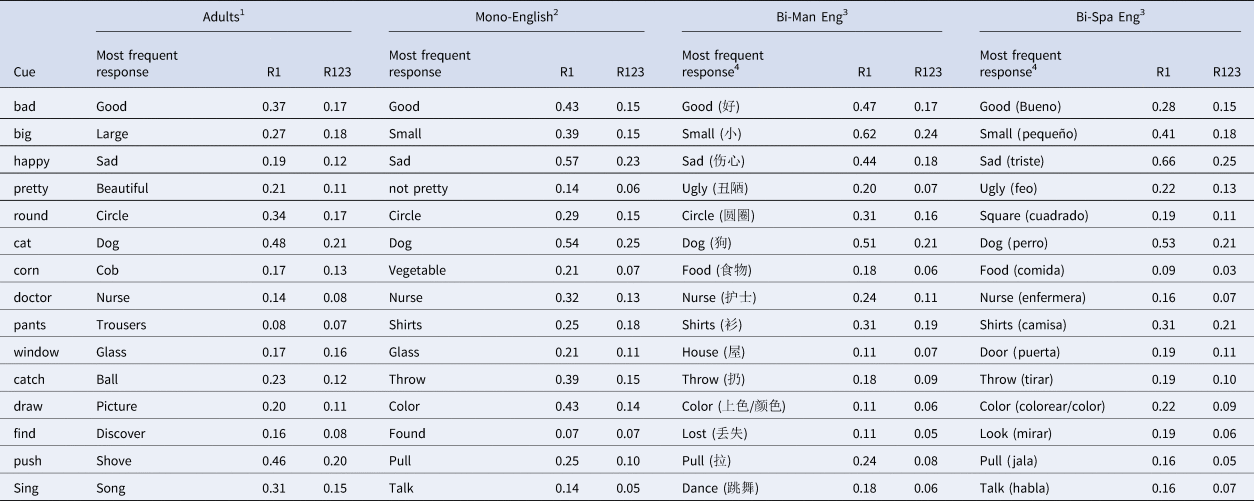
An item analysis was performed to examine the extent to which the three groups differed in the most predominant associates they produced for each cue (see Table 5). The analysis showed that nine out of 15 cues elicited the same most predominant associate from the three groups. These cues are evenly distributed across adjectives (bad, big, happy), nouns (cat, doctor, pants), and verbs (catch, draw, push). The most predominant associates elicited from children also matched the most predominant associates produced by adult respondents for two adjectival cues (bad, happy) and nominal cues (cat, doctor).
Summary of the most predominant associate for each cue produced by adult respondents reported in the “Small World of Words” Association Norm and child participants in this study. The table reports the proportion of participants producing the associates.

1 Adult native English speakers’ data based on the “Small World of Words” Association Norm (De Deyne et al., Reference De Deyne, Navarro, Perfors, Brysbaert and Storms2019)
2 Mono-English: English-speaking monolingual children
3 Bi-Man Eng: Mandarin-English bilingual children; Bi-Spa Eng = Spanish-English bilingual children Chinese and Spanish translational equivalents are provided in parenthesis
Discussion
Semantic convergence in WAT indicates integration with the target language community. This study examined the monolingual-bilingual gap in children regarding their abilities to produce adult-like associative behaviors with three scoring methods, using an English WAT norm that is the most recent and largest of its kind. Based on the same norms list, the study also located the most predominant associates adults produced for the same cues and investigated the effects of distributional properties of word relationships on children's likelihood to produce these adults’ targets in WAT. There were three findings. First, monolingual-bilingual gaps in producing adult-like associative behaviors were found in Mandarin–English and Spanish–English bilingual children, regardless of scoring methods. Second, both co-occurrence and semantic relatedness predicted children's likelihood to produce the adult-like associates. None of the effects interacted with bilingualism. Finally, children's likelihood to produce adult-like associates was influenced by multiple factors besides bilingualism and distributional properties of word relationships, which included maternal education, and age of acquisition and word frequency of the target associates.
The monolingual-bilingual gap in producing adult-like associative behaviors
Previous WAT studies focused on the qualitative aspect of cue-associate relationships (e.g., Cremer et al., Reference Cremer, Dingshoff, de Beer and Schoonen2011; Holmström et al., Reference Holmström, Salameh, Nettelbladt and Dahlgren-Sandberg2016; Namei, Reference Namei2004; Sheng et al., Reference Sheng, McGregor and Marian2006; Spätgens & Schoonen, Reference Spätgens and Schoonen2020) and generated inconsistent results about bilingual (dis)advantages in WAT assessment in children. Note that questions have been raised regarding scoring methods devised for qualitative analyses (e.g., paradigmatic vs. syntagmatic responses). For example, though paradigmatic associates are typically deemed as more advanced than syntagmatic associates and indicate maturation of the lexical-semantic system, previous work highlights the existence of late-acquired syntagmatic relationships that are produced by a significant number of adult native speakers in WAT as well (Lam & Sheng, Reference Lam and Sheng2020b; Nissen & Henriksen, Reference Nissen and Henriksen2006). This study showed that stereotypy scoring methods with direct response matching common in WAT studies (see Fitzpatrick et al., Reference Fitzpatrick, Playfoot, Wray and Wright2015 for a review) would reveal a bilingual disadvantage, regardless of whether the prototypicality of the associates was additionally considered.
Different scoring methods used in evaluating WAT performance may tap into the distinct dimensions of semantic abilities. Compared to qualitative analyses of cue-associate relationships, the direct matching methods adopted in measures of stereotypy and association strength (i.e., the conditional probability to trigger selected responses given a cue) exhibit a much-elevated specificity for target responses. As a result, the direct matching analyses likely tap into the size of language-specific vocabulary, which has been consistently shown to be smaller in bilingual children as compared to monolingual children in single-language testing (e.g., Bialystok, Reference Bialystok2009; Gross et al., Reference Gross, Buac and Kaushanskaya2014). This study shows that the monolingual–bilingual gap in semantic convergence does not decrease with age in children of 4- to 7-year-olds. Reduced language input associated with bilingualism would lead to fewer opportunities (Gollan et al., Reference Gollan, Montoya, Cera and Sandoval2008; Sandoval et al., Reference Sandoval, Gollan, Ferreira and Salmon2010) to learn language-specific lexical forms and word relationships. The gaps in the language-specific mental lexicon and weakened connectivity between words would likely lead to a lower likelihood to produce adult-like associative behaviors in the testing language. The relatively stable monolingual-bilingual gap between 4- and 7-years of age highlights the importance of language-specific experience to semantic convergence in young children.
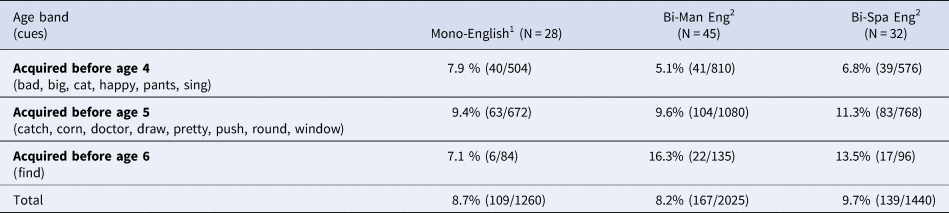
Spanish–English and Mandarin–English bilingual children performed comparably on WAT despite differences in language backgrounds when maternal education was controlled. The results highlight a general lag in semantic convergence in bilingual children in WAT when performance assessment attends to whether children would produce the same responses adults would produce for the same cues. Note that we selected early acquired cues with an aim to capture associative behaviors in young children – six cues were perceived to be acquired before age 4, eight before age 5, and only one before age 6 (c.f. Kuperman et al., Reference Kuperman, Stadthagen-Gonzalez and Brysbaert2012). Still, some children might not have known certain cue words due to individual differences in vocabulary abilities and, as a result, responded with “I don't know” (DK) or did not respond at all (NR). We performed a descriptive analysis on the amount of DK and NR based on the three age bands of cues (i.e., cues acquired before age 4 vs. age 5 vs. age 6; Appendix S2). For English-speaking monolingual children, the proportion of “DK/NR” remained relatively consistent across the three age bands of cues (7.1 to 9.4 % of total responses). In contrast, both bilingual groups showed comparable and steady increases in the proportion of “DK/NR” (Mandarin–English bilinguals: 5.1%, 9.6%, and 16.3% for cues acquired before age 4, age 5, and age 6 respectively; Spanish–English bilinguals: 6.8%, 11.3%, and 13.5% for cues acquired before age 4, age 5, and age 6 respectively). The differences between monolingual and bilingual children are not likely due to the differences in abilities understanding and completing the task – WAT has been used successfully in monolingual and bilingual children of a comparable range of age (Holmström et al., Reference Holmström, Salameh, Nettelbladt and Dahlgren-Sandberg2016; Sheng et al., Reference Sheng, McGregor and Marian2006). Furthermore, the three language groups in the present study produced a comparable proportion of “DK/NR” for cues acquired before age 4. The increasing proportion of “DK/NR” for later-acquired cues in both bilingual groups may reflect decreased familiarity with these cues, affecting children's abilities to produce even associates that are remotely related to the cues, such as responses sharing phonological forms (e.g., FIND-fine; Namei, Reference Namei2004).
Previous studies showed effects of cross-linguistic differences in tasks that targeted specific language features, such as cognates (Sheng et al., Reference Sheng, Lam, Cruz and Fulton2016) and derivational word formation rules (Lam & Sheng, Reference Lam and Sheng2016). In contrast, tasks measuring the general levels of conceptual development may be more likely to reveal similarities across bilingual groups. Lam and Sheng (Reference Lam and Sheng2020a) measured taxonomic awareness with category and contrast association tasks and showed comparable coordinate awareness in Mandarin–English and Spanish–English children despite differences in heritage language features. The consistent monolingual-bilingual gap in producing adult-like associates for both bilingual groups in the current study suggests that, like the coordinate awareness task in Lam and Sheng (Reference Lam and Sheng2020a), WAT may be relatively linguistically neutral compared to other vocabulary tasks.
Factors predicting children's likelihood to produce adult-like associates
The development of semantic convergence is multifaceted in nature. Age is a powerful factor because it encapsulates multiple effects that may influence semantic convergence, such as the development of cognitive capacity to categorize world experience, expansion of linguistic abilities, and accumulation of language experience. The study showed that the distributional properties of word relationships additionally predicted semantic convergence in children's WAT performance beyond age. The lack of interaction with bilingualism suggests monolingual and bilingual children may exhibit comparable sensitivities to tightly connected word pairs despite differences in the amount of cumulative language input. An analysis of naturalistic child-direct speech showed that language input provides rich statistical regularities of word relationships, which support the development of abstract and structured semantic knowledge in computational neural network (Huebner & Willits, Reference Huebner and Willits2018). Toddlers (Wojcik & Saffran, Reference Wojcik and Saffran2015) and young children of 4 –5-year-olds (Unger, Savic & Sloutsky, Reference Unger, Savic and Sloutsky2020) have been shown to be sensitive to co-occurrence information of words, which in turn influences the development of lexical-semantic organization (Unger et al., Reference Unger, Savic and Sloutsky2020) and the formation of word associations.
Both co-occurrence and semantic relatedness predicted semantic convergence. Co-occurrence refers to words bounded by close temporal proximity, which is sometimes addressed as first-order distributional statistics in computational corpus-based studies (Rapp, Reference Rapp2002). The effects of co-occurrence on connectivity strengthening may not be constrained to actual usages of words. Once association between two objects is established upon being experienced together, thinking of an object likely triggers the connected counterpart in covert mental processes (Wettler et al., Reference Wettler, Rapp and Sedlmeier2005). Sloutsky, Yim, Yao, and Dennis (Reference Sloutsky, Yim, Yao and Dennis2017) further suggested that experiential learning of the statistics of co-occurrences (e.g., LION-ZOO) may not only lead to learning of syntagmatic relationships but also facilitate the development of paradigmatic relationships, which signify the development of a mature lexical-semantic system. Accumulation of co-occurrence information of different word pairs (e.g., LION-ZOO; ZEBRA-ZOO; ANIMAL-ZOO) may allow children to discover and link words that exhibit similar syntagmatic associations. Interestingly, in a study comparing computational model of word associations to actual human performance (Wettler et al., Reference Wettler, Rapp and Sedlmeier2005), co-occurrence information derived from corpus predicted not only syntagmatic associates but also paradigmatic associates in WAT. Sloutsky and colleagues’ hypothesis suggests a linkage between co-occurrence and semantic relatedness – the accumulation of co-occurrence statistics may facilitate the explorations of semantic relatedness between word pairs. However, note that understanding of semantic relatedness may tap into more advanced linguistic-cognitive abilities because this distributional property speaks to patterns of word usages across sentences. Indeed, Wojcik and Saffran (Reference Wojcik and Saffran2015) found that encoding of word meanings might be facilitated by positional similarities across sentences in children as young as 2-year-olds but only in those with advanced grammar abilities. Future studies may examine the extent to which co-occurrence and semantic relatedness differ in their effects on semantic convergence, which is beyond the scope of this study. Nevertheless, findings from this study highlight the important role of experience to the distributional properties of language input in the development of lexical-semantic relationships.
Significant evidence highlights the effects of age of acquisition and word frequency on lexical access (for a review, see Goh et al., Reference Goh, Yap, Lau, Ng and Tan2016) – words acquired earlier or used more frequently are processed faster with improved accuracy. These two lexical factors also influence semantic convergence (Brysbaert et al., Reference Brysbaert, Van Wijnendaele and De Deyne2000; de Groot, Reference de Groot1989; Meara, Reference Meara1983). Findings from this study extend previous work that focused on the lexical features of the cues to the target associates. The findings that both lexical features predicted children's likelihood to produce the target associates show that word frequency may not be an age-of-acquisition effect in disguise (for a review, see Brysbaert et al., Reference Brysbaert, Van Wijnendaele and De Deyne2000).
Maternal education, which relates to levels of sophisticated word usage (Weizman & Snow, Reference Weizman and Snow2001), influences the quantity and quality of children's lexical-semantic experience. Maternal education predicts vocabulary development in children (Pan, Rowe, Singer & Snow, Reference Pan, Rowe, Singer and Snow2005) and influences children's understanding of word relationships within semantic categories (Sheng & Lam, Reference Sheng and Lam2015). The present study shows that maternal education impacts the stereotypy and association strength scores of children's associates in analyses considering all adults’ responses. The study also shows the effects of maternal education on children's likelihood to produce the most predominant adult responses. Mothers with more years of education may be more adept at highlighting similar semantic properties of objects and the relationship between concepts in engaging discourse, which improves the effectiveness in infusing children with a rich lexical-semantic experience that represents the larger language community. Improved effectiveness in concept elaborations may help children grasp how and why two concepts semantically relate, reinforcing the semantic network and the activation of related concepts given a cue. Increased frequency of communicative interactions between parents and children associated with higher social-economic status (Hart & Risley, Reference Hart and Risley1995) may result in more exposures to distributional properties of word relationships, which may highlight the co-occurrence and semantic relatedness of word pairs in sentence contexts. Finally, the relationship between maternal education and semantic convergence may reflect the demographic properties of the adult respondents sampled in De Deyne et al. (Reference De Deyne, Navarro, Perfors, Brysbaert and Storms2019). Since most of the adult participants in the norm had at least a college degree, the mothers with more years of education in our study may influence their children in a way that they responded more similarly to the norming population.
The significant differences in responses produced by adults and children are expected, given the young age of the child participants of the study. Item analyses highlight significant differences between adults and children even for the responses that are the most frequently produced by each group. The most predominant cue-associate pairs produced by the three child groups (see Table 5) were identical for 60% of the cues (adjectives: bad-good, big-small, happy-sad; nouns: cat-dog, doctor-nurse, pants-shirt; verbs: catch-throw, draw-color, push-pull). The two bilingual groups were similar for two additional cue-associate pairs (pretty-ugly; corn-food). These single, most predominant responses accounted for 25 to 30% of responses children produced in the first trial, and 11 to 13% of the total number of responses when aggregating the three elicitation trials. In contrast, children and adults matched on only four out of these most frequently produced associates (bad-good, happy-sad, cat-dog, doctor-nurse). The significant discrepancies between children and adults cannot be explained by the age of acquisition of these associates – some of the frequent adult responses are perceived to be acquired before age 4 (e.g., ball) and yet are still found to be less common in children's WAT responses. Interestingly, the “catch-ball” pair commonly produced by adults would be classified as a syntagmatic relationship, which is less mature than “catch-throw” commonly produced by children that exhibits a paradigmatic relationship. Findings from this preliminary item analysis suggest additional effects on semantic convergence beyond bilingualism and distributional properties between words that are beyond the scope of the study. For example, an elevated likelihood for children to produce the more “mature” associate for the cue “catch” may result from the effects of pedagogy (e.g., verbs are taught systematically in themes of action words, such as catch vs. throw), while adults’ performance may be influenced by personal orientation (e.g., baseball is a popular sport in the United States).
Limitations
This study does not aim at teasing apart the effects of semantic relatedness and co-occurrence on WAT performance. As suggested above, co-occurrence and semantic relatedness may exhibit a dynamic relationship (Gruenenfelder, Recchia, Rubin & Jones, Reference Gruenenfelder, Recchia, Rubin and Jones2016; Playfoot et al., Reference Playfoot, Balint, Pandya, Parkes, Peters and Richards2018) – connectivity is stronger for semantically-related words that are more likely to co-activate in lexical tasks and daily encounters (Collins & Loftus, Reference Collins and Loftus1975). Future studies might manipulate co-occurrence and semantic relatedness of target cue-associate pairs orthogonally to better understand the impacts of distributional properties of word relationships on children's WAT performance.
We derived distributional properties of word relationships and lexical-semantic properties of adults’ targets based on established, adult-oriented corpora and rating norms. On the one hand, obtaining these variables based on child-directed language databases (e.g., The Child Language Data Exchange System) may provide additional insights about children's assimilation to the ambient language environment. On the other hand, though child-directed language facilitates language acquisition (e.g., Newport, Gleitman & Gleitman, Reference Newport, Gleitman, Gleitman, Snow and Ferguson1977), restricting analyses to child-directed language databases may exclude meaningful forms of language input to which children are exposed – such as adult conversations that children overhear, and TV programs broadcasting in the background at home. One aim of this study was to explore the relationships between children's WAT performance and general patterns of language usages that represent the English communities. The significant effects of the distributional and lexical-semantic variables derived from adult-oriented corpora and norms found in this study suggest children's WAT behaviors may be influenced by factors external to the immediate child-directed environment. The findings may also suggest general social-cognitive principles shared among children and adults that drive the conventionality of language usages (e.g., “happy” and “sad” are two opposite ends of the emotional continuum and, therefore, are strongly associated in children and adults). Future studies are needed to evaluate the extent to which child-directed language input contributes to semantic convergence.
The study is limited by difference in maternal education among children, with lowered maternal education for Spanish–English bilingual children. The importance of maternal education is recognized in our findings and studies of other dimensions of semantic abilities, such as taxonomic awareness (Lam & Sheng, Reference Lam and Sheng2020a; Sheng & Lam, Reference Sheng and Lam2015). We performed ad-hoc analyses with maternal education removed from the model. The primary findings of the study hold with such analyses – the monolingual-bilingual gap in producing adult-like associative behaviors is evident in Mandarin–English bilingual children and Spanish–English bilingual children, suggesting a bilingual effect on semantic convergence that generalizes across children speaking different language pairs. The ad-hoc analyses further showed that Spanish–English bilingual children produced fewer adult-matching associates in WAT and named fewer pictures accurately than Mandarin–English bilingual children, when maternal education was not considered. In summary, these findings emphasize the general effects of bilingualism and highlights the additional impacts of maternal education on semantic convergence.
Conclusion
This study demonstrates the multi-faceted nature of semantic convergence development in young monolingual and bilingual children. WAT performance reflects language experience and the acquisition of distributional properties of word relationships based on language environment. The likelihood for children to produce adult-like associates was found to be influenced by the experiential factors (e.g., bilingualism, maternal education), the developmental factor (i.e., age), the distributional properties of word relationships (i.e., co-occurrence, semantic relatedness), and the inherent properties of target associates (age of acquisition, word frequency). A consistent monolingual-bilingual gap in the adult-likeness of children's responses was evident for young children between the ages of 4 years and 7 years. Despite significant differences in language backgrounds (e.g., Spanish vs. Mandarin; monolinguals vs. bilinguals), the distributional properties of word relationships exerted a general effect on children's abilities to mirror adult's associative behaviors.
Acknowledgements
This project was supported by a fellowship from the National Academy of Education and the Spencer Foundation to the second author. The authors thank the participants for volunteering their time and Diana Cruz, MaryAnn Flores, Aislynn Fulton, Andrea Hinnen, Fang Li, Ashley Pina, Brittany Rasansky, Ruei-An Shen, and other members of the Language Learning and Bilingualism Laboratory for assistance with stimulus design, data collection, and data analyses.
Appendix S1. Summary of the lexical-semantic features of the 45 most predominant adult respondents of produced for the “Small World of Words” Association Norm for 15 cues. The most predominant associates are defined as responses that are the most frequently produced when examining all responses produced in three consecutive elicitations.

Appendix S2. The percentage of “I don't know (DK)” or “no responses (NR)” in the word association task performed by child participants. The 15 cues in the present study are divided into three age bands (i.e., cues acquired before age 4, age 5, and age 6). Number of DK/NR and total number of responses are presented in parentheses.