Post-operative arrhythmias after CHD surgery are common, Reference Valsangiacomo, Schmid and Schüpbach1–Reference Hoffman, Wernovsky and Wieand3 and are associated with increased morbidity and mortality. Reference McFerson, McCanta and Pan4–Reference Mah, Cheng and Alexander6 Although a number of patient-specific baseline features as well as peri- and post-operative variables have been associated with the development of post-operative arrhythmias, Reference Valsangiacomo, Schmid and Schüpbach1,Reference Grosse-Wortmann, Kreitz and Grabitz2,Reference Fuchs, Smith, Van Driest, Crum, Edwards and Kannankeril5,Reference Delaney, Moltedo, Dziura, Kopf and Snyder7–Reference OʼConnor, Smith, Crum, Edwards and Kannankeril9 modifiable patient-specific variables have not yet been identified in the CHD population. In adults undergoing cardiac surgery, obesity has been associated with new post-operative paroxysmal atrial fibrillation. Reference Zacharias, Schwann, Riordan, Durham, Shah and Habib10–Reference Phan, Khuong, Xu, Kanagaratnam and Yan12 The spectrum of arrhythmia substrates and co-morbidities after CHD surgery are quite different than that seen in adults. We therefore investigated the impact of obesity on arrhythmias after CHD surgery in a large cohort of children and young adults with prospective arrhythmia surveillance.
Methods
Study Population
The patients included in the present analysis were enrolled in an ongoing prospective, observational study. Reference Fuchs, Smith, Van Driest, Crum, Edwards and Kannankeril5 All patients undergoing congenital heart surgery at Monroe Carell, Jr. Children’s Hospital at Vanderbilt, and subsequently admitted to the paediatric cardiac ICU from September 2007 to November 2019 were prospectively approached for enrolment. From this larger group, all patients ≥2 years of age were included in the current study. The Vanderbilt University Medical Center Institutional Review Board approved the present study. Patient’s parents or legal guardians provided written informed consent, and patient assent/consent was obtained as age appropriate.
Data Collection
Continuous telemetry monitoring was performed in all patients from the time of cardiac surgery until discharge from hospital, the next surgical procedure if performed before discharge, or death. Research study personnel reviewed these telemetry recordings daily, and arrhythmias were prospectively identified and then confirmed or coded by paediatric electrophysiologists. Arrhythmias were classified as tachyarrhythmia (atrial, junctional, other supraventricular, or ventricular) or bradyarrhythmia (sinus bradycardia, complete atrioventricular block, and other atrioventricular block); full arrhythmia definitions are outlined in Supplementary Table S1. Arrhythmias occurring in the operating room were included only if they remained sustained at the time of admission to the ICU. Post-operative recurrences of arrhythmias that had occurred pre-operatively were excluded. Arrhythmias were coded with respect to duration, mechanism, and any associated therapy. Treatment decisions were made at the discretion of the clinical teams. Arrhythmia treatment included the following: antiarrhythmic medication, cardioversion, defibrillation, pace termination, temporary pacing, permanent pacing, implantable cardioverter-defibrillator placement, cardiopulmonary resuscitation, or cannulation to extracorporeal membrane oxygenation support. Sinus bradycardia was only included when judged to contribute to a low cardiac output state.
Height and weight at the time of surgery were used to calculate body mass index (kg/m2). Patients aged 2–20 years were then categorised into one of the following four body mass index categories by body mass index percentile for age and sex: underweight <5th, normal 5–85th, overweight 85–95th, and obese >95th percentile. Patients aged >20 years were categorised using absolute body mass index: underweight <18.5, normal 18.5–25, overweight 25–30, and obese >30 kg/m2. Additional baseline demographic variables as well as peri- and post-operative variables were collected, including cardiopulmonary bypass and aortic cross-clamp times, and vasoactive–inotropic score Reference Gaies, Gurney and Yen13 (maximum score in first 48 hours post-op as well as score at 48 hours post-op). STAT scores are a tool developed by The Society of Thoracic Surgeons-European Association for Cardio-Thoracic Surgery to analyse the risk for mortality associated with congenital heart surgery. Reference Jacobs, Jacobs and Maruszewski14 Ranging from 1 to 5 (low to high complexity), these scores were also recorded in this study to account for surgical complexity and its potential relationship with post-operative arrhythmias.
Statistical analysis
Continuous variables are reported as the mean (standard deviation) for normally distributed data or median (interquartile range) for non-normally distributed data. Categorical variables are reported as frequencies with percentages. The demographic and clinical data were compared using the Mann–Whitney U test for continuous variables and the chi-square or Fisher’s exact test, as appropriate, for categorical variables. Univariate analysis was used to investigate the association of covariates on the development of arrhythmia using Student’s t-test. Multivariate logistic regression using any arrhythmia as the outcome was performed with body mass index category (each category referenced to normal weight) and other covariates that were chosen a priori given previously described associations with post-operative arrhythmias (vasoactive–inotropic scores, cardiopulmonary bypass duration, and cross-clamp duration). A post hoc analysis was performed examining arrhythmia incidence by body mass index category stratified by age quartiles. Data were analysed using SPSS for Windows version 26.0 (IBM Corporation, Armonk, NY).
Results
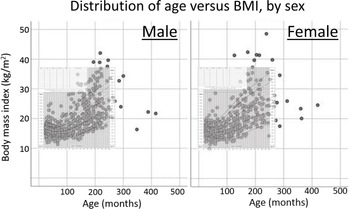
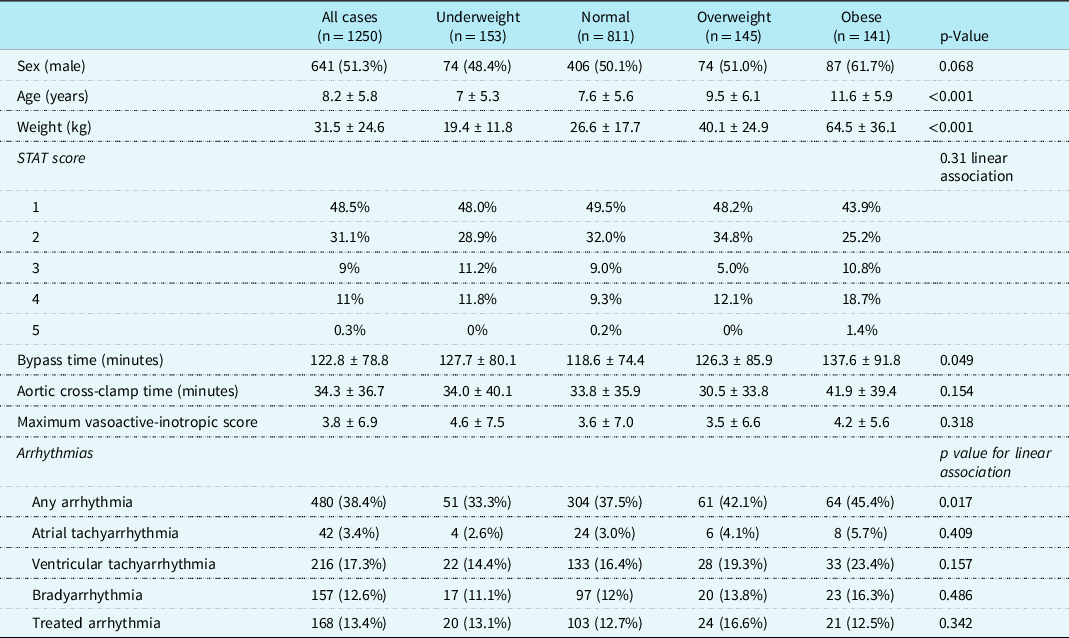
There were 1250 operative cases: 12% of patients were underweight, 65% normal weight, 12% overweight, and 11% obese. Table 1 details additional demographics, with covariates stratified by patient body mass index category: underweight, normal, overweight, and obese. The overweight + obese cohorts had longer cardiopulmonary bypass times and underwent higher complexity operations (15.7% overweight/obese with STAT score >3 compared to 9.8% underweight/normal, p = 0.024 between body mass index categories across all STAT scores). Most common congenital heart diagnoses and operations in the cohort are summarised in Supplementary Table S2. Even though assignment of body mass index category by body mass index percentile accounts for age and sex, the relationship between these covariates was further explored by plotting age against body mass index separately for males and females, and then overlaying those distributions on body mass index percentile curves by sex (Fig 1). These scatter plots did qualitatively suggest a wider range of body mass index above the 97%ile in older patients, a pattern corroborated by the observation that 50% of the obese patients were in the oldest age quartile.
Distribution of age versus body mass index, by sex.

Baseline demographics

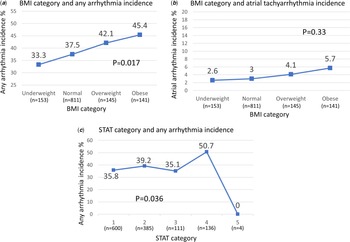
Post-operative arrhythmias were observed in 38% of all operative cases. Univariate analysis showed absolute body mass index was significantly higher in those with arrhythmias as compared to those without arrhythmia (18.8 kg/m2 versus 17.8, p = 0.003). Figure 2a shows the linear relationship between body mass index category and incidence of any arrhythmia: underweight 33%, normal 38%, overweight 42%, and obese 45% (p = 0.017 for trend). A similar linear trend was seen for atrial tachyarrhythmia (Fig 2b) as well as ventricular tachyarrhythmia and bradyarrhythmia. However, in the context of smaller sample numbers, none of these latter trends were statistically significant (Table 1). Figure 2c demonstrates a similar trend of increasing arrhythmia incidence across increasing STAT scores; the low number of STAT 5 cases likely explains the decreased arrhythmia incidence in that group. In contrast to the above arrhythmia subtypes, there was no association between treated arrhythmia and body mass index category (Table 1). Given the potential for interaction between age and body mass index category, incidence of “any arrhythmia” was re-analyzed by age quartile. This showed the body mass index–arrhythmia effect to be largest in the youngest age quartile (24–40 months), with incidence across body mass index categories including 41% of underweight patients, 38% of normal weight, 70% of overweight, and 53% of obese individuals (p = 0.025, Supplementary Table S3).
( a ) Body mass index category and any arrhythmia incidence. ( b ) Body mass index category and atrial tachyarrhythmia incidence. ( c ) STAT category and any arrhythmia incidence.

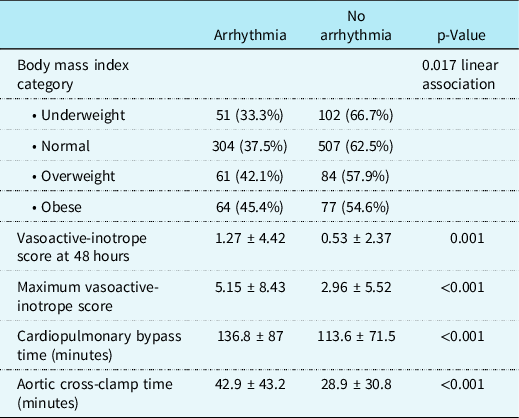
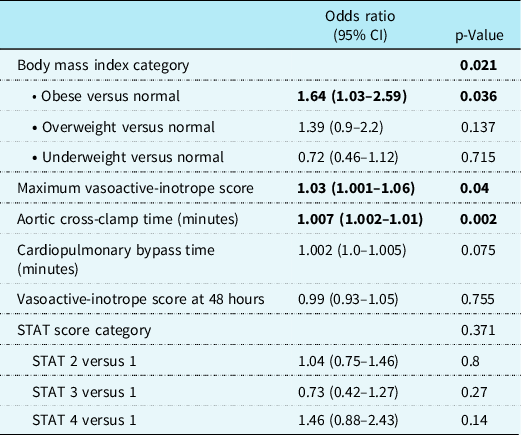
Additional univariate analyses are shown in Table 2, with any post-operative arrhythmia correlating with both higher vasoactive inotrope scores (both maximum and at 48 hours) and longer surgical duration (cross-clamp time and cardiopulmonary bypass time). Covariates included in the multivariate analysis of any arrhythmia end point were body mass index category (as referenced to normal weight), vasoactive inotrope score (both maximum in the first 48 hours as well as at 48 hours post-op), cardiopulmonary bypass time, aortic cross-clamp time, and STAT category (as referenced to STAT 1) (Table 3). Body mass index category remained significantly associated with post-operative arrhythmia (p = 0.021), with an odds ratio of 1.64 in obese patients as compared to normal weight (95% CI 1.03–2.59, p = 0.036). The odds ratio for overweight patients as compared to normal-weight patients was not statistically significant, nor was normal-weight patients as compared to underweight patients. Maximum vasoactive inotrope score (OR 1.03 with 95% CI 1.001–1.06, p = 0.04) and aortic cross-clamp time (OR 1.007 with 95% CI 1.002–1.01, p = 0.002) were also associated with post-operative arrhythmia in multivariate analysis; vasoactive score at 48 hours post-op, cardiopulmonary bypass time and STAT scores were not significant in the multivariate model. Univariate and multivariate analyses were also performed for post-operative-treated arrhythmias, as detailed in Supplementary Tables S4 and S5.
Any post-operative arrhythmia: univariate analysis.

Any post-operative arrhythmia: multivariate analysis.

Bold text highlights those variables which remained significant in multivariate analysis.
Discussion
Prior investigations have identified consistent peri- and early post-operative variables that impact the risk of post-operative arrhythmia following CHD surgery, Reference Valsangiacomo, Schmid and Schüpbach1,Reference Grosse-Wortmann, Kreitz and Grabitz2,Reference Fuchs, Smith, Van Driest, Crum, Edwards and Kannankeril5,Reference Delaney, Moltedo, Dziura, Kopf and Snyder7–Reference OʼConnor, Smith, Crum, Edwards and Kannankeril9 with associated increased post-operative morbidity and mortality. Reference McFerson, McCanta and Pan4–Reference Mah, Cheng and Alexander6 Patient weight has been associated with late post-operative outcomes after congenital heart surgery, Reference Siddiqui, Anderson and LaPar15 as well as non-operative natural history in complex CHD. Reference Byrne, Weingarten and Clark16 These associations are relevant in light of the increasing incidence of overweight and obese children and young adults with CHD, mirroring that in the general population. Reference Misra, Balakrishnan, Mewada, Singla, Singh and Aggarwal17,Reference Willinger, Brudy, Meyer, Oberhoffer-Fritz, Ewert and Müller18 However, although obesity has been shown to increase the risk of post-operative arrhythmias in adults undergoing cardiac surgery, Reference Zacharias, Schwann, Riordan, Durham, Shah and Habib10–Reference Phan, Khuong, Xu, Kanagaratnam and Yan12 there are limited data regarding the impact of obesity on post-operative arrhythmias after CHD surgery. Reference OʼByrne, Kim and Hornik19–Reference Garcia, Balakrishnan and Aggarwal20 A large multicenter retrospective cohort utilizing the Society of Thoracic Surgeons Congenital Heart Surgery Database examined the effect of obesity as well as underweight status on peri-operative outcomes in over 18,000 patients. With primary outcomes of operative mortality as well as a composite outcome (operative mortality, major adverse event [including atrioventricular block or arrhythmia requiring permanent pacemaker], wound infection, or prolonged length of stay), a higher operative mortality and incidence of major adverse events was seen in obese and underweight patients as compared to normal-weight/overweight patients. Reference OʼByrne, Kim and Hornik19 Rates of arrhythmia requiring pacemaker were low in this cohort (1.4%) and did not significantly differ by obesity/underweight status. A smaller single-center study similarly retrospectively reviewed the impact of obesity on peri-operative outcomes in 149 patients and found that obesity was an independent predictor of composite adverse outcomes in multivariate analysis. Reference Garcia, Balakrishnan and Aggarwal20 However, the obese patient group within that cohort did not have a significantly increased risk of post-operative arrhythmia.
We investigated the relationship of obesity and post-operative arrhythmias in a large single-center cohort of children and young adults with prospective arrhythmia surveillance after CHD surgery (n = 1250 cases) and found that body mass index was independently associated with post-operative arrhythmias. In this cohort, prospective telemetry review identified arrhythmias in 38% of all cases during the post-operative period. Absolute body mass index was significantly higher in those with arrhythmias as compared to those who did not have any arrhythmia, and there was a linear relationship between body mass index category and any arrhythmia incidence (Fig 2a). There was a similar but non-significant linear trend seen in incidence of subcategories of post-operative arrhythmias (atrial and ventricular tachyarrhythmias, bradyarrhythmia). It is noteworthy that we found a lower incidence of any arrhythmia or atrial tachyarrhythmia in underweight cases as compared to normal weight. Body mass index category remained significantly associated with any arrhythmia in multivariate analysis that incorporated covariates chosen a priori because of previously demonstrated influence on arrhythmia events status post CHD surgery. Of note, obese patients had an odds ratio of 1.64 (95% CI 1.03–2.59) for the development of post-operative arrhythmia as referenced to normal-weight patients. The multivariate model included intra-operative variables such as cardiopulmonary bypass time, aortic cross-clamp time, and STAT score category (surgical complexity), as well as early post-operative variables such as vasoactive infusion doses. Analysis stratified by age quartile suggested that the body mass index–arrhythmia association was strongest in the youngest quartile of patients; the relationship was less pronounced in older children.
Although an increased incidence of new paroxysmal atrial fibrillation has been shown in the post-operative period in obese adults, this current study is the first to our knowledge that performs a detailed analysis of the association of body mass index status on post-operative arrhythmias following CHD surgery. In contrast to the other peri-operative factors that have previously been shown to influence post-operative arrhythmias, body mass index status is a patient-specific, modifiable variable. However, association in this observational study does not prove causality. Specifically, the association seen in this study does not prove that pre-operative transition from obese to normal body mass index status would change post-operative arrhythmia risk or mortality. However, randomised clinical investigation in adults outside of a peri-operative setting has shown that weight reduction resulted in reduction of atrial fibrillation symptom burden and severity. Reference Abed, Wittert and Leong21 Regarding potential underlying mechanisms, increased adipose tissue has been associated with higher levels of biomarkers of oxidative stress and inflammation, Reference Pou, Massaro and Hoffmann22 processes that likely underlie post-operative paroxysmal atrial fibrillation. Reference Wu, Marchioli and Silletta23–Reference Dobrev, Aguilar, Heijman, Guichard and Nattel25 Likewise, progressive weight gain in an ovine model has been shown to result in increased atrial interstitial fibrosis and increased conduction heterogeneity. Reference Abed, Samuel and Lau26 Of relevance, obesity has been shown to correlate with increased electromechanical delay in inter-atrial conduction in children, potentially promoting a substrate for tachyarrhythmia. Reference Temiz, Güneş and Güneş27
Several potential limitations should be recognised in this study. Prospective arrhythmia surveillance by telemetry review and use of a fairly broad criteria to define arrhythmia have been previously seen to result in higher rates of arrhythmia identification, as there is not a “clinically relevant” threshold necessary to prompt the documentation of the arrhythmia in the medical record. Reference Hall, Smith and Fish28 This increases sensitivity but may decrease clinically significant specificity. Of note, for those patients included in this cohort who underwent multiple operations, each operative case was considered independently until the time of discharge or subsequent surgery. Multiple operations were counted in 8.8% of the 1131 patients, with 1.2% of all patients undergoing three operations and 0.3 % four operations. Although no direct adjustment was performed for repeated measures of the same patient, subgroup analysis limited to initial surgery at admission demonstrated the same linear trend of increasing arrhythmia incidence across body mass index categories. Finally, although the sample is relatively large, an observational study cannot eliminate the possibility of unrecognised but systematic confounding variables influencing apparent associations.
Conclusions
In summary, in this single-center study with prospective arrhythmia surveillance following CHD surgery, obesity is independently associated with post-operative arrhythmias in children after CHD surgery. As body mass index is a patient-specific, modifiable variable, there may be opportunity to impact post-operative arrhythmia incidence and associated adverse outcomes by pre-emptive interventions to improve nutrition and normalise body weight status prior to elective CHD surgery.
Supplementary material
To view supplementary material for this article, please visit https://doi.org/10.1017/S1047951121005114
Acknowledgements
The authors thank Ida Aka for calculating vasoactive–inotropic scores for the cohort.
Financial support
This work was supported in part by the National Institutes of Health (PJK, grants R01HD084461 and UL1TR000445). The funders had no role in study design, data collection and analysis, decision to publish, or preparation of the manuscript. There was no additional external or internal funding received for this study.
Conflicts of interest
None.
Ethical standards
The authors assert that all procedures contributing to this work comply with the ethical standards of the relevant national guidelines on human experimentation and with the Helsinki Declaration of 1975, as revised in 2008, and have been approved by the institutional committees of Vanderbilt University Medical Center. All subjects/guardians provided informed consent.