Women's access, representation, and leadership in the United Nations have been closely intertwined with issues of women's advancement globally. As the UN Intellectual History Project has shown, the UN has been at the forefront of conceptualizing women's roles in politics, development, and society more generally, not only through declarations and conventions intended to shape member states’ behavior but also through how it has shaped and implemented its own programs of assistance.Footnote 1 Nonetheless, for most of its seventy-five years, the UN could be aptly characterized as “the world's largest men's club.”Footnote 2 Only in more recent years has there been a significant change in the number of women serving as member states’ permanent representatives and in leadership positions.
The UN Charter (Articles 8 and 101) stipulates that there shall be no restrictions on the eligibility of men and women to participate in every capacity and under conditions of equality in its principal and subsidiary organs. Not surprisingly, however, aside from the clerical and translation staffs, there have been far fewer women than men employed within the UN system, particularly at professional and decision-making staff levels, let alone among member states’ permanent representatives, until recently. It has taken over forty years of extensive efforts to change that picture, and yet these efforts to achieve parity continue to fall short and gender biases persist within the UN system—biases that relate also to women's long exclusion from diplomacy more generally, particularly if they are married.Footnote 3
UN Goal Setting on Gender Equality
One of the challenges facing gender equality advocates in the UN's earliest years was the absence of gender-related data on UN personnel. In 1949, in response to a request from the Commission on the Status of Women (CSW), the UN secretary-general (UNSG), Trygve Lie, issued a report providing basic data on women in the Secretariat and in member state delegations as well as staff rules on conditions of employment of women. The report noted that as of November 30, 1949, of the 3,916-person Secretariat staff, 1,737 were women (44 percent), and the majority of those women were concentrated in lower-level positions.Footnote 4 It was not until 1970 that a CSW-drafted resolution entitled the “Employment of Qualified Women in Senior and Other Professional Positions by the Secretariats of Organisations in the United Nations System” called for the UNSG to include information on women in the annual report.Footnote 5 Beginning with the 1972 annual personnel report, there was both empirical evidence on the apparent exclusion of women and road maps toward improving the status of women within the organization, including a General Assembly–mandated goal of gender parity.Footnote 6 In the following years, the successive women's conferences and the UN Decade for Women (1975–1985) provided further impetus to advance women's status by calling for the UN system “to take all necessary measures to achieve an equitable balance between women and men staff members at managerial and professional levels in all substantive areas, as well as in field posts.”Footnote 7
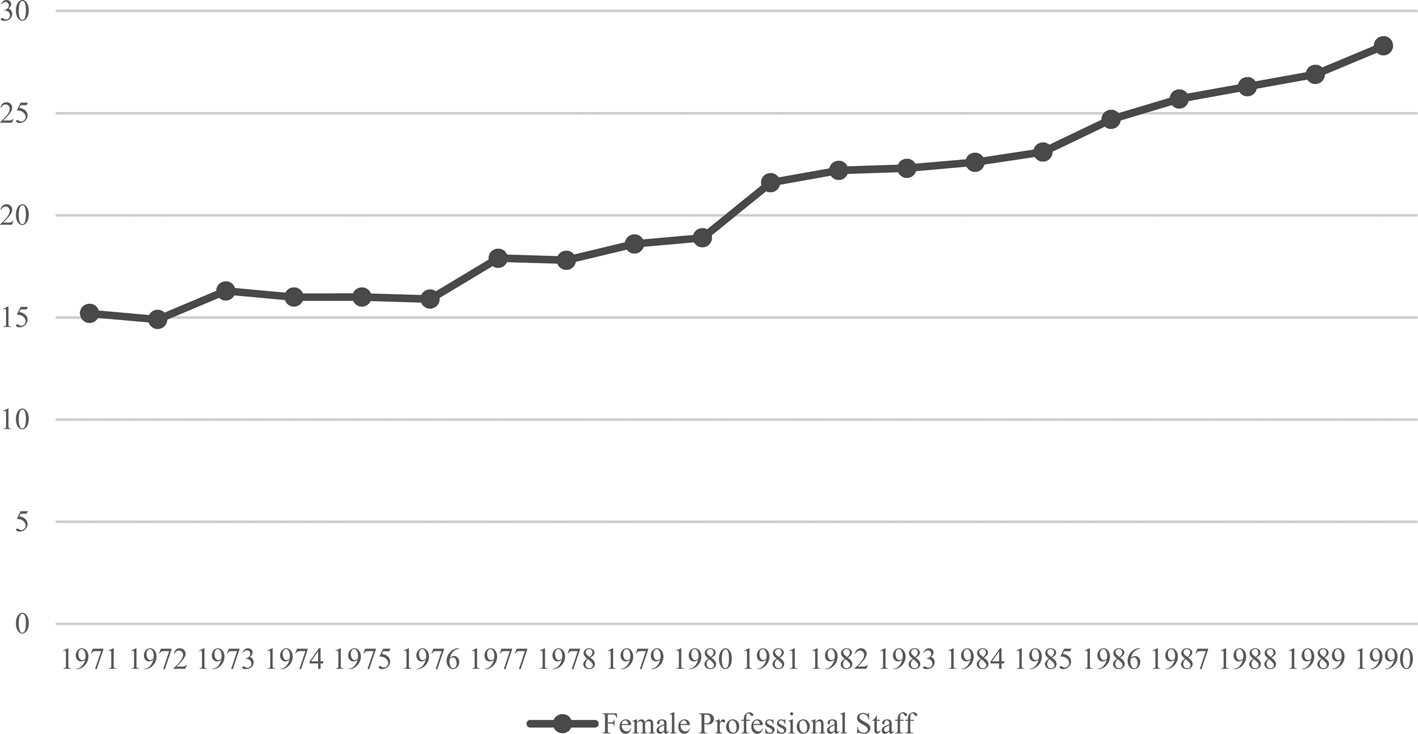
In December 1978, General Assembly Resolution 33/143 adopted a 25 percent target for the number of women in professional posts over the following four-year period, subject to geographic distribution considerations, reflecting the tension between the new goal of gender equality and developing countries’ call for equal representation among UN staff. The first data on women in the professional staff had shown that women represented only 15 percent of the total posts—with the 20 percent barrier only being broken in 1981. Following the Third World Conference on Women held in Nairobi in June 1985, the General Assembly in 1986 adopted a target of 30 percent by 1990 in Resolution 41/206. Figure 1 shows the evolution of the status of women among the UN Secretariat's professional staff from the early 1970s up to the passage of this resolution.
Percentage of women in professional staff in the UN Secretariat, 1971–1990.
Data Source: Annual Reports of the Secretary-General on Staffing at the Secretariat, 1971–1990.

Since 1990, the Chief Executives Board for Coordination (CEB) has published more comprehensive data in the UN System Human Resources Statistics Reports, providing a clearer picture of the position of women across the UN system. The reports break down staff into two broad categories: professional and general service. Professional staff covers a range of levels, including directors, executive heads, assistant secretaries-general (ASGs), and under-secretaries-general (USGs). General service staff represents nonprofessional staff and includes field service staff, security service, and manual workers.
Still, progress has been slow and women have faced hurdles as a result of member states’ lack of engagement. It was the 1995 Fourth World Conference on Women held in Beijing that gave impetus to the push for women's equal access to power structures and decision-making within the UN system. Section G of its Beijing Declaration and Platform for Action called for gender balance in the lists of national candidates nominated for election or appointment to UN bodies; for new employment policies and measures to achieve gender equality, particularly at the professional level and above by the year 2000; for the development of mechanisms to nominate female candidates for appointment to senior posts across the system; and for the continued collection, dissemination, and analysis of quantitative and qualitative data on women and men in decision-making, and of their differential impact on decision-making, as well as for monitoring progress toward the UNSG's target of having women in 50 percent of managerial and decision-making positions by 2000.Footnote 8 In 1999, the General Assembly adopted Resolution 54/139, which set the goal of achieving fifty-fifty gender distribution in all categories across the UN system and called for regular reports on the improvement of the status of women.
The Role of Secretaries-General
The UNSGs were relatively slow to promote women to higher-level positions, with Kurt Josef Waldheim appointing Helvi Sipilä of Finland as the first woman assistant secretary-general in 1972. Javier Pérez de Cuéllar issued the first action program for the improvement of the status of women in the Secretariat, encompassing recruitment, career development, training, work-/family-related issues, and an improved grievance redress system. He also made two senior appointments of women in 1987—Nafis Sadik as executive director of the UN Fund for Population Activities (which would later become UN Population Fund), and Margaret Anstee as director-general of the UN Office at Vienna. Pérez de Cuéllar took the added step of establishing Focal Point for Women to monitor and report on the status of women within the UN and assist in achieving gender balance. Kofi Annan created the Office of the Special Adviser to the Secretary-General on Gender Issues and the Advancement of Women (OSAGI) in 1997, and scored high marks in 1998 with his appointment of Louise Fréchette, Canada's deputy defense minister and former ambassador to the UN, to the newly created post of deputy secretary-general.Footnote 9 Fréchette's appointment increased the percentage of women in senior posts from 9.7 to 16.7. Annan's 2006 reform program provided the platform for the creation of UN Women by his successor, Ban Ki-moon.Footnote 10
Secretary-General Ban Ki-moon is credited with several important steps and appointments, including in 2010 the establishment of UN Women: The United Nations Entity for Gender Equality and the Empowerment of Women through the merger of four tiny, competing gender units;Footnote 11 the appointment of Michelle Bachelet, former president of Chile, as its executive director with the rank of USG; and launching two global campaigns relating to women. Ban also appointed the first woman commander of a UN peacekeeping force along with a female special representative, thus creating the first all-female leadership team in Cyprus. Still, although Ban had increased the number of women in senior positions by 40 percent by 2014,Footnote 12 the percentage of women in the professional categories had improved by only 8 percentage points to a total of 43 percent. Moreover, despite significant progress earlier in his tenure, 92 percent of Ban's senior appointments in 2015 went to men.Footnote 13
While the outcome of the major campaign in 2016 to name a woman as the ninth UNSG was disappointing, the idea of a woman secretary-general gained considerable support from member states and the media.Footnote 14 The new UNSG, Antόnio Guterres, noted the importance of gender equality in his opening speech, calling it both “an urgent need . . . and a personal priority . . . a moral duty and an operational necessity.”Footnote 15 Appointing an all-female team of top advisers in 2017, the UN hit a milestone in early 2018: it achieved full gender parity in its senior leadership—twenty-three out of forty-four posts that make up the UNSG's Senior Management Group or cabinet were held by women. Making approximately 150 appointments, Guterres appointed an equal or greater number of women than men, thus slowly reducing the gender gap, including the appointment of women to “hard-issue” area posts (typically held by men), such as the post of under-secretary-general for political and peacebuilding affairs.Footnote 16 Still, the Feminist U.N. Campaign noted more substantive support for gender equality was required.Footnote 17 Indeed, structural changes were meeting “considerable resistance” from staff and member states that resist women's rights.Footnote 18
How Far Has the UN Come?
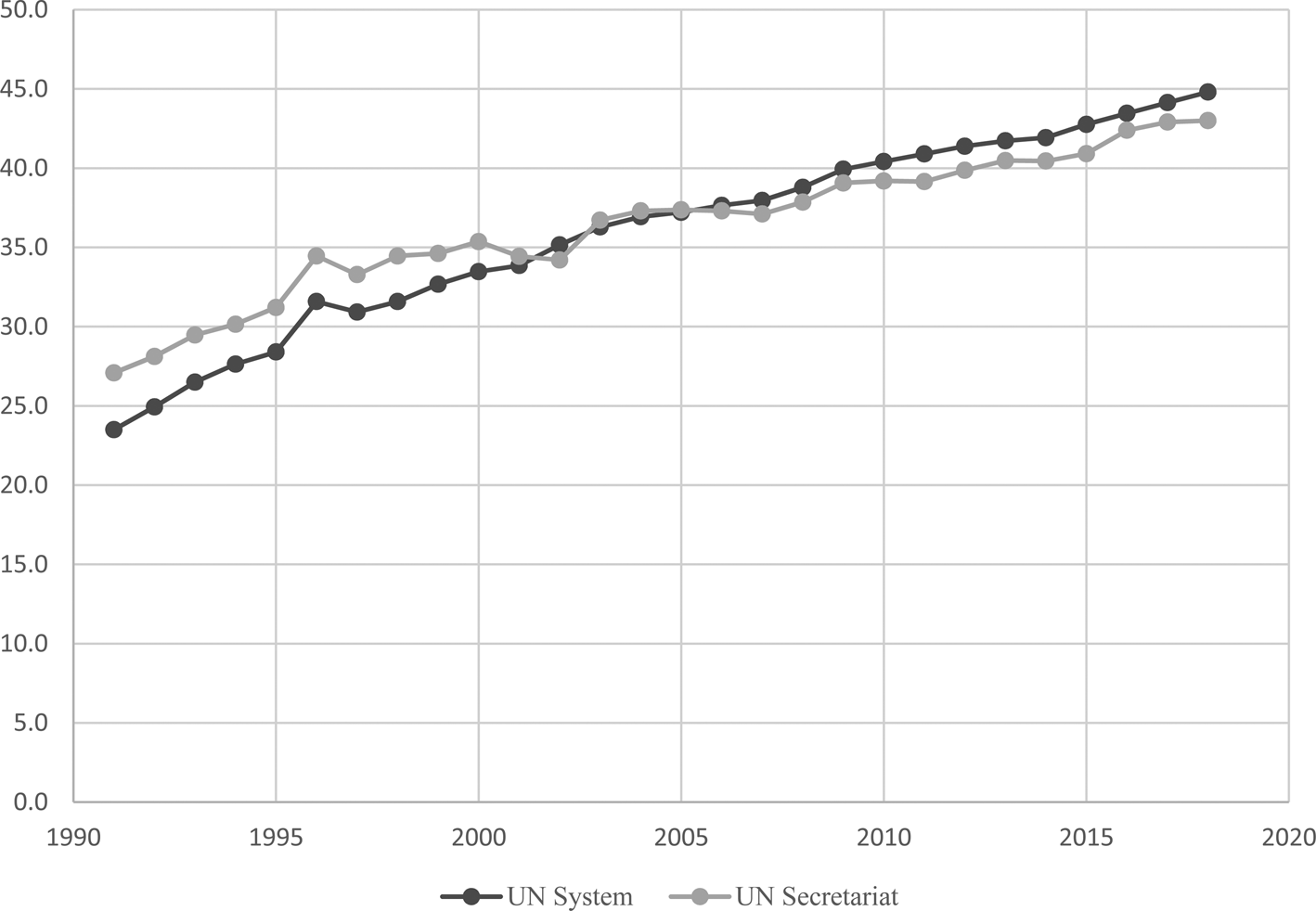
Previous studies on the status of women at the UN have focused largely on data for women in the Secretariat itself and on the percentage of women in the professional category because of their underrepresentation in these areas relative to the overall percentage of women in the organization, which has averaged 44 percent over the years and includes the large number of women in general services.Footnote 19 It was only in 2010 that the percentage of female professional staff broke the 40 percent barrier. This category can be used as a proxy for women's status and influence in decision-making. In 1991, 23.5 percent of professional staff were women, but between 1992 and 2018 the percentage of female professional staff in the UN system came close to doubling.
The large size of the UN Secretariat (comprising 33 percent of total professional staff) gives it significant influence on UN system-wide data. Figure 2 demonstrates that the two have followed a similar path in terms of the percentages of female employment. Most specialized agencies, programs, and fund secretariats at the UN have a staff of well under two thousand (by contrast, the UN Secretariat today has a staff of over eleven thousand).Footnote 21 Therefore, changes in either direction at the Secretariat can greatly influence the overall system data on the level of female inclusion.
Comparing percentages of female professional staff in the UN system and the secretariat.
Data Source: Figure constructed with data drawn from Chief Executives Board for Coordination, annual UN System Human Resources Statistics Reports, 1991–2019.Footnote 20

Gender Disparities across the UN System
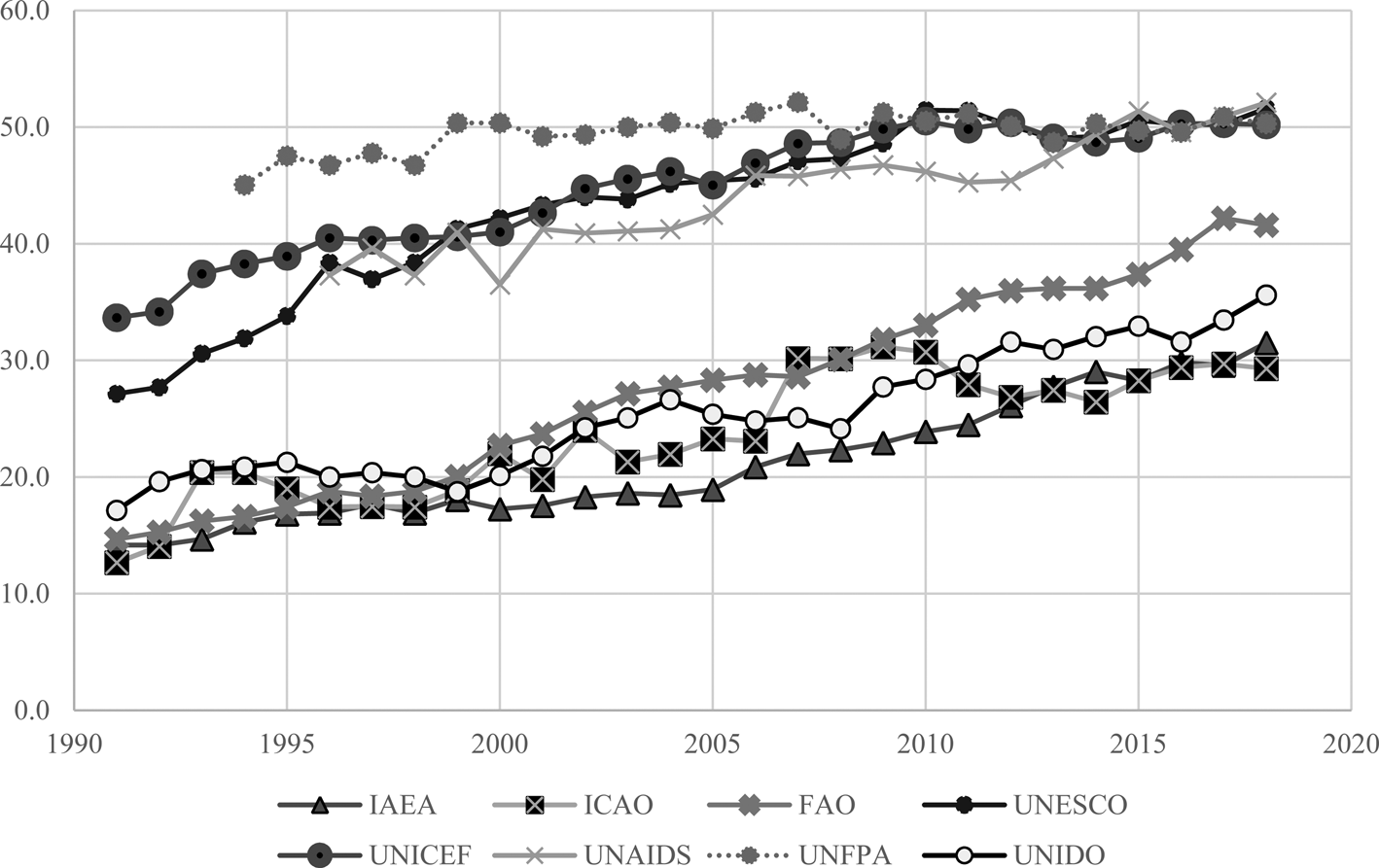
Not surprisingly, however, the numbers of female professional staff members vary significantly across UN agencies, funds, and programs. Data show that gendered assumptions about different roles or specific issue areas are still influencing recruitment, as evidenced in the variations in female employment that figure 3 shows among eight of these entities. Four of them had achieved parity as of 2018: the Joint United Nations Programme on HIV and AIDS (UNAIDS); the United Nations Educational, Scientific and Cultural Organization (UNESCO); the United Nations International Children's Fund (UNICEF); and UNFPA.Footnote 22
Percentages of female professional staff in select entities across the UN system.
Note: IAEA = International Atomic Energy Agency; ICAO = International Civil Aviation Organization; FAO = Food and Agriculture Organization; UNESCO = United Nations Educational, Scientific and Cultural Organization; UNICEF = United Nations International Children's Fund; UNAIDS = Joint United Nations Programme on HIV and AIDS; UNFPA = United Nations Population Fund; UNIDO = United Nations Industrial Development Organization.
Data Source: Figure constructed with data drawn from Chief Executives Board for Coordination, annual UN System Human Resources Statistics Reports, 1991–2019.

All of these four entities deal with issues generally considered gender specific, highlighting the phenomenon of glass walls that often steer women into “softer” gender-specific portfolios, while men dominate leadership roles in portfolios considered more “masculine.”Footnote 23 The glass walls are most apparent in the International Civil Aviation Organization (ICAO), the International Atomic Energy Agency (IAEA), and the UN Industrial Development Organization (UNIDO), whose portfolios have traditionally been male-dominated fields. Although all eight agencies show some improvement in the representation of women professional staff, the Food and Agriculture Organization (FAO) shows the most. Some might argue, for example, that this pattern reflects the comparatively low representation of women generally in science, technology, and engineering; the barriers women often face; and the fact that the staff in these organizations are drawn from national agencies that, by and large, have few women employees. Still, after decades of UN policy directives to improve the representation of women system-wide, these reasons alone do not explain the relatively poor performance of these entities.
The Status of Women in Leadership Positions
Women are still underrepresented in leadership positions across the UN system (although in 2017 Guterres earned high praise for his appointments of three women to his top staff). In early 2020, there were just nine women among the thirty-one members of the CEB, which includes the heads of twelve funds and programs, fifteen specialized agencies, and three related organizations.Footnote 24 Among the specialized agencies, women are currently head of only three: UNESCO, ICAO, and the International Monetary Fund (IMF)—though two of these are “hard-issue” areas. The forty-five-member Senior Management Group chaired by the UNSG, however, paints a picture of inclusiveness for women in leadership, with thirty women appointees (67 percent) as of February 2020.Footnote 25 Women are executive secretaries of all five regional economic commissions (Europe, Western Asia, Latin America and the Caribbean, Africa, and Asia-Pacific). And women hold five of the six special representative of the secretary-general (SRSG) and special adviser positions included in the Senior Management Group—notably, posts covering violence against children, children and armed conflict, sexual violence in conflict, disaster risk reduction, and Africa. Not surprisingly, in the past men have held the trade, development, economic and social affairs, and counterterrorism posts, but a woman is now executive director of the UN Office of Drugs and Crime as of November 2019. The increase of the total number of SRSG posts by Guterres and more women serving in the role in recent years have enlarged the pool of women in the UN system and women in leadership, in particular.
Conclusion
The question we ask in the title of this essay—Where are the women in the United Nations now?—has much wider significance than merely accounting for the most recent hirings by Secretary-General Guterres. The lack of gender parity between men and women in the UN itself could not be fully addressed before data revealed women's absence, both in professional staff and leadership roles.
From one perspective, the UN has shown marked improvement in the representation of women among the professional staff, although there are still notable disparities across the specialized agencies, funds, and programs. Gendered perceptions of organizational mandates and portfolios continue to be key barriers to achieving the goal of parity, especially at the levels of senior leadership. In short, glass walls continue to plague the gender equality agenda in the UN system, even while parts of those glass ceilings have certainly been shattered or shown flexibility.
Increasing the proportion of female professional staff within each UN entity will eventually increase the potential for more women to be promoted to higher ranks. Yet, there is further work to be done on obstacles and barriers women face, on the deeply embedded gender biases,Footnote 26 and on emerging evidence of sexual harassment and even assault experienced by women in the UN system.Footnote 27
As Kirsten Haack notes in a study of women's representation and leadership at the UN, efforts that began with the First World Conference of the International Women's Year in 1975 were a product of a “triangular alliance” of women in the UN Secretariat, women diplomats, and women's social movements outside the UN.Footnote 28 The story of those groups and movements has, to some extent, already been told, but much more remains to be done to provide a fuller understanding of the roles of various actors, including the women's movement and UN staff.Footnote 29 Successive UNSGs have contributed to the process of increasing the presence of women, but, like any leader, they can be hamstrung by their own bureaucracy. Hence, the path toward gender equality in UN staffing has been uneven and slow. Promotion within the UN has often depended more on nationality than ability, and gender has only gradually come to be a consideration. Yet, Ban and Guterres have placed more women in key leadership posts, heightening the visibility of women in the UN today and increasing their influence. The much larger question of what difference having more women in the UN will make is a task for future investigation. But since women hold up “half the sky,” having more women in all types of positions in the UN has the power to change perceptions of women's roles in societies everywhere.