Disasters are a complex mix of natural hazards and human action that occurs suddenly or uncontrollably. Reference Booth1 Earthquake is one of the most tragic and terrifying natural disasters that annually kills many people around the world. 2 Iran is one of the most seismically active countries in the world due to being located on the earthquake belt. Between 1982 and 2010, Iran had the highest number of earthquakes and 17.6% of the world’s destructive earthquakes occurred in Iran. Reference Soltani Nejad, Barshan and Baniasad3 On average, there is a severe earthquake every 4 years in Iran. The consequence is the destruction of 97% of rural units and the overall damage of 79% of urban units in earthquake-prone areas. Reference Soltani Nejad, Barshan and Baniasad3 East Azerbaijan Province is one of the most seismically active regions in Iran. Two earthquakes measuring 6.3 and 6.4 on the Richter scale occurred on August 12, 2012, in this province (Ahar, Haris, and Varzaghan). Reference Ommi and Zafarani4 At least 306 people died and more than 3000 others were injured.
Natural disasters have many effects on different aspects of a human’s life; depression, stress, and posttraumatic stress are the most important effects. Nutrition and food security of disaster-affected communities are one of the major issues, which are affected by both the psychological and food resources. Reference Bahmanjanbeh, Kohan, Yarmohammadian and Haghshenas5,Reference Cannon6
Some population groups are at considerably higher risk in this situation. Individuals who are at increased risk for physical and mental crisis include the elderly, children, and pregnant women. Reference Cannon6–Reference Peters, Peters and Walch9 Studies have shown that pregnant women and newborns were exposed to adverse birth outcomes as a result of earthquakes. Reference Laplante, Barr and Brunet10 Preterm delivery, increased fetal mortality, and low birth weight (LBW) are the reported consequences of natural disasters. Reference Glynn, Wadhwa and Dunkel-Schetter11–Reference Liu, Liu and Tseng13
Proper gestational weight gain during pregnancy and hemoglobin levels are important indicators of the nutritional status of pregnant women. Reference Sedaghati, Ziaee and Ardjmand14,Reference Scanlon, Yip, Schieve and Cogswell15 Women with inadequate gestational weight gain were found to be at a higher risk for LBW, birth defects, preterm delivery, and any adverse birth outcomes caused by nutritional inadequacy. Reference Shaw, Todoroff and Carmichael16,Reference Leddy, Power and Schulkin17 Low hemoglobin levels in pregnant women also lead to LBW, preterm labor, and perinatal death. Reference Allen18,Reference Levy, Fraser and Katz19 The results of a recent study in the Haris region where affected by Varzaghan earthquake showed that the prevalence of moderate malnutrition among children under 1 year was higher in highly damaged areas. Reference Esfandyari, Vaghef-Mehrabany and Ebrahimi-Mameghani20 However, in the mentioned study, no comparison was made before and after the earthquake regarding mothers’ and infants’ health indices. Reference Esfandyari, Vaghef-Mehrabany and Ebrahimi-Mameghani20
To the best of our knowledge, no information is available regarding the effects of the Varzaghan earthquake on the health status of pregnant women and birth outcomes. Studying the consequences of natural disasters and their detrimental effects on the health indicators of pregnant women helps us minimize the health problems. So, this study aimed at investigating the impact of the Varzaghan earthquake on the gestational weight gain and hemoglobin status of pregnant women and the birth outcomes.
Materials and Methods
This retrospective descriptive study was carried out on all women who had complete medical records available in the local health centers. Varzaghan is located 60 km northeast of Tabriz, the capital of East Azerbaijan Province. To examine the effect of the earthquake on pregnancy and birth outcomes, we compared 2 groups of pregnant women—those who experienced the earthquake and those who did not. The study population consisted of 1000 cases of pregnant women living in urban and rural areas of Varzaghan city that consisted of 550 pre-earthquake and 450 post-earthquake cases. All of the pregnant women were reviewed based on their health records availability in the health care centers in Varzaghan in the period of August 11, 2011, to August 12, 2013.
All procedures performed in this study were in accordance with the ethical standards of the Ethics Committee of Tabriz University of Medical Sciences (IR.TBZMED.REC5/168490) and with the 1964 Helsinki declaration and its later amendments or comparable ethical standards. Also, informed consent was obtained from all individual participants included in the study.
A researcher-made checklist was used to collect data on maternal and newborn health records before and after the earthquake. This form was developed according to the standard form of the Ministry of Health for Pregnant Women. This form is validated based on content, by 13 elite gynecologists and nutritionists in the Department of Community Nutrition, Tabriz University of Medical Sciences. Birth weight was classified as low if the birth weights were < 2.5 kg, stunting, and low head circumference (HC) was defined as height-for-age (H/A) and HC-for-age below -2 SD using the World Health Organization (WHO) Child Growth Standards median. 21 Anemia was defined as Hb < 10.5 g/dL, according to the WHO’s definition. Reference Stoltzfus22
Data analyses were conducted using the SPSS for Windows, version 22.0 (SPSS Inc., Chicago, IL, USA), and the Kolmogorov-Smirnov test was used to check the normality of the data distribution. Normally distributed continuous variables are presented as mean ± SD. Independent samples t-test and the chi-square test were used for between-group comparisons. P-values lower than 0.05 were considered significant.
Results
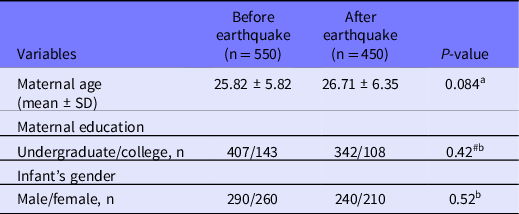
The study population consisted of 550 pre-earthquake and 450 post-earthquake pregnant women in Varzaghan. The demographic characteristics of pregnant women and infants are presented in Table 1. Maternal characteristics were similar between the 2 groups and there were no statistically significant differences (P > 0.05).
Demographic characteristics of pregnant women and infants

a Independent samples t-test.
b Chi-square test.
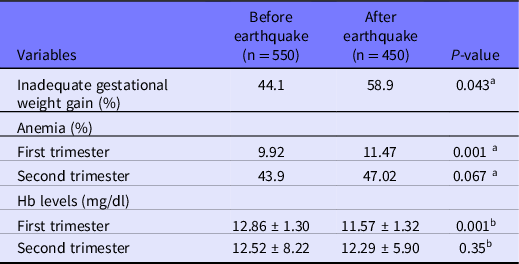
The comparison of inadequate gestational weight gain, anemia, and Hb levels in 2 groups is illustrated in Table 2. Inadequate gestational weight gain in the post-earthquake group (58.9%) has significantly (P = 0.043) increased compared with the pre-earthquake group (44.1%). There was significantly (P = 0.001) higher prevalence of anemia in post-earthquake pregnant women (11.47%) compared to pre-earthquake (9.92%) in the first trimester of pregnancy; however, this difference was not significant in the third trimester. The mean (SD) of hemoglobin levels were 12.86 (1.3) and 11.57 (1.32) in the first trimester and 12.29 (5.92) and 12.52 (8.22) in the third trimester in pre- and post-earthquake groups, respectively. The difference in hemoglobin levels in the first trimester was statistically significant (P = 0.001).
The comparison of inadequate gestational weight gain, anemia, and Hb levels in the 2 study groups

a Chi-square test.
b Independent samples t-test.
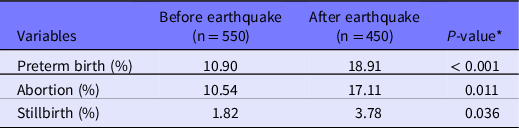
Table 3 describes the pregnancy outcomes for both groups. The rates of preterm birth (18.91% vs 10.90%), abortion (17.11% vs 10.54%), and stillbirth (3.78% vs 1.82%) for women exposed to the earthquake were significantly higher compared with those in the pre-earthquake group.
The comparison of pregnancy outcomes in the 2 study groups

* Chi-square test.
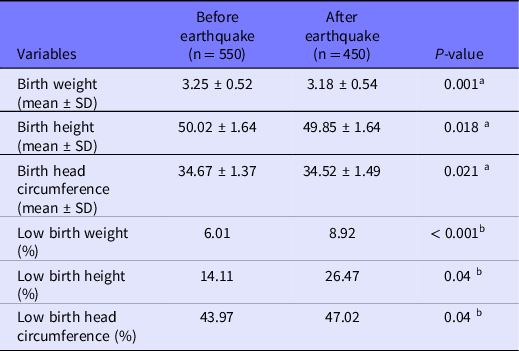
As can be seen in Table 4, the mean birth weight, birth height, and birth HC are significantly decreased in the earthquake-affected group (P < 0.05). Also, the percentage of LBW, low birth height, and low birth HC in the post-earthquake group is significantly increased in comparison with that in the pre-earthquake group (P < 0.05).
The comparison of infants’ anthropometric measures in the 2 study groups

a Independent samples t-test.
b Chi-square test.
Discussion
In the present study, it was demonstrated that an inadequate gestational weight gain ratio increased significantly after the earthquake. Gestational weight gain is one of the most important factors of fetal growth and development. Natural disasters such as earthquakes are one of the traumatic disasters that may cause posttraumatic stress disorder. Natural disasters change people’s lives, including the lives of pregnant women, in which access to food is limited. Governments and the quality of assistance, the emotional rehabilitation, and the timing of the earthquake may also be the reasons for the potential weight loss of pregnant mothers in post-earthquake conditions. These challenges during pregnancy have had unfavorable outcomes for the mothers or fetuses or both, while it can be associated with underweight or overweight during pregnancy. Reference Crane, Murphy, Burrage and Hutchens23
Based on the results, Hb levels decreased significantly after the earthquake in the mothers’ first trimesters of pregnancy; however, no significant difference was observed in the third trimester before and after the earthquake. Decreased hemoglobin levels during pregnancy are associated with reduced oxygen supply to the fetus, which can affect the differentiation and developmental processes of the fetus and may have acute or chronic effects on the fetus. Reference Zhang, Jin and Liu24 Besides, iron is an essential element for the proper functioning of the brain at all ages. Reference Mahan and Escott-Stump25 Lack of access to food and micronutrients and the psychological stress of pregnant women after the earthquake can cause many health problems related to stress, including weight loss and decrease of blood hemoglobin levels. Omote et al. found that the level of hemoglobin in those exposed to the earthquake was significantly reduced 1 year later. Special conditions influencing nutritional status like the adequacy of food intake have expressed as effective factors. Reference Omote, Kato and Kido26 Another important finding of this study was that the mean neonatal HC, birth weight, and birth height were significantly lower than those before the earthquake. Natural disasters can pose a threat to the physical and mental health of pregnant women. On the other hand, there is a direct relationship between maternal health during pregnancy and birth outcomes. Tan et al. have shown that earthquakes have significant effects on birth outcomes. Reference Tan27 Dancause et al. examined the effect of the psychological burden caused by a natural disaster during pregnancy and on fetal growth patterns. In that study, exposure to stressful events affected birth outcomes, and the magnitude of this effect depends on factors such as gestational age, neonatal sex, and characteristics of stress. Reference Dancause, Laplante and Oremus28 Sanguanklin et al. examined the effects of displacement due to flooding during pregnancy on birth outcomes. The results clearly showed that displacement caused by a natural disaster during pregnancy affects fetal growth. Reference Sanguanklin, McFarlin and Park29 Likewise, Frankenberg et al. and King et al. have confirmed in their studies the impact of natural disasters, especially earthquakes, on birth weight, height, and HC of a newborn. Reference Frankenberg, Friedman, Ingwerson and Thomas30,Reference King and Tarrant31
Maternal anemia is also one of the causes of LBW, and treatment of anemia in pregnant women and their follow-up has paramount importance for the improvement of neonatal health. Reference Negrato and Gomes32
Strengths and Limitations
The main strength of the current study was a large sample size that provides new data regarding the impact of Varzaghan earthquake on the health status of pregnant women and birth outcomes.
This study suffers from some limitations. One of the main limitations of this study is the cross-sectional design that restricts examining causal associations. Also, psychological stress and depression were not recorded in the medical records, so these variables could not be entered in the analyses.
Conclusions
The results of this study showed that earthquake can affect first-trimester weight gain and hemoglobin levels in pregnant women. Also, it can cause miscarriage and prematurity and decrease pregnancy length. In addition, it affects the birth weight, birth height, and birth HC of infants. Therefore, pregnant women need special attention and care during natural disasters to avoid the negative consequences. More longitudinal and well-designed studies are desired to investigate the longitudinal consequences of disasters in susceptible groups.
Acknowledgments
We thank Hedayat Gholizadeh Fard and Yousef Zare at Varzaghan Health Center for their efficient cooperation.
Author contributions
JGH designed and directed the project and aided in interpreting the results; HA, LN, and MG developed the theoretical framework and drafted the manuscript; MG, ST, and HA collected the data and performed the analysis. All authors provided critical feedback and helped shape the research, analysis, and manuscript.
Conflict(s) of interest
There is no conflict of interest.