Implications
Lowering protein concentration in dairy diets is known to decrease urinary nitrogen losses and ammonia emissions from manure but can also impair lactation performance. Essential oils could potentially modify ruminal fermentation and alleviate the negative effect of decreased dietary protein concentration on feed intake and performance of dairy cows. In this experiment, lowering dietary protein by 10 g/kg decreased urinary and fecal nitrogen excretion without affecting productivity. The supplementation of essential oils to a lowered-protein diet had only minor effects on ruminal fermentation and did not affect productivity and nutrient utilization in lactating dairy cows.
Introduction
Providing a sufficient amount of dietary CP is essential for maintaining milk and milk protein production in dairy cows. However, it is well known that excessive supply of dietary CP does not increase cow productivity but increases urinary nitrogen (N) losses and ammonia emission from manure (Colmenero and Broderick, Reference Colmenero and Broderick2006; Lee et al., Reference Lee, Giallongo, Hristov, Lapierre, Cassidy, Heyler, Varga and Parys2015), which are known to contribute to water and air pollution, respectively (Hristov et al., Reference Hristov, Hanigan, Cole, Todd, McAllister, Ndegwa and Rotz2011). Studies have shown that lowering protein concentration in dairy diets is an effective way to increase milk N efficiency and decrease urinary N loss and ammonia emissions from manure in dairy production systems (Huhtanen and Hristov, Reference Huhtanen and Hristov2009; Hristov et al., Reference Hristov, Hanigan, Cole, Todd, McAllister, Ndegwa and Rotz2011). A field study with 11 commercial dairy farms in Pennsylvania demonstrated that an 11 g/kg reduction in dietary CP concentration (from 165 to 154 g/kg) decreased barn floor ammonia emissions by 58% and increased milk protein N efficiency by 9.5% (Hristov et al., Reference Hristov, Heyler, Schurman, Griswold, Topper, Hile, Ishler, Wheeler and Dinh2015).
Lowering dietary protein, however, may have negative effects on cow productivity, due to decreased DM intake (DMI), fiber digestion and supply of key amino acids for milk protein synthesis (Hristov and Giallongo, Reference Hristov and Giallongo2014). A potential strategy to minimize the potential negative effects of lowering dietary protein in dairy cows can be to improve the efficiency of rumen fermentation by enhancing propionate synthesis and decreasing proteolysis of feed proteins, thus increasing gluconeogenic substrate and rumen-undegraded protein (RUP) supplies to the small intestine. Plant-derived essential oils (EO) have been reported to inhibit the growth of certain bacteria in the rumen and modify rumen fermentation, resulting in higher propionate and lower ammonia production (Calsamiglia et al., Reference Calsamiglia, Busquet, Cardozo, Castillejos and Ferret2007). For example, Cardozo et al. (Reference Cardozo, Calsamiglia, Ferret and Kamel2006) reported that dietary supplementation of eugenol increased propionate and decrease ammonia concentrations in the rumen of beef heifers. Carvacrol and thymol supplementation decreased ruminal ammonia concentration in dairy cows and sheep, respectively (Noirot and Etienne, Reference Noirot and Etienne2011; Khateri et al., Reference Khateri, Azizi and Jahani-Azizabadi2017). Blends of EO can exhibit additive, synergistic and antagonistic effects on bacteria (Burt, Reference Burt2004). To the best of our knowledge, a blend of carvacrol, eugenol and thymol has not been investigated as a feed additive to improve the efficiency of rumen fermentation in dairy cows.
Therefore, we hypothesized that dietary supplementation of an EO product, containing carvacrol, eugenol and thymol, could increase the overall rumen fermentation efficiency by enhancing propionate fermentation and decreasing dietary protein breakdown in the rumen, when supplemented to a decreased-CP diet. These effects may alleviate the potential negative effects of lowering dietary CP on cow productivity. Thus, the objective of the experiment was to investigate the effects of lowering CP supply alone or in a combination with EO on feed intake and milk production and composition, rumen fermentation, total tract digestibility and N utilization in dairy cows.
Material and methods
Animals and treatments
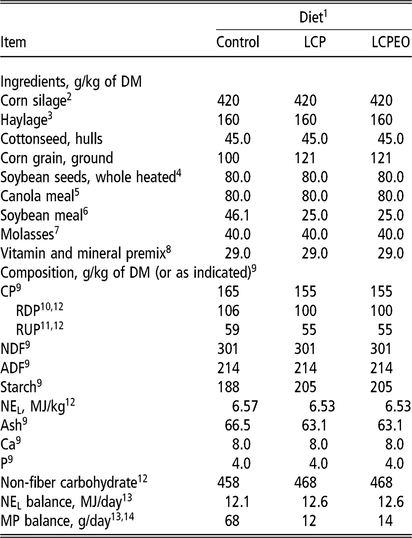
All procedures in this experiment were approved by the Pennsylvania State University Animal Care and Use Committee. The experiment was conducted in the tie-stall barn of the Pennsylvania State University’s Dairy Teaching and Research Center and involved 21 lactating cows (milk yield, 36 ± 7.3 kg/day; days in milk, 123 ± 58.4 day; and BW, 482 ± 60.1 kg at the beginning of the experiment) arranged in a replicated 3 × 3 Latin square design balanced for residual effects. Two cows per treatment (i.e. a total of six cows) were fitted with 10-cm internal diameter, soft plastic ruminal cannulas (Bar Diamond Inc., Parma, ID, USA). Cows were grouped in squares based on parity and milk yield. The experiment consisted of three experimental periods, and each period lasted 28 days: 14 days for adaptation and 14 days for data collection and sampling. Cows were randomly assigned to one of three experimental diets fed as total mixed ration (TMR): a 165 g/kg CP diet (control), a 155 g/kg CP diet (LCP) and LCP supplemented with 35 g/d per cow EO (LCPEO). The essential oil product (Oleobiotec® Ruminant; Laboratoires Phodé, France) contained 25 g/kg of a mixture of carvacrol, eugenol and thymol. The dose was determined based on published studies with EO (Noirot and Etienne, Reference Noirot and Etienne2011; Tekippe et al., Reference Tekippe, Tacoma, Hristov, Lee, Oh, Heyler, Cassidy, Varga and Bravo2013; Khateri et al., Reference Khateri, Azizi and Jahani-Azizabadi2017). Diet composition is shown in Table 1. The control diet was formulated to meet the net energy for lactation (NEL ) and metabolizable protein (MP) requirements of a 650 kg BW cow producing 40 kg milk/day with 36 g/kg milk fat and 30 g/kg milk true protein at the beginning of the experiment (National Research Council, 2001). The LCP and LCPEO diets were formulated to meet NEL but to be deficient in MP (−17 g/day per head). Cows were fed once daily and ad libitum targeting 5% to 10% refusals and had free access to fresh water. The essential oil product was mixed with one-third of the TMR and top-dressed at the time of feeding. Cows were milked twice daily (0500 h and 1700 h) and received recombinant bovine somatotropin (500 mg, i.m., Posilac; Elanco Co., Greenfield, IN, USA) at the beginning and at day 14 of each experimental period.
Ingredient and chemical composition of diets fed to dairy cows in the experiment

DM = dry matter; MP = metabolizable protein.
1 Control, 165 g/kg CP diet; LCP, 155 g/kg CP diet; LCPEO, 155 g/kg CP diet supplemented with 35 g/day of essential oils.
2 Corn silage was 465 g/kg DM and contained (DM basis) 66 g/kg CP, 335 g/kg NDF and 417 g/kg starch.
3 Haylage was 368 g/kg DM and contained (DM basis) 208 g/kg CP and 447 g/kg NDF.
4 Soybean seeds contained (DM basis) 430 g/kg CP.
5 Canola meal contained (DM basis) 378 g/kg CP.
6 Soybean meal contained (DM basis) 538 g/kg CP.
7 Molasses (Westway Feed Products, Tomball, TX, USA) contained (DM basis) 39 g/kg CP and 660 g/kg total sugar.
8 The premix (Cargill Animal Nutrition, Cargill Inc., Roaring Spring, PA, USA) contained (g/kg, as-is basis) trace mineral mix, 8.6; MgO (560 g/kg Mg), 80; NaCl, 64; vitamin ADE premix, 4.8; limestone, 372; selenium premix, 0.7; and dry corn distillers grains with solubles, 467. Ca, 141 g/kg; P, 3.9 g/kg; Mg, 45.9 g/kg; K, 4.4 g/kg; S, 3.9 g/kg; Se, 6.91 mg/kg; Cu, 362 mg/kg; Zn, 1085 mg/kg; Fe, 186 mg/kg, vitamin A, 276 717 IU/kg; vitamin D, 75 000 IU/kg; and vitamin E, 1983 IU/kg.
9 Values calculated using the chemical analysis (Cumberland Valley Analytical Services Inc., Waynesboro, PA, USA) of the individual feed ingredients and their inclusion rate in the diets.
10 Rumen-degraded protein.
11 Rumen-undegraded protein.
12 Net energy of lactation, estimated based on NRC (2001).
13 Net energy for lactation, estimated based on NRC (2001) using actual DM intake, milk yield, milk composition and BW of the cows throughout the experiment (Control, LCP and LCPEO, respectively).
14 Metabolizable protein.
In situ experiment
An in situ sub-experiment was conducted to determine the effect of EO on ruminal degradability of DM, N and fiber fractions of the LCP TMR. The six cannulated cows (two on each experimental treatment; i.e., control, LCP and LCPEO) were used for the ruminal incubation during each experimental period. Triplicated (within cow), 10-g DM samples of each experimental diet (i.e., control and LCP) were incubated in the rumen for 0, 6, 12, 24 and 72 h in 25-µm pore size Ankom filter bags (Ankom Technology, Macedon, NY, USA). Bags were inserted sequentially at specified time points and removed simultaneously from the rumen. A total of 12 bags per diet were incubated within each of the six cows. Aliquots of the incubated diets and bag residues were analyzed for DM, N, NDF and ADF (see below). Rumen degradability parameters of DM, N, NDF and ADF were estimated using the Ørskov and McDonald (Reference Ørskov and McDonald1979) model: y = a + b (1 – e−ct), where y is the percentage of DM, NDF or ADF that disappeared at time t, a is the fraction (%) of DM, NDF or ADF rapidly soluble/degradable, b is the potentially degradable (%) fraction of DM, NDF or ADF, c is the fractional rate constant (/h) for the disappearance of fraction b and t is the incubation time (h). Effective ruminal degradability (ED) was calculated using the following equation: ED = a + (b x c) ÷ (c + k), where k is the fractional passage rate from the rumen (assumed to be 0.06/h) and constants a, b and c are as defined earlier.
Sampling and analyses
Feed intake, milk yield and BW (AfiFarm 3.04E scale system; S.A.E. Afikim, Rehovot, Israel) were recorded daily during the entire experiment. Samples of TMR and refusals from the control and LCP diets were collected twice weekly and composited per week. Concentrate and forage feeds were sampled weekly and composited per experimental period. Dry matter of the composited feed samples was determined by drying at 55°C to constant weight in an air-forced oven. Dried samples were ground through a 1-mm screen and sent to Cumberland Valley Analytical Services (Waynesboro, PA, USA) for CP, NDF, ADF, ether extract, Ca, P and estimated non-fiber carbohydrate and NEL. Samples of TMR were ashed for 4 h at 600°C for organic matter (OM) determination and analyzed for starch using an enzymatic method of Karkalas (Reference Karkalas1985). The analyzed composition of the feed ingredients and their inclusion in the TMR were used to compute CP, NDF, ADF, fat, Ca and P concentration of the experimental diets (Table 1). Rumen-degraded protein (RDP), RUP, NEL, non-fiber carbohydrates and NEL and MP balances were estimated using NRC (2001) based on actual milk yield and composition, BW and DMI of the cows during the experiment.
Fecal, urine, blood and milk samples were collected during the last week of each experimental period. Grab fecal samples, about 300 g, were collected eight times at 1000, 1600 and 2200 h on day 1; 0400, 1300 and 1900 h on day 2; and 0100 and 0700 h on day 3 from the rectum. Fecal samples were dried at 65°C in an air-forced oven for 48 h, ground through a 1-mm sieve and composited by cow and period. Composited fecal samples were analyzed for apparent digestibility of DM, OM, N, NDF, ADF and starch as described in Oh et al. (Reference Oh, Hristov, Lee, Cassidy, Heyler, Varga, Pate, Walusimbi, Brzezicka, Toyokawa, Werner, Donkin, Elias, Dowd and Bravo2013). Spot urine samples were collected at the time of fecal sampling, immediately acidified with 2 M H2SO4, diluted 1:10 with distilled water and stored frozen at –20°C for further analysis. Urine samples were composited by cow and period and analyzed for urea-N, allantoin, uric acid, and creatinine as described in Oh et al. (Reference Oh, Hristov, Lee, Cassidy, Heyler, Varga, Pate, Walusimbi, Brzezicka, Toyokawa, Werner, Donkin, Elias, Dowd and Bravo2013). Purine derivatives (PD), allantoin and uric acid were used as indicators of ruminal microbial synthesis. Composited urine samples were freeze-dried and analyzed for N using a Costech ECS 4010 C/N/S elemental analyzer (Costech Analytical Technologies Inc., Valencia, CA, USA). Daily urine volume and urinary N and urea-N excretions were estimated based on urinary creatinine concentration with a creatinine excretion rate of 29 mg/kg BW (Hristov et al., Reference Hristov, Hanigan, Cole, Todd, McAllister, Ndegwa and Rotz2011). Milk samples for composition analyses were collected in one day during the last week of each experimental period from p.m. and a.m. milkings. Milk samples were submitted to Dairy One laboratory (Ithaca, NY, USA) and analyzed for fat, true protein, lactose, somatic cell count and milk urea-N using infrared spectroscopy (MilkoScan 4000; Foss Electric, Hillerød, Denmark). Milk composition data were weighted for the corresponding p.m. and a.m. milk weights.
Whole ruminal contents samples were collected from the cannulated cows at 0200, 0400, 0600, 1000 and 1400 h after feeding on two consecutive days during the last week of each experimental period. Whole ruminal contents were sampled as follows: two samples from the feed mat, one from the reticulum and two from the ventral rumen sac and mixed per cow to make a composite sample. The whole rumen contents samples were filtered through two layers of cheesecloth, and pH of the filtrate was immediately measured. Aliquots of the filtrate were processed for protozoal counts, ammonia and volatile fatty acids (VFA) concentration as described in Oh et al. (Reference Oh, Giallongo, Frederick, Pate, Walusimbi, Elias, Wall, Bravo and Hristov2015). Another set of rumen aliquots was centrifuged at high speed (20 000×g for 15 min), and the supernatant was analyzed for lactate concentration at Cumberland Valley Analytical Services (Waynesboro, PA, USA) using YSI 2700 Select Biochemistry Analyzer (YSI Inc., Yellow Springs, OH, USA).
Statistical analysis of results
All data were analyzed using the MIXED procedure of SAS 9.3 (2003; SAS Institute Inc., Cary, NC, USA). Milk yield, DMI and feed efficiency data for the last 14 days of each experimental period were used in the statistical analysis. The averaged milk yield and milk composition data were used to calculate yields of milk fat, true protein, lactose and energy-corrected milk (ECM). Data were tested for normality using the UNIVARIATE procedure of SAS. Data for VFA and total tract nutrient digestibility were log-transformed because the W statistic of the Shapiro–Wilk test was < 0.05.
Milk composition, nutrient digestibility, urinary and fecal N excretions, ruminal lactate concentration and in situ degradability data were analyzed by variance Latin square. The model used was as follows:
 $${Y_{ijkl}}{\rm{ \,=\, }}\mu {\rm{ \,+\, }}{S_i}{\rm{ \,+\, }}C{\left( S \right)_{ij}}{\rm{ \,+\, }}{P_k}{\rm{ \,+\, }}{T_l}{\rm{ \,+\, }} P{T_{kl}}{\rm{ \,+\, }}{e_{ijkl}}$$
where Yijkl is the dependent variable, μ is the overall mean, Si is the square, C(S) ij is the cow within square, Pk is the kth period, Tl is the lth treatment and PTkl is the period × treatment effect with the error term eijkl . Square and cow within square were random effects, and all others were fixed.
Dry matter intake, milk yield, feed efficiency and rumen fermentation parameters including pH, concentrations of ammonia, VFA and acetate to propionate ratio were analyzed with day or time as repeated measures assuming an AR(1) covariance structure. The model used was as follows:
 $${Y_{ijklm}}{\rm{ \,=\, }}\mu {\rm{ \,+\, }}{S_{\rm{i}}}{\rm{ \,+\, }}C{\left( S \right)_{{\rm{ij}}}}{\rm{ \,+\, }}{P_{\rm{k}}}{\rm{ \,+\, }}{T_l}{\rm{ \,+\, }}{D_m}{\rm{ \,+\, }}P{T_{kl}} {\rm{ \,+\, }}T{D_{lm}}{\rm{ \,+\, }}{e_{ijklm}}{\rm{,}}$$
where Yijklm is the dependent variable, μ is the overall mean, Si is the square, C(S) ij is the cow within square, Pk is the kth period, Tl is the lth treatment, Dm is the time effect, PTkl is the period × treatment interaction and TDlm is the treatment × time interaction with the error term eijklm . Square and cow within square were random effects, and all others were fixed.
When the main effect of treatment was significant, means were separated by pairwise t test (pdiff option of PROC MIXED). Statistical differences were declared at P ≤ 0.05. Differences between treatments at 0.05 < P ≤ 0.10 were considered as a trend toward significance. Data are presented as least square mean.
Results
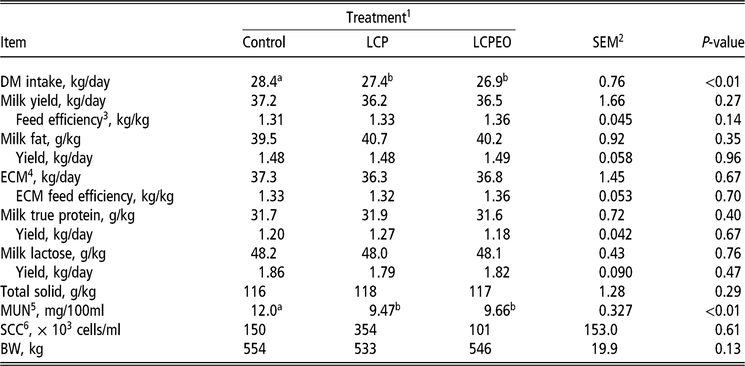
Compared with the control, DMI was decreased (P < 0.01) by both LCP and LCPEO (Table 2); LCPEO did not affect DMI compared with LCP. Milk yield and composition and feed efficiency were not affected by treatment. Treatments did not affect ECM and ECM feed efficiency. Milk urea N concentration was lower (P < 0.01) in both LCP and LCPEO compared with the control and was not affected by EO. Treatments did not affect (P ≥ 0.13) somatic cell count and cow BW.
Effect of an essential oil-based feed additive to a lowered-CP diet on milk yield and composition in dairy cows

SEM = standard error of mean; DM = dry matter;
1 Control, 165 g/kg CP diet; LCP, 155 g/kg CP diet; LCPEO, 155 g/kg CP diet supplemented with 35 g/day of essential oils.
2 Highest SEM shown; n = 378 for DMI, n = 369 for milk yield, n = 366 for feed efficiency and n = 63 for all other variables (n represents number of observations used in the statistical analysis).
3 Milk yield ÷ DM intake.
4 Energy-corrected milk.
5 Milk urea nitrogen.
6 Somatic cell count.
a,b Means with different letter superscripts differ at P < 0.05.
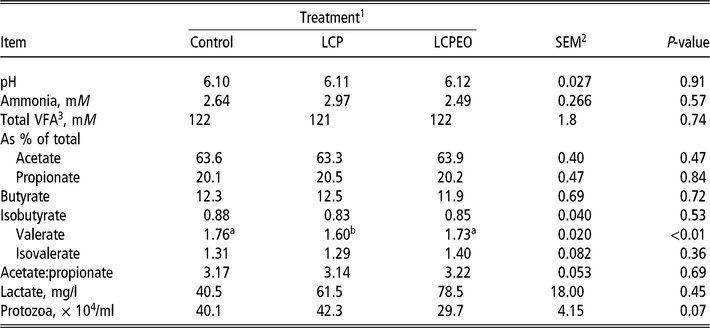
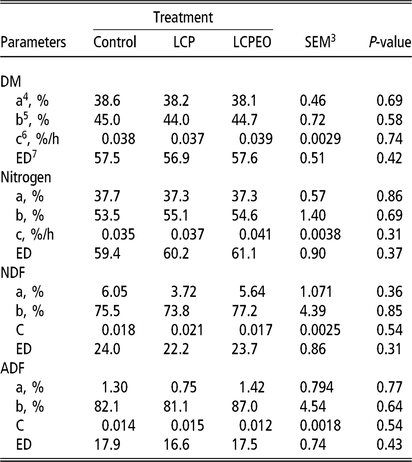
Lowering CP or EO supplementation did not affect pH, ammonia, lactate and concentration of the major VFA, including acetate, propionate, butyrate, isobutyrate and isovalerate in the rumen. Compared with LCP, LCPEO increased ruminal valerate concentration (P < 0.01) (Table 3). Protozoa numbers tended to be decreased (P = 0.07) by LCPEO compared with the control and LCP. In situ degradability parameters of dietary DM, N, NDF and ADF are presented in Table 4. Treatments did not affect the soluble and potentially degradable fractions, the fractional rate constant and effective degradability of the dietary nutrients studied.
Effect of an essential oil-based feed additive to a lowered-CP diet on rumen fermentation parameters in dairy cows

SEM = standard error of mean.
1 Control, 165 g/kg CP diet; LCP, 155 g/kg CP diet; LCPEO, 155 g/kg CP diet supplemented with 35 g/day of essential oils.
2 Highest SEM shown; n = 36 for lactate, n = 12 for protozoal counts and n = 180 for other variables (n represents number of observations used in the statistical analysis).
3 Volatile fatty acids.
a,b Means with different letter superscripts differ at P < 0.05.
In situ ruminal degradability of dietary DM, nitrogen, NDF and ADF in cows fed control, LCP, or LCPEO diets 1 , 2

SEM = standard error of mean; DM = dry matter.
1 Control, 165 g/kg CP diet; LCP, 155 g/kg CP diet; LCPEO, 155 g/kg CP diet supplemented with 35 g/day of essential oils.
2 Samples of control and LCP were incubated in cows fed control, LCP or LCPEO diets.
3 Highest SEM shown; n = 36 for DM and NDF and n = 35 for ADF (n represents number of observations used in the statistical analysis).
4 Soluble fraction.
5 Potentially degradable fraction.
6 Fractional rate constant of the disappearance of the potentially degradable fraction.
7 Effective ruminal degradability (estimated at 6%/h passage rate).
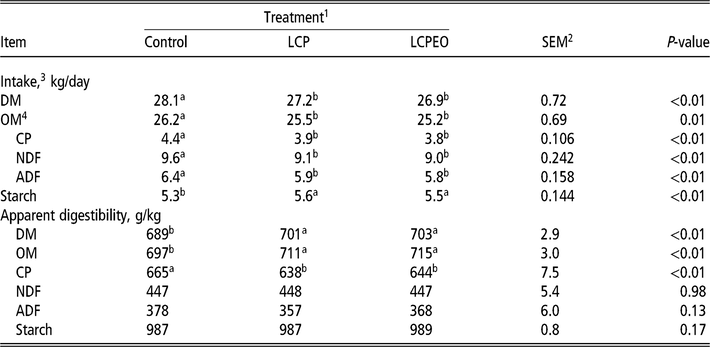
Compared with the control, intakes of DM, OM, CP, NDF and ADF were decreased (P ≤ 0.01) by LCP and LCPEO (Table 5). Starch intake was higher (P < 0.01) for LCP and LCPEO. Total tract apparent digestibility of DM and OM was greater (P < 0.01), but CP digestibility was lower (P < 0.01) for LCP and LCPEO compared with the control. Digestibility of NDF, ADF and starch was not affected (P ≥ 0.13) by treatment. Compared with LCP, LCPEO had no effect on intake and total tract digestibility of nutrients.
Effect of an essential oil-based feed additive to a lowered-CP diet on apparent total tract digestibility of nutrients in dairy cows

SEM = standard error of mean; DM = dry matter.
1 Control, 165 g/kg CP diet; LCP, 155 g/kg CP diet; LCPEO, 155 g/kg CP diet supplemented with 35 g/day of essential oils.
2 Highest SEM shown; n = 63 for all variables (n represents number of observations used in the statistical analysis).
3 Intake data during fecal collection days.
4 Organic matter.
a,b Means with different letter superscripts differ at P < 0.05.
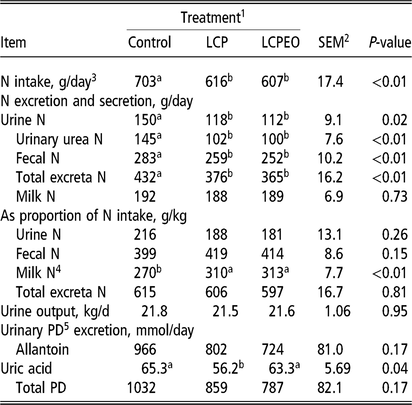
The lowered-CP diets resulted in decreased (P ≤ 0.02) N intake and excretion of total urinary N, urinary urea-N and fecal N (Table 6). Milk N secretion was not affected by treatment. When data were expressed as proportion of N intake, urinary and fecal N excretions were not different among diets, but milk N efficiency was increased (P < 0.01) by LCP and LCPEO, compared with the control. The EO supplementation did not affect N excretion or secretion compared with LCP. Excretion of uric acid in urine was decreased (P = 0.04) by LCP compared with the control, whereas LCPEO increased uric acid excretion compared with LCP. Excretion of allantoin and total urinary PD was not affected by treatment.
Effect of an essential oil-based feed additive to a lowered-CP diet on nitrogen (N) utilization and urinary purine derivatives excretion in dairy cows

SEM = standard error of mean; N = nitrogen; PD = purine derivatives.
1 Control, 165 g/kg CP diet; LCP, 155 g/kg CP diet; LCPEO, 155 g/kg CP diet supplemented with 35 g/day of essential oils.
2 Highest SEM shown; n = 63 for all variables (n represents number of observations used in the statistical analysis).
3 Period × treatment interaction, P < 0.01.
4 Milk true protein yield ÷ 6.38.
5 Purine derivatives.
a,b Means with different letter superscripts differ at P < 0.05.
Discussion
Feed intake and milk production
Dry matter intake responses to varying dietary CP in dairy cows have been inconsistent. Lee et al. (Reference Lee, Hristov, Cassidy, Heyler, Lapierre, Varga, de Veth, Patton and Parys2012) and Giallongo et al. (Reference Giallongo, Harper, Oh, Lopes, Lapierre, Patton, Parys, Shinzato and Hristov2016) reported that lowering dietary CP by 2% decreased DMI, which is in agreement with results from the current experiment. Decreased supply of ruminally available N may decrease the growth of fiber-degrading bacteria, resulting in DMI suppression (Allen, Reference Allen2000). Alternatively, decreased post-ruminal supply of specific amino acids, for example, histidine, may also contribute to depressed DMI as suggested by Lee et al. (Reference Lee, Hristov, Cassidy, Heyler, Lapierre, Varga, de Veth, Patton and Parys2012) and Giallongo et al. (Reference Giallongo, Harper, Oh, Lopes, Lapierre, Patton, Parys, Shinzato and Hristov2016). However, Colmenero and Broderick (Reference Colmenero and Broderick2006) observed no effect of dietary CP concentration, from 135 to 194 g/kg, on DMI. This is in line with Broderick et al. (Reference Broderick, Faciola and Armentano2015), who reported that DMI was not affected by 150 v. 170 g/kg dietary CP in dairy cows. Lowering protein in diets is known to impair productivity in dairy cows (Hristov and Giallongo, Reference Hristov and Giallongo2014), and there are results that show decreases in milk production in cows fed decreased-CP diets (Colmenero and Broderick, Reference Colmenero and Broderick2006; Broderick et al., Reference Broderick, Faciola and Armentano2015; Giallongo et al., Reference Giallongo, Harper, Oh, Lopes, Lapierre, Patton, Parys, Shinzato and Hristov2016). The lack of milk yield response to dietary CP in the current experiment did not support our hypothesis that enhanced rumen fermentation by EO would alleviate potential negative effects of lowering dietary CP on cow productivity. The most likely reason for this was that all three diets supplied MP in excess (from 12 to 68 g/day) of NRC (2001) requirements. Although the LCP diet was designed, based on production data of the cows before the experiment began, to be deficient in MP, DMI and milk yield during the experiment resulted in the LCP diets supplying MP slightly above the cow requirements (based on NRC, 2001).
Effects of the phenolic EO (carvacrol, eugenol and thymol) used in the current experiment on DMI and productivity have not been consistent among studies with dairy cows. For example, milk yield and composition were not affected by a mixture containing thymol and eugenol (0.75 to 1.2 g/day per head; Benchaar et al., Reference Benchaar, Petit, Berthiaume, Ouellet, Chiquette and Chouinard2007a; Vendramini et al., Reference Vendramini, Takiya, Silva, Zanferari, Rentas, Bertoni, Consentini, Gardinal, Acedo and Rennó2016). However, Kung et al. (Reference Kung, Williams, Schmidt and Hu2008) reported that the same mixture (supplemented at 1.2 g/day per head) increased 3.5% fat-corrected milk yield in dairy cows. Another blend containing eugenol (fed at 525 mg/day per head) had no effect on milk production in a series of experiments with dairy cows (Tekippe et al., Reference Tekippe, Tacoma, Hristov, Lee, Oh, Heyler, Cassidy, Varga and Bravo2013), whereas Wall et al. (Reference Wall, Doane, Donkin and Bravo2014) reported that the same blend increased milk yield in primiparous cows. It is likely that differences in chemical properties of active compounds, doses and perhaps parity resulted in different responses among studies. Further studies may need to assess lower or higher doses of the EO blend tested in the current experiment. In some studies with dairy cattle, EO were effective in triggering productive responses depending on doses (Yang et al., Reference Yang, Ametaj, Benchaar, He and Beauchemin2010; Oh et al., Reference Oh, Giallongo, Frederick, Pate, Walusimbi, Elias, Wall, Bravo and Hristov2015). It has also been shown that EO, particularly phenols, can have post-ruminal effects when given at low doses (Oh et al., Reference Oh, Wall, Bravo and Hristov2017).
Ruminal ammonia and propionate
There are reports where lowering dietary CP has decreased ammonia concentration in the rumen. Colmenero and Broderick (Reference Colmenero and Broderick2006) observed a linear decrease in ammonia concentration in the rumen of dairy cows with decreasing CP from 194 to 135 g/kg CP. Lee et al. (Reference Lee, Giallongo, Hristov, Lapierre, Cassidy, Heyler, Varga and Parys2015) and Broderick et al. (Reference Broderick, Faciola and Armentano2015) reported that lowering dietary CP diets by 2%-units decreased ruminal ammonia concentration in dairy cows. A possible explanation for the lack of effect of lowering dietary CP on ruminal ammonia in the current experiment is the narrow difference in dietary CP between the control and the lowered-CP diets.
Plant-derived EO have been shown to decrease ammonia and increase propionate concentration in the rumen due to their antimicrobial properties (Calsamiglia et al., Reference Calsamiglia, Busquet, Cardozo, Castillejos and Ferret2007). The antimicrobial activity is attributed to oxygenated cyclic hydrocarbons causing the loss of membrane stability of bacteria in the rumen (Calsamiglia et al., Reference Calsamiglia, Busquet, Cardozo, Castillejos and Ferret2007). Eugenol and thymol in an in vitro study decreased the growth of ammonia-producing bacteria, including Clostridium sticklandii and Peptostreptococcus anaerobius (McIntosh et al. Reference McIntosh, Williams, Losa, Wallace, Beever and Newbold2003). Carvacrol and thymol reportedly decreased ruminal ammonia concentration in studies with dairy cows (Noirot and Etienne, Reference Noirot and Etienne2011) and sheep (Khateri et al., Reference Khateri, Azizi and Jahani-Azizabadi2017), respectively. Ruminal propionate concentration was increased by eugenol and/or thymol in a continuous culture study (Castillejos et al., Reference Castillejos, Calsamiglia and Ferret2006) and in beef heifers fed a high-concentrate diet (Cardozo et al., Reference Cardozo, Calsamiglia, Ferret and Kamel2006). Benchaar et al. (Reference Benchaar, Chaves, Fraser, Beauchemin and McAllister2007b), however, reported that carvacrol, eugenol or thymol had no effect on ammonia and propionate concentration in rumen fluid in a batch culture study. This is in line with Benchaar et al. (Reference Benchaar, Petit, Berthiaume, Ouellet, Chiquette and Chouinard2007a) and Vendramini et al. (Reference Vendramini, Takiya, Silva, Zanferari, Rentas, Bertoni, Consentini, Gardinal, Acedo and Rennó2016) who observed no effect of a blend of EO containing thymol and eugenol (0.75 to 1.2 g/day per head) on ammonia and propionate concentrations in the rumen of dairy cows. Thymol and carvacrol non-selectively inhibit both gram-positive and gram-negative bacteria (Calsamiglia et al., Reference Calsamiglia, Busquet, Cardozo, Castillejos and Ferret2007), which may have resulted in lack of effect of LCPEO on rumen ammonia and propionate concentrations in the current experiment. Valerate concentration was increased by LCPEO compared with LCP in the current experiment. Although of a much lesser importance than propionate, valerate is also a glucogenic VFA (Bergman, Reference Bergman1990), and increased valerate production in the rumen may be beneficial for the energy supply of dairy cows. The supplementation of EO tended to decrease ruminal protozoa counts in the current experiment, indicating a potential antiprotozoal effect of EO (Pérez et al., Reference Pérez, Ramos-Lopez, Sánchez-Miranda, Fresán-Orozco and Pérez-Ramos2012). Although studies on the antiprotozoal effects of EO are limited and results are inconsistent, phenolic compounds such as eugenol, anethole and tannins have been reported to inhibit ruminal protozoa in vitro and in vivo (Oh and Hristov, Reference Oh, Hristov, Jeliazkov and Cantrell2016).
Apparent total tract digestibility
Lowering dietary CP reportedly decreased apparent total tract digestibility of nutrients in dairy cows, and the effect was attributed to RDP deficiency (Colmenero and Broderick, Reference Colmenero and Broderick2006; Giallongo et al., Reference Giallongo, Hristov, Oh, Frederick, Weeks, Werner, Lapierre, Patton, Gehman and Parys2015). Rumen cellulolytic bacteria require sufficient amount of degradable N to maximize microbial degradation of carbohydrates (Atasoglu et al., Reference Atasoglu, Newbold and Wallace2001). In the current experiment, it is unlikely that RDP was limiting microbial fermentation in the rumen, as suggested by the lack of effect on in situ NDF and ADF digestibility. The probable explanation for the increased DM and OM digestibility with LCP and LCPEO in the current experiment is the lower intake of these nutrients compared to the control diet. Huhtanen et al. (Reference Huhtanen, Rinne and Nousiainen2009) reported in a meta-analysis that OM digestibility was negatively related to feed intake in dairy cows.
The lack of effect of EO on total tract nutrient digestibility in the current experiment is consistent with other studies, where similar EO were investigated. Khateri et al. (Reference Khateri, Azizi and Jahani-Azizabadi2017) supplemented an EO mixture containing thyme (0.8 and 1.6 ml/day per head) and observed no effect on DM, OM, CP and NDF digestibility in sheep. Supplementation of a blend including eugenol (140 or 2800 mg/day per head) did not affect total tract digestibility of nutrients in dairy cows (Tager and Krause, Reference Tager and Krause2011).
Nitrogen utilization
Similar to results from the current experiment, the decreased excretion of urinary and, in some cases, fecal N has been commonly reported in studies with dairy cows fed lowered-CP diets (Hristov and Giallongo, Reference Hristov and Giallongo2014; Giallongo et al., Reference Giallongo, Hristov, Oh, Frederick, Weeks, Werner, Lapierre, Patton, Gehman and Parys2015). Dietary CP intake is the primary factor determining urinary N losses and milk N efficiency in dairy cows (Huhtanen and Hristov, Reference Huhtanen and Hristov2009). The increased milk N efficiency by lowering dietary CP concentration has been also observed in studies with dairy cows (Colmenero and Broderick, Reference Colmenero and Broderick2006; Broderick et al., Reference Broderick, Faciola and Armentano2015), which is in agreement with results from the current experiment.
The lack of effect of EO on N utilization in the current experiment is in line with the rumen fermentation and nutrient digestibility data. Other studies with dairy cows also reported that single or mixtures of EO containing thymol, eugenol and/or carvacrol did not affect N utilization (Benchaar et al., Reference Benchaar, Petit, Berthiaume, Ouellet, Chiquette and Chouinard2007a; Tekippe et al., Reference Tekippe, Tacoma, Hristov, Lee, Oh, Heyler, Cassidy, Varga and Bravo2013). The increased uric acid excretion with the LCPEO diet in the current experiment is difficult to explain, particularly because urinary excretion of allantoin and total PD was not different from that of the LCP diet.
Conclusions
Overall, decreasing dietary CP concentration by 1%-unit decreased DMI but because of the excess in net energy and MP supply had no production effects in dairy cows in this study. The decreased CP concentration had no effect on rumen fermentation but decreased urinary and fecal N losses. Dietary supplementation of EO to a 155 g/kg CP diet had only minor effects on rumen fermentation and did not affect feed intake, productivity, nutrient digestibility and N utilization in dairy cows.
Acknowledgements
The authors thank Laboratoires Phode (Terssac, France) for providing partial financial support for this project and the staffs of the Pennsylvania State University’s Dairy Teaching and Research Center for their conscientious care of the experimental cows.
J. Oh, 0000-0002-1906-5520
Declaration of interest
None.
Ethics statement
All procedures in this experiment were performed by trained personnel and were approved by the Pennsylvania State University Institutional Animal Care and Use Committee.
Software and data repository resources
None of the data were deposited in an official repository.