Introduction
The etymology of the Kaʿbah has usually been taken to be derived from the Arabic word kaʿb (cube). However, we will see that this assumption is not without problems. Interestingly enough, there is no clear usage of the term kaʿb in Arabic literature before the ninth century,Footnote 1 raising doubts about its borrowing from the Greek κύβος (cube, dice). Consequently, the following arguments aim to: revive the discussion on the origin of the Islamic Kaʿbah and its religious significance in light of ancient South Arabian culture; propose a hypothesis on the etymology of the Arabic word for cube; and provide further ethnographical and lexical remarks on the terms associated with the Kaʿbah.
The new South Arabian term
In 2015, Muḥammad al-Ḥājj published a newly discovered ancient South Arabian inscription – a Qatabanic monumental inscription dating back to the first century bce. This inscription was found in the ancient city of Maryamah, currently known as Hajar al-ʿĀdī, located south-east of Maʾrib. The importance of this new discovery lies in the use of the term kʿbt, arguably a variant of the well-known term kʾbt. Of particular concern is the seventh line of the new Qatabanic inscription (al-ʿĀdī 8) where it runs:
… w-bqr kʿbt (ḏ)-Ḫẓʿn …
… and dig out Kʿbt of dhū-Khaẓʿān …
Traditionally, scholars assumed a conflation of the laryngeals ʿ (ʿAyn) and ʾ (ʾAlif) between the usual Sabaic preposition ʿd(y), and its Ḥaḍramitic equivalent ʾd (Beeston Reference Beeston1984: 70; Al-Ṣulwī Reference Al-Ṣulwī2023: 78, 115, 315). Sima (Reference Sima1999–2000), however, contested this assumption, arguing that Ḥaḍramī ʾd is a cognate with Akkadian adi and Ethio-Semitic and Modern South Arabian *ʾd, and not related to *ʿd attested in Northwest Semitic, and Sabaean/Minaean/Qatabanian. Nevertheless, twelve years later, Noman (Reference Noman2012: 149–50) published a new marginal Sabaean inscription that has ʾd instead of the usual ʿd (Kh-al-Kawlah 4/4; Figure on page 284), which may challenge Sima's argument; Kogan (Reference Kogan2015: 76–7) maintains the traditional opinion on the Akkadian adi as a “well-known phonological irregularity”. Today, the shift from ʿAyn to ʾAlif stands out as a prominent feature in the Tihāmi Arabic dialect in Yemen (Amān Reference Amān2019: 140–42; Behnstedt Reference Behnstedt1985: map 3).Footnote 2
On the other hand, the opposite shift (from ʾAlif to ʿAyn) was noticed by the early Arab lexicographers who referred to it as “al-ʿanʿana” (al-Zuʿbī Reference Al-Zuʿbī2008: 20; Lane Reference Lane1968: 2163). This shift can be found in many words, like al-kaṯʾah and al-kaṯʿah (oily scum or floating curd of milk), or between the verb kaʾaṣnā and kaʿaṣnā (we ate). According to Ibn Duraid (Reference Ibn Duraid and Baalbaki1987, II: 886), “It is an hamzah that turned into ʿAyn, because Banī Tamīm and those who follow them emphasize [over-glottalize] the hamzah until it became an ʿAyn”.
The term kʿbt here is therefore arguably a variant of the well-known architectural term kʾbt (< KʾB), whose meaning was established based on several occurrences in the famous inscription of Maʾrib dam (Corpus Inscriptionum Semiticarum (CIH) (1889–1932): 540) as a part of a dam structure, or either one or two pillars as part of the dam (Müller Reference Müller2014: 93), and appeared as a sanctuary named Kʾbtn (Najrān 5/3).
The term also appears in some Minaic inscriptions, for example in M 401/2: bn kʾbt ḫlfn (from the jamb of the door), and appears in the form kʿb (not kʾb) in the fragment Nāmī NN 79, and in the Minaic dedicatory inscription (M 336/4) ṯny kʿbny (two kʿb-s). In addition it appears in recently published inscriptions: al-ʿĀdī 47/1 w-kʾbtn (and the pillar) (al-Hajj Reference al-Hajj2020: 311), and b-kʾbt-hw (in his Kaʾbat) (al-Hajj Reference al-Hajj2018: 67–8).
The term kʾb has survived in the Yemeni Arabic dialects as kābah (plural: kābāt, kuwab, kawāb) meaning “pillar as a boundary mark, doorpost, the two outer vertical stone doorposts” (Stace Reference Stace1893: 123; Landberg Reference Landberg1909: 666; Behnstedt Reference Behnstedt2006: 1088; al-Iryānī Reference al-Iryānī2012: 926; Müller Reference Müller2014: 93). A cognate with Amharic kabä “to build a dry wall of stone or bricks” (Kane Reference Kane1990: 1414), and Geʿez kāb “fortress, fort”, which Müller compared with the Ancient South Arabian kʾbt (Leslau Reference Leslau1991: 272).Footnote 3
The term was probably attested in pre-Islamic poetry, where al-ʾAʿšā (d. 625 ad) said: “yā man yarā Raymāna ʾamsā ḫāwiyan ḫariban kiʿābuhu” (Oh, who is observing Raymān,Footnote 4 became ruined are its kiʿāb [pillars?]) (ʾAʿšā Reference al-ʾAʿšā and al-Raḍwānī2010: I, 166). The editor suggested that the kiʿāb in the verse might refer to the Kaʿbah of Najrān, which is also mentioned by the same poet in a different verse (al-ʾAʿšā Reference al-ʾAʿšā and al-Raḍwānī2010: I, 13).
Among the ancient palaces of Nāʿiṭ in Yemen, al-Hamdānī (Reference Al-Hamdānī and al-Ḥawālī2004: 63, 142) mentions Ḏū Laʿwah the mukaʿʿab, and justifies the name “because some kiʿāb project out of its maʿārib walls, shaped like small shields”. In Nabih Faris's English translation, kiʿāb was rendered mistakenly as a cube (Faris Reference Faris1938: 31); but the Yemini editor of the book, Muḥammad al-Akwaʿ, in his own publication of the manuscript added in the footnotes that the kiʿāb are still in use in modern Yemen (al-Hamdānī Reference Al-Hamdānī and al-Ḥawālī2004: 63, n 7), identifying it as kābāt (pillars).Footnote 5 However, al-Akwaʿ followed Faris in dotting maʿārib as maʿāzib معازب , although it appears in all manuscripts undotted as معارب maʿārib; it is a well-known Yemeni word meaning columns (Al-Selwi Reference Al-Selwi1987: 149–50; Piamenta Reference Piamenta1990–91: 321), known in inscriptions as mʿrbt “dressed stone”, in Sabaic (CIH 540/77), and Minaic (RES 2797 in reference to the northern sluice of Marib dam).
The maʿārib stones are usually a pair of hewn blocks, called male and female (al-Aġbarī Reference al-Aġbarī2010: 136; al-ʿArīqī Reference al-ʿArīqī2023: 214–5). This might be behind the reference to the male pillar Kuʿayb and its wife by Al-ʾAzraqī, who mentions them as two large beams in the pre-Islamic church of Abraha (Al-ʾAzraqī Reference al-ʾAzraqī and Malḥas1983, I: 139–41).Footnote 6 Therefore, al-Hamdānī and al-ʾAzraqī provide two examples of the interchangeable usage of KʿB and KʾB as “pillar, column”.
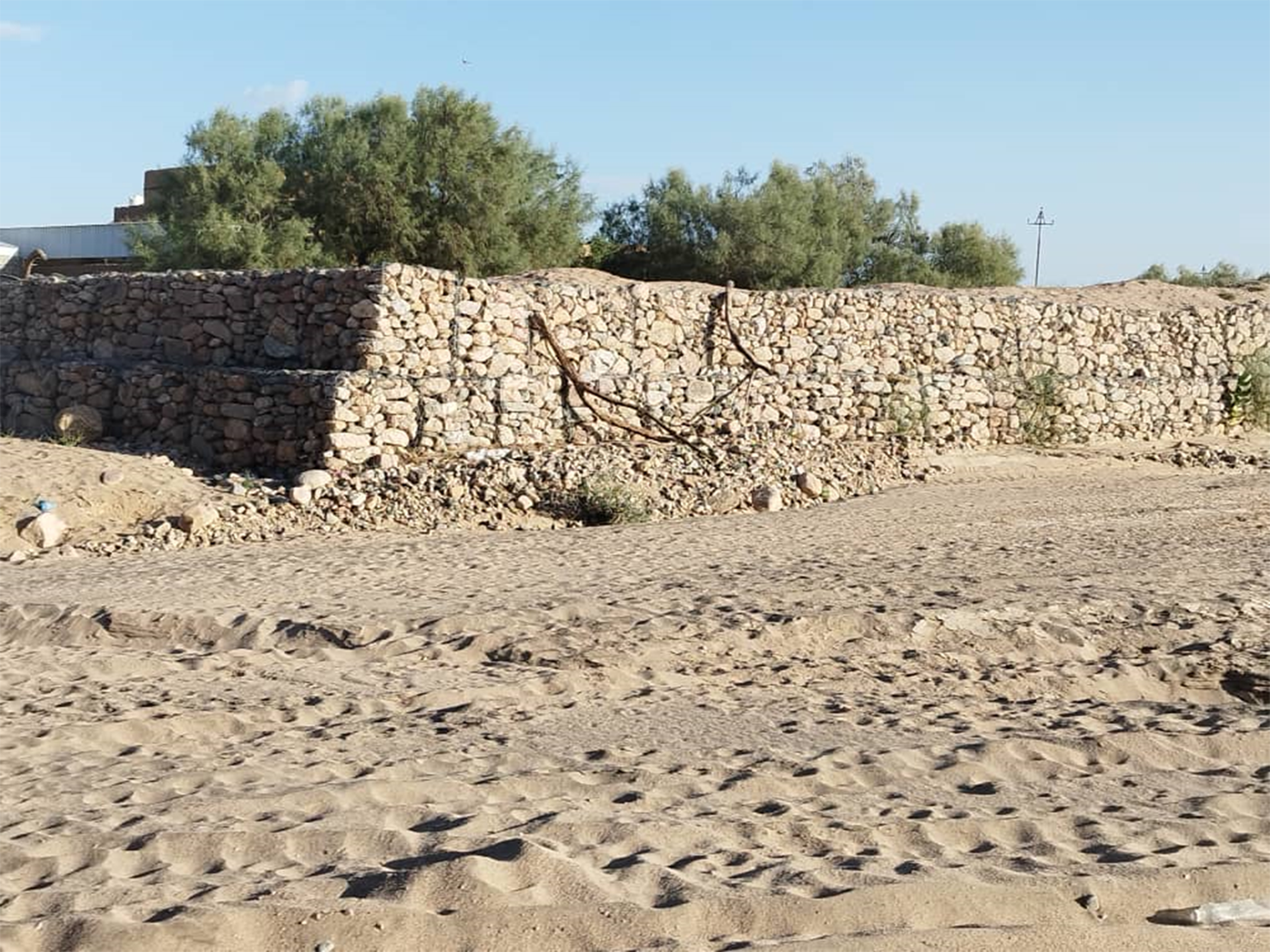
In contemporary Yemeni folk poetry, the term kābah is commonly used as an idiomatic expression “yā kābat al-wādī” (Oh ye the kābah of the valley) especially in Maʾrib folk poetry. One could find several poetic expressions addressing a respected leader, such as: yā kābat al-wādī w-mirzāḥah; yā kābat al-wādī w-miḍwāḥah; yā kābat al-wādī w-ṭāʿūnah, etc., referring to the person as a [flood] protector of the communityFootnote 7 (see Figure 1).
A modern kābah-wall (against flood) from Ḥarīb, Maʾrib.
Photo: Yazīd Ṣāliḥ as-Saqqāf, May 2023.

The comparison between the Ancient South Arabian term kʾbt and the Kaʿbah of Najrān was proposed by Christian Robin, when publishing another inscription from Najrān, namely Najrān 1/2, which has the line: (b)-kʾbt-hw (in his kʾbt) as a sanctuary name for the deity dhū-Samāwī, the deity of the city “rgmt” in Najrān, that is also attested in RES 4930 as ḏ-smwy ʿdy kʾbtn (dhū-Samāwī at the Kʾbt); thus, Robin wrote:
Il est vraisemblable que Kaʾbatān est devenu le grand temple de dhū-(ʾl)-Samāwī à Nagrān, quand la ville de Ẓirbān a supplanté Ragmatum. Ce serait lui … qui aurait donné naissance au mythe d'une ka'ba à Najrān, du fait de la ressemblance des noms. Si cette hypothèse est acceptée, il faut supposer que Kaʾbatān n'a pas été détruit lors du rejet du polythéisme, mais qu'il a changé de fonction (devenant un lieu de culte chrétien ou un bâtiment public), tout en conservant le même nom (Robin Reference Robin, Beaucamp, Briquel-Chatonnet and Robin2010a: 63).
Mais il est évident que le substantif kʾbt est progressivement devenu un nom propre, Kaʾbatān (en arabe al-Kaʾba). On peut ajouter que la Kaʾbat de Najrān est vraisemblablement le nom original de la Kaʿbat Najrān des sources islamiques (Robin et al. Reference Robin, al-Ghabbān and Fāyz al-Saʿīd2014: 1075).
Moreover, we encounter the term in the plural form ʾkʿb (could be vocalized as: ʾakʿāb) in the South Arabian minuscule inscription X.BSB 17, a term which Peter Stein interpreted as a capacity unit (kʿb-Maße), comparing it with the Arabic root KʿB, meaning a cube (Stein Reference Stein2010: 111). This is quite understandable in a trade context as a technical term, which is also preserved as a capacity unit in some early Arabic lexicons such as al-Farāhīdī (Reference al-Farāhīdī, al-Maḫzūmī and Sāmarāʾīn.d., I, 207), who wrote: wa-l-kaʿbu min as-samni qadru ṣubbatin ʾaw kaylatin (the kaʿb of ghee is a quantity, or a measure, of it), and also Yemeni Arabic kuʿābah “small pot of dhurah purée scooped into the broth” (Piamenta Reference Piamenta1990–91: 432).
The Meccan Kaʿbah description
Barbara Finster suggested that the origins of the Meccan Kaʿbah, at least as it was constructed by the anti-caliph Ibn al-Zubayr, perhaps “are to be sought in Ḥaḍramawt” and Maʿīn (Finster Reference Finster1973: 94; Reference Finster1991: 56; Reference Finster1992: 126; Reference Finster, Flood and Necipoğlu2017: 83). This may apply to the cubic design,Footnote 8 but not necessarily to the name Kaʿbah itself, which preceded al-Zubayr and Islam, and was assigned to a dome-shaped sanctuary of Najrān, also called Kaʿbah.Footnote 9
Western scholars generally understand the name Kaʿbah as a reference to a cubic or quadrangular architectural body (e.g. Wellhausen Reference Wellhausen1897: 73; Lane Reference Lane1968: 2616; Finster Reference Finster1973: 96; Reference Finster1991: 54; Wensinck Reference Wensinck1997: 317; Hawting Reference Hawting2003: 75; Finster Reference Finster, Neuwirth, Sinai and Marx2009: 76; Robin Reference Robin2010b: 236) even al-Hajj (Reference al-Hajj2015: 201), who published the inscription we are considering here, maintained the same meaning. Obviously, this is based on the Classical Islamic works, which state that “al-kaʿbatu: al-baytu al-murabbaʿu” (the kaʿbah is the quadrangular building) (e.g. ibn Manẓūr Reference Ibn Manẓūr1414 ah, I: 718). Nevertheless, the early Islamic sources do not make this clear, as the word Kaʿbah could equally be understood to be derived from kaʿb (heel, swelled breast).
Al-ʾAzraqī (Reference al-ʾAzraqī and Malḥas1983, I: 64, 66, 279), who provided us with the earliest description of the Kaʿbah,Footnote 10 wrote three times that the Kaʿbah was called so because it was ʿalā ḫilqat al-kaʿb (on a kaʿb form). The key lies in the meaning of the word kaʿb here, which might be misleading, as the kaʿb could mean several things in Arabic; it might mean the swelled breast (as in the Quranic usage Q. 78: 33) or ankle-joint bones (Q. 5: 6), but also might mean a “cube”. Al-Ṯaʿlabī did not leave room for confusion, as he mentioned the following explanation of the Kaʿbah name:
The philologists said: Its [the kaʿbah] original meaning is the ḫurūj (to go out) and the ʾirtifāʿ (to rise up). Thus, the ankle was called a kaʿb because it came out from both sides of the foot, and from it [this meaning of the word] was called a girl who approaches to puberty and her breasts swelled, she was called takaʿʿabat (she got heeled). Therefore, the kaʿbah was called kaʿbah because of its elevation from the ground. (al-Ṯaʿlabī Reference Ibn ʿĀshūr2000, IV: 112; XI: 511).
Moreover, Ibn Hishām (Reference Ibn Hishām and al-Saqqā1955, I: 89), Ibn Duraid (Reference Ibn Duraid and Baalbaki1987, I: 365), and Yāqūt (Reference Yāqūt1995, IV: 463), referred to a traditional poetic verse that mentions a sanctuary called kaʿbāt in a place called Sindād, with two slightly different versions. The first version is: wa-l-bayti ḏī-l-kaʿbāti min Sindādi (and the house of the kaʿbāt in Sindād); while the second reads: wa-l-bayti ḏī-l-šurufāti min Sindādi (and the house of the elevations in Sindād). šurufāt and kaʿbāt are used interchangeably, thus we can interpret kaʿbāt as Arabic šurufāt (plural of šurfah) “highest portions of a palace”, from šaraf “highness, elevation” (Lane Reference Lane1968: 1537).
This is in line with the description of the Meccan Kaʿbah as allegedly an ʿarīš, explained as a zarb (hut made of twigs), into which cattle could burst, which Rubin compares to the sacred TabernacleFootnote 11 used by the Israelites (Rubin Reference Rubin1986: 98; al-ʾAzraqī Reference al-ʾAzraqī and Malḥas1983, I: 65; Robin Reference Robin2000: 157–8), or that it had two corners in the shape  (wa-kānat ḏāt ruknayn) (Rubin Reference Rubin1986: 101; ibn Ḥajar Reference Ibn Ḥajar1379 ah, III: 441) and was not a cube. Even the Kaʿbah of Najrān was a dome (qubba) according to Ibn al-Kalbī (Yāqūt Reference Yāqūt1995, V: 268), and not a cube.
The Kaʿbah as a trellis (ʿarīš)
In their ethnographic works, Robert Serjeant and Werner Daum compared the Meccan religious institution of the Ḥaram and the South Arabian institution of the Ḥawṭah, which is associated with saints and prophets' shrines, usually a whitewashed dome (Serjeant Reference Serjeant1962; Daum Reference Daum, Arbach and Schiettecatte2015). Amongst his arguments, Serjeant found an interesting local poetic verse and recognized its sentiments as pre-Islamic. The verse is the eighth in a poem that the pilgrims chant in front the tomb of the prophet Hūd.
Serjeant (Reference Serjeant1954: 140) (with his translation):Footnote 12
Serjeant translated ʿarūs as “bride”, and commented that “to offer Hūd a bride and a marriage ceremony in return for his protection of the wheat crop (…) is reminiscent of ancient Semitic religion” (Serjeant Reference Serjeant1954: 141), an assumption that was adopted, and further extended, by Daum (Reference Daum, Arbach and Schiettecatte2015: 59). Daum and Serjeant were unaware of a similar verse, in two medieval Arabic works, related to Yemen. The two verses are equally enigmatic, and apparently are not attested elsewhere, other than Nashwān (Reference Nashwān, al-ʿAmrī, alʾIryānī and ʿAbdullah1999, VII: 4081) and Ibn al-Mujāwir (Reference Ibn al-Mujāwir and Lövgren1951: 212) as follows (see Figures 2, 3, 4. 5, 6).
The verse, from Nashwān's work (El Escorial, 603, page 45 left, line 28).

The verse, from Nashwān's work (Gl. 232, page 32 right, line 2).

The verse, from Nashwān's work (Hamidiye 1397, page 403 right, line 27).

Ayasofya, 3080 (page 85 left, line 1).

Bibliothèque nationale de France, Ar. 6021, has ʿarūs with S (page 134 left, line 11).
(This manuscript apparently not known to Oscar Lövgren)

Ibn al-Mujāwir (according to its manuscripts: Leiden Or. 5572 (Ar. 2450); Uppsala Landberg 69):Footnote 13
While the Ayasofya (30800) manuscript has ʿarūs with S:
This confusion between the S and Š in Nashwān's version can easily be explained as an orthographic error, while the original word was with Š (ʿarūš, i.e. trellis). This was already noticed in the Arabic translation of Serjeant's Prose and Poetry from Ḥaḍramawt where the verse was first published; the Ḥaḍramī translator of the book, Saʿīd Daḥī (d. 2000 ad), commented that ʿarūs is probably a mistake for ʿarūš (singular: ʿarīš) which suits the context (Sārjint Reference Sārjint2014: 106).
Serjeant's local informant, Raḥaiyam, suggested that ʿarūs [sic] might be a cover (kiswah) for the tomb (Serjeant Reference Serjeant1954: 141), probably trying to correct Serjeant's mishearing of the verse by providing an alternative term for ʿarūš, i.e. kiswah (cover), but Raḥaiyam's correction was not taken into consideration. We know that Serjeant was aware of the word ʿarūš from one of his later articles (Serjeant Reference Serjeant1981: 309), nevertheless, he did not associate it with the verse, possibly influenced by the exciting idea of the bride offering, or lacking awareness of ʿarūš at the time of publishing the Hūd article in 1954, until documenting it in 1981.
Although it may question a fundamental argument in Daum's work, these notes further support the relation between Hūd's sanctuary and the Meccan sanctuary (the Kaʿbah), and even more significantly the Kaʿbah of Najrān. The Kaʿbah of Najrān was a dome near a river (Yāqūt Reference Yāqūt1995, V: 268), just like the dome of Hūd which is near a river as well (Serjeant Reference Serjeant1954: 140, 150). The Meccan sanctuary was not near a river, but in the wadi bed and determined by the frequent floods, which forced the Meccans to build a barrier jidār (wall) in order to protect the sanctuary, turning it into a massive building against the flood (Rubin Reference Rubin1986: 101). This wall might be what South Arabians used to call kʾbt according to the epigraphic evidence and the modern usage, and might serve as a reason for the name Kaʿbah for the sanctuary, rather than a supposedly cuboid shape.
The qubba, ʿarīš, and zarb are interchangeable terms according to the tradition mentioned by Ibn Ḥajar (Reference Ibn Ḥajar1379 ah, VII: 289), related to the prophet Muḥammad, that “he was in a qubbah, that is an ʿarīš”. This type of dome-shaped trellis might be similar to the Tihāmi houses; it is tied around a central pole called qurʿaynah (described and illustrated by John Nankivell, in Stone Reference Stone1985: 87).
Idiomatic expression?
It seems that there is an idiomatic expression in the Yemeni folk-poetry, where the poet promises to build a qubbah wa-ʿarūš (a dome and a trellis), in return for fulfilling a certain desire. This can be compared with folk-poetic verse, documented in Southern Yemen by Landberg (Reference Landberg1909: 666), where a man promised to build a zarībah wa-kābah (an enclosure of wood and a kābah), according to Landberg's translation:
Another verse recorded recently by the Former Prime Minister of South Yemen, Muḥammad (Reference Muḥammad2019: 47), attributed to a certain ʿAli Sulaymān:
The history of the word “cube” in Arabic
Interestingly, there is no clear usage of the term kaʿb (cube) in Arabic literature before the philosophical authors who were heavily influenced by and translated Greek works, e.g. al-Kindī (801–873 ad), Qusṭā bin Lūqā or Costa ben Luca (820–912 ad), al-Māhānī (?–880 ad), al-Yaʿqūbī (?–897 ad), Ibn Ḥunayn (830–? ad), and Ibn Sīnā (980–1037 ad).Footnote 17
However, it should also be mentioned that the term kaʿb appears in Arabic as a name for the dice game. Pre-Islamic Arabia, or at least early Islamic Arabia, knew the dice (kaʿb) game, as al-Farāhīdī (Reference al-Farāhīdī, al-Maḫzūmī and Sāmarāʾīn.d., VI, 231; VIII, 22) wrote that the šazan,Footnote 18 and elsewhere the nard, is the kaʿb (cube?) used for playing.Footnote 19 But kaʿb here does not necessarily mean a cube but knucklebones. By analogy with Greeks, who used to make dice from the six-sided astragalus “knucklebones” of sheep or goats (Montanari Reference Montanari2015: 322), which Arabs call kaʿb, meaning “any joint, juncture, or place of division, of the bones” (Lane Reference Lane1968: 2616), it is expected to call the dice in Arabic a kaʿb, meaning a “knucklebone”, not necessarily a “cube”. It is still possible that it is borrowed from Greek, because the “words for dice are often loans” (Beekes Reference Beekes2010: 795).
According to the Doha Historical Dictionary of Arabic, the term kaʿb (cube) was first clearly used by al-Kindī, when he described “a fixed shape, limited, body, like a round shape or a mukaʿʿab [a cubed shape])”.Footnote 20 Similarly, Costa provides a straightforward definition of the cube as “a body surrounded by six square surfaces, of equal sides, right angles, and it is called a kaʿb [cube])”.Footnote 21 The term has no Semitic cognates, and is most likely an example of a phono-semantic matching loanword, from ancient Greek κύβος “cube, dice (for gaming)” (Montanari Reference Montanari2015: 1187) also “vertebra” (Beekes Reference Beekes2010: 795), which François de Blois suggested to be “probably a Mediterranean wander word”.Footnote 22
Loanwords in Arabic with ʿAyn are extremely rare, but one can mention Greek ᾰ̓́κρᾱ (ákrā) “peak, culminating point, summit, crest, tip” (Montanari Reference Montanari2015: 74), which has been borrowed into Arabic as ʿaqr meaning “citadel, elevated building”, as it appears in a verse by Labīd al-ʿĀmirī (D. 661 ad), where he likens his camel to a citadel.Footnote 23 Additionally, some fruit names, such as in Modern Iraqi Arabic, ʿarmūṭ and its Yemeni variant ʿambarūt (pear), from Persian or Hindi āmrūd; and Yemeni ʿanānīṣ (pineapple) from ananas (Piamenta Reference Piamenta1990–1991: 340, 432), all are examples of loanwords in Arabic with ʿAyn, for /a/ sound.
Conclusions
The name of the Kaʿbah, whether in Mecca or Najrān, is probably borrowed from Ancient South Arabian kaʾbat, which designates a high structure, probably with a protective function against water, a term which was later assigned to a sanctuary name for the deity dhū-Samāwī in Najrān, and not derived from Arabic kaʿb (cube).
The Greek term κύβος, which seems to have reached Arabia earlier, during pre-Islamic times, was not borrowed with the meaning of “cube”, but only as a capacity unit term, documented in the minuscule inscriptions, with no geometric connotations.
Later, when the Arabs translated the Greek philosophical works, they borrowed the Greek term κύβος, for cube, as kaʿb with a phono-semantic matching, after the time when the Meccan Kaʿbah established its cubical form that we know today. Consequently, some lexicographers mistakenly attributed the name Kaʿbah to its cubic shape, as it appears in the Arabic works compiled during the Abbasid era.
Acknowledgements
I extend my sincere gratitude to the two anonymous reviewers from BSOAS for their valuable suggestions, and I am thankful to Roey Schneider for revising the final draft and providing insightful comments. Any errors are solely mine.