INTRODUCTION
In animal industries, growth traits of animals are always of primary concern during breeding for their determinant economic value (Zhang et al. Reference Zhang, Ling, Wang, Hang, Guo, Zhang, Ding and Zhang2013). Early growth traits of animals are important factors influencing profitability in any meat-producing enterprise. In other words, growth traits are complex quantitative traits involving multiple genes and their interactions (Walling et al. Reference Walling, Visscher, Wilson, McTeir, Simm and Bishop2004), so a number of candidate genes have been implicated in growth traits. Of these, myostatin (MSTN), also known as growth and differentiation factor 8, is a member of the transforming growth factor-β super-family. This super-family encompasses a large number of growth and differentiation factors that play pivotal roles in regulating skeletal muscle development and maintaining tissue homeostasis in adult animals (Ansary et al. Reference Ansary, Tahmoorespur, Nassiry, Taheri and Valeh2011).
In goats, the MSTN gene is located on chromosome 2 (Li et al. Reference Li, Wu, Gong, Liu, Liu, Wang, Xin and Ji2006). Molecular analysis has shown that this gene consists of three exons and two introns. Transcripts from this gene are translated into a 376 amino acid precursor protein. This is processed by proteolytic cleavage at residues RSRR (a putative proteolytic processing site) to give an N-terminal prodomain and a C-terminal domain that only becomes the active MSTN protein ligand after the prodomain is further cleaved by proteolysis (McPherron et al. Reference McPherron, Lawler and Lee1999). The MSTN plays an essential role in the regulation of muscle growth and this regulatory role is via the inhibition of myoblast proliferation and differentiation, especially in skeletal muscles during embryonic development (Miar et al. Reference Miar, Salehi, Aleyasin and Raoufzadeh2011). Mutations in the MSTN gene can stop gene expression or produce a non-functional protein, which leads to dramatic muscularity and a ‘double-muscling’ phenomenon in many species (Lin et al. Reference Lin, Arnold, Della-Fera, Azain, Hartzell and Baile2002).
Increasing numbers of polymorphisms in the MSTN gene have been investigated intensively. In cattle, an 11-base pair deletion in exon 3 and some other polymorphisms of the MSTN gene are directly related to the ‘double-muscling’ phenotype and high growth rate (Grisolia et al. Reference Grisolia, D'Angelo, Porto Neto, Siqueira and Garcia2009). Also, Schenkel et al. (Reference Schenkel, Miller, Ye, Moore, Nkrumah, Li, Yu, Mandell, Wilton and Williams2005) found a difference of 3·5 and 2·0 kg at birth between the groups inheriting 2 and 1 copies and the groups inheriting 1 and 0 copies of the inactive MSTN allele, respectively. One of the mutations in the bovine MSTN gene is a cytosine (C) to adenine (A) tranversion in exon 1 (g.433C > A), causing substitution of leucine for phenylalanine in the 94th amino acid. This F94L substitution occurs in a region of the protein known to be the inhibitory domain of the MSTN (Esmailizadeh et al. Reference Esmailizadeh, Bottema, Sellick, Verbyla, Morris, Cullen and Pitchford2008; Khani et al. Reference Khani, Abdolmohammadi, Foroutanifar and Zebarjadi2014). Additional single-nucleotide polymorphisms (SNPs) associated with muscling have also been identified in the promoter and intron 2 regions (Kijas et al. Reference Kijas, McCulloch, Edwards, Oddy, Lee and Van der Werf2007).
In sheep, mutations in the region encoding the 3′untranslated region (UTR) region of the MSTN transcript have been identified and the g. + 6223A allele has been found to create an illegitimate miRNA-binding site that affects the double-muscling trait of Texel sheep (Johnson et al. Reference Johnson, McEwan, Dodds, Purchas and Blair2005). Mutations in the sheep MSTN gene had a significant effect on muscular development (Johnson et al. Reference Johnson, Dodds, Bain, Greer, McLean, McLaren, Galloway, Van Stijn and McEwan2009). In total, 23 SNPs in the ovine MSTN gene have been reported (Johnson et al. Reference Johnson, Dodds, Bain, Greer, McLean, McLaren, Galloway, Van Stijn and McEwan2009). However, other researchers did not detect SNP in the region encoding the 3′UTR region of the MSTN transcript in Chaal, Zel and Zandi Iranian sheep Breeds (Miar et al. Reference Miar, Salehi, Aleyasin and Raoufzadeh2011).
In a study on Boer goat, a 5 bp indel (1256 TTTTA/) present in exon 1 of the MSTN gene in the area encoding the 5′UTR region of the MSTN transcript (an untranslated regulatory region that has a key role in the translation process of the transcript) was detected by the polymerase chain reaction–restriction fragment length polymorphism (PCR–RFLP) method and reported that the AB genotype had a significant effect on growth performance (Zhang et al. Reference Zhang, Liu, Xu, Wen, Li, Zhang and Yang2012). Also, two SNPs in the MSTN gene (included in exon 1, with one in the region encoding the 5′UTR region of the MSTN transcript) were identified in Anhui White and Boer goats and the results showed significant associations between genotypes and body weight, body length and body height (Zhang et al. Reference Zhang, Ling, Wang, Hang, Guo, Zhang, Ding and Zhang2013). In 17 Chinese indigenous goat breeds, four haplotypes in intron 2 of the MSTN gene were identified (Li et al. Reference Li, Wu, Gong, Liu, Liu, Wang, Xin and Ji2006) and it was shown that body weight was associated with MSTN genotype. So far, no study has been conducted to investigate variants in other coding and uncoding regions of the MSTN gene in Markhoz goat populations. Following previous research on the MSTN gene, the objectives of the present study were to identify polymorphisms in exon 1 (which includes the region of exon 1 encoding the 5′UTR of the MSTN transcript) and exon 3 regions of the MSTN gene, to estimate the allele substitution effect of the MSTN gene, and to evaluate associations between these polymorphisms and growth traits in an Iranian Markhoz goat population.
MATERIALS AND METHODS
Flock management, data collection and DNA samples
The present study was conducted from October 2013 to January 2015. A total of 150 female Iranian Markhoz kids were randomly chosen at birth from the Animal Science Research Station, Sanandaj, Iran. The flock was housed in semi-extensive conditions with dry summer and cold winter. The grazing season generally lasted from April to October; goats were on pasture during the day and kept indoors at night. Supplemental feed, including alfalfa and barley grains, was offered to the animals.
Mating was from October to November 2013 with kidding in February to March 2014. Does were first exposed to the bucks at about 18 months of age. Annually, 20–30 bucks were allocated randomly to mate with about 10–15 does in breeding pens. Newborn male kids were not considered in the present study. All newborn female kids (samples) were weighed and ear-tagged immediately after birth and allowed them to remain with their mothers for a week. Most of the female kids were singletons (91%) and few (9%) were twins of the same sex (female). The female kids were separated from their mothers and suckled twice a day with the same amount of milk until weaning. They were weighed again at the end of weaning; the number of days for weaning varied from 3 to 3·5 months among the kids (Rashidi et al. Reference Rashidi, Bishop and Matika2011).
The growth traits that were evaluated in Markhoz goats included body weight at birth (BW), weaning (WW), average daily gain (ADG) from birth to weaning time (ADG) corrected for number of days, weight at 6 months of age (W6), 9 months of age (W9) and 12 months of age (W12).
Approximately 5 ml blood per goat was collected aseptically from the jugular vein and kept in a tube containing EDTA (ethylenediamine tetraacetic acid). All samples were transported to the laboratory on ice. Genomic DNA was extracted using a standard kit (Diatom DNA Prep 100, Cinagene, Tehran, Iran).
Primer synthesis and polymerase chain reaction conditions
According to the goat MSTN gene sequence (GenBank accession no. EF591039), two pairs of primers were designed to amplify exon 1 (which includes the region encoding the 5′UTR region of the MSTN transcript) and exon 3 of the goat MSTN gene (Table 1). The 25 µl volume of PCR reaction contained 50–100 ng genomic DNA, 0·25 µm of each primer, and 1 U Taq DNA polymerase, 2·5 mm magnesium chloride (MgCl2), 1× reaction buffer and 2 mm dNTPs (deoxynucleotides) (Rotor-Gene 6000; Corbett Research, Sydney, Australia). The cycling protocol was 5 min at 94 °C, 35 cycles of denaturing at 94 °C for 30 s, annealing at 58 °C for 30 s, extending at 72 °C for 45 s, with a final extension at 72 °C for 10 min (Table 1). The PCR products were separated on 1% non-denaturing agarose gel.
Primers information to amplify the MSTN gene in Markhoz goat

Polymerase chain reaction–restriction fragment length polymorphism
The suitable restriction endonucleases including DraI (5′…TTTAAA…3′) polymorphism, HinIII (5′…CATG…3′) and HindIII (5′…AAGCTT…3′) were selected using DNAstar and Webcutter software (http://rna.lundberg.gu.se/cutter2/) in order to digest the PCR products and to detect polymorphisms in exon 1 and 3 regions of MSTN gene, respectively. The different genotypes of MSTN gene were identified by the PCR–RFLP method at 37 °C for 12–14 h with the following reaction system: a final volume of 15 µl that contained 7 µl PCR products, 6 U endonuclease, 1·4 µl buffer. The digested products were electrophoretically separated on a 3% agarose gel, stained with ethidium bromide and observed by ultraviolet light (Uvi-Tech, Fire reader D56, Cambridge, UK).
Statistical analysis
The allelic frequencies, heterozygosity (He), Hardy–Weinberg (H–W) equilibrium and linkage disequilibrium were analysed by PopGene (Version 32) software (Yeh et al. Reference Yeh, Yang, Boyle, Ye and Mao1999).
Associations of the MSTN gene genotypes with growth traits in Iranian Markhoz goats were evaluated using analysis of variance (ANOVA), constructed using the MIXED procedure of SAS (Version 9.1) software (SAS Institute 2004). The general mixed model can be described as:
 $$Y_{ijklm} = \mu + YS_i + {\rm Type}B_j + \Sigma G_k + S_l + e_{ijklm} $$
where Y ijklm represents the dependent variable or growth trait, μ is overall mean of traits, YS i represents the fixed effect of the ith year-season of kidding, TypeB j represents the fixed effect of the jth birth type (singleton or twin), G k represents the fixed effect of the kth genotype, S l represents the random effect of the lth sire and e ijklm is the random residual effect with an expected value of 0 and normal distribution. The interactions among genotypes in different positions of MSTN gene were statistically not significant and removed from the model.
Allele substitution effects of MSTN polymorphisms for the studied traits were investigated using regression analysis as follows:
 $$Y_{ijkl} = \mu + YS_i + {\rm Type}B_j + \Sigma b_m G_k + e_{ijkl} $$
where Y ijkl represents the dependent variable or growth trait, b m is the regression coefficient (allele substitution effect) and G k is the number of copies of allele (0, 1, 2). Least-square means of different genotypes for growth traits were compared at level 0·05 and 0·1 to show significant statistical differences.
RESULTS
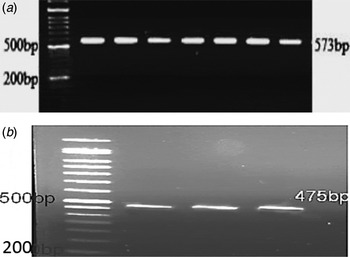
Two amplicons of 573 bp (including exon 1) or 475 bp fragments (including exon 3) from the MSTN gene were amplified from genomic DNA (Fig. 1). The PCR products had a clean strip and were without smearing.
PCR products of exon 1 (a) and exon 3 (b) of MSTN gene (50 bp ladder marker).

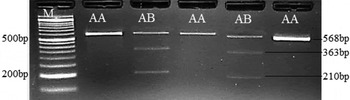
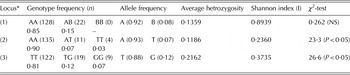
A 5 bp indel TTTTA located in the region encoding the 5′UTR of the MSTN transcript (at position 206 of the 573 bp PCR product) was detected in Iranian Markhoz goats. The digestion results by enzyme showed that the wild-type allele (TTTTA/TTTTA), including two 210 and 363 bp that can be digested by DraI endonuclease (named BB genotype) was not found in the Markhoz goat population. The PCR product could not be digested by DraI endonuclease and was named AA homozygote genotype. These genotypes showed a 568 bp fragment on agarose gel due to a 5 bp indel within 573 bp PCR product. Also, the AB heterozygote genotype showed three bands of 568, 363 and 210 bp on agarose gel (Fig. 2). The frequency of A allele was higher than that of B allele (Table 2). Also, the equilibrium χ 2-test is shown in Table 2. The deletion locus was in H–W equilibrium.
Digested results of the 573 bp fragments by DraI endonuclease: AA genotype (568 bp) and AB genotype (568, 363 and 210 bp).

Allele and genotype frequencies, average heterozygosity, Shannon index and equilibrium test in loci studied in Markhoz goat population

* (1) 5 bp indel located in the region of exon 1 encoding the 5′UTR of the MSTN transcript, (2) SNP in exon 1, (3): SNP in exon 3.
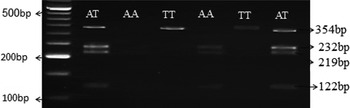
The 339 A/T substitution in exon 1 (at position 339 of 573 bp PCR product) was detected by HinIII (CATG/) endonuclease. Firstly, due to a monomorph region in the PCR products, the enzyme (CATG/) cuts the 573 bp PCR products at position 219, giving two bands at 219 and 354 bp. If the target mutation (339 A/T) is not present (T allele) then the TT genotype is seen at 354 and 219 bp fragments on the gel, but if the enzyme cuts at 339 bp (A allele), then 232 + 122 bp and also 219 bp fragments can be observed on the gel for AA genotypes. All possible genotypes, including AA (232, 122 and 219 bp), AT (354, 232, 122 and 219 bp) and TT (354 and 219 bp) were observed in the samples taken from Markhoz goats (Fig. 3). The genotype frequencies showed a tendency for AA > AT > TT, i.e. the largest frequency was for genotype AA (Table 2).
Digested results of the 573 bp fragments by HinIII endonuclease: AA genotype (232, 122 and 219 bp); TT genotype (354 and 219 bp) and AT genotype (354, 232, 122 and 219 bp).

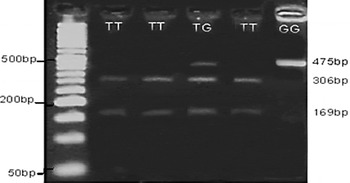
The 169T/G substitution in exon 3 (at position 169 of 475 bp PCR product) was detected by HindIII (AAGCTT/) endonuclease, as the endonuclease cannot cut this region if the G nucleotide is located in this position. Three genotypes, including TT (169 and 306 bp), TG (169, 306 and 475 bp) and GG (475 bp), were identified after digestion by enzyme (Fig. 4). The frequency of the T allele was higher than that of the G allele (Table 2). The genotype frequency showed a tendency for TT > TG > GG, i.e. the largest frequency was the TT genotype. These frequencies showed H–W disequilibrium in two positions (exons 1 and 3) of the MSTN gene (P < 0·05).
Digested results of the 475 bp fragments by HindIII endonuclease: TT genotype (306 and 169 bp); GG genotype (475 bp) and TG genotype (475, 306 and 169 bp).

Association of exon 1 and 3 genotypes with growth traits
The linkage disequilibrium test between the deletion locus and two SNPs loci indicated that they were strongly linked (r 2 = 0·71 and 0·69).
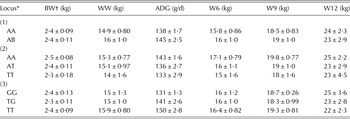
Evaluation of the associations between the polymorphism regions of MSTN gene and the studied growth traits showed that the AA genotype of exon 1 has a significant positive effect (P < 0·05) on W6 trait (Table 3), but genotypes in the region encoding the 5′UTR of the MSTN transcript did not have any significant effect on the studied growth traits. The results obtained on the association of different genotypes of exon 3 with the studied growth traits showed that the GG genotype has tendency for a positive effect (P < 0·1) on ADG trait (Table 3).
Least square means (±s.e.) of growth traits and association with MSTN gene polymorphisms

* (1): 5 bp indel located in the region of exon 1 encoding the 5′UTR of the MSTN transcript, (2): SNP in exon 1, (3): SNP in exon 3.
† Body weight at birth (BW); weaning (WW), 6 months of age (W6), 9 months of age (W9), 12 months of age (W12) and average daily gain from birth to weaning time (ADG) corrected for number of days.
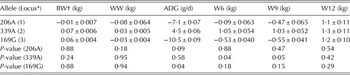
Average allele substitution effects of the 339A and 169G alleles for all growth traits were estimated (Table 4). The statistical analyses confirmed positive and significant effect of the 339A allele for W6 and negative and significant effect of the 169G allele for ADG (P < 0·05). No significant effect was found for other growth traits.
Allelic substitution effects (±s.e.) of MSTN gene for growth traits in Markhoz goats

* (1) 5 bp indel located in the region of exon 1 encoding the 5′UTR of the MSTN transcript, (2) SNP in exon 1, (3) SNP in exon 3.
† Body weight at birth (BW); weaning (WW), 6 months of age (W6), 9 months of age (W9), 12 months of age (W12) and average daily gain from birth to weaning time (ADG) corrected for number of days.
DISCUSSION
The Shannon's Information Index and average hetrozygosity represent the extent of genetic diversity. The relatively high Shannon's Information Index (0·8939–0·3735) and average hetrozygosity (0·2162–0·1186) indicated moderate diversity of the MSTN gene in this population.
In the present study, polymorphisms of exons 1 (which includes the region of exon 1 encoding the 5′UTR of the MSTN transcript) and 3 of the MSTN gene were detected in 150 goats but, in this population, no wild-type genotype was observed at the 206–211 TTTTA/ locus. There are two possible reasons for this finding: limited sample size in the current research (150 goats) and the natural selection effect. Also, this allele may have a negative effect on individual performance; therefore individuals with the missing genotypes may have been eliminated in the breeding process (Johnson et al. Reference Johnson, McEwan, Dodds, Purchas and Blair2005; Hu et al. Reference Hu, Gao, Feng, Liu, Wang, Du, Wang and Li2009).
Also, the results of other research have shown that the TTTTA deletion in the region of exon 1 encoding the 5′UTR region of the MSTN transcript was not conserved among different species and only goats had this kind of deletion in the MSTN gene (Esmailizadeh et al. Reference Esmailizadeh, Bottema, Sellick, Verbyla, Morris, Cullen and Pitchford2008; Hu et al. Reference Hu, Gao, Feng, Liu, Wang, Du, Wang and Li2009; Singh et al. Reference Singh, Kumar, Kumari, Kumar and Mitra2014). Their results could be explained thus: (1) it might be unique to goats, after using a BLAST (basic local alignment space tool) with sheep, cattle, pig and human and (2) due to positive selection on individual performance.
The current results showed that polymorphisms of the MSTN gene have significant effects on some growth traits in Iranian Markhoz goats. The AA (in exon 1) and GG (in exon 3) genotypes were associated with the W6 and ADG traits, respectively. Moreover, there was a tendency for individuals with the AB genotype (in 5′UTR encoding region of exon 1) to have better performances in BW, WW, W6 and W9 than AA genotype, although the differences were not significant. This might be due to a low number of BB genotypes in the samples.
It has been reported that there is significant effect of 5 bp indel (in the region of exon 1 encoding the 5′UTR of the MSTN transcript) on early body weight and size in goat, and that the AA homozygote individuals have better growth performance than AB heterozygotes (Li et al. Reference Li, Liu, Zhou, Zheng, Gong and Li2008). Recently, researchers have reported a significant effect of the RFLP/HinIII polymorphism at nucleotide position 1388 within the exon 1 region on growth traits in Boer goat breeds; the CD genotype generally had better BW and W9 than those of the CC and DD genotypes (Zhang et al. Reference Zhang, Liu, Xu, Wen, Li, Zhang and Yang2012). A similar result was also observed in Boer and Xinong Saanen goat breeds, where the relationships between different genotypes and growth traits showed that the AA genotype in exon 1 of the MSTN gene has higher body weight and greater length than those of the AC and CC genotypes (Hu et al. Reference Hu, Gao, Feng, Liu, Wang, Du, Wang and Li2009).
In the present study, substitution effects of the A and G alleles for W6 and ADG traits were significant. But, so far, allele substitution effects attributable to MSTN have not been reported in goat. In sheep, studies have investigated the effects of MSTN g + 6723A on carcass traits and increase of muscle mass observed in New Zealand Texel sheep (Johnson et al. Reference Johnson, Dodds, Bain, Greer, McLean, McLaren, Galloway, Van Stijn and McEwan2009). The results of the present study indicated a superior effect of the wild-type allele compared with the mutant allele in exon 1 and also mutant allele compared with the wild-type allele in the exon 3 of goat MSTN gene. Therefore, selection of A and G alleles may have the potential to increase some growth traits in the Iranian Markhoz goat breed.
The main determinant of fast growth in mammals is an increase in muscle cell growth and proliferation. MSTN is the essential hormone for growth development, which is responsible for the proliferation of somite cells during the early stages of embryogenesis, and muscle mass (McMahon et al. Reference McMahon, Popovic, Jeanplong, Oldham, Kirk, Osepchook, Wong, Sharma, Kambadur and Bass2003). Muscle mass is determined by a balance between protein synthesis and break-down that are modulated by many anabolic and catabolic factors. Catabolic factors such as glucocorticoids, which cause muscle atrophy, and anabolic factors, such as androgens, can increase protein synthesis and thus promote muscle hypertrophy. Additionally, glucocorticoids and androgen receptors can play a role in regulating muscle cell and reproductive cycles (Ma et al. Reference Ma, Mallidis, Artaza, Taylor, Gonzalez-Cadavid and Bhasin2001; McMahon et al. Reference McMahon, Popovic, Jeanplong, Oldham, Kirk, Osepchook, Wong, Sharma, Kambadur and Bass2003; Khani et al. Reference Khani, Abdolmohammadi, Foroutanifar and Zebarjadi2014). In human C2C12 and L6 muscle cell lines, deletions of the 5′-upstream region of the promoter from 23 322 to 21 187 bp resulted in a marked increase in transcriptional activity (Ma et al. Reference Ma, Mallidis, Artaza, Taylor, Gonzalez-Cadavid and Bhasin2001). In mice, deactivation of the MSTN gene causes a significant increase in muscle mass through muscle cell hypertrophy and hyperplasia (Grisolia et al. Reference Grisolia, D'Angelo, Porto Neto, Siqueira and Garcia2009).
Recently, it has been reported that some mutations in the MSTN gene can inactivate its expression, which causes dramatic muscularity and the double-muscling phenomenon in Bos taurus (Esmailizadeh et al. Reference Esmailizadeh, Bottema, Sellick, Verbyla, Morris, Cullen and Pitchford2008). In addition, Boman et al. (Reference Boman, Klemetsdal, Nafstad, Blichfeldt and Vage2010) reported that mutation (2360G > A) in the region of exon 3 encoding the 3′UTR region of the MSTN transcript had a significant effect on carcass conformation and fatness in Norwegian white sheep breeds. The MSTN polymorphism associated with growth traits in the Baluchi sheep breed using PCR–single-strand conformation polymorphism (PCR–SSCP) showed three patterns including P1, P2 and P3 for intron 1, with the P1 genotype pattern having the highest weight and estimated breeding value for the weaning weight (Ansary et al. Reference Ansary, Tahmoorespur, Nassiry, Taheri and Valeh2011).
Some chromosomal fragments influencing growth traits such as weight and post-weaning ADG in cattle and also weight at first shearing in sheep have been detected (Visser et al. Reference Visser, Van Marle-Köster, Snyman, Bovenhuis and Crooijmans2013). However, studies have yet to identify quantitative trait loci (QTL) for growth traits in goats (Mohammad Abadi et al. Reference Mohammad Abadi, Askari, Baghizadeh and Esmailizadeh2009). Visser et al. (Reference Visser, Van Marle-Köster, Snyman, Bovenhuis and Crooijmans2013) could not detect any QTL influencing WW in Argentinean Angora goats. Quantitative trait loci between 54 and 62 cM, close to the MSTN gene, have been reported that influence muscle depth and live weight at 8 weeks of age in Texel sheep (Johnson et al. Reference Johnson, McEwan, Dodds, Purchas and Blair2005). Johnson et al. (Reference Johnson, McEwan, Dodds, Purchas and Blair2005) also suggested the MSTN as a positional candidate gene for growth traits rate using refined QTL mapping.
In summary, it is supposed that the mutations studied in the MSTN gene, two in exon 1 and the single mutation in exon 3, have potential to influence the gene expression or functional structure of MSTN protein and therefore may affect growth traits in the animals. The deletion and SNPs observed in the present study are probably non-functional variants. In the present paper, the weak association of the deletion and SNPs of MSTN gene with growth traits may be due to linkage disequilibrium with other variants in the MSTN gene or QTL reported in this region of chromosome 2. Also, it should be noted that the sample size of the current research was small. Therefore, more studies are needed to simultaneously consider variants of this region in a larger population to better understand MSTN gene effects on the economic traits in goat.
This paper was funded by Razi University, Iran. Also, authors would like to thank Dr Mojtaba Goli (Faculty of Veterinary Medicine, Razi University, Iran) for his helpful comments on the manuscript.