INTRODUCTION
Leptomeningeal carcinomatosis, also called leptomeningeal metastasis (LM), is characterized by seeding of the leptomeninges and the subarachnoid space with a dense infiltrate of malignant cells (Chamberlain, Reference Chamberlain2005).
Currently, the incidence of leptomeningeal carcinomatosis is increasing among both solid tumor (Wasserstrom et al., Reference Wasserstrom, Glass and Posner1982; Martins et al., Reference Martins, Azevedo and Chinen2011) and lymphoproliferative malignant disease patients (Birnbaum et al., Reference Birnbaum, Baumgarten and Dudil2014) due to both progress in neuroimaging (including improved screening and prolonged control of extracerebral disease) and the use of antineoplastic agents that diffuse poorly into the central nervous system (CNS) (Le Rhun et al., Reference Le Rhun, Taillibert and Chamberlain2013a ). Therefore, LM is increasingly being detected in association with special advanced cancer conditions, such as breast (Scott et al., Reference Scott, Oberheim-Bush and Kesari2015) and lung (small-cell) cancers (Hammerer et al., Reference Hammerer, Pauli and Quoix2005), melanomas (Amer et al., Reference Amer, Al-Sarraf and Baker1978), and non-Hodgkin's lymphoma (Chamberlain, Reference Chamberlain2011). The diagnosis is confirmed by the presence of cancer cells in the cerebrospinal fluid (CSF) or by the absence of cancer cells in the CSF, and by the presence of concomitant typical clinical and imaging signs of meningeal involvement. CNS signs and symptoms may be pleomorphic and are often subtle and difficult to distinguish from other cancer complications, such as brain metastases or antineoplastic treatment complications (Chamberlain et al., Reference Chamberlain, Glantz and Groves2009). The development of new therapies involving combinations of chemotherapy and targeted therapy that are administered systemically or via the intra-CSF route has increased survival among advanced cancer patients by 4 to 6 weeks when the condition is untreated and several months if the condition is treated (Mack et al., Reference Mack, Baumert and Schäfer2016). Some authors have even reported 10% survival at one year (Le Rhun et al., Reference Le Rhun, Taillibert and Zairi2013b ).
Early treatment prior to initiation of fixed neurological deficits is required to permit potentially more effective treatment and improve both survival and quality of life. Multidisciplinary approaches must be implemented and must be specific to each characteristic of the meningeal diseases, the general primary tumor conditions of the patients, the clinical aspects, and the previous lines of treatments.
The psychiatric aspects of leptomeningeal carcinomatosis and the implications for the psychooncological team in terms of management of this pathology will be illustrated through our report of an unusual case of breast carcinomatous meningitis mimicking a manic episode.
CASE REPORT
A 61-year-old woman diagnosed in 2004 with a past history of left breast cancer (stage T4N1MO) was 100% estrogen receptor (ER)-positive, 85% progesterone receptor (PR)-positive, and HER2-negative. Additionally, she was initially treated with neoadjuvant chemotherapy, radical mastectomy, radiotherapy, and hormonotherapy (anastrozole) and was confronted in 2010 with a first axillary node relapse followed by several recurrences of the disease (in the bones in 2012, liver in 2013, and multiple cutaneous nodes and pleural metastases in 2014). Each of the latter conditions was treated with different regimens of systemic chemotherapy. In October of 2015, she developed a deficit of the upper left limb. Brain magnetic resonance imaging (MRI) was performed at the end of October of 2015 and revealed a contrast enhancement of the acoustic and facial nerves. A spinal MRI revealed a meningeal contrast enhancement. A lumbar puncture demonstrated hyperproteinorachia (3.41 g/l) and numerous tumor cells in the cerebrospinal fluid. The diagnosis of leptomeningeal metastasis was then confirmed.
Prednisolone (40 mg/day) was initiated at the end of October of 2015 due to the clinical deficit, and the patient was enrolled in a protocol (NCT01645839) evaluating systemic treatment alone versus systemic treatment plus liposomal cytarabine. She first received cyclophosphamide monohydrate treatment alone in November.
At the end of December, the psychiatrist was called for a psychiatric assessment due to behavioral disorders co-occurring with mood disorders. No past psychiatric history was found during a patient interview in terms of mood and/or psychotic disorders or the existence of cognitive dysfunction.
A suspicion of a hypomanic state induced by steroids without steroid psychosis was made but not confirmed by Angst score (6, with N < 10). The symptomatology continued to fluctuate. Steroids were tapered out by December 29.
Nine days later on January 7, 2016, the son of the patient called because his mother had exhibited three days of agitation with hyperactivity that included cleaning her entire house, spending money (she had written numerous large checks as presents to all of her family members—e.g., she wanted to buy a car for her son), wanting to perform work around the house, such as repainting a wall), calling a friend 30 times in four days on her mobile phone, and doing six crossword puzzles in the morning and five in the afternoon. During the interview, the patient felt relaxed and in “great form.” Her Angst scale score was 13 (N < 10). The patient denied her state. Olanzapine (10 mg) at night was prescribed. Within a week, the patient had calmed down, was sleeping better, and was less active. She criticized her prior behavior, saying that “it was not me.” Her Angst score dropped to 4. As of January of 2016, the patient remained in a psychiatrically steady state with no recurrence of the behavioral disorder. The olanzapine was maintained at 10 mg/day.
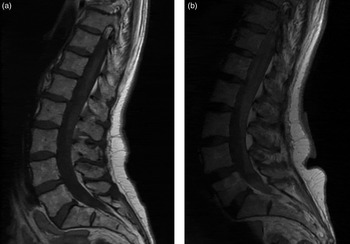
A moderate worsening of the left motor deficit and MRI progression were diagnosed on January 22. Increased contrast enhancement in the left lower cerebellum and increased perimedullary contrast enhancement were noted (see Figure 1).
Spinal MRIs at baseline and at first recurrence. Lumbar spinal MRI sequence sagittal T1 post-contrast enhancement; progression of perimedullary contrast enhancement from baseline: November 2015 (a) and January 2016 (b).

She left the study on January 22 and received two injections of intrathecal cytarabine plus systemic treatment with cyclophosphamide monohydrate. She passed away on March 2.
DISCUSSION
Meningeal carcinomatosis can be the first presentation of an undetected primary cancer (6–38%) or can occur during cancer evolution or oncological treatment. The frequencies of meningeal carcinomatosis are estimated to be between 2 and 5% in breast cancer patients, from 9 to 25% in lung cancer patients, and up to 23% in melanoma patients (Martins et al., Reference Martins, Azevedo and Chinen2011).
Carcinomatous meningitis can present with a bizarre and polymorphic clinical picture. During involvement of the cerebral hemispheres, mental or behavioral changes can appear and be associated with memory loss and cognitive disturbances. Psychiatric signs are less frequent due to the paucity of case reports in the literature.
Psychotic behavior has been seldom described. In a rather old paper, Hawkins and Brown (Reference Hawkins and Brown1963) reported a case of a 67-year-old white man who was admitted for “blackout spells,” confusion, and visual hallucinations. This patient died two days after hospitalization. An autopsy revealed a tumor in the fundus of the gall bladder with meningeal carcinomatosis in the absence of a metastatic tumor in the substance of the brain, spinal cord, or choroid plexus. Nevertheless, the delirium picture was classical and included visual hallucinations, deteriorating short-term memory, paranoid delusions, and agitation (Lobo et al., Reference Lobo, Pillay and Kennedy2013). Meningeal carcinomatosis secondary to prostate cancer presenting as delirium tremens has also been reported (Rubins & Guzman-Paz, Reference Rubins and Guzman-Paz1997).
Manic episodes have seldom been reported among breast cancer patients without past histories of bipolar disorder. Usually, the occurrences of mood disorders among cancer patients must be considered as organic complications due either to the disease or brain metastasis (paraneoplastic syndromes must be excluded) or due to such treatments as steroids (Gable & Depry, Reference Gable and Depry2015). Nevertheless, such emotional dysregulation can be understood as a reaction to a stressful event, such as a recent cancer diagnosis (Asevedo et al., Reference Asevedo, Brietzke and Chaves2013).
In our case, we hypothesize two differential diagnoses to explain the occurrence of the manic episode. First, the cause may have been iatrogenic. Mood disorders that can be induced by steroids include depression, hypomania, mania, or even psychosis (Stiefel et al., Reference Stiefel, Breitbart and Holland1989; Brown & Suppes, Reference Brown and Suppes1998). Usually, corticosteroids generally result in short-lasting neuropsychiatric symptoms following cessation. Arguing against this hypothesis, the Angst score was normal during steroid treatment, which was rapidly halted, and the behavioral problems occurred one week later while the patient was not on corticotherapy. However, the case of a longlasting course of psychiatric symptoms (mania and psychosis) in a patient following nearly immediate cessation of corticosteroids 10 days prior to the occurrence of mania and psychotic symptoms was recently reported (Gable & Depry, Reference Gable and Depry2015). In our current case report, the manic episode occurred one week after the corticosteroids were stopped. Notably, steroids play only a limited role in the treatment of leptomeningeal metastases without associated brain metastases outside of prophylaxis against chemotherapy-induced arachnoiditis (Chamberlain et al., Reference Chamberlain, Soffietti and Raizer2014).
The second hypothesis is that the neurological condition of our patient (i.e., the manic episode) was induced by recurrence of the meningeal carcinomatosis. To our knowledge, there are no previous reports of manic episodes related to carcinomatous meningitis either at first diagnosis or upon recurrence. In our case study, the evolution of the neurological state of the patient was recognizable on physical clinical evolution and MRI, and psychiatric clinical features with a picture of worsened behavioral disorder and expression of a typical manic episode was also observed. Although, as mentioned previously, we cannot rule out the iatrogenic hypothesis, sustained corticosteroid-induced mania despite cessation is a rare condition. Therefore, we tend to consider that the psychiatric picture could have been an unusual manifestation of leptomeningeal metastatic progression. Nevertheless, we acknowledge that it is difficult to distinguish whether the manic reaction was more strongly related to the steroids or the leptomeningeal disease. In addition, despite the timing of the discontinuation of steroids, both entities are acceptable as possible causes—about which clinicians should be aware.
CONCLUSION
Leptomeningeal carcinomatosis is a severe manifestation of advanced cancer, and, despite chemotherapy, the prognosis remains grim (2–3 month survival times). Psychiatric manifestations can represent an important comorbidity that can emphasize negative outcomes. Faced with a patient with a psychiatric picture that includes altered behavior, drastic changes in mood, and confusion, and with either no past medical history or previous solid tumor, organic causes, particularly leptomeningeal carcinomatosis, have to be ruled out.
CONFLICTS OF INTEREST
The authors hereby state that they have no conflicts of interest to declare.