Introduction
Mild cognitive impairment (MCI) is a state between normal cognition and dementia. The defining criteria most commonly used in research are those first proposed by Petersen et al. in 1999 (Petersen et al., Reference Petersen, Stevens, Ganguli, Tangalos, Cummings and DeKosky2001) i.e.
• Memory complaint (preferably corroborated by an informant)
• Objective memory impairment (for age and education)
• Preserved general cognitive function
• Intact activities of daily living (ADLs)
• Not having dementia
MCI is relatively common. The prevalence and incidence reported in the literature vary widely depending on the definition used and population studied, but in general elderly populations where strict definitions are used (such as the Petersen criteria given above) prevalence is generally given as approximately 3% and incidence as approximately 1% per year (Busse et al., Reference Busse, Bischkopf, Riedel-Heller and Angermeyer2003; Gauthier et al., Reference Gauthier2006; Anstey et al., Reference Anstey2008; Palmer et al., Reference Palmer, Backman, Winblad and Fratiglioni2008). Current estimates are that approximately 1.5 million people in the UK have MCI (Smith et al., Reference Smith2010). The annual incidence of dementia is around 3% in those with MCI in the general population (Mitchell and Shiri-Feshki, Reference Mitchell and Shiri-Feshki2009) compared to approximately 0.5% in all people over 60 years in the UK (2006).
It seems likely that rates of diagnosis of MCI will increase in the UK in the coming years. The National Dementia Strategy (NDS), which was published in the UK by the Department of Health in 2009, includes an objective focusing on “good quality early diagnosis and intervention for all” (Department of Health, 2009). The Department of Health National Campaign on early diagnosis of dementia was launched in November 2011 (Department of Health, 2011); this incorporated a media campaign to raise public awareness of the fact that many cases of dementia go undiagnosed. The campaign was particularly aimed at the friends and family of those at risk of dementia and emphasized the importance of consulting a health professional for assessment if they had concerns about a person's memory.
Increased awareness of dementia and MCI among the general public and primary care physicians, combined with the NDS and increasing availability of memory services, are likely to result in higher rates of referral for assessment and, hence, diagnosis of both dementia and MCI.
Despite its prevalence, and in contrast to dementia, little is known about the experiences of patients with MCI and their carers, nor the best way to support this group. There are no national or international guidelines for the management of MCI. In this paper, we review the current literature on the patient's and carer's experience of MCI together with recommendations that have been made about support and interventions. For the purposes of this review, patient/carer experience is defined as “occurrences in daily life and contact with health and social care services related to MCI and the consequent challenges experienced by patients and carers.”
Methods
The Embase and Medline databases were searched via the NHS Evidence Health Information Resources website. The title and abstract of all papers up to July 2011 were searched for the following keywords (without explosion):
“mild cognitive impairment” combined in turn with:
“symptoms” (limited to papers from 2008 to current)
“subjective complaint*”
“carer*”
“experience*”
“clinic*” (limited to papers from 2008 to current)
“primary healthcare” or “general pract*”
“consult*” or “attend*” or “seeking help,”
“patient perception*”
‘future’
“memory clinic*” combined in turn with:
“patient experience*”
“patient perception*”
A search of the Cochrane Library was performed using the “advanced search” facility to search “All of the Cochrane Library” using the terms “Mild Cognitive Impairment” and “MCI.” Systematic Cochrane and “other” reviews were considered.
The National Electronic Library for Health “Specialist Collections” “Later Life: Dementia” section was also examined. Articles in the “Guidance and Pathways” and “Patient Information” subsections were reviewed. Searches for the term “Mild Cognitive Impairment” were then carried out in each of these subsections.
The reference lists of obtained articles were examined for any additional articles of relevance. A large number of citations were excluded from the review, since on examination of the title and / or abstract, they were clearly not relevant to the topic being reviewed. Papers published in languages other than English were also excluded. Abstracts were included if they contained sufficient information, unpublished studies were not.
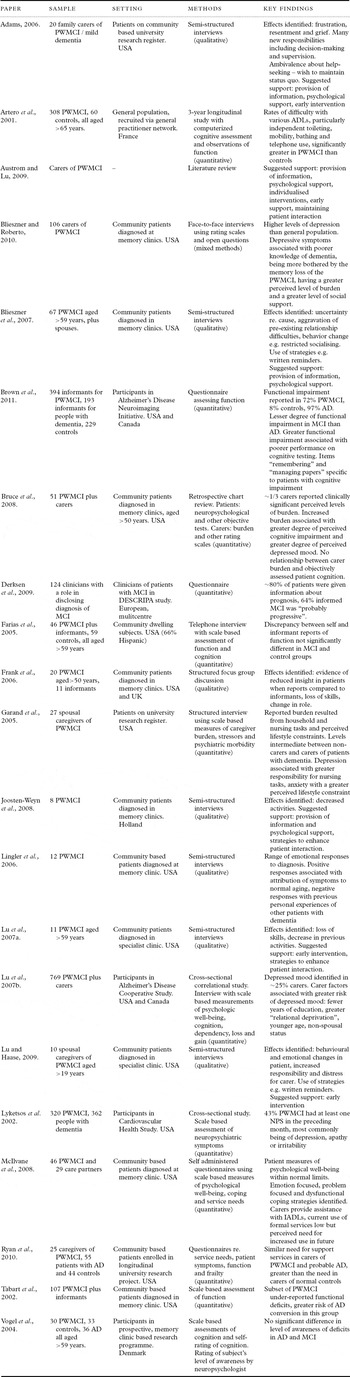
Details of the papers included in this review are summarized in Table 1.
Summary of the key findings of papers included in review

PWMCI = persons with mild cognitive impairment; ADL = activities of daily living; AD = Alzheimer's disease; NPS = neuropsychiatric symptom; IADL = instrumental ADL.
Results
The search strategy yielded 673 papers, of which, on review of the title and/or abstract, 20 proved to be of interest. Reference lists from obtained papers yielded one further article of interest; therefore, a total of 21 papers were included in this review.
Patient's experience of MCI
Diagnosis
No studies of the effect of disclosing a diagnosis of MCI to patients or carers have been carried out. One study has specifically examined patient's perceptions of having a diagnosis of MCI (Lingler et al., Reference Lingler2006). The study was limited to 11 patients who were aware of the term “mild cognitive impairment” relating to their cognitive problems. A range of emotional responses were identified, from positive (such as relief that the diagnosis was not dementia) to negative (such as fear about the future). Several important influences on patient perception were identified including the associations between attribution of symptoms to normal aging with a positive emotional response and previous personal experiences of other patients with dementia with a negative response. As part of the multicenter European Descripa study, 124 clinicians were surveyed about their practice of diagnostic disclosure in MCI. The results revealed that the diagnostic terms used to describe MCI were variable but that almost 80% of patients were given information about prognosis (Derksen et al., Reference Derksen, Graff, Visser, Vernooij-Dassen and Olde Rikkert2009); for example, 64% of patients were informed that their condition was “probably progressive.”
Practical problems
In several qualitative studies, interviews with patients diagnosed with MCI have been carried out and some common themes have been identified (Frank et al., Reference Frank2006; Lu et al., Reference Lu, Haase and Farran2007a; Joosten-Weyn et al., Reference Joosten-Weyn, Vernooij-Dassen, Rikkert and Teunisse2008). Although the patients interviewed described a myriad of challenges in everyday life, there were several themes which recurred across the interview groups, namely loss of skills in areas such as dealing with finances, decreased involvement in usual activities such as hobbies and difficulty with planning and spatial orientation.
Indeed, despite the stipulation in the Petersen definition of MCI that basic activities of daily living should be intact, it has been increasingly recognized that more complex or instrumental ADLs (IADLs) may be affected by MCI. Analysis of data from the Alzheimer's Disease Neuroimaging Initiative, in which nearly 400 patients with amnestic MCI were compared with cognitively intact patients and those with Alzheimer's disease (AD), revealed that informants reported functional impairment in at least one area for 72% of persons with MCI (PWMCI) – a figure much greater than the control group (8%) and approaching that in the AD group (97%). The degree of functional impairment reported for the MCI group, however, was less than that in the AD group. Unsurprisingly, greater functional impairment was found to be associated with poorer performance on cognitive testing (Brown et al., Reference Brown, Devanand, Liu and Caccappolo2011). Two items – difficulty with remembering (appointments, family occasions, holidays and medications) and managing papers (financial/business) – were specific to patients with cognitive impairment (as compared with cognitively intact controls); these were reported in 66% of the subjects with MCI. A study of functional ability in approximately 300 French patients with MCI found rates of difficulty with various ADLs, particularly independent toileting, mobility, bathing and telephone use, to be significantly greater than cognitively intact subjects in the same age group (30.8% vs. 3.3%) (Artero et al., Reference Artero, Touchon and Ritchie2001).
Emotions and neuropsychiatric symptoms
The qualitative interviews identified a number of emotions associated with MCI, almost all of which were negative. Those which recurred across the interview groups included decreased self-confidence, embarrassment, fear of becoming a burden to others, anxiety, sadness, frustration, and anger. Uncertainty about the nature of their diagnosis was also commonly expressed.
Neuropsychiatric symptoms (NPS) are thought to be a common feature of MCI: in a population-based cohort study of patients with MCI, carried out as part of the Cardiovascular Health Study in the USA, Neuropsychiatric Inventory (NPI) scores were examined for 320 patients classified as having MCI: 43% of these patients were found to have had at least one NPS in the preceding month with the commonest symptoms being of depression (20%), apathy (15%) and irritability (15%) (Lyketsos et al., Reference Lyketsos, Lopez, Jones, Fitzpatrick, Breitner and DeKosky2002). These findings have subsequently been confirmed in other quantitative studies where similar rates of NPS have been identified. However, there has been some disagreement as to the psychological impact of living with MCI. A questionnaire-based study of 46 patients recently diagnosed with MCI found measures of psychological well-being (such as depression and life satisfaction) to be within normal limits (McIlvane et al., Reference McIlvane, Popa, Robinson, Houseweart and Haley2008).
Attributions, coping and insight
Patients interviewed in the qualitative studies were asked about their understanding of the cause of their memory problems. Interviewees attributed their problems to various causes, the most common of which were “normal aging”, impending dementia or somatic causes. The same patients described various coping strategies including acceptance of their memory problems and attempts to maintain their previous function and relationships as far as possible. In McIlvane's questionnaire-based study, patients appeared to perceive the risk of conversion to AD as low (20% on average). Again, a variety of coping strategies were identified in this study, these were categorized as “emotion-focused” (such as acceptance and use of emotional support), problem-focused (such as planning and taking action to improve the situation) or dysfunctional (including self-blame and denial). Emotion and problem-focused coping strategies were used more commonly than dysfunctional ones (McIlvane et al., Reference McIlvane, Popa, Robinson, Houseweart and Haley2008).
In some studies linked patients and informants were considered, making it possible to compare their reported experiences and assess the patients’ degree of insight. In one such qualitative study authors found that the patients with MCI appeared to have reduced insight into their difficulties when compared to informant reports, although this was less marked than in the group with mild AD who were also interviewed (Frank et al., Reference Frank2006). Findings of other studies support the idea that some patients with MCI may under-report cognitive and functional limitations: in one study, self-reports of function for 107 PWMCI were compared with informant reports; a subset of the patients appeared to under-report functional deficits and this group had a greater risk of developing AD on follow-up (Tabert et al., Reference Tabert2002). Another study, which compared the results of cognitive tests to self-rating of cognitive abilities, found that both PWMCI and those with mild AD had impaired insight for their memory deficits and that insight was impaired to the same degree in MCI and mild AD (Vogel et al., Reference Vogel, Stokholm, Gade, Andersen, Hejl and Waldemar2004). However, there have been conflicting findings in this area and other studies have found no significant difference in the discrepancy between self- and informant-reported deficits between MCI and control groups (Farias et al., Reference Farias, Mungas and Jagust2005). It may be that insight changes as MCI progresses (Lu et al., Reference Lu, Haase and Farran2007a) resulting in the inconsistent results in studies of this topic.
Carers' experience of MCI
“Carer” role in MCI
Some studies have specifically examined the role of carers in MCI and the results of these are described below. It is notable that, in these studies of MCI, there is no generally accepted term for the person fulfilling the role that would be described as a “carer” in dementia. This reflects the fact that patients with MCI occupy a difficult middle ground where they often require some assistance to maintain optimum function but do not require enough help for it to be clearly classified as “caregiving”. This difficulty is reflected in many of the issues described in the studies. For the sake of consistency, the term “carer” has been used in this article to refer to those assisting patients with MCI.
Changes noticed by carers and attributions
Several qualitative studies involving interviews with carers of patients with MCI have provided detailed insight into the experiences of this group (Adams, Reference Adams2006; Blieszner et al., Reference Blieszner, Roberto, Wilcox, Barham and Winston2007; Lu and Haase, Reference Lu and Haase2009; Blieszner and Roberto, Reference Blieszner and Roberto2010). The carers interviewed described a variety of changes in the patients, the most commonly reported of which were changes in behavior, effects on the patient's ability to socialize and exacerbation of pre-existing problems such as marital difficulties and medical conditions. They attributed the changes to a wide variety of causes including the effect of “normal” aging, incipient dementia, longstanding personality traits and physical health problems.
Emotions and neuropsychiatric symptoms
Carers interviewed in the qualitative studies described a range of negative emotions, most commonly frustration, guilt, and anger. A mixed methods study on the impact of caring for a relative with MCI which examined the relationship between depressive symptoms in MCI carers and various demographic factors and other characteristics (Blieszner and Roberto, Reference Blieszner and Roberto2010) identified clinically significant depressive symptoms in 12.5% of the study population (compared with 9% in the general population). Associations were identified between depressive symptoms and poorer knowledge of dementia, being more bothered by the memory loss of the PWMCI, having a greater perceived level of burden and, interestingly, having a greater level of social support. Secondary analysis of data for 769 carers from the Alzheimer's Disease Cooperative Study MCI trial identified depressed mood in nearly a quarter of all MCI caregivers (Lu et al., Reference Lu2007b) – a prevalence that is greater than in non-carers of a similar age (~13%) but less than in AD carers (~ 40%). Factors associated with a greater risk of depressed mood were fewer years of education in the carer and greater “relational deprivation”. Younger, non-spousal carers were also at greater risk for depression.
Carer burden and other effects
In the qualitative interviews carers described the detrimental effects that the transition to a caregiving role had on their relationship with the patient. Many reported less effective communication within the relationship and a resulting loss of intimacy. They described taking on new roles such as decision-making and instrumental tasks such as managing household finances and housework whilst struggling not to undermine patients’ sense of independence.
A retrospective notes-based study of carers of PWMCI found that about one third reported clinically significant perceived levels of burden and that increased burden was associated with a greater degree of perceived cognitive impairment as reported by both the patient and carer and a greater degree of depressed mood in the patient as perceived by the carer (Bruce et al., Reference Bruce, McQuiggan, Williams, Westervelt and Tremont2008). There was no relationship between carer burden and cognition as objectively assessed on neuropsychological testing, suggesting that the perceived severity of a patient's cognitive impairment has more effect on carer burden than the actual degree cognitive impairment. Another study identified carer burden resulting from a wide range of areas such as household and nursing tasks in addition to perceived lifestyle constraints (Garand et al., Reference Garand, Dew, Eazor, DeKosky and Reynolds2005) at levels greater than those reported by non-carers but less than reported by carers of patients with dementia. Carer depression was associated with a greater responsibility for nursing tasks (such as administering medication) and anxiety with a greater perceived lifestyle constraint (for example, reporting having a lack of time for themselves).
Coping strategies
A wide variety of coping strategies were described by carers in the qualitative interviews. Many had developed practical solutions to the problems caused by patients’ memory problems, for example the use of written reminders of appointments (Blieszner et al., Reference Blieszner, Roberto, Wilcox, Barham and Winston2007; Lu and Haase, Reference Lu and Haase2009). They described efforts to maintain patients’ previous level of function and activity through encouragement and by planning activities together. Some carers described the need to set aside additional time to devote to caregiving, for example by cutting back on working hours or socializing outside the home. Others, conversely, described the importance of maintaining “time for themselves”, for example by continuing with previous hobbies. McIlvane's questionnaire-based study showed that carers, as well as patients, tended to use emotion- and problem-focused coping strategies more commonly than dysfunctional ones (McIlvane et al., Reference McIlvane, Popa, Robinson, Houseweart and Haley2008).
Several of the interviews covered carers’ thoughts about, and plans for, the future. Although a few had begun to plan for the future, for example by relocating to more manageable accommodation, the majority had not made any specific plans as a result of the patient's MCI, many believing it was “too early” to do so.
Support needs
In a study comparing the support service needs of carers of PWMCI with those of cognitively normal controls and people with probable AD, a similar need for support services was identified in the carers of PWMCI and probable AD which was greater than the need in carers of normal controls (Ryan et al., Reference Ryan2010). The term “support services” encompassed medical, social, community and mental health support. Assessment of support needs and patient factors was achieved by the use of several numerical scales, such as the neuropsychiatric inventory (NPI), meaning that the analysis of the reasons for the elevated support needs in the MCI group was limited. However, a correlation was found between support needs and patient frailty as well as number and frequency of patient NPS in the MCI carer group. One of the questionnaire-based studies found that carers reported that patients tended to require assistance with IADLs and that they spent, on average, 24 hours per week providing this. Current reported use of formal services in this group was low, but many felt that they would require greater input from services, such as housekeeping, support groups, and legal services in the future (McIlvane et al., Reference McIlvane, Popa, Robinson, Houseweart and Haley2008).
In the qualitative studies, the carers described a number of needs resulting from patients’ MCI – the most frequently reported of which was a need for information about the medical aspects of MCI. Many carers also reported an increased need for support from other family members.
Support that has been recommended
No studies have assessed the efficacy of interventions in patients and carers for patients with MCI. However, several of the observational studies and reviews, which have focused on the difficulties faced by these patients and carers, have included recommendations for interventions that might prove effective in light of the study's findings. Most of the studies recommended the provision of information to patients and carers, particularly regarding the nature of MCI and sources of support, for example in legal and financial matters (Adams, Reference Adams2006; Blieszner et al., Reference Blieszner, Roberto, Wilcox, Barham and Winston2007; Joosten-Weyn et al., Reference Joosten-Weyn, Vernooij-Dassen, Rikkert and Teunisse2008; Austrom and Lu, Reference Austrom and Lu2009). Many also recommended that some form of psychosocial support should be provided – either in the form of family therapy or support groups (Adams, Reference Adams2006; Blieszner et al., Reference Blieszner, Roberto, Wilcox, Barham and Winston2007; Joosten-Weyn et al., Reference Joosten-Weyn, Vernooij-Dassen, Rikkert and Teunisse2008; Austrom and Lu, Reference Austrom and Lu2009). The importance of developing strategies to enhance interaction between the patient and his/her carer, and family and social contacts, was also emphasized (Lu et al., Reference Lu, Haase and Farran2007a; Joosten-Weyn et al., Reference Joosten-Weyn, Vernooij-Dassen, Rikkert and Teunisse2008; Austrom and Lu, Reference Austrom and Lu2009). Several of the studies stressed the need for early assessment and intervention for both carers and patients, in order to capitalize on the period where patient insight is most likely to be preserved (Adams, Reference Adams2006; Lu et al., Reference Lu, Haase and Farran2007a; Austrom and Lu, Reference Austrom and Lu2009).
Discussion
Evidence on the topic of patient and carer experience of living with MCI is limited, in contrast to the equivalent literature relating to patients with dementia. In some areas, it may be that the results of studies of people with early or mild dementia can be at least partially extrapolated to PWMCI. Some of these studies are discussed below.
One area where there is a particular paucity of evidence concerns the patient's experience of diagnosis of MCI. Some work has been done in this area in dementia: a qualitative study of diagnosis disclosure in patients undergoing assessment for AD and their families was undertaken in 2001 (Smith and Beattie, Reference Smith and Beattie2001). Analysis of interviews revealed that diagnosis disclosure was “generally beneficial” although information given was understood to a varying extent. More ambiguous assessment outcomes resulted in greater uncertainty, and it was notable that patients who were told they did not have AD did not necessarily experience relief – in fact, some continued to worry considerably about the etiology of their symptoms, something which may be particularly relevant to patients with MCI.
There is relatively good evidence that PWMCI face a range of practical problems, particularly with IADLs, generally at a level greater than cognitively intact controls but less than those with mild AD. Results of qualitative studies suggest that patients experience a range of emotions related to their memory problems that are almost exclusively negative. Many quantitative studies formally assessing the presence of NPS suggest elevated rates of symptoms in PWMCI (e.g. of depression or anxiety), although results in this area have been somewhat variable. There is also relatively good evidence regarding the range of coping strategies employed by PWMCI which were classified by one author as emotion focused, problem focused, or dysfunctional (McIlvane et al., Reference McIlvane, Popa, Robinson, Houseweart and Haley2008). A number of studies attempted to address the issue of whether PWMCI have reduced insight into their functional and cognitive limitations; although several studies suggested that this seemed to be the case (in common with patients with mild AD) the finding was not universal and other studies found no evidence of reduced awareness of deficits.
The studies of carer experience in MCI that have been done suggest that, in keeping with the evidence that patients often experience negative emotions and difficulties with IADLs, carers are consequently frequently affected by increased levels of burden resulting from taking on caring or supervisory roles as well as negative emotions in themselves. As a result, several studies identified increased usage of support services in this group; in one study this was at an equivalent level to carers of people with probable AD (Ryan et al., Reference Ryan2010). However, there is a limited amount of evidence in this area. In contrast, the burdens associated with caring in dementia have been extensively studied. A review of the literature published in 2000 described the varied patient and carer factors that have been shown to be associated with carer burden and stress in dementia (Burns and Rabins, Reference Burns and Rabins2000). The most consistent of these appeared to be personality change and behavioral disturbance in the patient and level of expressed emotion in the carer. The commonest manifestation of carer stress was found to be depression which was identified in up to 70% of carers. It is far from clear, however, whether the findings of studies of caregiving in dementia are applicable to caregiving in MCI. In fact, it is likely that carers of PWMCI face a number of issues which may not be pertinent to dementia carers, for example the fact that a diagnosis of MCI carries a much greater degree of prognostic uncertainty and that these carers are at a much earlier stage in their caregiving career so may not yet have adapted to their new role.
Although several observational studies have suggested possible interventions, such as information provision and psychological support, to improve patient and carer experience in MCI, no interventional studies have been done. In contrast, a great deal of research into carer interventions in dementia has been published, often with conflicting results (Burns and Rabins, Reference Burns and Rabins2000; Acton and Kang, Reference Acton and Kang2001). A meta-analysis of 127 controlled intervention studies in dementia carers identified small but significant effects on burden, depression, subjective well-being, ability and knowledge ratings following carer interventions (Pinquart and Sorensen, Reference Pinquart and Sorensen2006). Active participation in psychoeducational programs in which information about dementia and carer support was provided seemed to be the most effective intervention. A reduced risk of patient admission to long-term care was also identified, but only following multicomponent interventions (i.e. those combining at least two types of intervention). The authors caution, however, that the effect sizes where identified were small and tended to diminish with time (particularly in the case of subjective well-being).
Conclusions
Evidence regarding the experiences of patients with MCI and their carers is limited and evidence for successful interventions in this group is nonexistent. The studies which have been carried out suggest that patients with MCI experience a range of cognitive, neuropsychiatric and practical issues. Carers experience a range of emotions (mainly negative) and are faced with practical challenges; in addition, relationships between patients and carers often change as they adapt to their new roles.
Various intervention strategies have been suggested by the authors of the observational studies of MCI reviewed here. The most frequently suggested interventions include provision of information about MCI and practical matters such as sources of legal and financial support, psychosocial support and interventions to improve communication between patients and carers. Most authors emphasize the importance of early, individualized needs assessment and intervention. Further work in this area is required in order to establish the most effective way of providing support to PWMCI and their carers.
Conflict of interest
None.
Description of authors' roles
Dr Katherine Dean wrote the paper and Professor Gordon Wilcock assisted with the writing.