INTRODUCTION
Norman rulers, after the conquest of Sicily, consolidated their power by building castles, founding bishoprics, and bestowing lands to the faithful, especially Norman knights (Maurici Reference Maurici1992). Activities including the foundation of numerous churches and monasteries, which contributed to the development and at the same time re-Christianization of the island (White Reference White1938, Reference White1984). Because almost one-third of the island population was Greek-speaking, as the language survived the period of Arab rule, the monastic congregations founded by the first Norman rulers also consisted of monks of Italo-Greek origins, derived also from Calabria (Scaduto Reference Scaduto1982; Reina Reference Reina2016).
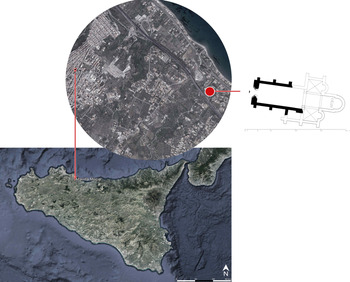
The goal of the study was to determine the origin of the church and the Italo-Greek monastery known as Santa Maria di Campogrosso (also San Michele del Golfo; Figure 1), a religious center founded at the beginning of the Norman conquest of Sicily. The monastery and the church are located on a 60-m-high hill dominating the nearby coast, and represented a strategic point between important centers, such as Termini Imerese and Palermo, ensuring the control of the route from the east to the west of the island (Oliva Reference Oliva2008; Brancato et al. Reference Brancato, Brancato and Scammacca2011). The Institute of Archaeology and Ethnology of the Polish Academy of Sciences, Centre for Late Antique and Early Medieval Studies in Wrocław started the excavations in the area as part of the research program on the role of the Normans in shaping the cultural image of medieval Europe in cooperation with the Soprintendenza per i Beni Culturali ed Ambientali di Palermo (Moździoch et al. Reference Moździoch, Baranowski and Stanisławski2015).
Location of the church of Santa Maria di Campogrosso, also called San Michele del Golfo, and currently Chiesazza near the town of Altavilla Milicia (Italy). Edited by S. Moździoch.

In the discussion on the role of the monastery of Santa Maria di Campogrosso in the Middle Ages, it is important to establish the chronology of the construction of the church and the monastery. The date of construction of the church building (the second half of the 11th century) has been derived from the references in written sources. The most important written record is from the father of Sicilian historiography, Dominican Tommaso Fazello (Fazello Reference Fazello1558), which stated that this church was founded at the end of the 11th century. According to Fazello, the church was founded by Roger I of Sicily, and the act of the foundation took place in the period between the battle with the Muslims, which occurred near Misilmeri (1068), and the conquest of Palermo (1072). According to another early modern source composed 100 years after Fazello’s, this one written by Rocco Pirri (Pirri Reference Pirri1630), it was the founded by Roger’s brother, Robert Guiscard. The oldest of the known documents concerning the monastery Santa Maria di Campogrosso were written in 1134 (Mongitore Reference Mongitore1734), suggesting that the church was constructed before 1134.
The form, construction materials, and construction techniques evident in preserved remains of the church, have produced a wide range of estimated dates for the moment of the construction of the church, some of which point to the 12th century (Zorić Reference Zorić1989), and others to the 13th (Schwarz Reference Schwarz1944; Guiotto Reference Guiotto1955) or even the 16th century (Oliva Reference Oliva2008) as the date of the church construction.
Similarly planned churches of southern Italy generally are dated to the second half of the 11th or 12th century, as for example San Filippo—Fragalá, San Giovanni Vecchio di Stilo, San Nicolò a Sciacca, Santa Maria di Terreti, San Giovanni degli Eremiti or San Giovanni Theristis (Salinas Reference Salinas1887; Orsi Reference Orsi1929; Bottari Reference Bottari1936-8; Agnello Reference Agnello1969; Basile Reference Basile1975; Bellafiore Reference Bellafiore1990; Di Gangi Reference Di Gangi2003; Cuteri Reference Cuteri2003). However, the largest number of analogies are present in Western Europe and are dated to the 10th, 11th, and 12th centuries, such as the church of Saint-Céneri-le-Gérei (Normandy, France) or the church Saint-Léon-sur-Vézère (New Aquitaine, France) (Stewart Reference Stewart1959; Porter Reference Porter1969).
At the end of the 13th century, the monastery was liquidated, and the fate of the church itself until the 16th century is unknown. The collapse of the monastery in the 13th century is confirmed by written sources (Fazello Reference Fazello1558), but the church itself was probably destroyed later. In the 16th century it was already in ruins (Fazello Reference Fazello1558), and its remains were the occasional refuge of pirates or robbers (Pirri Reference Pirri1630). After two inspections of the royal visitors, in 1583, according to the recommendation of inspector Francesco del Pozzo (Franciscus Puteus), a final decision was made on the deconsecration and partial demolition of the church (De Ciocchis Reference De Ciocchis1836).
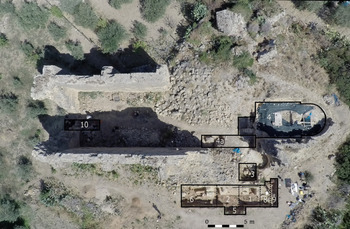
Preliminary excavations carried out by the Polish expedition led to the unearthing of the southern wall of the church and the adjacent cemetery (Figure 2). The problem of the church chronology is tightly connected to the dating of the cemetery, which was presumably constructed after the church. Ceramics, which, in the absence of other artifacts, generally are used to support the dating, in this specific case does not lead to any conclusion. For this reason, the chronology has been based on coins and radiocarbon (14C) dating of charcoal from mortars and human bones.
Santa Maria di Campogrosso (Chiesazza). Arrangement of trenches within the site. Edited by S. Moździoch.

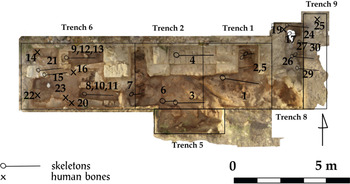
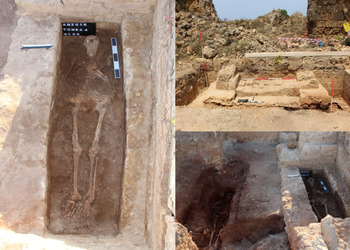
In the years 2015–2016, about 60 m2 of the cemetery surface were examined, which led to the discovery of the remains of 29 humans; among which 7 men, 1 woman and 5 children could be identified (Figure 3). Some of the buried persons were of high social status, which is confirmed by the shapes of the graves located near the southern wall of the church. In one special case, a monumental construction made of stone (Grave 4) was discovered, with a male body almost 180 cm high (Figure 4).
Distribution of human remains discovered in the cemetery. Edited by S. Moździoch.

Santa Maria di Campogrosso (Chiesazza). Grave No. 4. Photo by Błażej Stanisławski.

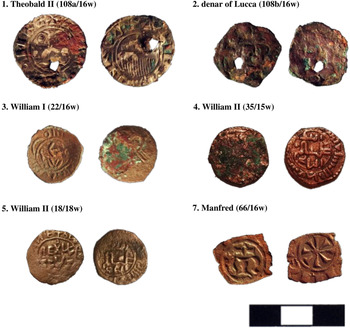
During the excavation 26 coins, in small denominations, minted of bronze or billon, i.e. low purity silver, were found. The oldest coin dates to the first half of the 12th century, while the most recent one to the 16th–17th century. The earliest coins were found in trench VI, in the grave of an infant buried south of the church wall, under two roof tiles. Two denarii from the 12th century originating from Provins (France; Capobianchi Reference Capobianchi1896: no. 2; Finetti Reference Finetti1993: no. 41–113; Figure 5: no. 1) and Lucca (Italy; Figure 5: no. 2) were deposited on the baby’s breast.
Finds of coins from the churchyard. Edited by Ewa Moździoch.

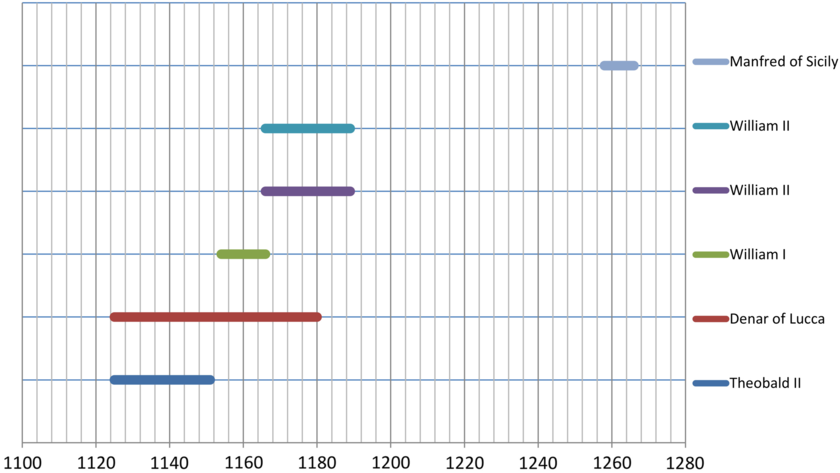
Although foreign currency, they were used in Sicily and southern Italy at fairs and markets, serving as a local coin until the 13th century (Travaini Reference Travaini1999). In the layers directly over the graves that were dug during the period in which the church was functioning, coins from the 12th–13th centuries were found (Figure 6). Many more recent coins, mainly Aragonese coins from the 14th and 15th centuries, were discovered in the demolition layers inside the church.
Periods of coins issues from the churchyard (some of them may have been in circulation much longer, such as denars of Lucca (enriciani) and of Theobald II, count of Champagne). Edited by Ewa Moździoch.

MATERIAL AND METHODS
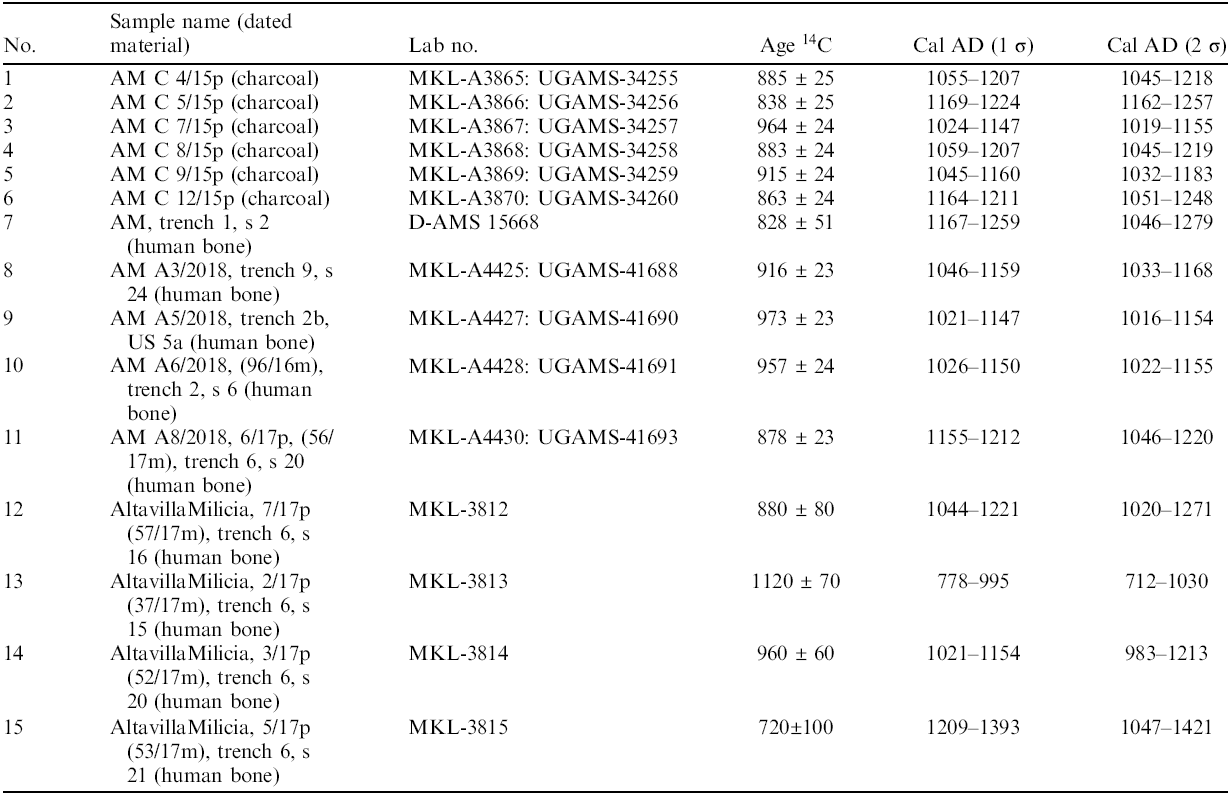
14C analysis was performed on 15 samples collected during the excavations of the church and cemetery area. Samples were taken from mortars (charcoal—6 pcs., Table 1) and human bones (9 pcs., Table 1). Charcoal samples were chemically pretreated with the acid–alkali–acid (AAA) method. From the bone samples, collagen was extracted using a modernized version of Longin method with additional alkali treatment (Longin Reference Longin1971, Piotrowska and Goslar Reference Piotrowska and Goslar2002). The collagen and charcoal samples were combusted, purified, and transformed into graphite (Nadeau et al. Reference Nadeau, Grootes, Schleicher, Hasselberg, Rieck and Bitterling1998) in a laboratory at the AGH-UST in Kraków (Krąpiec et al. Reference Krąpiec, Rakowski, Huels, Wiktorowski and Hamann2018).
The list of 14C dates for samples from Santa Maria di Campogrosso (the location of the samples is presented in Figure 7).

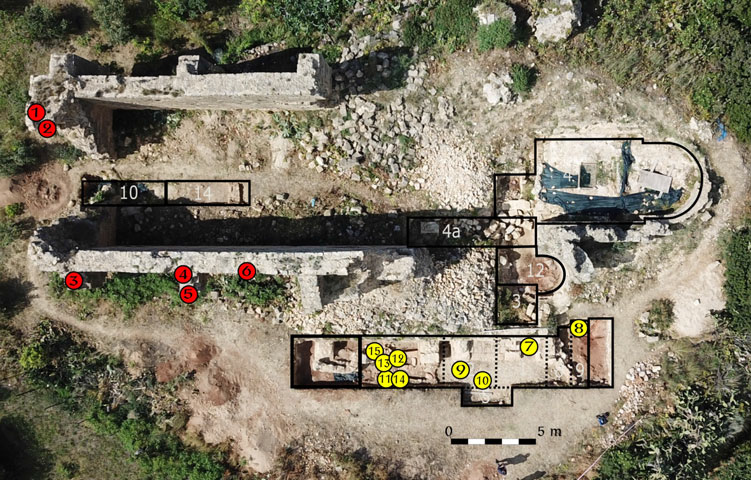
Distribution of 14C samples against the background of archaeological trenches (see Table 1). Edited by S. Moździoch.

The mixture of graphite and Fe powder was pressed into a target holder and measured with the AMS system at the Center for Applied Isotope Studies at the University of Georgia, USA (Labcode UGAMS; Cherkinsky et al. Reference Cherkinsky, Culp, Dvoracek and Noakes2010) and the DirectAMS laboratory, Bothell, USA (Labcode D-AMS, Zoppi et al. Reference Zoppi, Crye, Song and Arjomand2007).
Four samples were dated using the conventional LSC 14C dating technique in the Laboratory of Absolute Dating in Kraków, Poland (MKL signature). After drying the sample, further procedures included a standard synthesis of benzene from carbonized samples (Skripkin and Kovalyukh Reference Skripkin and Kovalyukh1998). Measurements were carried out with the Hidex 300 SL spectrometer (Krąpiec and Walanus Reference Krąpiec and Walanus2011).
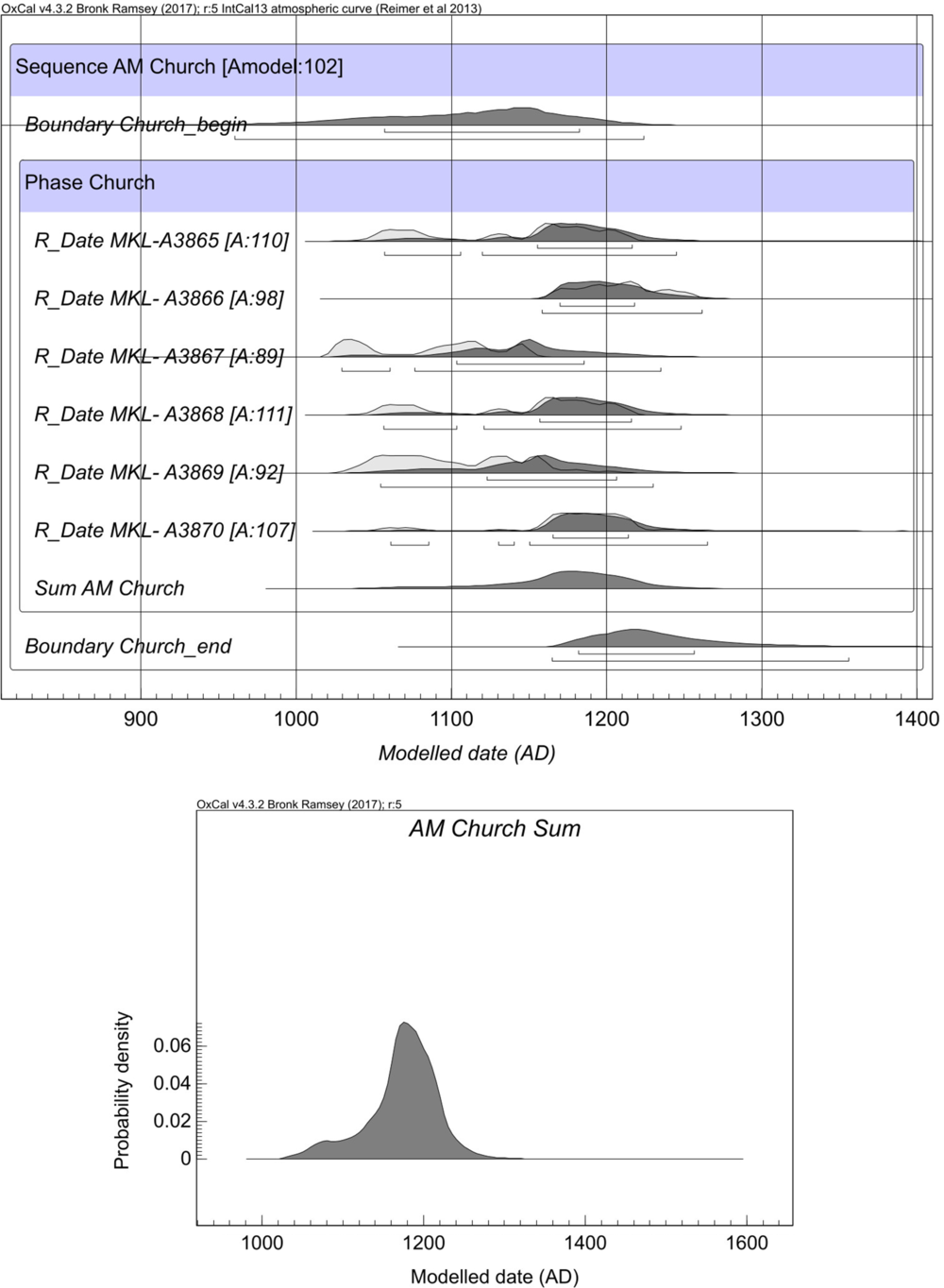
All dates were calibrated using the OxCal 4.2 calibration program (Bronk Ramsey and Lee Reference Bronk Ramsey and Lee2013) on the basis of the IntCal13 calibration curve (Reimer et al. Reference Reimer, Bard, Bayliss, Beck, Blackwell, Bronk Ramsey, Buck, Cheng, Edwards, Friedrich, Grootes, Guilderson, Haflidason, Hajdas, Hatte, Heaton, Hoffmann, Hogg, Hughen, Kaiser, Kromer, Manning, Niu, Reimer, Richards, Scott, Southon, Staff, Turney and van der Plicht2013). The chronology of the cemetery was determined based on a model calculated with the OxCal program (using the Sequence command). The dates were modeled as a Phase. The beginning and end of the Phases were determined using the Boundary Begin/Boundary End commands, and their duration was calculated using the command Interval (supplementary file). Charcoal samples from masonry mortar yield terminus post quem information. We consider the Charcoal Outlier model (Bronk Ramsey Reference Bronk Ramsey2009; Dee and Bronk Ramsey Reference Dee and Bronk Ramsey2014) as plausibly the most appropriate for such data.
RESULTS AND DISCUSSION
The results of 14C analysis of charcoal from masonry mortar connecting the stone elements of the church walls are summarized in Table 1 (Nos. 1–6). Their location in the examined structure is presented in Figure 2. Because small fragments of charcoal occurring in the mortar may originate from different part of trunks, the Charcoal Outlier model (Figure 8) was used to obtain information about the time section representing the period of church construction. This model displays a high agreement index Amodel=102 in OxCal. The probability distribution for all charcoal dates and End Boundary (1175–1235 AD probability 68.2%), combined together indicate that the construction of the church walls studied took place in the end of second half of the 12th century or at the beginning of the 13th century.
Modeled calendar age AD placements of the 14C dated samples of charcoal from masonry mortar. The 14C dates are listed in Table 1. Edited by Marek Krąpiec.

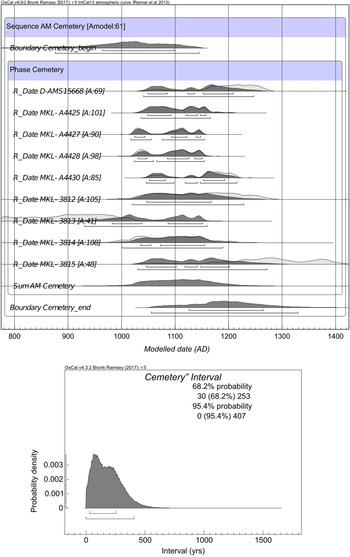
Bone samples from graves discovered in trenches at the churchyard were used in a separate model. The results of dating these samples are listed in Table 1 (Nos. 7–15). The chronology of the cemetery was determined based on a model presented in Figure 9. They indicate a long duration of the cemetery, at over 220 years (probability 68.2%). Unfortunately, despite the high statistical parameters of the model, where the compliance index A exceeds the value 60 recommended by Bronk Ramsey (Reference Bronk Ramsey1995), and is Amodel = 61, its usefulness is small, due to the wide and overlapping probability distributions representing the beginning and ending boundaries of the cemetery. This is due to the course (shape) of the calibration curve for this time section (Reimer et al. Reference Reimer, Bard, Bayliss, Beck, Blackwell, Bronk Ramsey, Buck, Cheng, Edwards, Friedrich, Grootes, Guilderson, Haflidason, Hajdas, Hatte, Heaton, Hoffmann, Hogg, Hughen, Kaiser, Kromer, Manning, Niu, Reimer, Richards, Scott, Southon, Staff, Turney and van der Plicht2013), especially concerning determining the date of the beginning of the cemetery operation. In this situation, the dating of the church, next to the cemetery, as well as independent dating artifacts in the form of coins found in graves, were used to determine the probable period of the cemetery operation.
Results of Bayesian modelling of radiocarbon determination with phase boundaries marked for the 14C dated bone samples from cemetery. The 14C dates are listed in Table 1. Edited by Marek Krąpiec.

In the light of the results of the research, the end of the operation of the cemetery coincides with the moment of liquidation of the monastery at the end of the 13th century, while the beginnings of its use, contrary to our previous assumptions, could predate the construction of the current church and involve an earlier sacred structure.
While the 14C dating of mortar inclusions indicates the end of the 12th century or the beginning of the 13th century as the time of construction of the church, architectural, archaeological and historical data suggest it could have been constructed earlier. A formal-stylistic analysis of the buildings indicates that churches of a similar plan, known from southern Italy and western Europe, were built mainly in the 11th and 12th centuries (Kubicka Reference Kubicka2020). This could be also pointed out by the study of stone masonry discovered on the walls of the church. Vladimir Zorić (Reference Zorić1989) compared the stone mason’s marks of the church of Santa Maria di Campogrosso with the marks in the Cathedral of Cefalú. By demonstrating this analogy, he supposed that the church was built in the 12th century (before 1131 or in the period 1144–1146).
Written sources, historical considerations, and architectural observations point toward the middle/second half of the 12th century as a construction date, and the coin finds agree with this hypothesis, or at least do not contradict it. Similar dating seems to be indicated by the existing written sources (Moździoch, Vassallo Reference Moździoch and Vassallo2018). Such a large investment could be possible only at the time of the economic prosperity of the monastery, which took place during the reign of Roger II, Wilhelm I, and Wilhelm II (between 1105 and 1189). Divergent dating results (historical-archaeological analyses indicating the first half of the 12th century and 14C analyses pointing to the end of the 12th century) could be due to long time of construction of the church, up to several decades.
Summing up the above observations, we concluded that the comparison of the dating of coins (Figure 6) with the dating of bones in graves (Figure 9) and mortars in the church walls (Figure 8) suggest that the main works associated with the construction of the church took place in the second part of the 12th century.
ACKNOWLEDGMENTS
The study was supported by NSC Poland, grant no 2017/25/B/HS3/01699 “Changes of intercultural relations in local communities in medieval Sicily after Norman conquest in the light of archaeological research. The case of area of Altavilla Milicia.”
Supplementary material
To view supplementary material for this article, please visit https://doi.org/10.1017/RDC.2020.85