




No CrossRef data available.
Development of reduced tillage systems in organic farming in Europe
Published online by Cambridge University Press: 16 December 2011
Abstract
No-tillage and reduced tillage are considered sustainable options of conservation tillage. While US organic farming researchers have focused on no-tillage, European organic farming researchers have concentrated on reduced tillage through the reduction of tillage depth or the application of noninversion tillage practices. Combinations of these two approaches have been implemented by the use of the two-layer plow or the layer cultivator. These innovations often came from farmers, aiming at reducing off-farm inputs such as fuel, and saving costs and labor, while at the same time building up soil fertility. Systematic, documented research on reduced tillage systems in Europe started only 1–2 decades ago, with experiments in Germany, Switzerland and France. While most experiments mimic stockless farms, other experiments include fodder crops such as grass–clover ley and applications of manure and slurry as is typical for mixed farms with animals and crops. Soil organic carbon, microbial activity and soil structure are often improved in the upper soil layer under reduced tillage compared with plowed soils. However, these positive findings were confounded by lower yields in some cases and enhanced weed pressure, except for the two-layer plow. Often it was not possible to determine whether and to what extent yield reduction was due to weed competition or to nitrogen shortage, because of retarded nitrogen mineralization in spring in reduced tillage systems. In systems with manure use, also higher soil fertility measures concomitant with increased yields were reported under reduced tillage. Indeed, it is difficult to gain an overview on research activities dealing with reduced tillage in organic farming in Europe due to dispersed experimental infrastructures and the scarcity of peer-reviewed published literature. To close this knowledge gap a European Network is being established aiming at further developing reduced tillage systems in organic farming, addressing the issue of carbon sequestration and N2O emissions, as well as weed and nutrient management.
Information
- Type
- Commentary
- Information
- Copyright
- Copyright © Cambridge University Press 2011
References
1Pimentel, D., Harvey, C., Resosudarmo, P., Sinclair, K., Kurz, D., McNair, M., Christ, S., Shpritz, L., Fitton, L., Saffouri, R., and Blair, R. 1995. Environmental and economic costs of soil erosion and conservation benefits. Science 267:1117–1123.CrossRefGoogle ScholarPubMed
2Montgomery, D.R. 2007. Dirt: The Erosion of Civilizations. University of California Press, California, USA.CrossRefGoogle Scholar
3Huggins, D.R. and Reganold, J.P. 2008. No-till: the quiet revolution. Scientific American 299:71–76.CrossRefGoogle ScholarPubMed
4Mäder, P., Fließbach, A., Dubois, D., Gunst, L., Fried, P., and Niggli, U. 2002. Soil fertility and biodiversity in organic farming. Science 296:1694–1697.CrossRefGoogle ScholarPubMed
5Hole, D.G., Perkins, A.J., Wilson, J.D., Alexander, I.H., Grice, P.V., and Evans, A.D. 2005. Does organic farming benefit biodiversity? Biological Conservation 122:113–130.CrossRefGoogle Scholar
6Triplett, G.B. and Dick, W.A. 2008. No-tillage crop production: a revolution in agriculture! Agronomy Journal 100:153–165.CrossRefGoogle Scholar
7Gadermaier, F., Berner, A., Fließbach, A., Friedel, J., and Mäder, P. 2012. Impact of reduced tillage on soil organic carbon and nutrient budgets under organic farming. Renewable Agriculture and Food Systems 27(1): in press.CrossRefGoogle Scholar
8Derpsch, R., Friedrich, T., Kassam, A., and Li, H. 2010. Current status of adoption of no-till farming in the world and some of its main benefits. International Journal of Agricultural and Biological Engineering 3:1–25.Google Scholar
9Leite, L.F.C., Oliveira, F.C., Araújo, A., Galvão, S.R.S., Lemos, J.O., and Silva, E.F.L. 2010. Soil organic carbon and biological indicators in an Acrisol under tillage systems and organic management in north-eastern Brazil. Australian Journal of Soil Research 48:258–265.CrossRefGoogle Scholar
10Freibauer, A., Rounsevell, M.D.A., Smith, P., and Verhagen, J. 2004. Carbon sequestration in the agricultural soils of Europe. Geoderma 122:1–23.CrossRefGoogle Scholar
11Baker, J.M., Ochsner, T.E., Venterea, R.T., and Griffis, T.J. 2007. Tillage and soil carbon sequestration – What do we really know? Agriculture, Ecosystems and Environment 118:1–5.CrossRefGoogle Scholar
12Steinbach, H.S. and Alvarez, R. 2006. Changes in soil organic carbon contents and nitrous oxide emissions after introduction of no-till in pampean agroecosystems. Journal of Environmental Quality 35:3–13.CrossRefGoogle ScholarPubMed
13Khan, S.A., Mulvaney, R.L., Ellsworth, T.R., and Boast, C.W. 2007. The myth of nitrogen fertilization for soil carbon sequestration. Journal of Environmental Quality 36:1821–1832.CrossRefGoogle ScholarPubMed
14Davidson, E.A. 2009. The contribution of manure and fertilizer nitrogen to atmospheric nitrous oxide since 1860. Nature Geoscience 2:659–662.CrossRefGoogle Scholar
15Carr, P., Mäder, P., Creamer, N., and Beeby, J.S. 2012. Overview and comparison of conservation tillage practices and organic farming in Europe and North America. Renewable Agriculture and Food Systems 27(1): in press.CrossRefGoogle Scholar
16Rusch, H.P. 1968. Bodenfruchtbarkeit. Eine Studie Biologischen Denkens. Haug, Heidelberg, Germany.Google Scholar
17Peigné, J., Ball, B.C., Roger-Estrade, J., and David, C. 2007. Is conservation tillage suitable for organic farming? A review. Soil Use and Management 23:129–144.CrossRefGoogle Scholar
18Carter, M.R. 1994. A review of conservation tillage strategies for humid temperate regions. Soil and Tillage Research 31:289–301.CrossRefGoogle Scholar
19Hobbs, P.R., Sayre, K., and Gupta, R. 2008. The role of conservation agriculture in sustainable agriculture. Philosophical Transactions of the Royal Society B: Biological Sciences 363:543–555.CrossRefGoogle ScholarPubMed
20Köpke, U. and Schulte, H. 2008. Direct seeding of faba beans in organic agriculture. In Cultivating the Future Based on Science: Second Conference of the International Society of Organic Agriculture Research ISOFAR, June 18–20, Modena, Italy. p. 184.Google Scholar
21Henriksen, C.B., Rasmussen, J., and Søgaard, C. 2005. Kemink subsoiling before and after planting. Soil and Tillage Research 80:59–68.CrossRefGoogle Scholar
22Müller, E., Wildhagen, H., Quintern, M., Heß, J., Wichern, F., and Joergensen, R.G. 2009. Spatial patterns of soil biological and physical properties in a ridge tilled and a ploughed luvisol. Soil and Tillage Research 105:88–95.CrossRefGoogle Scholar
23Schmidt, H. 2010. Öko-Ackerbau ohne tiefes Pflügen. Praxisbeispiele und Forschungsergebnisse. Köster, Berlin, Germany.Google Scholar
24Hampl, U. 1996. Soil tillage systems in Eco-Farming. In 11th IFOAM International Scientific Conference ‘Down to Earth—and Further Afield’, August 11–15, Copenhagen, Denmark. p. 65.Google Scholar
25Emmerling, C. 2001. Response of earthworm communities to different types of soil tillage. Applied Soil Ecology 17:91–96.Google Scholar
26Vakali, C., Zaller, J.G., and Köpke, U. 2011. Reduced tillage effects on soil properties and growth of cereals and associated weeds under organic farming. Soil and Tillage Research 111:133–141.CrossRefGoogle Scholar
27Kainz, M., Gerl, G., Lemnitzer, B., Bauchenss, J., and Hülsbergen, K.-J. 2005. Effects of different tillage systems in the long-term field experiment Scheyern. In Heß, J. and Rahmann, G. (eds), 8. Wissenschaftstagung Ökologischer Landbau, Kassel, Germany. p. 1–4.Google Scholar
28Schmidt, H., Schulz, F., and Leithold, G. 2006. Organic farming trial Gladbacherhof. Effects of different crop rotations and tillage systems. In Raupp, J., Pekrun, C., Oltmans, M., and Köpke, U. (eds). Long-Term Field Experiments in Organic Farming. Köster, Berlin. p. 165–182.Google Scholar
29Schulz, F., Brock, C., and Leithold, G. 2008. Effects of farm type and different intensities of soil tillage on cash crop yields and soil organic matter. In: Cultivating the Future Based on Science. Proceedings of the Second Scientific Conference of the International Society of Organic Agriculture Research (ISOFAR), June 18–20, Modena, Italy, p. 580–583.Google Scholar
30Pekrun, C. and Claupein, W. 2004. The effect of stubble tillage and primary tillage on population dynamics of Canada thistle (Cirsium arvense) in organic farming. Journal of Plant Diseases and Protection – Special Issue 19:483–490.Google Scholar
31Pekrun, C. and Claupein, W. 2006. The implication of stubble tillage for weed population dynamics in organic farming. Weed Research 46:414–423.CrossRefGoogle Scholar
32Gruber, S. and Claupein, W. 2009. Effect of tillage intensity on weed infestation in organic farming. Soil and Tillage Research 105:104–111.CrossRefGoogle Scholar
33Vian, J.F., Peigné, J., Chaussod, R., and Roger-Estrade, J. 2009. Effects of four tillage systems on soil structure and soil microbial biomass in organic farming. Soil Use and Management 25:1–10.CrossRefGoogle Scholar
34Peigné, J., Cannavaciuolo, M., Gautronneau, Y., Aveline, A., Giteau, J.L., and Cluzeau, D. 2009. Earthworm populations under different tillage systems in organic farming. Soil and Tillage Research 104:207–214.CrossRefGoogle Scholar
35Berner, A., Hildermann, I., Fließbach, A., Pfiffner, L., Niggli, U., and Mäder, P. 2008. Crop yield and soil quality response to reduced tillage under organic management. Soil and Tillage Research 101:89–96.CrossRefGoogle Scholar
36Krauss, M., Berner, A., Burger, D., Wiemken, A., Niggli, U., and Mäder, P. 2010. Reduced tillage in temperate organic farming: implications for crop management and forage production. Soil Use and Management 26:12–20.CrossRefGoogle Scholar
37Börstler, B., Thiéry, O., Sykorová, Z., Berner, A., and Redecker, D. 2010. Diversity of mitochondrial large subunit rDNA haplotypes of Glomus intraradices in two agricultural field experiments and two semi-natural grasslands. Molecular Ecology 19:1497–1511.CrossRefGoogle ScholarPubMed
38Sans, F.X., Berner, A., Armengot, L., and Mäder, P. 2011. Tillage effects on weed communities in an organic winter wheat–sunflower–spelt cropping sequence. Weed Research 51:413–421.CrossRefGoogle Scholar
39Metzke, M., Potthoff, M., Quintern, M., Heß, J., and Joergensen, R.G. 2007. Effect of reduced tillage systems on earthworm communities in a 6-year organic rotation. European Journal of Soil Biology 43:209–215.CrossRefGoogle Scholar
40Müller, E., Wildhagen, H., Quintern, M., Heß, J., Wichern, F., and Joergensen, R.G. 2009. CO2 evolution from a ridge tilled and a mouldboard ploughed luvisol in the field. Applied Soil Ecology 43:89–94.CrossRefGoogle Scholar
41Lehocká, Z., Klimeková, M., Bieliková, M., and Mendel, L. 2009. The effect of different tillage systems under organic management on soil quality indicators. Agronomy Research 7:369–373.Google Scholar
42Reduced tillage and green manures for sustainable organic cropping systems. A CORE Organic II project. Available at Web site www.tilman-org.net (accessed November 22, 2011).Google Scholar
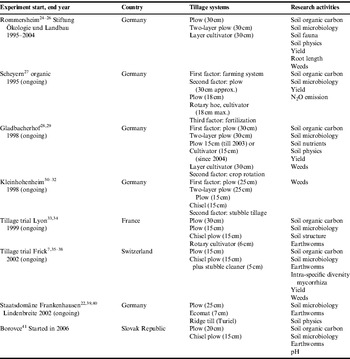
Table 1. Research experiments with reduced tillage under organic conditions in Europe (selection).
 You have
Access
- 93
- Cited by
Introduction
The loss of large areas of arable land by erosion calls for more sustainable cropping systemsReference Pimentel, Harvey, Resosudarmo, Sinclair, Kurz, McNair, Christ, Shpritz, Fitton, Saffouri and Blair1–Reference Huggins and Reganold3. Both organic farming and no-tillage offer many benefits in view of soil fertility and biodiversityReference Mäder, Fließbach, Dubois, Gunst, Fried and Niggli4–Reference Triplett and Dick6. No-tillage systems were developed under conventional management aiming at conserving soil moisture, protecting soils from erosion and minimizing soil compaction. The combination of organic farming and no-tillage may provide additional benefits to the environment and further improve the resource use efficiencyReference Gadermaier, Berner, Fließbach, Friedel and Mäder7. However, in no-till systems, weeds are usually controlled by herbicides, and plants fertilized via mineral nitrogen, methods that are not permitted in organic farming systems.
Only relatively small areas are currently under no-tillage in Europe as compared to USA, Brazil, Argentina, Canada and AustraliaReference Derpsch, Friedrich, Kassam and Li8, Reference Leite, Oliveira, Araújo, Galvão, Lemos and Silva9. Both organic farming and no-tillage have been identified as promising options to sequester carbon in European soilsReference Freibauer, Rounsevell, Smith and Verhagen10. However, only a few studies so far have analyzed carbon pools across the whole soil profile. While organic carbon, in most cases, was elevated under no-tillage in upper soil layers, it may decrease in deeper soil layers, in particular when organic matter input to the systems is lowReference Baker, Ochsner, Venterea and Griffis11. Climate-change mitigation potential of no-tillage systems may also be offset by elevated N2O emissions, which are fostered under the more anaerobic conditions prevailing in this systemReference Steinbach and Alvarez12, Reference Khan, Mulvaney, Ellsworth and Boast13. Recent research indicates that integrating appropriate conservation agriculture approaches into organic cropping systems may overcome these limitations. For example, N2O emissions were greater when microbial soil populations were exposed to low C/N ratios by the use of mineral N-fertilizers in conservation agricultureReference Khan, Mulvaney, Ellsworth and Boast13, Reference Davidson14. This may be of lesser importance when using organic fertilizers. Notwithstanding, the introduction of conservation tillage practices such as no-tillage or reduced tillage can further improve organic systems with respect to soil fertility. While no-tillage system development in organic farming is mainly restricted to the USAReference Carr, Mäder, Creamer and Beeby15, farmers and researchers in Europe focus on reduced tillage systems. The current article gives an overview on the development of reduced tillage in organic farming in Europe and identifies relevant research gaps.
Reduced Tillage Systems in Europe
The idea of noninversion soil preparation in organic farming dates back to the early 1950s, when RuschReference Rusch16 developed his ideas of organic farming. His vision was to mimic a stable, natural ecosystem, and pointed out that each soil layer has its adapted biocenosis, which should not be disturbed by deep inversion plowing. In practice, the ‘credo’ of organic farmers in these times was ‘shallow plowing and deep loosening’ [Otto Schmid, organic farming advisor at FiBL (the Research Institute of Organic Agriculture), pers. comm.]. Nowadays, reduced tillage practices in organic farming comprise several practices such as the reduction of plowing depth but also noninverting, less-invasive soil loosening, e.g. by the chisel plowReference Peigné, Ball, Roger-Estrade and David17. CarterReference Carter18 pointed out that conservation tillage practices in humid temperate regions need adaptation to soil and climatic conditions. This applies in particular to organic farming systems, because no synthetic nitrogen fertilizers and herbicides are available.
Rationale for the Reduced Tillage Approach in Organic Farming in Europe
No-tillage started in the USA triggered by tragic dust storms in the mid-western USA in the 1930s. This served as a wake-up call to how human interventions in excessive soil cultivation led to unsustainable agricultural systemsReference Hobbs, Sayre and Gupta19. Later on in the 1980s and 1990s no-till was introduced in Brazil and moved to Argentina. Currently approximately 26 million hectares are under no-till in Brazil and approximately 20 million hectares in ArgentinaReference Derpsch, Friedrich, Kassam and Li8, Reference Leite, Oliveira, Araújo, Galvão, Lemos and Silva9.
We interpret the different approaches in Europe (reduced tillage) and USA (no-tillage) in organic farming in the context of the predominant pedo-climatic conditions of the two continents and the type of farms. European farmers in large areas are faced with humid and cold conditions during crop growth, limiting the suitability of no-tillage practices. Mixed farms with animals, fodder and cash crops are considered ideal in view of nutrient recycling, environment protection and specifically the farms' influence on climate change in Europe.
In this context, there are a number of arguments for a better suitability of reduced tillage under humid temperate climate, such as manure incorporation, faster warming up of soil in spring, resulting in faster nitrogen mineralization, better control measures of perennial weeds and removal of grass–clover by shallow undercutting of the whole field. Moreover, in crop rotations comprising maize and wheat, a shallow incorporation of straw residues into the soil may result in faster decay, and thus in a better regulation of pathogens such as Fusarium sp. Altogether, reduced tillage may also lead to faster crop establishment able to better compete with weeds compared with no-tillage systems. Nonetheless, newly developed systems such as the ‘roller/crimper’ system attracted European researchers, who recognize the need for inclusion of more conservation techniques such as the systematic use of cover cropsReference Peigné, Ball, Roger-Estrade and David17, Reference Hobbs, Sayre and Gupta19, Reference Köpke and Schulte20.
Machinery, Equipment and Research Activities
Organic pioneers, aiming at materializing the ideas of reduced soil tillage, developed special equipment, such as the Kemink systemReference Henriksen, Rasmussen and Søgaard21, the ridge tillage system of TurielReference Müller, Wildhagen, Quintern, Heß, Wichern and Joergensen22, the two-layer plow and the layer cultivator. The two-layer plow inverts the soil in the upper soil layer and loosens deeper layers. Similarly, the layer cultivator mixes the soil in the upper soil layer and also loosens deeper layers. More recently, machines were created allowing for a shallow cleaning of stubbles or the removal of grass–clover such as the stubble cleaner (German: Stoppelhobel, Zobel—Stahlbau, Germany, a type of skim plow, undercutting the whole field) or the Ecomat™ (Kverneland, Germany), which allows for quite shallow plowing.
Despite some early attempts to introduce reduced tillage in organic farm operations, systematic research under organic farming conditions started relatively late. Experiments established since the mid 1990s often included not only two-layer systems such as the layer plow and the layer cultivator, but systems with variable tillage depths were also tested. There is no general agreement on what to call a reduced tillage system. Here, we define all tillage systems as reduced that operate at shallower depths or at lower intensity compared to customary plowing in a given region. To date many research findings are only available in ‘grey’ literature such as conference proceedings and reports, with restricted availability. A most useful overview on organic farming without deep plowing was recently published in German by SchmidtReference Schmidt23. Table 1 gives an overview on some key experiments on reduced tillage in organic farming in Europe.
In almost all these experiments reduced tillage enhanced soil organic carbon contents, soil microbial activity and soil structure in the upper soil layer. In general, greatest differences were observed when comparing conventional plow treatments (full inversion to 30 cm) with layer cultivation. Benefits of two-layer plowing compared with conventional plowing were less pronounced.
Yields were often similar in plow systems and systems using a two-layer plow, but were lower in systems using a two-layer cultivator or chisel. Unexpectedly, the chisel plow combined with a stubble cleaner, in the tillage trial Frick (Table 1), resulted in even higher yields as compared to the plow system in the long term. This was attributed to the relatively high stocking density mimicked in this experiment, allowing for better timing of available nitrogen to the crops according to their needs, and the inclusion of green manures in the rotation. Moreover, the 2-year grass–clover ley contributed to weed suppression. This experiment clearly demonstrated that tillage systems need the specific adaptation of system components such as tillage timing, the planting of green manures and the use of new equipment to optimize a system.
Research experiments with reduced tillage under organic conditions in Europe (selection).
Weed pressure was generally acceptable in two-layer plow systems, but was increased in two-layer cultivator systems and systems with a chisel plow. In particular monocotyledonous weeds were enhanced in reduced tillage systems.
Research Challenges
The results of reduced tillage experiments in organic farming obtained so far clearly demonstrate the superiority of these systems to conventional plow systems with respect to soil biology and soil fertility. However, there are major challenges and research gaps inhibiting more widespread application of reduced tillage in organic systems in Europe. Moreover, the experiments are extremely scattered and often published in national languages only. To close these research gaps, a European Network42 is currently being established to address the following issues:
• The lack of knowledge on the effect of reduced tillage and no-tillage systems under organic farming on the soil carbon stock across the whole soil profile. This information is urgently needed to assess these systems' potential to mitigate climate change.
• Because N2O emissions are strongly dependent on available carbon and nitrogen, as well as on soil temperature and soil oxygen, climate gas-emission studies should be performed in various tillage systems and pedo-climatic zones.
• The higher weed pressure, with perennial weeds in particular, under reduced tillage calls for smart technological and biological solutions for efficient weed control. The acceptability of ‘bio-herbicides’ such as vinegar and bio-control organisms should be discussed anew.
• The optimum integration of green manure systems shall be investigated to guarantee the crops' nitrogen needs.
We expect that this Network will also facilitate the exchange of information between European and American researchers in the field of conservation tillage techniques.
Acknowledgements
We thank Andreas Fließbach, Andreas Gattinger (FiBL) and Julia Cooper (Newcastle University) for helpful comments on this manuscript.