Interparental conflict has been shown to increase children's vulnerability to a wide array of psychological problems, including depressive symptoms, anxiety, social withdrawal, and aggression. Toward the goal of identifying the processes that give rise to these psychological difficulties in high-conflict homes, emotional security theory (EST) proposes that interparental conflict increases children's risk for poor health outcomes by undermining their sense of safety or security in the interparental relationship (Cummings & Davies, Reference Cummings and Davies1996; Davies & Cummings, Reference Davies and Cummings1994). In the first part of the mediational cascade, EST posits that children experience substantial difficulties in preserving a sense of emotional security in the interparental relationship following repeated exposure to destructive interparental conflict characterized by hostility, escalating distress, and detachment. Although emotional security is conceptualized as a latent goal, child difficulties achieving this goal can be inferred from multiple, observable classes of responses. Thus, signs of insecurity are theorized to be reflected in (a) emotional reactivity, characterized by intense, prolonged distress (e.g., fear) reactions to interparental conflict; (b) regulation of exposure to parent affect evidenced by coercive forms of involvement (e.g., triangulation) and intense avoidance (e.g., freezing or hiding); and (c) negative internal representations of interparental relations, as indexed by children's evaluation of the adverse consequences interparental conflict has for the welfare of themselves and their families. In the second part of the mediational chain, prolonged concerns about security in the interparental relationship are theorized to intensify into broader and increasingly stable patterns of psychological problems.
In support of this hypothesized cascade, studies using rigorous methodological approaches (i.e., multiple methods, informants, and measurement occasions) have repeatedly identified children's emotional insecurity as a mediator of associations between their exposure to interparental conflict and their psychological problems (e.g., Buehler, Lange, & Franck, Reference Buehler, Lange and Franck2007; Cummings, George, McCoy, & Davies, Reference Cummings, George, McCoy and Davies2012; Davies, Martin, & Cicchetti, Reference Davies, Martin and Cicchetti2012; Kelly & El-Sheikh, Reference Kelly and El-Sheikh2013). According to a developmental psychopathology perspective, the mediational role of emotional security in this pathway is part of a broader, reciprocal constellation of exchanges between the active, dynamic child in a shifting context of interparental relations (Cicchetti & Toth, Reference Cicchetti, Toth, Nolen-Hoeksema and Hilt2009; Sameroff & MacKenzie, Reference Sameroff and MacKenzie2003). Thus, embedding EST within a developmental psychopathology framework generates a broader consideration of how changes in children's coping (i.e., security) and psychological functioning (e.g., maladjustment) may be products and predictors of each other and interparental conflict (Davies, Martin, & Sturge-Apple, Reference Davies, Martin, Sturge-Apple and Cicchettiin press). However, there is a paucity of empirical tests of the reciprocal interplay among interparental conflict, children's emotional insecurity, and their psychological difficulties. Accordingly, the goal of this paper was to examine the transactions among two forms of destructive interparental conflict (i.e., interparental hostility vs. dysphoria), children's emotional insecurity, and their psychological difficulties across five measurement occasions that span the developmental periods of middle childhood through middle adolescence.
The Mediational Role of Child Insecurity in Associations Between Interparental Conflict Characteristics and Child Psychological Problems
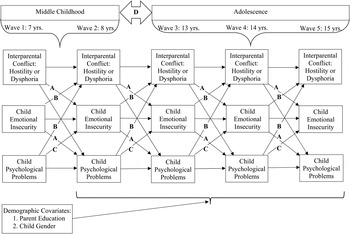
As a template for organizing our research questions and hypotheses, Figure 1 provides our transactional conceptualization of emotional security. Guided by EST, the A paths illustrate our primary proposal that displays of hostility and dysphoria during interparental conflict may increase children's vulnerability to psychological problems by undermining their sense of security. Prior work highlights the potential utility of dissecting forms of destructive conflict in understanding children's coping and adjustment. For example, daily diary research with samples of families that are different from the present study has shown that parents exhibit a wide array of negative conflict tactics (Cummings, Goeke-Morey, Papp, & Dukewich, Reference Cummings, Goeke-Morey, Papp and Dukewich2002). Although angry and hostile displays are most commonly reported by parents, sadness and more subtle forms of dysphoric behaviors (e.g., withdrawal) are also relatively common (Cummings, Goeke-Morey, & Papp, Reference Cummings, Goeke-Morey and Papp2003). In addition, EST proposes that children exhibit a natural proclivity to detect and defend against parental expressions that serve as reliable markers of interpersonal threat, struggle, or rejection within social hierarchies (Davies et al., Reference Davies, Martin, Sturge-Apple and Cicchettiin press; Davies & Sturge-Apple, Reference Davies and Sturge-Apple2007). Thus, both hostile and dysphoric displays during interparental conflict are theorized to pose a threat to children's sense of security. Consistent with this hypothesis, assessments of interparental dysphoria and hostility have each been identified as predictors of dimensions of children's emotional insecurity (e.g., emotional reactivity or negative internal representations) with different multiple samples of children in middle childhood through adolescence (Cummings et al., Reference Cummings, Goeke-Morey, Papp and Dukewich2002; Davies, Sturge-Apple, Winter, Cummings, & Farrell, Reference Davies, Sturge-Apple, Winter, Cummings and Farrell2006; Du Rocher Schudlich & Cummings, Reference Du Rocher Schudlich and Cummings2007).
A conceptual model depicting transactional associations among interparental conflict dimensions, children's emotional insecurity in the interparental relationship, and their psychological problems across childhood and adolescence. Paths A, B, C, and D reflect key hypotheses in the transactional analysis of emotional security.

Despite this growing body of work, little is known about whether emotional security acts as a mediator between these specific parameters (i.e., parental hostility and dysphoria) of destructive interparental conflict and children's poor adjustment outcomes. According to a recent literature review, 16 of the 17 existing studies examining emotional security as a mediator assessed destructive interparental conflict within a single, unidimensional construct that predominantly captured hostility, anger, and aggression (Davies et al., Reference Davies, Martin, Sturge-Apple and Cicchettiin press). As the only empirical exception, Du Rocher Schudlich and Cummings (Reference Du Rocher Schudlich and Cummings2007), using a separate sample than the present study, reported that interparental dysphoria characterized by sadness and emotional distress was associated with children's psychological problems (i.e., a combination of internalizing and externalizing symptoms) indirectly through children's emotional insecurity. Therefore, based on prior theory and research on EST (e.g., Davies et al., Reference Davies, Martin, Sturge-Apple and Cicchettiin press; Du Rocher Schudlich & Cummings, Reference Du Rocher Schudlich and Cummings2007), we specifically hypothesize that emotional insecurity will mediate associations between both forms of interparental conflict (i.e., hostility and dysphoria) and children's psychological problems.
However, a plausible alternative hypothesis is that insecurity is an extraneous product of other transactional pathways among interparental conflict and child adjustment rather than a risk mechanism. Although the DuRocher Schudlich and Cummings (Reference Du Rocher Schudlich and Cummings2007) study was an important first step in disentangling forms of destructive conflict, the cross-sectional design was unable to definitively identify directionality in associations between interparental and child functioning. Therefore, it is possible that the mediational role of emotional security is an artifact of the etiological roles children's insecurity and psychological problems play in increasing destructive interparental conflict. In building on this finding, our inclusion of repeated measures of interparental conflict, emotional insecurity, and child psychological adjustment across multiple prospective waves provides a stringent test of the robustness of emotional security as a mediator. Accordingly, our multivariate approach is designed to examine whether interparental hostility and dysphoria each predict subsequent increases in children's emotional insecurity, with emotional insecurity, in turn, predicting downstream increases in psychological adjustment problems while also specifying children's prior histories of functioning (i.e., insecurity and psychological problems) as alternative predictors in the proposed cascade.
Child Insecurity and Psychological Problems as Precursors of Interparental Conflict Characteristics
As signified by the B paths in Figure 1, a transactional conceptualization of interparental conflict posits that children's behaviors also shape interparental dynamics. Developmental psychopathology models have hypothesized that child effects may operate at multiple levels of analysis, encompassing both children's traitlike dispositions and their coping within relationship contexts (e.g., Brock & Kochanska, Reference Brock and Kochanska2015; Masten & Cicchetti, Reference Masten and Cicchetti2010). At a trait level of analysis, there is emerging empirical evidence that children's psychological problems serve as precursors to interparental conflict. For example, Jenkins, Simpson, Dunn, Rasbash, and O'Connor (Reference Jenkins, Simpson, Dunn, Rasbash and O'Connor2005) found that child externalizing problems subsequently led to increased arguments between parents 2 years later. Likewise, Cui, Donnellan, and Conger (Reference Cui, Donnellan and Conger2007) identified adolescent depressive and delinquency symptoms as both outcomes and predictors of interparental conflict in a series of cross-lagged autoregressive analyses conducted over three annual measurement occasions.
Children's responses to interparental conflict have also been conceptualized as affecting the nature and course of interparental problems. In his behavioral conceptualization of family violence, Emery (Reference Emery1989) proposed a transactional cycle of effects between children's reactivity to interparental conflict and interparental relationship quality. In the initial series of unfolding processes, interparental conflict is framed as an aversive event that produces distress in children. In the subsequent series of interactions, children's distress (e.g., temper tantrums, high distress, and involvement) reduces their exposure to aversive interparental stimuli in the short term by distracting parents from engaging in ongoing conflicts. Although children's reactivity may temporarily reduce interparental conflict, questions remain as to whether signs of insecurity are effective in reducing interparental conflict over broader developmental spans of months or years. The only study to assess child responses indicative of insecurity, which used data from the same project as the present paper, found that coercive forms of involvement (e.g., yelling or siding with one parent) were associated with increases in interparental conflict over a 2-year span (Schermerhorn, Cummings, DeCarlo, & Davies, Reference Schermerhorn, Cummings, DeCarlo and Davies2007). Thus, the proposed utility of involvement in reducing contemporaneous bouts of interparental conflict was paradoxically related to greater long-term disruptions in the interparental relationship. Although the mechanisms for these differential associations have yet to be identified, transactional models have posited that high levels of negative reactivity to interparental conflict are part of a coercive family process that, while temporarily alleviating conflict, ultimately increase distress, hostility, and ill will in both the children and parents (Emery, Reference Emery1989; Patterson, Reference Patterson1982; Schermerhorn et al., Reference Schermerhorn, Cummings, DeCarlo and Davies2007).
Given the sparse research on children's effects on interparental conflict, our study is designed to address several empirical gaps. Although EST proposes that children's concerns about safety and security are reflected in multiple domains of responding, research examining children's reactivity to conflict as precursors of interparental conflict has been limited to a single sign of insecurity: levels of child involvement (Schermerhorn et al., Reference Schermerhorn, Cummings, DeCarlo and Davies2007). To address this barrier, the goal of the current paper is to examine whether a more complete assessment of children's insecurity, one that encompasses emotional reactivity, involvement, avoidance, and negative internal representations, predicts subsequent changes in interparental conflict in childhood and adolescence.
In addition, studies have yet to examine the nature of the interplay between children's psychological problems and insecurity in their putative roles as antecedents of interparental difficulties (Cummings & Davies, Reference Cummings and Davies2010). In reflecting the possible operation of additive effects, a plausible hypothesis is that each form of child functioning may place strain on the interparental relationship and, as a result, serve as unique proximal predictors of conflict between parents. In reflecting the possibility of more complex cascades, insecurity in the interparental relationship may serve as (a) a distal predictor of interparental conflict through its association with psychological problems that serve as more potent risk factors for interparental discord; and/or (b) a more proximal mediator of prospective associations between children's psychological problems and interparental conflict (Davies et al., Reference Davies, Martin, Sturge-Apple and Cicchettiin press). Therefore, in the present study, we test the relative viability of each of these three hypothesized pathways. Our simultaneous inclusion of interparental conflict, children's psychological problems, and their emotional insecurity in the interparental relationship within a cross-lagged, autoregressive design provides a seminal test of the possible interplay between different levels of child functioning as predictors of interparental conflict. Moreover, because prior studies have treated interparental conflict as a single unidimensional outcome in testing child effects models (e.g., Cui et al., Reference Cui, Donnellan and Conger2007; Jenkins et al., Reference Jenkins, Simpson, Dunn, Rasbash and O'Connor2005; Schermerhorn et al., Reference Schermerhorn, Cummings, DeCarlo and Davies2007), little is known about whether children's difficulties increase discord between parents in specific or diffuse ways. Therefore, as a first step toward testing the generalizability or specificity of child antecedents of interparental conflict, we explore whether children's emotional insecurity and psychological problems predict subsequent increases in interparental hostility and dysphoria.
Child Psychological Problems as Precursors of Insecurity
Although EST places emphasis on conceptualizing children's insecurity as a precursor of psychological difficulties, it also suggests that children's preexisting psychological problems may operate in a reciprocal fashion to organize how they process and respond to interparental conflict (Cummings & Davies, Reference Cummings and Davies2010). Thus, as the C paths in Figure 1 denote, our transactional model also highlights the possibility that children's psychological difficulties may directly tax their ability to preserve their sense of security in the face of subsequent parental discord by sensitizing them toward interpersonal threat cues (e.g., negative facial expressions or gestures) and limiting their enactment of effective coping strategies (e.g., distraction). Consistent with this hypothesis, Klaczynski and Cummings (Reference Klaczynski and Cummings1989) found that children with histories of aggressive behavior responded with greater emotional arousal during a live anger simulation involving two adults.
However, it is unclear whether these findings generalize to associations between children's broader psychological problems and their concerns about emotional security in actual contexts of interparental conflict. In drawing on data from different projects than the current paper, findings from the two empirical tests of this pathway are inconclusive. On the one hand, results from a static longitudinal design indicated that adolescent internalizing and externalizing symptoms predicted their emotional insecurity 2 years later (Davies, Harold, Goeke-Morey, & Cummings, Reference Davies, Harold, Goeke-Morey and Cummings2002). On the other hand, the only direct empirical test of children's psychological maladjustment (i.e., a combination of internalizing and externalizing symptoms) as a predictor of change in their emotional insecurity yielded null results in a sample of preschool children (Davies, Martin, & Cicchetti, Reference Davies, Martin and Cicchetti2012). Accordingly, our study more authoritatively examines children's psychological problems as antecedents of subsequent change in security across childhood and adolescence. Given the inconclusive nature of previous research findings, we hypothesized that child psychological problems would be relatively weak predictors of children's emotional insecurity, particularly relative to the mediational role of emotional insecurity in predicting adjustment problems.
Developmental Differences in Insecurity Transactions Across Childhood and Adolescence
Consistent with the D path in Figure 1, developmental conceptualizations underscore that relationships between interparental conflict and children's coping and adjustment (i.e., A, B, and C paths) may differ across childhood and adolescence. However, these models vary in their formulation of the nature and timing of developmental changes. For example, stress autonomy and experiential canalization models posit that plasticity and change in children's social and emotional adjustment becomes increasingly circumscribed as longer experiential histories give rise to progressively more stable and automatic patterns of responding to adversity, including family conflict (Gottlieb, Reference Gottlieb1991; Morris, Ciesla, & Garber, Reference Morris, Ciesla and Garber2010; Sroufe, Reference Sroufe1997). Similarly, indices of interparental functioning may become increasingly stable and resistant to the influence of individuals or other subsystems of the family, as adults become entrenched in automatic ways of relating to one another. Thus, within a transactional model of EST, increasing stability of interparental conflict, emotional security, and child psychological functioning may result in their weakening interdependence as children enter adolescence.
Alternatively, developmental processes unique to adolescence (e.g., the onset of puberty and increased social–affective engagement) may make this a period of heightened sensitivity to environmental stress, as reflected in the amplification of transactional relations between interparental conflict and child functioning (Crone & Dahl, Reference Crone and Dahl2012). Significant life events within challenging transitional periods may have a particularly profound impact on subsequent development (Graber & Brooks-Gunn, Reference Graber and Brooks-Gunn1996; Rutter, Reference Rutter1994). For example, school transitions, increases in stressful life events, and pubertal development during early adolescence have been posited to overtax children's coping resources and magnify their vulnerability to family conflict (Davies & Cummings, Reference Davies, Cummings, Cicchetti and Cohen2006; Graber & Brooks-Gunn, Reference Graber and Brooks-Gunn1996). Accordingly, these transitions may exacerbate (a) the impact interparental conflict has on children's difficulties preserving emotional security and (b) the deleterious implications of insecurity for adolescent psychopathology. In complementary fashion, family systems theory postulates that the pronounced developmental changes experienced by teens precipitate adjustments in broader family subsystems (Cox & Paley, Reference Cox and Paley2003). By extension, the interparental relationship, as a cornerstone of family dynamics, may be particularly susceptible to adolescent perturbations that are expressed through heightened insecurity or psychological problems.
The concept of sensitive periods in developmental psychopathology adds another conceptual layer to the diversity of possible shifts that may occur in the strength of insecurity across childhood and adolescence (Cicchetti, Reference Cicchetti2013). On the one hand, disentangling parts of the complex undercurrent of social, cognitive, emotional, and physiological processes that organize children's coping and adjustment may provide bases for expecting that insecurity may be a stronger mediator of interparental conflict in middle childhood. For example, evolutionary models have posited that the juvenile period (i.e., middle childhood) is a sensitive period or “switch point” for the translation of early stress experiences into heightened reactivity to threat and conflict (Del Giudice, Reference Del Giudice2014; Del Giudice, Angeleri, & Manera, Reference Del Giudice, Angeleri and Manera2009). Supporting this hypothesis, studies utilizing data independent of the current study have shown that children in the early school period respond to conflict between adults with greater fear, distress, threat, and coping difficulties than do older children (e.g., Cummings, Vogel, Cummings, & El-Sheikh, Reference Cummings, Vogel, Cummings and El-Sheikh1989; El-Sheikh & Cummings, Reference El-Sheikh and Cummings1995; Grych, Reference Grych1998). On the other hand, it is also possible that the strength of emotional security cascades may be particularly pronounced during adolescence. For example, adolescents' coping difficulties may be amplified by their greater awareness of subtle interparental difficulties, stronger dispositions to mediate conflicts, and their longer histories of exposure to interparental conflict (Cummings, Ballard, El-Sheikh, & Lake, Reference Cummings, Ballard, El-Sheikh and Lake1991; Davies, Myers, Cummings, & Heindel, Reference Davies, Myers, Cummings and Heindel1999). As another possibility, the shifts in age-linked protective and vulnerability processes may counteract each other in ways that render no one age group as being uniformly more vulnerable to experiencing insecurity and adjustment problems in the face of interparental conflict. Accordingly, another aim of this study is to test whether the magnitude of transactional pathways outlined in Paths A, B, and C differ across childhood and adolescence. Given the variability in hypotheses derived from the various developmental conceptualizations and the early stage of research in this area, we do not offer specific hypotheses about age as a moderator.
Summary
In summary, our study is designed to break new ground by testing the reciprocal interplay among interparental conflict, children's emotional insecurity, and their psychological problems across five measurement occasions. Our measurement of psychological problems encompassed both internalizing and externalizing symptoms for several reasons. Research indicates that emotional security is a consistent predictor of a wide array of psychological difficulties. For example, in a recent review of EST research, 9 of the 10 studies that examined both internalizing and externalizing symptoms as outcomes of the mediational role of insecurity indicated that emotional insecurity was a predictor of both outcomes (Davies, Sturge-Apple, & Martin, Reference Davies, Sturge-Apple, Martin, Landale, McHale and Booth2013). In addition, internalizing and externalizing symptoms have each been identified as consistent antecedents of interparental conflict (Cui et al., Reference Cui, Donnellan and Conger2007). Therefore, for the sake of parsimony, we specifically examine overall psychological problems in transactional tests of emotional security.
Within our transactional model of emotional security, the three primary pathways that are specifically tested include (a) an analysis of the mediational role of emotional security in pathways between two dimensions of interparental conflict (i.e., hostility and dysphoria) and children's psychological problems; (b) delineation of the unique and conjoint operation of children's emotional insecurity and psychological problems in predicting interparental conflict; and (c) identification of children's psychological problems as antecedents of their emotional insecurity. As denoted by Paths A, B, and C in Figure 1, the cross-panel design specifically examines transactions between these constructs while also controlling for the stability of the interparental and child functioning variables, their interrelationships within each measurement occasion, and demographic characteristics that have been previously linked to family and child functioning (i.e., child gender and parent education). In contextualizing the analysis of transactions within a developmental framework, we further examine whether the transactional model of interparental conflict and child functioning varies depending on age (i.e., 7, 8, 13, 14, and 15 years old). To increase the methodological rigor of our tests, we also employ a multiple-method (i.e., observation, interview, and self-report) and multiple-informant (i.e., child, mother, father, and observer) battery to assess the primary constructs. Finally, we examine whether the transactions of insecurity vary as a function of child gender across childhood and adolescence. The limited research comparing mediational pathways of insecurity for boys and girls have failed to identify gender as a moderator (for a review, see Davies et al., Reference Davies, Martin, Sturge-Apple and Cicchettiin press). However, because much of the existing research has been limited to narrow developmental periods that examine unidirectional cascades of mediation, it is possible that the moderating role of child gender may emerge in broader bidirectional models that encompass wider developmental spans. Therefore, we compare the applicability of our transactional interplay among interparental conflict, children's emotional insecurity, and their psychological problems for boys and girls across childhood and adolescence.
Methods
Participants
Participants were drawn from a larger project that originally included 235 parents and children recruited through local school districts and community centers in a moderate-sized metropolitan area in the Northeast and a small city in the Midwest. Interested families were included in the project if they met the following eligibility criteria: (a) the primary caregivers had a child in kindergarten; (b) the kindergarten child and two primary caregivers lived together for at least the preceding 3 years; and (c) the primary caregivers and child were fluent in English. The two-stage longitudinal design consisted of three annual measurement occasions beginning when children were in kindergarten (M age = 6 years) followed by three additional annual measurement occasions beginning when children were in seventh grade (M age = 13 years). Because the child interview measures of emotional security were implemented after the first wave of data collection, data from the second through sixth waves of data collection were used in the current paper. For simplicity and clarity, the primary measurement occasions in the paper are referred hereafter as Waves 1 through 5. Families were only included in this paper if they participated in at least one of the five measurement occasions. Three families did not meet this criterion. Therefore, the sample for this paper consisted of 232 first-grade children and their parents.
The average age of children at Wave 1 was 7.0 years (SD = 0.48), with 55% of the sample consisting of girls. Median household income of the families was between $40,000 and $54,999 per year. On average, mothers and fathers completed comparable years of education, 14.54 years (SD = 2.33) and 14.68 years (SD = 2.69), respectively. Most parents (i.e., 92%) were married at the outset of the study. The majority of the sample was White (77%), followed by smaller percentages of African American (16%), Latino (4%), and family members of other races (3%). Children lived with their biological mother in most cases (95%), with the remainder of the sample living with either an adoptive mother (3%) or a stepmother or female guardian (2%). In addition, children lived with their biological father in the majority of cases (87%), with the remainder of the sample living with either an adoptive father (4%) or a stepfather or male guardian (9%). Retention rates across contiguous waves of data collection averaged 94% (range 90%–97%) across the five waves.
Procedures
At each of the five waves, families visited the laboratory at one of the two research sites. The laboratories were designed to be comparable in size and quality and included (a) an observation room that was designed to resemble a family living room and equipped with audiovisual equipment to capture family interactions and (b) interview rooms for completing confidential survey measures. All research procedures were approved by the institutional review board at the research site prior to conducting the study. Families were compensated monetarily for their participation.
Interparental conflict task
Across all five waves, mothers and fathers participated in an interparental conflict task in which they attempted to engage in two common disagreements that they viewed as problematic in their relationship. Following similar procedures in previous research (Du Rocher Schudlich, Papp, & Cummings, Reference Du Rocher Schudlich, Papp and Cummings2004), each parent was asked to independently select the three most problematic topics of disagreement in their relationship that they felt comfortable discussing. Couples were provided with a list of common disagreements to use as a guide in the selection. After this procedure, partners conferred to select two topics from their lists that they both felt comfortable discussing. The couples subsequently discussed each of the two topics. Consistent with previous research (Davies, Sturge-Apple, et al., Reference Davies, Sturge-Apple, Winter, Cummings and Farrell2006; Du Rocher Schudlich et al., Reference Du Rocher Schudlich, Papp and Cummings2004), the aim of the interparental interaction task was to assess parents' characteristic ways of managing conflict. To test the validity of this assumption, mothers and fathers completed postinteraction interviews at each wave in which they individually responded to the following question: “Overall, how much did the discussion resemble disagreements that usually occur between you and your partner?” Response alternatives on a 7-point scale ranged from 1 (a lot more negative) to 7 (a lot more positive). Supporting the comparability of the interactions to conflicts that occur in the home, the means of mother and father responses fell between a 4 (about the same) and a 5 (a little more positive) across the waves: M = 4.54 (SD = 0.95) for mothers and M = 4.65 (SD = 0.93) for fathers. For Waves 1 and 2, the interaction task was 20 min in duration (i.e., 10 min for each topic). During Waves 3 through 5, the interaction task was reduced to 14 min in length (i.e., 7 min for each topic). Interactions were video recorded for subsequent coding.
Postinterparental conflict survey
Following the interparental conflict interaction task, mothers and fathers confidentially completed a survey in separate rooms that was designed to assess their subjective emotions and their appraisals of their partner's emotions during the conflict.
Questionnaire and interview assessments
At each wave, mothers and fathers also completed survey assessments of children's psychological problems and family demographic characteristics. Children reported on their emotional insecurity in the interparental relationship in a structured interview during Waves 1 and 2 and in a questionnaire format during Waves 3 through 5.
MacArthur Story Stem Battery—Revised (MSSB-R)
Children completed the MSSB-R (Cummings, Schermerhorn, Keller, & Davies, Reference Cummings, Schermerhorn, Keller and Davies2008; Davies, Sturge-Apple, et al., Reference Davies, Sturge-Apple, Winter, Cummings and Farrell2006) at Waves 1 and 2 to obtain assessments of insecure representations of the interparental relationship. Consistent with the original MSSB (Bretherton, Ridgeway, & Cassidy, Reference Bretherton, Ridgeway, Cassidy, Greenberg, Cicchetti and Cummings1990), the MSSB-R consists of children completing narrative stories in response to experimenter-administered story stems describing various stressors or threats to different family subsystems. Relative to survey assessments, narrative story stem techniques are regarded as providing valid, developmentally appropriate assessments of children's representations because they capitalize on young children's natural interest, engagement, and skill in storytelling without requiring developmentally advanced cognitive abilities (Bretherton et al., Reference Bretherton, Ridgeway, Cassidy, Greenberg, Cicchetti and Cummings1990; Robinson, Reference Robinson2007). The MSSB-R is designed to provide a more extensive measurement of child representations of the family system, including stories focusing on threats to the mother–father relationship. To facilitate child engagement in the task, experimenters used dramatic, animated voices, various toy props, and family action figures corresponding to the child's sex and ethnicity. After each story stem, children completed the story with the assistance of the action figures, props, and various probes and prompts by the experimenter. Given our focus on children's representations of interparental relations, for this paper we utilized only the two stories depicting various levels of threat or stress in the interparental relationship: a mild interparental conflict regarding a lost set of keys and an intense conflict regarding a messy kitchen. Videotaped records of the children's responses to the vignettes were obtained for later coding of children's interparental representations.
Measures
Interparental hostility
The assessment battery at each wave was designed to yield a multiple-method, multiple-informant composite. For the observational component of the measurement, trained coders rated interparental interactions using five dimensional scales from the System for Coding Interactions in Dyads (SCID; Malik & Lindahl, Reference Malik, Lindahl, Kerig and Baucom2004). Mothers and fathers were each coded for negativity and conflict, characterized by the extent to which the individual in the dyad displays anger, frustration, and tension, and verbal aggression, defined as the level of hostile or aggressive behaviors and verbalizations displayed by each individual. At a dyadic level of analysis, coders also rated negative escalation, reflecting the degree to which the couple as a unit has a tendency to reciprocate or escalate expressions of anger, hostility, and negativity. Each code is rated on a 5-point scale ranging from 1 (very low) to 5 (high). Interrater reliability, based on the intraclass correlation (ICCs) coefficients of coders' independent ratings on at least 20% of the interactions at each wave, ranged from 0.72 to 0.99 across five codes and measurement occasions (mean ICC = 0.86).
During the postconflict survey at each wave, mothers and fathers also provided subjective reports of interparental hostility by completing two questions: “How angry did you feel during the discussion with your partner?” and “How angry did your partner feel during the discussion?” Mothers and fathers rated each question along a 5-point scale ranging from 0 (not at all) to 5 (a whole lot), yielding four indices assessing each parents' appraisals of their own and their partners' anger during the conflict interaction task. To obtain a single multiple-method, multiple-informant composite of interparental hostility, the five observational codes and four parental survey ratings were standardized and averaged together. The α coefficients for the composite ranged from 0.87 to 0.89.
Interparental dysphoria
In accord with the measurement approach for interparental hostility, the interparental dysphoria composite consisted of an aggregate of observational and parental ratings of interparental dejection and resignation. As part of the observational assessment, trained coders rated mothers and fathers separately along the dimensional SCID scales of (a) dysphoric affect, defined by sadness, dejection, and hopelessness expressed through tone of voice, posture, facial expressions, or verbalizations; and (b) withdrawal, characterized by displays of detachment, avoidance of conflict topics, flat affect, and unresponsiveness. Coders also provided a dyadic SCID rating of the pursuit–withdrawal pattern, indexing the degree to which one parent responds to the other partner's complaints or demands by avoiding the topic, shutting down, or disengaging from the interaction. Ratings for each code ranged from 1 (very low) to 5 (high). ICC coefficients assessing reliability based on coders' independent ratings of at least 20% of the interactions at each wave were between 0.66 and 0.99 (mean ICC = 0.83) across the five codes and measurement occasions.
For comparability with the measurement of interparental hostility, mothers and fathers independently completed two questions to assess their subjective appraisals of interparental dysphoria in the post-interparental conflict survey: “How sad did you feel during the discussion with your partner?” and “How sad did you think your partner felt during the discussion?” As with the questions assessing interparental hostility, response alternatives ranged from 0 (not at all) to 5 (a whole lot). The four postconflict survey assessments and the five observational ratings were standardized and averaged together to create a single parsimonious composite of interparental dysphoria at each wave. Internal consistencies for the composite across the measurement occasions were between 0.68 and 0.81 (mean α = 0.74).
Adolescent insecurity in the interparental relationship
Consistent with prior research (e.g., Davies, Sturge-Apple, Bascoe, & Cummings, Reference Davies, Sturge-Apple, Bascoe and Cummings2014), adolescents completed five scales derived from the Security in the Interparental Subsystem (SIS; Davies, Forman, & Rasi, & Stevens, Reference Davies, Forman, Rasi and Stevens2002) scales to assess emotional insecurity at Waves 3, 4, and 5. As the first measure of insecurity, the emotional reactivity scale assessed multiple, prolonged experiences of fear and distress in response to interparental conflict (e.g., nine items; “When my parents argue, I feel scared”). As the second measure, the avoidance scale consists of seven items that capture efforts to reduce their exposure to the conflict (e.g., “I try to get away from them”). As a third measure, the newer, longer version of the SIS contains a coerciveness scale that is designed to assess forms of involvement that are theorized to be particularly potent signs of insecurity (Shelton & Harold, Reference Shelton and Harold2008; Davies, Coe, Martin, Sturge-Apple, & Cummings, Reference Davies, Coe, Martin, Sturge-Apple and Cummings2015). The five-item scale indexes bossy, aversive, and domineering approaches to interrupting parental conflicts (e.g., “I argue with one or both of them,” “I end up taking sides with one of them,” or “I tell one of my parents that he or she is wrong”). As a final measure, insecure interparental representations were assessed by the insecure representations scale (Davies et al., Reference Davies, Sturge-Apple, Bascoe and Cummings2014), a measure consisting of an aggregation of adolescent appraisals of the deleterious impact of interparental conflict for the self (four items; “When my parents have an argument, I feel like they are upset at me”) and family (four items; “When my parents have an argument, I wonder if they will divorce or separate”). Response alternatives for the items on the SIS scales were as follows: 1 = not at all true of me, 2 = a little true of me, 3 = somewhat true of me, and 4 = very true of me. Across the three waves, α coefficients ranged from 0.61 to 0.72 (M = 0.67) for coerciveness; 0.87 to 0.90 (M = 0.88) for emotional reactivity; 0.83 to 0.85 (M = 0.84) for avoidance; and 0.79 to 0.83 (M = 0.82) for insecure representations. The SIS coerciveness, emotional reactivity, avoidance, and insecure representations scales were standardized and averaged to create a parsimonious composite of children's emotional insecurity at each of the waves. Scale-level internal consistency coefficients for the insecurity composites ranged from 0.76 to 0.80 (M = 0.79) across Waves 3 through 5.
Child insecurity in the interparental relationship
Because the original SIS questionnaire was designed for older children, our measurement approach was modified for use with younger children at Waves 1 and 2 to maximize measurement equivalence across measurement occasions. Consistent with our previous methods of assessing children's emotional reactivity, involvement, and avoidance (Davies et al., Reference Davies, Sturge-Apple, Bascoe and Cummings2014), we utilized the younger child version of the SIS (SIS-YC). To increase comprehensibility, the SIS-YC was administered in interview format and response alternatives for items were reduced from five to three (i.e., 0 = no, 1 = sometimes, and 2 = yes). In addition, complexity in wording of the original items was simplified, and original items assessing abstract, cognitive items (e.g., “I can't stop thinking about their problems”) were replaced with more concrete, physical forms of reactivity (e.g., “Do you feel sick when your parents argue?”). To maximize comparability with the SIS scales at Waves 3, 4, and 5, three SIS-YC scales were selected for this paper. First, the emotional reactivity scale consisted of nine items capturing children's frequent and prolonged negative emotional arousal in response to conflict (e.g., “When your parents have an argument, do you get scared?). Second, the coerciveness scale contained six items measuring children's attempts to directly mediate interparental conflicts in aversive, controlling ways (e.g., “When your parents argue, do you tell your dad that he is wrong about the argument?”). Third, five items comprising the avoidance scale were designed to index children's attempts to reduce their exposure to the interparental conflicts (e.g., “Do you try to get away from your parents when they argue”). Internal consistencies for the scales ranged from 0.72 to 0.80 (mean α = 0.76).
Finally, because the SIS-YC does not contain a measure of insecure representations of interparental conflict that is comparable to the SIS, we measured children's interparental representations at Waves 1 and 2 based on their narratives from the more developmentally appropriate MSSB-R. To maximize construct equivalence with the SIS insecure representations scale (Davies et al., Reference Davies, Sturge-Apple, Bascoe and Cummings2014), coders assessed children's representations of the implications of interparental conflict for the welfare of themselves and their family using two scales for each story. First, the poor relationship quality code assesses the child's appraisals of the emotional impact of conflict on the interparental relationship. The rating of the dyadic relationship ranged from 1 (intense harmony), indicating portrayals of supportive interparental relations, to 5 (intense discord), describing representations consisting of signs of intense, prolonged problems between parents. Second, coders rated each story along a 5-point scale of overall felt insecurity ranging from 1 (strong security), in which the parents are depicted as resolving challenges in a manner that fosters family harmony and the welfare of the child, to 5 (strong insecurity), in which the interparental disagreement is portrayed as a severe threat to the child's safety and welfare. To evaluate interrater reliabilities, all coders on the team rated the same subsample (20%) of tapes. ICCs, which examined interrater reliabilities of the team of judges, ranged from 0.90 to 0.95 for the codes across the two waves. To obtain a single index of insecure internal representations at each wave, the four ratings (i.e., 2 codes × 2 stories) were averaged together. Internal consistencies for the internal representations scale were 0.83 at Wave 1 and 0.86 at Wave 2.
To achieve correspondence between childhood and adolescent insecurity assessments, we utilized a comparable approach to the adolescent measurement battery in creating composites of child insecurity at Waves 1 and 2. Thus, at each wave, the four measures of insecurity (i.e., emotional reactivity, coercive involvement, avoidance, and insecure representations) were standardized and averaged together. Internal consistencies of the four-indicator composite were 0.67 at Wave 1 and 0.66 at Wave 2.
Child psychological maladjustment
At each wave, mothers and fathers completed the anxious/depressed, withdrawal, aggressive behavior, and delinquency scales of the Child Behavior Checklist (CBCL; Achenbach, Reference Achenbach1991). Items from the four CBCL scales were summed together at each wave to assess psychological maladjustment. Internal consistencies were excellent for maternal (αs = 0.91–0.93) and paternal (αs = 0.91–0.93) CBCL reports of child psychological adjustment. Mother and father assessments of child psychological problems were moderately to highly correlated within each wave, with rs ranging from .41 to .61, ps < .001. Therefore, mother and father reports were subsequently averaged together within each measurement occasion to obtain more rigorous and parsimonious multiple-informant composites of psychological problems.
Sociodemographic covariates
Two covariates were derived from parent reports of demographic characteristics: children's gender (1 = boys, 2 = girls) and Wave 1 parental educational level, calculated as the average of maternal and paternal years of education.
Results
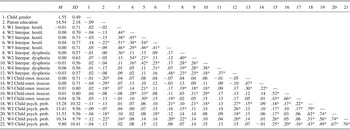
Table 1 shows the means, standard deviations, and correlations for the two demographic characteristics and the primary variables across the five measurement occasions. Inspection of the average level of parental reports of their children's psychological problems revealed that sample levels of symptomatology were stable across the first two measurement occasions in the sample as a whole. In contrast, there was a substantial drop in parent reports of psychological maladjustment from childhood (Wave 2) to adolescence (Wave 3; Cohen d = 0.41). Parental reports of child maladjustment dropped more modestly across the three measurement occasions during adolescence: Cohen d = 0.12 and 0.02 from Waves 4 to 5 and Waves 5 to 6, respectively. Consistent with their conceptualization as relational constructs that evidence both stability and change, examination of the correlations in Table 1 further indicated that interparental conflict dimensions and children's emotional insecurity evidenced moderate differential stability. Correlations across contiguous measurement occasions ranged from .41 to .54 for interparental hostility (all ps < .001); .26 to .40 for interparental dysphoria (all ps < .01); and .22 to .66 for children's insecurity (all ps < .01). In accord with traitlike conceptualizations of psychological maladjustment as evidencing higher differential stability, correlations between parental reports of psychological adjustment were strong in magnitude, ranging from r = .74 to .79 (all ps < .001).
Means, standard deviations, and correlations for the primary variables in the analyses

Note: Child gender: 1 = boys, 2 = girls. W1, Wave 1; W2, Wave 2; W3, Wave 3; W4, Wave 4; W5, Wave 5; W6, Wave 6.
*p ≤ .05.
Analytic plan
To address our primary objective of examining the nature and directionality of associations among interparental conflict, children's emotional insecurity, and their psychological adjustment, we used path analyses with Amos 22.0 statistical software program to specify cross-lagged, autoregressive models across the five time points spanning childhood and adolescence. To increase parsimony in the complex transactional analyses, separate models were specified for interparental hostility and dysphoria. For each model, all stability and cross-lagged paths between contiguous measurement occasions were freely estimated. As the two covariates, child gender and parental education level were specified as predictors of all endogenous variables in the model (i.e., the interparental conflict dimension, emotional insecurity, and child maladjustment at Waves 2–6). Correlations were also specified between (a) the residuals of the three variables within measurement occasions; and (b) all Wave 1 predictors and covariates. Path models were estimated using full-information maximum likelihood to estimate missing data (i.e., data were missing for 21.1% of the values) and retain the full sample for primary analyses (Enders, Reference Enders2001).
Primary analyses: Transactional model for interparental hostility
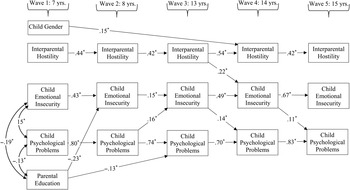
Figure 2 provides the results of the cross-panel analyses for interparental hostility. The model provided an adequate representation of the data, χ2 (54, N = 232) = 142.57, p < .001, root mean square error of approximation = 0.08, comparative fit index = 0.92, and χ2/df ratio = 2.64. For clarity, only significant structural paths and correlations are depicted in the figure. Because both gender and parent education levels were significant predictors of at least one endogenous variable in the analyses, all of their predictive paths were retained in the final model. Specifically, adolescent girls experienced higher levels of interparental hostility at Wave 4 (β = 0.15, p < .05), while parent education level was associated with lower levels of children's emotional insecurity at Wave 2 (β = –0.23, p < .001) and decreases in psychological problems (β = –0.13, p < .001) at Wave 3.
A cross-lagged path model examining transactional associations among interparental hostility, children's emotional insecurity in the interparental relationship, and their psychological problems across childhood and adolescence. For clarity, only significant structural pathways and correlations are depicted in the model. *p < .05.

In accord with prior research, autoregressive coefficients across contiguous waves were uniformly strong in magnitude for children's psychological maladjustment (βs = 0.70–0.84, all ps < .001) and consistently moderate in strength for interparental hostility (βs = 0.42–0.54, all ps < .001). Pairwise parameter comparison tests examining differences in the strength of the autoregressive paths across temporal periods (e.g., Wave 1 to Wave 2; Wave 2 to Wave 3) for each of the constructs yielded nonsignificant findings. Thus, the stability coefficients for both interparental hostility and child maladjustment were statistically comparable in magnitude across waves. The strengths of the autoregressive paths for emotional security were more variable. As expected, the 5-year lag between the middle childhood assessment of security at Wave 2 and the adolescent assessment at Wave 3 yielded the lowest (i.e., modest) stability coefficient (β = 0.15, p = .05). Conversely, the autoregressive coefficient was highest between Waves 4 (14 years old) and 5 (15 years old; β = 0.67, p < .001). Stability coefficients for the other annual spans during childhood (Wave 1 to Wave 2) and early adolescence (Wave 3 to 4) fell within the moderate range (βs = 0.43 and 0.49, respectively, ps < .001). Pairwise parameter comparisons testing the differences in the strengths of these path coefficients indicated that the stability of emotional insecurity between Waves 4 and 5 was significantly stronger than the autoregressive path between (a) Waves 1 and 2 (z = 2.65, p < .01), (b) Waves 2 and 3 (z = 4.84, p < .01), and (c) Waves 3 and 4 (z = 1.93, p = .05).
Evaluation of the cross-lagged tests of linkages among interparental hostility, insecurity, and child maladjustment revealed several findings. First, interparental hostility at Wave 3 (13 years old) predicted subsequent changes in children's emotional insecurity 1 year later (β = 0.22, p = .001), even after controlling for the children's prior emotional insecurity and psychological maladjustment, parental education, and child gender. Pairwise parameter comparison tests designed to examine whether this pathway was significantly different from the other three cross-lagged associations between interparental hostility and emotional insecurity revealed that Wave 3 interparental hostility was a stronger predictor of subsequent insecurity than Wave 4 interparental hostility (β = 0.03, p = .63, z = 2.05, p < .05). Second, as hypothesized, changes in children's psychological symptoms over the course of a year were predicted by their emotional insecurity at Waves 3 (13 years old, β = 0.14, p < .01) and 4 (14 years old, β = 0.11, p = .01). Pairwise parameter tests comparing the relative strength of these pathways with each other and the nonsignificant paths for Waves 1 and 2 indicated that Wave 3 insecurity was a significantly stronger predictor of subsequent child problems than insecurity at Wave 1 (7 years old, z = 1.99, p < .05) and Wave 2 (8 years old, z = 2.38, p < .05). Likewise, Wave 4 insecurity predicted subsequent child problems significantly more strongly than Wave 2 insecurity (z = 2.23, p < .05) and marginally more strongly than Wave 1 insecurity (z = 1.88, p < .07). Taken together, the results in Figure 2 support the hypothesis that children's emotional insecurity at Wave 4 is an explanatory mechanism in the association between Wave 3 interparental hostility and their psychological problems. Therefore, we conducted bootstrapping tests using the PRODCLIN software program to more authoritatively test the mediational cascade (MacKinnon, Lockwood, Hoffman, West, & Sheets, Reference MacKinnon, Lockwood, Hoffman, West and Sheets2002; Preacher & Hayes, Reference Preacher and Hayes2008). In support of the mediational pathway, the results indicated that the indirect path involving Wave 3 interparental hostility, Wave 4 emotional insecurity, and Wave 5 child psychological problems was significantly different from zero, 95% confidence interval (CI) = 0.07 to 0.82.
In contrast, the findings did not readily support a child effects model on the functioning of the interparental dyad. Specifically, children's emotional insecurity and their psychological problems failed to predict subsequent levels of interparental hostility. However, the results did support a negative transactional cycle in which an early history of psychological problems increased children's subsequent levels of psychological problems through its association with higher emotional insecurity in the interparental relationship. Children's psychological problems at Wave 2 (8 years of age) specifically predicted higher levels of emotional insecurity 5 years later at Wave 3 (13 years of age, β = 0.16, p < .05). Wave 3 insecurity, in turn, predicted greater psychological problems 1 year later when children were 14 years old (β = 0.14, p = .01).
Primary analyses: Transactional model for interparental dysphoria
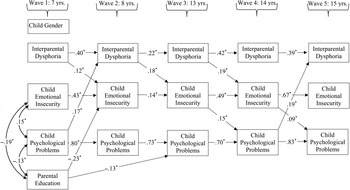
The transactional model for interparental dysphoria, which is shown in Figure 3, provided a good representation of the data, χ2 (54, N = 232) = 96.88, p < .001, root mean square error of approximation = 0.06, comparative fit index = 0.96, and χ2/df ratio = 1.79. The autoregressive path coefficients for child emotional insecurity and psychological problems were virtually identical (i.e., standardized path coefficients within 0.01) in the interparental dysphoria and hostility models. Consistent with the stability coefficients for interparental hostility, autoregressive paths for interparental dysphoria were generally moderate in magnitude, with βs ranging from 0.22 to 0.42 (all ps < .01). As with the interparental hostility model, pairwise parameter comparison analyses further revealed that the stability paths were statistically comparable for most comparisons, with two exceptions. The stability of interparental dysphoria during the 5-year span between Wave 2 and Wave 3 (β = 0.22, p < .01) was significantly lower than the autoregressive paths for dysphoria from Waves 1 to 2 (β = 0.40, p < .001, z = 2.40, p < .05) and Waves 3 to 4 (β = 0.42, p < .001, z = 2.10, p < .05).
A cross-lagged path model examining transactional associations among interparental dysphoria, children's emotional insecurity in the interparental relationship, and their psychological problems across childhood and adolescence. For clarity, only significant structural pathways and correlations are depicted in the model. *p < .05. †p = .06.

Analysis of the cross-lagged paths in Figure 3 revealed that interparental dysphoria consistently predicted children's emotional insecurity. Emotional insecurity was predicted by prior interparental dysphoria when children were 7 years old at Wave 1 (β = 0.12, p < .05), 8 years old at Wave 2 (β = 0.18, p < .05), and 13 years old at Wave 3 (β = 0.19, p < .01). Pairwise parameter comparisons indicated that the cross-lagged associations between interparental dysphoria and insecurity did not differ significantly from each other in magnitude (all zs < 1.79). Consistent with the interparental hostility findings, increases in children's psychological maladjustment were predicted by their emotional insecurity 1 year earlier at Wave 3, β = 0.15, p < .01, and 4, β = 0.09, p = .05. Pairwise parameter comparisons of cross-lagged paths between children's emotional insecurity and their subsequent psychological problems yielded two significant findings. Wave 3 emotional insecurity was a significantly stronger predictor of Wave 4 psychological problems than comparable prospective associations between (a) Wave 1 emotional insecurity and Wave 2 psychological problems (β = 0.00, p = .99, z = 2.18, p < .05) and (b) Wave 2 emotional insecurity and Wave 3 psychological problems (β = –0.04, p = .45, z = 2.56, p = .01). Taken together, these results provide some initial support for the mediational role of emotional insecurity at Waves 3 (13 years old) and 4 (14 years old). In further support of the mediating role of emotional insecurity, PRODCLIN bootstrapping tests indicated that the indirect paths involving (a) Wave 2 interparental dysphoria, Wave 3 emotional insecurity, and Wave 4 psychological problems; and (b) Wave 3 interparental dysphoria, Wave 4 emotional insecurity, and Wave 5 psychological problems were each significantly different from 0 (95% CI = 0.06 to 0.97 and 0.01 to 0.82, respectively).
In contrast to the interparental hostility model, children's psychological problems were significant predictors of subsequent increases in interparental dysphoria. Even after controlling for autoregressive effects, the two demographic covariates, and children's emotional security as predictors, Wave 1 child psychological problems predicted greater interparental dysphoria at Wave 2 (β = 0.17, p = .01) and Wave 4 child psychological problems were also prospectively associated with increases in Wave 5 interparental dysphoria (β = 0.19, p < .05). None of the pairwise parameter comparisons examining the relative strength of child psychological problems as predictors of interparental dysphoria were significant. Thus, the significant paths identified were not stronger in magnitude than the comparable paths that were nonsignificant.
Finally, although children's emotional insecurity was unrelated to downstream levels of interparental dysphoria, the findings in Figure 3 support an indirect pathway of insecurity as a predictor. Wave 3 emotional insecurity when teens were 13 years old predicted subsequent increases in their psychological problems at age 14, which, in turn, predicted higher levels of Wave 5 interparental dysphoria 1 year later. PRODCLIN bootstrapping tests further revealed a significant indirect pathway involving Wave 4 psychological problems as an intervening mechanism between Wave 3 emotional insecurity and Wave 5 interparental dysphoria (95% CI = 0.002 to 0.05).
Tests of child gender as a moderator
To test the generalizability of the associations in our two transactional models, we also examined whether the results of the cross-lagged paths varied as a function of child gender. To test the moderating role of child gender, we conducted multiple group comparisons in which the data were split into subsamples of boys and girls. Separate multigroup analyses were conducted for each form (i.e., hostility and dysphoria) of interparental conflict. Each multiple group comparison for the structural paths in Figures 2 and 3 consisted of comparing a model in which all cross-lagged parameters were allowed to vary freely with a model in which comparable paths across the male and female groups were constrained to equality. Comparisons of the fully constrained and free to vary models revealed no significant difference in fit for the interparental hostility, χ2 diff (20) = 17.52, p = .62, or interparental dysphoria, χ2 diff (20) = 30.46, p = .06, models. Therefore, gender did not moderate the cross-lagged paths for the two transactional models of interparental conflict.
Discussion
Developmental psychopathology has long advanced the notion of understanding psychopathology as an evolving interplay between the developing child in an ever changing socialization context (Cicchetti & Lynch, Reference Cicchetti and Lynch1993; Sameroff & MacKenzie, Reference Sameroff and MacKenzie2003). However, this conceptualization has yet to be systematically integrated into empirical tests of interparental conflict, children's coping, and adjustment. To address this issue, the goal of this paper was to embed EST into a broader transactional model by examining reciprocal relationships among interparental conflict, children's insecurity in the interparental relationship, and their psychological problems across five measurement occasions spanning middle childhood through middle adolescence. Consistent with hypotheses derived from EST (Davies & Cummings, Reference Davies and Cummings1994), cross-panel, autoregressive analyses indicated that emotional insecurity mediated associations between interparental hostility and dysphoria and children's psychological problems, particularly during adolescence. In further supporting the value of advancing a transactional model, the results also indicated that children's psychological problems predicted subsequent increases in interparental dysphoria in childhood and adolescence. Although children's concerns about their emotional insecurity were not directly associated with changes in interparental conflict, it was identified as both a mediator of increases in children's psychological problems over time and a distal process that was indirectly related to greater interparental dysphoria through its association with psychological problems.
Although prior studies have examined pathways involving hostile interparental conflict, children's emotional insecurity, and psychological adjustment, empirical studies that distinguish between dimensions of destructive conflict in tests of emotional insecurity as a mediator are very rare (Davies et al., Reference Davies, Martin, Sturge-Apple and Cicchettiin press). According to EST, interparental dysphoria may confer some of the same risks as interparental hostility in increasing children's insecurity and their subsequent adjustment problems. In accord with this hypothesis, findings from the only study to directly examine this research question showed that emotional insecurity mediated concurrent links between interparental dysphoria and children's psychological maladjustment (Du Rocher Schudlich & Cummings, Reference Du Rocher Schudlich and Cummings2007). Following statistical recommendations for authoritatively identifying mediational cascades, our aim was to build on these cross-sectional findings through the employment of cross-lagged models. In support of the hypothesized mediational pathways, our results indicated that interparental hostility and dysphoria were each predictors of subsequent increases in emotional insecurity in adolescence. Teen emotional insecurity, in turn, predicted greater increases in psychological problems over a 1-year period. Interparental dysphoria was a more consistent predictor of the mediational cascade of insecurity (i.e., two of the three mediational pathways tested were significant) in comparison to interparental hostility (i.e., one of the three mediational pathways were significant). In keeping with our findings, marital theorists have posited that apathy, helplessness, and detachment reflect particularly dire prognoses for the long-term stability of the interparental relationship and the family (e.g., Gottman, Reference Gottman1993). Previous research has also shown interparental dysphoria (e.g., withdrawal and apathy) to predict children's negative reaction patterns to interparental conflict, parenting problems, and broader disturbances in the family (e.g., Cox, Paley, Payne, & Burchinal, Reference Cox, Paley, Payne, Burchinal, Cox and Brooks-Gunn1999; Davies, Sturge-Apple, et al., Reference Davies, Sturge-Apple, Winter, Cummings and Farrell2006; Katz & Woodin, Reference Katz and Woodin2002).
Our analysis of the sequelae of interparental hostility and dysphoria across childhood and adolescence also support the notion that early adolescence may be a sensitive period for the operation of emotional security as a mediator. Emotional insecurity in adolescence, but not in middle childhood, was found to be a significant mediator in the prospective paths between interparental hostility and dysphoria and children's psychological problems. In interpreting these findings, it may be tempting to conclude that interparental conflict is more likely to sensitize children's concerns about security during adolescence than childhood by virtue of their stronger dispositions to mediate conflicts, greater awareness of interparental emotional displays, or their longer histories of exposure to interparental conflict (Cummings, Schermerhorn, Davies, Goeke-Morey, & Cummings, Reference Cummings, Schermerhorn, Davies, Goeke-Morey and Cummings2006; Davies & Cummings, Reference Davies, Cummings, Cicchetti and Cohen2006). However, if heightened emotional sensitivity to interparental conflict was the primary explanation for the findings, then associations between dimensions of interparental conflict should be more consistent and stronger in magnitude during adolescence. Our results failed to support these conditions. For example, associations between interparental conflict (i.e., dysphoria and hostility) and emotional insecurity were statistically indistinguishable in strength across childhood and adolescence.
What might more readily explain our findings? One interpretation is that concerns about insecurity in early adolescence confer greater risk for adjustment problems than insecurity during middle childhood. In support of this explanation, most of the longitudinal associations between insecurity at ages 13 and 14 and psychological problems were significantly stronger than predictive paths between childhood insecurity and psychological maladjustment. Although moderator tests of age in models of emotional insecurity are rare, confidence in our results is bolstered by meta-analytic findings indicating that proxies of emotional insecurity (e.g., negative affect) more strongly predicted internalizing and externalizing symptoms for older children within the age range of 5 to 19 (Rhoades, Reference Rhoades2008).
Questions still remain as to why difficulties preserving emotional security may confer disproportionate mental health burdens in early adolescence. Consideration of transition-linked turning points may offer insights into the underlying pathogenic processes (Graber & Brooks-Gunn, Reference Graber and Brooks-Gunn1996). During early adolescence, children must face a high density of potentially life-altering challenges, including transitions to larger, less personal, and more complex school settings, the socioemotional ramifications of pubertal changes, and increases in stressful life events (Castellanos-Ryan, Parent, Vitaro, Tremblay, & Seguin, Reference Castellanos-Ryan, Parent, Vitaro, Tremblay and Seguin2013; Ge, Conger, & Elder, Reference Ge, Conger and Elder2001; Mendle, Harden, Brooks-Gunn, & Graber, Reference Mendle, Harden, Brooks-Gunn and Graber2010; Reference Mendle, Harden, Brooks-Gunn and Graber2012; Roeser, Eccles, & Sameroff, Reference Roeser, Eccles and Sameroff1998; Seidman, Allen, Aber, Mitchell, & Feinman, Reference Seidman, Allen, Aber, Mitchell and Feinman1994). Increases in the prevalence and scope of challenging and novel events in biological, social, emotional, and academic domains are significant risk factors in themselves. Consistent with diathesis–stress models, increasing challenges in these domains during early adolescence may serve as diatheses that not only directly increase children's vulnerability to psychological problems but also intensify the negative health consequences of their concerns about insecurity (e.g., Davies & Cummings, Reference Davies, Cummings, Cicchetti and Cohen2006). Thus, future studies may benefit from examining whether these transitions account for the stronger association between insecurity and psychological problems during early adolescence.
By the same token, our findings do not necessarily imply that age moderates the mediational role of emotional insecurity in a linear fashion. Whereas interparental hostility and dysphoria when children were 13 years old were significant predictors of insecurity 1 year later, these same conflict dimensions at 14 years of age failed to predict subsequent insecurity. Moreover, interparental hostility at age 13 was a significantly stronger predictor of insecurity than the comparable assessment at age 14. If these findings are replicated, they may signify a trend for destructive forms of interparental conflict to progressively weaken in strength as predictors of insecurity as children traverse through middle and late adolescence. For example, middle adolescence may be accompanied by not only reductions in some normative stressors (e.g., pubertal-linked biological changes and adaptation to school structure and climate) but also growth in a wider repertoire of effective coping strategies (Compas, Connor-Smith, Saltzman, Thomsen, & Wadsworth, Reference Compas, Connor-Smith, Saltzman, Thomsen and Wadsworth2001; Grych & Fincham, Reference Grych and Fincham1990), autonomy (Oudekerk, Allen, Hessel, & Molloy, Reference Oudekerk, Allen, Hessel and Molloy2015), and support networks outside of the family (Wrzus, Hanel, Wagner, & Neyer, Reference Wrzus, Hanel, Wagner and Neyer2013). Therefore, these changes may buffer children from the vulnerability associated with exposure to destructive conflict. As a complementary explanation, the findings may be a product of a canalization whereby plasticity in the goal-corrected system of emotional security is progressively constrained over time (Cicchetti & Cohen, Reference Cicchetti, Cohen, Cicchetti and Cohen1995; Sroufe, Reference Sroufe1997). The narrowing or deepening of individual pathways through the canalization process may be evidenced by substantial increases in the stability of individual differences in emotional security. Consistent with this interpretation, our findings indicated that the stability of emotional insecurity was strong in magnitude during middle adolescence (i.e., the 14- to 15-year-old period) and significantly higher than the other stability coefficients in childhood and early adolescence.
Partial empirical support was also found for “child effects” paths in the transactional model (B paths in Figure 1). Although children's psychological maladjustment was negligibly associated with subsequent interparental hostility in all cross-lagged paths, it did significantly predict increases in interparental dysphoria in childhood and adolescence. Our findings are broadly consistent with previous studies identifying children's psychological problems as precursors of interparental discord using a variety of designs (e.g., longitudinal, autoregressive analyses of naturalistic designs, and experimental manipulation of children's behavior; Jenkins et al., Reference Jenkins, Simpson, Dunn, Rasbash and O'Connor2005; Schermerhorn et al., Reference Schermerhorn, Cummings, DeCarlo and Davies2007; Wymbs, & Pelham, Reference Wymbs and Pelham2010; Wymbs et al., Reference Wymbs, Pelham, Molina, Gnagy, Wilson and Greenhouse2008). Accordingly, the findings can be interpreted as supporting the family systems notion of interdependency between subsystems in the family and, more specifically, the hypothesis that children's difficulties may place significant stress and strain on interparental relationship quality (Minuchin, Reference Minuchin1985).
What is less clear is why interparental stress is specifically expressed through dysphoria. In this context, it is important to note that prior research has relied on broad indices of interparental adjustment (e.g., dissatisfaction and dissolution) or discord (e.g., global positivity and negativity, conflict frequency, and child-rearing disagreements) that commonly encompass both dysphoria and hostility during conflicts (e.g., Cui et al., Reference Cui, Donnellan and Conger2007; Jenkins et al., Reference Jenkins, Simpson, Dunn, Rasbash and O'Connor2005; Schermerhorn, Cummings, & Davies, Reference Schermerhorn, Cummings and Davies2005; Wymbs, Reference Wymbs2011; Wymbs et al., Reference Wymbs, Pelham, Molina, Gnagy, Wilson and Greenhouse2008). Because these measures do not distinguish between interparental displays of dysphoria and hostility, they are unable to address whether the documented burden of parental coping with children's psychological problems may be manifested in hostility, vulnerability, or both. Although more research is needed to replicate our results before drawing any definitive conclusions, our finding that children's psychological problems are precursors to interparental dysphoria may offer a new level of insight into the negative implications of children's adjustment problems. For example, cascade theories of marital conflict have posited that indices of interparental dysphoria (e.g., withdrawal) evolve in the wake of mismanaged bouts of hostility and, as a result, serve as more proximal forerunners to divorce and family instability (Christensen & Heavey, Reference Christensen and Heavey1990; Gottman, Reference Gottman1993). If interparental dysphoria is part of this toxic cascade, our findings suggest that children's problems may be taxing the interparental relationship in significant and, in some cases, irreparable ways.
In contrast to the evidence found for children's psychological problems as antecedent to interparental dysphoria, emotional insecurity was a negligible predictor of both interparental conflict dimensions across all five waves. On the surface, this may appear to be inconsistent with earlier findings showing that coercive involvement increases interparental conflict over a 2-year period (Schermerhorn et al., Reference Schermerhorn, Cummings, DeCarlo and Davies2007). However, high levels of involvement are conceptualized as a particularly evocative, bold response to conflict within a larger constellation of signs of insecurity that are more discreet in their expression (e.g., freezing, negative internal representations, and avoidance). EST specifically posits that coercive involvement distracts parents from effectively addressing ongoing disagreements, resulting in a progressive accumulation of unresolved discord, distress, and animosity over time (Davies et al., Reference Davies, Martin, Sturge-Apple and Cicchettiin press). In contrast, other insecure responses are commonly expressed in more subtle or covert ways during interparental conflicts and, thus, may not be salient to parents while they are embroiled in interparental conflict. By the same token, it is also important to note that emotional insecurity may play a more insidious, indirect role in increasing interparental problems. More specifically, our findings indicated that emotional insecurity when children were 13 years old was associated with increases in their psychological problems 1 year later. These resulting psychological problems, in turn, predicted greater interparental dysphoria over the course of the subsequent year. Examining the relative power of specific parameters of insecurity as distal and proximal precursors to interparental conflict may be an important next step toward identifying the sources of variability in transactions between child and interparental functioning.
As the final component of our transactional model, we tested the possibility that children's psychological problems may sensitize them to concerns about security in the interparental relationship (i.e., C paths in Figure 1). In comparison to other components of the transactional conceptualization, support for this pathway was more limited. In the 10 structural paths examined across the two analytic models, psychological problems only predicted subsequent insecurity in a single cross-lag (i.e., from 8 to 13 years old) and the finding was not replicated for the interparental dysphoria analyses. Previous longitudinal documentation of links between psychological problems and subsequent emotional insecurity has failed to control for the stability of emotional insecurity over time (e.g., Cummings et al., Reference Cummings, Schermerhorn, Davies, Goeke-Morey and Cummings2006; Davies, Harold, et al., Reference Davies, Harold, Goeke-Morey and Cummings2002). To our knowledge, only one previous study of preschool children has rigorously tested directionality by modeling change in emotional insecurity (i.e., Davies et al., Reference Davies, Martin and Cicchetti2012). Consistent with our findings, emotional insecurity was identified as a predictor but not an outcome of children's psychological problems. Taken together, these findings highlight the importance of not simply assuming that all factors and processes in an open system will evidence uniformly potent bidirectional associations across time. The specificity in the directionality of our findings is actually consistent with multiple family process models in developmental psychopathology. For example, risky family process models cast children's short-term responses to family stressors as intermediary mechanisms in pathways between their exposure to family conflict and their psychological problems (Repetti, Robles, & Reynolds, Reference Repetti, Robles and Reynolds2011; Repetti, Taylor, & Seeman, Reference Repetti, Taylor and Seeman2002). Likewise, EST emphasizes how emotional insecurity may serve as a carrier of risk in pathways between interparental conflict and subsequent child maladjustment (Cummings & Miller-Graff, Reference Cummings and Miller-Graff2015; Davies et al., Reference Davies, Martin, Sturge-Apple and Cicchettiin press).
Interpretation of our results should also be balanced by a consideration of the study limitations. First, although there was some diversity in the racial and socioeconomic backgrounds of the families in our study, our study consisted of a community sample of predominantly White and middle-class families. Thus, our findings may not generalize to families experiencing other demographic or risk conditions (e.g., interparental violence). Moreover, although our findings support the notion that the transactional pathways of security were comparable for boys and girls, more empirical tests of child gender as a moderator are needed before drawing definitive conclusions. For example, even though our sample size has been interpreted as being sufficiently powered to identify gender differences in the cascades of interparental conflict (Davies et al., Reference Davies, Martin, Sturge-Apple and Cicchettiin press), use of larger sample sizes would provide more definitive and powerful tests of moderation. Second, even though our 9-year transactional study from childhood to adolescence may be an advance over previous studies, it does not eliminate all effects of possible contextual (e.g., parenting) or genetic (e.g., shared genes between parents and children) confounds (e.g., Harden et al., Reference Harden, Turkheimer, Emery, D'Onofrio, Slutske and Heath2007; Nikolas, Klump, & Burt, Reference Nikolas, Klump and Burt2013). For example, although behavioral genetics studies support the notion that environmental processes partially account for many of the associations between interparental and child functioning, genetic risks shared by the biological parents and children in our sample may give rise to both higher discord between parents and greater child coping and psychological problems (e.g., Amato & Cheadle, Reference Amato and Cheadle2008; Nikolas et al., Reference Nikolas, Klump and Burt2013). Third, although the strength of the effects in our path models were comparable to or higher than previous studies (Cui et al., Reference Cui, Donnellan and Conger2007), the prospective associations identified were still modest to moderate in magnitude.
Finally, the use of different measures to assess insecurity in childhood and adolescence raises questions about the measurement equivalence across the two developmental periods. However, to allay these concerns, we made concerted efforts to implement strategies, derived from developmental psychopathology, for maximizing construct equivalence across time (e.g., Carlson, Sroufe, & Egeland, Reference Carlson, Sroufe and Egeland2004; Sroufe, Egeland, Carlson, & Collins, Reference Sroufe, Egeland, Carlson, Collins, Grossmann, Grossmann and Waters2005). Thus, we were careful to utilize psychometrically sound measures that captured comparable indices of emotional insecurity (i.e., emotional reactivity, avoidance, involvement, and negative representations) across childhood and adolescence using procedures tailored to the developmental levels of the children (see Measures section for details). Finally, given that parents may offer important complementary data on children's emotional insecurity, future research may benefit from incorporating parental reports in tests of transactional processes. For example, parental appraisals of children's insecure reactions to interparental conflict may be more potent predictors of subsequent interparental conflict.
Because the ultimate goal of EST is to facilitate the translation of theoretically informed empirical findings into practice (Cummings & Schatz, Reference Cummings and Schatz2012), we conclude our paper by highlighting how our results might guide, at least in rough form, clinical and public policy initiatives. Our empirical documentation of the central role of children's emotional insecurity as a mediator of children's vulnerability to interparental conflict in a transactional framework highlights the importance of developing treatment plans that are designed to stop the pathogenic cascade of insecurity. Directly reducing expressions of children's insecurity (e.g., reframing negative appraisals and coping skills) may appear, on the surface, to be a logical point of intervention. However, because our findings indicate that insecurity is inextricably linked with previous experiences with interparental conflict, any gains in security are likely to be lost as children revert back to their previously formed ways of responding within an unchanged context of interparental conflict and threat (Davies, Winter, & Cicchetti, Reference Davies, Winter and Cicchetti2006). Thus, one tentative implication of our findings is that any program designed to reduce children's reactivity to interparental conflict would benefit from a comparable effort to improve interparental relationship quality. In the context of our empirical delineation of interparental hostility and dysphoria as precursors of children's insecurity, family or interparental intervention components that are designed to reduce a wide array of destructive conflict tactics (i.e., anger, hostility, sadness, and withdrawal) may be particularly effective in fostering children's well-being (e.g., Cowan & Cowan, Reference Cowan and Cowan2002; Faircloth, Schermerhorn, Mitchell, Cummings, & Cummings, Reference Faircloth, Schermerhorn, Mitchell, Cummings and Cummings2011).
However, family interventions may not always be feasible to implement by virtue of their expense or the inability or unwillingness of families to participate in treatment (Davies, Winters, et al., Reference Davies, Sturge-Apple, Winter, Cummings and Farrell2006). Under these circumstances, our empirical identification of consistent links between insecurity and psychological problems in the context of multiple transactional pathways may offer a more flexible and efficient target for intervention. Complementary research has delineated several downstream mechanisms that account for why insecurity poses a risk for children, including the proliferation of negative representations to other interpersonal (e.g., peer) contexts (Bascoe, Davies, Sturge-Apple, & Cummings, Reference Bascoe, Davies, Sturge-Apple and Cummings2009), disruption of biological processes (e.g., sleep activity; Kelly & El-Sheikh, Reference Kelly and El-Sheikh2013), difficulties sustaining attention and executive functions (e.g., Martin, Davies, Cummings, & Cicchetti, Reference Martin, Davies, Cummings and Cicchetti2015), and failure to resolve stage salient tasks (e.g., Davies, Manning, & Cicchetti, Reference Davies, Manning and Cicchetti2013). Thus, taken together, interventions that are designed to address these cascade mechanisms may provide a feasible way to disrupt the pathogenic cascades of insecurity (e.g., DuPaul, Helwig, & Slay, Reference DuPaul, Helwig, Slay, Bray and Kehle2011; Johnston, Roseby, & Kuehnler, Reference Johnston, Roseby and Kuehnle2009; Schulz & Kerig, Reference Schulz, Kerig, Kerig, Schulz and Hauser2012).
As a potentially hopeful developmental message for practitioners, the moderate levels of differential stability in interparental conflict and children's emotional insecurity through middle adolescence suggests that plasticity in interparental processes is still evident during the early teen years. Coupled with our evidence that children's emotional insecurity mediates associations between interparental hostility and dysphoria and their psychological problems during early to middle adolescence, the findings collectively highlight the potential efficacy of interventions in reducing children's vulnerability to interparental conflict well into adolescence. By the same token, it is important to note that adolescence may not necessarily be the most opportune period for intervening. First, developmental plasticity in the emotional security system may reach a limit in the latter part of adolescence. For example, the significant increase in the stability of emotional insecurity from 14 to 15 years of age could indicate that individual differences are becoming increasingly entrenched during middle adolescence. Thus, substantially more clinical resources may need to be devoted to improve child well-being during middle adolescence and beyond. Second, earlier periods in childhood have also been identified as possible sensitive periods for the operation of family antecedents and sequelae of children's emotional insecurity (Davies, Sturge-Apple, et al., Reference Davies, Sturge-Apple, Winter, Cummings and Farrell2006; Davies, Winters, et al., Reference Davies, Sturge-Apple, Winter, Cummings and Farrell2006). Third, our empirical identification of the childhood roots of negative, bidirectional cycles involving interparental and child distress also underscores the clinical significance of earlier developmental periods. For example, Figure 3 denotes a long, reciprocal amplification process whereby (a) children's psychological problems at 7 years of age predicted greater interparental dysphoria 1 year later (Wave 2), (b) interparental dysphoria in turn was linked with greater insecurity during early adolescence (Wave 3), (c) the resulting insecurity was related to greater psychological problems 1 year later (Wave 4), (d) and this ultimately predicted further increases in their interparental dysphoria at Wave 5. Thus, in highlighting the translational implications of transactional models (e.g., Brock & Kochanska, Reference Brock and Kochanska2015; Masten & Cicchetti, Reference Masten and Cicchetti2010; McClain et al., Reference McClain, Wolchik, Winslow, Tein, Sandler and Millsap2010), interventions designed to reduce child psychopathology may ultimately disrupt the reciprocal amplification of interparental and child distress.