In his dedication of La nova scientia (Venice, 1537) to the Duke of Urbino, Niccolò Tartaglia presents a narrative of how he came to contend with problems of projectile motion.Footnote 1 He tells of how, six years earlier, while he was working as a maestro d'abaco in Verona, a bombardier at the Castel Vecchio posed a question to him: at what inclination to the horizon would a cannon achieve maximum range? Although he had never before fired a weapon, he promised his friend that he would find the answer. Tartaglia recounts that having ‘chewed over and ruminated on this matter, I concluded and proved to him by physical and geometrical reasoning’ that the optimal elevation of the barrel is 45 degrees.Footnote 2 Later, he explains, after others had experimentally verified his claim, he embarked on a more thorough investigation of projectiles. In the first two books of the treatise he uses the geometry of Euclid's Elements and Aristotle's account of motion to set forth a justification of the solution on the basis of ‘demonstrative geometrical reasoning’, which is very different from the ‘physical and geometrical reasoning’ presented to his friend. Moreover, in the preface Tartaglia explains that he employed both ‘Archimedean reasoning’ and ‘algebraic reasoning’ in order to discern the proportion by which shots fired at 45 degrees exceed those that travel parallel to the horizon.
Tartaglia thus enumerates four different kinds of ragioni (reasonings) that he applied to solve the bombardier's challenge, but he does not explain what he means by these phrases, and his reference to ‘Archimedean reasoning’ is particularly enigmatic. Tartaglia is counted among the Renaissance restaurateurs of works of ancient mathematics and mechanics, in part for his edition of Archimedes, published only six years later.Footnote 3 The context of the phrase suggests, however, that in this instance he was not appealing to the Syracusian in his capacity as a mathematician who reduced physical problems to geometry, and the question of what exactly Tartaglia meant has remained unanswered. Serafina Cuomo concedes that she
cannot think of any reason why the reasoning of the Nova scientia, II, Prop. 8 should have been called ‘Archimedean’ – hence Drabkin and Drake's hypothesis that ‘since there is reason to believe that Tartaglia did not see the authentic works of Archimedes before 1539, the change suggests that tradition wrongly ascribed to him some writings on projectiles’, 66 n6, will have to do for the time being.Footnote 4
Unfortunately, Drake and Drabkin did not delineate their reasons for believing that Tartaglia had not seen the works before the publication of the Nova scientia, nor did they justify their hypothesis. At a later point in the treatise, Tartaglia explains that even though the lines along which heavy bodies fall in actuality converge at the centre of the earth, the degree to which they deviate from being parallel is so slight that he will treat them as such. This argument is found in three of Archimedes' works, and I consider which ones Tartaglia might have known by 1537. Tracing what he knew of Archimedes at different times helps shed light on his curious phrase ‘Archimedean reasoning’.
The Nova scientia reveals that Tartaglia was well versed in Euclid, had knowledge of Aristotle's natural philosophy, and is likely to have had access to some of Archimedes' mathematical texts, but searches for his sources in the classical traditions alone provide an incomplete picture. He had worked as a maestro d'abaco – a teacher of arithmetic, algebra, and geometry problems – for about seventeen years prior to the publication of his first work. The abacus books of the late fifteenth and the early sixteenth centuries influenced both his style and his methods, and they provide a fruitful context in which to read the treatise. His lack of rigour, his chatty vernacular rhetoric, his structuring of the treatise as problems to be solved, his use of ‘algebraic reasoning’, and his medley of mathematical approaches reflect this tradition.Footnote 5
In addition to providing instruction at abacus schools, Tartaglia taught Euclid at Venice's Basilica di San Giovanni e Paolo, or Zanepolo.Footnote 6 While this anecdote is often noted, it has been unclear why he was teaching at a church and what the nature of the instruction was. Marino Sanuto's famous diary sheds light on these lectures. In addition to considering Tartaglia's various forms of ragioni and the influence of the abacus tradition on his work, I scrutinize an implicit assumption upon which his solution rests. I also draw attention to a technological invention that made the question of the relation between the inclination and range of cannons particularly relevant. This paper thus aims to enrich our understanding of Tartaglia's first publication by treating a handful of factors that have eluded the historical literature.Footnote 7
Tartaglia, maestro d'abaco and teacher of Euclid
In brief autobiographical accounts found in his later works, Tartaglia relates that poverty prevented him from receiving formal schooling, but that he pieced together an education and began teaching mathematics in his home town of Brescia.Footnote 8 Subsequently, from the age of about twenty to thirty-five, he taught public abacus classes in the House of Merchants of Verona before relocating to Venice.Footnote 9 Abacus schools provided instruction in practical applications of algebra, arithmetic and geometry to boys between the ages of eleven and sixteen.Footnote 10 In mid-sixteenth-century Veronese city records, we find a teacher advertising the usefulness of his courses for those who wish to learn bookkeeping; currency exchange; translation of units of measurement; measurement of the height of mountains, the size of walls and the depth of wells; and other skills required by merchants, architects, engineers and surveyors.Footnote 11 Among the few histories of the abacus tradition there is a notable dearth of studies on Venice, in particular ones that treat the first half of the sixteenth century.Footnote 12 While little is known about everyday life at these schools, the trattati or libri d'abaco reveal the types of questions and methods that students learned.Footnote 13 Since the kinds of problems and methods of solving them are very standard throughout these books, they provide a general sense of what Tartaglia was teaching at these schools. The trattati comprise story problems, ragioni, each of which begins with an enunciation immediately followed by an explanation of its solution, written in an informal, discursive style. The stories cover the range of subjects listed by the Veronese teacher above and usually end by charging the student to go and solve similar problems by the same method. In contrast to university and humanist mathematics, which focused on abstract, rigorous demonstrations, the aim of the abacists was to teach concrete problem-solving. The latter relate only which methods one ought to apply; they do not discuss theoretical matters, nor do they seek to justify the validity of the given approach. They treat both abstract geometrical figures and physical objects; their solutions often require knowledge of basic geometrical principles, such as formulae to calculate the size of figures and the Pythagorean theorem. While geometrical problems in the libri appeal to relations expounded by Euclid, they do so in order to make measurements that they express numerically. Similarly, in contrast to scholarly arithmetic, which was concerned with theories of numbers, abacists used arithmetical procedures to calculate numerical values. While the former restricted themselves to the quadrivium, the latter also employed algebraic techniques, which they combined freely with those of arithmetic and geometry. Before examining how exactly Tartaglia applies various methods, it is worthwhile to highlight commonalities between abacus books and the Nova scientia: as in the trattati, Tartaglia's language is colloquial and unpolished; he uses a combination of mathematical methods, including algebra; and he frames the treatise as a solution to a practical problem, which he presents in the form of a story.Footnote 14
In addition to teaching at abacus schools, Tartaglia notes in the Quesiti that he gave lectures on Euclid in Venice's Dominican basilica, Santi Giovanni e Paolo.Footnote 15 This comment raises a host of questions to which there are no definite answers, but the Venetian senator Marino Sanuto's I diarii provides some leads. How was he teaching Euclid – theoretically or in order to solve problems? Was this a class or a public lecture series? Whom was he teaching – vocational students or humanists who had a lay interest in mathematics? Sanuto's enormous diary describes various non-religious presentations held at the basilica, both on humanistic and mathematical subjects, which provide some context in which to make sense of this seemingly odd venue of Tartaglia's lectures.Footnote 16 Sanuto gives an account of an oration delivered at the basilica in praise of humanistic arts and rhetoric, and he notes that many were present.Footnote 17 His entries also list this church as the location of a philosophical competition, a public disputation in philosophy and theology and a theatrical performance.Footnote 18 In 1530 he attended lectures at the church on Euclid by Gianbattista Memmo, whose translation of Apollonius and acquaintance with Tartaglia are discussed below.Footnote 19 It was in the summer of 1536, when Memmo died, that Tartaglia began his lectures on Euclid. Sanuto passed away the same year and had ceased making diary entries three years earlier, so his Diarii provides no direct account of Tartaglia. However, it is safe to surmise that Tartaglia was filling the lectureship left by Memmo, which was frequented by non-academics with broad intellectual interests, such as the senator. This suggests that he taught a variety of people, both abacus students and humanists, who are likely to have sought different sorts of instruction.
As has frequently been noted, the general structure of the Nova scientia clearly follows that of the Elements and employs its theorems to formulate geometrical demonstrations, and the famous frontispiece casts Euclid in a central role.Footnote 20 Six years later, Tartaglia was to publish the first translation of the Elements into a modern language.Footnote 21 He draws on the skills he taught, both Euclid's geometry and abacus mathematics, in order to answer the bombardier's question. His first publication thus begins to emerge as a strange amalgam of abacus, axiomatic–deductive and natural-philosophical traditions. Since he leaves ‘algebraic reasoning’ until the final proof, I turn first to explore what he meant by ‘demonstrative geometrical reasoning’ and ‘physical and geometrical reasoning’.
‘Physical and geometrical reasoning’ versus ‘demonstrative geometrical reasoning’
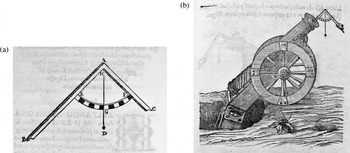
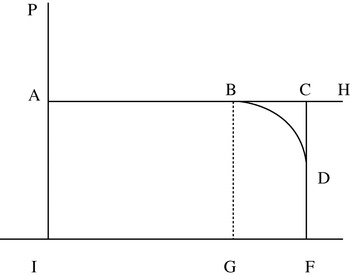
In Tartaglia's narrative of how he first became interested in analysing projectile motion, he does not claim to have solved the challenge without experiments, but the metaphor of ‘chewing and ruminating’, and his emphasis on having had no practice in the art of artillery, create the sense of distance from hands-on experience.Footnote 22 He identifies the method by which he ‘concluded and proved’ the problem as ‘physical and geometrical reasoning’, but it is not immediately clear what he means by this phrase. Mary Henninger-Voss describes ‘physical reasoning’ as ‘sometimes educated guesses, sometimes sharp analysis of common sense, and sometimes the concepts taken over from natural philosophers’.Footnote 23 In light of the passage immediately following the phrase, I suggest an additional meaning. Tartaglia explains that the solution requires ‘a square made of metal or hard wood that includes a quadrant with its vertical pendant, as appears below in the figure’ (see Figures 1a and 1b). He proceeds to explain how to use this tool to measure the angle of inclination and then testifies to the efficacy of such an implement.Footnote 24 He also points out that the prefect at Verona, who descended from a noble Venetian family, learned of his method of using a squadra and corroborated his findings.Footnote 25
Tartaglia's squadra (courtesy of the Lilly Library, Indiana University, Bloomington, Indiana).

Tartaglia alludes to astronomers' use of quadrants, and historians have disputed whether he was the first to appropriate them for ballistics.Footnote 26 In contrast to the ‘demonstrative geometrical reasons’ in the treatise proper, the geometrical aspect of this proof in the dedicatory letter consists in using a device to measure the angle of the barrel's gradient. The third book of the Nova scientia is devoted to explicating qualities and various applications of such an instrument. The quadrant provides a means by which to determine correlations between angles of inclination and distances attained by projectiles, which one derives from actually firing cannons and making measurements. ‘Physical and geometrical reasoning’ therefore entails knowledge acquired through the senses that can be measured and compared.Footnote 27
There are no records of whether Tartaglia actually solved the challenge empirically, geometrically or by a combination of the two. When it came to publishing his discovery he described the ‘physical and geometrical reasoning’ in only a few lines of the preface. In the treatise itself he provided ‘demonstrative geometrical proof’, a systematic analysis of trajectories which is entirely distinct from his initial solution. To determine experimentally which angle of elevation yields the greatest horizontal distance, one need only to hold the weight and motive force of the projectile constant and measure the horizontal distances achieved at various degrees of inclination.Footnote 28 However, to demonstrate geometrically why a 45-degree inclination yields the furthest range requires knowledge of the shape of the trajectory. Tartaglia's conception of this shape was determined by his restricting himself to the geometry of Euclid and the Aristotelian dichotomy between violent and natural movement. This distinction between different kinds of motion follows from Aristotle's partition of sublunar matter into elements that tend toward the earth and those that strive away from it.Footnote 29 One can determine whether a given body is undergoing natural or violent motion by identifying whether its speed is increasing or decreasing with distance, at which point along its trajectory it has the greatest effect, and the direction towards which it moves with respect to the earth. Tartaglia argues that since it is an element's nature that determines these factors, it is impossible for a single body to partake in motion that is both violent and natural.Footnote 30
The other parameter which determines the shape of the trajectories is that when it comes to geometrical elements, Tartaglia relies exclusively on those contained in Euclid; that is, straight lines and arcs of circles. In 1537, Gianbattista Memmo published a Latin translation of the first four books of Apollonius' Conics in Venice.Footnote 31 In the Quesiti, Tartaglia mentions that he had been friends with Memmo since his arrival in Venice in 1534.Footnote 32 Moreover, as I discuss below, Tartaglia was familiar with Archimedes' Quadrature of the Parabola. Thus, while he may well have been familiar with conic sections before the publication of the Nova scientia, Tartaglia does not appear to have considered these curves useful to analyses of natural phenomena. Ironically, one of the trajectories represented on the frontispiece appears to trace a parabola, but it was not until a century later that Galileo published his discovery of projectiles' parabolic motion.Footnote 33
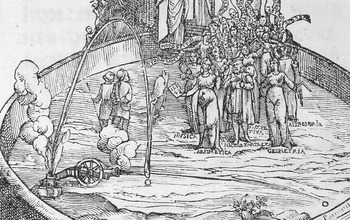
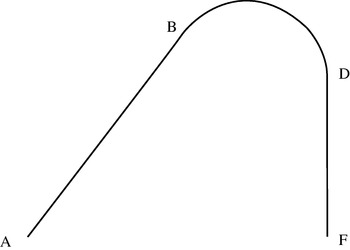
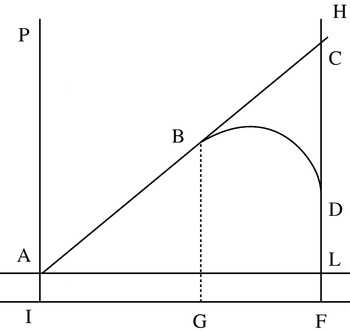
Tartaglia produced idealized geometrical diagrams of trajectories in order to render an intractably quick succession of positions into a single entity that he could analyse by using previously established physical and geometrical principles. He notes that the trajectories are in fact continuously curved, as they are depicted on the frontispiece (Figure 2a).Footnote 34 However, in order to adhere to the Aristotelian conception of motion, and to draw exclusively upon shapes contained in the Elements, he assembled a trajectory from two straight lines connected by an arc of an imaginary circle: the motion along the straight section AB and arc BD is violent, and the portion perpendicular to the horizon, DF, is natural (see Figure 2b).Footnote 35 Tartaglia never attempted to justify his assumption that the ‘evidently curved’ path is part of the circumference of a circle, as opposed to being any other curve. He did, however, discuss other problematic judgements involved in the process of reducing complicated motions to their essential components and idealizing these skeletal parts.Footnote 36 For example, he grants that no trajectory other than the perpendicular can have any part that is perfectly straight, because the weight of the body
continually acts on it and draws it toward the centre of the world. Nevertheless, we shall suppose that part which is insensibly curved to be straight, and that which is evidently curved we shall suppose to be part of the circumference of a circle, as they do not sensibly differ.Footnote 37
That is to say, while he observed curvature and recognized that a body's weight causes it to tend downwards, he judged this discrepancy negligible. To the same end, Tartaglia explains why he represented natural movements of uniformly heavy bodies as ‘parallel to one another and to the perpendicular of the horizon as well’.Footnote 38 He acknowledges that in reality natural motions tend toward the centre of the earth, and therefore their trajectories can never be perfectly parallel to one another nor to the perpendicular of the horizon. ‘Nevertheless’, he maintains, ‘since this error is undetectable in a short space, we shall suppose them all parallel to one another and to the perpendicular of the horizon as well’.Footnote 39 I return to this argument, and consider a possible source of it, in the discussion of ‘Archimedean reasoning’ below. It is important here to note that Tartaglia's justifications for these idealizations appeal to the small size of the discrepancy between the actual phenomenon and the representation – he was not seeking a general account of the trajectory of projectiles at any scale, but specifically the path cannonballs trace.
Detail from the frontispiece of the Nova scientia (Courtesy of the Lilly Library, Indiana University, Bloomington). Note the continuously curved trajectory.

Tartaglia's idealized trajectory

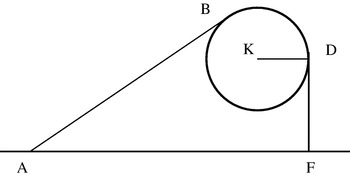
Following the structure of Euclid's Elements, Tartaglia sets out definitions and supposition about various aspects of motion, and then draws upon these principles to deduce the shapes of trajectories. The first step of his solution to the bombardier's challenge by ‘demonstrative geometrical reasoning’ is to argue that a projectile achieves the greatest distance possible when violent motion ends precisely in the horizontal plane from which it was shot.Footnote 40 While from a geometrical standpoint the propositions throughout the book are valid, Tartaglia's argument ultimately relies on questionable physical assumptions. The argument that the maximum range is achieved when violent motion ends precisely in the horizontal plane of the cannon depends on an implicit supposition that he does not try to explain.Footnote 41 One must assume that for bodies of equal size and propulsion, regardless of the elevation at which they are fired, the radii of the imaginary circles (KD in Figure 3a) are all equal, as are the lengths of the straight parts of the violent motion (AB). At no point does Tartaglia state this fundamental assumption, but his argument falters unless it is granted. It would be interesting to know whether this issue was noted by any of Tartaglia's readers. I have not found any discussion of it, either among his contemporaries or in studies of his work.
Tartaglia's idealized trajectory, of which the arc is a section of a circle.

Next, Tartaglia points out that a projectile fired point-blank comes to the end of its violent motion further below the plane of the horizon than cannons fired at any other elevation. In turn, a shot aimed perpendicular to the horizon completes its violent motion further above this plane than if it were fired at a lower inclination. The final step in his solution by ‘demonstrative geometrical reasoning’ is to reason that a shot fired at an elevation midway between these two extremes – that is, 45 degrees above the horizontal plane – must terminate its violent motion furthest from the cannon.Footnote 42
Further propositions in Book II are built upon the assumption that the radius of the imaginary circle and the length of the straight violent motion are equal at any inclination (AB in Figures 3b and c), as long as all other variables are constant. It is on the basis of this assumption that Tartaglia argues that arc BD is directly proportional to the angle of inclination and is inversely proportional to the horizontal distance covered by the straight violent motion (IG).
Point-blank shot from A.

Shot fired at an acute angle of inclination.

That is to say, as AB approaches the perpendicular, BD increases and IG diminishes. A large part of the second book is devoted to establishing this relationship, which does not contribute to the solution of the bombardier's challenge. Although the dedicatory letter focuses on the bombardier's challenge – a selling-point since it appears to have been the subject of many wagers and could easily be verified – the problem of how to achieve maximum range is only a portion of the treatise. The theorems just described indicate that Tartaglia's ambitions reached beyond demonstrating a solution to the challenge: his project entailed identifying a spectrum of variables in the system and deducing the relations between them.
Exploring what exactly Tartaglia's ‘physical and geometrical reasoning’ and ‘demonstrative geometrical reasoning’ entail has provided a clearer understanding of his methods, unearthed an implicit assumption at the basis of his arguments, and, above all, highlighted the eclecticism of Tartaglia's approach. His patching together of a variety of subjects, approaches and assumptions makes it a challenge to follow the steps of his arguments; this difficulty is further augmented by his lack of candour about what he had read and drawn upon. This is particularly true in the case of his peculiar use of the phrase ‘Archimedean reasoning’, the third form of ragione that he introduces in his analysis of projectile motion.
‘Archimedean reasoning’
In the dedicatory epistle, Tartaglia explains that he ascertained by ‘Archimedean reasoning’ that a shot elevated by 45 degrees goes about ten times further along the horizon than a point-blank shot.Footnote 43 The context reveals that he understood this form of reasoning to provide knowledge gained through sense perception. In the second edition of the Nova scientia (1550), which Tartaglia oversaw, he replaced the phrase ‘Archimedean reasoning’ with ‘physical reasoning’.Footnote 44 As I noted in the introduction, historians have commented on the peculiarity of his invoking Archimedes in this context. This incongruity and the fact that he later replaced the name suggest that his knowledge of Archimedes changed during the intervening years. The issue of what he knew about Archimedes in 1537 involves several factors. First, his axiomatic and geometrical approach to physical problems calls to mind Archimedes' mechanical texts, and it is tempting to surmise that he must have known them while writing the Nova scientia. Tracing the manuscripts available to him suggests that it is highly unlikely that he had first-hand knowledge of On Floating Bodies or On the Equilibirium of Planes at that time. It is, however, likely that he had access to On the Quadrature of the Parabola, which includes several mechanical propositions. A second factor is his argument that the lines along which bodies fall can be considered parallel even though they actually converge. Archimedes makes this claim in several texts, and I consider which ones Tartaglia might have known. After tracing which works he had access to, I consider why he might have chosen the phrase ‘Archimedean reasoning’.
Although Tartaglia was clearly working within an Aristotelian framework, the aspect of motion that interests him is very different from that of the Peripatetic tradition. Aristotle and his commentators' discussions of motion focus on its nature, distinguish between different kinds of motion and grapple with what causes a projectile to continue to move once it is no longer in contact with the motive force. Later, medieval schoolmen were preoccupied with impetus theories which challenged Aristotle's suggestion that it is the medium that conveys force. In contrast, Tartaglia forwent engaging in philosophical discussions of motion, and he refrained from inquiring into what causes the continuation of projectiles.Footnote 45 His interest was in giving mathematical explanations of trajectories, not in revealing their efficient causes. Tartaglia's method of idealizing physical conditions, which he then subjects to rigorous geometrical demonstrations, raises the question whether he was familiar with Archimedes' work on mechanics.Footnote 46
Considering that in 1543 Tartaglia published the first printed edition of Archimedes' treatises on mechanics, On Plane Equilibrium and the first book of On Floating Bodies, it is tempting to conjecture that his method in the Nova scientia was influenced by the classical texts. At the time that Tartaglia was preparing his first publication, the only manuscripts of Archimedes' works that included both of these mechanical treatises were a thirteenth-century Latin translation (MS O) and a copy thereof, made around the year 1500 (MS M).Footnote 47 The translation had been made from two Greek manuscripts, MSS A (which lacked one of the mechanical treatises) and B.Footnote 48 Since the latter disappeared after the early fourteenth century, MS A was the source of all Renaissance copies. A Latin translation of MS A was made in Rome around 1450, but it does not appear that Tartaglia would have had access to the holograph or to copies; when he prepared his 1543 publication of the mechanical works he used MS M.Footnote 49 There is, however, no documentation of the whereabouts of MS M from 1527 to 1550, at which time it appears in the records at the Escorial. It seems that the Spanish ambassador to Venice and humanist scholar Diego Hurtado de Mendoza brought the manuscript together with his collection of classical manuscripts to Spain. In the Quesiti, Tartaglia notes that Cardano introduced him to Mendoza in 1539.Footnote 50 The ambassador and maestro d'abaco subsequently developed a symbiotic working relationship: the former had the means and connections to acquire manuscripts and acted as Tartaglia's patron, while the latter had the mathematical knowledge to serve as Mendoza's tutor. It seems most likely that Tartaglia's first access to On Floating Bodies and On the Equilibrium of Planes was through reading Mendoza's manuscript at least two years after the publication of the Nova scientia.Footnote 51
Even if Tartaglia did not have access to these particular Archimedean treatises, it is plausible that he had knowledge of them through the works of others. One conjecture that immediately comes to mind is that Archimedes may have had an indirect influence on him via medieval Arab mechanics that influenced Jordanus' science of weights. Footnote 52 However, Tartaglia only obtained a manuscript of Jordanus' De ratione ponderis in 1539.Footnote 53 Another possibility is that he was familiar with Archimedes' mechanics through an encyclopedic mathematical work, such as Giorgio Valla's De expetendis et fugiendis rebus opus (Venice, 1501). Valla actually owned MS A and included excerpts in his large compendium, making them the first printed passages of Archimedes.Footnote 54 The selections that he did include are, however, strictly geometrical.Footnote 55 Although the passages taken from Archimedes do not treat his mechanics, Valla also included the first sixty lines of Eutocius' commentary on On the Equilibrium of Planes.Footnote 56 Eutocius here discusses centres of gravity of planes, and Archimedes' postulate that planar figures which are unequal but similar have similarly situated centres of gravity. While this brief excerpt treats a very different subject from the one that concerns Tartaglia, both are axiomatic and geometrical treatments of physical problems.
Although Tartaglia does not appear to have seen the two Archimedean mechanics treatises prior to 1537, he is likely to have had access to On the Quadrature of the Parabola, which includes several propositions that rely on principles of mechanics. In 1503 Luca Gaurico had published Quadrature of the Parabola and On the Measurement of the Circle in Venice, and Tartaglia's 1543 edition of Archimedes included these very translations together with the mechanical texts taken from MS O.Footnote 57 Archimedes begins the work on quadrature with a letter to a friend in which he explains, ‘I have written out the proof and send it to you, first as investigated by means of mechanics, and afterwards too as demonstrated by geometry.’Footnote 58 He proceeds to use the principles of the balance to analyse and identify relationships between figures of various shapes.Footnote 59 In the Nova scientia Tartaglia does not draw upon the science of weights, but he does adopt an axiomatic–geometrical approach to analysing physical problems. While it is impossible to determine what exactly Tartaglia had read before 1537, it is likely that he had some exposure to Archimedes' application of mathematics to physical problems.
As discussed above, Tartaglia argues that even though the lines along which bodies fall to earth actually converge, they can be considered parallel when describing objects on a human scale. Archimedes makes this assumption in On the Method, in On the Equilibrium of Planes and in Quadrature of the Parabola. The first of these was lost until the nineteenth century and it appears that Tartaglia did not have access to the second. It seems very likely, however, that he had seen the third. Since Gaurico's volume was printed in Venice and includes the argument that the lines along which bodies descend can be considered parallel, it is probable that Tartaglia was familiar with it by the time he was preparing the Nova scientia.
There remains the question why Tartaglia initially chose the phrase ‘Archimedean reasoning’ to indicate knowledge derived by observation. Roy Laird describes Archimedes' various reputations in the Middle Ages up into the sixteenth century, none of which pertain to his work in theoretical mechanics. In Roman and early Christian histories he is famed for his creation of ballistic instruments to defend Syracuse, his unwavering concentration even as the city fell to the Romans and his death at their hands.Footnote 60 Renaissance humanists beginning with Petrarch studied classical accounts of Archimedes' life and his outstanding abilities as a practical artificer. Accounts of his marvellous machines and Herculean feats (such as displaying his ability to move a boat single-handedly before King Hieron), together with his mathematical treatises, seem to have been the cause for Archimedes' fame until the mid-sixteenth century. Rose maintains that it was only late in the sixteenth century that Archimedes' reputation as a genius in theoretical mechanics developed.Footnote 61 Moreover, references to him from the fourteenth century to the early eighteenth, including Petrarch's mention of him in De remediis utriusque fortunae, attributed the invention of cannons and gunpowder to Archimedes.Footnote 62 It appears that Tartaglia chose the phrase ‘Archimedean reasoning’ on the basis of the Syracusian's fame as a practical artificer, in particular a builder of war machines, whose knowledge was practical rather than deduced from first principles.
‘Algebraic reasoning’
In the dedicatory epistle Tartaglia draws attention to the fact that he solved the final problem by means of a combination of geometrical and algebraic reasoning. Solving problems by naming unknowns and then determining their value by means of equations was among the main pursuits of abacists. It was in their books and schools, rather than in more scholarly circles, that algebra subsisted and was disseminated between the time of its arrival in Europe during the thirteenth century and the development of solutions to higher-degree equations, of symbolic notation and of analytic geometry during the sixteenth and early seventeenth centuries. Before symbols were used, abacist algebra designated unknowns simply as cose, or things, squares of unknowns as censi, and articulated equations in sentence format. For example, an equation written in modern notation as ax=bx 2 would be expressed ‘when the cosa are equal to the censi’.Footnote 63 The Nova scientia follows these conventions.Footnote 64
In the final proposition of the second book, Tartaglia uses ‘geometric and algebraic reasoning’ to show that when similar and uniformly heavy bodies are shot with equal force, one at a 45-degree inclination, the other fired point-blank, the initial straight part of the trajectory of the former will be four times that of the latter. There are two stages to the argument, the first is a straightforward geometrical construction, and the second stage applies algebraic reasoning.
Step 1: geometrical construction
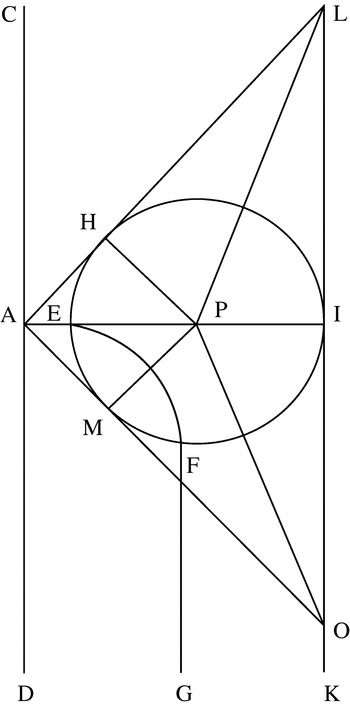
Trajectory of cannon fired at maximum range: AHIO (Figure 4)
Trajectory of cannon fired point-blank: AEFG
He completes the circle of the curved part of the trajectory, HI, and through a series of Euclidean propositions constructs the right isosceles triangles ALO, ALI and AIO.
From experience (by ‘Archimedean’ or ‘physical reasoning’) he knows that AE is one-tenth of AI
By construction the altitude of triangle ALO is AI, which is equal to LI and IO.
If AE is taken as one unit of measurement, then triangle ALO is equal to 100 square units and AL and AO are both equal to the square root of 200.
The line AE is the initial straight section of a trajectory of a projectile fired point-blank. Tartaglia argues that AE is one tenth of the horizontal distance AI of a shot fired at maximum range.

Step 2: algebraic reasoning
He joins the circle's centre to the angles of the large triangle, and constructs perpendiculars on AL and AO that meet the centre.
He labels the radius as the cosa.
The altitude of triangles PLO, APL, and APO are equal to the cosa.
To find the areas of these triangles:
Cosa multiplied by half of LO to find the area of PLO.
Cosa multiplied by half of AL and half of AO to find the areas of APO and APL, each of which is the square root of 50 censi.Footnote 65
The sum of the areas of the triangles therefore comes to the root of 200 censi and 10 cose.
From the above we know the area of triangle ALO is 100 units.
He can therefore proceed to solve for the cosa, which comes to the root of 200 minus 10, or 41/7.
In the geometrical construction he had shown that the radius (which is the cosa) is equal to the initial straight part of the trajectory, which is about four.Footnote 66
While Tartaglia's notation is cumbersome for the modern reader, it is useful in providing a sense of his abacus roots. Surveying geometric–algebraic problems in the trattati d'abaco reveals that as is the case here, they are most often solved by appealing to the rules of right triangles to solve for an unknown.Footnote 67 Tartaglia thus draws on Euclidean propositions to establish proportions between sides of figures, labels an unknown, and solves for it by appealing to known geometrical relationships. Unlike Euclid, he multiplies sides to calculate areas. His combination of the methods of classical geometry with those of medieval abacus algebra to analyse projectile motion is a further example of his innovative mixing of traditions.
The maestro's patchwork
By exploring how Tartaglia applied the four types of ragioni that he introduces in the dedicatory epistle it becomes apparent that as a maestro d'abaco in sixteenth-century Venice he was in a unique position to draw on a variety of sources. As a teacher of practical mathematics he was well versed in Euclid and in algebra. He applied the former to solving physical problems and to calculating numerical values of areas, and he combined Euclidean theorems with algebraic methods to determine distances. Moreover, during the late fifteenth and early sixteenth centuries, a large number of classical mathematics and mechanics manuscripts arrived in Venice. Many of these were translated, copied and printed, and contributed to a revival of interest in classical mathematics. Tartaglia reaped this harvest: he seems to have been familiar with some Archimedean treatises through a recent printing of On the Quadrature of the Parabola and possibly through second-hand accounts. While it appears that he knew of conic sections and the frontispiece depicts a continuously curved trajectory, he does not seem interested in exploring whether the curved paths of projectiles might be anything other than arcs of circles. Examining his demonstrations has revealed several instances in which he chose approximations over precise representations of natural phenomena. He admits that no trajectory other than the perpendicular can have any part that is perfectly straight, but he maintains that it is close enough for his purposes.Footnote 68 Similarly, he argues that although the paths of falling bodies actually converge, we can consider them perpendicular to the horizon. Although he does not discuss his assumption that the arcs of trajectories are all drawn from circles of the same size, it is possible that this is a further example of his willingness to make approximations in order to formulate a mathematical solution to the bombardier's question.
The pseudo-Aristotelian Quaestiones mechanicae is a further classical work that Tartaglia appears to draw upon, but which he does not directly reference. In his discussion of the relationship between the speed and the effect of cannonballs, he explains that one can compare the quantity of effects by the depths of the holes they make in the ground.Footnote 69 His use of percussion in order to compare quantities of effect, and by extension speeds (an otherwise intractable factor in the system), suggests that Tartaglia was familiar with the Mechanica. The third-century treatise includes a brief treatment of percussion which is unique among classical applications of mathematics to physical problems insofar as it introduces the concept of virtual velocity and considers the role of velocity in percussion.Footnote 70 All the questions in the Mechanica concern the relationships between the size, position and effect of bodies in motion, including projectile motion. Judging by the similar conceptions of the Mechanica and the Nova scientia of the relationship between speed and effect, it seems probable that Tartaglia was familiar with the former treatise. Moreover, he is likely to have had knowledge of recent editions of the Mechanica: the Venetian humanist Vittore Fausto published (albeit in Paris) the first Latin translation of the work in 1517, and a more influential edition was made by the Paduan philosophy professor Niccolò Leonico (Venice, 1525).Footnote 71 In light of the shared subject matter of the two texts and Tartaglia's geographical proximity to the new Latin edition of the classical work, it seems highly probable that pseudo-Aristotle's Mechanica was a source of his treatment of projectile motion.Footnote 72
Tartaglia drew on multiple traditions and applied his knowledge and skills to a variety of ends. Beyond his various forms of teaching, Tartaglia accepted odd jobs that involved mathematical calculations. In the General trattato, he describes how he was employed to calculate tables by which bakers determine the cost of bread on the basis of the cost of ingredients.Footnote 73 It was not uncommon for abacus teachers to be hired for private or publicly funded projects, especially in the arenas of engineering, surveying and architecture.Footnote 74 Considering the various ways in which he marketed his skills, it is hardly surprising that he applied them to a military problem. A brief survey of the political and technological context in which Tartaglia worked reveals that the Nova scientia was a response to Venice's urgent needs to improve their armaments, in particular the accuracy of cannons. Tartaglia's lifespan (c.1500–1557) maps onto the duration of the Italian Wars, during which Spain, France, England and many Italian city states engaged in a series of wars on Italian soil. As a boy he was wounded when French troops seized his home town of Brescia, of which they maintained control throughout his youth. Apart from the French occupation, Brescia was under Venetian authority, as was Verona, where he lived before settling in Venice. During the 1520s and 1530s, the Republic of Venice engaged in a succession of alliances and negotiations as the Holy Roman Emperor, Francis I of France and the Pope vied for cities across the Italian peninsula. The Nova scientia is dedicated to the chief commander of Venetian troops in Lombardy, the Duke of Urbino, who was also put in charge of the city's defence when the Ottoman Empire became a threat to Venice. Tartaglia identifies this menace from the east as his primary reason to go ahead and publish the unfinished treatise. Indeed, in the year of the publication of the Nova scientia, the Ottoman Empire, which under Suleiman the Magnificent had already laid siege to and conquered large parts of eastern Europe, the Mediterranean and Mesopotamia, drew Venice into war.Footnote 75
Surrounded by wars and threats of invasion, Tartaglia was savvy to promote his area of expertise as an aid to the advancement of artillery. Cannons propelled by gunpowder had been invented in the first half of the fourteenth century, but due to problems in their design and materials, two centuries later their accuracy remained very poor.Footnote 76 Initially, cannons were mounted on stationary stands at a fixed vertical axis. By the end of the fifteenth century they were placed on wheeled carriages, and founders began casting barrels with trunnions, the mounting lugs that allow barrels to pivot so that their inclination is adjustable.Footnote 77 The construction of cannons, warfare tactics, fortifications and the production of gunpowder for artillery underwent significant developments during the Italian Wars. Tartaglia recognized a market for a treatise dealing with various aspects of the use of cannons: in the letter of dedication, he promised not only a means by which to determine how to aim cannon barrels, but also recipes for compounding explosives.Footnote 78 The latter were advertised as the subject of the fifth book of the treatise, which was never published.Footnote 79
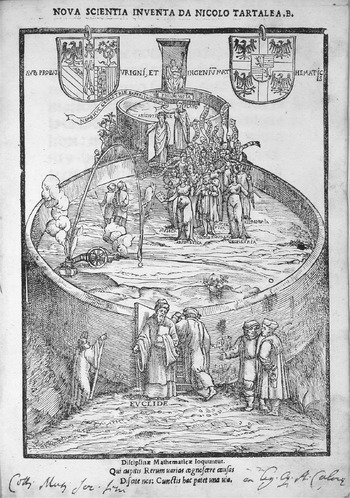
Mathematics had recently received a significant boost in intellectual esteem from humanist scholars and Tartaglia had reason to hope that his demonstrations would attract the attention not only of military men, but also of paying students or even a patron from more learned circles.Footnote 80 Italian humanists' interest in Neoplatonist writings in particular contributed to a shift in the general perception of mathematics.Footnote 81 Humanist educators also highlighted the pedagogical importance of mathematics: in a letter on pedagogy Aeneas Sylvius Piccolomini, later Pope Pius II, explained that geometry is a valuable form of reasoning insofar as it provides understanding of truths that are not fully apparent to the senses.Footnote 82 It is this very capacity to analyse that which the senses can only apprehend in a confused manner that Tartaglia employs when he seeks to describe projectile motion in a mathematical form. The allegorical frontispiece (Figure 5) and the title of the treatise show Tartaglia establishing himself as the father of a new science, and he continues to be lauded as the founder of ballistics and the first to claim that ‘the mathematical study of gunshot could yield a science’.Footnote 83
Frontispiece of La nova scientia (Courtesy of the Lilly Library, Indiana University, Bloomington, Indiana).

He does not actually discuss what his criteria are for creating a ‘new science’. On the one hand, Tartaglia worked in an Aristotelian framework insofar as he distinguished between natural and violent motion, and he argued that a body cannot partake of both at the same instant.Footnote 84 It was Galileo's rejection of this division of motion, and the acceptance that projectiles can simultaneously move horizontally and vertically, that enabled him to identify projectiles as tracing a parabolic trajectory.Footnote 85 On the other hand, Tartaglia broke from the Aristotelian tradition in that his ‘new science’ did not seek to reveal the requisite four causes. The caption below the frontispiece announces that mathematics is the path that leads to knowledge of the causes of things:
Disciplinae Mathematicae loquuntur:
Qui cupitis Rerum varias cognoscere causas
Discite nos: Cunctis hac patet una via.Footnote 86
This is the full extent to which Tartaglia deals explicitly with the status of mathematics and its epistemological role. Tartaglia does not expand on what he understood by the causas mentioned in the caption below the engraving, but it is certain that his accounts of motion do not provide the causes required by Aristotle. His approach was distinct from Aristotelian and medieval discussions of motion insofar as he did not seek to explain how a body remains in motion (that is, the efficient cause of motion), but confined himself to describing its path.
We have found Tartaglia mixing methods from a vast spectrum of sources. Being accustomed to the diversity of problems and solutions presented by abacus books, he does not discuss his crossing of different approaches and traditions. Neither does he engage in philosophical debates about mathematics and its relation to other realms of knowledge in the text of the Nova scientia – these topics are entirely confined to the famous frontispiece. The woodcut depicts Euclid as the St Peter at the gates of the fortress of Philosofia, and it is only through him that one gains access into her domain; those who try to scale the walls on their own are stranded on their rickety, too-short ladders. On the lower level of the bastion, Tartaglia leads a procession of women who represent mathematical disciplines. At the top of the fortress Queen Philosophy herself is enthroned, and on the steps between the two terraces Aristotle and Plato watch the parade. Plato, situated closer to philosophy's sanctum sanctorum, waves a banner that reads, ‘Nemo huc geometrie expers ingrediatur’, a warning allegedly inscribed above the Academy door.Footnote 87 There is, however, no indication in the text that Tartaglia was interested in Neoplatonic efforts to unearth the mathematical structure of the universe.Footnote 88
Although Tartaglia did not entertain philosophical questions, they caught the attention of humanist scholars. Soon after the publication of the Nova scientia, a large-scale dispute erupted over the question whether geometrical proofs conform to Aristotle's requirements of an ideal science, and more generally, what role mathematics ought to play in natural philosophy. Those who argued that mathematics was not a valid form of scientific demonstration focused on two issues. One concern was the absence of syllogisms in mathematical demonstrations; ensuing attempts to present Euclid in syllogistic form and, conversely, to arrange the Posterior Analytics in an axiomatic structure were, however, short-lived.Footnote 89 The more persistent problem was that geometrical demonstrations do not explain effects by identifying causes, but rather demonstrate relationships between entities. While Tartaglia himself did not address the question of the certainty of mathematics or attempt to justify his mathematical treatment of physical problems, his mixed methods prompted his contemporaries to raise questions that captivated mathematicians and natural philosophers well into the seventeenth century.Footnote 90 It was in the immediate wake of Tartaglia's attempts in the Nova scientia to use mathematics to analyse motion that the Mechanica moved from the domain of humanists to that of natural philosophy.Footnote 91 Archimedes' reputation underwent a parallel shift during the nine years between the publications of the Nova scientia and the Quesiti.
As a maestro d'abaco and resident of Venice during the early to mid-fifteenth century, Tartaglia was conversant with mathematical traditions that were well established (such as algebra and Euclid's Elements). By means of these skills he was able to approach various recently recovered classical mathematical works, but he went far beyond explaining and commenting on them. The frontispiece focuses on Euclid, Aristotle, Plato and the quadrivium, but in the dedicatory epistle Tartaglia draws attention to use of ‘algebraic reasoning’. In the final proposition of the second book, he combines the practical geometry methods of the abacus literature with rhetorical algebraic calculations.Footnote 92 Moreover, beyond this proposition, Tartaglia's immersion in the abacus tradition is reflected in the structure, style and methods of the Nova scientia, which are blended with elements drawn from Euclid, various Archimedean traditions, and Aristotelian natural philosophy.Footnote 93 Just as he pieced together an education for himself, and then patched together an income by teaching various forms of mathematics to different groups of people and by employing mathematics to practical ends, he combined a spectrum of traditions and methods, as are reflected in his four ragioni.