Nesiritide is a recombinant human B-type natriuretic peptide and is composed of a 32 amino acid sequence that is identical to endogenous B-type natriuretic peptide. The physiological effects of nesiritide include decrease in right atrial pressure, pulmonary capillary wedge pressure, pulmonary artery pressure, pulmonary vascular resistance, systemic vascular resistance, and subsequently increase in cardiac output.Reference Abraham, Cheng and Smoluk 1 In addition to its cardiovascular effects, nesiritide acts on the renal tubules to inhibit the renin–angiotensin–aldosterone system, increase urinary sodium excretion, and diuresis.Reference Abraham, Cheng and Smoluk 1
Nesiritide has been well studied in adults with heart failure, but with equivocal benefit.Reference O’Connor, Starling and Hernandez 2 , Reference Dontas, Xanthos, Dontas, Lelovas and Papadimitriou 3 The aetiology of heart failure in children is different from adults and it is unclear how the different aetiologies of heart failure in children may affect the response to nesiritide. The concept of “optimal medical therapy” for acute heart failure relies on recommendations of current consensus-derived guidelines, most of which are supported by “level of evidence C”. The most recent International Society of Heart and Lung Transplantation guidelines assigned a class IIB for the use of nesiritide, and it is recommended that nesiritide may be beneficial for the treatment of paediatric heart failure in select situations where other interventions to lower central venous pressure have been unsuccessful.Reference Rosenthal and Shaddy 4
We report a series of four children (five encounters) with biventricular dysfunction of differing aetiologies with generalised oedema and oliguria, despite intravenous diuretics and inotropic therapies in addition to standard heart-failure management that were treated with continuous nesiritide infusion and outcome.
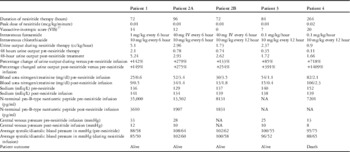
Patient No. 1: Patient 1 was a 20-month-old boy with left ventricular non-compaction and dilated cardiomyopathy who developed low cardiac output with end-organ dysfunction despite milrinone infusion. A left ventricular assist device (Berlin ExcorTM) 25-ml pump was placed electively as a bridge to heart transplantation; 4 months after left ventricular assist device implantation, he developed anasarca, respiratory distress, and oliguria secondary to right ventricular failure. His left ventricular assist device settings were optimised, diuresis was achieved with intravenous furosemide and chlorothiazide, and he was started on supplemental oxygen (FIO2 1.0) and inhaled nitric oxide of 20 ppm with no significant improvement. He was also on intravenous epinephrine, and milrinone infusion was initiated for worsening right ventricular function. His urine output decreased significantly with rising blood urea nitrogen and creatinine levels. He underwent cardiac catheterisation, which showed mean right atrial pressure of 33 mmHg, mean pulmonary artery pressure of 39 mmHg, and mean left pulmonary capillary wedge pressure of 22 mmHg. He was started on a nesiritide infusion at 0.01 mcg/kg/minute. The response to nesiritide therapy is shown in Table 1. A suitable donor became available 48 hours after stopping nesiritide and he underwent heart transplantation successfully.
Summary of clinical features of patients and nesiritide therapy response data.

VIS is calculated using the formula proposed by Gaies et alReference Gaies, Gurney and Yen 17 =dopamine (mcg/kg/minute )+dobutamine (mcg/kg/minute)+100×epinephrine (mcg/kg/minute)+100×norepinephrine (mcg/kg/minute)+10×milrinone (mcg/kg/minute)+10,000×vasopressin (mU/kg/minute)
Patient No. 2A: Patient 2 was a 17-year-old male who had undergone heart transplantation at the age of 4 years due to restrictive cardiomyopathy and was admitted with dyspnoea and anasarca. He had a history of multiple rejections and transplant coronary vasculopathy involving the right coronary artery. His admission echocardiogram demonstrated moderate tricuspid regurgitation, a dilated inferior caval vein, and markedly decreased right ventricular function, with normal left ventricular systolic function (shortening fraction 36%) and moderate-sized pericardial effusion. He was started on milrinone and dopamine infusions and intravenous diuretics – furosemide and chlorothiazide – for his right ventricular failure. His immunosuppression was continued to maintain therapeutic levels. Despite these therapies, his oedema progressed and his blood urea nitrogen and creatinine levels continued to rise. He underwent cardiac catheterisation to evaluate his coronary arteries and to evaluate the progression of his coronary artery disease, and endomyocardial biopsy was performed to evaluate for acute rejection. His haemodynamics showed mean right atrial pressure of 28 mmHg, right ventricle pressure of 48/22 mmHg, mean pulmonary artery pressure of 32 mmHg, and mean left pulmonary capillary wedge pressure of 24 mmHg. His endomyocardial biopsy showed no evidence of acute rejection and there was no progression of coronary artery disease by angiography. A nesiritide infusion was started at 0.01 mcg/kg/minute in addition to intravenous diuretics and inotropic therapy. Response to nesiritide is shown in Table 1. Clinical examination and echocardiogram showed significant improvement of right ventricular function and he was discharged home 2 weeks later on oral therapy.
Patient No. 2B: 2 months after his previous admission, he re-presented with signs and symptoms of right heart failure. His admission echocardiogram showed normal left ventricular systolic function, with shortening fraction of 34%, left ventricular diastolic function, dilated right ventricle with decreased systolic function, and moderate-to-severe tricuspid insufficiency. He was admitted to the ICU for his right heart failure and possible rejection. He was treated with pulse steroids and intravenous diuretics. As he was not a re-transplant candidate, catheterisation was deferred. He refused to receive intravenous inotropic therapy. After 3 days, there was no improvement of his oedema and oliguria, and his serum creatinine level was rising to 3.5 mg/dl. A nesiritide infusion was started and continued for 3 days. Response to nesiritide therapy is shown in Table 1. He had clinical and echocardiographic improvement in right ventricular function and was discharged home. He has not required hospital re-admissions for >12 months.
Patient No. 3: Patient 3 was a 14-year-old male with aortic valve disease who underwent a Bentall procedure and augmentation of both ventricular outflow tracts. His postoperative echocardiogram demonstrated no residual defects with good biventricular systolic function; however, he had decreased urine output and elevated central venous pressure (25–28 mmHg) in spite of intravenous diuretics and inotropic support. He underwent cardiac catheterisation for evaluation of his haemodynamics and coronary artery anatomy. His cardiac index was 3.8 L/minute/m2 despite elevated right atrial pressure (mean of 25 mmHg), mean pulmonary artery pressure (33 mmHg), and mean pulmonary capillary wedge pressure (26 mmHg). There was no residual outflow tract gradient and the coronary arteries were normal. Nesiritide was started at 0.01 mcg/kg/minute for biventricular diastolic dysfunction and fluid overload. Response to nesiritide therapy is shown in Table 1. His central venous pressure decreased significantly and he was successfully extubated 3 days later. He maintained his urine output with furosemide only following discontinuation of nesiritide and inotropes. He was discharged home 5 days after discontinuing nesiritide on oral furosemide.
Patient No. 4: Patient 4 was a 9-year-old boy with Ebstein’s anomaly who underwent tricuspid valve replacement with a St. Jude 33-mm bio prosthetic valve and right atrial reduction. In the immediate postoperative period, he developed severe biventricular dysfunction requiring transthoracic veno-arterial extracorporeal membrane oxygenation. He was evaluated for heart transplantation. After 8 days of extracorporeal membrane oxygenation, a 70-cc SynCardiaTM temporary total artificial heart (Syncardia systems, Inc., Tucson, Arizona, United States of America) was implanted and he was decannulated from extracorporeal membrane oxygenation. His body surface area was 1.3 m2 – the lower threshold for a total artificial heart device. Although his haemodynamics improved, cardiac output ranged between 5 and 6 L/minute and his central venous pressure was between 12 and 13 mmHg, he remained critically ill and intubated on FIO2 of 1.0 and inhaled nitric oxide of 10 ppm. He remained oliguric with rising blood urea nitrogen and creatinine despite intravenous diuretics and inotropic therapy. Nesiritide was started as continuous infusion due to persistent oliguria and fluid overload despite good cardiac output with total artificial heart device. After nesiritide was started at 0.01 mcg/kg/minute, there was an increase in urine output from day 1 to 4; however, he developed hypotension, requiring increasing dosages of vasoactive agents, and the nesiritide was stopped due to hypotension, and consequently urine output decreased significantly (day 6–7). Again, nesiritide was resumed on day 8 at 0.01 mcg/kg/minute, and this time infusion was better tolerated with regard to maintenance of blood pressure. Increased urine output was observed; however, as he was still very oedematous, the dose was further increased to 0.02 mcg/kg/minute on day 11 with the hope that this would aid in diuresing a fluid-overloaded patient. He responded with increased urine output (summarised in Table 1). Unfortunately, he developed sepsis and fungal mediastinitis and died 20 days after placement of the total artificial heart device.
Discussion
Although the use of nesiritide has been reported in children with congestive heart failure,Reference Feingold and Law 5 – Reference Mahle, Cuadrado, Kirshbom, Kanter and Simsic 9 it is unclear how potent nesiritide is as a diuretic, especially in the setting of right heart failure associated with left ventricle dysfunction. Less information exists on the role of nesiritide in patients with isolated right ventricular failure, although one retrospective study in adults suggests a worsening of kidney function.Reference Kelesidis, Mazurek and Saeed 10 The Acute Study of Clinical Effectiveness of Nesiritide and Decompensated Heart failure trial revealed that nesiritide did not increase urine output in adult patients with acute decompensated heart failure.Reference Gottlieb, Stebbins and Voors 11 Children with heart failure differ from adults because of their age, underlying diagnoses, rate of progression of heart failure, end-organ dysfunction, ability to re-model, and neurohormonal responses. Although adaptation of therapies from adults to children is not unusual, not all therapies yield similar results as seen in adults. Recently, Costello et alReference Costello, Dunbar-Masterson and Allan 12 published their single-centre experience of empirical perioperative nesiritide or milrinone infusion in children after Fontan surgery and concluded that neither drug is associated with improvement in early clinical outcomes. Mahle et alReference Mahle, Cuadrado, Kirshbom, Kanter and Simsic 9 published their experience in 30 children (aged 5 days to 16 years) who were treated with nesiritide and exhibited a significant improvement in fluid balance: 18 of the patients had CHD, seven had dilated cardiomyopathy, and five had undergone cardiac transplantation.
In our series, nesiritide was used in Patient 1 for right ventricular failure after left ventricular assist device placement, in Patient 2 for post-heart transplant left ventricular diastolic dysfunction with right heart failure due to transplant coronary artery vasculopathy, in Patient 3 for postoperative biventricular dysfunction after complex CHD surgery, and in Patient 4 for the treatment of fluid overload and oliguria despite augmentation of cardiac output with total artificial heart device. After subtotal cardiectomy and implantation of a total artificial heart device, the abrupt withdrawal of B-type natriuretic peptide impaired renal function despite normal haemodynamic variables. This is supportive of the notion that nesiritide may have a direct renal influence unrelated to its cardiovascular effect.Reference Delgado, Wadia and Kar 13
In all four patients, nesiritide was administered by continuous infusion with a median dose of 0.01 mcg/kg/minute. No IV loading dose was administered. Patients receiving nesiritide in conjunction with other vasodilators such as milrinone or nitroprusside were closely monitored for hypotension. All patients except Patient 4 had stable blood pressure. In our series, urine output, renal function, and oedema markedly improved with initiation of nesiritide and the onset of diuresis was immediate. The association between hyponatraemia and nesiritide infusion has been reported. Patients with hyponatraemia related to heart failure are assumed to have significant activation of the renin–angiotensin–aldosterone system, upregulation of the sympathetic nervous system, and excessive vasopressin release contributing to fluid retention and relative hyponatraemia.Reference Schrier and Abraham 14
Patient 1 had right heart failure while on left ventricular assist device despite aggressive support with pulmonary vasodilators, synergistic diuretics, and inotropy. There is dynamic interplay and interdependence between the left ventricular assist device and the right ventricle. Multiple mechanisms can combine to cause right ventricular failure after left ventricular assist device implantation. Increased cardiac output from the left ventricular assist device increases venous return to the right ventricle, potentially worsening pre-existing right ventricular failure.Reference Farrar, Compton and Hershon 15 Excessive leftward shift of the interventricular septum, particularly with overly aggressive left ventricular decompression, may also decrease septal contribution to right ventricular contraction, leading to right ventricular failure.Reference Moon, Bolger and DeAnda 16 Nesiritide may be helpful in this setting when administered with pulmonary vasodilators, diuretics, and inotropes in order to decrease right atrial pressure, pulmonary capillary wedge pressure, pulmonary artery pressure, and pulmonary vascular resistance.
In Patient 2 with transplant coronary vasculopathy, nesiritide allowed recovery from two episodes of symptomatic right heart failure as palliative therapy. Nesiritide is efficacious in the short term; thus, if there is reversibility to the underlying condition – for example, post-CHD surgery right heart failure as in Patient 3 – then substantial benefit is seen.
Unlike milrinone, nesiritide is cleared through lysosomal proteolysis within cells and cleavage by endopeptidase on vascular luminal surfaces. Dosage adjustment is not required in patients with renal dysfunction. On the basis of our limited clinical experience, nesiritide provided benefit in the treatment of refractory fluid overload in conjunction with intravenous diuretic and inotropic therapy.
Nesiritide should be considered as adjunctive therapy in critically ill children with biventricular dysfunction suffering from oedema and oliguria despite standard heart-failure management.
Acknowledgements
We are indebted to all CVICU nursing and medical staff who took care of patients listed in this study.
Financial Support
This research received no specific grant from any funding agency, commercial, or not-for-profit sectors.
Conflicts of Interest
None.
Ethical Standards
This study has been approved by UTSW Medical Center IRB.