INTRODUCTION
Treatments for head and neck cancer (HNC), particularly surgery, may permanently impair a patient's ability to lead a normal life. Researchers and healthcare professionals have acknowledged patients' posttreatment difficulties due to facial disfigurement; these included problems related to a person's social life as well as such basic everyday activities as speaking, breathing, and eating (Howren et al., Reference Howren, Christensen and Karnell2013).
It has been reported that patients with HNC are more likely than patients with other types of cancer to develop symptoms of posttreatment psychological distress (e.g., anxiety or depression) (Singer et al., Reference Singer, Krauss and Keszte2012). Although impaired physical functioning and facial disfigurement have been examined in relation to quality of life or psychological distress in patients with HNC in Western countries (Dropkin, Reference Dropkin1999; Katz et al., Reference Katz, Irish and Devins2003; Katre et al., Reference Katre, Johnson and Humphris2008), few studies done in Japan are available.
While little is known about the factors that influence psychological distress in Japanese HNC patients, European studies have found that social support positively affected posttreatment psychological distress (Singer et al., Reference Singer, Krauss and Keszte2012) and quality of life (Karnell et al., Reference Karnell, Christensen and Rosenthal2007). However, one Japanese study found that social support was not a predictor of depressive mood (Kugaya et al., Reference Kugaya, Akechi and Okamura1999). Pretreatment information is thought to be another factor that potentially influences posttreatment psychological distress, with one study finding that pretreatment satisfaction with information was a negative predictor for depression (Llewellyn et al., Reference Llewellyn, McGurk and Weinman2007). It has also been suggested that the provision of pretreatment information can significantly reduce anxiety but not depression (D'Souza et al., Reference D'Souza, Blouin and Zeitouni2013). Another Japanese study reported that physician communication style was associated with patient anxiety in an oncology setting (Takayama et al., Reference Takayama, Yamazaki and Katsumata2001). However, to date, no study has examined the relationship between pretreatment information and psychological distress in Japanese patients with HNC cancer.
The paucity of research on the relationships among physical functioning, facial disfigurement, and psychological distress supports the need for research specific to a Japanese population. However, it is not known whether it would be advantageous to investigate anxiety and depression separately.
The purpose of the present study was to investigate the factors influencing anxiety and depression in Japanese HNC patients. The factors examined were: (1) physical functioning and facial disfigurement, (2) preoperative information provided by surgeons, and (3) social support.
METHODS
Participants
The participants in this cross-sectional study were adult patients who had received treatment for HNC (malignant tumor of the oral cavity and maxillary sinus, pharynx, larynx, and salivary gland) and followed up as outpatients in the oral surgery, head and neck surgery, or otolaryngology departments at six hospitals in Tokyo. The exclusion criteria were: (1) patients at risk for serious psychological distress caused by completing the questionnaire, as judged by their primary physician; (2) an inability to complete the (self-administered) questionnaire by themselves; and (3) patients who had not been informed of their malignancy diagnosis. A total of 244 eligible patients participated in the study between September of 2008 and March of 2009. The investigators informed each patient of the study purpose and ethical concerns. After a participant signed the consent form, they received the questionnaire, which they could complete either in a room at the hospital or at home. Patients who took the questionnaire home returned it by mail or on their next hospital visit. The ethical and scientific validity of this study was approved by the institutional review boards at the University of Tokyo and each of the participating hospitals.
Measurements
Demographic data were collected by a self-report questionnaire completed by participants (age, sex, marital status, household, employment, education level, and annual household income). Medical data were collected through a review of medical records conducted by the investigators and included such information as tumor site, stage, and treatment regimen (with/without radiation and/or chemotherapy).
The Hospital Anxiety and Depression Scale (HADS) (Zigmond & Snaith, Reference Zigmond and Snaith1983) was employed to measure anxiety and depression. The HADS is a 14-item self-assessment scale with two 7-item subscales: anxiety and depression. Responses for each item are on a 4-point Likert-type scale. The possible total score for each subscale ranges from 0 to 21, with 0–7 categorized as “no,” 8–10 as “probable,” and ≥11 as “present” anxiety or depression. Because the distributions in our study were skewed, the anxiety and depression variables were dichotomized, with a cutoff point of 7, as “no” (0–7) and “yes” (8–21). The Japanese version of the HADS was translated by Kitamura (Reference Kitamura1993) and validated by Kugaya et al. (Reference Kugaya, Akechi and Okamura1999).
The Japanese version of the European Organization for Research and Treatment of Cancer Head and Neck cancer module (EORTC QLQ–H&N35) (Toth et al., Reference Toth, Sakaguchi and Mikami2005) was used to evaluate patients' perceived symptom level. The EORTC QLQ–H&N35 has 35 items and consists of 7 subscales (pain, swallowing, sense, speech, social eating, social contact, and sexuality). Responses for each item are on 4-point Likert-type scales. The possible score ranges for the subscales are 4–16 for pain, swallowing, and social eating; 2–8 for sense and sexuality; 3–12 for speech; and 5–20 for social contact. As there was a skewed distribution for all subscales, scores were dichotomized at the mean, indicating no/milder versus more severe symptoms.
Social support was measured using the Social Support Scale developed by Okabayashi et al. (Reference Okabayashi, Sugisawa and Yatomi1997). This is a brief scale comprising two items—“degree of supportive listening” and “degree of sympathy” that the patient perceives from their spouse, children, and others. Responses are on a 5-point Likert-type scale (1 = “not at all” to 5 = “extremely so”), and the scores for each item were summed to yield a total score. As the distribution was skewed, scores were categorized into three groups: 10 = extremely supported, 8–9 = supported, and 2–7 = minimally or not at all supported. The Social Support Scale is widely used (Stroebe et al., Reference Stroebe, Zech and Stroebe2005; Shiozaki et al., Reference Shiozaki, Hirai and Tokoro2006) and has shown adequate internal consistency (Stroebe et al., Reference Stroebe, Zech and Stroebe2005).
In addition, participants' perceptions about their disfigurement, on the adequacy of the preoperative information provided by their surgeon, and about whether their postoperative disfigurement and functional impairment were as explained preoperatively were assessed. Perceived disfigurement was assessed by a yes/no question: “Do you have scar(s) or disfigurement caused by surgery on your face and neck?” Participants were also asked to rate the adequacy of the preoperative information provided by their surgeon: “Before your surgery, to what extent did your surgeon explain about possibly worsening functioning in eating, swallowing, and speaking, and anticipated scars on your face after surgery?” (1 = adequately explained, 2 = minimally explained, 3 = did not explain). Participants were then asked to rate the congruency between the preoperative information and their postoperative impairments: “Were your facial scars and impairment in those functions the same as explained by your surgeon before surgery?” (1 = exactly the same as the explanation, 2 = : almost the same as the explanation, 3 = not the same as the explanation).
Statistical Analysis
Data analysis was conducted using the SPSS statistical software package for Windows (v. 20.0). A backward elimination logistic regression analysis was performed to examine the variables associated with anxiety and depression. Prior to the logistic regression analysis, descriptive statistics and bivariate analyses (t and chi-square tests) were performed. The variables associated with anxiety or depression with a p value below 0.20 in the bivariate analyses were entered into each of the original models for anxiety or depression. The level of statistical significance was set at p < 0.05.
RESULTS
Sample Characteristics
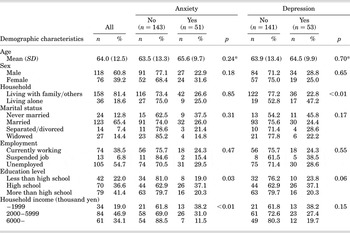
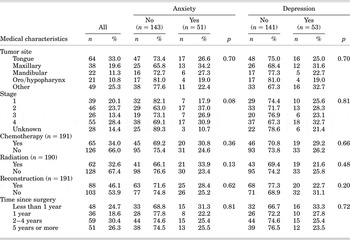
A total of 244 questionnaires were distributed to participants, and 229 questionnaires were returned. Four questionnaires with missing data were excluded from analysis. Of the 225 eligible respondents (effective response rate of 96.6%), 194 who underwent surgery were analyzed in the present study. The mean age of the study sample was 64 years (SD = 12.5), and the majority were male and married. Most participants had completed high school (Table 1). The most common cancer site was the tongue. About 28% of participants had stage 4 cancer. More than 30% had had chemotherapy and/or radiation therapy in addition to surgery. On average, the length of time since surgery was 3.2 years (SD = 3.9); with a range of 0 to 27 years and a median of 2 years (Table 2).
Demographic characteristics of participants by presence of anxiety and depression (n = 194)

p = p value.
* p values with an asterisk are based on a t test; otherwise, p values are based on a chi-square test.
Medical characteristics of participants by presence of anxiety and depression (n = 194)

p = p value.
* p values were based on a chi-square test.
Prevalence of Anxiety and Depression
The means for the HADS subscales were 5.1 (SD = 3.9) for anxiety and 5.6 (SD = 3.6) for depression. More than 25% of participants scored 8 or higher on either of the HADS subscales and were considered to have anxiety or depression. About 10% of the sample scored 11 or higher, a score classified in the original HADS study (Zigmond & Snaith, Reference Zigmond and Snaith1983) as clinically present anxiety (n = 21, 10.8%) or depression (n = 18, 9.3%).
Participant Characteristics by Presence and Absence of Anxiety and Depression
Tables 1 and 2 present the demographic and medical characteristics of participants with anxiety or depression, compared with those without. High school graduates and participants with a low to middle income were significantly more anxious (p = 0.03 and <0.01, respectively). Depression was more likely to be observed in those living alone (p < 0.01), while anxiety was not associated with living arrangements. None of the medical characteristics were significantly associated with anxiety or depression.
Perception of Disfigurement, Preoperative Explanation, and Social Support
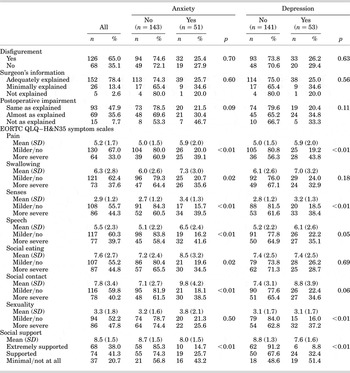
Table 3 shows a comparison between those participants with and those without anxiety or depression for perceived disfigurement, adequacy of preoperative information, congruency between preoperative explanation and postoperative impairment, and social support. The majority of participants (n = 126, 65.0%) reported that they had deformities and scars on their face and neck (disfigurement). However, perceived disfigurement was not found to be associated with anxiety or depression. Almost 80% of participants perceived that their surgeon's explanation was adequate, with only 5 indicating they did not receive preoperative surgical information from their surgeon. Fifteen (7.7%) participants perceived that their impairment and disfigurement differed from that explained by their surgeon preoperatively, and these participants tended to have anxiety (p = 0.09) and depression (p = 0.11). Most participants (79.3%) perceived that they were supported by their family members and others (social support). The more participants felt they were supported by family and others; the less likely they were to have anxiety or depression (p < 0.01).
Participant perceptions of disfigurement, symptoms, and social support by anxiety and depression (n = 194)

Abbreviations: EORTC QLQ–H&N35 = European Organization for Research and Treatment of Cancer Head and Neck cancer module; OR = odds ratio; CI = confidence interval.
p values were based on a chi-square test.
Perceived Symptoms and Anxiety/Depression
In general, participants with more severe symptoms, as measured by the EORTC QLQ–H&N35, were more likely to have anxiety and depression (Table 3). Sexuality was not related to anxiety, and difficulty with swallowing, social eating, and social contact were not related to depression.
Factors Associated with Anxiety
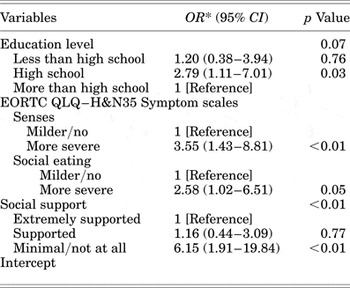
To determine the variables that were significantly associated with anxiety, a logistic regression analysis with backward elimination was performed. Based on bivariate analyses, the following variables were entered into the initial model: sex, education, income, disease stage, radiation, social support, perceived postoperative impairment, pain, swallowing, senses, speech, social eating, and social contact. Of these variables, education, senses, social eating, and social support remained in the final model (chi-square = 28.63, df = 9, p = 0.001). High school graduates (OR = 2.8, 95% CI = 1.1–7.0) and those who had sensory problems (OR = 3.5, 95% CI = 1.4–8.8), trouble with social eating (OR = 2.6, 95% CI = 1.0–6.5), and perceived lower social support (OR = 6.1, 95% CI = 1.9–19.8) were more likely to have anxiety (Table 4). Social support was a significant predictor of anxiety even when other significant factors were concurrently entered into the model. However, the gap between explained and experienced postoperative impairment did not affect anxiety.
Variables associated with anxiety on the logistic regression model (n = 146)

Abbreviations: EORTC QLQ–H&N35 = European Organization for Research and Treatment of Cancer Head and Neck cancer module; OR = odds ratio; CI = confidence interval.
* Odds ratios were based on the final model of a backward elimination logistic regression.
Factors Associated with Depression
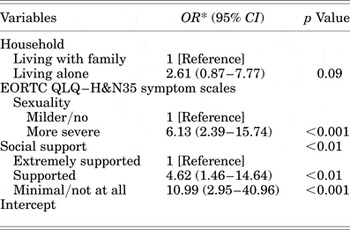
For depression, the variables entered into the initial logistic regression model were: marital status, living with family, education, income, reconstruction, social support, perceived postoperative impairment, pain, swallowing, senses, speech, social contact, and sexuality. In the final model (chi-square = 39.46, df = 4, p < 0.001), having reduced sexuality (OR = 6.1, 95% CI = 2.4–15.7) and perceiving lower social support (OR = 11.0, 95% CI = 3.0–41.0 for little/not at all supported; and OR = 4.6, 95% CI = 1.5–14.6 for supported as opposed to extremely supported) were significant predictors of depression (Table 5). Living alone remained in the final model but was not statistically significant (OR = 2.6, 95% CI = 0.9–7.8). As for anxiety, social support was a significant predictor of depression, while the gap between explained and experienced postoperative impairment was not associated with level of depression.
Variables associated with depression on the logistic regression model (n = 133)

Abbreviations: EORTC QLQ–H&N35 = European Organization for Research and Treatment of Cancer Head and Neck cancer module; OR = odds ratio; CI = confidence interval.
* Odds ratios were based on the final model of a backward elimination logistic regression.
DISCUSSION
We examined the factors that influence postoperative anxiety and depression in Japanese head and neck cancer patients to explore possible interventions for this population. More than 25% of participants had anxiety or depression, a finding consistent with previous research (Kugaya et al., Reference Kugaya, Akechi and Okuyama2000). The mean anxiety and depression scores were similar to or slightly higher than those for other Japanese samples (Kobayashi et al., Reference Kobayashi, Sugimoto and Matsuda2008; Mochizuki et al., Reference Mochizuki, Matsushima and Omura2009). In these previous longitudinal studies, participants were followed for up to six months after surgery or discharge, while the present cross-sectional study sample included longer-term survivors, more than half of whom had undergone surgery two or more years before the study.
In our study, the length of time since surgery was not associated with presence of psychological distress. This suggests that some long-term survivors continue to experience a degree of psychological distress, rather than psychological distress subsiding over time. In our sample, patients were excluded if they were assessed by their physician as at risk for serious psychological distress as a result of participation, which suggests that more long-term survivors continue to suffer from psychological distress. However, careful interpretation of these findings is needed as it is possible that, with time, various factors or life events other than surgery influenced their psychological distress.
Our study highlighted that the perception of being supported well by family members and others serves as a buffer against psychological distress, particularly depression. It may therefore be helpful to provide patients with opportunities to interact with people outside of their home, although it has been suggested that social support from the person's spouse would be a strong negative factor for depression in Japanese HNC patients (Kugaya et al., Reference Kugaya, Akechi and Okamura1999).
Even though 65% of participants perceived postoperative disfigurement, this factor was not associated with anxiety or depression in our study. It is noteworthy that disfigurement after surgery did not necessarily lead to psychological distress. However, as our study measured perceived disfigurement with a simple yes-or-no question, further study is needed to confirm this finding. A prospective longitudinal study in the United States found that poor body image can have a negative impact on depressive symptoms (Rhoten et al., Reference Rhoten, Deng and Dietrich2014), which would indicate that it is necessary to evaluate the degree of disfigurement in greater detail in order to detect the relationship between disfigurement and psychological distress.
Our findings on the negative relationship between adequacy of pretreatment information and postoperative distress were not consistent with previous research (D'Souza et al., Reference D'Souza, Blouin and Zeitouni2013; Llewellyn et al., Reference Llewellyn, McGurk and Weinman2007). Given that the majority of participants in our study were long-term survivors, their accumulation of experience may have obscured the impact of pretreatment information. A previous study reported that the majority of patients did not recall the specifics of preoperative information after major medical procedures, yet most described the explanation as “clear and detailed” (Brezis et al., Reference Brezis, Israel, Weinstein-Birenshtock and Pogoda2008). Therefore, participants with fewer symptoms and less impairment at the time of our study might have been more likely to believe that they had received adequate preoperative information, and to perceive greater congruency between preoperative information and postoperative impairment. These findings suggest a need for longitudinal studies conducted from the preoperative through the postoperative periods to confirm the impact of pretreatment information on posttreatment conditions.
The physical symptoms associated with anxiety and depression differed slightly in the present study. Problems with taste, smell, and social eating remained as significant predictors in a multivariate model of anxiety. Interestingly, sexual problems were significantly related to depression, but not to anxiety. Depression was more likely to be observed in those living alone than in those living with family. This suggests that depression was associated with a lack of intimate relationships, while anxiety tended to relate to sensory and social eating difficulties.
Studies on the effectiveness of interventions to improve psychological distress have yielded inconsistent results. While one metaanalysis concluded that psychosocial interventions had no effect on HNC patients (Semple et al., Reference Semple, Parahoo and Norman2013), it was reported more recently that a psychosocial intervention at a nurse-led clinic improved depressive symptoms and quality of life for up to 18 and 24 months after surgery, respectively (van der Meulen et al., Reference van der Meulen, May and Ros2013; Reference van der Meulen, May and de Leeuw2014). It would be worthwhile to prospectively evaluate the long-term effects of careful and individualized interventions on psychological distress.
A major limitation of our study was its cross-sectional design, as it prevented the investigators from assessing causality. Recall bias was also a potential problem arising from this design, and a prospective longitudinal study would be needed to eliminate this bias. Notwithstanding the limited feasibility, the cross-sectional design made it possible to obtain a relatively large sample of the HNC population. In addition, inclusion of long-term survivors in the study sample was beneficial in terms of gaining knowledge about the postoperative trajectory among HNC patients.
In conclusion, despite these limitations, there are several significant factors arising from our findings. Survivors of head and neck cancer experience anxiety and depression for an extended period of time, and social support may alleviate the severity of these disorders. Further robust research is certainly needed to confirm the impact of facial disfigurement and preoperative information provided by a surgeon on psychological distress in patients with HNC.
ACKNOWLEDGMENTS
This research was supported by a grant-in-aid for cancer research endowed to Mitsunori Miyashita by the Ministry of Health, Labor, and Welfare.