1 Background to prodigal systems
1.1 Litteral and PotestaticFootnote 2 Substitution Sets
Few writing systems with evolutionary histories are economical, approaching the ideal of one littera one potestas.Footnote 3 Even most modern so-called ‘standard’ systems have islands of prodigality. A prodigal system allows considerable multivocal relationship in the mappings of sound to symbol. Hence Litteral and Potestatic Substitution Sets:
A set of litterae in variation for the same potestas or etymological category we call a Litteral Substitution Set (LSS: see Laing Reference Laing1999). Thus Hand C [of Cambridge, Trinity College B.14.39 (323)] has for OE -ht the LSS {‘t’, ‘tt’}, Hand B has the LSS {‘st’, ‘t’, ‘tt’ ‘d’}, Hand D has the LSS {‘t’, ‘st’, ‘cht’, ‘ch’, ‘ct’, ‘d’, ‘th’, ‘tht’, ‘ʒt’, ‘dt’, ‘tf’, ‘tt’} and Hand A has the LSS {‘st’, ‘t’, ‘tt’, ‘cst’, ‘ct’, ‘th’, ‘chit’, ‘cht’, ‘cðth’, ‘sþ’, ‘th’, ‘thth’, ‘tth’}. The inverse of an LSS we call a Potestatic Substitution Set (PSS: Laing & Lass Reference Laing and Lass2003: 262–3). So in Trinity Hand D the littera ‘ʒ’ maps to the PSS {[h], [x], [j], [w], [ɣ]}. For instance [h]: ʒu how < OE huˉ; [x] driʒten lord < OE dryhten; [j]: ʒe ye < OE geˉ; [w]: roʒen to row < OE roˉwan; [ɣ]: daʒes days < OE dagas (LAEME, Introduction, chapter 2, section 2.3.2).
We examine further some of the usage in Hands A and D of Cambridge, Trinity College B.14.39 (323) in relation to the work of several other scribes. We illustrate how the figural confusion in ‘þ’, ‘y’ and ‘ƿ’ in some early Middle English writing systems also interacts with the figura <ʒ> (yogh) to produce an extensive range of LSS types. We demonstrate how changes in the mappings of sound to symbol between Old English and early Middle English cause the litterae listed above, as well as some others, to develop varied new patterns of reference and distribution. We consider the multiple mappings of ‘þ’, ‘y’, ‘ƿ’, ‘ʒ’, ‘w’, ‘h’, ‘g’ and Ø to [θ~ð], [i~j], [w~u], [ç~x], [ɣ], [h] and Ø. Graphic interaction and phonetic change lead to LSSs and PSSs that show not only one-to-many mappings, but many-to-many mappings as well.
1.2 Background to shape-shifting: ‘þ’ and ‘y’ in late Middle English
In the writing of later Middle English, the representation of the litterae ‘þ’ and ‘y’ as a single figura is the mark of a northern, northerly or North-East Midland scribe (Benskin Reference Benskin1982). For late Middle English, there is in fact a clear ‘þ’/‘y’ boundary.
South of a line running roughly from the Mersey to the Wash, but excluding much of East Anglia, the distinction [between the functions of ‘þ’ and ‘y’] was regularly maintained; north of this line, and also over much of East Anglia, ‘þ’ and ‘y’ were represented by the same (usually y-like) symbol. (LALME 3: xv)
The figurae <þ> and <y> may sometimes appear as end points of a cline: there is no systematic functional distinction made between <y>-shaped, <þ>-shaped or formally indeterminate figurae, however many actual shapes the scribe employs (Benskin Reference Benskin1982: 14).
There are therefore four types of scribal praxis in relation to ‘þ’ and ‘y’:
(a) ‘southern’ <þ>/<y> differentiation both in shape and function;
(b) ‘northern’ <þ/y> confusion where a single figura, usually <y>-shaped but sometimes <þ>-shaped is used for both [θ~ð] and [i~j];Footnote 4
(c) the use of a figural cline for the same functions, i.e. there are clearly defined end points and an ambiguous middle;
(d) ‘<þ> and <y> are discretely distinct symbols and there are no intermediate letter-shapes which defy classification as either <þ> or <y>, but their functions are confused’ (Benskin Reference Benskin1982: 14).
1.3 Confusion
We use the terms ‘confusion’ and ‘confused’ without pejorative intent. We do not mean to imply any necessary mental failure on the part of the scribe(s). The terms refer to a formal equivalence and/or an overlap in function, which is normally systematic. They rarely denote intellectual confusion, or even inadvertence. Formal equivalence and functional overlap may sometimes lead to genuine intellectual confusions; but in our experience they are unusual. ‘Confusions’ are more often than not systematically explicable in terms of the writing praxis of the exemplar and/or of the copyist. Simple scribal error, whose existence in individual cases we of course do not deny, is comparatively uncommon.
2 ‘þ’, ‘y’ and ‘ƿ’ in early Middle English
In early Middle English, the developments in script that create the <þ/y> confusion are already in evidence. Early Textura scriptsFootnote 5 become squared and compressed, while the cut of the pen makes for the decorative alternation of thick vertical strokes with hairline diagonals. In such scripts, the ascender of <þ> tends to become shortened. There also develops a type of <y> with the long element on the left and the short element on the right (cf. Benskin Reference Benskin1982: 23 pl. 4 ii). The short element begins with a hairline approach stroke. In some scripts, this begins from contact with the upper part of the first long element, creating a closed-lobe type of <y>. The result can be very like a short-ascendered <þ>. In early Middle English, there is little surviving material from the North and North-East Midlands, but <þ/y> confusion is frequently observable in such texts as do survive. However, it is not so clearly regionally restricted as in later Middle English. Moreover, in early Middle English, there is another littera with which ‘þ’ and ‘y’ are easily confusable – ‘ƿ’ (wynn).
In some early Middle English scripts, the shortening of the ascender of ‘þ’ that makes it potentially confusable with ‘y’ can cause equal or even closer resemblance to ‘ƿ’, both ‘þ’ and ‘ƿ’ being lobed characters from the start. The functions [θ~ð] and [w] may thus be represented by the same figura, whether it be <þ>-like or <ƿ>-like. There are also clinal figurae. As with ‘þ’ and ‘y’, therefore, ‘þ’ and ‘ƿ’ may be formally and functionally distinct, formally and functionally confused, clinal, or distinct formally but confused functionally.
2.1 The <þ> and <y>/<ƿ> cline: London, British Library, Cotton Caligula A ix, part II
Cotton Caligula A ix (hereafter C) contains one of the two surviving versions of The Owl and the Nightingale (O&N). It is written in a single hand dated to the second half of the thirteenth century and the script is Textura semiquadrata. The C scribe uses a cline of shapes for ‘þ’ and ‘ƿ’ (Stanley Reference Stanley1960: 9–10; Laing 1998: note 14; Cartlidge Reference Cartlidge2001: l–li). ‘ƿ’ is usually dotted, and ‘þ’ not, though there are exceptions in both cases. The C scribe rarely uses the littera ‘y’, preferring ‘ʒ’ for [j] and ‘i’ for [i]. He does however use ‘y’ very occasionally for [i]. His ‘y’ is identical to his ‘ƿ’. For examples of the cline of shapes for ‘þ’, ‘ƿ’ and ‘y’, and illustration of their functions, see figure 1.Footnote 6
Examples from the Cotton Owl and the Nightingale

These alternations in C are ‘purely graphic’. This is shown by the fact that there is usually no difficulty in reading the correct littera from any one figura according to which linguistic item is being represented. However, there is a source of possible ambiguity for the reader in the C scribe's forms for then/when and there/where, which may reflect Old English initials in either hƿ- or þ-, and for which therefore an ambiguous initial figura <þ/ƿ> can lead to multiple lexical identifications (Cartlidge Reference Cartlidge2001: l–li). Whether or not these ambiguities were in the C scribe's head when he wrote his text is unknowable. If the figurae for ‘þ’ and ‘ƿ’ were identical or clinal in his exemplar, the C scribe might have had the same difficulty as we do. Where there is potestatic ambiguity there may be litteral confusion as well as figural confusion. In this case the potestatic ambiguity lies in the fact that there is a choice between reading [θ] and [w] depending on the word intended. This case illustrates one kind of potestatic ambiguity: where a given figura maps to more than one littera and hence to more than one potestas, and context does not always reliably indicate lexical identity.
2.2 <þ/ƿ> + <y> confusion
2.2.1 Cambridge, Gonville and Caius 234/120, Ancrene Riwle
Most early Middle English confusers of <þ> with <ƿ> show something of a cline, as the C scribe does. One, however, the scribe of Gonville and Caius Ancrene Riwle (hereafter G)Footnote 7 consistently uses a single lobed figura for both functions. It is neither a prototypical ‘þ’, since it always lacks an ascender, nor a prototypical ‘ƿ’, since it has a very long descender. Sometimes the lobe is left slightly open at the top. The G scribe has a separate figura for ‘y’, made up of a long back-curving first stroke and a short second stroke meeting the first at the baseline. The figura is not lobed but open, and is usually (though not always) dotted between the two arms. See figure 2 for illustration of the G scribe's <þ/ƿ> and <y>. He uses ‘y’ (beside much more usual ‘i’) for [i] both syllabic and nonsyllabic.Footnote 8 He does not use ‘y’ for [j]; for this he regularly employs ‘g’ and rarely ‘i’.Footnote 9 However, there are a few examples of the G scribe's <y>-shape (undotted) being used for [w] – a confusion of function rather than form. See e.g. ye for we (manuscript p. 2, line 14; Wilson Reference Wilson1954: 2, line 29) and cyic for quick (manuscript p. 22, line 14; Wilson Reference Wilson1954: 12, line 11).Footnote 10 Scribe G's system has potentially the same built-in potestatic ambiguity in then/when and there/where, etc. contexts as the C scribe's system.Footnote 11 We will return to the G scribe's usage later.
Examples from Cambridge, Gonville and Caius 234/120, Ancrene Riwle

2.2.2 Cambridge, Trinity College B.14.39 (323), Scribe A
Trinity College B.14.39 is a manuscript containing pieces in prose and verse in Latin, Anglo-French and English. At least four hands contribute to the English texts, all of which may be dated to the last quarter of the thirteenth century. Two of them (A and D) are particularly prodigal in their litteral substitution. We will begin by considering Scribe A's usage with regard to ‘þ’, ‘y’ and ‘ƿ’. For [w], he tends to favour ‘w’, but also employs a <þ>-shaped figura for [w]Footnote 12 as well as for [θ~ð]. The figura is variable, the lobe sometimes being left a little open at the top perhaps because the hairline stroke fails to ‘hold’. However, the figura is mostly more prototypically <þ>-like than <ƿ>-like, in that it usually has a clear ascender above minim height. Scribe A also uses ‘v/u’ for [w] and ‘w’ beside ‘v/u’ for [v], including historical initial f- (see further Laing Reference Laing1999: tables 3 and 4). The interpretation of his usage is made more difficult by the fact that while his ‘ƿ’ is <þ>-shaped, his ‘v’ is not unlike some scribes' realisation of <ƿ>. Scribe A's <v> figura often has the second stroke meet the first only about half way down instead of near the foot. In these cases it is tempting to read it as a <ƿ>, but it appears in such a form in his Latin text (e.g. in vigili, fol. 19r) and the second part of his normal ligatured <w> also matches it in shape, so Brown (Reference Brown1932) and Reichl (Reference Reichl1973) are right to read it as <v>. See figure 3 for examples of Scribe A's relevant letter shapes.
Examples from Cambridge, Trinity College B.14.39 (323), Scribe A

Scribe A distinguishes the figurae <þ> and <y> but he confuses their functions. Like the G scribe, Scribe A makes his ‘y’ with a long back-curving first stroke and a short second stroke meeting the first at the baseline; it is always dotted. The functional confusion is not symmetrical. <y> is never used for [θ~ð] nor for [j] but appears for [i] both syllabic and nonsyllabic. (It appears once only for [w] in syikel (< OE swicol) deceitful.) However, <þ/ƿ> is used in ‘y’ contexts both for [j], and for nonsyllabic [i]. In these functional contexts, where <þ/ƿ> is being used neither for the etymologically appropriate [θ~ð] nor for the etymologically appropriate [w], we transcribe þ: e.g. iþeuene given, paþede paid and ioþe (alternating with ioye) joy. As well as in these diphthongs of French origin, <þ/ƿ> is found for nonsyllabic [i] also in native Germanic words, e.g. eþen eyes, deþen die (beside deyþen once),Footnote 13he þe (alternating with hey and hei) high, and note daiþe (alternating with dai and day) day. Scribe A's own writing system probably did not include ‘ʒ’.Footnote 14
3 Excursus on ‘ʒ’
Middle English ‘ʒ’ formally develops from Old English insular ‘g’ (< >). The history of the littera ‘g’ from Old to Middle English is complex:
In Anglo-Saxon scripts insular ‘g’ (<>) served for [ɡ], [j] and [ɣ] and, in combination with <c> (or sometimes just doubled), for medial [dʒ:]. Before the Conquest, Caroline script was reserved for the writing of Latin. The post-Conquest adoption of Caroline minuscule for the writing also of English introduced a new figura for ‘g’ (<ɡ>). Some early Middle English scribes . . . simply transferred the composite functions of insular ‘g’ to Caroline ‘g’. But there gradually emerged a new consensus. This was to use Caroline ‘g’ for [ɡ] and [dʒ], while insular ‘g’ (whose shape developed from <> to <ʒ>, and is thereafter perceived as a different littera – yogh) retained the functions of [j] and [ɣ]. Later, in some systems, yogh was also adopted (with or without the support of <h>) for [x], a function carried out in Old English by <h>, and in later Middle English and beyond also by <gh>. (Laing Reference Laing, Dossena, Dury and Gotti2008: 8–9)Footnote 15
In LAEME ‘’ and ‘ʒ’ are transcribed according to manuscript figura. Judgements as to whether the shape (as opposed to any developments in function) is classifiable as one or the other in particular early Middle English scripts are sometimes problematic. There are intermediate shapes between classic insular ‘g’ forms and forms that have not fully ‘arrived’ at the varying 3-shaped figurae of later Middle English. The decision to keep them separate in LAEME was made to allow us to observe diachronic development in figura as well as in function. However, there is never any problem in distinguishing between the </ʒ> figurae and the <þ/ƿ> figurae.
4 The addition of ‘ʒ’ to the substitution set
4.1 Cambridge Trinity College B.14.39 (323), Scribe D
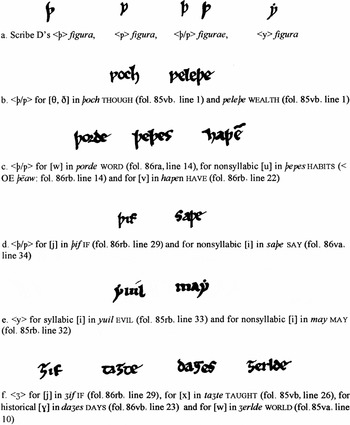
Scribe D writes two texts, Orison to Our Lady (fols. 81v–82r) and The Proverbs of Alfred (PofA: fols. 85r–87v). First we will describe Scribe D's usage with regard to ‘þ’, ‘ƿ’ and ‘y’. In Orison he writes ‘w’ to the exclusion of ‘ƿ’ for [w]. In PofA, however, ‘ƿ’ is much preferred, especially after the first few stanzas.Footnote 16 There seems to be some initial attempt to differentiate the shapes of ‘þ’ and ‘ƿ’ in PofA, but this is very soon abandoned and the previous cline reduced to a <þ>-shaped symbol, which is used for the functions of both. For examples see figure 4.
Examples from Cambridge, Trinity College B.14.39 (323), Scribe D

Scribe D's usage is like that of Scribe A in that the <þ/ƿ> figura and <y> are distinct in shape and confused in function. Again the functional confusion is not symmetrical, and for these figurae is identical to that of Scribe A (section 2.2.2). His system, however, includes the use of ‘ʒ’ for some of the functions listed above, where Scribe A's does not. To summarise: in Scribe D's writing system <þ/ƿ> often appears (beside <ʒ>) for [j] and occasionally (beside <i> and <y>) for nonsyllabic [i]. <y> is not only never used for [θ~ð] but it is not used for [j] either. Its function is confined to syllabic or nonsyllabic [i] for which <i> is also commonly used.
Scribe D's use of ‘ʒ’ is peculiar. In Orison ‘ʒ’ does not appear at all. In PofA, however, the figura <ʒ> is used, as one might expect, for [j] (e.g. ʒung young) and for [x~ç] (e.g. taʒte taught, driʒten lord). It is used (also expectedly) for OE -g- (e.g. daʒes days, amorʒe amorrow) where historically it stood for [ɣ]. However, in these contexts it is arguable that <ʒ> could stand for some form of nonsyllabic [u] ([w]).Footnote 17 The rationale for this suggestion is that it alternates with <w> and <þ/ƿ>, for historical [ɣ], in e.g. laʒe, lawe and laƿe law. The status of this ‘ʒ’~‘w’/‘ƿ’ alternation is uncertain. Middle English [ɣ] was certainly on its way to becoming [u] at this time, but whether the textual alternation represents a completed sound change with which the orthography has not yet caught up, or a case of lexical diffusion, is undecidable. What is clear is that Scribe D also sometimes writes <ʒ> instead of <w> or <þ/ƿ> for historical [w], e.g. ʒerlde world, ʒise wise, roʒen to row, saʒin sown. Moreover, it also appears for historic [v] twice (in heʒe[de] had, ƿerʒe for OE weorf (after preposition) beast for riding) where the environment could also accept the litterae ‘w’ or ‘ƿ’, since Scribe D sometimes uses these for medial [v]. <ʒ> also appears once for [θ(:)] in ƿraʒed wrathed (past participle).
The writing of <ʒ> for <þ/ƿ> has traditionally been put down to the ignorance of Anglo-Norman scribes.Footnote 18 But as Benskin (Reference Benskin1982: 20–1) puts it:
If, however, we observe that <þ> and <y> are as letter-shapes not distinguished, and that when <þ/y> corresponds to a [j]-segment, it is equivalent to <ʒ>, writing <ʒ> for <þ> is merely a case of back-spelling: if, for example, ‘year’ can be spelled either <þer> or <ʒer>, then it is not unreasonable for ‘that’ to be spelled either in the traditional way, with <þ>, or as <ʒat>. Notice that in order to make this substitution, the scribe has to know the language: a Norman monoglot could perpetuate such a system, but he could scarcely invent it.
Scribe D is no doubt unusual in being such a florid <ʒ> substituter, but there is evidence that he was not alone.
4.2 Indications of the addition of ‘ʒ’ in Cotton O&N
Evidence for complex litteral interchanges is not always directly accessible. Sometimes it comes in the form of show-throughs from a copyist's exemplar, where the system of the copyist himself would not normally display the phenomenon in question. The exemplar for O&N and the other texts in Cotton Caligula A ix is known as X. It is generally accepted that X was common to the two surviving copies of O&N (the other being that in Oxford, Jesus College 29 (J)). The C scribe of O&N is a well-known literatim copyist whose language reflects closely that of his exemplar. This is clear from the two distinct types of language, C1 and C2, that alternate in his text. It is assumed that these were faithfully transmitted from X, where the two types may have been the work of two different scribes. The evidence of the C scribe's copy suggests that not only did X's writing system have similar figurae for ‘þ’ and ‘ƿ’ (<þ/ƿ>), but that it could also allow occasional substitution of <ʒ> for <þ/ƿ> and vice versa. Two clear examples are (from language C1) soʒe sooth (184, J soþe) and (from language C2) ʒif wife (1469) (J wif). Further show-throughs are observable in corrected forms in C1: ƿoʒe < OE woˉh crooked (815, with <ƿ> corrected from a partially erased <ʒ>); þin thine (990, with <þ> corrected from <ʒ> by overwriting); noþeles nonetheless (679, with <þ> corrected from <ʒ> by overwriting). Since the C scribe strongly prefers <ʒ> to <y> for [j], another probable example of interchange between <ʒ> and <þ/ƿ> is underþat understood (1091, J underyat).Footnote 19 It is evident from this that the scribe of X had <þ/ƿ> + <ʒ> confusion.Footnote 20
4.3 Indications of the addition of ‘ʒ’ in Gonville and Caius Ancrene Riwle Footnote 21
The evidence for interchange of <þ/ƿ> and <ʒ> in Gonville and Caius is more equivocal than that cited above for Cotton O&N. The G scribe himself does not use ‘ʒ’ at all. For [j] he regularly employs ‘g’ and rarely ‘i’. He does however also occasionally write <þ/ƿ> for [j]. In our tagged sample we have noted the following: þe ye, þet yet, þatte gate, underþeten (< OE -gitan) understand, chircþard churchyard.Footnote 22 The G scribe does not use his separate <y> figura for [j] nor for [θ~ð]. The only functional confusion for <y> is two instances where it appears for [w] (see section 2.2.1 above). The G scribe's own system seems normally to reserve <y> for vocalic use. It seems unlikely therefore that the examples of <þ/ƿ> for [j] cited above can be explained as substitution of <þ/ƿ> for <y>. It is possible that these have a more complex explanation.
Note the following: druhiegh dry (3rd plural present indicative). Here the verbal ending is puzzling. For the present indicative plural of Old English class II weak verbs the G scribe uses elsewhere the following endings: -ed, -ied, -et, -eð, -ieð and in other types of verb plurals also -eth. That is, he uses both fricative and stop symbols in these endings (as well as elsewhere).Footnote 23 The ending -iegh is clearly anomalous. The sequence gh here is the equivalent in his system of d, t, th or ð, and presumably must therefore stand for [d], [t] or [θ]. The simplest explanation is to assume that the G scribe's exemplar, unlike the G scribe himself, had (at least sometimes) <ʒ> for [j], and also occasionally <ʒ> for <þ>. If this were the case, wherever he found <ʒ> for [j], the G scribe would need to translate it to his own normal usage for [j], namely <g>. If the exemplar scribe was an occasional <þ>/<ʒ> substituter, then we may suppose that in the case of druhiegh the G scribe had in front of him something like *druhieʒ(h) and automatically substituted <g> for <ʒ> in his copy without taking account of the sound involved. There is another piece of evidence that may support this intricate interpretation.
On p. 119 of the manuscriptFootnote 24 the G text has (Wilson Reference Wilson1954: 56/14–16): Ah þat / god ded him. oþer haƿied idon him. oþer him / oþer hire. Magen ha understonden ʒef ha / ƿel biþohten. This might be translated ‘. . . but which God does for him or hath done for him (either for him or for her). They may understand if they bethought themselves well. . .’ However, the G version here is not the same as the other early Middle English copies of Ancrene Riwle. These all have close variants of the text preserved in version A (Cambridge, Corpus Christi College 402), fol. 53v (Tolkien Reference Tolkien1962: 103/14–16): ah godd deð him. oðer haueð idon him. / oðer him oðer hire. mare þen ha understont ʒef ha/hire ƿel biþohte. This might be translated ‘. . . but which God does for him or hath done for him (either for him or for her), more than she understands if she bethought herself well . . .’. The G scribe's Magen corresponds to the consensus (and probably authorial) reading mare þen. G's anomalous text may be explained by assuming that the version behind G, whether in its proximate exemplar or further back in the copying history, had something like *ma ʒen going back to *ma þen as a variant of mare þen. The creation of a plural verb form out of a comparative construction in G then demanded the substitution of a plural ending also for biþohten, an alteration facilitated by the formal equivalence of ha for both she and they.
It is difficult to account for either druhiegh or Magen in G without invoking interchange of <þ> and <ʒ> in the exemplar. This in turn gives further support for accounting for þe, þet, þatte, underþeten and chircþard in the same way.
4.4 Avenues for the addition of ‘ʒ’ to the substitution set
4.4.1 Via [j]
The litterae ‘y’ and ‘ʒ’ overlap in usage for the potestas [j]. Like ‘y’, ‘ʒ’ can represent [j] both initially and also intervocalically in the context of front vowels. In writing systems with figural equivalence or functional confusion of ‘þ’, ‘ƿ’ and ‘y’, the figurae <þ> and <ƿ> (or <þ/ƿ>), not normally associated with [j], are usable for [i~j] in addition to their respective traditional potestates. In such systems, then, <þ>, <ƿ> or <þ/ƿ> are able to represent any or all of [θ~ð], [w] and [i~j] and so is <y>. Therefore <ʒ> can also be used wherever <þ>, <ƿ> or <þ/ƿ> are used.
4.4.2 Via the -et syllabic
The figura <ʒ> when used word finally may not have its origins in the littera ‘ʒ’ but may derive from the abbreviation for -et found in Latin and French, especially in verbal endings (see note 14 above). The orthographic practice can be transferred to the writing of indicative verb endings in Middle English, whether the written-out equivalents be -et or -eþ, -eð, -eth and irrespective of whether the scribe's spoken language may have had fricative or stop variants. Although <ʒ> in these contexts was originally a syllabic sign, it could be reinterpreted as a simple consonant and combined with a preceding vowel, whence its further reinterpretation as [θ] (Benskin in LALME: 3, xv (section 14.6)). This phenomenon is not as common in early Middle English as it is later, and we do not discuss it further.Footnote 25
4.4.3 Via [ɣ]
As a result of the sound to symbol remappings between Old and Middle English discussed in section 3 above, insular ‘’ lost its association with the voiced velar stop. In most early Middle English writing systems, [ɡ] is represented by Caroline ‘g’ (<g>), which was also normally used for [dʒ] (other than in initial position where ‘i’ was usual, e.g. ioye joy). Occasionally Caroline ‘g’ was also employed (with or without the addition of ‘h’) for the old intervocalic uses of insular ‘’. Thus [ɣ] may be written ‘g’ or ‘gh’, dag(h)es beside daʒes days. The ‘new’ littera ‘ʒ’ (Laing Reference Laing1999: 255, table 4) took over the use of ‘’ to represent [j] and most frequently [ɣ] too. It also, to some extent, and in some writing systems, took over from Old English ‘h’ the functions of [x~ç].Footnote 26
If ‘ʒ’ can be used for [ɣ], it has the potential to be used for anything that [ɣ] becomes. Litteral history is carried along on the back of phonetic history. By the first half of the thirteenth century there is already evidence of the vocalisation of [ɣ]. For instance, the Worcester Tremulous Scribe has spellings of days (< OE dagas) with medial ‘ƿ’ beside medial ‘’. In the mid thirteenth century we find the two scribes of Laʒamon A spelling days with both medial ‘w’ and medial ‘ʒ’.
We have already noted for the late thirteenth century the alternation of ‘ʒ’ with ‘w’ and ‘þ/ƿ’ for historical [ɣ] in e.g. laʒe, lawe and laƿe law. By this date spellings in ‘u’, ‘v’, ‘w’ and ‘ƿ’ are commonplace. Some early thirteenth-century scribes adopt a different solution – the use of ‘h’. We will return to this in section 5.3 below.
5 ‘h’ and lenition
Changes in spelling may be either phonetically or nonphonetically motivated. We have already seen some examples of nonphonetic motivation: similarities in shape lie behind the possibilities of ‘þ’, ‘ƿ’ and ‘y’ entering into substitution sets. In contrast, the use of ‘w’ and ‘ƿ’ for the reflexes of Old English intervocalic -g-, as discussed in the previous section, is motivated by a phonetic change – vocalisation of [ɣ]. There are also ‘mixed’ cases in which combinations of phonological and orthographic change trigger alterations of sound/symbol mappings, creating what might be called ‘floating figurae’.
The discussion so far illustrates how remappings of litterae, figurae and potestates during the transition between Old and Middle English caused the figurae <þ>, <y>, <ƿ> and <ʒ> in some writing systems to become floating. That is, they are ‘unanchored’ from their original potestatic moorings and can therefore be redeployed. Different scribes adopt different local remappings of sound to symbol, which vary depending on which floating figurae they happen to utilise. Figural redeployments may have implications for individual scribes' perceptions of the boundaries of particular litterae, which in their turn may become floating.Footnote 27
5.1 London, British Library, Arundel 248
Arundel 248 contains on fols. 154r–155r four religious lyrics with musical notation (Brown Reference Brown1932: 75–80, 83–5). The hand is dated to the last quarter of the thirteenth century. The writing system has features that are of great interest to our present discussion: they are fully described in Laing (Reference Laing, Dossena, Dury and Gotti2008: 31–4, 42–4). and we here present only a short summary. In initial position, the scribe deploys two floating figurae, <h> and <þ>, suggesting particular potestatic developments. The script shows no figural confusions, so we do not illustrate it here. The Arundel scribe shows alternations of initial ‘h’ and Ø, both in cases where there is etymological [h] and cases where there is not, indicating at least variable loss of historical initial [h]. This interchange happens in both lexical and grammatical words e.g. auest hast (main verb), im-self himself and houet oweth, hure our. There is also interchange between initial <h> and <þ> and Ø and <þ>, e.g. þe he, þauet haveth, þar-þan erethat, beside historical spellings. Additionally, <þ> is used initially in words with historical initial [j], e.g. þif if, þielde yield. Initial <þ> is used historically in the, that, thou, thee, thy (but compare hin thine and hese (beside þis) this). Initial <þ> is also used historically in all nonpronominal words except for hare there.
The evidence of deletion and excrescence suggests that <h> used initially is virtually a null symbol.Footnote 28 If so, then its use even occasionally in [θ~ð] contexts suggests that historical initial [θ~ð] may sometimes also be weakened to zero in Arundel's system. This is not unexpected given the standard lenition hierarchy of oral fricative > laryngeal fricative > Ø (Lass & Anderson 1975: ch. V; Lass Reference Lass1984: section 8.3.1).Footnote 29 If this weakening has occurred in Arundel's system, then it makes sense that the figura <þ> has here been partially ‘unanchored’ from its historical uses. It can thus represent either [h] (as its appearance in he and haveth could imply), or zero (implying [h]-loss in he and haveth) as its appearance initially in erethat rather indicates. Laing (Reference Laing, Dossena, Dury and Gotti2008: 33–4) gives a summary of the likely explanations of the orthographic facts:
(1) Variable loss of initial [h], especially (but not exclusively) in low stressed words or contexts. <h> therefore becomes a symbol that used in initial position can imply either [h] or Ø.
(2) Reduction of unstressed initial [θ~ð] to [h] or (given (1) above) to Ø. <þ> therefore becomes a symbol that used in initial position can imply [θ], [ð], [h] or Ø.
(3) (a) One explanation for the use of <þ> for initial [j] is that it is a purely orthographic substitution of <þ> for ‘y’ or <þ> for ‘ʒ’: both are paralleled in other early Middle English writing systems. This scribe does use the figura <y> in vocalic contexts; he does not use the figura <ʒ>. (b) However, given (2) above, it could be argued that the use of <þ> in these contexts might just possibly imply loss of initial [j] and substitution (or continued use) of a symbol that can imply Ø.
On the above evidence the Arundel scribe has the following LSS {‘þ’, ‘h’, ‘Ø’, ?‘y’}.Footnote 30 As the examples indicate, the potential for potestatic ambiguity is very great. The Arundel scribe must have had some uncertainty about which litterae to relate to sounds that had changed. Here we surmise that these litterae themselves have, for the Arundel scribe, also become floating.
5.2 ‘h’ in Maidstone Museum A.13
Maidstone Museum A.13 (hereafter M) is in several early thirteenth-century hands and contains mostly Latin. There are a few short texts and fragments in English. At least four of these, and possibly two others, are by the same rather variable hand. Two of the texts, a shortened version of Proverbs of Alfred (PofA) on fol. 93r and a version of the lyric Death's Wither-Clench on fol. 93v, show usage that is relevant to our present discussion.
The M scribe clearly differentiates <ƿ> from <þ>. In the first four stanzas of PofA he uses <w> in preference to <ƿ>, but thereafter no <w> appears. Note that this change from <w>-usage to <ƿ>-usage is paralleled in the version of PofA copied by Scribe D of Trinity, but there the switch is made a stanza earlier. In M <w> also appears three times for [j], in wiuen and wyuen for give and awen for against. The avenue for this substitution is most easily explained as <ƿ> for <ʒ> and then <w> for <ƿ>.Footnote 31 Since <ƿ> tends to interchange with <ʒ> via <þ/ƿ> figural equivalence, this may suggest that the scribe of M's exemplar (like Scribe D of Trinity) confused <þ/ƿ> and <ʒ>.Footnote 32 The M scribe himself presumably understood such a system but displays only <ƿ>/<ʒ> confusion. However, his usage shows some additional complexity.
The M scribe also sometimes writes <h> where one would expect <þ>, and vice versa. He normally contrasts the shapes clearly, but they can be similar enough to make differentiation uncertain. At times the ascender of <h> crosses below the baseline and the curved limb hits the bottom of it, making it look like <þ>. Sometimes the descender of <þ> is short and the lobe lengthened so that it cuts the bottom of the descender rather than meeting it at the level of the baseline, making it look like a malformed <h>. There is in effect a cline of shapes for <þ/h> in much the same way as there can be clines for <þ/y> or for <þ/ƿ>. See figure 5 for examples of clear <þ> and <h> figurae and ambiguous clinal ones. In all the examples cited below, the <þ> and <h> figurae are clear ends of the cline.
Examples from the text of Proverbs of Alfred in Maidstone Museum A.13

5.2.1 The deployment of ‘h’ in M
The M scribe appears to have litteral substitution of ‘h’ and ‘þ’. But the situation is somewhat different from that of Arundel discussed in section 5.1 above. We set out all the etymological contexts for which the M scribe uses the littera ‘h’ and list also his spellings for historical ‘h’.
The M scribe's uses of ‘h’
(a) ‘h’ for historical initial [h], e.g. him him, herte heart;
(b) ‘h’ for historical medial and final [x] e.g. tahte taught, þoh though;
(c) ‘h’ for historical medial [ç] in miht might, drihten (< OE dryhten) lord;
(d) ‘h’ preceding ‘ƿ’ for historical initial [h] in OE hw-, eg. hƿanne when, hƿo who;
(e) ‘h’ following ‘w’ for historical hw- in what what (once only – usually hƿ-);
(f) ‘h’ following ‘c’ in the digraph for historical [tʃ], e.g. child child, -liche -ly;
(g) ‘h’ following ‘s’ in the digraph for historical [ʃ], e.g. sholde should (once only – usual spelling ‘sc’);
(h) ‘h’ following ‘t’ in the digraph for historical [θ], e.g. soweth soweth;
(i) ‘th’ for historical [t], e.g. beth better, selth shalt, þath that;
(j) ‘h’ in various combinations with ‘c’ or ‘t’ (other than simple ‘ht’) for historical [xt, çt], e.g. nocht not, tothte taught, brith bright, mith might, drithten (< OE dryhten) lord;
(k) ‘h’ alone for historical [θ~ð], e.g. wurh (< OE weorþan) is, becomes, Wih-vten without;
(l) ‘h’ in combination with ‘þ’ for historical [θ], e.g. haueþh hath, dohþ doth (these examples only);
(m) ‘h’ for historical [j], e.g. hwng young (this example only);
(n) ‘ch’ for historical [k], e.g. starch stark (this example only);
(o) ‘nch’ for historical [ŋg], e.g. endinch ending (this example only);
(p) ‘nch’ for historical [ŋkθ], e.g. brinch bringeth (this example only);
(q) excrescent ‘h’ in his is (this example only beside usual is)
The M scribe's non-‘h’ spellings for historical ‘h’Footnote 33
(r) initial ‘h’ loss in is his (only in this word beside usual his);
(s) final ‘h’ loss in þo though (once beside usual þoh) and þur through (once beside þurh once).
(t) <fw> for OE hw- e.g. fwi why.
Other possibly relevant unhistorical spellings
(u) ‘þ’ for historical [j] in þung young;
(v) ‘w’ for historical [j] in wiuen, wyuen give inf.;
(w) ‘sw’ for historical [ʃ] in swo shoe.
(x) possible loss of final [θ] in wur (< OE weorþan) be imp. (two examples and no counterexamples).
The picture may appear complex, but the M scribe's uses of ‘h’ seem to fall into four categories, some of which overlap:Footnote 34
(1): as an autonomous historical segmental representation – (a)–(d);
(2): as part of an already accepted digraph – (e)–(h) and possibly (i) if ‘th’ for historical [t] represents spirantisation;
(3): as a diacritic possibly indicating fricativeness – (j);
(4): as part of a litteral and/or potestatic substitution set – (k)–(q) and possibly (i) if historical [t] still represents a stop.
5.2.2 Commentary
The assignment of types (a)–(c) to category (1) requires no further explanation since the mappings of symbol to sound are straightforward survivals from Old English. Type (d) may also belong to category (1) but could arguably be assigned instead to category (3) since in Middle English, ‘h’ in combination with ‘w/ƿ’ may represent not an autonomous segment, but a diacritic implying voicelessness. Type (e) belongs in both categories (2) and (3): ‘ƿh/wh’ is already well established in early Middle English as a digraph for the reflexes of OE hw-; its membership of (3) assumes that within the established digraph ‘h’ is a diacritic for voicelessness. Types (f)–(h) also belong in both categories (2) and (3) for the same reasons. Type (i) may plausibly fall in with (h) if the [t] in these instances has been spirantised.Footnote 35 If ‘th’ is taken to represent unchanged historical [t] in these examples, type (i) must be listed in category (4). The M scribe has endings for the 3rd sg. pres. ind. in -eth, -(e)þ and -et; these may be either phonetic variants or the results of litteral substitutions. We incline to the phonetic interpretation for the reasons given in Lass & Laing (forthcoming Reference Lass, Laing, Dossena and Lass2009).
Type (j) is complex. The examples here include several different combinations for historical -ht. The various possible potestates implied include [çt], [xt], [θ] and [θt]. The possible membership categories would then include (2), (3) and (4) depending on interpretation. We suggest that they all belong at least to category (3). The motivation for calling ‘h’ in these cases a diacritic for fricativeness is simple: in every case, if ‘h’ is removed what is left behind is a canonical representation for a stop.
Types (k)–(r), (t)–(w) and possibly (s) and (x) all fall into category (4). Type (k) is our main subject. It provides the means by which to account also for (l), (p), (w) and possibly for (s) and (x), and also (via (v) and (u)) for (m). Before we discuss this matter, we will indicate the arguments by which the other types listed above may be explained. The very small numbers of examples of each type make it difficult to be sure whether they are all part of the M scribe's own system or whether some may be carried over from the usage of his exemplar(s).
Since the M scribe (or the scribe of his exemplar) is clearly interested in the registration of phonetic detail (see the account of type (t) below), the most likely explanation for type (n), ‘ch’ for historical [k], is that ‘ch’ here is an attempt to represent a final affricate. This might perhaps be of the type [kx], as in modern vernacular Merseyside speech. Type (o), ‘nch’ for historical [ŋg], is difficult. The only explanation we can offer invokes a postulated exemplar system for which we have parallel examples in another writing system, that of Scribe D of Trinity (see section 4.1 above).Footnote 36 Scribe D has spellings for both [ŋg] and [ŋk] in both ‘ng’ ~ ‘nk’, e.g. -þing- ~ -þink- (< OE þyncan) seem, þing ~ þinke thing, þeng ~ þenk- think, -ing ~ -inke for verbal noun endings (see Jordan Reference Jordan1968: section 158). Scribe D also has spellings for [ŋg] in ‘nh’, e.g. brinhin inf. bring, kinhis kings, þinhes things. It seems likely that [ŋg] and [ŋk] have fallen together in his system and, judging by the ‘nh’ spellings, the final stop has weakened, at least in some instances. There is no evidence for this change having happened in the M scribe's own usage, but if we postulate some such litteral interchange in his exemplar, then the form endinch may be explained as follows: [ŋg] and [ŋk] have merged and the stops have weakened; the spellings ‘nk/nc’, ‘ng’ and ‘nh’ are therefore all available to represent this output; the combination ‘nch’ is an extension of this set, substituting two available litterae for one.Footnote 37
Type (q), excrescent ‘h’, and the non-‘h’ spelling types (r), (t) and possibly (s) belong together as a sub-group. The (r) type, (variable) loss of initial [h], is well known throughout early Middle English (see Milroy Reference Milroy, Davenport, Hansen and Nielsen1983). The one example of excrescent initial ‘h’ may be assumed to be a back-spelling dependent on loss of initial [h]. The (s) type may be explained as external sandhi. The contexts of the examples listed are as follows: þo him though him, þur his through his.Footnote 38 The (t) type, ‘fw’ for historical [hw], is probably an attempt at direct phonetic representation: loss of [h] as a segment but retention of voiceless labialised friction over the cluster. Our purpose in this long explication is to illustrate the potential prodigality and inventiveness of scribal behaviour in relation to even a single littera.
We now return to the pivotal type (k). We have observed that <h> and <þ> in M form a cline of shapes (see figure 5) similar to the <þ/y> cline in some late Middle English northern and northerly orthographies, or to the <þ/ƿ> cline in the spelling systems of the Cotton scribe and the A and D scribes of Trinity (sections 2.1, 2.2.2 and 4.1 above). This means that in any ‘þ’ or ‘h’ context <þ>, <h> (or any other member of the cline) may be used. ‘þ/h’ is the main litteral substitution involved not just in type (k) but also in types (l) and (p). Type (l) may be explained by the practice of ‘two for one’. Many Middle English writing systems have litteral substitutions for [θ~ð]. These often include the digraph ‘th’. If a system can employ two symbols for one sound in some contexts, then the two-for-one principle is often extended into similar contexts. In the M scribe's system, simple <þ>, simple <h> and intraclinal <þ/h> vary with <th> and (in verbal endings) with <t> for historical [θ]; <þh> and <hþ> simply extend the set. In type (p) we assume that the sequence ‘ch’ in brinch stands not for usual [tʃ] but for [k] followed by inflexional [θ]; this is then a simple ‘h’ for ‘þ’ substitution.
We have postulated (section 5.2 above) that the scribe of M's exemplar had <þ/ƿ> + <ʒ> confusion. Type (w), swo for shoe, may be explained by the following sequence of substitutions: ‘sh’ (beside usual ‘sc’) may represent [ʃ]; there is ‘þ/h’ substitution making ‘sþ’ theoretically possible for [ʃ]; via the postulated exemplar system, ‘þ’ and ‘ƿ’ are interchangeable (though in M itself they have distinct figurae), therefore sƿ- is a possible spelling for [ʃ]; with substitution of <w> for <þ/ƿ>, sw- is a possible spelling for [ʃ] – hence swo for shoe.Footnote 39
We have already explained type (v) in section 5.2 above. The supposition is that the exemplar for M confused <þ/ƿ> + <ʒ>. With substitution of <w> for <þ/ƿ>, this would enable <w> to represent [j], accounting for wiuen and wyuen for give. Type (u) is also directly explained by <þ/ƿ> + <ʒ> substitution, allowing þung for young. The explanation of type (m), hwng for young, follows from an intertwining of the two strands of substitution: initial [j] is represented by ‘h’ for ‘þ’ for ‘y’/‘ʒ’. ‘w’ for [u] is a variant of the two-for-one principle. It is part of a common early Middle English substitution set where ‘ƿ’, ‘u’, ‘v’, ‘uu’, ‘vv’, ‘w’ may all interchange for [u], [v], [w] or [wu].
5.2.3 Implications
So far we have treated type (k) as litteral substitution: there are four clear cases of ‘h’ for expected ‘þ’. But as we stated in section 5.2 and illustrated in figure 5, the M scribe has a cline of figurae for <þ/h>. One of the primary functions of alphabetic writing is to map phonology. Is it possible that the cline could in fact indicate a potestatic (i.e. phonetic) phenomenon? In the great majority of cases the M scribe clearly writes the figura that we would associate unambiguously with the historically correct clinal end point. But in a small number he not only confuses the functions of ‘h’ and ‘þ’, he also occasionally has second thoughts about the original figura employed and changes it. Some of these changes are made by altering or overwriting a figura at or near one end of the cline with a figura at or near the other end. In these circumstances, it is sometimes difficult to decipher what has been changed into what. But some changes are made by deletion of all or part of the word and substitution of a new version after it or in the margin. These changes involve alteration of clear ‘h’ or ‘þ’ to the other clinal end point. The changes happen in both directions: e.g. muh mouth is corrected to muþ, u ehe youth to u eþe, and þise his to hise. Here the new versions are all historically ‘correct’. Change away from historical spelling is illustrated by one example: the sequence lih is crossed through and the whole word liþet for the 3rd sg. pres. ind. of lie (< OE leˉogan) is written immediately after the aborted attempt.
Including the examples above there are eight changed forms. Of these six are <h> changed to <þ> for historical [θ], one is <þ> changed to <h> for historical [h] and one is <h> changed to <þ> for historical [h]. So only one change is historically ‘erroneous’. We have found eight examples of intraclinal ambiguous figurae. Seven of these are employed in words where we would expect ‘þ’ and one where we would expect ‘h’. The M scribe seems to have had a sense of how these words ‘should’ be spelled, but given the numbers of ‘uncorrected’ spellings, we consider that these represent something more complex than scribal error. They may even suggest something more than confusion caused by an ambiguous clinal figura.
The potestatic values we would assign to the litterae ‘þ’ and ‘h’ are related on a significant phonological hierarchy: that of ‘strength’. It is usually assumed that fricatives are ‘weaker’ than stops and glottal segments are weaker than those with supraglottal articulation (see Lass Reference Lass1976: 145–6, 156–63).
The standard treatments of weakness are based on strength scales where processes of lenition involve the crossing of intercategory spaces, which are not filled with any material. A typical scale might read stop > fricative > approximant > zero. In phonetic reality, however, the intercategory spaces may be clines. For instance, maximal lenition of [θ] would begin with full supraglottal articulation (apex of the tongue making full contact with the upper incisors). There may then be an indefinitely large series of weaker articulations, in which the tongue tip is gradually removed from the teeth but the formant structure of the friction is still (though decreasingly) [θ]-like. At some point in this sequence, the audible dentality vanishes and we have [h]. We can assume that such phenomena occurred in Middle English as well as in modern English. Since we have seen that the M scribe is sensitive to phonetic detail, such a cline might very well have had an obfuscating effect on his ability to distinguish prototypical [θ] from [h]. When writing, he had to choose one or the other – or did he? We can assume that his phonetic repertoire (upon which he must to some extent have drawn when making decisions about representation) included sounds that could not ‘properly’ be expressed either by ‘þ’ or ‘h’. For these segments he usually wrote according to both prototype and history, but how might we explain the nonhistorical spellings? Our hypothesis is that phonetic ambiguity led him at times to choose an unhistoric representation, which he sometimes thought better of on reflection. That accounts for the surviving unhistoric spellings and the ‘corrected’ forms. Given the mannerisms of his script, he also had the opportunity of producing a fudged figura, which exhibits elements of both end points of the cline. Might this figural fudge represent an indeterminate potestas?
What we are suggesting here is something very different from the ‘classical’ figural clines sometimes associated with the functional confusion of ‘þ’ and ‘y’ or ‘þ’ and ‘ƿ’. In the case of ‘þ’ and ‘y’, one or other of the two prototypical figurae, or a clinal sequence with the two figurae as end points, may be employed to represent both [θ~ð] and [i~j]; similarly, in the case of ‘þ’ and ‘ƿ’, for both [θ~ð] and [w]. Nobody would suggest that [θ~ð] and [i~j] or [θ~ð] and [w] have fallen together. The common figura, and/or the cline, represent still distinct phonetic categories or potestates, and context alone tells us which is intended. With the M scribe's (as far as we know) unique system, the two end points and the cline may represent precisely that – two end points and a cline.
The M scribe's type (k) spellings may then be accounted for as a characteristic type of lenition via loss of glottal articulation like that observed in Arundel 248 of initial [θ] > [h] and [h] > Ø. In the M scribe's case the apparent lenition of [θ~ð] to [h] is in syllable-medial and final position rather than in initial position. Although there are two examples of ‘h’-loss and one example of excrescent ‘h’, there is no direct evidence of historical [θ]-loss as there is in Arundel. We might here assume therefore that the postulated lenition in M was a merger of [θ] with already existing [h], which potentially could have further weakened and deleted but apparently did not.
If we consider that the M scribe's type (k) spellings might be explained as part of a PSS, instead of, or combined with, an LSS, does this have any implications for our explanations of the other types of ‘h’ spellings listed above? The two types that we have not yet fully accounted for are (s) and (x). We have suggested that both types might represent sandhi, which would be as much morphological as phonological. But equally, type (s) (þo for though and þur for through) and type (x) (wur for *wurþ be) could represent staged lenitions leading to zero.
There is sporadic evidence also in other textsFootnote 40 for weakening of [θ] to [h] and occasionally to zero. Examples of loss are least common and are mainly confined to the word through. Examples of ‘h’ for historical [θ] and inverse spellings of dental fricative litterae (‘þ’, ‘ð’, ‘th’) for historical h are each roughly three times as common as deletions. Lest it be thought that such spellings represent sporadic scribal errors, the Ormulum also shows evidence of weakening of [θ] to [h] and of [h] to zero. As Orm was the original writer of his verse homilies, this evidence cannot be dismissed as transmission error in the usual sense. However, Orm himself in almost all tell-tale cases ‘normalises’ his own prior output. In only one case does he leave uncorrected þurr þ through. Elsewhere (not in the LAEME tagged sample) he corrects original þurr þ through to þurr h (once), original ƿurrh worthy to ƿurrð (once), original ƿurr hlike and ƿurr like worthly to ƿurr þlike (once each) original ƿurrli/ke to ƿurrþli/ke (once).Footnote 41
5.3 ‘h’ in Gonville and Caius Ancrene Riwle (G)
5.3.1 Functions of ‘h’
The history of ‘h’ in both Arundel and M involves lenition. The history of ‘h’ in G apparently also involves lenition but in a different phonological context.
In section 2.2.1 we characterised the G scribe as having <þ/ƿ> + <y> confusion. In section 4.3 we made the case for the G scribe's exemplar having at least occasional substitution of <þ/ƿ> + <ʒ>. The G scribe himself does not use <ʒ> but has <g> for [ɡ] and [j] and also for [ɣ], where it varies with <gh> and with <h>. This latter usage also occurs in AB language and in G it may therefore be carried over from that found in his exemplar, and may or may not also belong to the G scribe's own active repertoire.
The G scribe is as prodigal in his use of ‘h’ as the M scribe. There is considerable overlap, both in historical and unhistorical uses, between the two systems; but they are not identical.
The G scribe's uses of ‘h’
(a) ‘h’ for historical initial [h], e.g. his his, heuen heaven;
(b) ‘h’ for historical medial and final [x], e.g. biþoht bethought, þah though;
(c) ‘h’ for historical medial and final [ç], e.g. mihte might, heh high;
(d) ‘h’ for historical medial [ɣ], e.g. dahes days, -fuhel fowl;
(e) ‘h’ for historical medial [j], e.g. wiheles (< OEwigel) wiles, unƿhrihen unwound;
(f) ‘h’ in combination with ‘i’ for historical medial [j], e.g. geihet (< OE *geˉgan) cry out (this example only beside gei-, gey- with no ‘h’);
(g) ‘h’ preceding ‘ƿ’ for historical initial [h], e.g. OE hw-, e.g. hƿet what, hƿen when;
(h) ‘h’ following ‘ƿ’ for historical hw-, e.g. ƿhite white, ƿhile while;
(i) ‘h’ following ‘ƿ’ for historical [w], e.g. unƿhrihen unwound;
(j) ‘h’ following ‘c’ in the digraph for historical [tʃ] and [ʃ], e.g. chirche church, flech flesh, -chipe -ship;
(k) ‘h’ following ‘c’ for historical medial and final [x], e.g. ibrocht brought, ah ought;
(l) ‘h’ following ‘g’ for historical medial [ɣ], e.g. daghes days;
(m) ‘h’ following ‘c’ for historical medial [ç] and [çt], e.g. michte might, richƿisnesse righteousness (note also ‘chi’ in nichit night);
(n) ‘h’ following ‘p’ for historical [f] in phariseus pharisee gen., prophete prophet (ultimately Hellenisms in Latin);
(o) ‘h’ following ‘s(c)’ in the sequence for historical [ʃ], e.g. s(c)hulen shall pl., disch dish;
(p) ‘h’ in combination with ‘c’ and ‘s’ for historical final [ʃ], e.g. flechs, flecsh- flesh, englichs english;
(q) ‘h’ following ‘s’ and in combination with ‘c’ for historical [sw], e.g. alsha also, schuc such (and see note 39 above);
(r) ‘h’ following ‘t’ in the digraph for historical final [θ], e.g. deth death, bi-holdeth beholdeth;
(s) ‘th’ for historical [t], e.g. geth yet (this word only, one example);
(t) ‘h’ alone or ‘gh’ for historical final [θ], e.g. strecheh stretcheth (not in the LAEME tagged text: cited from Scahill Reference Scahill2009: note 16), druhiegh dry (3rd plural present indicative) (see section 4.3 above);
(u) ‘ch’ for historical [k], e.g. floch flock, ach (< OE ac) but;
(v) ‘nch’ for historical [ŋg], e.g. kanche-ship (of obscure origin but elsewhere normally cang-) folly (note also unstrechþe unstrength with missing ‘n’ or abbreviation);
(w) ‘sth’ for ‘str’ in sthengðe strength (not in the LAEME tagged text: cited from Scahill Reference Scahill2009: note 16);
(x) ‘soh’ for historical [ʃ] in i-sohouen shoved (this example only);
(y) excrescent ‘h’ in hures ours, huuel evil;
The G scribe's non-‘h’ spellings for historical ‘h’
(z) initial ‘h’ loss in is his, undred hundred;
(aa) ‘þ/ƿ’ for historical hw- in e.g. ƿet what (beside usual hƿ-);Footnote 42
Other relevant unhistorical spellings
(ab) ‘þ’ for historical [j] in þard yard, þet yet (see section 4.3 above)
(ac) ‘sƿ’ for historical [ʃ] in sƿaƿed showed, sƿulen shall 2nd pers. pl. (see note 39 above).
5.3.2 Commentary
We will not analyse all these types in as much detail as we did for the M scribe. What is clear from both the M scribe and G scribe listings, and what we have presented for Arundel 248 in section 5.1, is that there are large numbers of multivocal mappings for the littera ‘h’ in early Middle English. We have already shown that the LSS {‘þ’, ‘ƿ’, ‘ʒ’, ‘h’, Ø} existed in the writing systems of both Arundel and M. We suggest that many of the G scribe's unorthodox and ‘problematic’ spellings can be easily explained if one assumes that his system had the LSS {‘þ’, ‘ƿ’, ‘h’, Ø} with an additional ‘ʒ’ element operating only via its postulated existence in his exemplar. The G scribe's own mixture of spellings may in part belong to an exemplar in a complex and/or mixed writing system, which may also account for the fact that he returned to his text and made a number of corrections at a later stage. His highly cursive scriptFootnote 43 suggests that he was working at great speed, which also probably has a bearing on some of his idiosyncratic renditions. Speedwriting would tend to promote copying in units larger than single words, and the use of auditory perception and memory rather than visual memory alone.
One striking peculiarity of G (which he shares with the scribes of AB and its related texts)Footnote 44 is the use of ‘h’ to represent the reflexes of OE foot-medial -g-. There are two accounts in the literature as to why the designer of AB chose to represent putative OE [ɣ] with ‘h’ (Dance Reference Dance and Wada2003: 67–8). One is that the devoicing of [ɣ] in final position (e.g. burh < burg hill) created a situation where [ɣ] and [x] were in complementary distribution. They were therefore construable as members of one category, and could be written with the same littera. It might seem strange at first that a littera with a normally voiceless potestas should be used in a prototypically voiced position. However, such apparently contradictory usage would not be foreign to Old English – cf. the use of ‘c’ for both velars and palatals. The point is that ‘h’ was available for [ɣ], and this was a stylistic choice either invented, or at least very consistently employed, by the designer of AB. The scribes in the copying tradition of the AB and related texts also varyingly adopt it.
Dance, however, prefers an alternative explanation. He suggests that foot-medial ‘h’ was adopted to avoid a potential ambiguity between [ɣ] and intervocalic [j], which would have resulted from the use of ‘ʒ’ for both. This ‘may have been felt to be a problem’ and a ‘desire to clarify’ led to ‘h’ being used for [ɣ]. Dance says that a potential weakness in his theory is that such a use of ‘h’, being exceedingly rare in ‘classical’ late West Saxon, would have been an unlikely model for thirteenth-century writers. In fact this need not disqualify the idea from serious consideration, as West Saxon would probably not have been the primary influence on the orthographic tradition of the South-West Midlands. However, the usage is also absent from Vespasian Psalter, which is often considered a prototypical antecedent of some elements of AB language. We have little other evidence for the West Mercian tradition, which arguably would have had the greatest influence on the writing systems of this area (the Vespasian Psalter itself is 400 years older). But there is no reason to suppose that the designer of AB, or any other early Middle English scribe in the South-West Midlands, was incapable of initiating an independent development.
There is, however, a third possible explanation, which as far as we know has not previously been considered. This both explains the use of ‘h’ and makes its motivation purely phonetic. We suggest that in the tradition represented by AB, the early lenition of OE -g-, which led to [ɣ], did not continue via a pathway of vocalisation. Instead the articulation opened further, which produced as output a ‘voiced h’ [ɦ], as in the medial consonant of English ahead (cf. the initial of head). This is close enough to [h] to be written with the same symbol despite its different glottal attitude. With this suggested trajectory added, there would then have been three possibilities for the development of OE foot-medial [ɣ] during early Middle English, and one or more of them might be represented in the same writing system:
(a) it remains as [ɣ] and is spelled ‘g’, ‘gh’ or ‘ʒ’;
(b) it vocalises to [u] or [w] (assuming these are different) and is spelled ‘u’, ‘w’, ‘ƿ’;
(c) it continues to weaken by simple opening of stricture, becoming [ɦ], spelled ‘h’.
We believe that the G scribe's usage indicates that the third pathway is the predominant one for him. His spelling for this category is in fact variable. The variation may have one or more of three sources: change in progress, selection or random variation among different available chronological layers, or exemplar influence. To indicate his hierarchy of spelling preferences we give here the numbers of different spellings for OE foot-medial [ɣ] in the LAEME tagged sample for G – see (d) in the listing in section 5.3.1 above:Footnote 45
for original velars (26 types)
‘h’ 44 tokens
‘g’ 12 tokens
‘gh’ 2 tokens + 1 inserted ‘h’ as a correctionFootnote 46
‘ƿ’ 1 token
We have so far restricted ourselves to back environments, which are in fact where most of the ‘h’ spellings occur. But ‘h’ also appears for original palatals (i.e. between front vowels) – see (e) and (f) in the listing in section 5.3.1 above. In palatal contexts ‘h’ spellings vary with spellings in ‘i/y’ and minimally with ‘g’ (though in unstressed syllables, which we do not list here, ‘g’ is somewhat more common):
for original palatals (23 types)
‘h’ 13 tokens + 1 inserted ‘h’ as a correction. Note also ‘eih’ 1 example
‘i’ 34 tokens. Note also ‘eih’ 1 example as above.
‘y’ 2 tokens
‘g’ 1 token
If indeed foot-medial ‘h’ in G represents [ɦ] in back contexts, there appears to be no reason why it should not in front contexts. After all, since it has no supraglottal articulation it is not sensitive to coarticulatory effects, unlike a velar or a palatal. It is effectively neutral for backness, and therefore is appropriate regardless of the surrounding environment.
Although there is only one example of an apparent diphthong in combination with ‘h’ in our sample of the G scribe's usage for foot-medial [j], the LAEME corpus indicates that such spellings do occur occasionally elsewhere in early Middle English. If we suppose that in this context ‘h’ may represent [ɦ] these combinative spellings presumably indicate a stage before further lenition and diphthong-only realisations.
It is clear from our investigations of the writing systems of Arundel, M and G that ‘h’ has two main functions. One is its use as multiple segmental representation of [h] or [ɦ] or Ø; the other is its diacritic use for fricativeness and/or weakness.
5.4 Peroration
This investigation of six early Middle English orthographies illustrates the complex interrelationships of figural, litteral and potestatic mappings that involve both floating figurae and floating litterae. Each scribal system has to be looked at on its own terms, but their analyses nevertheless inform each other. Scribes are not muddled but are doing sophisticated and interesting linguistic analysis. Prodigal writing systems arise from the interplay of orthographic tradition and sound change in the context of a highly flexible matrix of available items and procedures.