Introduction
Suicidal ideation is part of a spectrum of suicidality, which includes more severe manifestations such as suicide plans and attempts. A recent cross-national community study found that suicidal ideation is not rare, with 9.2% of participants endorsing lifetime suicidal ideation. Furthermore, among those who endorsed lifetime suicidal ideation, 33.6% reported making a plan to commit suicide and 29.0% attempted suicide (Nock et al. Reference Nock, Borges, Bromet, Alonso, Angermeyer, Beautrais, Bruffaerts, Chiu, de Girolamo, Gluzman, de Graaf, Gureje, Haro, Huang, Karam, Kessler, Lepine, Levinson, Medina-Mora, Ono, Posada-Villa and Williams2008). Thus, understanding suicidal ideation and its correlates is important in order to prevent the development of more severe forms of suicidality.
Psychological disorders are one of the primary risk factors for suicidality, with up to 95% of suicides committed by individuals with one or more disorder (Cavanagh et al. Reference Cavanagh, Carson, Sharpe and Lawrie2003). In particular, the mood and anxiety disorders (also referred to as the internalizing disorders) are robustly associated with suicidal ideation and attempts (e.g. Sareen et al. Reference Sareen, Cox, Afifi, de Graaf, Asmundson, ten Have and Stein2005a; Bolton et al. Reference Bolton, Cox, Afifi, Enns, Bienvenu and Sareen2008; Cougle et al. Reference Cougle, Keough, Riccardi and Sachs-Ericsson2009a). However, controversy remains as to whether suicidal ideation is specifically related to the anxiety disorders or if the association is due to confounding factors. Because the internalizing disorders have notably high rates of co-morbidity (Mineka et al. Reference Mineka, Watson and Clark1998; Watson, Reference Watson2009), many have argued for the importance of controlling for co-morbid internalizing disorders when examining how each anxiety disorder is associated with suicidality (e.g. Sareen et al. Reference Sareen, Cox, Afifi, de Graaf, Asmundson, ten Have and Stein2005a, Reference Boden, Fergusson and Horwoodb; Boden et al. Reference Boden, Fergusson and Horwood2006; Cougle et al. Reference Cougle, Keough, Riccardi and Sachs-Ericsson2009a).
Panic disorder has received the most attention because of strong zero-order relationships with suicidal ideation. This association becomes non-significant in the majority of multivariate analyses that control for depression (e.g. Hornig & McNally, Reference Hornig and McNally1995; Chioqueta & Stiles, Reference Chioqueta and Stiles2003; Sareen et al. Reference Sareen, Cox, Afifi, de Graaf, Asmundson, ten Have and Stein2005a, Reference Sareen, Cox, Afifi, de Graaf, Asmundson, ten Have and Steinb; Boden et al. Reference Boden, Fergusson and Horwood2006; Diefenbach et al. Reference Diefenbach, Woolley and Goethe2009), although some reported that a significant association remained (e.g. Marshall et al. Reference Marshall, Olfson, Hellman, Blanco, Guardino and Struening2001; Norton et al. Reference Norton, Temple and Pettit2008; Cougle et al. Reference Cougle, Keough, Riccardi and Sachs-Ericsson2009a). Post-traumatic stress disorder (PTSD) has also received substantial recent attention and shows the most consistent relationship with suicidality among the anxiety disorders, with significant prospective and concurrent associations with suicidal ideation (e.g. Marshall et al. Reference Marshall, Olfson, Hellman, Blanco, Guardino and Struening2001; Oquendo et al. Reference Oquendo, Friend, Halberstam, Brodsky, Burke, Grunebaum, Malone and Mann2003; Sareen et al. Reference Sareen, Houlahan, Cox and Asmundson2005b; Cougle et al. Reference Cougle, Keough, Riccardi and Sachs-Ericsson2009a, Reference Cougle, Keough, Riccardi and Sachs-Ericssonb; Jakupcak et al. Reference Jakupcak, Cook, Imel, Fontana, Rosenheck and McFall2009) and with attempted and completed suicide (Wilcox et al. Reference Wilcox, Storr and Breslau2009; Gradus et al. Reference Gradus, Qin, Lincoln, Miller, Lawler, Sørensen and Lash2010), after controlling for co-morbidity. In contrast, specific phobia does not appear to be associated with suicidal ideation beyond co-morbidity with other disorders (Chioqueta & Stiles, Reference Chioqueta and Stiles2003; Sareen et al. Reference Sareen, Cox, Afifi, de Graaf, Asmundson, ten Have and Stein2005a, Reference Sareen, Cox, Afifi, de Graaf, Asmundson, ten Have and Steinb; Cougle et al. Reference Cougle, Keough, Riccardi and Sachs-Ericsson2009a).
There is mixed evidence for social phobia, obsessive-compulsive disorder (OCD) and generalized anxiety disorder (GAD). That is, several studies have supported – and several have failed to support – a unique association between each disorder and suicidal ideation (e.g. Marshall et al. Reference Marshall, Olfson, Hellman, Blanco, Guardino and Struening2001; Chioqueta & Stiles, Reference Chioqueta and Stiles2003; Sareen et al. Reference Sareen, Cox, Afifi, de Graaf, Asmundson, ten Have and Stein2005a, Reference Sareen, Cox, Afifi, de Graaf, Asmundson, ten Have and Steinb; Boden et al. Reference Boden, Fergusson and Horwood2006; Norton et al. Reference Norton, Temple and Pettit2008; Cougle et al. Reference Cougle, Keough, Riccardi and Sachs-Ericsson2009a; Diefenbach et al. Reference Diefenbach, Woolley and Goethe2009). These conflicting results may be influenced by factors such as the use of dichotomous diagnoses versus dimensional symptom assessment, reliability/validity of the measures, the inclusion of different covariates, concurrent versus prospective analyses, psychiatric patient versus population-based samples, and the criterion for statistical significance.
Most previous research has controlled for co-morbidity by performing logistic regressions in which depression and other internalizing disorders are entered prior to entering individual anxiety disorders into the model. A different approach to examining underlying etiological sources may be found in the large literature on personality–psychopathology relationships. Personality traits are of interest in understanding the characteristics and etiology of psychological disorders because traits are heritable, relatively stable over time, and can predict and explain behaviors (Krueger et al. Reference Krueger, McGue and Iacono2001).
Research has consistently shown that the personality trait neuroticism/negative emotionality (N/NE; stress reactivity and a tendency to experience negative emotions) is broadly related to the internalizing disorders, as N/NE levels are elevated in all of the internalizing disorders and contribute to co-morbidity among them (e.g. Watson et al. Reference Watson, Gamez and Simms2005; Kotov et al. Reference Kotov, Gamez, Schmidt and Watson2010). In contrast to the broad relevance of N/NE, extraversion/positive emotionality (E/PE; sociability, assertiveness and a tendency to experience positive emotions) shows greater specificity, with moderate negative correlations with depression and social phobia. Although E/PE is significantly correlated with other anxiety disorders in some studies, these correlations tend to be weak and significantly smaller in magnitude than correlations of depression and social phobia with E/PE (e.g. Brown et al. Reference Brown, Chorpita and Barlow1998; Mineka et al. Reference Mineka, Watson and Clark1998; Watson et al. Reference Watson, Gamez and Simms2005). Together, N/NE and E/PE are an important source of co-morbidity, as they account for a substantial proportion of the shared genetic variance associated with the internalizing disorders (e.g. Krueger et al. Reference Krueger, McGue and Iacono2001; Hettema et al. Reference Hettema, Neale, Myers, Prescott and Kendler2006; Bienvenu et al. Reference Bienvenu, Hettema, Neale, Prescott and Kendler2007).
N/NE and E/PE are also relevant to – and predictive of – suicidality. N/NE has a particularly robust association with suicidal ideation (r=0.22 to 0.52) that remains when controlling for other traits (Velting, Reference Velting1999; Useda et al. Reference Useda, Duberstein, Conner and Conwell2004; Chioqueta & Stiles, Reference Chioqueta and Stiles2005) and prospectively predicts suicide attempts beyond other traits and co-morbid disorders (Yen et al. Reference Yen, Shea, Sanislow, Skodol, Grilo, Edelen, Stout, Morey, Zanarini, Markowitz, McGlashan, Daversa and Gunderson2009). The association of E/PE with suicidal ideation is less clear, with a weaker inverse correlation that was not statistically significant in some samples (r=−0.14 to −0.27; Velting, Reference Velting1999; Useda et al. Reference Useda, Duberstein, Conner and Conwell2004; Chioqueta & Stiles, Reference Chioqueta and Stiles2005). Taken together, this research indicates that by controlling for the variance that each disorder and suicidal ideation shares with N/NE and E/PE, we can control for an important source of co-morbidity among these constructs, parsing out the unique variance of each.
The present study examines the unique associations of depression and numerous anxiety disorders (panic disorder, social anxiety, PTSD, GAD and specific phobia; data were not available for OCD or agoraphobia) with suicidal ideation. Based on previous evidence, we expect that depression will be uniquely associated with suicidal ideation, but we include it in the model for the sake of comprehensiveness and to provide an interpretive context (in terms of effect-size magnitude) for the anxiety disorder–suicidal ideation associations. Rather than controlling for co-morbidity via individual disorders as prior studies have done, we model and control for it by including broad, underlying personality traits (i.e. N/NE and E/PE) that are associated with suicidal ideation and are known to contribute substantially to co-morbidity among the internalizing disorders (e.g. Watson et al. Reference Watson, Gamez and Simms2005).
We seek to examine whether (a) the anxiety disorders are specifically associated with suicidal ideation or (b) the association is due to shared variance with N/NE and E/PE.
Method
Participants and procedure
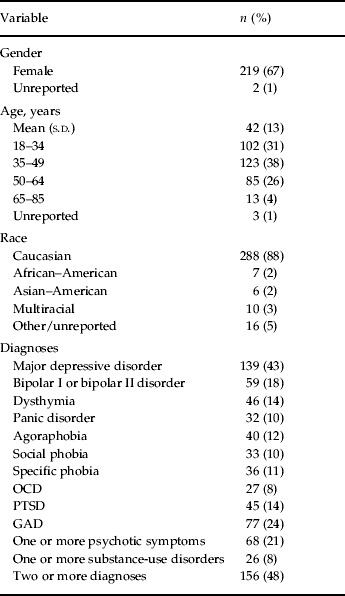
Participants were 327 adult psychiatric out-patients who were recruited from the waiting rooms of two local mental health centers. Patients were eligible regardless of the disorder for which they were being treated, as we wanted a heterogeneous, representative sample of the treatment-seeking psychiatric population. Inclusion criteria were age ⩾18 years, English-speaking, and oriented to reality at the time of participation (i.e. not currently psychotic, manic, delirious or demented). This sample is a subset of a larger sample from which data have been previously published (Watson et al. Reference Watson, O'Hara, Simms, Kotov, Chmielewski, McDade-Montez, Gamez and Stuart2007, Reference Watson, O'Hara, Chmielewski, McDade-Montez, Koffel, Naragon and Stuart2008); previous reports focus on the psychometric properties of the Inventory of Depression and Anxiety Symptoms (IDAS) and do not overlap with the current analyses. See Table 1 for a summary of demographic characteristics and current diagnoses [as assessed with the Structured Clinical Interview for DSM-IV (SCID)] of the sample. Participants completed the questionnaires in small groups and were interviewed individually. At the end of the session, they were paid for their participation. All interviewers were trained staff members with masters' level training in clinical psychology/counseling psychology/public health. Interviews were audiotaped and a subset (n=47) was scored independently by a second interviewer to assess inter-rater reliability.
Demographic and diagnostic characteristics of the patient sampleFootnote a

s.d., Standard deviation; OCD, obsessive-compulsive disorder; PTSD, post-traumatic stress disorder; GAD, generalized anxiety disorder.
a Total n=327.
Self-report measures
Adult Suicidal Ideation Questionnaire (ASIQ; Reynolds, Reference Reynolds1991a)
This measure uses a seven-point Likert scale for each item to assess the frequency of thoughts about death, dying and suicide in the past month. The ASIQ has very high internal consistency (α=0.96 to 0.98; Reynolds, Reference Reynolds1991a, Reference Reynoldsb), as well as strong 1-week test–retest reliability in various populations (r=0.86 to 0.95; Reynolds, Reference Reynolds1991a, Reference Reynoldsb). It shows good convergent and discriminant validity with other measures of suicidality and related constructs such as depression (Reynolds, Reference Reynolds1991b).
Beck Anxiety Inventory (BAI; Beck & Steer, Reference Beck and Steer1990)
This inventory was developed as a general measure of anxiety, wherein respondents rate their symptoms in the past week on a four-point scale for each item. However, subsequent research has demonstrated that the BAI actually assesses panic symptoms, rather than general anxiety (e.g. Cox et al. Reference Cox, Cohen, Direnfeld and Swinson1996; Watson et al. Reference Watson, O'Hara, Simms, Kotov, Chmielewski, McDade-Montez, Gamez and Stuart2007, Reference Watson, O'Hara, Chmielewski, McDade-Montez, Koffel, Naragon and Stuart2008). Therefore, the BAI is used as a marker of panic in the current study. This widely used scale has excellent internal consistency and good test–retest reliability over 1 week (r=0.75; Beck & Steer, Reference Beck and Steer1990).
Beck Depression Inventory – II (BDI-II; Beck et al. Reference Beck, Steer and Brown1996)
The BDI-II is a commonly used measure that assesses depressive symptoms within the past 2 weeks. Each item has four statements that range from the absence to a severe manifestation of the symptom. The BDI-II has good internal consistency and adequate retest reliability in a variety of populations (Beck et al. Reference Beck, Steer and Brown1996). For the current study, the item assessing suicidality was removed in order to avoid criterion contamination when examining the relationship of depression with suicidal ideation.
Big Five Inventory (BFI; John & Srivastava, Reference John, Srivastava, Pervin and John1999)
The BFI consists of 44 short phrases that relate to one of the ‘Big Five’ personality traits; we only report results for the Neuroticism and Extraversion scales in this study. This measure uses five-point Likert scales. The scales have good internal consistency and strong convergent validity with other measures of the Big Five. In addition, the BFI has demonstrated good retest reliability, with r=0.85 after a 3-month interval (John & Srivastava, Reference John, Srivastava, Pervin and John1999).
IDAS (Watson et al. Reference Watson, O'Hara, Simms, Kotov, Chmielewski, McDade-Montez, Gamez and Stuart2007)
The IDAS is a factor analytically derived, multidimensional inventory that uses five-point Likert scales to assess symptomatology over the past 2 weeks. The current study uses the following scales as markers of internalizing symptoms: Dysphoria, Traumatic Intrusions, Anxious Mood, Social Anxiety, Panic, and Suicidality. The IDAS has strong internal consistency reliability, with a median α coefficient >0.80 (Watson et al. Reference Watson, O'Hara, Simms, Kotov, Chmielewski, McDade-Montez, Gamez and Stuart2007). The scales have shown good convergent and discriminant validity with diagnoses and self-report measures, as well as good 1-week retest reliability in a patient sample (Watson et al. Reference Watson, O'Hara, Simms, Kotov, Chmielewski, McDade-Montez, Gamez and Stuart2007, Reference Watson, O'Hara, Chmielewski, McDade-Montez, Koffel, Naragon and Stuart2008). The Dysphoria and Anxious Mood scales share one item (i.e. ‘I found myself worrying all the time’); this item was removed from the Dysphoria scale for the present study so that the item content of each factor is non-overlapping.
Positive and Negative Affect Schedule, Expanded Version (PANAS-X; Watson & Clark, Reference Watson and Clark1999)
The PANAS-X is a self-report measure of specific types of affect; we report results on the trait versions of three positive affect scales (Joviality, Self-assurance, Attentiveness) and four negative affect scales (Fear, Sadness, Guilt, Hostility). Participants rate each mood term on a five-point intensity scale. These subscales have shown strong internal consistency in diverse samples. The PANAS-X also has demonstrated good convergent and discriminant validity with other measures of affectivity, and adequate retest reliability after 2 months (r=0.59; Watson & Clark, Reference Watson and Clark1999).
Phobic Stimuli and Response Scale (PSRS; Cutshall & Watson, Reference Cutshall and Watson2004)
The PSRS assesses social anxiety and four dimensions of specific phobia, using four-point Likert scales. The scales have strong internal consistency (α=0.80 to 0.87; Cutshall & Watson, Reference Cutshall and Watson2004). They also show good convergent validity with other measures of phobic fears and substantial criterion validity in relation to diagnoses (Watson, Reference Watson2010). Because the specific phobia scales are not strongly correlated (r=0.31 to 0.51) and therefore are unlikely to be reliable indicators of the higher-order Specific Phobia factor, these scales were instead summed into a single PSRS Specific Phobia Total scale that functions as a counter for any specific phobia symptoms.
Interview measures
Clinician Rating Version of the Inventory of Depression and Anxiety Symptoms (IDAS-CR; Watson et al. Reference Watson, O'Hara, Chmielewski, McDade-Montez, Koffel, Naragon and Stuart2008)
The IDAS-CR is the interview version of the IDAS; it consists of a series of ratings that correspond to each of the IDAS scales. The ratings use a three-point scale for each symptom dimension: absent, subthreshold, and present. Symptom frequency in the past 2 weeks and level of impairment both contribute to this rating. For each symptom dimension, there is a standard initial probe as well as several standard follow-up questions and clarification questions as needed. For the current study, intraclass correlations indicated good inter-rater reliability (r=0.78 to 0.97; for more detail, see Watson et al. Reference Watson, O'Hara, Chmielewski, McDade-Montez, Koffel, Naragon and Stuart2008).
Structured Clinical Interview for DSM-IV, patient version (SCID-I/P; First et al. Reference First, Spitzer, Gibbon and Williams1997)
The mood, anxiety, substance-use and psychotic disorders modules of the SCID-I/P were administered. Although diagnoses were obtained, only the screeners are used as indicators in the structural equation model in the current study because (a) the screeners use a trichotomous scale, whereas diagnoses are dichotomous; thus, the screeners should provide better measurement of the underlying continuous constructs and are preferable for structural equation modeling (SEM) analyses, and (b) none of the screeners is confounded with the assessment of suicidality, whereas the depression diagnosis includes suicidal ideation and behavior. In the current study, inter-rater reliability for the screeners ranged from κ=0.61 to 0.98, with most above 0.80 and showing good to excellent reliability (for more detail, see Watson et al. Reference Watson, O'Hara, Chmielewski, McDade-Montez, Koffel, Naragon and Stuart2008).
Statistical analyses
SEM was used in this study, as it offers several analytic advantages. SEM is a multivariate analysis that can incorporate multiple measures (or indicators) of each construct and accounts for the measurement error associated with each of these indicators. We included both self-report and clinical interview measures for each disorder and for suicidal ideation, providing a broad assessment that limits the impact of error due to method variance or rater biases. In SEM, these multiple observed indicators are formed into latent variables (referred to collectively as the ‘measurement model’), which can then be regressed onto or correlated with one another, as specified by the researcher (referred to as the ‘latent variable model’) (for an introduction to SEM, see Kline, Reference Kline2010).
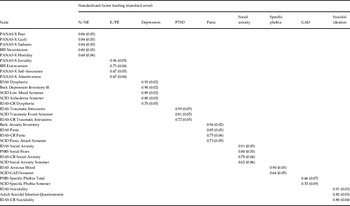
The measurement model was constructed based on both theory and previous empirical research. Indicators were selected for suicidal ideation, N/NE, E/PE and the six disorders of interest. Each latent variable had between two indicators (for GAD and specific phobia) and five indicators (for depression and N/NE). See Table 2 for a list of the hypothesized indicators for each latent variable. Substance-use disorders and gender have been found to be significant covariates in similar models examining suicidality and internalizing disorders (e.g. Cougle et al. 2009 a), so we also tested a model that included these constructs as covariates.
Factor loadings and standard errors for the measurement modelFootnote a,b

N/NE, Neuroticism/negative emotionality; E/PE, extraversion/positive emotionality; PTSD, post-traumatic stress disorder; GAD, generalized anxiety disorder; PANAS-X, Positive and Negative Affect Schedule – Expanded Version; BFI, Big Five Inventory; IDAS, Inventory of Depression and Anxiety Symptoms; SCID, Structured Clinical Interview for the DSM-IV; IDAS-CR, Inventory of Depression and Anxiety Symptoms – Clinician Rated Version; PSRS, Phobic Stimuli and Response Scale.
a n=327.
b All loadings are significant at p<0.001.
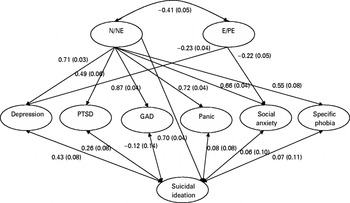
For the latent variable model, relationships of N/NE and E/PE with disorders were specified according to previous research. Thus, N/NE was expected to have a significant regression path with each disorder and suicidality (e.g. Watson et al. Reference Watson, Gamez and Simms2005). In contrast, paths from E/PE were only freed to depression and social anxiety because associations between E/PE and the other disorders (as well as between E/PE and suicidality) are typically negligible (e.g. Brown et al. Reference Brown, Chorpita and Barlow1998; Watson et al. Reference Watson, Gamez and Simms2005). Note that a similar structural model relating N/NE and E/PE to the internalizing disorders (suicidality was not included) was found to fit the data well in previous research using SEM (e.g. Brown et al. Reference Brown, Chorpita and Barlow1998). See Fig. 1 for the hypothesized model.
Standardized path coefficients among latent variables in the model generated using structural equation modeling. Standard errors are given in parentheses. Coefficients in the top half of the figure are regression coefficients of the disorders [depression, post-traumatic stress disorder (PTSD), generalized anxiety disorder (GAD), panic disorder, social anxiety and specific phobia] and suicidal ideation on neuroticism/negative emotionality (N/NE) and extraversion/positive emotionality (E/PE), whereas coefficients on the bottom half are correlations between the residual term of suicidal ideation and each disorder's residual. n=327. All coefficients greater than |0.14| are significant at p<0.008 (Bonferroni-corrected α).

To address our primary research question regarding the specificity of suicidal ideation's association with the anxiety disorders, the residual of suicidal ideation (i.e. the remaining variance after regressing suicidal ideation onto N/NE) was allowed to correlate with the residuals of each of the disorders. We correlated the residuals rather than regressing suicidal ideation on each disorder because regression implies causal directionality (i.e. that the disorder ‘causes’ suicidality), which may be unwarranted in this case. We view suicidal ideation here as a symptom dimension that may or may not co-occur with the other internalizing symptoms, rather than as a consequence of a larger diagnostic entity.
We used weighted least squares with adjusted means (WLSM) estimators in Mplus 5.1 (Muthén & Muthén, 1998–Reference Muthén and Muthén2007) to account for the categorical (i.e. trichotomous) interview measures. These estimators can accommodate categorical data because they do not require the multivariate normality assumption and instead calculate optimal weights. WLSM estimators also use Satorra–Bentler χ2 that adjusts the test statistics and provides robust standard errors. Several types of fit indices were used to assess model fit. The comparative fit index (CFI) is an incremental fit index that compares the hypothesized model with a baseline (or independence) model. Hu & Bentler (Reference Hu and Bentler1999) suggested that values greater than or equal to 0.95 indicate good model fit. The root mean square error of approximation (RMSEA) is a stand-alone measure of overall fit. This index should be less than 0.05 for good model fit (Hu & Bentler, Reference Hu and Bentler1999), but values of 0.05 to 0.08 are consistent with acceptable model fit (Browne & Cudeck, Reference Browne, Cudeck, Bollen and Long1993). Finally, the weighted root mean square residual (WRMR) is used with weighted least squares estimators as an index of the model residuals, where good-fitting models should have a value <1.0 (Yu, Reference Yu2002). Overall model fit will be considered acceptable if all three indices suggest adequate fit.
Results
Rates of symptoms and diagnoses
All scales showed acceptable internal consistency, with α coefficients ranging from 0.75 to 0.97. The means for the symptom measures were consistent with moderate levels of depressive and anxiety symptoms; for example, the mean BDI score [20.9 (s.d.=12.7)] and mean BAI score [17.1 (s.d.=13.2)] fell in the ‘moderate’ range according to the cut-offs in their respective manuals (Beck & Steer, Reference Beck and Steer1990; Beck et al. Reference Beck, Steer and Brown1996). See the Supplementary online material for self-report scale means, standard deviations, α coefficients and number of items per scale (Supplementary Table A), and percentage of ratings in each of the three rating categories for the interview measures (Supplementary Table B).
Structural equation models
The model shown in Fig. 1, wherein paths were allowed from N/NE to each disorder and to suicidal ideation, as well as from E/PE to depression and social anxiety, provided an acceptable fit to the data (CFI=0.95, RMSEA=0.08, WRMR=0.91). Including gender and substance-use disorders as covariates resulted in only negligible changes to model fit and parameter estimates, so these constructs were not included in the final model.
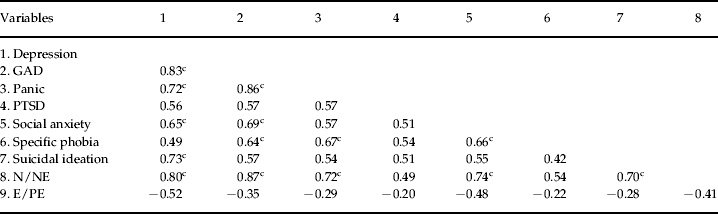
Table 2 presents the standardized factor loadings and standard errors of the measurement model; this was examined prior to latent variable relationships to assess whether each latent variable was adequately measured. The standardized loadings were all significant (p<0.001) and in the expected direction (loadings=0.52 to 0.99), suggesting that all indicators were good markers for their hypothesized construct. The implied zero-order correlation matrix among the latent constructs is shown in Table 3. As expected from previous zero-order research, all of the disorders and suicidal ideation were moderately to strongly correlated with one another at the zero-order level (r=0.42 to 0.86, p<0.001). Depression was strongly related to suicidal ideation (r=0.73), specific phobia had the weakest relationship with suicidal ideation (r=0.42), and the other anxiety disorders were all similarly and moderately related to suicidal ideation (r=0.51 to 0.57). Consistent with previous research (e.g. Watson et al. Reference Watson, Gamez and Simms2005), depression and GAD were very strongly correlated with N/NE (r=0.80 and 0.87, respectively); these correlations are high enough to suggest somewhat poor discriminant validity for these constructs. Panic, social anxiety and suicidal ideation were strongly correlated with N/NE (r=0.72, 0.74 and 0.70, respectively), and PTSD and specific phobia were more moderately correlated with N/NE (r=0.49 and 0.54, respectively). As expected, E/PE was most strongly related to depression and to social anxiety (r=−0.52 and −0.48, respectively).
Zero-order correlations among latent variablesFootnote a,b

GAD, Generalized anxiety disorder; PTSD, post-traumatic stress disorder; N/NE, neuroticism/negative emotionality; E/PE, extraversion/positive emotionality.
a n=327.
b All correlations are significant at p<0.001.
c Correlations >|0.60|.
Fig. 1 shows the standardized parameter estimates and standard errors for the relationships among the latent constructs. The standardized coefficients were all significant as specified in the model (p<0.001). The regression coefficients from N/NE to each disorder ranged from 0.49 to 0.87; these largely followed the same pattern in terms of magnitude as the zero-order correlations with N/NE. In addition, both social anxiety and depression were significantly, although more weakly, related to E/PE (regression coefficients=−0.22 and −0.23, respectively). N/NE and E/PE were moderately inversely correlated with one another (r=−0.41).
The correlations of the residual term of suicidal ideation with the residuals of each disorder were then examined, as the residuals contain each construct's unique variance after removing shared variance with N/NE and E/PE. In contrast to the zero-order results, only two of the correlations between the disorders and suicidal ideation remained significant (using a Bonferroni-corrected α of 0.008): depression (r=0.43) and PTSD (r=0.26). Thus, none of the other anxiety disorders was significantly associated with suicidal ideation after controlling for co-morbidity due to N/NE and E/PE.
Discussion
After controlling for variance shared with N/NE and E/PE – two personality traits associated with co-morbidity among the internalizing disorders – this study found that only depression and PTSD were significantly related to suicidal ideation in a sample of psychiatric out-patients; associations with the other anxiety disorders all dropped to non-significance. These results were derived from SEM analyses with several methodological strengths. First, by using multiple self-report and interview measures of each construct, our design should provide more reliable and valid measurement of each construct than would studies utilizing single items or measures. Second, by including dimensional symptom measures in addition to categorical interviews, the current study captured variance associated with subthreshold symptoms that have been found to co-vary with suicidal ideation (Marshall et al. Reference Marshall, Olfson, Hellman, Blanco, Guardino and Struening2001; Norton et al. Reference Norton, Temple and Pettit2008; Diefenbach et al. Reference Diefenbach, Woolley and Goethe2009). Our finding that PTSD was the only anxiety disorder to remain significantly related to suicidal ideation after controlling for co-morbidity is consistent with previous research (e.g. Marshall et al. Reference Marshall, Olfson, Hellman, Blanco, Guardino and Struening2001; Oquendo et al. Reference Oquendo, Friend, Halberstam, Brodsky, Burke, Grunebaum, Malone and Mann2003; Sareen et al. Reference Sareen, Houlahan, Cox and Asmundson2005b; Cougle et al. Reference Cougle, Keough, Riccardi and Sachs-Ericsson2009a, Reference Cougle, Keough, Riccardi and Sachs-Ericssonb); this replication is particularly striking because this is the first study to control for co-morbidity via personality traits and to use dimensional assessment. Similar to previous research (e.g. Cougle et al. Reference Cougle, Keough, Riccardi and Sachs-Ericsson2009a), we did not find evidence that specific phobia is uniquely related to suicidal ideation.
Our null findings regarding panic, social anxiety and GAD in relation to suicidal ideation add to a body of conflicting evidence. What factors might have contributed to differing results across studies? A review of studies that conducted multivariate analyses with numerous anxiety disorders reveals several trends that may have influenced findings. First, results seem to differ depending on whether anxiety disorders were assessed with dichotomous interviews or dimensional symptom measures. At least two of these three disorders were significantly associated with suicidality in several studies that used diagnoses (Sareen et al. Reference Sareen, Cox, Afifi, de Graaf, Asmundson, ten Have and Stein2005a; Boden et al. Reference Boden, Fergusson and Horwood2006; Cougle et al. Reference Cougle, Keough, Riccardi and Sachs-Ericsson2009a), whereas the current study and two others that included dimensional symptom assessment reported non-significant results for all three (Chioqueta & Stiles, Reference Chioqueta and Stiles2003; Diefenbach et al. Reference Diefenbach, Woolley and Goethe2009). It may be that controlling for co-morbidity with dichotomous diagnoses only accounts for the upper end of the severity continuum, resulting in a substantial loss of relevant information and, therefore, a greater number of significant relationships between individual disorders and suicidal ideation. Consistent with this hypothesis, Marshall et al. (Reference Marshall, Olfson, Hellman, Blanco, Guardino and Struening2001) found that subthreshold PTSD symptoms predicted impairment beyond PTSD diagnoses, illustrating that subthreshold symptoms carry additional relevant variance beyond diagnoses.
A related observation is that two studies that included more extensive controls for co-morbidity – by coding for the presence of three or more lifetime diagnoses (Sareen et al. Reference Sareen, Houlahan, Cox and Asmundson2005b) or by controlling for both the BDI and BAI (Chioqueta & Stiles, Reference Chioqueta and Stiles2003) – reported significant associations with PTSD only or with none of the anxiety disorders, respectively. In contrast, two studies that controlled for depression but not for co-morbid anxiety disorders reported that all of the included anxiety disorders were significantly (p<0.05) associated with suicidal ideation (Marshall et al. Reference Marshall, Olfson, Hellman, Blanco, Guardino and Struening2001; Norton et al. Reference Norton, Temple and Pettit2008). Perhaps the former (more stringent) methods of controlling for co-morbidity better tap in to sources that may contribute to etiology, such as N/NE and E/PE.
A third potentially relevant variable is whether the sample is population-based or consists of psychiatric patients. It is noteworthy that four of the five population-based studies found that several anxiety disorders were uniquely associated with suicidality (Marshall et al. Reference Marshall, Olfson, Hellman, Blanco, Guardino and Struening2001; Sareen et al. Reference Sareen, Cox, Afifi, de Graaf, Asmundson, ten Have and Stein2005a; Boden et al. Reference Boden, Fergusson and Horwood2006; Cougle et al. Reference Cougle, Keough, Riccardi and Sachs-Ericsson2009a), whereas neither the current study nor two other patient studies reported significant associations other than for PTSD (Chioqueta & Stiles, Reference Chioqueta and Stiles2003; Diefenbach et al. Reference Diefenbach, Woolley and Goethe2009). Biases related to sample selection or differences in the distribution of suicidality may have been relevant to these results. Finally, it may also be the case that the population effect sizes are small and therefore difficult to detect for social anxiety, panic and GAD, or that different endophenotypes for suicidal ideation may be associated with different disorders (see Mann et al. Reference Mann, Arango, Avenevoli, Brent, Champagne, Clayton, Currier, Dougherty, Haghighi, Hodge, Kleinman, Lehner, McMahon, Mościcki, Oquendo, Pandey, Pearson, Stanley, Terwilliger and Wenzel2009 regarding endophenotypes in suicidal behavior).
Several limitations should be kept in mind when interpreting the results of the current study. The cross-sectional design precludes any causal interpretations regarding personality traits, the internalizing disorders and suicidal ideation; longitudinal studies are necessary to address such questions. In addition, retrospective biases and content overlap between the traits and disorders may have inflated some of these associations, although the inclusion of interview measures may have improved precision due to clinical judgment and clarification. This study did not include some important covariates known to be relevant to suicidal ideation, such as impulsivity and hopelessness (for a review, see Brezo et al. Reference Brezo, Paris and Turecki2006), or borderline personality disorder and antisocial personality disorder (e.g. Cougle et al. Reference Cougle, Keough, Riccardi and Sachs-Ericsson2009a). Future studies should expand this model to include these constructs, as well as other anxiety disorders such as OCD and agoraphobia. Finally, these results are specific to suicidal ideation, and further research is needed to determine whether the results apply to suicidal behaviors.
Our findings add to a growing body of literature indicating that PTSD has a unique association with suicidal ideation, even in the absence of co-morbid disorders. Thus, it is particularly important to assess suicidality in those with PTSD or subthreshold PTSD symptoms. Of course, the moderate zero-order correlations between all disorders assessed here and suicidal ideation suggest that a substantial number of patients encountered in clinical settings will have suicidal ideation, regardless of their particular diagnoses. Future research may help to elucidate our understanding of the nature and etiology of suicidal ideation by further examining the specific associations among depression, PTSD and N/NE. Both disorders are heterogeneous and may be broken down into specific symptom dimensions: for example, depression includes components such as sleep disruption, ill temper and low well-being, whereas PTSD includes components such as dysphoria, intrusions, avoidance and physiological hyperarousal (see Watson, Reference Watson2009). The current study assessed PTSD primarily in terms of intrusive re-experiencing of a traumatic event, but further research could clarify whether the individual symptom dimensions might relate differently to suicidal ideation. Such research could bring us closer to common etiological sources shared by the internalizing disorders and suicidality.
Note
Supplementary material accompanies this paper on the Journal's website (http://journals.cambridge.org/psm).
Acknowledgements
This research was supported by a grant to D.W. from the National Institute of Mental Health (no. R01-MH068472). We thank Jennifer Glanville for her help with the data analysis. D.W. is now at the Department of Psychology, University of Notre Dame.
Declaration of Interest
None.