Unsafe injection practices place both patients and healthcare workers (HCWs) at risk for infection transmission. For patients, the vast majority of recent infectious outbreaks in healthcare have occurred in the outpatient setting as the result of unsafe injection practices. 1 More than half of these outbreaks involved bloodborne viral or bacterial infections and have not been restricted to a single type of clinic or specialty. 1 – 4 During a 2007 outbreak in Nevada, the reuse of syringes and the use of single-dose vials (SDVs) for multiple patients resulted in up to 106 cases of healthcare-acquired hepatitis C and the notification of 63,000 patients for possible exposure of hepatitis C and other bloodborne pathogens. 5 , 6 Since 2001, >150,000 people have been notified of exposure to bloodborne infections in similar outbreak investigations. These incidents prompted The Joint Commission (TJC) to release a Sentinel Event Alert calling for the improvement of injection practices. 7
Safe injection practices also protect HCWs from exposure to bloodborne pathogens. The Centers for Disease Control and Prevention (CDC) defines a sharp injury as “a penetrating stab wound from a needle, scalpel, or other sharp object that may result in exposure to blood or other body fluid.” The CDC estimates that 385,000 sharps-related injuries occur annually in hospital settings; however, it is also estimated that 50% of sharp injuries go unreported. 8 Most needlestick injuries occur in the inpatient setting, but almost 10% occur in ambulatory settings. 9 Among the 150 ambulatory clinics in the current study, the incidence of sharps injuries has increased since 2015, and more than half have been from needle sticks (unpublished internal communication).
Safe medication administration is a national patient safety goal for ambulatory healthcare. 10 To promote safe medical injection practices, the CDC launched “The One & Only Campaign,” which emphasizes the use of 1 needle and 1 syringe for each patient and the correct usage of multidose (MDV) and single-dose (SDV) vials. 1 The CDC also recommends implementing training programs to reinforce safe injection practices and monitoring adherence to the recommendations. 1
The Institute of Medicine (IOM) promotes viewing safety from a systems perspective 11 and asserts that healthcare outcomes do not result from the action of a single individual but depend on the interaction of many factors, including environment of practice, organizational culture and structure, and human factors.Reference Carayon, Hundt and Karsh 12 Focusing on just 1 of these factors does not necessarily produce the desired improvements in healthcare outcomes.Reference Yanke, Carayon and Safdar 13 The continued occurrence of unsafe medication-vial usage suggests that the knowledge of safe practices alone is not enough to ensure adherence.Reference Branch-Elliman, Weiss, Balter, Bornschlegel and Phillips 14 , Reference Anderson, Weissburg, Rogers, Musuuza, Safdar and Shirley 15 The Systems Engineering Initiative for Patient Safety (SEIPS) model, which emphasizes persons, organization, technologies and tools, tasks, and environmentReference Carayon, Hundt and Karsh 12 is one framework used to evaluate healthcare systems.
Understanding the SEIPS barriers and facilitators that prevent or assist safe injection practices can help guide clinical interventions to reduce disease risk exposure. In a recent study by Anderson et al,Reference Anderson, Weissburg, Rogers, Musuuza, Safdar and Shirley 15 HCWs self-reported a high knowledge of injection safety and no barriers to safe usage of medication vials; however, observation data collected in the same study revealed significant nonadherence to safe usage of medication vials. In addition, 2 other studies that collected anonymous survey data from clinicians reported that reuse of syringes for multiple patients still occurs in practice.Reference Pugliese, Gosnell, Bartley and Robinson 16 , Reference Kossover-Smith, Coutts, Hatfield, Cochran, Akselrod, Schaefer, Perz and Bruss 17 At the time of this project, few other published studies have described the extent of nonadherence to available injection safety standards, and no published studies have described contributing factors to these practices. The goal of this study is to identify barriers and facilitators to safe injection practices in the ambulatory setting to guide quality improvement interventions.
METHODS
An invitation for voluntary study participation was sent to the manager or director at clinic sites that were known to perform intramuscular, intradermal, intravenous, or intra-articular injections. Observations and interviews were conducted in person by investigators familiar with site-visit observation and standardized interviewing techniques. Clinics that accommodate high volumes of patients, defined as 1 patient every 15–45 minutes, as well as those that provide urgent care or same-day services or perform invasive procedures, were given priority. Participating clinics were categorized by type and included adult primary care, pediatric primary care, family medicine, urgent care, medical specialty services, procedural centers, dialysis centers, and imaging departments. To maintain confidentiality, the names of participating staff were not recorded.
Observations
The investigator observed the preparation and administration of 10 injections or all injections within 2 hours, whichever came first. We defined 1 injection as the administration of medication or contrast through 1 syringe to 1 patient. If the observed staff member also participated in the interview, observation was completed first. For each injection observed, the investigator recorded whether staff performed the elements of safe injection using a checklist of safe injection standards guided by the CDC, the National Institute for Occupational Safety and Health, and the American Nurses’ Association standards on safe injection and the prevention of needle stick injuries (Table 1). 18 – 20
Injection Safety Observation ChecklistFootnote a Reported by Number of Injections Adherence to Elements from May to August 2017 (n=106)

NOTE. SEIPS, System Engineering Initiative for Patient Safety; NA, not applicable.
a Adapted from standards from the Centers for Disease Prevention and Control, National Institute for Occupational Health and Safety, and the American Nurses’ Association.
b Total reported number of adherence and nonadherence; does not include not applicable or not observed.
For all standards, the investigator recorded “yes” if the standard was performed or “no” if it was not performed (Table 1). The observer offered guidance to the staff at the time of observing a practice not meeting standards. Totals for each standard were calculated using Microsoft Excel. In some clinics, interviews were conducted even though no injections were observed.
Interviews
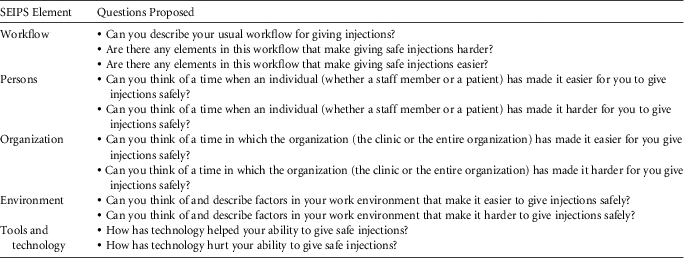
Semistructured interviews consisted of 5 open-ended questions that addressed each of the SEIPS domains: persons, organization, technologies and tools, tasks, and environment (Table 2). Following observations, the investigator interviewed at least 1 staff member who performed injections at the clinic site and a supervisor. Interviews were digitally recorded and transcribed when possible. Information was transcribed, and data were entered into the QDA Miner Lite software program (Provalis Research, Montreal, Quebec, Canada) to assist with the coding of themes according to SEIPS domains of persons, organization, technologies and tools, tasks, and environment. Each coded segment was classified as a barrier or facilitator and whether it was reported by supervisory staff. It was then assigned a category and grouped according to common theme or multiple themes if applicable. The frequency of each theme and their attribution as a facilitator or barrier to injection safety were calculated (Figures 1 and 2). Finally, the observed data and interview data were compared to identify associations between the elements performed and the SEIPS themes reported (Table 1). This project was considered a quality improvement study and was exempt from review by our institutional review board.
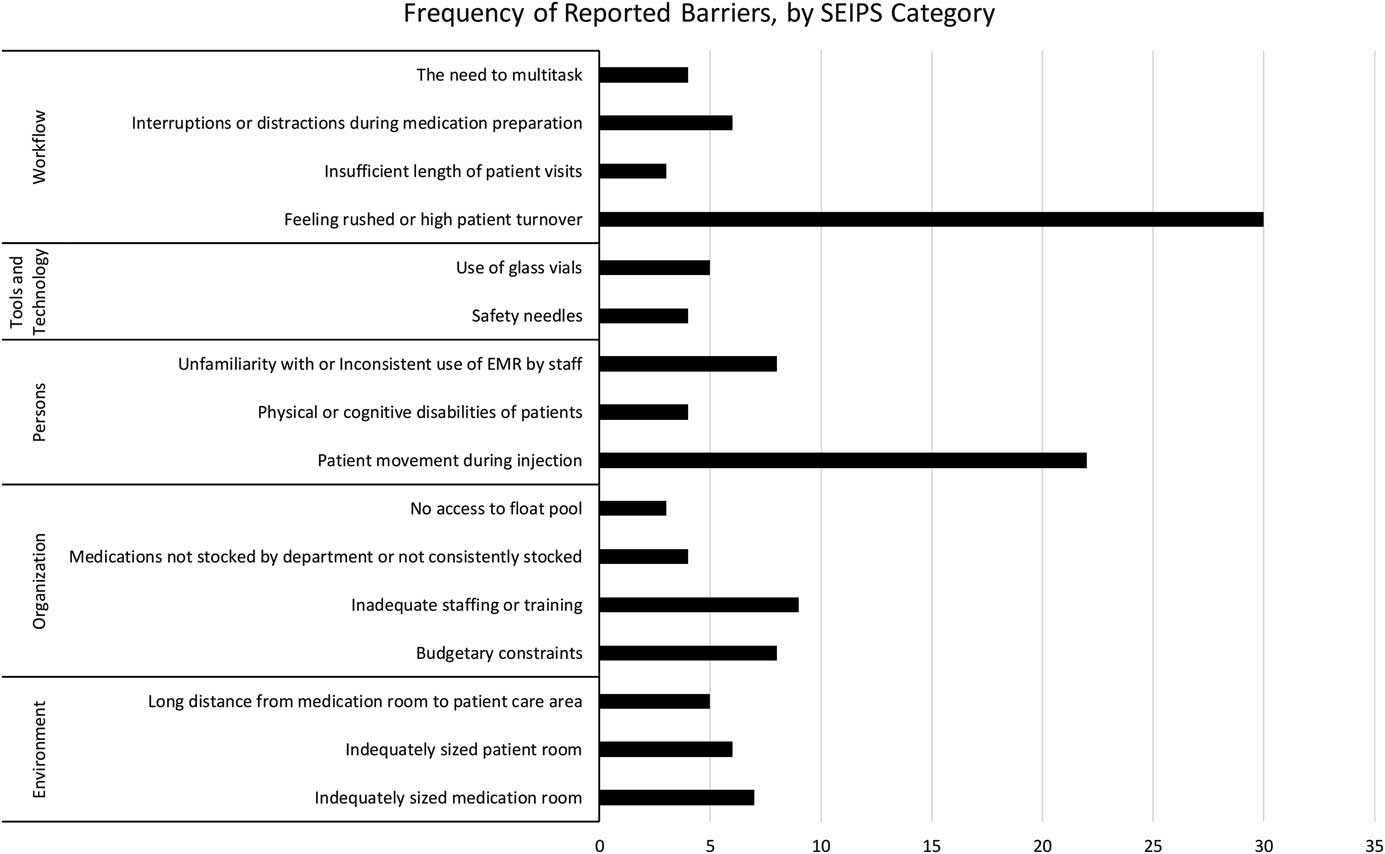
Frequency (%) of reported barriers, arranged by System Engineering Initiative for Patient Safety (SEIPS) category.

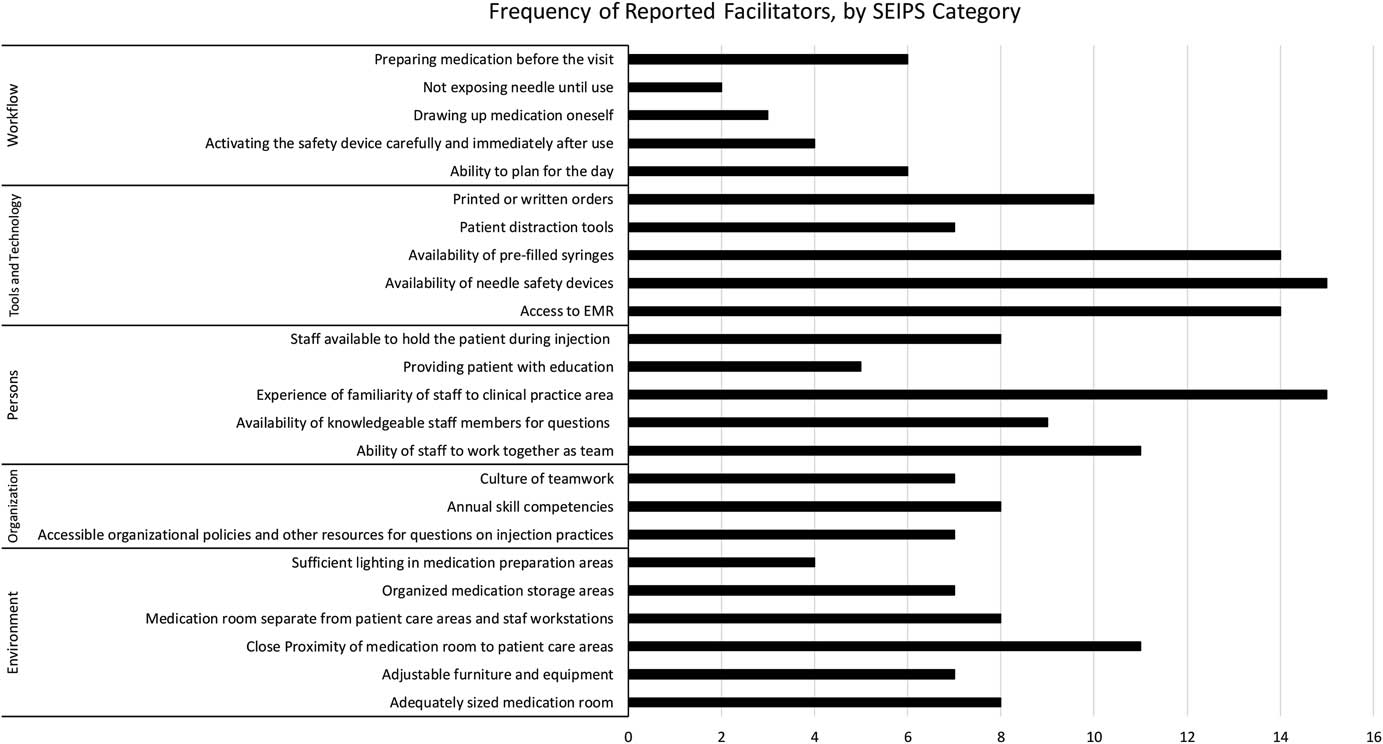
Frequency (%) of reported facilitators, arranged by System Engineering Initiative for Patient Safety (SEIPS) category.

Injection Safety Interview Questions

NOTE. SEIPS, System Engineering Initiative for Patient Safety.
RESULTS
Of the 32 clinics contacted between May and August 2017, 21 clinics participated in this study. Of the 11 nonparticipating clinics, the most common reasons for declining participation were (1) staff turnover issues, (2) giving injections so infrequently that none would be observed, (3) providers giving the injections did not have time to accommodate the visit, or (4) they did not feel that injection safety was an issue. Of the 21 clinics, 16 participated in both the interviews and observations, 2 participated in observations only, and 3 had interviews only. For 3 clinics, only interviews were performed because no injections were given during the observation period. One staff member and one manager were interviewed in all clinics except for pediatrics where only one staff was available for interview. Participating clinics included 4 adult internal medicine departments, 6 pediatric or family medicine departments, 1 provided urgent-care services, 3 adult specialty medicine services (dermatology, allergy, and immunology), 3 ambulatory procedures (digestive health, radiation oncology, and ambulatory surgery), 2 provided imaging services, and 2 provided outpatient dialysis services (Table 1). Most of the clinics were located within the city of Madison, and 3 were in outlying communities.
In total, 106 injections were observed at the 21 clinics (average 5 injections per clinic, range, 0–10 injections). Most injections (82.1%) involved SDVs compared to MDVs (17.9%). Of the 13 standards, 5 were followed 100% of the time, including the standard of not using SDVs for >1 dose or >1 patient (Table 1). The standard with the lowest compliance rate was preparing and administering injections using needleless access devices. Primary care and urgent care clinics were more likely to not meet this standard (Table 1) because needleless devices were unavailable for the preparation of injectables. Other elements with low adherence included checking the expiration date of MDVs prior to use (20%–40% nonadherence) and keeping MDVs out of patient care areas (Table 1). For these standards, primary and urgent care locations were more likely than other clinic types to be nonadherent due to the frequency of MDV use and the relative nonuse of MDVs in procedural, dialysis, and imaging clinics.
Of the 36 completed interviews, 819 segments were coded across the 5 SEIPS elements. Of those, 358 (43.7%) segments were considered barriers and 461 (56.3%) were considered facilitators. Interview segments infrequently directly addressed the checklist standards. For instance, none of the participants noted barriers to cleansing the rubber hub of the vial prior to accessing, despite that element only being followed 86% of the time. The only standards explicitly mentioned in interview responses were the availability and correct use of safety devices and the availability of needleless devices for preparation of injectables. No pattern was noted between responses and type of clinic or between staff within clinics. Themes indirectly relating to checklist standards along with SEIPS categories are reported in Table 1 with the frequencies of adherence by clinic type.
Workflow
A wide variety of responses were recorded for the workflow category, reflecting the diversity of practice across participating clinics. In total, 72 different themes were assigned to 154 coded segments, 87 (55%) of which were described as barriers. The most frequently described barrier was the perception of feeling rushed and a high patient turnover (Figure 1). One participant commented that being in a hurry increases the risk for missing steps in the injection process. For reported facilitators, themes that included planning ahead for the injections emerged. Some technical aspects of injection administration were also noted to be facilitators (Figure 2).
Persons
Of the 202 segments coded to persons, 101 (50%) were described as barriers. The most frequently described barrier theme was patient movement during the injection (Figure 1), such as jumping or attempting to swat the hands of the HCW. One participant described having to hold a child during an immunization due to concerns of the child jumping and causing a needlestick injury. In pediatric populations, HCWs reported this type of patient reaction most often. For facilitators, a primary theme involved attempts to ameliorate a negative patient reaction. However, facilitators most frequently described were positive characteristics of staff giving the injection and available resources (Figure 2).
Environment
Of the 129 segments coded to environment, 51 (40%) were considered barriers to safe injection practice, including lack of space, smaller patient care areas, and limited storage supply space. The most common facilitator reported by both staff and managers was having injection supplies near work areas. Other common themes characterized the room in which medications are prepared and the availability of adjustable equipment (Figure 2).
Organization
Of the 136 segments coded to organization, 67 (49%) were classified as barriers. Most of the barrier themes involved inadequate staffing and training (Figure 1). Financial barriers were reported exclusively by managers. Managers were more likely than staff members to report annual skill competencies as helpful (Figure 2). One manager explained that regular competencies served as reminders for skills and safety concerns and provided assurance that staff adhered to safe injection practices. Both managers and staff reported that a culture of teamwork and accessible resources were important to injection safety.
Tools and Technology
Of the 198 segments coded to tools and technology, only 54 (27%) were classified as barriers. The most frequently reported facilitator was the availability of supplies near the work area (Figure 2). Although most participants reported the availability of safety needles and other types of safety devices as a facilitator, some reported safety needles as barriers because they obstructed visualization of the injection site or required the user to push up the shield over the needle with one or both hands. Characteristics of types of syringe were also important to participants. Another frequently reported facilitator was access to an electronic medical record (EMR) to assist with preparing medication and access to other online resources. Finally, although patient movement was the most frequently reported barrier in the “Persons” section of the study, tools used for needle pain management were reported less frequently as facilitators.
DISCUSSION
Concurrent use of observations followed by interviews allowed investigators to better identify gaps in injection safety practice. Interestingly, the safe practice elements that investigators observed were not frequently discussed in the interviews. Preference for using SDVs over MDVs was reported rarely in interviews, despite the recommended practices involving MDV use being suboptimal in observations. Thus, the self-reported data may not sufficiently gauge actual practice in the clinics. This finding is consistent with the study by Anderson et al, 11 which highlighted deficits in safe practice despite survey responses reporting no barriers.
Instead of directly discussing safe injection practices, many interview participants focused on elements that may indirectly impact the medication administration process or the overall daily clinic workflow. This type of response is supported by the most frequently reported barrier, the perception of being rushed. The interviews revealed that infection control aspects of safe injection practices are perceived to be closely connected with other clinic processes. Therefore, addressing practice concerns from only an infection control perspective may not achieve improved adherence to safe injection practices.
The strengths of this study include that observations and interviews were performed at a variety of outpatient settings offering different medical services as well as settings that give injections at different frequencies (Table 1). Semistructured interviews allowed investigators to gather diverse responses from both clinical staff directly involved in patient care as well as participants in managerial or supervisory roles. Observations also captured a wide variety of patient care staff, including medical assistants, licensed practical nurses, and physicians.
This study has several limitations. The possibility of reporting bias in interviews could not be excluded due to the inherent pressure to give a socially desirable response. Staff may have known the correct practice for injections but have been hesitant to report factors in which their practice deviates from the accepted one for fear of penalty. The greater number of reported facilitators over barriers may indicate the presence of this bias. Participants may have changed injection practices due to the presence of the observer. Because of time limitations in the study, investigators were only able to observe a small number of injections given in a period, and sometimes investigators observed the same staff for multiple injections. Thus, it is impossible to generalize results to all injections performed across all clinics. Finally, because of the limitations in the scope of the study, only a small number of the total reported barriers and facilitators could be discussed here.
Given the limitations of self-reporting, organizations may incorporate this model of observation to identify areas of nonadherence to practice standards and policies. The infection prevention department at the organization in this study routinely performs site visits to assess adherence to regulatory standards of safe injection, much like the elements assessed in this study. Most of the information gathered during these site visits is obtained through the self-report from the clinic manager. Because the observations of this study revealed more deficits in safe practice than the site visits reports, the study suggests that it may be necessary to monitor for adherence of regulatory standards with additional observations.
Future studies should aim to collect a larger amount of observation data from different staff members across the clinics. Inadequate staffing and staff unfamiliar with the clinic workflow were identified as barriers; thus, clinics that declined participation in the study due to staffing or training issues may have more unrecognized safe injection performance challenges. Because of the design, this study could not explore causative factors of nonadherence to safe injection practices. Additional studies on the effect of interventions focusing on the identified barriers and facilitators are needed.
In conclusion, perceived barriers and facilitators to infection control elements of injection safety are interconnected with the SEIPS elements of persons, organizations, technologies, tasks, and environment affecting injection administration and clinic processes. Frequently identified barriers included patient reactions during injection administration and challenging staff workflows. Frequently identified facilitators were supplies availability and appropriate safety devices. Direct observations may not align with self-reported data and may be necessary to accurately assess adherence to injection best practices.
ACKNOWLEDGMENTS
The authors would like to acknowledge clinic mangers and staff participating in the observations and interviews as well as Julia Jensen, University of Wisconsin School of Medicine and Public Health, MPH 2018 Candidate, for her work reviewing the interview transcripts, and Mary Hitchcock, MLIS Health Sciences Librarian, Ebling Library, University of Wisconsin–Madison, for her assistance with the literature review.
Financial support: No financial support was provided relevant to this article.
Potential conflicts of interest: All authors report no conflicts of interest relevant to this article.