Introduction
Historically, the main approach to conserving biodiversity globally has been through establishing protected areas, yet only 12% of the terrestrial areas of the planet are under some form of protection (Jenkins & Joppa Reference Jenkins and Joppa2009). There are few areas left that can be put under such conservation, which often excludes people. Conservation approaches that are community-based have a greater likelihood of success. Biocultural and indigenous approaches to conservation are increasingly being recognized and valued; at these sites, including the sacred groves of India, the ecological aspects and cultural significance of the landscape are considered (Berkes Reference Berkes2009, Gavin et al. Reference Gavin, McCarter, Mead, Berkes, Stepp, Peterson and Tang2015).
Sacred groves are forested landscapes that are protected through social norms based on spiritual values. For example, many sacred groves have community rules against hunting or taking any resources from the groves. Sacred landscapes exist globally and are a form of biocultural conservation (Mgumia & Oba Reference Mgumia and Oba2003, Bhagwat & Rutte Reference Bhagwat and Rutte2006, Ormsby Reference Ormsby, Pungetti, Oviedo and Hooke2012, Ruelle et al. Reference Ruelle, Kassam and Asfaw2018). India has the highest concentration of sacred groves in the world (Malhotra et al. Reference Malhotra, Gokhale, Chatterjee and Srivastava2007, Ormsby & Bhagwat Reference Ormsby and Bhagwat2010), and these forests harbour greater species richness and diversity than adjacent non-sacred forests or surrounding landscapes (Mgumia & Oba Reference Mgumia and Oba2003, Ambinakudige & Satish Reference Ambinakudige and Satish2008, Rath et al. Reference Rath, Banerjee and John2020). Some plant species have been extirpated outside of sacred groves, such as Dysoxylum malabaricum (Ormsby & Ismail Reference Ormsby and Ismail2015). In the Western Ghats, Boraiah et al. (Reference Boraiah, Vasudeva, Bhagwat and Kushalappa2003) found that sacred groves contain a greater diversity of medicinal plants than reserve forests, while Bhagwat et al. (Reference Bhagwat, Kushalappa, Williams and Brown2005a, Reference Bhagwat, Kushalappa, Williams and Brown2005b) studied forest reserves, sacred groves and coffee plantations and found threatened tree species that now only occur in sacred groves. In Odisha, Pradhan et al. found tree species diversity in sacred forests to be greater than or comparable to that of the non-sacred forests of the Eastern Ghats.
Most studies of Indian sacred groves have been on the Western Ghats, such as on medicinal plants (Boraiah et al. Reference Boraiah, Vasudeva, Bhagwat and Kushalappa2003), socioeconomic aspects (Chandrakanth et al. Reference Chandrakanth, Bhat and Accavva2004), landscape ecology (Bhagwat at al. Reference Bhagwat, Kushalappa, Williams and Brown2005a) and timber use (Ormsby & Ismail Reference Ormsby and Ismail2015), and in north-eastern India on plant diversity (Jamir Reference Jamir2002), ethnomedicinal plants (Khumbongmayum et al. Reference Khumbongmayum, Khan and Tripathi2005), woody plant species (Khumbongmayum et al. Reference Khumbongmayum, Khan and Tripathi2006), forest management (Tiwari et al. Reference Tiwari, Tynsong and Lynser2010) and local attitudes towards groves (Ormsby Reference Ormsby2013), and in Himalayan regions on sacred plant species, ceremonies and medicinal plants (Anthwal et al. Reference Anthwal, Sharma and Sharma2006), ecosystem services (Gokhale & Pala Reference Gokhale and Pala2011), sacred species and beliefs (Anthwal et al. Reference Anthwal, Gupta, Sharma, Anthwal and Kim2010), conservation management (Gokhale & Pala Reference Gokhale and Pala2016), floristic composition and threats (Singh et al. Reference Singh, Husain and Agnihotri2010) and the cultural politics of groves (Acharya & Ormsby Reference Acharya and Ormsby2017).
Sacred groves in India provide a number of values, including conservation of biodiversity (Bhagwat et al. Reference Bhagwat, Kushalappa, Williams and Brown2005a, Reference Bhagwat, Kushalappa, Williams and Brown2005b, Khan et al. Reference Khan, Khumbongmayum and Tripathi2008, Ormsby & Bhagwat Reference Ormsby and Bhagwat2010, Anthwal et al. Reference Anthwal, Gupta, Sharma, Anthwal and Kim2010), medicinal plants (Boraiah et al. Reference Boraiah, Vasudeva, Bhagwat and Kushalappa2003, Khumbongmayum et al. Reference Khumbongmayum, Khan and Tripathi2005), habitats for rare and endangered species (Bhagwat et al. Reference Bhagwat, Kushalappa, Williams and Brown2005a), climate regulation through carbon sequestration (Pala et al. Reference Pala, Negi, Gokhale, Aziem, Vikrant and Tadoria2013a, Waikhom et al. Reference Waikhom, Nath and Yadav2017) and watershed services (Jana et al. Reference Jana, Dasgupta and Todaria2017). In addition to the provisioning, regulating and supporting ecosystem services of sacred forests are cultural and spiritual services, which include ceremonies and rituals held within the groves. Sacred groves experience different levels of threats due to changing cultural practices, pressure to use their natural resources and increasing human populations (Chandrakanth et al. Reference Chandrakanth, Bhat and Accavva2004, Daye & Healey Reference Daye and Healey2015). The threats not only affect the biological diversity, but also the cultural diversity of these sacred landscapes if the associated ceremonies and belief systems are forgotten or banned (Pretty et al. Reference Pretty, Adams, Berkes, de Athayde, Dudley and Hunn2009).
Odisha’s sacred groves have been studied for their birds (Pradhan et al. Reference Pradhan, Mishra and Behera2016), trees (Pradhan et al. Reference Pradhan, Ormsby and Behera2019b) and carbon sequestration (Pradhan et al. Reference Pradhan, Ormsby and Behera2019a). Our research fills a gap in understanding of cultural values by documenting the following in five sacred groves in four districts of western Odisha: the types of groves; grove activities; resource use; management approaches; and ecological disturbance levels. We used an interdisciplinary approach to provide insights into how community activities, management and resource use have shaped the groves.
Methods
Study area and sites
Odisha, formerly Orissa, on India’s eastern coast contains tropical dry deciduous forests and has a strong tradition of nature conservation due to cultural and religious practices, including festivals and the presence of large populations of tribal people, as well as sacred forests (Panda et al. Reference Panda, Bisoi and Palita2014, Behara & Pradhan Reference Behara and Pradhan2015, Das Reference Das2016). However, from 1935 to 2010, the state’s forest cover declined by 40.5% (Reddy et al. Reference Reddy, Jha and Dadhwal2013); this deforestation in Odisha was due to mining, industrialization and agricultural expansion.
Sacred groves are common features of landscapes inhabited by tribal peoples in Odisha. The tribal population forms 22.8% of the state’s total population (Bisai et al. Reference Bisai, Saha, Sharma, Muniyandi, Singh, Singh, Rajasubramaniam and Roy2014). These groups, such as the Gonds, Bhils, Bhuyan and Jhara, worship traditional deities associated with forests; conserving the forest home of the deities thereby protects nature. The Gonds and Bhuyan are recognized by the government of India as scheduled tribes, and the Bhils and Jhara are scheduled castes (Bisai et al. Reference Bisai, Saha, Sharma, Muniyandi, Singh, Singh, Rajasubramaniam and Roy2014). Most continue to worship animist traditional deities, but some people have also adopted elements of Hinduism (Das Reference Das2016).
Western Odisha is different from the rest of the state topographically, historically, linguistically and culturally. Many small community-owned sacred groves exist in tribal villages. These have experienced minimal disturbance due to a strong associated belief system, including taboos on harming vegetation. In Odisha, sacred groves are generally named after the deity dwelling in each grove (Behara & Pradhan Reference Behara and Pradhan2015). There are 2163 sacred groves in the entire state of Odisha (Sahoo Reference Sahoo2015) and 322 sacred groves in the Koraput district of Odisha alone (Malhotra et al. Reference Malhotra, Gokhale, Chatterjee and Srivastava2007); however, there is no documentation of the grove sizes.
We studied five sites in four districts of western Odisha (Table 1) that were selected to represent a variety of grove sizes, ranging from 1 to 1000 ha (see study site figure in Supplemental Materials, available online). Sites were also selected due to the practicality of time constraints in limiting the sample size to five locations for which we had both ecological and cultural data. We distinguished sacred forests as being larger in size than sacred groves, which are generally patches of <5 ha. We intentionally used a qualitative case study approach to document the unique characteristics of each grove and to compare the groves.
Characteristics of the study sites.

VSS = Vana Surakhya Samiti.
Andhari sacred forest (c. 1000 ha) covers a chain of hills in Jharsuguda district. One hill is the abode of the goddess Maa Andhari (Mother Andhari), in whom people have deep faith and who is worshipped along with the village goddess in the sacred grove (demul) in surrounding villages. Gonds are the major ethnic group associated with this forest. All the rituals at the demul are performed by the head village priest. In addition to daily offerings of prayers by community members, an annual festival in November is open to everyone. Each year, thousands of pilgrims and tourists (both tribal Gonds and non-tribal visitors) attend the festival at the top of the hill where the goddess resides.
Dedungri sacred forest (Sambalpur district) covers c. 50 ha on a small hill that has a religious association with the Gond community of Nuadihi village; it is believed to be home to the holy spirit of Monk Manchaka who resided and died there. The Gond community believes that this divine spirit resides in the forest, and that worshipping the spirit will bring good fortune to the community. At an annual festival in December, the head priest performs all of the rituals. Out of respect for the divine spirit, the local communities protect and do not disturb the hill’s biodiversity.
Gugarpat, a community-owned sacred grove of 1 ha in area in Sambalpur district, is the abode of the goddess Gugarpat and is managed by the Gond community of the Solpali village. The head priest performs all of the rituals in an annual festival in April. Community residents also seek blessings from their grove goddess during several ceremonies, such as marriage, childbirth and the annual harvest.
Medha sacred temple forest covers c. 25 ha under the state reserve forest area on the bank of the river Safei in Majhapara village (Sundargarh district). Two communities – Bhuyan and Jhara – are culturally associated with this forest. Lord Medheswar (Shiva) is worshipped in the temple by the priests of the Jhara community. The local people associated with this temple believe that if the forest is degraded, it will adversely affect the value of the temple. The temple is managed by a temple committee formed in 1997 by the people of 32 adjacent villages. A forest conservation committee established in 2000 addresses illegal activities in the forest and supports the temple committee that undertakes temple development work.
Papanga sacred forest (Bargarh district) is of c. 250 ha on a sacred hill associated with the village god Budharaja, who is worshiped in an annual festival in April. Budharaja is culturally associated with the local Bhil community of Papanga village. All rituals are performed by specially recruited priests known as Dehri. According to the local residents and members of the Vana Surakhya Samiti (VSS; forest conservation committee), as this hill is considered sacred, a Ram temple was constructed in 2003 on the hill to attract pilgrims throughout the year.
Survey methods
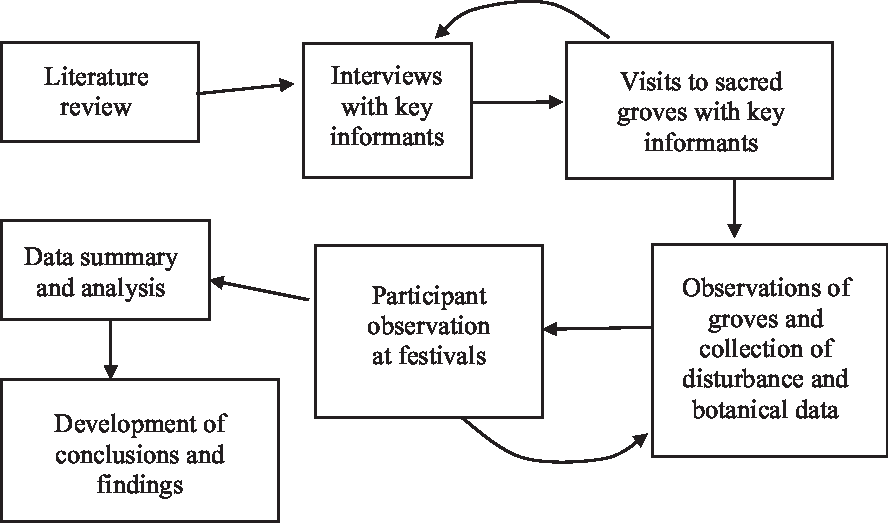
From 2012 to 2015, using a multi-step mixed-methods approach (Fig. 1), we documented grove conditions using quantitative botanical survey methods and management practices at each grove using qualitative social science research methods, including interviews and participant observation. Only field notes were taken during the interviews, which were conducted by the first author in the Sambalpuri dialect of the local language Odia (formerly called Oriya). The cultural ecosystem services offered by different sacred groves were documented during monthly visits to the sites and interviews with community residents; the first author facilitated discussions and conducted interviews with a total of 81 stakeholders, including forest officials, the main priest(s), the site managers and herbal healers, similar to studies at other sacred groves in India (Ormsby Reference Ormsby2013, Ormsby & Ismail Reference Ormsby and Ismail2015, Notermans et al. Reference Notermans, Nugteren and Sunny2016). Five unique interview questionnaires (see Supplemental Materials) were used for different stakeholders, focusing on the status of each grove, medicinal plants used, rules, religious practices, natural resource threats and conservation measures. In addition, the first author conducted key informant interviews with at least one traditional healer in the community at each sacred forest and visited the sacred forests numerous times with these key informants (Weiss Reference Weiss1994). Furthermore, the first author met with the VSS members and community members to discuss traditional rules for the sacred forests, the history of each site and natural resource-use challenges. He also held discussions with residents and visitors during the annual festivals associated with sacred groves as a form of participant observation and as a way to understand grove-related practices (Montello & Sutton Reference Montello and Sutton2013). Many community visits took place during the study, with numerous overnight stays. The use of qualitative methods through ethnographic fieldwork over an extended timeframe allowed for a deeper understanding of the local characteristics and practices of each research site (Neuman Reference Neuman2013). A case study approach (Stake Reference Stake1995, Notermans et al. Reference Notermans, Nugteren and Sunny2016) was taken in order to investigate the characteristics of the sites. Once interviews were completed, the results were summarized, looking for emergent themes, and reported uses of grove resources were also summarized and quantified.
Research process.

Studies in Tamil Nadu (India) by Mani and Parthasarathy (Reference Mani and Parthasarathy2006) and Parthasarathy et al. (Reference Parthasarathy, Selwyn and Udayakumar2008) measured levels of disturbance to forests on a multi-point scale by qualitatively assessing factors including impacts of temple visitors, grazing and resources removal. We based our forest disturbance categories on those used in these studies. After obtaining community permission, we installed and monitored 40 quadrats (20 m × 20 m each) per forest, except Gugarpat, a smaller site, which had 20 quadrats. We documented the levels of disturbance in our study sites and recorded categories of disturbance based on a four-point scale (from 0 = no disturbance to 3 = heavily disturbed). For example, we used three species as indicators to record the presence of exotic and/or invasive plant species: Lantana camara, Acacia auriculiformis and Chromolaena odorata (scoring 0 = absent, 1 = present in herbaceous layer (<1000 ha–1), 2 = present in herbaceous layer (>1000 ha–1), 3 = present in both herbaceous and shrub layer). Full disturbance criteria are provided in the Supplemental Materials (see also Pradhan et al. Reference Pradhan, Ormsby and Behera2019b).
The sizes of the groves were determined using Google Earth images and online area calculator tools including ArcGIS and Google Hybrid. In the field, specific locations were cross-checked with a handheld GPS unit.
Results
In western Odisha, there are different kinds of sacred natural sites: sacred forests, temple forests and sacred groves.
Types of groves, activities and management approaches
Key informants affirmed that these sites have religious importance, but interviewees reported that in most cases the sacred forests were impacted in the past by exploitation of rich timber resources, improper management and lack of enforcement by the Forest Department. Current community monitoring is helping to avoid timber removal from sites. At some sites, the Forest Department has been unable to control illegal activities such as firewood and timber collection for household use, in part due to a lack of local participation, a lack of infrastructure and equipment and corruption. Thus, at the Andhari and Papanga forests, needs for conservation involving local people led to the establishment of the VSS forest conservation committee. The first VSS in Andhari was set up in 1994, and in Papanga in 2004. Because local residents are the main custodians of the forest, involvement of these community members supports nature conservation, which has a religious basis in both Hinduism and tribal religions.
Temple sacred forests are larger in size than traditional sacred groves and have been preserved due to the existence of a temple in the forest. The forest is managed by the temple trust or temple committee, made up of elected local village representatives who monitor forest conditions. In western Odisha, most of the temple forests have either a Lord Shiva or Maa Durga temple. In addition, rest houses have been built to accommodate pilgrims. During the annual festivals, thousands of visitors come to the forest to honour and express their faith in the temple god. Most of the temple forests are managed by the temple trust/committee for monetary income – to produce more income from tourists or pilgrimage activities each year, as well as acting as a community centre to organize and host functions such as marriages and ceremonies. This income is generally then invested in infrastructure development in these temple forests specifically, not in biodiversity conservation, since the focus is on the temple.
We use the term ‘sacred groves’ for patches that are smaller than sacred forests, some of which contain only a few trees. Local communities have strong cultural and religious associations with these sacred groves (demul), which are found in almost all of the villages of western Odisha and named according to the deity associated with the grove. These sacred groves were found to be mostly free of disturbance. People are afraid to enter the groves because of stories of the divine power of the associated goddess and the fear of ill health or death befalling those who take grove resources. The rituals and ceremonies are performed by the Jhankar (head priest). Community members observe unwritten guidelines that restrict interference with the groves.
Grove resource use and disturbance levels
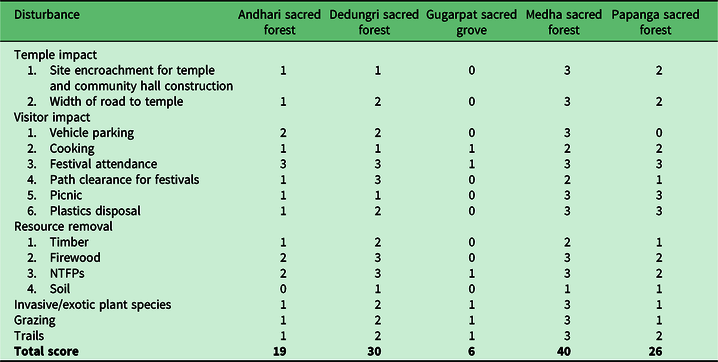
Each of the study sites differs in ownership and pressures, leading to different levels of disturbance (Table 2). Resources from the groves desired for use by local communities include timber, firewood and non-timber forest products (NTFPs). Groves can be an important source of NTFPs; however, there is also the potential for over-harvest of NTFPs. Soil and pebbles are taken from the groves on a limited scale for use in construction. Individuals sometimes graze their cattle and goats in the sacred forests, and trails are created through groves.
Disturbance levels in study sites (0 = no disturbance; 1 = low disturbance level; 2 = medium disturbance level; 3 = high disturbance level).

NTFP = non-timber forest product.
Andhari sacred forest is a protected reserve forest and is jointly managed by the Forest Department and the VSS committees of adjoining villages. There are 15 villages surrounding the Andhari sacred forest, and each village has formed an individual VSS to guard its forested area. There have been some issues in managing the sacred forest, such as conflict between villages or committees and a lack of timely incentives from the Forest Department, such as payments for tree plantations, providing logs for housing materials and limits on the extraction of NTFPs. Therefore, local residents created a committee in 1994 to try to resolve conflicts and to organize the annual festival. An annual forest conservation bike rally has been held in Andhari for 3 years to involve school students at the time of the festival.
Dedungri sacred forest is a village forest solely protected by the community. Tree felling is prohibited; however, villagers are allowed to use forest resources such as firewood and NTFPs. As the adjoining villagers are not Gond communities, and thus are not associated culturally with this site, the local Gond community restricts any outsiders from resource use, such as tree felling or any kind of disturbance. These restrictions for outsiders have led to conflicts between community residents and others regarding resource use by local people as well as people from the adjoining villages. There is no support from the Forest Department to manage this forest; the people of the community do not receive any kind of external incentives for forest protection. This weakens local efforts and interests in protecting the biodiversity within the sacred forest.
Extraction of forest products is restricted at Gugarpat sacred grove, except for the use of latex from Shorea robusta for rituals, an example of a cultural ecosystem service. However, there is no restriction on grazing in the field surrounding the grove. Entry to the grove for common people is completely restricted. Community residents can enter only during festival time, and outsiders cannot participate in the festival. This strong belief system helps this site to maintain a low level of disturbance.
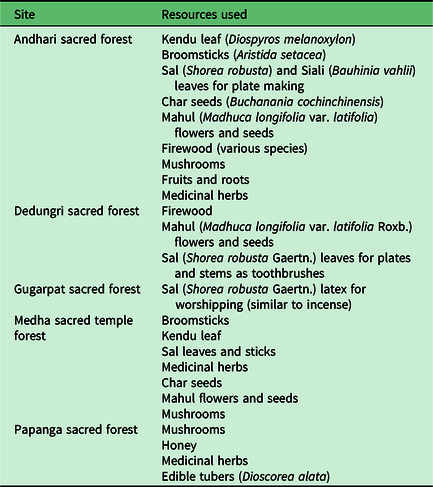
Tree felling in the Medha sacred temple forest is completely restricted by the temple committee; however, limited extraction of some resources has been allowed (Table 3). There is a high demand for firewood supply during the festival time, when thousands of pilgrims come to this forest.
Non-timber forest resources used from the study sites.

Papanga sacred forest is a reserve forest jointly managed by the local VSS and the Forest Department. The VSS of Papanga conserves a limited area surrounding the temple, where resource extraction is completely prohibited. Based on discussions at study sites, most local VSS members expressed that they do not get enough support from the Forest Department. The government is only providing support to develop tourism, rather than forest protection. This can provide local residents with additional alternative income, but may lead to forest impacts from visitors’ activities. According to interviewees in Papanga and Dedungri, Forest Department guards have been unable to check illegal activities in the area. One cause of disturbance is intra-village conflicts over use of forest resources, including firewood, timber and NTFPs.
Discussion
In western Odisha, we documented types of sacred groves, numerous community activities associated with groves and resources used, as well as ecological disturbance levels. Although sacred groves may contain valuable timber and NTFPs, we observed that community traditions and management approaches are maintaining the conservation of these sacred natural sites. The mixed-methods approach used in this study can be applied to biocultural research globally. Gavin et al. (Reference Gavin, McCarter, Mead, Berkes, Stepp, Peterson and Tang2015) provide guidelines for biocultural approaches to conservation, including acknowledging various stakeholders, knowing the socio-ecological context and prioritizing partnerships and relationship building. Two studies in different states of India encouraged ecological restoration efforts at sacred groves and the revitalization of cultural traditions associated with the groves – Parthasarathy et al. (Reference Parthasarathy, Selwyn and Udayakumar2008) in Tamil Nadu and Ormsby and Ismail (Reference Ormsby and Ismail2015) in Karnataka.
Historically, forest management in India by the government has not involved local communities; during the 1990s, joint community–government forest management policies were encouraged, and the 2006 Forest Rights Act provided a chance for scheduled tribes and other traditional forest-dependent communities to regain land previously taken by the government (Ormsby Reference Ormsby2011). Community residents near some sacred forests in our study (such as Andhari and Papanga) expressed concern that there is limited help (non-governmental or governmental) with the conservation of these sites. Community participation could be supplemented by government help if the communities desire assistance and support. For example, the VSS committees generally said that they need more support and help from the Forest Department in order to further biodiversity conservation. According to Mcleod and Palmer (Reference Mcleod and Palmer2015), effective partnerships between religious and conservation groups can result in significant help for biodiversity conservation, when a clear, specific challenge is identified and with shared vision and respect between groups.
Based on observation and interviews, most of the sacred sites we studied have become sanskritized (replacing local deities such as Gram pati, Gugarpat or Ayappa with Hindu deities), with construction of temples or concrete structures in the groves. This has particularly affected the sacred forests of Medha, Andhari and Papanga, and it demonstrates a shift from nature-centric to temple-centric worship, as in the sacred groves and temple forests of the state of Karnataka (Ormsby & Ismail Reference Ormsby and Ismail2015). This often results in temples being built within forests and the focus shifting towards the temple and away from the grove as a way of showing more respect for the god by improving the temple and building a home for the god (Bhagwat & Rutte Reference Bhagwat and Rutte2006). In some of the sites, Hindu worship is happening in one sacred space, while the tribal animistic worship is happening in a separate sacred grove in the same general area and community. Thus, in Andhari, the annual festival was mainly performed by Hindu Brahmin priests (who worship Durga), while a week before, the tribal priest started the annual function by worshiping the forest deity using tribal rituals, including sacrifice of a goat. In Papanga, along with the annual festival of tribals, there is also a temple in the forest and idols are worshiped by a Brahmin priest. Furthermore, in Medha, along with the temple of Lord Shiva, several other Hindu temples were established in the 1990s, which are run by Brahmin priests.
Some sacred natural sites are also pilgrimage sites (Digance Reference Digance2003, Kang Reference Kang2009). Conflicts often arise over access and usage of the sites between local communities, site managers and pilgrims (Digance Reference Digance2003, Kang Reference Kang2009). In western Odisha, some sacred landscapes act as pilgrimage sites that attract pilgrims during a particular period of the year to celebrate the grove deity. The pilgrims are both tribal and Hindu, and both locals and visitors from other areas of Odisha. In sacred forests such as Andhari, Papanga, Medha and Dedungri, where the worship focus is the idol, the sacred forest itself may or may not be worshipped; pilgrims have complete access to the site to experience its divine power through festival activities, including picnics and making offerings. But in the strict traditional sacred groves such as Gugarpat, local residents are forbidden to enter even for prayers and worship.
Sites allowing general access have greater potential for environmental impact as compared to the traditional sacred groves where only the local community can take part in rituals and worship. The pilgrimage events in temple sacred forests are revenue generators that can support religious facilities and activities. In sacred forests where annual festivals occur, these also represent chances to earn extra income from tourists or pilgrims. In our study, we recorded festival visitor impact to include vehicle parking, firewood for cooking, path clearing and plastics disposal (Table 2). Other studies have reported the negative impacts of a large influx of pilgrims and tourists on the integrity of the sacred groves (Malhotra et al. Reference Malhotra, Gokhale, Chatterjee and Srivastava2007) and on the regeneration potential of the forest (Pala et al. Reference Pala, Negi, Gokhale and Todaria2013b).
Pilgrimage tourism has a potentially substantial role in impacting biodiversity, mainly during the annual festival when the volume of visitors can increase by thousands. Typical pilgrimage visitor impacts include collecting firewood and even cutting down trees for firewood used for cooking food for picnics, improper solid waste disposal (e.g., plastics from water bottles) and vegetation trampling. Land clearance for vendor stalls and parking areas and the paths created for the journey affect the forest. These pilgrimage events mainly affect the sites’ biodiversity, which is tangible heritage, not the cultural or religious practices, which are the intangible heritage of the site.
Andhari is one sacred natural site that we studied where the annual pilgrimage also raises environmental awareness through holding conservation-related programmes. These activities, including guest lectures and theatre performances, represent collaborations of the VSS and Forest Department. Such activities were not observed in the other study sites. These types of collaborative activities should be encouraged in order to support biodiversity conservation.
Our study was limited in scope; more inventories of sacred natural sites are needed in order to fully understand associated beliefs, management and biodiversity. A full inventory of all 2000 sacred sites in Odisha (Sahoo Reference Sahoo2015) has not been conducted. Our study suggests that local community participation helps in maintaining site biodiversity conservation, specifically through the efforts of the VSS forest conservation committees. Traditional sacred groves were smaller than sacred forests and had fewer disturbances because of strong religious beliefs. Larger sacred sites are more difficult to monitor, and community participation is not always completely effective in site management. Thus, support from external agencies such as the Forest Department and/or environmental organizations could potentially be helpful.
The sacred forests of western Odisha represent a form of biocultural conservation that can contribute to global forest conservation. Annual functions at sacred sites may provide a platform for raising awareness regarding nature conservation through community education activities associated with festivals. More research on the ecological value and the socio-cultural mechanisms of sacred groves is needed in order to fully understand and realize their potential for biodiversity conservation.
Acknowledgements
We thank the late Professor SP Mishra and Professor Niranjan Behera for guidance, B Forys for map assistance and numerous anonymous reviewers for helpful comments.
Financial support
The authors recognize the Ministry of Environment and Forest, Government of India (MoEF, Govt. of India – vide grant no. 22/19/2011-(SG)/RE, dated 28 March 2012) for providing financial assistance to carry out this work.
Conflict of interest
None.
Ethical standards
The authors assert that all procedures contributing to this work comply with applicable ethical standards of the relevant national and institutional committees on human experimentation and with the Helsinki Declaration of 1975, as revised in 2008. Interviews were conducted in the local language and verbal consent was given by all participants. Support of community leaders was also sought and received.
Supplementary material
To view supplementary material for this article, please visit https://doi.org/10.1017/S0376892920000181