Introduction
In many ancient cultures, such as Greece, Rome, and Egypt, gold was highly prized due to its incorruptible nature, and gold objects were regarded as symbols of high status (Bunker Reference Bunker1993, 27; Clark Reference Clark1986, 50–57). In China, by contrast, there was a cultural tradition of valuing jade as a high-status material for its durability, translucence and tactility throughout all periods of history (Liji, 63.1669–72; Lin Reference Lin2009, 7–8; Rawson Reference Rawson1995, 13; Wu Reference Wu and Scott1997, 147).Footnote 1 Unlike other cultures, gold was incorporated into China and mortuary practice as a new fashion originating from regions to the west (Bunker Reference Bunker1993, 27; Liu Reference Liu2020; Rawson Reference Rawson1995, 60). The trend for gold as an exotic, foreign material can be traced back to at least the eighth century bce (Qi Reference Qi2006, 71–2; Rawson Reference Rawson2017, 378 & 381). During this period, the competing feudal states of the Zhou dynasty had contact with mobile herders to the west and north, who used gold as a symbol of prestige and power. These interactions stimulated an increasing interest in gold in China (Rawson & Bunker Reference Rawson and Bunker1990, 293–5).
This article explores the unprecedented manner of using gold in burial assemblages of the elite in the Han dynasty, such as the gold thread to make the Han-period-specific jade suits and depositing gilded or gold objects decorated with motifs of both local and western origins. It argues that gold objects became an integral part of the burial system in the mainstream culture of China for the first time, i.e. they were included in a system of varied decorations, motifs and materials that developed in the Han period as a means to convey good wishes and engender favourable outcomes such as well-being in the afterlife and immortality.Footnote 2 This is informed by the beliefs and symbolism behind the burial practices, and the broader ideological and social context in early imperial China. Local adaptation of foreign techniques is examined to demonstrate how materials from one place may not be entirely adopted when they arrive in another, but are adapted and certain aspects transplanted. These processes are illuminated using theories of agency and materiality, which emphasize the mutually informative relationship between materials, technologies and styles, as well as broader contextual trends in art, society and history.
The meaning of ‘gold’ is firstly defined by reference to relevant textual materials. In the Han period, the numbers of written sources that refer to gold and the amount of gold recorded rise hugely, though some should be treated with caution as regards their reliability.Footnote 3 Secondly, the western origin of the tradition of gold use is traced. Important sites in north, west and south China dating to around the eighth century bce onwards are mentioned specifically, because they represent distinct regional styles of use and design, which laid the foundation for goldwork in the following period.
There are multiple related researches including general studies on gold in early China (Bunker Reference Bunker1993; Lin Reference Lin2006; Qi Reference Qi2006; Rawson & Bunker Reference Rawson and Bunker1990), specific studies on goldwork techniques and their influence on other materials, like jade (He Reference He2008; Liu Reference Liu2017; Reference Liu2020; Qi Reference Qi1999; Reference Qi2006; Rawson Reference Rawson1995, 60–74), and more on gold in later dynastic China.Footnote 4 Nevertheless, the transition to new shared practices in gold use in the Han period has, to date, not been sufficiently studied in relation to other burial practices, such as its use in the jade suits, nor to the overall historical and ideological background. This article thus examines the finds mainly from royal tombs of the Han period where a large number of gold objects have been discovered, which provides a realistic range of sources to be studied for the major changes in gold use and reasons behind them.Footnote 5
Definition
In modern English, ‘gold’ refers to a yellow precious metal resistant to tarnishing and corrosion, relatively malleable and ductile, and is used in finance, as well as to make jewellery and ornament (Oxford English Dictionary 2017). This definition indicates the key qualities of gold that probably made it appealing to early people, namely that it is incorruptible and relatively easy to work.
The Chinese character for gold used today is jin 金, but it was originally used to denote ‘metal’ in general (Bunker Reference Bunker1993, 28). Inscriptions on Shang dynasty (1600–1046 bce) oracle bones and Western Zhou (1046–771 bce) bronzes represent the earliest forms of writing in ancient China, and jin is mostly used to refer to bronze or copper (Fig. 1) (Li Reference Li1985, 330–6; Qi Reference Qi1999, 68). It was not until the Eastern Zhou period (770–256 bce) that gold was differentiated from copper, evident in Guanzi 管子,Footnote 6 ‘under [the mountain] there is gold … under [the mountain] there is copper’.Footnote 7 Later, the third-century bce dictionary Erya 爾雅 refers to gold as ‘yellow metal’ (huang jin 黃金), while silver is defined as ‘white metal’ (bai jin 白金).Footnote 8
The character for gold (jin 金) in early forms of Chinese writing. (1) Oracle bones, Shang dynasty; (2–4) Bronze inscriptions, Western Zhou dynasty. (Reprinted from Qi Reference Qi1999, 68, with permission.)

That the concept of gold was specified in the Eastern Zhou reflects that more specific attention was being paid to gold, and more discussion is conducted in the following section on relevant archaeological excavation dating to the period. Later, the Han dynasty witnessed an unprecedented abundance of texts on gold, including mining and goldwork techniques, and gold used for trade, imperial benediction and stockpiles.Footnote 9 The overall amount of gold mentioned in Western Han (206 bce–ce 9) records totals around 2,000,000 jin 斤 (445,201 kg).Footnote 10 Such numbers attest to exploitation of the many natural gold sources, often allied with silver, within China. Although these texts may not provide a complete picture of gold circulation during early imperial China, and archaeological evidence suggests that it does not, it was likely that gold became an important part of life and afterlife for the imperial family and others of high rank in society.Footnote 11
Historical background
Gold from outsiders: the Shang and Western Zhou dynasties
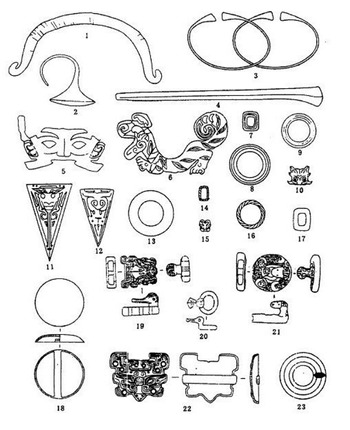
Over the third to first millennia bce the societies of central China were constantly influenced by the metallurgical traditions of mobile pastoralists from across the steppe (Anthony Reference Anthony2007, 371–457; Di Cosmo Reference Di Cosmo2002, 56–87; Frachetti Reference Frachetti2012; Rawson Reference Rawson2017). Trade and contact between the dynasties and these groups have been acknowledged (Bunker Reference Bunker1993; Keightley Reference Keightley2012, 174–93; Li Reference Li2006, 141–92). Since these groups on the borders were also in contact with Eurasian Steppe people, the dynasties were introduced to objects and technologies through them, including chariots for warfare, metallurgy and gold foil.Footnote 12 The earliest archaeologically attested production and use of gold within modern China borders––but outside the territory of the central Chinese dynasties––can be dated to the late second millennium bce (Gong Reference Gong1997, 353–60): (1) gold jewellery and ornaments of Siberian styles in the Hebei–Liaoning region (c. 2000–1500 bce) in the northeast (Bunker Reference Bunker1993, 30–31; Renn Reference Renn2012, 112–16); (2) gold ornaments of southern Siberian style in Shanxi and Gansu provinces (c. 1600–1046 bce) in the northwest (Lin Reference Lin and Zhang1986, 241–8; Wong Reference Wong2019, 84–123); (3) gold human masks with hollow eyes and raised noses from pits at the peculiar site of Sanxingdui 三星堆 (c. 1200 bce) in Sichuan Province in the southwest (Sage Reference Sage1992; Zhao Reference Zhao2004) (Figs 2 & 3).
Gold objects dated to the Shang and Zhou dynasties. Shang dynasty: (1) ornament, Shanxi Province; (2–4) ornaments, Beijing; (5) and (6) human-head and tiger ornaments, Sichuan Province. Western Zhou dynasty: (7–11) belt ornaments, Henan Province; (12–17) belt ornaments, Shanxi Province. Eastern Zhou dynasty: (18–23) objects, Shaanxi Province. (Reprinted from Qi Reference Qi1999, 70, with permission.)

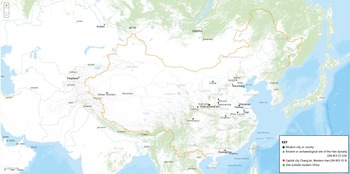
Some major sites in the pre-Han and Han dynasties in and outside modern China. (Drawing: Shengyu Wang.)

In the Western Zhou, most examples of gold have been excavated from parts of Zhou territory formerly under Shang rule and in peripheral areas (Huang Reference Huang1996, 143–4). These areas extend northwest into the Ordos and Liaoning and south into Sichuan, where pastoralists were prevalent (Bunker Reference Bunker1993, 27). Gold was widely used among such groups as decoration on weapons and utensils and adornments for people and horses, which reflect contacts with south Siberia and the Central Asian steppes (Honeychurch Reference Honeychurch2015, 157–8; Zhu Reference Zhu1984, 14). Gold was the main object to display status, and was made into artefacts for the dead (Li Reference Li2011, 19 & 27; So et al. Reference So, Bunker and Sackler Gallery1995, 62), practices that are not evident in the Shang and Zhou, where bronze and jade were most heavily used.
Intensified contacts: gold in the Eastern Zhou dynasty
The Eastern Zhou dynasty was a time when goldwork developed quickly. The former constituent states of the Western Zhou were no longer united by a central authority, and the competition between them and cultural contacts with outside groups resulted in various types of gold objects or items decorated with gold.
The pre-dynastic Qin 秦 State (770–221 bce), located around the earlier Zhou heartland in Shaanxi, eastern Gansu and southern Ningxia provinces, partially laid the foundation for the increase in gold use after its unification of the Warring States (Warring States period of the Eastern Zhou, c. 480–221 bce) in 221 bce. Extensive discoveries of openwork, zoomorphic designs, buckles and belt hooks show strong similarities to examples in Scytho-Siberian groups in southern Siberia (Wong Reference Wong2019, 82–3). Cast gold, a technique similar to granulation, was found,Footnote 13 of which the earliest examples were discovered in Guo 虢 State (c. 1000–655 bce), at Sanmenxia 三門峽 in Henan Province.Footnote 14 The earliest metal belt ornaments on the Central Plain were also found there, a fashion traced back to the second millennium bce in Western Asia (Moorey Reference Moorey1967).
Gold was used as currency in the form of coins and bronze shell money (bei 貝) covered with gold (Huang Reference Huang1996, 145; Li Reference Li2017). Key sources of gold have been discovered in another powerful state, Chu 楚 (1030–223 bce), in southern China, where the largest amount of gold for currency was used by then.Footnote 15 This, together with gold vessels, bronzes enhanced with gold inlay, and traces of incense—prevalent in Central and Western Asia—discovered such as in the tomb of the Marquis Yi 乙 (c. 475–433 bce) of a smaller allied state of Chu, Zeng 曾 (c. early Western Zhou–mid Warring States period) in Suizhou 隨州, Hubei Province, indicates the contact with groups to the north and west (Hubei Provincial Museum 1989, vol. 1, 245–51; Rawson Reference Rawson2006, 75).
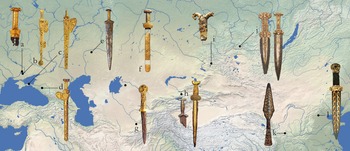
The earliest metallurgical technologies for working gold also developed at the time (Lawton Reference Lawton1982, 21; Li Reference Li1985, 167 & 357–8; Liu Reference Liu2020). In Shanxi Province, moulds for gold sword handles with Central or Western Asian-style motifs were found in the Houma 侯馬 Foundries of the Jin 晋 State (1033–349 bce), which served as a market that extended to Qin territory and sites over northern China, another centre for metalworking.Footnote 16 Influence from Arzhan (c. ninth–sixth centuries bce) in the Tuva Republic and the Minusinsk Basin, etc., can be detected there (Chen & Wang Reference Chen and Wang2012, 29–31) and later in the Western Han, represented by the decorated gold dagger from a royal tomb at Mancheng 滿城, Hebei Province (Fig. 4) (Rawson Reference Rawson2017, 383).
Decorated gold daggers from Mancheng in Hebei Province, China, the steppe, and Central Asia: (a) Chertomlyk (late fourth century bce); (b) Solokha (early fourth century bce); (c) Kul’-Oba (fourth century bce); (d) Kelermes (mid–late seventh century bce); (e) Filippovka (fifth–fourth centuries bce); (f) Tagisken (sixth–fifth centuries bce); (g) Tiliya Tepe (first century bce–ce first century); (h) Issyk (fourth–third centuries bce); (i) Berel’ (fourth–third centuries bce); (j) Arzhan II (sixth–fifth centuries bce); (k) Majiayuan (fourth–third centuries bce); (l) Mancheng (second century bce). (Drawing: Jessica Rawson and Peter Hommel, with permission.)

The outline shows contact between Eastern Zhou states and pastoralists to their north and west, as well as peoples further west in Central Asia and north in the Altai Mountains and southern Siberia. Intensified contacts with outsiders and improved techniques led exotic gold items to become highly prized in the Han Empire. With unity achieved, a window of opportunity was further created for the exotic material and new artefacts to be used to retain a long-standing social order, ideological tradition, and burial and ritual culture.
New uses of gold in the Han dynasty
The use of objects, motifs and metalworking techniques from distant regions and cultures has been a common way for society's upper echelons to express social and military power across history (Helms Reference Helms1988; Liu Reference Liu2017, 1589), for such rarities demonstrate financial ability and privilege to have access to exotic objects, or power granted by the sovereign and the court to be in contact with other peoples. In the Han Empire, there was an unprecedented increase in the use of gold and related foreign designs (Qi Reference Qi1999, 79). The foundation of the Empire and its expansion into Central Asia probably prompted the influx of foreign goldwork (Liu Reference Liu2013, 81–6). This section examines some of the typical new uses of gold by then, mainly the gold thread used to sew the jade plaques of jade suits and the gold ornamental pieces and gilded objects composed of local and foreign motifs and techniques. The number, quality and types of luxury goldwork increased compared to the pre-Han period.Footnote 17 This article proposes that such frequency of gold use and the new types indicate that gold was not merely a status symbol. More specifically, during this period, gold––like jade––became a symbol of intangible immortality and well-being within the Chinese belief system as reflected in the burial context, which was developed in accordance with the ideology and the political situation.
Gold thread in jade suits
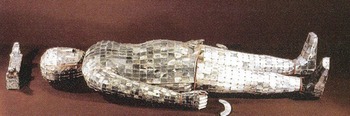
The most extraordinary artefacts that were specific to China, and also to the Han period, are the jade suits, usually composed of thousands of plaques in various shapes to encase the deceased (Fig. 5) (Gu Reference Gu1996, 137; Liu Reference Liu2011). Nearly 20 complete or fragmentary suits were sewn with gold or gilded thread (full list in Liu Reference Liu2011, 39–40; Wang Reference Wang2008, 8–14). Emma Bunker proposed (1993, 46) that the merging of the two incorruptible materials, jade and gold, perhaps served to preserve the physical body of the deceased. She is one of very few scholars who have paid attention to the gold used in the jade suits, but has not developed this idea further. This article examines the gold thread in more detail and explores the questions of why gold or gilded thread was used in the suits, and in what sense the use of this material with an exotic association became included in the burial and cosmological system of the Han period.
The jade suit from the tomb of Liu Sheng, Mancheng. (Reprinted from Hebei 1980, vol. 2, colour pls. 19 & 20, with permission.)

One of the best-preserved jade suits belongs to Liu Sheng 劉勝 (d. 113 bce), King Jing 靖 of Zhongshan 中山, which was excavated from Mancheng, Hebei (Fig. 3). The gold threads sewing jade plaques measured 4–5 cm long each, and the thicknesses varied from 0.08 to 0.5 mm (Fig. 5) (Hebei 1980, vol. 1, 98 & 354–6). The manufacturing method for the thread was to cut gold sheet (0.1–0.2 mm thick) into strips (1–2 mm wide); some of the strips were then twisted into wires (Hebei 1980, vol. 1, 389). Such techniques of gold or silver wire can be traced to the filigree technique of Mesopotamia and Egypt around 2700 bce, which appears in Asia from around 2000 bce (Liu Reference Liu2017, 1594; Ogden Reference Ogden1982, 11–15). The earliest example found in China dates to the fourth century bce in Hebei Province (Qiao Reference Qiao2004; Xi'an Northwest University 2016, 15–31), though the tomb of Marquis Yi of Zeng contained 426 springs shaped from gold wire, the exact function of which is still unclear (Hubei Provincial Museum 1989, vol. 1, 451). The overall lack of technical precedents for gold wire prior to the fourth century bce suggests that the technique was introduced to the former Zhou states by outsiders, though manufacture in the Han period became highly technical and delicate.
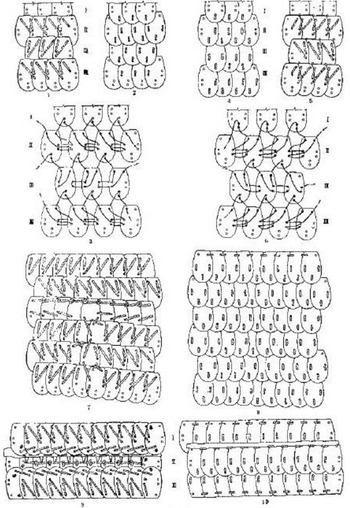
There were overall four ways of sewing and knotting the thread for plaques of different shapes in different parts of the suit (Fig. 6) (Hebei 1980, vol. 1, 355). As has been proposed by some scholars, the jade suits are likely to have imitated iron armour for protecting the body (Lin Reference Lin2003; Lu Reference Lu1989, 65). The plaques were made in the shape of squares, rectangles, triangles and half-moons, etc., to avoid gaps or spaces, which shows that the deceased's whole body was supposed to be enclosed.Footnote 18 It can therefore be assumed that all jade plaques were intended to be tied to one another firmly, similar to the iron plaques of armour tied with rough linen rope (Fig. 7).Footnote 19
Different knots used for the gold thread on the jade suit of Liu Sheng. (1–2) cross; (3–6) hitch; (7) circuit; (8) & (9) wrapped knots. (Reprinted from Hebei 1980, vol. 1, 356, fig. 233, with permission.)

Different ways of securing the plaques on the iron armour from the tomb of Liu Sheng. (Reprinted from Hebei 1980, vol. 1, 361, fig. 235, with permission.)

Not all jade suits discovered to date, however, were sewn with gold thread. Silver, (gilded) bronze and silk thread were also used. Silver, together with gold, is mentioned as having been used for constructing palaces for the immortals in the Records of the Grand Historian (Shiji, 28.383). The Book of the Later Han, on the other hand, dictated regulations of burial practice in the Western Han:
When an emperor died, … jade was used to make clothes in the shape of armour, the jade was sewn together with gold as the thread … [to make] a [jade] suit … when feudal vassals, nobles, newly appointed consorts, and princesses died, … jade suits with silver thread [were made]; sister-princesses and grand consorts [used] bronze thread.Footnote 20
It is noteworthy that this text on Western Han practice was written in the Eastern Han, and no related Western Han records have been found, nor have imperial tombs been excavated to confirm this description. Among the Western Han suits from royal tombs that were discovered with thread still preserved, more than half used gold or gilded thread (Liu Reference Liu2011, 40–41; Wang Reference Wang2008, 8–14). Those which used silver, bronze or silk were mostly for women, noblemen, unidentified occupants, or produced in early Western Han, and far predate the above description of regulations (Hou hanshu, 3152–6; Lu Reference Lu1989, 65; Wang Reference Wang2017). The Book of the Later Han records that the corpses in jade suits in the imperial tombs were ‘all like living people’ (Hou hanshu, 41.487–90). This seems to describe an ideal state of body preservation as opposed to the actual, as no human body has yet been found preserved completely in the suits. However, the written records indicate that the preservation of a physical body was engendered and desired. Additionally, the suits are also called ‘jade case’ (yuxia 玉匣) in historical sources (Hou hanshu, 41; Shi Reference Shi1972, 48; Sun Reference Sun2014, 253–4), which suggests that the design to contain and preserve the body may have been important. To understand such burial practice further, and whether the selection of gold was merely due to its tarnish-resistant feature and representation of prestige without other symbolism or mechanism of agency in the realm of burial ritual and ideology, views towards death, afterlife and the idea of immortality (xian 仙) must be examined.
The concept of immortality
In the Zhou dynasty, prayers for blessings to the ancestors or Heaven were inscribed on bronze vessels in Central China, and shou 壽 was by far the most popular character used, meaning longevity, i.e. prolonging human life (Creel Reference Creel1937, 333; Kern Reference Kern, Lagerwey and Kalinowski2008). After the eighth century bce, however, the specific idea of immortality began to appear, as reflected in inscriptions that refer to ‘no death’ (wusi 毋死) and ‘impeding old age’ (nanlao 難老) (Yü Reference Yü1964–65, 87). Scholars’ opinions vary as to where the idea of physical immortality originated, but one thing has been widely acknowledged: the concept denoted the process of leaving this world to become immortal in the afterlife, as opposed to living forever in the human world.Footnote 21
The search for immortality and a drug to prevent death reached its peak in the reigns of the first emperor Qin Shi Huang 秦始皇 (r. 221–210 bce) and the Han emperor Wudi 武帝. Textually, the idea of ‘no death’ developed into an imagined, faraway ‘no death land’ (busi guo 不死國), where the ‘no death people’ (busi min 不死民) lived (Shanhaijing, 6.145–53, 14.204–12 & 15.213–20; Shiji, 28.983, 989–90 & 992). After the unification, numerous ‘immortalists’ or ‘necromancers’ (fangshi 方士) convinced Qin Shi Huang that immortality could be realised by taking ‘drugs of no death’ (busi zhi yao 不死之藥) under certain circumstances (Shiji, 6.129–31). In the Western Han, immortalists from the coastal region of Qi 齊, a large part of what is now Shandong Province, flocked to the court in Chang'an 長安 to offer the emperor their services in seeking the drugs at sea (Shiji, 12.288; Watson Reference Watson1971, vol. 2, 25–6) (Fig. 3). One of the most famous of these was Li Shaojun 李少君 (fl. c. second century bce), who told Wudi that the legendary Yellow Emperor had achieved the state of no death after meeting immortals on the isle of Penglai 蓬萊 off Shandong and performing the sacrifice to Heaven (feng 封) and Earth (shan 禅) (Shiji, 28.996–7 & 1002; Watson Reference Watson1971, vol. 2, 3–52):
Offering sacrifices to the stove [god] allows one to transform cinnabar into gold. Making the gold into vessels for drinking and eating then increases the length of one's life. With long life, one can meet the immortals of Penglai. On seeing them, one makes the Feng and Shan sacrifices to achieve deathlessness, just as the Yellow Emperor did.Footnote 22
Furthermore, another relationship existed between the resurgence in interest in immortality in Wudi's reign and the contemporary political situation. A more comprehensive, or ‘greedier’, concept of immortality flourished to denote both worldly and otherworldly eternal life. As a result of Zhang Qian's 張騫 (164–113 bce) expedition in the late second century bce to the western regions, geographical knowledge of the lands west of the Han Empire increased and, as the imperial quest for immortality grew larger in scope, more attentions were directed westward (Yü Reference Yü1964–65, 97–8). Wudi expressed his desire to ascend Kunlun 昆侖 Mountain in the west to meet the immortals.Footnote 23 The opening-up of the west to Han trade may have occurred partially because Wudi coveted Ferghana horses that could run fast over long distances, from what is today Uzbekistan, believing that these so-called ‘heavenly horses’ (tian ma 天馬) acted as media of communication between the human world and the immortals (Liu Reference Liu2020) and possessing them would finally bring immortality (Rawson Reference Rawson1999, 19). The search for immortality in the imperial court probably impacted high officials and even the common people, as such quests began to be a recurring theme in tomb ornaments such as the hoof-shaped gold miniature symbols of heavenly horses (Liu Reference Liu2020; Wei Reference Wei2017). These objects and the association of gold with immortality evident in texts including the use of gold food vessels and the performance of appropriate rituals (Hanshu, 25.1215–6; Liu Reference Liu2020, 190) help us to understand better the selection of the costly material for jade suits. Like the durable jade and its metaphorical function of bringing immortality (Rawson Reference Rawson1995; Sun Reference Sun2014, 243–63), the mechanism of agency of gold shifted from long-lasting anti-tarnishing physicality in this world to the realm of funerary ritual, to bestow immortality. Similarly, for gilt-bronze- or silver-threaded suits, besides arousing prestige within the framework of the regulation for people of different ranks, it was likely that the materiality of gold-like metals were responsive to and indicative of the will or expectation of the agents, i.e. the deceased, to generate a similar cosmic link to immortality. Furthermore, the quest for immortality was not merely otherworldly as described in pre-Han literature.Footnote 24 Rather, the transplantation of worldly pleasures, enjoyments and fashion, etc., were craved, as represented by the rise to Heaven of Liu An 劉安 (179–122 bce), Prince of Huainan, with his whole household, dogs, even cockerels (Shiji, 6.134 & 12.284), and also by other gold use in Han burials described in the discussion below.
Adapted zoomorphic motifs and the enriched afterlife
There was a dominant trend for adopting and adapting foreign motifs on foreign luxuries in the Han period. This section proposes that zoomorphic motifs, usually in three-dimensional renderings and represented dynamically in motion, were regarded as powerful and protective spiritual creatures that could concentrate power, benefits and exotica as fashion in the afterlife. Motifs of animals and mythical creatures, along with ways of combining them, were introduced from regions to the west of China and used on various objects and ornaments. Like jade and bronze, gold had increasing ritual and social importance, and therefore it can be considered a catalyst that engendered new forms of imagery and object types (Rawson Reference Rawson1995, 30). The visual and material-cultural variety were influenced and constructed by the social and ideological approach towards a better afterlife.
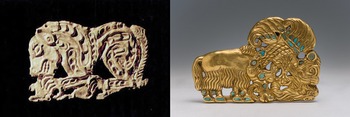
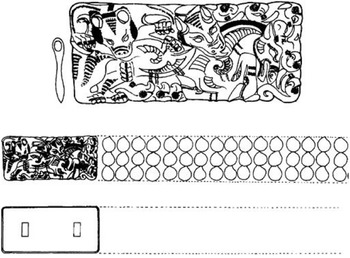
Real or imaginary animals depicted in conflict with each other or with humans appear during the Eastern Zhou. Mostly from north or western China, where the inhabitants had different identities to those in Central China, the zoomorphic motifs are acknowledged as having been taken from Western and Central Asian examples (Fig. 8) (see ‘Historical background’, above). In the Han dynasty, the overall number of such works uncovered from archaeological sites and recorded in texts increases exponentially (Hanshu, 3871–932; Li Reference Li and Lin2014, 87; Qi Reference Qi1999, 81–2; Yang Reference Yang2018). Zoomorphic motifs are seen in the forms of relief and openwork on belt and weapon fittings and numerous tiny ornaments in Han royal tombs. Representative examples are gold plaques from the tomb of the King of Chu at Shizishan 獅子山 (c. 154 bce) (Fig. 9), the King of Jiangdu 江都 at Xuyi 盱眙, Jiangsu Province (d. c. 128 bce), and the King of Zhongshan at Mancheng (Li Reference Li and Lin2014; Lin Reference Lin2012, 188–9 & 294–5; Shizishan 1998, 17 & 29). The plaques display creatures such as wolves or felines attacking other animals, a theme popular in southern Siberian metal ornament.Footnote 25 From Han rhapsodies (fu 賦) and historical records, it is known that these beasts, engrossingly, were associated with good omensFootnote 26––believed to herald the arrival of good fortune in political and historical context (Loewe Reference Loewe1994).Footnote 27 In the Han period, more of these motifs on plaques or belt ornaments were replaced with traditional local motifs, such as dragons and tortoises, the directional mythical creatures with cosmological significance (Liji, 3.81; Ni Reference Ni1999; Zou & Wei Reference Zou and Wei1998),Footnote 28 as demonstrated on plaques excavated from Tomb no. 9 at Dayunshan 大雲山 at Xuyi, and from the King of Nanyue 南越 (d. 122 bce) in Guangzhou 廣州, Guangdong Province (Fig. 10) (Guangzhou 1991, vol. 1, 65–6; Li Reference Li2012, 88–9; Liu Reference Liu2017, 1599). Cosmic motifs including cloud and constellations were intertwined with the localized creatures (Guo Reference Guo2020; Wu Reference Wu2010, 50–51 & 253). The unprecedented development and increase in gold use reflect the interactions between the Han Empire and their neighbours, mainly the Xiongnu (Rawson Reference Rawson and Lin2012, 35), as well as a cultural trend for adapting and including a variety of artefacts, materials and motifs into the ornament repertoire and the rising concern with good omens, which had an origin and historical background of studying the skies, celestial indications and correlating human affairs with invisible spirits, gods and Heaven since the Shang and Zhou (Graham Reference Graham1986; Lippiello Reference Lippiello2001; Rawson Reference Rawson2000). Not only did patterns, motifs and meanings change over time; so did the materials on which they were depicted. The growing fascination with gold influenced designs of jade and lacquer (Rawson Reference Rawson1995, 61). Materials thus serve as a contact point between people and the physical world for expressions of ideology and ideas actively to be created and abstract beliefs formed and even brought into being (Dobres & Robb Reference Dobres and Robb2000, 12; Rawson Reference Rawson2007).
(Left) One of a set of gold belt plaques with a combat scene between an ungulate and a feline from Liuping 劉坪, Gansu Province. Fourth–third centuries bce. (Reprinted from Li & Nan Reference Li and Nan2003, 11, with permission). (Right) Belt buckle with a combat scene between a yak, a tiger, and a raptor from south Siberia. Fifth–fourth centuries bce. Gold and turquoise. (Siberian collection of Peter I. Russia, Siberia. © The State Hermitage Museum, St Petersburg. Photograph: Vladimir Terebenin.)

A pair of gold belt plaques, each depicting a wolf and a bear attacking a horse-like animal. The tomb of the King of Chu, Shizishan. (Reprinted from Zou & Wei Reference Zou and Wei1998, 38–9, with permission.)

Gilded bronze belt plaque with the decoration of two tortoises and a dragon from the tomb of King of Nanyue. (Reprinted from Guangzhou 1991, vol. 1, 166, with permission.)

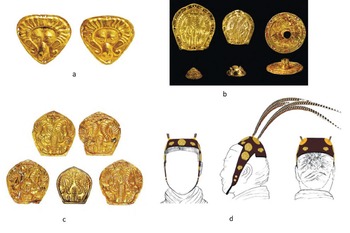
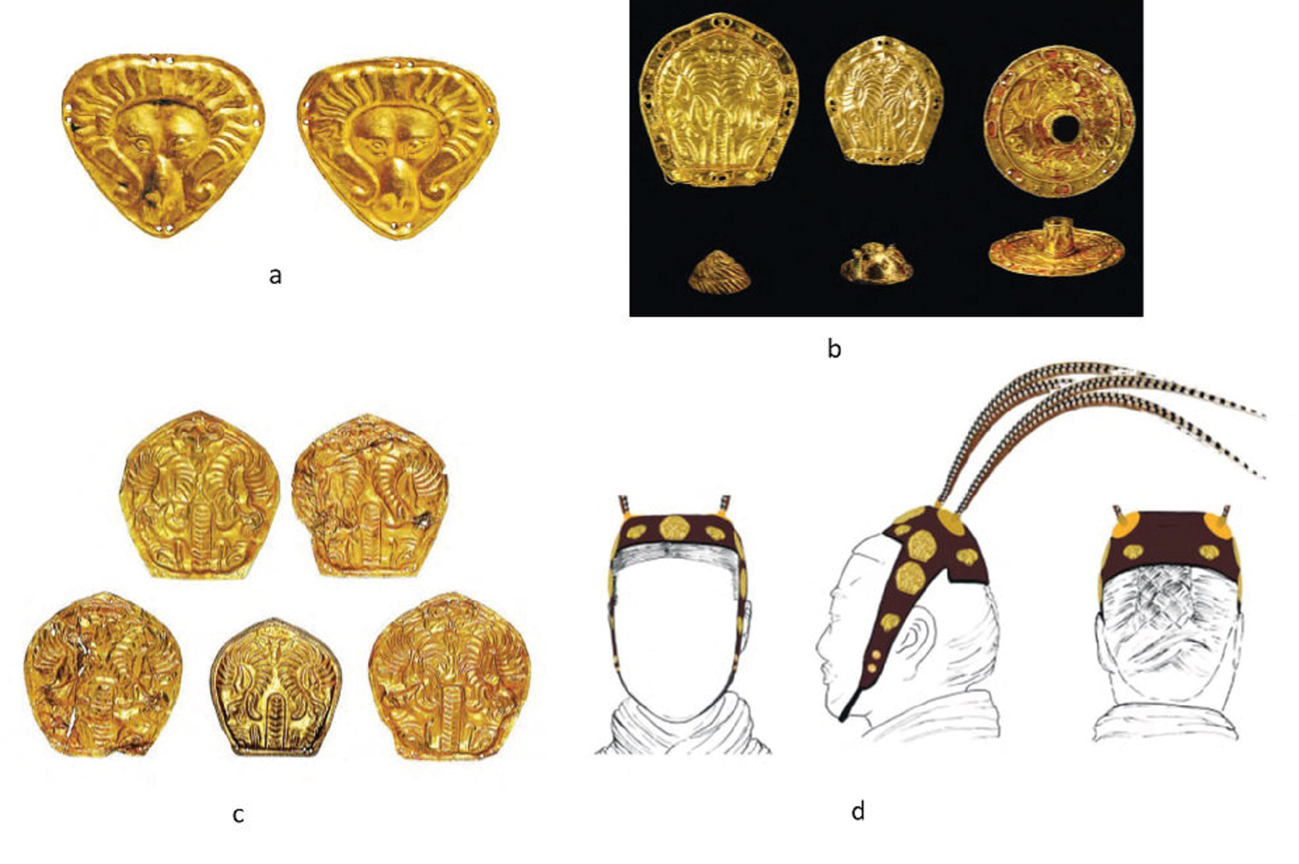
Tiny gold ornamental pieces are another common find. A few Warring States precedents clearly indicate their western origin (Zuo Reference Zuo2020), but their widespread use on Han fabrics provides an essentially new difference in the fashion for personal adornment, which also had ritual function on certain occasions (Liu Reference Liu2017, 1591 & 1597–8). Typical examples are from Shizishan, Mancheng and the tomb of Liu Fei 劉非 (169–127 bce), King Yi 易 of Jiangdu at Xuyi, including gold appliqué thin sheets embossed with confronting ram's heads; buttons decorated with filigree, granules and enamel; and roundels with tubular sockets (Fig. 11) (Liu Reference Liu2017, 1592). Besides exhibiting status, taste and wealth of the deceased, they were probably buried to continue the ornamental and ceremonial function in the afterlife. Added to this was the concept that gold was associated with immortality; therefore they guaranteed the intended well-being, ritual tradition and fashion in the funeral complex to be continued and eternal.Footnote 29 The fascination with gold as a material and the related motifs depicted grew, became adapted and enriched in burial practice as well as in the visualization and materialization of good expectations and ideological concepts of Han China.
(a) Gold ornaments with rams’ heads, Shizishan (Reprinted from Xuzhou Museum Reference Museum2011, 284); (b) appliqué, roundels and buttons, Dayunshan (Reprinted from Nanjing Museum 2013, 294–302); (c) appliqué, Mancheng (Reprinted from Zuo Reference Zuo2020, 60); (d) possible ways of wearing the gold ornaments in the Han period (Reprinted from Zuo Reference Zuo2020, 65). (All with permission.)
Conclusion
A Western Han folk song laments: ‘No one is made of gold or stone, [so] how can one escape death?’ (Birrell Reference Birrell1988, 75; Guo Reference Guo1979, 547; Wu Reference Wu2010, 138) Gold, according to contemporary beliefs, was everlasting. The Han dynasty witnessed increase and development in uses of gold not seen before, improved techniques in gold working and increased adaptation of foreign motifs. These developments were motivated by the need to display the power of the Han Empire and the pursuit of immortality both in this world and in the burial context. Gold was first used to enhance objects in the Shang and Zhou dynasties in the forms of foil and inlay, which, as acknowledged, was regarded mainly as another symbol of status and wealth. In early imperial China, however, emperors became interested in achieving immortality. Court-employed alchemists suggested that gold, with its incorruptible properties, could facilitate immortality if made into special medicines to be ingested, or vessels. By examining some royal tombs where gold objects have been found, it is proposed in this article that there were several significant new uses of gold in the Han period: gold or gilded thread used for jade suits; and ornamental pieces and objects with zoomorphic motifs from the west and of Chinese origins that may have had cosmological significance.
The Han-specific jade suits could only be afforded by society's highest ranks. Texts indicate that only in the Eastern Han did a more regulated system governing the use of jade suits appear, and gold thread was restricted to the imperial family. Before that, no evident regulations limited the manufacture or use of jade suits, and gold thread has been discovered in various royal tombs. It has been argued in previous scholarship that the suits were protective, like armour in life, and that bodily encasing was incredibly important. The durable jade and gold were symbolic of eternity, and the composite suits were believed to secure a firm layer around the body and thus a safe and immortal afterlife. These suits specifically made for burials had ritual and ideological significance in themselves; therefore it is unlikely that gold or gold-like materials were selected for the thread unconsciously, or only for showing status; otherwise the treasured bronze or silk could have been more heavily used to link the many jade plaques. The shift in burial practice, including the appearance of gold-threaded jade suits, was a reflection of social and ideological development that cannot be overlooked. The above-mentioned assumption, however, is based on current excavations, when no imperial tombs have been explored and many royal tombs looted.
Gold, from the very beginning of its known use in pre-Han tombs, was considered ornamental and imbued with exotic characteristics, as it was an influence from places west of the Central Plain and the Eurasian Steppe. In the Han dynasty, more western motifs were combined with local themes and ideas to form new designs. Exotic goldwork, such as buckles, was taken into the afterlife for continuous enjoyment; meanwhile as argued here, to channel the intentions and beliefs of the period, i.e. reinforce immortality and auspiciousness. Similar objects were not totally unavailable in pre-Han discoveries, but the unified Han Empire adopted a hugely increased number of exotic objects and used them by localizing related motifs to expand the repertoire of art and the expression of social beliefs. The depositions are examined in a more comprehensive and contextual manner in this article for a fuller understanding of the development in material culture and the overall course of history. An eternal, luxurious and trendy afterlife was evidently the aim, as suggested by the gold ornaments and other common finds decorated with gold (e.g. incense burners, vessels and medicinal objects: He Reference He2008), which due to space limitations are not discussed here.
Though initially a material popular among outside groups, gold was eventually adopted, transplanted, highly prized and integrated into the existing complex of motifs and objects, which collectively served to emphasize an immortal and happy afterlife in Han period China. By contrast with the preceding era, this period represents the first time that such a large number of foreign material, motifs and objects were included in the burial and ideological system in unified or centralized China. Focusing on the material agency of gold provides a markedly different perspective of changes in archaeology and history––by compounding materials, forms and technologies, tastes and styles, and the belief system that emphasized correlation and good outcomes, namely immortality, fashion and general well-being in an eternal afterlife, the rule of the mutual shaping of human beings and material culture is illustrated.
Acknowledgements
The author is indebted to Professor Dame Jessica Rawson, the editor and two anonymous reviewers for helpful comments.