Introduction
Demographic change leads to a rapid increase in the number and proportion of the elderly, resulting in an increase of prevalent and incident cases of age-associated illnesses, such as dementia (Fendrich and Hoffmann Reference Fendrich and Hoffmann2007; World Health Organization and Alzheimer's Disease International 2012). In European countries, dementia is associated with substantial and increasing healthcare costs, which makes dementia one of the most expensive diseases in old age and a serious healthcare priority (Wimo et al. Reference Wimo, Jonsson and Winblad2006; Reference Wimo, Jonsson, Bond, Prince and Winblad2013). In Germany, studies determined that the annual costs of dementia diseases range from € 8,851 ($ 11,992) up to € 29,492 ($ 39,958) from the perspective of statutory health insurance, including direct costs for medical treatments and formal healthcare services (Leicht et al., Reference Leicht2011; Schwarzkopf et al., Reference Schwarzkopf2011). However, costs varied widely, depending on methodological differences of cost of illness studies, such as differences in perspectives, data sources, cost categories included and approaches assumed for the cost calculations. Furthermore, studies were based on patients formally diagnosed with dementia (Leicht et al., Reference Leicht2011; Schwarzkopf et al., Reference Schwarzkopf2011) or on both cognitively impaired patients and patients with a formal dementia diagnosis (Handels et al., Reference Handels, Wolfs, Aalten, Verhey and Severens2013). However, it is well-known that dementia is under-diagnosed in many populations. Even in high income-countries, fifty to eighty percent of people with dementia (PWD) do not receive a formal dementia diagnosis (Boustani et al., Reference Boustani, Peterson, Hanson, Harris and Lohr2003; Connolly et al., Reference Connolly, Gaehl, Martin, Morris and Purandare2011; Prince et al., Reference Prince, Bryce and Ferri2011). Eichler et al. (Reference Eichler2014) showed that only 39% of German community-dwelling patients, who were screened for dementia in primary care, had received a formal dementia diagnosis. Thus, solely these patients were included in most cost-of-illness (COI) studies. Eisele et al. (Reference Eisele2010) showed increased healthcare utilization in the year before and after the first diagnosis of dementia, which means that healthcare utilization could differ between patients with and those without a dementia diagnosis. However, patients without a dementia diagnosis were not included in most COI studies, and thus far little is known about the differences in resource utilization and its costs between patients formally diagnosed with dementia and those without a formal diagnosis. Furthermore, due to the increasing prevalence of PWD in European countries and increasingly common discussions about earlier diagnosis of dementia diseases, it is important to know the cost differences triggered by a formal dementia diagnosis. Thus, the objectives of the present analyses were the following: (a) to determine healthcare resource utilization and (b) its costs of primary care patients screened positive for dementia with a formal diagnosis and those without a formal diagnosis of dementia, and (c) to analyze the association between having received a formal dementia diagnosis and dementia-related healthcare costs.
Methods
Study design and sample
The present study is a cross-sectional analysis of utilization patterns and healthcare costs of community-dwelling patients who screened positive for dementia in a primary care setting. Analyses are based on primary data of the on-going DelpHi-MV study (Dementia: life- and person-centered help in Mecklenburg-Western Pomerania), a general practitioner-based, cluster-randomized, controlled, intervention trial in the primary care setting. Eligible patients (70 years or older, living at home) were screened in general practitioner (GP) practices for dementia using DemTect (Calabrese and Kessler, Reference Calabrese and Kessler2000). The patients who met the inclusion criteria (DemTect < 9) were informed by their GPs about the study, invited to participate and asked to provide written informed consent (as approved by the Ethical Committee of the Chamber of Physicians of Mecklenburg-Western Pomerania, registry number BB 20/11). Baseline assessment was carried out by specific qualified dementia care managers (Dreier et al., Reference Dreier, Thyrian and Hoffmann2011; Thyrian et al., Reference Thyrian2012; Eichler et al., Reference Eichler2014).
Overall, for the baseline assessment of the study, 6,838 people were screened by 125 GPs, and 1,166 (17%) patients at 102 GPs were eligible for the study. A total of 634 (54.4%) agreed to participate, and 516 participants at 101 GPs started the baseline assessment. There were 99 participants excluded from the analyses because of missing data. The primary causes for missing data included dropout due to death (n = 19), withdrawal of informed consent (n = 85), relocation (n = 5), and other reasons (n = 9). A total of 496 participants completed the baseline assessment. In thirty-three patients, the psychometric instruments used in this analysis could not be utilized because of the patient's severe dementia. Furthermore, in thirty-four patients the utilization review was missing.
In this analysis, formally diagnosed patients were defined as patients, who had received a formal ICD‑diagnosis (F00-F03, G30-G31) of dementia by their treating GP or specialist (neurologist, psychiatrist) at least one year before carrying out the utilization review. For a clear differentiation between patients with and those without a formal dementia diagnosis, we excluded a further 189 patients who received a formal diagnosis for dementia after screening by the GP less than 12 months before carrying out the utilization review. Hence, the present analyses are based on the complete data of n = 240 study participants.
Assessment of resource utilization
At baseline assessment, a comprehensive standardized computer-assisted interview was conducted to assess the type and frequency of healthcare resource utilization for the last 12 months prior to the interview. The interview contained lists of possible common resources and services to minimize recall bias. For more precise information and to improve data quality, the participant's caregiver (if present) assisted in the interview and was asked to fill out a questionnaire to validate the patient's data. In case of missing data, other available proxies, such as nursing services, were used. The utilization review records detailed information about the participant's individual utilization of medical services, including out-patient physician treatment (GP, specialists), in-patient treatment (acute and planned in-hospital treatment and rehabilitation), pharmaceutical treatment, medical supplies, and other forms of out-patient services (e.g. physical therapy, occupational therapy, speech therapy, psychological intervention), as well as formal care services, including day care, and professional home care. This analysis focused on medical care services and formal care. Medical care services comprise outpatient physician treatment, in-patient treatment, pharmaceuticals, medical aids, and other outpatient treatments. Formal care includes professional home care and day care. Informal care given by patients’ informal caregivers was not included in this analysis.
Calculation of healthcare costs
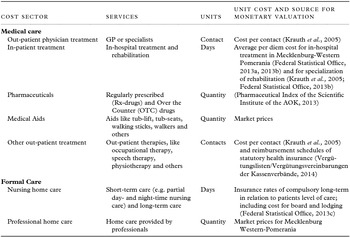
Costs of healthcare resource utilization were assessed from the perspective of statutory health insurance, solely including the direct costs covered either by health or nursing insurance. Indirect costs (lost productivity) were not included in this analysis due to participants’ age being above 70. Methods of cost calculation and applied unit costs are demonstrated in Table 1.
Methods for monetary valuation of healthcare resources and services
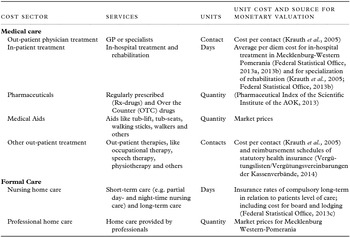
GP, general practitioner; AOK, allgemeine Ortskrankenkasse.
We analyzed total, medical and formal care costs. Furthermore, for an in-depth cost analysis we focused on dementia-specific evidence-based treatment (Deutsche Gesellschaft für Psychiatrie & Deutsche Gesellschaft für Neurologie (DGN) 2009): first, the dementia-specific medication treatment with anti-dementia drugs and second, the non-medication treatment for PWD, consisting of outpatient physician treatment (GP, neurologist and psychiatrist), other outpatient physician services, geriatric rehabilitation, and professional home care. Costs were calculated in euro (€) at 2014 price levels. In the case that a price was not available for the year 2014, it was inflated to the year 2014 by means of the individual inflation rate of recent years.
Socio-demographic and clinical variables
To analyze the associations between the presence of a formal diagnosis of dementia and healthcare resource utilization and its costs, the following socio-demographic and clinical covariables were included. Socio-demographic variables were age, sex, living situation (dichotomous: alone, not alone), cognitive impairment, comorbidity (number of medical ICD-10 diagnoses in the patient's medical record), activities of daily living (ADL), and depression. The severity of cognitive impairment was assessed by the Mini Mental Status Test (MMST) (Kessler et al., Reference Kessler, Markowitsch and Denzler1990), which is a psychometric testing procedure that measures patient's cognitive impairment. The Bayer Activities of Daily Living Scale (B-ADL) (Hindmarch et al., Reference Hindmarch, Lehfeld and Erzigkeit1998) was used to assess deficits in ADL, and the sum score of the Geriatric Depression Scale (GDS) (Gauggel and Birkner, Reference Gauggel and Birkner1999) was used to assess depression. Patient's medical diagnoses were retrieved from the patient's medical records with the permission of the patients and the treating GPs, as per ICD-10 (International Statistical Classification of Diseases and Related Health Problems) codes: F00, F01, F02, F03, G30, and G31.
Statistical analysis
We used descriptive statistics to analyze the medical and formal healthcare utilization and costs for patients with and without a formal diagnosis of dementia. Differences in means were evaluated using t-tests and differences in proportions were evaluated using Fisher´s exact test. To analyze associations between dementia diagnosis and healthcare costs, a multiple linear regression model was fitted. To minimize confounding due to socio-demographic or psychological factors, sex, age, living situation, ADL, comorbidity, cognitive impairment, and depression were included as covariates. To account for the dependency of data from multiple patients of the same GP, the GP entered the model as a random effect. Because of a highly skewed distribution of healthcare costs, standard errors and confidence intervals for regression coefficients were estimated by bootstrapping (2,000 replications) (Desgagne et al., Reference Desgagne, Castilloux, Angers and LeLorier1998). Statistical analyses were performed using the software STATA/IC (Stata Corporation) version 11.0.
Results
Socio-demographic characteristics and clinical variables
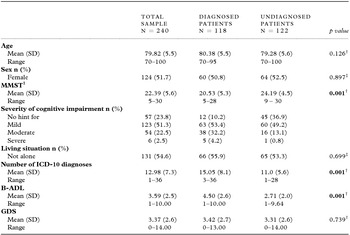
A total of 38.7% of all patients who completely finished the baseline assessment were diagnosed with dementia before the screening in the GP practices. Based on an analyzed sample of 240 including patients who screened positive for dementia, the excluded sample (n = 394) from this analysis was significantly more female (63.2% vs. 51.7%; p value = 0.005) and likely to live alone (55.7% vs. 45.4%, p = 0.021). Differences between the analyzed and excluded sample are represented in the Supplementary Table 1. After the exclusion of all patients who were formally diagnosed after screening, and patients who received a formal diagnosis not more than 12 months before the baseline assessment, 49.2% of the n = 240 patients in this analysis had received a formal dementia diagnosis at least 12 months before the baseline assessment. Table 2 presents characteristics of the analyzed sample of 240 participants. Patients formally diagnosed with dementia had significantly more ICD-10 diagnoses (mean value 15.1 vs. 11.0; p value = 0.001), significantly more deficits in ADL (mean value 4.5 vs. 2.7; p value = 0.001) and significantly more cognitive deficits (20.5 vs. 24.2; p value = 0.001) compared to patients without a formal dementia diagnosis.
Socio-demographic and clinical characteristic of formally diagnosed and undiagnosed patients
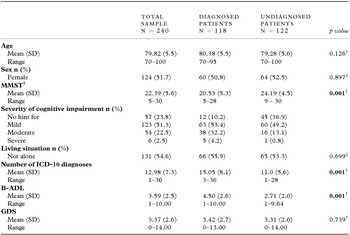
MMST, Mini-Mental Status-Test, range 0–30, higher score indicates better cognitive function.
B-ADL, Bayer-Activities of Daily Living Scale, range 0–10, lower score indicates better performance.
GDS, Geriatric Depression Scale, sum score 0–15, score ≥6 indicates depression.
†Differences in means: T-Tests two-tailed.
‡Differences in proportions: Fisher's exact Tests.
Resource utilization of medical services and formal care
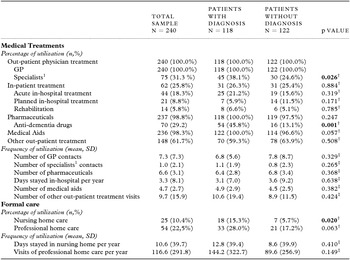
The healthcare resource utilization is shown in Table 3. Outpatient specialists (neurologists and psychiatrists) were used significantly (p = 0.026) more often by diagnosed patients (38.1%), compared to patients without a formal dementia diagnosis (24.6%). Regarding the treatment by a GP, which was used by all patients, patients diagnosed with dementia had fewer GP visits per year (6.8 vs. 7.8) than patients without a dementia diagnosis. Patients formally diagnosed with dementia received significantly more day care (15.3% vs. 5.7%; p = 0.020) and anti-dementia drugs (41.9% vs. 23.6%; p = 0.001), such as memantine or acetyl-cholinesterase inhibitors. For in-patient treatment, more patients with a formal dementia diagnosis had acute (21.2% vs. 15.6%; p = 0.319) but fewer planned (5.9% vs. 11.5%; p = 0.171) in-hospital treatments. Reasons for planned in-hospital treatments among patients without a formal diagnosis were typically surgical interventions, such as surgeries on hip, knee, eye, hands or prostate, in 50.0% (n = 7) of cases. By contrast, two (28.5%) of the patients formally diagnosed with dementia stated a planned surgery. For patients formally diagnosed with dementia, the main reason for acute in-hospital stays was falling (24.0%). Only 10.5% of patients without a formal dementia diagnosis were treated as inpatients due to a fall. Regarding patients who stayed in-hospital (n = 59; 24.6%), patients formally diagnosed with dementia had a shorter in-hospital stay of approximately 12.0 (SD 9.2) days, compared to patients without a formal dementia diagnosis with an average stay of 15.0 (SD 13.8) days.
Percentage and amount of resource use of patients, who screened positive for dementia (total sample, subsamples with and without formal diagnosis of dementia)
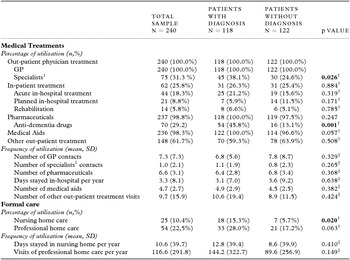
1Neurologist and psychiatrist.
†Differences in means: T-test two-tailed referring to patients with and without dementia diagnosis.
‡Differences in proportions: Fischer's exact test referring to patients with and without dementia diagnosis.
Concerning the utilization of formal care services, professional home care was used more by patients with a formal dementia diagnosis (28.0%; 144 annual visits) compared to patients without a formal dementia diagnosis (17.2%; 89.6 annual visits).
Healthcare costs
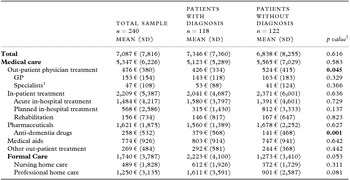
Total annual healthcare costs per patient were € 7,087 (SD 7,816). Among diagnosed patients, total care costs accounted for € 7,346 (SD 7,360) compared to € 6,838 (SD 8,255) for patients without a formal dementia diagnosis and thus did not differ significantly (p = 0.616) between the groups. Healthcare costs for the total sample, as well as for patients with and without a formal dementia diagnosis, are shown in Table 4.
Healthcare cost of patients screened positive for dementia (total sample, subsamples with and without formal diagnosis of dementia)
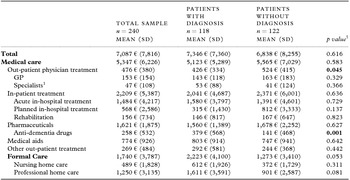
1Neurologist and Psychiatrist.
†Differences in means: t-test two-tailed.
We found significant cost differences solely for outpatient physician treatment and for the costs of anti-dementia drug treatment. Despite a higher utilization of specialists (neurologist, psychiatrist), patients diagnosed with dementia had significantly (p = 0.045) lower costs for total outpatient physician care. This is due to the significantly fewer annual contacts (12.3 vs. 15.0; p = 0.038) with all other outpatient physicians. For pharmaceuticals, the average annual costs for anti-dementia drugs were significantly (p = 0.001) higher for patients formally diagnosed with dementia (€ 379; SD 568), as opposed to € 141 (SD 468) in patients without a formal dementia diagnosis. Furthermore, there were considerable differences in costs for in-patient treatment, resulting in three times lower costs for planned treatments (€ 315 vs. € 812) among patients formally diagnosed with dementia. Thus, medical care costs for diagnosed patients (€ 5,123; SD 5,289) were lower than for patients without a formal dementia diagnosis (€ 5,565; SD 7,029). Looking at formal care, the annual cost for day care (€ 612 vs. € 372; p = 0.311) and professional home care (€ 1,611 vs. € 901; p = 0.081) differ considerably but not significantly between patients with and without a formal dementia diagnosis. For non-medical treatment, there were considerable but non-significant differences (p = 0.066) between patients with (€ 2,125) and without a formal dementia diagnosis (€ 1,348).
Association between the presence of a formal dementia diagnosis and healthcare costs
Table 5 shows the results of the mixed regression models, which analyzed the association between the presence of a formal diagnosis of dementia and healthcare costs (unadjusted and adjusted for sex, age, living situation, comorbidity, severity of dementia, ADL, and depression).
Associations between dementia diagnosis and healthcare cost

Linear mixed models with random effects for general practitioner; standard errors were estimated with a nonparametric bootstrapping (2.000 replications).
‡unadjusted linear mixed model.
†adjusted linear mixed model for sex, age, living situation, number of ICD-10 diagnosis, severity of dementia (MMST-value), activities of daily living (B-ADL), depression (GDS).
*p value<0.05; **p value<0.01; ***p value<0.001.
b, observed coefficient.
Ref., reference.
SE, standard error.
The presence of a formal diagnosis of dementia was significantly negatively associated with medical care costs in the adjusted linear mixed model (b = −1,454; p = 0.050). Furthermore, the association between formal dementia diagnosis and costs for anti-dementia drug treatment was significant in the unadjusted model (b = 262; p = 0.001) as well as in the adjusted linear mixed model (b = 171; p = 0.037). Neither in the unadjusted model nor in the adjusted linear mixed model was dementia diagnosis significantly associated with formal care costs or costs for non-medication treatment. Further, in view of the other socio-demographic and clinical co-variables, a lower age and more deficits in daily living activities were associated with higher medical care costs. Furthermore, deficits in daily living activities were associated with higher formal care costs, higher anti-dementia drug treatment costs and higher costs of non-medication treatment and care (see Supplementary Table 2).
Discussion
To our knowledge, this is the first study using primary data to determine and to compare healthcare resource utilization and its costs in community-dwelling patients with a formal diagnosis of dementia and those without a formal diagnosis. According to our results, annual costs were € 7,346 for patients formally diagnosed with dementia and € 6,838 for patients who screened positive for dementia but without a formal diagnosis of dementia. The cost of the total sample was € 7,087.
Costs for the total sample in comparison with previous studies
Leicht et al. (Reference Leicht2011) estimated total annual medical and formal care costs of approximately € 18,500 (excluding costs for informal care) in a cross sectional study using primary data of patients formally diagnosed with dementia. In this analysis, nearly 32% of patients were living fully assisted or in nursing and retirement home residences. Furthermore, Leicht et al. determined a resource utilization of professional home care of 46%. Thus, estimated annual costs of Leicht et al. (Reference Leicht2011) were twice as high as the costs of the total sample in this analysis, due to a higher utilization of formal care and a higher proportion of institutionalized patients (approximately € 11,500 solely for nursing and professional home care). Schwarzkopf et al. (Reference Schwarzkopf2011) evaluated costs of community-dwelling patients formally diagnosed with dementia based on secondary data. These patients were mildly or moderately cognitively impaired according to the MMST and also had a higher use of day care (up to 82.2%) and of professional home care (up to 54.0%), resulting in total annual medical and formal healthcare costs of approximately € 9,000 in mild and € 10,500 in moderate dementia. The lower healthcare costs determined in our analysis are likely due to a less cognitively impaired sample, which also includes patients (51%) who are mildly cognitively impaired according to the MMST.
Differences in resource utilization and costs depending on dementia diagnosis
Our findings indicate significant differences in the utilization and costs for anti-dementia drug treatment. Hence, significantly more patients formally diagnosed with dementia received anti-dementia drugs (46% vs. 13%) resulting in costs more than twice as high (€ 379 vs. € 141) for this treatment. Higher prescription rates of anti-dementia drugs and the resulting higher costs are not surprising because evidence-based guidelines (German Association for Psychiatry, Psychotherapy and Psychosomatics & German Association for Neurology (DGN) 2009) recommend anti-dementia drugs as the primary treatment for dementia. These guidelines require a formal dementia diagnosis as a prerequisite for the prescription of an anti-dementia drug treatment. However, the proportion of patients who receive anti-dementia drugs, even though they are not formally diagnosed with dementia, is surprising and cannot be clearly explained. It could be possible that these patients received a formal diagnosis by different treating specialists. However, the total costs for pharmaceuticals did not differ significantly between patients with and without a formal dementia diagnosis (€ 1,560 vs. € 1,678). An increasing cognitive impairment could be negatively associated with the total number of drugs taken (Michalowsky et al., Reference Michalowsky2014). In this analysis, patients formally diagnosed with dementia are significantly more cognitively impaired (mean MMST value: 20.5 vs. 24.1). Thus, in spite of obtaining a cost-intensive anti-dementia drug treatment, these patients receive fewer drugs (6.4 vs. 6.8), resulting in lower costs for all other drugs.
In this analysis, significantly more patients formally diagnosed with dementia visited a specialist, such as a neurologist or psychiatrist (38% vs. 25%), resulting in higher costs. This percentage of the treated patients formally diagnosed with dementia is comparable to the findings of Eisele et al. (Reference Eisele2010), who found that the utilization of neuropsychiatric treatment is 35% of PWD within a case-control study based on the claim data. Another study showed that within the first quarter of the incidence year of dementia, a formal dementia diagnosis was coded by the GP in 71% of cases, by a specialist in 14% of cases and by both in 6% of cases (Kaduszkiewicz et al., Reference Kaduszkiewicz, Wiese, Steinmann, Schon, Hoffmann and Van den2014). Furthermore, specific anti-dementia drug treatment is increasingly managed by specialists, rather than by GPs (Hoffmann et al., Reference Hoffmann, Van den Bussche, Glaeske and Kaduszkiewicz2010). This could partly explain the higher utilization and costs for outpatient specialists for patients formally diagnosed with dementia. In spite of a higher utilization of neurologists and psychiatrists, formally diagnosed patients received fewer outpatient physician treatments (12.3 vs. 15.0; p = 0.038), resulting in lower costs compared to undiagnosed patients. In this analysis, diagnosed patients had more comorbidities, which could cause a higher need of differentiated outpatient physician treatments. However, less treatment by outpatient physicians in the progression of dementia diseases is out of line with published studies, which frequently state constant or higher outpatient physician treatments for more cognitively impaired PWD (Leicht et al., Reference Leicht2011; Schwarzkopf et al., Reference Schwarzkopf2011). It is questionable whether a formal diagnosis for dementia leads to inadequate outpatient treatment or if the outpatient treatment is managed more effectively to reduce the patient's burden after receiving a formal diagnosis of dementia. This finding should be clarified in further analyses.
In hospital, patients formally diagnosed with dementia are less frequently treated in planned cases (6% vs. 12%) but more frequently treated in acute cases (21% vs. 16%). For planned in-hospital treatment, this results in costs that are far lower than those for patients without a formal dementia diagnosis (€ 315 vs. € 812). Furthermore, diagnosed patients were treated in hospital with a lower average length of stay (9.9 days vs. 13.5 days). Leicht et al. demonstrated that the resource utilization of patients formally diagnosed with dementia for an inpatient treatment is 29%, which is consistent with our demonstrated findings (Leicht et al., Reference Leicht2011). The reason for a higher utilization of acute in-hospital treatments for patients with a formal dementia diagnosis could be particularly due to the fact that these patients were significantly more physically impaired (mean B-ADL value: 4.5 vs. 2.7) and more comorbid (mean ICD-10 diagnoses: 15.1 vs. 11.0) compared to patients without a formal dementia diagnosis. Impairments in ADL could cause a higher risk for falls and other accidents, which was also demonstrated in our results (24% vs. 11%, respectively). For planned in-hospital stays, our results showed a high rate of planned surgeries for patients without a formal diagnosis of dementia (50% vs. 29%). It is puzzling that in our sample, people with a formal diagnosis of dementia underwent less planned surgery than expected. However, it is possible that a subgroup of patients received a formal diagnosis in hospital and was less frequently admitted to the hospital in the following periods, particularly for planned in-hospital cases. These findings, both the lack of planned surgeries and the shorter in-hospital stay for patients formally diagnosed with dementia, should be clarified in further analyses.
For formal care costs, the higher utilization and frequencies (stayed days in day care, visits per year of professional home care service) led to care costs twice as high as for patients formally diagnosed with dementia. This is particularly due to the higher cognitive impairment and more deficits in daily living activities of these patients.
Associations with dementia diagnosis
The presence of a formal diagnosis of dementia was significantly negatively associated with medical care costs. Therefore, our results suggest that medical costs are lower for patients formally diagnosed with dementia. In this analysis, this is mainly attributable to demonstrated lower costs for planned in-hospital treatments, pharmaceuticals (next to the anti-dementia drugs) and outpatient physician treatment. Furthermore, we found an association between dementia diagnosis and costs for an anti-dementia drug treatment (unadjusted p = 0.001; adjusted p = 0.001). Adequate pharmacotherapy is important because it can slow down cognitive decline, preserve cognitive abilities, reduce the need for nursing care (Wimo et al., Reference Wimo, Winblad, Stoffler, Wirth and Mobius2003), and delay institutionalization (Sano et al., Reference Sano, Wilcock, Van and Kavanagh2003), all of which could be associated with savings in formal and informal healthcare costs. However, a formal dementia diagnosis is currently not sufficient to ensure subsequent adequate non-medication treatment for community-dwelling PWD, including the prescription of other evidence-based outpatient treatments, such as occupational therapy, physical activities, psychosocial interventions, and rehabilitation, which have been shown to improve patients’ cognition and deficits in ADL (Borson et al., Reference Borson2013). Beside the association between dementia diagnosis and costs, deficits solely in ADL resulted in higher medical, formal and non-medical care costs, as well as in higher costs for anti-dementia drug treatment. This finding is in line with published studies (Leicht et al., Reference Leicht2011).
Limitations
This analysis is based on the primary data of patients who screened positive for dementia. Therefore, data was collected directly from the source, implying that the given information from cognitively impaired patients could be restrictive in terms of completeness and accuracy for the comparison of primary data. To improve validity, other available proxies, such as nursing services and the patient's caregiver, were also used. Furthermore, patients were screened in GP practices for dementia, which could lead to false positive screening results for dementia, and participants may have received a formal dementia diagnosis from their treating GP that could not be validated. Furthermore, it is unclear whether the received formal dementia diagnosis was provided as evidence-based by the treating GP, according to the guidelines (German Association for Psychiatry, Psychotherapy and Psychosomatics & German Association for Neurology (DGN) 2009).
Conclusions
Our results indicate that there are no significant differences in total healthcare costs between patients with and without a formal dementia diagnosis. However, patients without a formal dementia diagnosis, who were unnoticed in the most COI studies, incur significantly higher total medical costs. These findings are currently not taken into account in the most COI studies, in spite of the well-known fact that dementia is underdiagnosed in primary care. Furthermore, the presence of a formal diagnosis of dementia is beneficial to receiving cost-intensive dementia-specific medication treatment and treatment by neurologists or psychiatrists. However, currently, a dementia diagnosis seems to not be beneficial for adequate planned in-hospital treatment or outpatient physician specialist treatment, in addition to treatment by the GP or neurologists. Furthermore, a dementia diagnosis does not seem beneficial to ensure a subsequent adequate non-medication treatment for community-dwelling PWD, including the prescription of evidence-based outpatient treatments to improve patients’ cognition and deficits in ADL. Thus, currently, the widely discussed diagnosis of dementia at the early stage of the disease might not be sufficiently beneficial if it does not go hand in hand with further dementia-specific non-medication treatment. To ensure the optimum treatment and care for PWD, care management programs such as DelpHi - MV (Thyrian et al., Reference Thyrian2012; Eichler et al., Reference Eichler2013) offer one possible solution to overcome insufficient treatment and care to delay the institutionalization in patients diagnosed with dementia. Our analysis disclosed a need for such management programs for adequate treatment for PWD and from an economic point of view, to realize long-term cost savings. Thus, it is important to manage the demographic change and the associated increase in prevalence of dementia cases.
Conflict of interest declaration
None.
Description of authors’ roles
All authors contributed to the development, co-ordination and implementation of the DelpHi-MV study in their area of special expertise. BM is responsible for health economic analyses and drafted the manuscript. TE contributed significantly to the manuscript. JRT is the coordinator of the study and contributed substantially to the overall design. DW managed the pharmaceutical part of the intervention and is responsible for pharmaceutical analyses. JH conducted the statistical analyses. WH is the principal investigator of the study and has contributed substantially to the concept of DelpHi-MV and to this manuscript. SF is the principal investigator for health economic analyses. All authors read and approved the final manuscript.
Acknowledgments
Development, coordination, and implementation of the DelpHi-MV study was influenced by input from several experts in their respective fields and supported by an experienced field study team: Ines Abraham, Grit Aßmann, Kerstin Albuerne, Vaska Böhmann, Georgia Böwing, Kathleen Dittmer, Thomas Fiß, Sarah Gardzella, Jana Hubert, Ulrike Kempe, Ingo Kiliman, Leonore Köhler, Saskia Moll, Andrea Pooch, Sabine Schmidt, Christiane Schnick, Stefan Teipel, and Christine Winckler.
Supplementary material
To view supplementary material for this article, please visit http://dx.doi.org/10.1017/S1041610215001453