Determining how best to obtain valid consent for the use of human biological samples collected for research is a challenging issue for investigators, sponsors, and institutional review boards (IRBs) because the goals of maximizing participants’ autonomous decisionmaking and advancing scientific research may conflict. Some participants want control over their samples to avoid research projects that they find morally objectionable. In this article, we argue that the use of exclusion clauses in informed consent can minimize risks to participants and social groups and promote accountability and trust without significantly deterring research.
Exclusion clauses are written statements used during informed consent to (1) exclude the use of biological samples and personal health information for certain types of research and (2) limit sharing of biological samples and personal health information with specific researchers, biobanks, or organizations—for example, investigators working on certain types of research projects, insurance companies, government or law enforcement agencies, advocacy organizations, and private companies, that is, employers. Exclusion clauses are meant to capture contentious research that could risk discrimination or stigmatization of individuals or groups and sharing with organizations the public perceives as less trustworthy. Exclusion clauses are statements included in consent forms by the researchers on areas of contentious research in which they will not take part in the future and organizations they are unlikely to share with. Although exclusion clauses may limit unrestricted use and global sharing, they can be useful for smaller biobanks with specific purposes.
Biobanking and Informed Consent
Biobanking involves the collection of human biological materials and health information that are used for a current study and stored for future research. Samples can be tested to detect the presence of cell types, proteins, metabolites, antibodies, DNA sequences, and other biomarkers in a given population.Footnote 1With the accompanying health information of participants, investigators can analyze data derived from biological samples (such as genomic information), as well as other types of data (such as demographic and health information), to discover statistical relationships between various factors and diseases and patterns of heritability within families and populations. Sharing of biological samples is important for promoting scientific progress, because investigators can take advantage of one another’s labor and resources and can access diverse populations and include more samples in their studies. Sometimes, samples come from populations where individuals are thought to have unique genetic predispositions or environmental exposures.
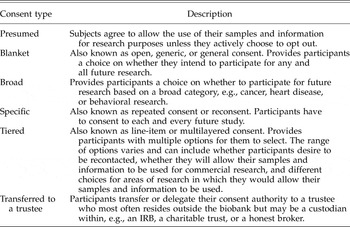
One of the most controversial issues in contemporary ethical debates on biobanking is informed consent. A range of approaches have been used and discussed (see Table 1) that involve complex tradeoffs among different values, including individual autonomy and privacy, risks to participants, costs, convenience, bias reduction, and scientific progress. Presumed consent promotes scientific progress but compromises individual autonomy because participants may not have an opportunity to make an affirmative choice to participate in a study. Although some argue that presumed consent for biobanking is sufficient,Footnote 2 many have objected to this idea in favor of procedures in which individuals make an affirmative choice to participate.Footnote 3 As participants desire control over their samples and information,Footnote 4 specific consent maximizes individual autonomy at the expense of scientific progress and convenience. Arguments for blanketFootnote 5 or broad consentFootnote 6 are based on several points: biobanking research is socially valuable; people prefer broad or general consent; there are low risks to participants when privacy and data-protection measures are put into place; and reconsenting may be resource intensive, may be inconvenient, may induce stress to those who donated as patients, and may possibly bias research by encouraging researches to select only those wishing to be recontacted.Footnote 7 However, some have objected to broad or blanket consent on the grounds that the information provided to participants is insufficient to make a reasonable choice on whether to participate.Footnote 8 Also, some participants may not realize that their samples could be used in research they find morally objectionable,Footnote 9 and some may change their minds in the future, especially if they develop an illness.Footnote 10 Tiered consent, in which participants are offered a variety of options for granting permission to use their samples or data (including general or specific use), helps to preserve autonomy while promoting progress.Footnote 11 This approach also has difficulties, as it is a labor-intensive process requiring investigators to keep track of individual choices,Footnote 12 and offering too many options may result in participants deciding not to choose any option, thereby undermining consent.Footnote 13 Another approach that aims to preserve autonomy and promote progress is to transfer consent authority to a trustee.Footnote 14An advantage of this approach is that it is convenient for participants, but drawbacks include high costs and the risk that trustees may not make decisions that accurately align with participants’ desires.
Informed Consent Approaches for Biobanking

Whereas there are advantages and disadvantages of different consent types, our proposal can be applied to most approaches and serves to minimize the risks to participants and groups while permitting the progress of research.
Exclusion Clauses in Informed Consent for Biobanking
Our proposal for using exclusion clauses in consent for biobanking does not necessarily apply to all types of biobanks, because it depends on the nature or purpose of the biobank. As biobanks operate at national, state, local, and institutional levels (e.g., within hospitals or research institutes), those biobanks with specific purposes could benefit from the use of exclusion clauses. For example, biobanks created to study cancer can benefit from exclusion clauses. In this example, researchers specializing in cancer research are unlikely to use the cells collected for purposes outside of cancer research; similarly, they may not share samples with others who wish to pursue studies outside of cancer biology or with government organizations, insurance companies, or private employers. This would be especially important for a cancer biobank that is situated locally within a town, city, or state with a clear research mandate. The foundation for our proposal is clearly noted by Jeffrey Botkin, who states that researchers should not offer participants choices during informed consent that are not essential to their work.Footnote 15In our example, the cancer biobank may employ a broad informed consent approach and include a written statement that explains the use of samples as follows:
Your samples and health information will be collected and used for the current study and for future studies on cancer.
Your samples and health information will not be used for research on (1a) mental disorders, (1b) genetic profiling, (1c) ancestry or race determination.
Your samples and health information will not be shared with researchers or organizations including (2a) biotech companies, (2b) law enforcement agencies, (2c) insurance companies, and (2d) other government agencies without your expressed permission.
The cancer biobank may also decide to employ a general consent approach (e.g., for all medical research) because they envision future research in other areas. In this instance, some exclusion clauses can still be applied, because it is unlikely that the researchers will perform research on mental disorders or to determine race or will share samples with law enforcement agencies or insurance companies. Aside from the example of a cancer biobank, smaller biobanks formed specifically to study neurological diseases, heart disease, or obesity can also utilize exclusion clauses because they will not use or share samples and health information outside their current or future areas of research.
It should be made clear that the researchers running biobanks—not the participants—will create the exclusion clauses. Our proposal should not be confused with tiered consent, in which options are offered directly to participants, who indicate their preferences. The incorporation of exclusion clauses into informed consent does not offer any choices to participants. A participant cannot choose the type of research or whom to share with and cannot customize a consent form suited to their desires; such an approach could require that all participant consent forms be individually reviewed by IRBs—a burdensome process we are confident IRBs and researchers would reject. For the use of exclusion clauses in consent, the onus is placed on researchers or biobankers to design consent forms that exclude contentious areas of research and sharing with external organizations. Our proposal does not completely eliminate any opportunity for researchers to use samples and information in areas originally excluded. If investigators determine that their scope of practice now requires expansion beyond the exclusions placed in the initial consent, they would be required to seek new consent from participants.
Rationale for Exclusion Clauses
The main rationale for having exclusion clauses in informed consent is supported by some recent cases and public perception data suggesting that, although most participants are comfortable with having their samples used for disease research, some may have qualms about their samples being used for research that may contribute to stigma, racism, or discrimination, such as research on psychological disorders (e.g., schizophrenia, bipolar disorder, criminality); research on lifestyle choices (e.g., drug or alcohol abuse); racial profiling; research on genetic ancestry or heritage, inbreeding, and sexual orientation; and forensic analysis and cataloguing for criminal profiling.Footnote 16 Beyond the fear of discrimination or stigmatization, some participants may fear that established cultural or religious traditions, beliefs, or heritage may be threatened due to certain types of genetic or evolutionary studies.Footnote 17 In addition, there is evidence suggesting that different publics have less trust in biotech companies, insurance companies, their employers, law enforcement agencies, and the federal government than publicly funded academic researchers,Footnote 18which is why they would not wish to share their samples freely. These fears may stem from a lack of trust in scientists or in science more generally, distrust of industry and government, and individual perceptions of risk, scientific knowledge, beliefs, and worldviews.
In addition to public perception data, two cases illustrate that some have a desire to control the use of their samples and information. In 1990, investigators from Arizona State University (ASU) collected blood samples from 200 members of the Havasupai American Indian Tribe and indicated that they would be used for diabetes research. However, the consent form indicated that samples and data would also be used for behavioral research. Members of the tribe became upset when they learned that their samples and information were being used for schizophrenia research, research on inbreeding, and tracing the evolutionary origins of the tribe. The tribe filed a $50 million lawsuit against the investigators and ASU, alleging that participants’ informed consent had been violated. In 2010, ASU settled the lawsuit, returned the samples, paid each participant $1,700, and issued a formal apology. Members of the tribe said they would not participate in future studies conducted by ASU.Footnote 19
In a second case, several parents of newborns filed a lawsuit against the Texas Department of State Health Services for retaining samples for research without permission when its stated purpose for collection was to test newborns only for specific conditions. This litigation resulted in the destruction of more than 5 million blood samples and the creation of new state legislation and a destruction directive permitting parents to opt for their child’s samples to be destroyed after testing.Footnote 20The Texas Civil Rights Project (TCRP) director, who represented the parents, stated:
[t]he government can’t just go around collecting people’s blood with all its confidential genetic information and use it for its own purposes without consent or legal authority. . . . This raises the specter of a DNA data bank, which can too easily be matched with other personal information the government collects, such as social security numbers and fingerprints. There is something utterly incompetent about this—or utterly sinister—or both. This is “Big Brother” in one of its worst incarnations.Footnote 21
These cases illustrate the importance of having a clear informed consent process for biobanking, that potential stigmatizing or discriminatory harms can arise from broad or general consent, and that some participants may show apprehension about sharing their samples or having them shared with certain organizations.
The Value of Informed Consent for Biobanking Research
Many scholars suggest that informed consent for biobanking can be limited or altogether abandoned based on three main presumptions: (1) biobanking research is socially valuable, (2) specific reconsent could stifle research, and (3) the risks to participants are minimal when adequate privacy protection measures and antidiscrimination policies are in place. To some degree, we agree with the view that there is little risk to individuals in some areas of biobanking research. However, the legal cases discussed previously serve to highlight that presumed or general consent does pose some serious risks to individuals or groups. Moreover, there is data to suggest that many want control over their samples, perhaps because they fear some negative consequences or do not trust certain social institutions. This research suggests that biobanking risks are more substantial than they seem.
In a separate study, we analyzed the academic literature on biobanking and coded articles arguing for a particular informed consent type. When we graphed the pro-broad-consent and pro-specific-consent articles in relation to time, we observed an increase in the number of articles advocating broad consent at an earlier time point, with a rise in the number of pro-specific-consent articles occurring later.Footnote 22 Despite the trend of biobanks to predominantly use broad or general consent,Footnote 23we believe that the rise in pro-specific-consent articles in the literature is a reaction of the academic community to the proliferation of pro-broad-consent articles. Together, these observations suggest that informed consent does have a substantive role and place in biobanking research and that greater specificity in consent is likely to grow, instead of fade. This may be especially true as public awareness heightens over the types of research and uses of biobanking.Footnote 24
Advantages and Disadvantages of Exclusion Clauses
Exclusion clauses aim to target and limit contentious research—that is, research that is perceived to result in greater social discrimination or stigmatization and that is not part of the scientists’ or biobankers’ focus. It also limits sharing to organizations that legal cases and empirical studies have shown are perceived as less trustworthy. In this sense, our proposal helps balance harms to participants and research progress by limiting areas that people might fear the most but still employing models not requiring specific consent. Here we outline the advantages and disadvantages of our proposal.
Benefits of Exclusion Clauses
There are several advantages to using exclusion clauses in informed consent for biobanking. First, exclusion clauses can be incorporated simply into existing informed consent processes. They are short phrases written within consent forms and can also be communicated verbally. Moreover, exclusion statements can be incorporated in a variety of consent models, including broad, general, and tiered consent, and when consent is transferred to a trustee. Although it bears little weight, exclusion clauses can also be used for specific consent approaches, even though reconsent will be obtained, because one of the aims of exclusion clauses is to provide more information and to educate participants. Exclusion clauses can also apply to situations in which the samples will be identifiable, anonymized, or deidentified. Second, exclusion statements provide participants with information on the range of biobanking uses. Participants who donate samples for biobanking (especially those who are patients) may not fully understand that samples could be used for all types of medical and even nonmedical research in open or broad consent approaches. By having exclusion clauses, investigators educate participants on the different uses of their biological samples and health information. Third, the use of exclusion clauses in informed consent increases transparency and promotes accountability by researchers, biobanks, and research institutions. Fourth, exclusion clauses provide guarantees to participants that will likely foster greater trust between participants and researchers, biobanks, research institutions, and possibly the scientific or medical enterprise. Exclusion clauses in informed consent serve to add specificity to different consent types, educate participants, and provide guarantees and thus would increase accountability and heighten trust in biobanking.
Disadvantages of Exclusion Clauses
One potential objection to the use of exclusion clauses in informed consent is that it may instill unnecessary anxiety about biobanking in potential participants, because it could raise potential concerns that they had not previously considered and reduce the number of individuals who would participate. Although it is possible that exclusion clauses may cause anxiety in some, this is a reasonable risk to take, given the importance of informing and educating participants. One of the tenets of informed consent is to clearly disclose relevant information that is pertinent to participants, that is, the risks and benefits of research, so that they may make an informed choice whether or not to participate. Many clinical studies can be fraught with significant risks that cause anxiety to participants, but causing anxiety is not sufficient to avoid providing pertinent information that can influence their decision on participation. An alternate scenario is that participants may regard researchers as trustworthy because they fully disclose information and are honest about their intensions, and because researchers take the time to be clear and explain the uses of the samples and health information. Although we agree that exclusion clauses may make some participants skeptical about the entire research endeavor, we believe that most people will not feel this way and that having exclusion clauses serves a greater good by educating participants and promoting autonomous decisionmaking.
A second objection is that exclusion clauses could become an administrative hassle if biobanks decide to expand their research and include previously excluded areas, because recontacting participants would be required. We agree that removing exclusion clauses presents an administrative challenge for biobanks. However, the same type of problem could occur if a biobank used a broad consent approach to use samples, for example, for cancer research and then decided to use samples for other medical research. Recontacting participants is a necessary burden if researchers want to promote trust in biobanking research. It is not enough to use general consent approaches because of exactly the types of potential repercussions that are illustrated by the Havasupai American Indian Tribe case. In this sense, it is important for biobanks to think about the mission of the biobank and anticipate future research uses, maintain contact with participants, and have a process in place in case recontacting individuals becomes necessary.
Another objection is that researchers may not know what participants would like to exclude. We recommend that researchers should exclude areas of research that (1) are generally considered contentious and (2) are outside the scope of their current and future practice. The researchers would need to be able to foresee, at minimum, the near-future areas of research they may undertake. For example, a researcher who studies leukemia may want to know how a certain rare allele is inherited and might want to move toward, or collaborate with others who perform, genealogical research. In such a case, the idea would be to not exclude pedigree research in the informed consent process. It is not necessary for researchers to have insight into the desires of their participants; the rationale is that, in general, the public would probably desire greater control over their samples and information and be hesitant to donate them for research that has greater risk of discrimination or stigmatization to them and to their culture, group, or race. However, researchers or biobankers can benefit from greater knowledge of their study population to make determinations on excluding specific areas of research and sharing with organizations. To make this determination, researchers could appoint a community representative (or advisory board) to help obtain input about their study population to better understand whether the community is likely to be concerned about certain types of stigma or discrimination resulting from research or sharing of samples. We have offered several current examples based on public opinion data of contentious research and of sharing with organizations the general public perceives as less trustworthy. The idea is to exclude research that is not within the immediate or near-future scope of research and that might be considered to be at higher risk of discrimination or stigmatization.
Among the list of contentious research topics, mental health research may raise concerns about discrimination or stigmatization. Mental health research is a field that would greatly benefit from biobanking, because biobanks capture both hereditary and environmental information. Again we must reiterate that the onus is on biobanking researchers to determine which exclusions are appropriate and which might infringe on future research. Researchers may wish to exclude other areas of discriminatory research, that is, HIV/AIDS or other sexually transmitted diseases, substance abuse, and other examples. Thus, if the samples are to be used for future research on mental health or other areas, then it is prudent for researchers to omit such categories in the exclusion clauses.
To help validate this proposal, a qualitative research study can be designed to assess public and stakeholder preferences on exclusion clauses and other consent modalities. For example, would IRB reviewers or chairs prefer this proposal because it might serve as an additional safeguard? Would biobankers or researchers prefer exclusion clauses because they can be easily implemented or would they consider them burdensome because researchers prefer to cast a wider scope? What areas of research would participants wish to exclude from a broad or general consent or which organizations do they deem less trustworthy, leading them to hesitate to donate if their samples and information were to be shared with such organizations? Qualitative measures should carefully capture a richer understanding of the thought processes and rationale behind public and stakeholders’ choices and help in determining whether this proposal should be implemented into research ethics policies.
Conclusions
Determining the appropriateness of different informed consent modalities for biorepository research requires a careful balancing of different ethical considerations, including research progress, participant autonomy, preferences and beliefs, privacy, and protection of confidentiality. Many proposals have been put forward that attempt to reach a fair and effective compromise among competing values, but as of yet no clear solution has emerged. In this article, we have argued for the merits of employing exclusion clauses in informed consent. Exclusion clauses are statements that exclude the use and sharing of samples and health information for certain contentious types of research. Exclusion clauses are implemented by researchers on research areas beyond the scope of their biobanking project. They serve to educate participants and provide guarantees that their biological samples and health information will not be used for the explicit purposes indicated. Our proposal is modest, because it serves to add further specificity to general and broad consent approaches with limited recourse against research progress. It does not propose to resolve the issue of the appropriateness of different consent models for biobanking. The strength of this proposal lies in the simplicity and ease of incorporation of exclusion clauses into existing consent frameworks, and in their ability to, at the same time, enhance transparency and accountability of biobanking research and promote public trust.