Autism spectrum disorders (ASDs) are a class of neurodevelopmental disorders that are associated with profound social impairments. These impairments include failures to form normal peer relationships, engage in reciprocal social behavior, or respond appropriately to nonverbal cues such as emotional facial expressions (American Psychiatric Association, 2000, 2013). The ability to appropriately respond to the affective facial expressions of others is thought to be essential to adaptive interpersonal functioning (Ekman, Reference Ekman1992), and it has been theorized that face-emotion processing deficits contribute to the social deficits that characterize ASD (Schultz et al., Reference Schultz, Grelotti, Klin, Kleinman, Van der Gaag and Marois2003). However, empirical studies of face-emotion processing in ASD have yielded contradictory results, raising questions about whether purported deficits even exist or if they vary by age or expression (Harms, Martin, & Wallace, Reference Harms, Martin and Wallace2010). It has been suggested by various authors that individuals with autism are “as able as controls” to recognize emotional facial expressions (Castelli, Reference Castelli2005); that ASD affects only the recognition of fear (Pelphrey et al., Reference Pelphrey, Sasson, Reznick, Paul, Goldman and Piven2002), or, more broadly, all “negative basic emotions” (Ashwin, Chapman, Colle, & Baron-Cohen, Reference Ashwin, Chapman, Colle and Baron-Cohen2006); and that ASD affects recognition of all emotions (Rump, Giovannelli, Minshew, & Strauss, Reference Rump, Giovannelli, Minshew and Strauss2009). The accumulation of contradictory results hinders the generation of a consensus-based, empirically supported, and well-accepted theory of the development of face-emotion recognition in this population, and the relationship of face-emotion processing to other social deficits in autism. Qualitative reviews have sought to integrate these research findings toward this end, but an empirical assessment of face-emotion recognition deficits in ASD is still lacking. The aim of this meta-analysis was to quantitatively determine whether ASDs are associated with generalized face-emotion recognition deficits, whether deficits persist across multiple emotional expressions or are limited to specific emotions, and whether moderator variables such as age and IQ affect the magnitude of any identified deficits.
Given that diagnoses of ASD rely in part on deficient processing of nonverbal social cues, the results of experimental investigations of face-emotion recognition among individuals with ASD have yielded surprising variability. Some studies have identified generalized face-emotion recognition deficits (in which accuracy scores across all emotional facial expressions that were included in the stimulus battery are collapsed) in children (Balconi, Amenta, & Ferrari, Reference Balconi, Amenta and Ferrari2012; Braverman, Fein, Lucci, & Waterhouse, Reference Braverman, Fein, Lucci and Waterhouse1989; Celani, Battacchi, & Arcidiacono, Reference Celani, Battacchi and Arcidiacono1999; Davies, Bishop, Manstead, & Tantam, Reference Davies, Bishop, Manstead and Tantam1994; Lindner & Rosen, Reference Lindner and Rosen2006; Rump et al., Reference Rump, Giovannelli, Minshew and Strauss2009; Tantam, Monaghan, Nicholson, & Stirling, Reference Tantam, Monaghan, Nicholson and Stirling1989) and adults (Ashwin et al., Reference Ashwin, Chapman, Colle and Baron-Cohen2006; Baron-Cohen, Wheelwright, & Jolliffe, Reference Baron-Cohen, Wheelwright and Jolliffe1997; Critchley et al., Reference Critchley, Daly, Bullmore, Williams, Van Amelsvoort and Robertson2000; Humphreys, Minshew, Leonard, & Behrmann, Reference Humphreys, Minshew, Leonard and Behrmann2007; O'Connor, Reference O'Connor2007; Pelphrey et al., Reference Pelphrey, Sasson, Reznick, Paul, Goldman and Piven2002; Philip et al., Reference Philip, Whalley, Stanfield, Sprengelmeyer, Santos and Young2010; Wallace, Coleman, & Bailey, Reference Wallace, Coleman and Bailey2008). In others, global deficits appear driven by poor recognition performance for one or a subset of expressions, which have variously included anger, fear, disgust, sadness, and surprise (Ashwin et al., Reference Ashwin, Chapman, Colle and Baron-Cohen2006; Balconi et al., Reference Balconi, Amenta and Ferrari2012; Humphreys et al., Reference Humphreys, Minshew, Leonard and Behrmann2007; Pelphrey et al., Reference Pelphrey, Sasson, Reznick, Paul, Goldman and Piven2002; Philip et al., Reference Philip, Whalley, Stanfield, Sprengelmeyer, Santos and Young2010; Rump et al., Reference Rump, Giovannelli, Minshew and Strauss2009; Wallace et al., Reference Wallace, Coleman and Bailey2008, Reference Wallace, Case, Harms, Silvers, Kenworthy and Martin2011). Still others have observed specific deficits for recognition of anger (Bal et al., Reference Bal, Harden, Lamb, Van Hecke, Denver and Porges2010; Wright et al., Reference Wright, Clarke, Jordan, Young, Clarke and Miles2008) and surprise (Baron-Cohen, Spitz, & Cross, Reference Baron-Cohen, Spitz and Cross1993; Jones et al., Reference Jones, Pickles, Falcaro, Marsden, Happé and Scott2011) in the absence of global face-emotion recognition deficits. Finally, some studies have found no evidence of either global or emotion-specific impairments (Castelli, Reference Castelli2005; Gepner, Deruelle, & Grynfeltt, Reference Gepner, Deruelle and Grynfeltt2001; Grossman, Klin, Carter, & Volkmar, Reference Grossman, Klin, Carter and Volkmar2000; Rosset et al., Reference Rosset, Rondan, Da Fonseca, Santos, Assouline and Deruelle2008; Rutherford & Towns, Reference Rutherford and Towns2008). These discrepancies suggest the influence of variables that modulate face-emotion recognition task performance and lead to inconsistent findings across studies (Harms et al., Reference Harms, Martin and Wallace2010), underscoring the need for quantitative characterization of face-emotion recognition deficits in ASD and the influence of potential moderator variables.
There are some indications that age may moderate the severity of face-emotion recognition deficits in ASD (Harms et al., Reference Harms, Martin and Wallace2010). This variable is particularly important to consider given the developmental nature of both face-emotion recognition and ASD, and previous suggestions that face-emotion recognition in ASD may progress along a distinct developmental time course, diverging from that of typically developing individuals over time (Gepner et al., Reference Gepner, Deruelle and Grynfeltt2001; Rump et al., Reference Rump, Giovannelli, Minshew and Strauss2009). In typically developing children, the groundwork for face-emotion recognition is evident at birth. Neonates preferentially orient their attention toward facial configurations and primate faces over other complex stimuli (Di Giorgio, Leo, Pascalis, & Simion, Reference Di Giorgio, Leo, Pascalis and Simion2012; Simion, Di Giorgio, Leo, & Bardi, Reference Simion, Di Giorgio, Leo and Bardi2011), despite their poor visual acuity, and by 5 to 7 months infants can reliably discriminate among emotional facial expressions (Leppanen & Nelson, Reference Leppanen and Nelson2009; Walker-Andrews, Reference Walker-Andrews1997). The ability to explicitly identify discrete emotional expressions emerges during early childhood and develops into adulthood, with gains in both speed and accuracy (De Sonneville et al., Reference De Sonneville, Verschoor, Njiokiktjien, het Veld, Toorenaar and Vranken2002; Herba & Phillips, Reference Herba and Phillips2004; Thomas, De Bellis, Graham, & LaBar, Reference Thomas, De Bellis, Graham and LaBar2007), although there are indications of a brief regression in performance during adolescence (Blakemore, Reference Blakemore2008). Among the emerging competencies that support mature face-emotion recognition abilities are the rapid decoding and interpretation of salient visual information, which are subserved by a distributed brain network that includes the inferior occipital gyrus, lateral fusiform gyrus, and superior temporal sulcus. These areas play key roles in processing and integrating the visual aspects of faces and work in concert with emotion-processing areas such as the amygdala and orbital frontal cortex (Leppanen & Nelson, Reference Leppanen and Nelson2009). This network and its basic connections are present at birth, and underlie early orienting and discrimination. Throughout development, experience refines and strengthens network connections via synaptic pruning and myelination, resulting in a mature network in late adolescence and adulthood (Leppanen & Nelson, Reference Leppanen and Nelson2009).
The developmental trajectory for face-emotion recognition varies across emotions, however. The recognition of happiness and sadness develops earliest and approaches adult-level performance by 5 or 6 years, whereas mature recognition of fear and disgust may not develop until much later (Camras & Allison, Reference Camras and Allison1985; Durand, Gallay, Seigneuric, Robichon, & Baudouin, Reference Durand, Gallay, Seigneuric, Robichon and Baudouin2007). As a result, the gradient of age-related improvements in face-emotion recognition during development are greater for expressions like fear and disgust that undergo more protracted developmental time courses (Herba, Landau, Russell, Ecker, & Phillips, Reference Herba, Landau, Russell, Ecker and Phillips2006). This pattern of variation across emotions suggests that although some aspects of face-emotion recognition result from the progressive tuning of a core face-processing network, emotion-specific differences may reflect partially dissociable neurocognitive processes with variable structural and functional development. This variability reinforces the importance of determining whether ASD affects only the recognition of particular emotions, because impairments in specific recognition of, for example, fear or disgust would implicate dysfunction in different neurocognitive systems than would general emotion recognition deficits (Adolphs, Tranel, Damasio, & Damasio, Reference Adolphs, Tranel, Damasio and Damasio1994; Marsh & Blair, Reference Marsh and Blair2008; Vytal & Hamann, Reference Vytal and Hamann2011).
It may also be important to consider the influence of cognitive intelligence (IQ), especially with regard to its interaction with age. Although IQ is not correlated with face-emotion recognition in typically developing individuals of normal intelligence (McAlpine, Kendall, & Singh, Reference McAlpine, Kendall and Singh1991), IQ in ASD may be associated with performance in social cognition tasks, including face-emotion recognition (Dyck, Piek, Hay, Smith, & Hallmayer, Reference Dyck, Piek, Hay, Smith and Hallmayer2006; Wright et al., Reference Wright, Clarke, Jordan, Young, Clarke and Miles2008). It has been suggested that intelligence might constitute a compensatory mechanism in ASD (Rutherford & Troje, Reference Rutherford and Troje2012). If individuals with ASD proceed along a different developmental trajectory than do typical individuals, a compensatory mechanism would become more important later in development as abilities between those with and without ASD become more divergent, which suggests the interaction between age and IQ may be especially important to consider.
The ability to recognize and respond to the affective states of others is critical for appropriate social reciprocity. Impairments in social interaction and responding to nonverbal cues such as emotional facial expressions are included in the diagnostic criteria for autism, and deficits in this ability are frequently described as critical to social deficits in ASD. However, the available empirical evidence provides inconsistent support for this deficit. We therefore conducted a meta-analysis to identify the nature of face-emotion processing deficits in ASD, aggregating the results of 43 studies to answer three primary questions. Do individuals with ASD exhibit a generalized face-emotion recognition deficit? Do deficits generalize across multiple emotional expressions or are they limited to specific emotions? Are face-emotion recognition performance differences modulated by age and/or the interaction of age and IQ?
Method
Literature search
We conducted literature searches using PubMed, Web of Knowledge, and Google Scholar to find relevant articles. Search terms included face affect, face emotion, autism, and ASD. References from articles identified using these searches were also reviewed for potentially relevant studies. Studies that met our prespecified criteria were included in the meta-analysis. These criteria included the following:
-
1. Studies must have included a group with one or more ASD diagnoses, including autism, Asperger syndrome, and pervasive developmental disorder, not otherwise specified. Diagnoses were either confirmed by a clinician prior to participation in the study using objective criteria acceptable at the time of publication, such as the DSM-IV-TR (American Psychiatric Association, 2000) or the ICD-10 (World Health Organization, 1993), or by using a standardized diagnostic tool such as the Autism Diagnostic Interview—Revised (Lord, Rutter, & Couteur, Reference Lord, Rutter and Couteur1994), the Autism Diagnostic Observation Schedule (Lord et al., Reference Lord, Rutter, Goode, Heemsbergen, Jordan and Mawhood1989, Reference Lord, Rutter and Couteur1994), or the Childhood Autism Rating Scale (Schopler, Reichler, & Renner, Reference Schopler, Reichler and Renner1986).
-
2. The studies must also have included a control group for comparison. In cases where more than one control group was tested, the group that was typically developing, healthy, and chronologically age matched was included in the meta-analysis.
-
3. Face-emotion recognition tasks with an objective measure of accuracy (mean correct, percentage correct, number of errors, etc.) must have been used. In studies that included more than one face-emotion recognition task, the task with the most prototypical and well-validated stimuli was included to increase homogeneity across studies (e.g., if recognition of both photographic faces and cartoon faces were tested, we used only data for the photographic faces). Tasks assessing affect recognition through voice, body language, or other means were not included. Response data from studies across different experimental contexts (e.g., behavioral testing only, or data recording during psychophysiological or neuroimaging testing) were included as long as accuracy for the behavioral task was reported.
-
4. Studies that reported accuracy results combined across multiple expressions (overall affect recognition) as well as studies that reported results for any of the six basic emotions were included.
-
5. Both adult and pediatric studies were included. Although adolescent development continues into the early or mid-20s from a neurodevelopmental perspective (Blakemore & Choudhury, Reference Blakemore and Choudhury2006), for the purpose of this meta-analysis the legal age of 18 was used to designate studies as either adult or pediatric. This reflects a consistent distinction in the literature: 42 of the 43 studies that qualified for inclusion in this analysis included either participants who were older than 18 or those who were younger than 18. Post hoc comparisons between early childhood and adolescent samples were also conducted by partitioning the pediatric studies into two separate groups on the basis of a median split of average participant age.
Study characteristics
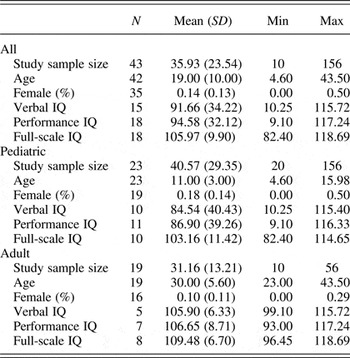
Forty-three studies met our inclusion criteria, yielding a total sample size of 1,545 participants (ASD = 791, control = 754; Table 1). When available, total sample size, mean participant age, percentage of females, and mean verbal, performance, and full-scale IQ were recorded for both the ASD and control groups in each study. Studies were classified as pediatric (N = 23) if study participants were younger than 18, and otherwise as adult (N = 19). Only one study (Howard et al., Reference Howard, Cowell, Boucher, Broks, Mayes and Farrant2000) reported combined results from both children and adults; the 10 participants in that study ranged in age from 15.8 to 40.3 years, and the mean age was not reported. This study was therefore excluded from analyses incorporating age group or average age. In addition, one study (Ashwin et al., Reference Ashwin, Chapman, Colle and Baron-Cohen2006) reported two experiments with independent samples that met our inclusion criteria and therefore were considered to be two separate studies in the meta-analysis. Forty-one of the studies used static stimuli with posed expressions, and 40 studies used forced-choice response options such as multiple choice, sorting, or matching to sample.
Characteristics of the 43 studies included in the meta-analysis

Detailed indices of ASD diagnosis and symptom severity were infrequently and inconsistently reported. For example, in a given study the ASD participants may have received a variety of diagnoses (e.g., low functioning autism or Asperger syndrome), but no details about number of participants, symptom severity, or behavioral results were reported for each diagnostic category. For this reason, variables that index ASD subtype or symptom severity could not be included.
Statistical analyses
Our first aim was to determine whether there is an overall face-emotion recognition deficit in ASD. To provide us with consistent units of analysis across studies, we calculated two separate statistical variables for each study for which the required data were provided: group differences in the percentage accuracy (PA) and a measure of effect size (Zr), both weighted for sample size. Either or both variables were calculated for overall affect recognition (across all expressions included in the study) and specific emotions whenever possible (online only Supplementary Materials, Table S.1).
PA was calculated for studies that reported percent accuracy scores or data that could be converted to percent accuracy scores. In order to compare studies that used a multiple-choice format with different numbers of response options, accuracy scores were corrected for chance guessing using the following formula: proportion correct – (1/number of choices)/1 – (1/number of choices) (Elfenbein & Ambady, Reference Elfenbein and Ambady2002). For each study, a score expressing the difference in performance between the control and ASD groups using the corrected percentage accuracy was calculated. Difference scores were then weighted by the total sample size of the study. The Zr value was calculated as a measure of effect size (r) between the ASD and control groups in each study, derived from reports of Pearson r values or data that could be converted to r such as F values. To account for the logarithmic scale of r values, they were normalized using a Fisher Z transformation then weighted by the total sample size of the study.
Both variables were included because each offers distinct advantages for the current data. PA is a metric that expresses the difference in accuracy of ASD and control groups, so it provides an intuitive measure of performance differences. Unlike Zr, a measure of variance is not required for the calculation of PA, and therefore studies that failed to report standard deviation (or data from which a measure of variance could be derived) could be included using this metric. The Zr value was also included because r is one of the most common and recommended measures of effect size and is often considered the gold standard for meta-analyses (Rosenthal & DiMatteo, Reference Rosenthal and DiMatteo2001). It is a more comprehensive and (potentially more accurate) measure than PA because sample variance is incorporated in the calculation. To probe for possible publication bias, funnel plots were created to assess the distribution of overall PA and Zr as a function of total study sample size.
Data were analyzed using JMP 10 software (SAS Institute Inc., Cary NC). All statistical tests were conducted in tandem on both PA and Zr variables. Many of the studies reported data that could be transformed into both PA and Zr (see online only Supplementary Materials, Table S.1), so this approach enabled us to corroborate our results across two variables and increase confidence in the reliability of our findings.
Results
Overall facial affect recognition deficits in ASD
We assessed overall face-emotion recognition deficits in ASD across emotional facial expressions using one-sample t tests conducted on mean PA and Zr variables. The PA calculations included the results of 38 of the 43 available studies (M PA = 11.91, SD = 61.01), and Zr included 34 (M Zr = 0.36, SD = 1.53; Table 2). For both variables, positive values indicate greater accuracy for the control group compared to the ASD group (and therefore a relative face-emotion recognition deficit in ASD). Calculations using both variables indicated that ASD is associated with significant impairments in face-emotion recognition, t (37)PA = 7.30, p < .001; t (33) Zr = 7.77, p < .001, with the magnitude of the effect nearly identical across the two dependent variables (Table 2).
Differences in face-emotion recognition across emotions and for each of the six basic emotions

Note: ALL, Overall/multiple expressions; ANG, anger; DIS, disgust; FEA, fear; HAP, happiness; SAD, sadness; SUR, surprise; N, number of studies that reported data for each emotion in total (Total), for which PA and Zr could be calculated, and number of studies for which both PA and Zr could be calculated; PA, weighted, corrected percent correct difference; Zr, weighted, normalized r; ASD, autism spectrum disorder; CON, control.
*p < .05. **p < .05. Bonferroni adjusted for multiple comparisons.
Funnel plots assessing the distribution of PA and Zr values as a function of total study sample size revealed roughly symmetrical distributions for both variables (see online only Supplementary Materials, Figure S.1). One study (Celani et al., Reference Celani, Battacchi and Arcidiacono1999) in which accuracy between ASD and control groups differed by almost 40% was identified as a possible outlier with Mahalanobis distances of 3.33 and 2.81 for PA and Zr, respectively. One-sample t tests calculated after excluding the outlier yielded results very similar to those that included the outlier.
Emotion-specific facial affect recognition deficits in ASD
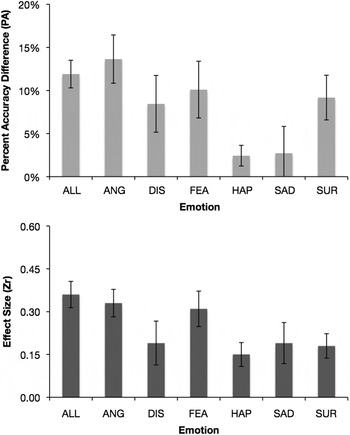
We next wished to determine if ASD is associated with specific deficits in the recognition of one or more emotions. Twenty-three of the 43 studies reported separate results for one or more of the six basic emotions (anger, disgust, fear, happiness, sadness, and surprise). The PA and Zr variables could be calculated for 17 and 19 studies, respectively (Figure 1). The number of studies that reported data on each individual emotion varied; 13 studies reported results for all six emotions for which results (N PA = 10, N Zr = 11) could be calculated. Owing to the reduced power this limited number of studies would yield, we did not conduct a 6 × 1 analysis of variance (ANOVA) to identify ASD deficits in facial affect recognition across the emotions. Instead, we performed one-sample t tests, applying a Bonferroni-adjusted p value of .008 to correct for multiple comparisons, to identify the extent to which ASD impairs the recognition of the six basic emotions. The outlier study (Celani et al., Reference Celani, Battacchi and Arcidiacono1999) identified in our initial analysis did not report results that could be transformed into PA or Zr variables for any individual emotion, so its influence was not a concern in any emotion-specific analyses.
Mean and standard error for percentage accuracy difference (PA) and effect size (Zr) for overall face-emotion recognition and recognition for each of the six basic emotions.

The results of these t tests revealed consistent, marked recognition deficits in ASD for expressions of anger, fear, and surprise. For all three emotions, tests using both PA and Zr variables showed impaired recognition of these emotions in ASD relative to controls. For happiness, ASD was associated with less accurate recognition of the expression for Zr (p Zr = .002), but the magnitude of the effect was smaller and (not statistically significant following Bonferroni correction) for PA (p PA = .031). For expressions of disgust and sadness, the evidence for impaired recognition in ASD was less strong (sadness: p Zr = .010, p PA = .200; disgust: p Zr = .014, p PA = .014) and did not indicate significant deficits in ASD following Bonferroni correction (because Bonferroni corrections are statistically conservative, these results should be interpreted cautiously). In summary, the results indicate face-emotion recognition deficits in ASD are not limited to one particular emotion, although they vary in severity across the six basic emotions (Table 2).
Moderation of ASD deficits by participant age
We next explored how moderating variables may influence both overall and emotion-specific face-emotion recognition. To determine how age affects face-emotion recognition deficits in ASD, we conducted separate one-sample t tests on PA and Zr variables for emotion recognition across categories to test for the presence of deficits in both age groups. Of the 38 studies for which PA could be calculated, 23 pediatric and 15 adult studies were included in the analysis (with 18 years old the designated cutoff between groups). For the 34 studies for which Zr could be calculated, 18 pediatric and 15 adult studies were included in the analysis (Table 1). For each study, the mean participant age was calculated as a weighted average of the chronological ages of the ASD and control participants in that particular study. As a result, each study was associated with a single value that corresponded to the mean age of all participants. The results indicated significant face-emotion recognition deficits in ASD in both the pediatric and the adult samples for PA and Zr (all ps < .025, Bonferroni adjusted). The results were unchanged when the previously identified outlier study (Celani et al., Reference Celani, Battacchi and Arcidiacono1999), a pediatric study, was omitted from the analysis.
We then conducted independent samples t tests comparing deficits in ASD in the pediatric studies to the adult studies to test if the magnitude of deficits differed between the two groups. The results of these tests showed some support for age as a moderator of ASD deficits in face-emotion recognition. We found marginally significant differences between deficits in children and adults for differences in accuracy, t (36)PA = 1.75, p = .089, and significant differences for effect size, t (31) Zr = 1.33, p = .027. Omitting the previously identified outlier study (Celani et al., Reference Celani, Battacchi and Arcidiacono1999), both calculations, t (35)PA = 2.17, p = .037 and t (30) Zr = 2.91, p = .007, showed age to be a significant moderator of ASD deficits in face-emotion recognition. Across tests, the magnitude of the performance difference between groups was greater for adult (M PA = 15.85, SD = 44.52; M Zr = 0.47, SD = 1.46) than pediatric (M PA = 9.28, SD = 59.38; M Zr = 0.24, SD = 1.16) samples, indicating more severe face-emotion deficits in adulthood. Because of the high leverage affects of the outlier study, it was removed from further analyses.
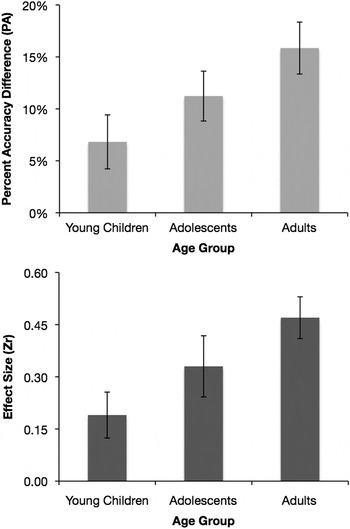
Because face-emotion recognition abilities change most profoundly during childhood (Herba & Phillips, Reference Herba and Phillips2004), we conducted post hoc studies comparing pediatric samples assessing ASD in early childhood and in adolescence. We conducted a median split on average participant age to divide samples into early childhood and adolescent samples (median = 11.5 years). This median age approximately divides the samples into prepubertal and postpubertal samples (Rogol, Roemmich, & Clark, Reference Rogol, Roemmich and Clark2002). Separate ANOVAs for PA and Zr variables were conducted to compare face-emotion deficits in ASD across age groups (early childhood, adolescent, and adult). For PA, this analysis included 11 early childhood, 11 adolescent, and 15 adult studies. The results revealed a marginally significant effect of age, F (2, 34)PA = 3.16, p = .055. Post hoc t tests indicated that this effect was roughly linear in nature, with significantly greater deficits emerging in adults (M PA = 15.85, SD = 44.52) than in early childhood samples (M PA = 6.82, SD = 46.56), t (34)PA = 2.51, p = .017, with the mean of adolescent samples (M PA = 11.23, SD = 67.06) falling between the two but not significantly different from either early childhood or adult studies. A similar pattern of results was obtained using Zr scores (the analysis of which included 10 early childhood, 7 adolescent, and 15 adult studies). The results showed a significant effect of age, F (2, 29) Zr = 5.07, p = .013, and post hoc t tests indicated greater face-emotion recognition deficits in adult samples (M Zr = 0.47, SD = 1.46) than in early childhood samples (M Zr = 0.19, SD = 1.35), t (29) Zr = 3.18, p = .004, with the mean of adolescent studies (M Zr = 0.33, SD = 0.65) falling between the early childhood and adult studies but not significantly differing from either (Figure 2). (Reduced power prevented us from conducting similar tests assessing the effects of age on specific emotions.)
Mean and standard error for percentage accuracy difference (PA) and effect size (Zr) for overall face-emotion recognition for studies with young children, adolescents, and adults.

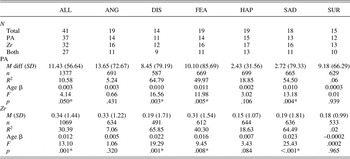
Because the results of our analyses supported developmental changes in the magnitude of face-emotion recognition deficits in ASD with age, we next conducted regression analyses to more sensitively assess age as a moderating variable. We conducted separate linear regressions using both PA and Zr variables with average participant age as a predictor of face-recognition deficits. Of the 41 studies included in the age-based analyses, 32 matched the average chronological age of ASD and control samples, but for 6 pediatric studies (Baron-Cohen et al., Reference Baron-Cohen, Spitz and Cross1993; Braverman et al., Reference Braverman, Fein, Lucci and Waterhouse1989; Buitelaar, van der Wees, Swaab-Barneveld, & van der Gaag, Reference Buitelaar, van der Wees, Swaab-Barneveld and van der Gaag1999; Castelli, Reference Castelli2005; Gepner et al., Reference Gepner, Deruelle and Grynfeltt2001; Ozonoff, Pennington, & Rogers, Reference Ozonoff, Pennington and Rogers1990) and 2 adult studies (Clark, Winkielman, & McIntosh, Reference Clark, Winkielman and McIntosh2008; Critchley et al., Reference Critchley, Daly, Bullmore, Williams, Van Amelsvoort and Robertson2000), significant age differences existed between the ASD and control groups. In all 8 cases, ASD participants were chronologically older than their control counterparts. One study (Pelphrey et al., Reference Pelphrey, Sasson, Reznick, Paul, Goldman and Piven2002) did not provide a standard deviation for age data, so a t test could not be conducted; the mean ages were 25.20 and 28.20 years for the ASD and control groups, respectively. For overall affect recognition, we found that age was a significant predictor of both PA and Zr variables, indicating that the magnitude of face-emotion recognition deficits in ASD increases with age (Table 3).
Simple linear regressions on overall face-emotion recognition and each of the six basic emotions with mean participant age as the predictor

Note: ALL, Overall/multiple expressions; ANG, anger; DIS, disgust; FEA, fear; HAP, happiness; SAD, sadness; SUR, surprise; N, number of studies that reported data for each emotion in total (Total), for which PA and Zr could be calculated, and number of studies for which both PA and Zr could be calculated; PA, weighted, corrected percent correct difference; Zr, weighted, normalized r; ASD, autism spectrum disorder; CON, control.
*p < .05.
Given that the developmental time course of typical face-emotion recognition is not uniform across emotional expressions (Durand et al., Reference Durand, Gallay, Seigneuric, Robichon and Baudouin2007), we conducted additional linear regressions on PA and Zr variables to assess age as a moderator variable for each emotion. To maximize power, regressions were fit separately, and varying degrees of freedom reflect the inclusion of different numbers of studies (Table 3). The results showed that age was a significant predictor of deficits in the recognition of disgust, fear, and sadness for both PA and Zr variables (all ps < .01), such that the magnitude of face-emotion recognition deficits in ASD increased with age. We found weak support for increased recognition deficits for happy expressions with age (p Zr = .084, p PA = .106). Age was not found to be a significant moderator of deficits in recognizing anger or surprise (ps > .10).
Moderation of ASD deficits by participant age and IQ
We next tested whether IQ might influence age-related differences because IQ has been associated with social cognition in ASD (Dyck et al., Reference Dyck, Piek, Hay, Smith and Hallmayer2006; Wright et al., Reference Wright, Clarke, Jordan, Young, Clarke and Miles2008) and because the possibility of IQ-related compensatory mechanisms in ASD has been previously suggested (Rutherford & Troje, Reference Rutherford and Troje2012). Multiple linear regression was used to assess the influence of both age and IQ on face-emotion recognition deficits in ASD. Separate, independent regressions were run with PA and Zr as outcome variables with average participant age, average full-scale IQ (FSIQ), and an Age × FSIQ interaction term as predictors in the model. The outlier study was omitted from these analyses. For PA, 17 studies were included. The overall model was marginally significant (R 2 PA = .44), F (3, 13) = 3.34, p = .053, with age as a significant predictor in the model (p PA = .032), but neither FSIQ (p PA = .966) nor Age × FSIQ (p PA = .136) was significant. Similar results were obtained for Zr, whereby the model was significant (N Zr = 11, R 2 Zr = .83), F (3, 7) = 11.48, p = .043, and age was a significant predictor (p Zr = .001) but not FSIQ (p Zr = .970). The Age × FSIQ interaction term was marginally significant (p Zr = .056), indicating the magnitude of age-related facial-affect processing deficits in ASD tended to be greater in participants with lower IQs.
Analogous multiple linear regressions were also run using age and verbal IQ (VIQ) scores because many of the included studies required the use of affective labels during the task and there is evidence that language ability is related to performance ability in ASD (Wallace et al., Reference Wallace, Coleman and Bailey2008). Incorporating data from 15 studies and using PA as an outcome variable, results of a multiple linear regression found the model was not significant (R 2 PA = .21), F (3, 11) = 0.9754, p = .439, and there were no significant terms or interactions. For Zr, 10 studies were included and the model was significant (R 2 Zr = .712), F (3, 6) = 4.94, p = .046, with age as a significant predictor in the model (p Zr = .010) while neither VIQ (p Zr = .142) nor Age × VIQ (p Zr = .092) was significant. (Regressions were not run for specific emotions owing to to limited power: studies that reported emotion-specific data from which PA or Zr could be calculated and included FSIQ or VIQ measures ranging between 6 and 11 depending on the measure of the effect size, emotion, and IQ metric.)
Discussion
The results of this meta-analysis provided strong evidence that individuals with ASDs are significantly impaired in recognizing multiple emotional facial expressions and that these deficits increase in magnitude over the course of development. This effect is robust, reflecting the results of 43 studies consisting of 1,545 (ASD = 791, control = 754) total participants, does not appear to result from publication biases, and is consistent with clinical observations that impaired use of nonverbal cues and reciprocal social behaviors are characteristic of ASD.
These results bring some clarity to ongoing debates about whether face-emotion recognition deficits in ASDs are limited to one or more particular emotions or extend across multiple emotions. Individual studies have linked ASD to deficits in recognition of various exemplars or subsets of the six basic emotions, such as fear, surprise, or negative emotions (Ashwin et al., Reference Ashwin, Chapman, Colle and Baron-Cohen2006; Bal et al., Reference Bal, Harden, Lamb, Van Hecke, Denver and Porges2010; Balconi et al., Reference Balconi, Amenta and Ferrari2012; Baron-Cohen et al., Reference Baron-Cohen, Spitz and Cross1993; Humphreys et al., Reference Humphreys, Minshew, Leonard and Behrmann2007; Jones et al., Reference Jones, Pickles, Falcaro, Marsden, Happé and Scott2011; Pelphrey et al., Reference Pelphrey, Sasson, Reznick, Paul, Goldman and Piven2002; Philip et al., Reference Philip, Whalley, Stanfield, Sprengelmeyer, Santos and Young2010; Rump et al., Reference Rump, Giovannelli, Minshew and Strauss2009; Wallace et al., Reference Wallace, Coleman and Bailey2008, Reference Wallace, Case, Harms, Silvers, Kenworthy and Martin2011; Wright et al., Reference Wright, Clarke, Jordan, Young, Clarke and Miles2008). However, our meta-analysis did not find evidence of deficits strongly consistent with emotion-specific theories; individuals with ASD were less accurate than were controls for all six basic emotions, showing significantly worse performance for anger, fear, and surprise after adjusting for multiple comparisons. This finding is particularly important because impaired recognition of specific expressions has markedly different implications than general face-emotion processing deficits. For example, previous findings that Huntington disease primarily impairs recognition of disgust (Calder, Keane, Manes, Antoun, & Young, Reference Calder, Keane, Manes, Antoun and Young2000; Hayes, Stevenson, & Coltheart, Reference Hayes, Stevenson and Coltheart2007), and that psychopathy primarily impairs recognition of fear (Dawel, O'Kearney, McKone, & Palermo, Reference Dawel, O'Kearney, McKone and Palermo2012; Marsh & Blair, Reference Marsh and Blair2008), implicate dysfunction in the neural structures that specifically support recognition of those emotions. Along the same lines, some have suggested that putative specific impairments in the recognition of fear or surprise suggest primary dysfunction in, respectively, the amygdala (Howard et al., Reference Howard, Cowell, Boucher, Broks, Mayes and Farrant2000) or in structures supporting theory of mind (Baron-Cohen et al., Reference Baron-Cohen, Spitz and Cross1993). However, the present results suggest that face-emotion recognition impairments in ASD emerge across a variety of affective facial expressions, such that neurodevelopmental differences associated with ASD are also likely to be diffusely distributed.
Age-related differences in face-emotion recognition deficits
Our findings also explain why previous research findings have yielded inconsistent effect sizes for emotion recognition deficits in ASD: the age of study participants may be a significant moderator of group differences. We investigated age as a moderator variable using two different strategies that yielded a clear and consistent relationship between participant age and the magnitude of face-emotion recognition deficits in ASD. First, we divided the studies into those that assessed pediatric (younger than 18 years) and adult participants. Significant ASD-associated deficits were present in both age groups, but a direct comparison of the two groups via independent sample t tests indicated face-emotion recognition deficits in ASD were greater in adults than in children. Using the average age of participants in each study, we further divided pediatric studies into those incorporating primarily early childhood samples versus adolescents, and used ANOVAs to compare deficits in these two groups with adult studies. We again found a strong age-based effect, with face-emotion recognition deficits in ASD least pronounced in young children followed by adolescents and adults, indicating a widening gap between individuals with ASD and controls over the course of development. Second, we conducted linear regression analyses and modeled mean participant age in each study as a predictor variable. Here again, we found the magnitude of face-emotion recognition deficits in ASD increased with age and age-related deficits for recognition of individual emotions varied across expressions. We found strong evidence that deficits in recognizing disgust, fear, and sadness increased with age, with the observed patterns suggesting that whereas typically developing individuals improved over time, those with ASD did not. We found moderate evidence that the same was true for happiness. We did not find evidence for a widening gap in the recognition of anger or surprise, suggesting individuals with ASD continually lag behind their typical counterparts throughout development and the relative deficits may not substantially change. The variability of the results may reflect the different developmental time courses for the recognition of different emotions (Herba et al., Reference Herba, Landau, Russell, Ecker and Phillips2006).
Although research on face-emotion recognition in ASD has been conducted in both children and adults, most studies are cross-sectional and incorporate participants from a narrow age range. No previous longitudinal studies met our inclusion criteria, and only one study included in our meta-analysis (Rump et al., Reference Rump, Giovannelli, Minshew and Strauss2009) directly compared recognition abilities across age groups. Because there is no objective criterion for behavioral deficits in face-emotion recognition, performance in individuals with ASD must be assessed via comparison to controls, such that the magnitude of deficits in this population is necessarily related to where along the developmental curve face-emotion recognition abilities are being tested. Performance deficits would thereby be expected to vary depending on the age of the participants in the study. The developmental nature of the face-emotion recognition deficits in ASD may account for some inconsistencies among the results of previous studies. A qualitative review recently hypothesized that age may moderate the severity of face-emotion recognition deficits in ASD (Harms et al., Reference Harms, Martin and Wallace2010), but to our knowledge, no previous study has quantitatively assessed age-related face-emotion recognition deficits in ASD.
Divergent developmental trajectories for face-emotion recognition
The widening developmental gap identified by our analyses is consistent with suggestions that the acquisition of face-emotion recognition skills in typical individuals and those with ASD proceeds along distinct developmental trajectories, and that individuals with ASD may never achieve the performance level of their control counterparts (Gepner et al., Reference Gepner, Deruelle and Grynfeltt2001; Rump et al., Reference Rump, Giovannelli, Minshew and Strauss2009). The results of this meta-analysis suggest that the development of neural systems that support generalized face-emotion recognition are most likely to be affected in ASD. These systems have been delineated in previous research: during typical development, brain regions supporting face-emotion recognition, such as the amygdala, fusiform gyrus, and superior temporal sulcus, undergo functional and structural maturation (Leppanen & Nelson, Reference Leppanen and Nelson2009), and face-emotion recognition abilities improve throughout early childhood (Herba & Phillips, Reference Herba and Phillips2004). Although growth curves may vary slightly for different affective expressions, typical individuals improve in recognition speed, accuracy, and efficiency over time, typically reaching peak accuracy levels by late adolescence (Herba et al., Reference Herba, Landau, Russell, Ecker and Phillips2006). This improvement seems to be driven by reciprocal interactions between biological maturation and experience, whereby the brain network that supports face-emotion processing is tuned through exposure to facial affect (obtained through everyday interactions with others), which leads to further and more specialized experience with these nonverbal cues (Leppanen & Nelson, Reference Leppanen and Nelson2009) and contributes to age-related increases in face-emotion recognition performance.
Exactly how the developmental trajectory of face-emotion recognition in ASD diverges from that of typically developing children and adolescents is not yet well understood. However, the results of our meta-analysis are consistent with suggestions that face-emotion recognition abilities in this population remain essentially flat over time rather than steadily improving from childhood to adulthood (Gepner et al., Reference Gepner, Deruelle and Grynfeltt2001; Rump et al., Reference Rump, Giovannelli, Minshew and Strauss2009). A variety of aberrant processes may underlie this flat trajectory. Neural structures and connections important for face-emotion processing may differ from those of typical individuals very early in development (Courchesne, Redcay, & Kennedy, Reference Courchesne, Redcay and Kennedy2004; Sparks et al., Reference Sparks, Friedman, Shaw, Aylward, Echelard and Artru2002), with downstream consequences for facial affect recognition. For example, young children with ASD do not show a visual preference for human faces, lack spontaneous gaze to emotionally salient facial features, and have impaired joint attention abilities (Dawson et al., Reference Dawson, Toth, Abbott, Osterling, Munson and Estes2004). Abnormal gaze patterns continue throughout development, marked by reduced eye contact (Mundy, Sigman, Ungerer, & Sherman, Reference Mundy, Sigman, Ungerer and Sherman1986) and atypical visual scan paths when looking at faces (Pelphrey et al., Reference Pelphrey, Sasson, Reznick, Paul, Goldman and Piven2002). This suggests that a breakdown in the mutually reinforcing gains in biological maturation and experience characteristic of typical development may attenuate improvements in face-emotion recognition as individuals with ASD mature (Grelotti, Gauthier, & Schultz, Reference Grelotti, Gauthier and Schultz2002; Sasson, Reference Sasson2006). Reciprocal interactions between brain networks that are inherently different from those of typical individuals and limited experience with facial affect, perhaps driven in part by abnormal gaze patterns, may drive ongoing atypical development of face-emotion recognition.
Some have argued that generalized face-emotion recognition deficits in ASD reflect atypical development specifically in the fusiform gyrus, a critical region of the “social brain” and a region implicated in many aspects of human face processing (Kanwisher, McDermott, & Chun, Reference Kanwisher, McDermott and Chun1997; Lewis et al., Reference Lewis, Thoma, Lanoue, Miller, Heller and Edgar2003). One of the prevailing theories is that the fusiform gyrus activation reflects the development of visual expertise (Gauthier, Skudlarski, Gore, & Anderson, Reference Gauthier, Skudlarski, Gore and Anderson2000; Gauthier, Tarr, Anderson, Skudlarski, & Gore, Reference Gauthier, Tarr, Anderson, Skudlarski and Gore1999), and improvements in the speed and accuracy of face-emotion processing characteristic of facial affect expertise may reflect increased functional reliance on the fusiform gyrus (Nelson, Reference Nelson2001; Tarr & Gauthier, Reference Tarr and Gauthier2000). Functional expertise may also be supported by the predominant use of configural and holistic processing (Gauthier & Tarr, Reference Gauthier and Tarr1997; Mondloch, Le Grand, & Maurer, Reference Mondloch, Le Grand and Maurer2002), an efficient cognitive strategy that utilizes the spatial relations among facial features, rather than the appearance of individual features in isolation.
Fusiform dysfunction has been implicated in face-emotion recognition deficits in ASD in part because these neurocognitive hallmarks of face-emotion expertise are absent in individuals with this disorder. Those with ASD often fail to develop configural or holistic processing strategies (Joseph & Tanaka, Reference Joseph and Tanaka2003), instead relying on inefficient featural processing throughout development (Happé & Frith, Reference Happé and Frith2006). The results of neuroimaging studies suggest that, in ASD, activation in the lateral fusiform gyrus may be attenuated during face-emotion recognition tasks (Critchley et al., Reference Critchley, Daly, Bullmore, Williams, Van Amelsvoort and Robertson2000; Schultz et al., Reference Schultz, Gauthier, Klin, Fulbright, Anderson and Volkmar2000) and reflect deficits in a core social cognitive mechanism (Schultz et al., Reference Schultz, Grelotti, Klin, Kleinman, Van der Gaag and Marois2003). However, when individuals with ASD are explicitly directed to orient their gaze to faces, fusiform gyrus activation approaches that of typical individuals (Dalton et al., Reference Dalton, Nacewicz, Johnstone, Schaefer, Gernsbacher and Goldsmith2005; Hadjikhani et al., Reference Hadjikhani, Joseph, Snyder, Chabris, Clark and Steele2004), indicating that function in this region is preserved to the extent it can respond to human faces at least in some contexts. In addition, imaging studies featuring social stimuli with which individuals with ASD have extensive expertise, such as familiar cartoon characters, have found typical patterns of fusiform recruitment (Grelotti et al., Reference Grelotti, Klin, Gauthier, Skudlarskin, Cohen and Gore2005) and configurally based processing (Rosset et al., Reference Rosset, Rondan, Da Fonseca, Santos, Assouline and Deruelle2008). These findings suggest that rather than profound deficits in functioning in the fusiform gyrus being critical to face-emotion recognition deficits in ASD, atypical patterns of fusiform activation in previous neuroimaging studies may reflect strategic differences in face processing in individuals with this disorder.
Intelligence has been previously hypothesized to be a variable that influences the development of different face-processing strategies (Rutherford & Troje, Reference Rutherford and Troje2012). Cognitive intelligence affects performance in a variety of social cognition tasks in individuals with ASD, suggesting that it may provide a compensatory mechanism that confers a face-emotion recognition advantage (Dyck et al., Reference Dyck, Piek, Hay, Smith and Hallmayer2006; Rutherford & Troje, Reference Rutherford and Troje2012). Our data provided limited evidence in favor of the possibility of such compensatory processes. One analysis found that higher full-scale IQ scores mitigated age-related deficits in ASD at the trend level, with the greatest IQ-conferred advantages observed in adulthood, when face-emotion recognition deficits are generally most pronounced. Other analyses, however, found no significant effects of age. One difficulty with these analyses is that age and VIQ may in some cases be confounded; as can be seen in Table 1, the average IQ in pediatric samples is significantly lower than that in adult samples. Clearly, further research on the impact of IQ on face-emotion recognition is needed, for example, whether particular cognitive strategies can be effectively deployed to improve recognition of facial emotion in naturalistic settings.
If evidence supports the possibility that deliberate strategies can be used to reduce face-emotion processing deficits in adults with ASD, however, then it would favorably support the goal of training children and adolescents with ASD to read faces using robots or computer training tasks, although evidence for the efficacy of such programs as they are currently implemented is mixed (Ramdoss et al., Reference Ramdoss, Machalicek, Rispoli, Mulloy, Lang and O'Reilly2012). The need for effective interventions is clear, given that face-emotion recognition deficits in ASD appear not to naturally normalize over time, but rather increase in severity, and that a lack of expertise in social skills like face-emotion recognition may contribute to profound deficits in communication and social functioning in adults with ASD (Boraston, Blakemore, Chilvers, & Skuse, Reference Boraston, Blakemore, Chilvers and Skuse2007; Humphreys et al., Reference Humphreys, Minshew, Leonard and Behrmann2007).
Considerations and limitations
Our results should be interpreted in the context of some limitations inherent in the meta-analytic process as well as those that reflect omissions typical of studies of ASD. For example, a number of studies of face-emotion recognition did not provide sufficient information to permit their inclusion in emotion-specific analyses and regressions with IQ, reducing power for these analyses. Some studies only tested responses to a few of the six expressions typically included in face-emotion recognition studies, which also limited our ability to compare the magnitude of observed effects across all expressions. Finally, not all studies reported values that could be converted to a common metric. The effects of some differences in reported statistics could be mitigated by our use of two different measures of effect size. The strong correspondence in the results between the two variables, despite incorporating slightly different studies with different expressions, increases our confidence in our results. The influence of task design among the included studies should also be considered. The overwhelming majority of the studies used tasks with static stimuli and posed facial expressions, which may limit ecological validity and raises questions as to whether the face-emotion recognition deficits we found associated with ASD would extend to other settings. In addition, most studies used forced-choice paradigms (primarily multiple choice) that may have enabled participants to use strategies such as valence matching to narrow their choices and improve performance; it is possible group differences in accuracy could in part reflect differences in strategy rather than pure differences in recognition abilities. Forced-choice tasks can also exacerbate issues with expression confusion, particularly when discriminating fear/surprise and anger/disgust, and may be particularly problematic in young children (Gagnon, Gosselin, Hudon-ven der Buhs, Laroque, & Millard, Reference Gagnon, Gosselin, Hudon-ven der Buhs, Larocque and Milliard2010).
It should also be noted that no data were available to permit analysis of how variability of ASD subtypes (e.g., autism; Asperger syndrome; pervasive developmental disorder, not otherwise specified) and symptom severity affect face-emotion recognition ability. It is possible these differences account for real recognition differences and may also contribute to discrepant findings in the literature (Balconi et al., Reference Balconi, Amenta and Ferrari2012; Harms et al., Reference Harms, Martin and Wallace2010). The collapsing of diagnostic categories in the most recent Diagnostic and Statistical Manual (American Psychiatric Association, 2013) may obviate the utility of investigating differences across diagnostic categories. With reference to symptom severity, because many studies assess face-emotion recognition using paradigms that require basic verbal competency or are physically taxing (e.g., neuroimaging, eye-tracking, or psychophysiological studies that require long periods of concentration or stillness and tolerance of unfamiliar machinery touching the face), it is primarily the results of studies among individuals with low symptom severity and without intellectual disabilities that are included in the literature. However, because little concrete evidence is available to determine whether level of functioning influences face-emotion recognition abilities, we cannot know how these sampling biases influence the patterns of results we have observed.
Conclusions
Our meta-analysis integrated a large and variable body of research results that has not been previously assessed quantitatively. Our results offer an empirical framework within which to understand face-emotion recognition deficits in ASD and interpret both past and future research findings. Moreover, it supports a developmental theory of face-emotion recognition deficits in this population: our results indicate that individuals with ASD exhibit a strong, generalized deficit in face-emotion recognition, and that the magnitude of this deficit increases during development. This relative deficit may be driven by improvements in typically developing children and adolescents that reflects both the maturation of neuronal circuits that underlie the recognition of facial affect and experience-dependent expertise for recognizing emotional expressions. Face-emotion recognition in individuals with ASD may proceed along a distinct developmental trajectory that impedes the acquisition of mature face-emotion recognition abilities. This deficit, most pronounced in adulthood, may contribute to broader social impairments in ASD that are characterized by inappropriate use of nonverbal cues.
Supplementary Material
The supplementary materials referred to in this article can be found online at http://journals.cambridge.org/dpp.