Introduction
Vegetable oils are mainly obtained from oilseeds such as soybean, sunflower, cottonseed, peanut and rapeseed, which are in high demand for water. However, these common oilseeds, despite their many benefits, have their limitations in terms of cultivation and climatic conditions (Shonnard et al., Reference Shonnard, Williams and Kalnes2010).
Camelina (Camelina sativa) is from the Brassicaceae family and has been shown in many experiments to have much lower water requirements and greater resistance to spring cold than the other oil crops, especially rapeseed (McVay, Reference McVay2008). Regarding its wide adaptability, camelina has been listed among the most promising new crops for oil production in temperate and semi-arid regions (Vollmann and Eynck, Reference Vollmann and Eynck2015). Camelina is a crop native to Europe and South Asia and may grow like a weed in some farms. Its cultivation history dates back to 4000 years ago. The Former Soviet Union was the largest producer of this crop in the 20th century with 300,000 hectares under cultivation in 1950 (Gehringer, Reference Gehringer2010). Public interest in camelina has been re-emerged due to its level of omega-3 fatty acids, favourable agronomic characteristics and low-input potential as a biofuel crop (Ghamkhar et al., Reference Ghamkhar, Croser, Aryamanesh, Campbell, Kon'kova and Francis2010). Camelina oil possesses high omega-3 fatty acids, so has many properties and uses in nutrition and health that may prevent many diseases and disorders. In industry, it is used as biofuel, resins, waxes, as well as for the production of cosmetics and pharmaceutical products. In oil refineries, industrial antioxidants, which are extremely dangerous to human health, are added to prevent oxidation as well as to increase the duration of the oil. However, due to the high content of alpha-tocopherol and high vitamin E in camelina oil, which are strong antioxidants, camelina does not need any additives to last (Kahrizi et al., Reference Kahrizi, Rostami-Ahmadvandi and Akbarabadi2015).
In total, 89,418 protein-coding genes have been identified in the camelina genome as a hexaploid plant (2n = 40, 750 Mb) (Kagale et al., Reference Kagale, Koh, Nixon, Bollina, Clarke, Tuteja, Spillane, Robinson, Links, Clarke, Higgins, Huebert, Sharpe and Parkin2014). Unlike many crops, there was limited information about the genus Camelina and its biodiversity until 2005. The genome map of the camelina was drawn by Gehringer et al. (Reference Gehringer, Friedt, Luhs and Snowdon2006). Singh et al. (Reference Singh, Bollina, Higgins, Clarke, Eynck, Sidebottom, Gugel, Snowdon and Parkin2015) developed a genomic map using 768 SNP markers and the Illumina GoldenGate SNP array method. Vollmann et al. (Reference Vollmann, Grausgruber, Stift, Dryzhyruk and Lelley2005) performed DNA analysis using RAPD markers to investigate the variation of camelina accessions in Australia and reported four distinct clusters. In that study, only 63% of the 30 markers studied were polymorphic. This indicates a relatively low diversity of the camelina accessions. Creating variation is essential for camelina improvement to consider positive characters and examine them in different environments (Vollmann et al., Reference Vollmann, Grausgruber, Stift, Dryzhyruk and Lelley2005).
As mentioned, due to the polyploidy of the camelina genome, the classical breeding methods are partly complicated. On the other hand, cross-species hybridization in this plant has not been successful (Vollmann and Eynck, Reference Vollmann and Eynck2015). It seems that the production of double haploid plants isolated from the cultivation of anthers or microspores is a suitable method of creating diversity and improvement of this crop.
Analysis of genetic relationships in crops is a prerequisite for their breeding programmes, as it serves to provide information about genetic variation (Mohammadi and Prasanna, Reference Mohammadi and Prasanna2003). This research was conducted to assess the genetic diversity of 81 camelina doubled haploid (DH) lines using inter simple sequence repeat (ISSR) markers.
Materials and methods
Plant materials
In this study, 81 camelina DH lines were studied in terms of genetic diversity. Online supplementary Table S1 shows the list of these lines, their parents and origins. Camelina DH seeds were planted in October 2018 in the greenhouse of the College of Agricultural Sciences and Engineering, Razi University, Kermanshah, Iran.
DNA purification
DNA extraction was performed in the laboratory of Zagros Bioidea Company located in Science and Technology Park, Kermanshah, Iran. Leaf samples of young leaves of potted seedlings grown in the greenhouse were prepared and immediately transferred to a freezer at −80°C in liquid nitrogen (−196°C). DNA extraction from leaf samples was performed using a kit made by Zagros Bioidea Company.
ISSR amplification
Ten ISSR markers were used to detect genetic variation at the molecular level among all DH lines (Table 1). PCR amplification was done according to Najaphy et al. (Reference Najaphy, Ashrafi Parchin and Farshadfar2011) and Williams et al. (Reference Williams, Kubelik, Livak, Rafalski and Tingey1990) in a BIOER XP CYCLER thermocycler. Agarose gel staining and visualization were conducted using ethidium bromide and a UV transilluminator, respectively.
ISSR marker parameters for genetic diversity evaluation of camelina DH lines

PPB, percentage of polymorphic bands; PIC, polymorphism information content; MI, marker index; EMR, effective multiplex ratio; RP, resolving power.
Statistical analysis
Amplified products were scored as (0) for the absence or (1) for the presence of each of the camelina DH lines. Jaccard's similarity coefficients were calculated based on the bivariate. Cluster analysis using the complete method and principal coordinate analysis (PCoA) were performed by NTSYS-pc software version 2.02.
The number of amplified and polymorphic bands, and the percentage of polymorphic bands (PPB) were measured for all of the markers. To determine the informative ISSRs to discriminate among camelina DH lines, polymorphism information content (PIC), effective multiplex ratio (EMR), marker index (MI) and resolving power (RP) were estimated. PIC was measured according to Mousapour Gorji et al. (Reference Mousapour Gorji, Poczai, Polgar and Taller2011), as PIC = 1 − p 2 − q 2, where p is the frequency of the present band and q is the frequency of the absent band. Diversity index (DI) was calculated as the average PIC value. EMR was recorded using the product of the number of polymorphic bands and the fraction of polymorphic bands (Kumar et al., Reference Kumar, Mishra, Singh, Kumar, Naik and Singh2009). MI index was measured according to Powell et al. (Reference Powell, Morgante, Andre, Hanafey, Vogel, Tingey and Rafalsky1996) as the product of EMR and PIC. The formula RP = ΣIb was used to calculate RP, where Ib is band informativeness and Ib = 1 − [2 × (0.5 − p)], where p is the proportion of the genotypes that contain the band (Altintas et al., Reference Altıntas, Toklu, Kafkas, Kilian, Brandolini and OZkan2008).
Results
ISSR polymorphism and marker parameters
In this experiment, 10 ISSR markers were used individually. Marker parameters are summarized in Table 1. The total number of amplified bands was 243, of which 239 bands (98.3%) showed polymorphism. The character ranged between 16 (P4) and 33 (MM15). MM15 and P9 primers possessed the highest number of total amplified products as 32 and 31, respectively. The PPB differed from 93.75% for P4 to 100% for primers P1, P6, P7, P8, P9 and MM14. The size of the bands varied between 50 and 1700 base pairs. The highest PIC was observed for MM16 primer (0.49) and P10 (0.48). PIC ranged between 0.25 and 0.49 with an average of 0.35.
MI ranged from 4.64 to 13.03. The highest MI parameter was determined for ISSR primers P9 and MM16 which amplified more bands (32 and 31, respectively). EMR index depends on the PPB and the number of polymorphic bands. This feature marker varied from 14.06 to 31.03 with a mean of 23.52 (Table 1).
Three ISSR markers had higher RP values (9.88, 8.5 and 7.46 for MM15, MM16 and P10, respectively) and could be useful informative markers to identify DH lines (Table 1). This index varied from 3.36 to 9.88 with an average of 5.63 (Table 1).
Genetic relationships and cluster analysis
Jaccard's similarity coefficients using ISSR data for camelina DH lines were calculated. Genetic similarity ranged between 0.0.05 and 0.85 (data not shown). The minimum similarity (0.05) was recorded between lines 27 and 45. These two DH lines were obtained from separate crosses with different parents (online Supplementary Table S1). DH lines 103 and 104 had the most similarity coefficient (0.85).
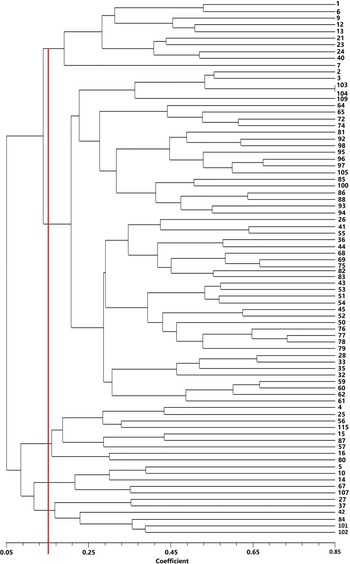
To investigate genetic relationships among camelina DH lines and to classify the lines, cluster analysis was performed using Jaccard's similarity coefficients matrix. Various clustering methods were tested and finally, complete method was selected as the most appropriate due to the lowest rate of chaining and a considerable cophenetic correlation coefficient of r = 0.89. The dendrogram grouped the camelina DH lines into five clusters (Fig. 1):
-
Group Ι: DH lines 1, 6, 9, 12, 13, 21, 23, 24, 40, 7.
-
Group II: DH lines 2, 3, 103, 104, 109, 64, 65, 72, 74, 81, 92, 98, 95, 96, 97, 105, 85, 100, 86, 88, 93, 94, 26, 41, 55, 36, 44, 68, 69, 75, 82, 83, 43, 53, 51, 54, 45, 52, 50, 76, 77, 78, 79, 28, 33, 35, 32, 59, 60, 62, 61.
-
Group Ш: DH lines 4, 25, 56, 115, 15, 87, 57, 16, 80.
-
Group IV: DH lines 5, 10, 14, 67, 107.
-
Group V: DH lines 27, 37, 42, 84, 101, 102.
Complete dendrogram of 81 camelina doubled haploid lines based on ISSR marker data.

Principal coordinate analysis based on ISSR markers
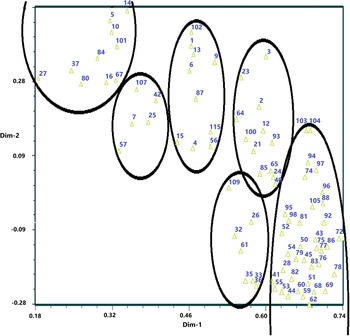
PCoA was carried out using the marker system (Fig. 2). The Latent roots (Eigen values) calculated by ISSRs data showed that the first five principal coordinates accounted for 25.27, 3.61, 2.74, 2.34 and 2.10% of total variability, respectively (36.06% cumulatively). PCoA classified the 81 camelina DH lines into six distinct groups. Most of the lines that came together in the scatter plot were in the same cluster dendrogram (Fig. 2).
Plot of camelina doubled haploid lines by principal coordinate analysis using the ISSR data.

Discussion
In the presented research, the genetic variation of camelina DH lines was assessed by ISSR markers. The set of 81 DH lines, obtained from 15 different crosses, possessed the parents from The Former Soviet Union and some parts of Europe (online Supplementary Table S1).
The efficiency of the used markers was assessed by calculating their PIC parameter. The high average polymorphism (98.3%) among camelina DH lines and mean PIC value of 0.35 (DI = 0.35) in our study indicates considerable genetic variation among the lines and high efficiency of the ISSR markers to distinguish the variation. An average PIC, i.e. DI = 0.29 indicating moderate genetic variation of C. sativa spring accessions using SNPs was reported by Luo et al. (Reference Luo, Brock, Dyer, Kutchan, Schachtman, Augustin, Ge, Fahlgren and Abdel-Haleem2019). Najaphy et al. (Reference Najaphy, Ashrafi Parchin and Farshadfar2011) detected 80.2% polymorphism among 30 wheat accessions and reported an average PIC value of 0.22 using ISSR markers. Rostami-Ahmadvandi et al. (Reference Rostami-Ahmadvandi, Cheghamirza, Kahrizi and Bahraminejad2013) recorded a mean PIC value of 0.39 for ISSR markers in cumin.
EMR based on the product of the number of polymorphic bands and the fraction of polymorphic bands, and MI index as the product of EMR and PIC were the two other parameters recorded for the marker system. The primers that produced more polymorphic bands had a higher EMR record. On the other hand, most of the primers with higher PIC showed higher MI values (Table 1). Different reports have been used on MI and EMR parameters to assess the discriminatory characteristic of molecular markers in some plants such as wheat (Najaphy et al., Reference Najaphy, Ashrafi Parchin and Farshadfar2011), thyme (Yousefi et al., Reference Yousefi, Najaphy, Zebarjadi and Safari2015) and apricot (Kumar et al., Reference Kumar, Mishra, Singh, Kumar, Naik and Singh2009).
The ability of primers to identify the DH lines was also assessed by determining RP. This index ranged between 3.36 and 9.88 with a mean of 5.63 (Table 1). Three ISSR markers: M15, MM16 and P10 had higher RP values (9.88, 8.5 and 7.46, respectively) and could be useful informative markers to distinguish DH lines (Table 1). RP parameter presents a partly precise estimate of the number of accessions that can be distinguished using a marker. The index may provide no knowledge about the ability of a marker to show the phylogenetic relationships of the accessions (Prevost and Wilkinson, Reference Prevost and Wilkinson1999). Some reports while calculating the ISSR parameters in the study of different crops genetic diversity introduced the resolution power and MI as indicator parameters for informative primers (Najaphy et al., Reference Najaphy, Ashrafi Parchin and Farshadfar2011; Yousefi et al., Reference Yousefi, Najaphy, Zebarjadi and Safari2015).
The genetic similarity matrix of camelina DH lines based on Jaccard's similarity coefficients using ISSR data was calculated (data not shown). The highest similarity coefficient (0.85) was found between lines 103 and 104. Interestingly, the two DH lines were also originated from different crosses by the parents from different countries. Line 103 had been obtained from the cross between Svalöf (originated from Sweden) and Ukrajinskij (from the Former Soviet Union). DH line 104 originated from a cross between Przybrodzka (from Poland) and Hoga (from Denmark).
Cluster analysis using the complete method depicted genetic relationships and classified the lines into five groups (Fig. 1). The clustering method indicated a relatively clear configuration from the geographic distribution patterns of the parents of the DH lines. Nevertheless, there is a mixture of DH lines with different parents, especially in group II (Fig. 1, online Supplementary Table S1). The phenomenon may be related to genetic interchange between populations cultivated in close proximity to one another in the Former Soviet Union and some parts of Europe. The relationships between geographic distribution and genetic variation have been shown in some other studies (Fracaro and Echeverrigaray, Reference Fracaro and Echeverrigaray2006; Agostini et al., Reference Agostini, Echeverrigaray and Souza-Chies2008; Najaphy et al., Reference Najaphy, Ashrafi Parchin and Farshadfar2011; Yousefi et al., Reference Yousefi, Najaphy, Zebarjadi and Safari2015; Luo et al., Reference Luo, Brock, Dyer, Kutchan, Schachtman, Augustin, Ge, Fahlgren and Abdel-Haleem2019; Li et al., Reference Li, Hu, Lovell, Grabowski, Mamidi, Chen, Amirebrahimi, Kahanda, Mumey, Barry, Kudrna, Schmutz, Lachowiec and Lu2021). Ghamkhar et al. (Reference Ghamkhar, Croser, Aryamanesh, Campbell, Kon'kova and Francis2010) reported a high genetic variation of 53 camelina genotypes from Ukraine.
By the analysis, PCoA revealed six distinct groups. The output of grouping DH lines obtained from PCoA was partly comparable and consistent with the cluster analysis (Fig. 2). It is noteworthy that most of the camelina DH lines that occupied positions together in the scatter plot of PCoA were classified in the same grouping dendrogram. Li et al. (Reference Li, Hu, Lovell, Grabowski, Mamidi, Chen, Amirebrahimi, Kahanda, Mumey, Barry, Kudrna, Schmutz, Lachowiec and Lu2021) observed a clear pattern of genetic divergence in population structure of a worldwide collection of 222 camelina accessions and principal component analysis.
Conclusion
DH is one of the applied mapping populations that can facilitate QTL mapping and molecular breeding programmes. The identification of genetic diversity and relationships among C. sativa DH lines is useful in breeding efforts. In our investigation, ISSR markers were employed to explore the genetic variation of C. sativa DH lines. The ISSRs generated high polymorphism for assessing genetic diversity and can be used in mapping QTLs and distinctive fingerprinting investigations of camelina accessions. Our results showed that the C. sativa DH lines were genetically diverse, and clustering of the lines according to the geographic distribution patterns of the parents of the DH lines was depicted. PIC, MI and RP are suggested as marker features to identify informative ISSRs. The molecular diversity evaluated in this research, along with the characterization of biochemical traits of the lines, can improve classical and molecular breeding programmes of the crop.
Supplementary material
The supplementary material for this article can be found at https://doi.org/10.1017/S1479262123000114.