Introduction
Depressive disorder is a major risk factor of suicide and self-harm (Harris & Barraclough, Reference Harris and Barraclough1997). The use of antidepressants is a standard treatment for depressive disorder; however, it might be paradoxically associated with an increased risk of suicidal behaviors, especially in younger people (Barbui et al. Reference Barbui, Esposito and Cipriani2009; Stone et al. Reference Stone, Laughren, Jones, Levenson, Holland, Hughes, Hammad, Temple and Rochester2009). In 2004, the US Food and Drug Administration (FDA) added a black-box warning that antidepressants might be associated with suicidal risk among children and adolescents. Based on a meta-analysis of antidepressant trials among adults, suicidal behavior risk was increased among individuals aged <25 years, neutral for those aged 25–64 years, and reduced for those aged 65 years or more (Stone et al. Reference Stone, Laughren, Jones, Levenson, Holland, Hughes, Hammad, Temple and Rochester2009). Thus, the black-box warning was extended to young adults aged <25 years in 2007. After the FDA advisory, the overall prescription rate of antidepressants declined among children and adolescents as well as adults in the USA and Taiwan (Valuck et al. Reference Valuck, Libby, Orton, Morrato, Allen and Baldessarini2007; Wu et al. Reference Wu, Shau, Chan, Lee, Lai and Lai2012; Lu et al. Reference Lu, Zhang, Lakoma, Madden, Rusinak, Penfold, Simon, Ahmedani, Clarke, Hunkeler, Waitzfelder, Owen-Smith, Raebel, Rossom, Coleman, Copeland and Soumerai2014). Utilization of psychotherapy, an alternative treatment for depressive disorder, did not increase in the USA during this period (Libby et al. Reference Libby, Brent, Morrato, Orton, Allen and Valuck2007). Recent studies suggested that the rate of psychotropic drug poisoning, a proxy measure of suicidal behavior, increased inversely when the antidepressant prescription decreased (Lu et al. Reference Lu, Zhang, Lakoma, Madden, Rusinak, Penfold, Simon, Ahmedani, Clarke, Hunkeler, Waitzfelder, Owen-Smith, Raebel, Rossom, Coleman, Copeland and Soumerai2014). Whether the US FDA warning on antidepressants regarding suicidal risk has carried an adverse impact remains controversial (Stone, Reference Stone2014).
Another important issue is whether the suicide risk is similar for different kinds of antidepressants. If the risk of suicidal behavior varies across different antidepressants, which agents carry a relatively low risk and could be prescribed preferentially? Previous meta-analyses of clinical trials suggested that the effect of antidepressants on suicide risk might be different across antidepressants (Fergusson et al. Reference Fergusson, Doucette, Glass, Shapiro, Healy, Hebert and Hutton2005; Stone et al. Reference Stone, Laughren, Jones, Levenson, Holland, Hughes, Hammad, Temple and Rochester2009). However, the event number of suicide or suicidal behaviors in clinical trials was too small to conclude the difference in suicidal risk of antidepressant agents. Observational studies have advantages in sample size and generalizability to real-world settings. Some recent studies using claims data showed that the risk of suicide or self-harm might be different across antidepressants (Tiihonen et al. Reference Tiihonen, Lonnqvist, Wahlbeck, Klaukka, Tanskanen and Haukka2006; Valuck et al. Reference Valuck, Orton and Libby2009; Valenstein et al. Reference Valenstein, Kim, Ganoczy, Eisenberg, Pfeiffer, Downing, Hoggatt, Ilgen, Austin, Zivin, Blow and McCarthy2012; Cheung et al. Reference Cheung, Aarts, Noordam, van Blijderveen, Sturkenboom, Ruiter, Visser and Stricker2015; Coupland et al. Reference Coupland, Hill, Morriss, Arthur, Moore and Hippisley-Cox2015). However, other studies found that the risk of suicide or self-harm for individual antidepressants was similar to each other. (Jick et al. Reference Jick, Kaye and Jick2004; Rubino et al. Reference Rubino, Roskell, Tennis, Mines, Weich and Andrews2007; Schneeweiss et al. Reference Schneeweiss, Patrick, Solomon, Dormuth, Miller, Mehta, Lee and Wang2010a , Reference Schneeweiss, Patrick, Solomon, Mehta, Dormuth, Miller, Lee and Wang b ; Cooper et al. Reference Cooper, Callahan, Shintani, Fuchs, Shelton, Dudley, Graves and Ray2014; Miller et al. Reference Miller, Pate, Swanson, Azrael, White and Sturmer2014). These inconsistent findings might be due to chance as a result of small sample size, or methodological issues such as variations in the definition of study outcome. Furthermore, despite several studies exploring such issues in European countries and the USA, to the best of our knowledge, no study had investigated this issue in Asian settings. The comparative risk of suicidal behavior associated with the use of different antidepressants in Asian populations is still little known. Therefore, we conducted a retrospective cohort study to explore the risk of hospitalization due to self-harm for antidepressant use based on Taiwan's national insurance claims data.
Method
Data source
In this study we used the National Health Insurance Research Database (NHIRD), which was derived from the reimbursement claims records of the National Health Insurance (NHI) program in Taiwan. The NHI program was launched in 1995 and enrolled around 23 million individuals, representing 99% of Taiwan's population in 2009. The NHIRD includes information about demographic characteristics, clinical diagnoses, medical and surgical procedures, and prescription records. All information that could be used to identify insured individuals and medical care providers was scrambled and made anonymous to ensure confidentiality. The NHIRD has been used for pharmaco-epidemiological studies and research on psychiatric disorders and self-harm behaviors (Wu et al. Reference Wu, Shau, Chan, Lee, Lai and Lai2012; Shih et al. Reference Shih, Lin, Lin, Hsu, Lee, Chi, Sung, Chang and Kao2013).
Study sample
The study cohort included all antidepressant users aged over 10 years, registered with the NHIRD between 1 January 2001 and 31 December 2012, and with a diagnosis of depressive disorders [International Classification of Diseases, Ninth Revision, Clinical Modification (ICD-9-CM) codes: 296.2, 296.3, 300.4 or 311]. The date of the first antidepressant prescription with a concomitant diagnosis of depressive disorders was defined as the cohort entry date. Only new antidepressant users, defined as those who were not prescribed any antidepressants during the 1-year period prior to the cohort entry date, were included. Patients using multiple antidepressant drugs on the cohort entry date were excluded. Patients with schizophrenia, other psychosis or bipolar disorder were excluded. In total, 751 606 new antidepressant users with depressive disorders were identified in this study. The flowchart of participant enrollment is shown in online Supplementary Fig. S1.
Antidepressant exposure
The antidepressant exposure information was based on the NHIRD prescription records, which contain medication type, prescription date, dosage and the duration of drug supply. Antidepressants were identified according to the Anatomical Therapeutic Chemical Classification System using the code N06A (WHO Collaborating Centre for Drug Statistic Methodology, 2009). We further classified antidepressants into seven groups according to their proposed mechanisms of action: tricyclic or tetracyclic antidepressants (TCAs: amitriptyline, clomipramine, dothiepin, doxepin, imipramine, maprotiline and melitracen/flupentixol); selective serotonin reuptake inhibitors (SSRIs: citalopram, escitalopram, fluoxetine, fluvoxamine, paroxetine and sertraline); serotonin-norepinephrine reuptake inhibitors (SNRIs: venlafaxine, duloxetine and milnacipran); noradrenergic and specific serotonergic antidepressants (NaSSAs: mirtazapine); norepinephrine dopamine reuptake inhibitors (NDRIs: bupropion); reversible inhibitors of monoamine oxidase A (RIMAs: moclobemide); and serotonin antagonist and reuptake inhibitors (SARIs: trazodone).
Study end point
The study end point was defined as the first hospitalization due to self-harm or injury of undetermined intent after starting use of the new antidepressants. Hospitalization due to self-harm was defined as hospitalization with a diagnosis of self-harm (ICD-9-CM codes: E950–E958). Late effects of self-harm (E959) were not included. Previous research showed that many deaths classified as undetermined intent (E980–E988) were likely to be misclassified suicides (Chang et al. Reference Chang, Sterne, Lu and Gunnell2010), and therefore we included hospitalization for injury with undetermined intent as the study end point.
Patient characteristics and potential confounders
Patients’ characteristics during the 1-year period prior to the cohort entry date were assessed; these included demographic characteristics, co-morbid psychiatric and medical disorders, concomitant use of other medications, and health care utilization. These variables were found to be associated with the risk of self-harm or suicide (Hawton & van Heeringen, Reference Hawton and van Heeringen2009; Robertson & Allison, Reference Robertson and Allison2009; Gorton et al. Reference Gorton, Webb, Kapur and Ashcroft2016) and thus may confound the association between antidepressant use and hospitalizations due to self-harm. Co-morbid psychiatric conditions included dementia, anxiety disorder, organic brain syndrome, personality disorder and substance use disorder. Medical co-morbidities included cerebrovascular disease, chronic pulmonary disease, coronary heart disease, diabetes mellitus, hypertension, heart failure, malignant neoplasm, peripheral vascular disease, dyslipidemia and epilepsy. Concomitant medications included angiotensin-converting enzyme inhibitors and angiotensin receptor blockers, anticoagulants, antidiabetic agents, β-blockers, benzodiazepines, calcium-channel blockers, diuretics, other antihypertensives, antipsychotics and mood stabilizers. Health care utilization indices included the number of psychiatric and non-psychiatric hospitalizations, and psychiatric and non-psychiatric out-patient visits in the preceding year.
Statistical analysis
Descriptive statistics of the patients’ characteristics by various antidepressant classes and individual agents were provided. We calculated the number of patients, total follow-up period, the number of self-harm hospitalizations, and the crude incidence rate of self-harm hospitalization for each antidepressant class and drug, respectively.
We estimated the risk of self-harm hospitalization among patients who continued their initial antidepressant therapy. We focused on self-harm hospitalization over the first-year follow-up period because the initiation of antidepressant treatment as any causal role of antidepressant use on self-harm risk would become less certain after the first-year treatment. Patients were censored when they were hospitalized for self-harm; treatment was discontinued, switched to, or augmented with another antidepressant at the end of the first-year follow-up; or at the end of study period, whichever came first. Discontinuation of antidepressant treatment was defined as a gap of 30 or more days between the end of drug supply of the previous prescription and the start date of the next antidepressant prescription, if any. In the case of switching to or augmentation with another antidepressant, patients would be censored on the date when the second antidepressant drug was prescribed.
Given that there could be multiple potential confounders and the number of self-harm hospitalization was small, we used propensity score analysis to further control for confounding by patients’ baseline characteristics (Cepeda et al. Reference Cepeda, Boston, Farrar and Strom2003). The propensity score is a probability of patients receiving an antidepressant. In brief, we estimated the propensity score for each study patient using a logistic regression model, which included all above-mentioned covariates listed in Table 1. All variables were included without selection. The propensity score of each antidepressant class or each individual drug was calculated for each participant, separately, against SSRIs or fluoxetine (i.e. the comparison antidepressant class or drug) in the analyses. The risk of self-harm hospitalization was estimated using Cox proportional hazards regression models stratified by the exposure propensity score deciles. Age difference in the association of self-harm hospitalization with antidepressant use was examined by including appropriate interaction terms (age group × antidepressant use) in the regression models, and we used likelihood ratio tests to compare data fit in models with and without interaction terms.
Baseline characteristics for depressive disorder patients using different classes of antidepressants in the study cohort

Data are given as number (percentage) unless otherwise indicated.
SSRIs, Selective serotonin reuptake inhibitors; TCAs, tricyclic or tetracyclic antidepressants; SARIs, serotonin antagonist and reuptake inhibitors; SNRIs, serotonin norepinephrine reuptake inhibitors; NaSSAs, noradrenergic and specific serotonergic antidepressants; RIMAs, reversible inhibitors of monoamine oxidase A; NDRIs, norepinephrine dopamine reuptake inhibitors.
To test for the robustness of the results, we conducted several sensitivity analyses. First, we restricted the study outcome to hospitalization due to self-inflicted injury or poisoning (ICD-9-CM E950–E958) only (i.e. excluding injury of undetermined intent). Second, given that antipsychotic augmentation might have enhanced treatment response and altered the risk of self-harm, we excluded patients with concomitant antipsychotic treatment and censored those who were given antipsychotic augmentation therapies in a sensitivity analysis. Users of melitracen/flupentixol, a combination of tricyclic antidepressant and conventional antipsychotic, were excluded.
The statistical uncertainty of the associations was assessed using 95% confidence intervals (CIs). Adjustment of multiple comparisons was not considered, since the analysis was exploratory in nature. All the analyses were performed using SAS version 9.2 (SAS Institute; USA).
Ethical standards
This study protocol was approved by the Institutional Review Board of the National Health Research Institutes, Taiwan.
Results
We identified 751 606 new antidepressant users over the study period. The baseline characteristics of study participants by each antidepressant class and individual drug are shown in Table 1 and online Supplementary Table S1, respectively. The most frequently prescribed antidepressant class was SSRIs (58.1%), followed by SARIs (13.6%), TCAs (10.3%), SNRIs (8.3%), NaSSAs (4.3%), NDRIs (2.7%) and RIMAs (2.7%) (Table 1). The proportion of males was higher in the users of SARIs (44.3%), NaSSAs (44.2%) and NDRIs (47.5%) than SSRI users (35.2%). In addition, NDRI users were less likely to have co-morbid anxiety disorder (24.2%), compared with SSRI users (32.2%). Users of SARIs (6.6%), NaSSAs (9.3%) and NDRIs (5.5%) had a higher percentage of substance use disorder, compared with SSRI users (2.7%).
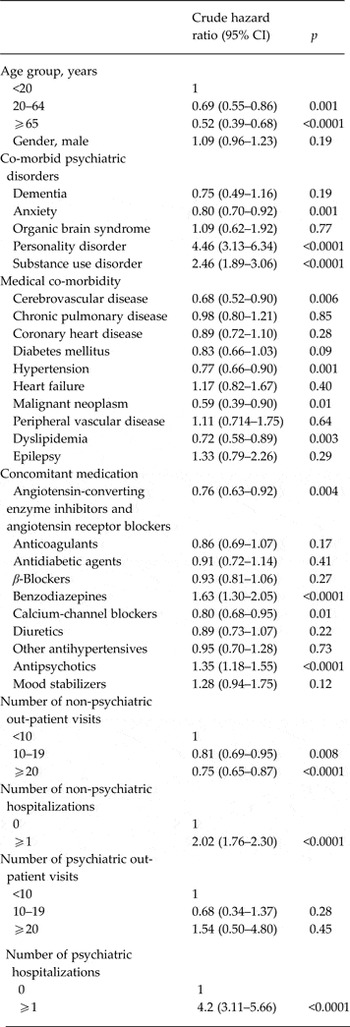
Table 2 shows the associations of self-harm hospitalization with various participant characteristics. Factors found to be associated with self-harm included a younger age (11–19 years), co-morbid personality disorder, substance use disorder, concurrent use of benzodiazepines or antipsychotics, and hospitalization in the previous year. In contrast, co-morbid anxiety disorder, cerebrovascular disease, hypertension, malignancy, dyslipidemia, concurrent use of angiotensin-converting enzyme inhibitors and angiotensin receptor blockers or calcium-channel blockers, and higher number of out-patient visits in the previous year were associated with reduced risk of self-harm hospitalization (Table 2).
Associations of various factors with self-harm hospitalization among patients with depressive disorders using Cox regression

CI, Confidence interval.
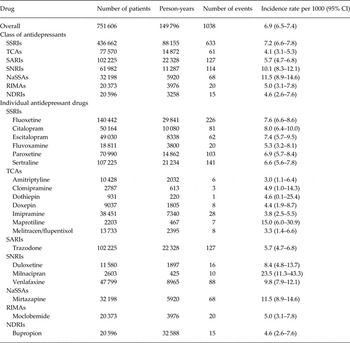
There were 1038 hospitalizations due to self-harm, including 817 (78.7%) cases coded as self-inflicted injuries or poisoning (ICD-9-CM E950–E958) and 221 (21.3%) cases coded as undetermined intent (ICD-9-CM E980–E988), occurring during a total follow-up period of 149 796 person-years. The overall incidence rate of self-harm hospitalization in the first year after the initiation of antidepressant treatment was 6.9 (95% CI 6.5–7.4) per 1000 (Table 3). The crude incidence rate (per 1000) of hospitalization due to self-harm was the highest for NaSSAs (11.5; 95% CI 8.9–14.6), while the lowest was 4.1 (95% CI 3.1–5.3) for TCAs. The incidence rate of hospitalization due to self-harm for SSRIs, the reference antidepressant class, was 7.2 (95% CI 6.6–7.8) per 1000. Regarding individual antidepressants, the incidence rate of self-harm hospitalization (per 1000) varied markedly, ranging from 23.5 (95% CI 11.3–43.3) for milnacipran to 3.0 (95% CI 1.1–6.4) for amitriptyline, while it was 7.6 (95% CI 6.6–8.6) for fluoxetine, the reference antidepressant drug (Table 3).
Incidence rate of self-harm hospitalization in depressive disorder patients using different antidepressants

CI, Confidence interval; SSRIs, selective serotonin reuptake inhibitors; TCAs, tricyclic or tetracyclic antidepressants; SARIs, antagonist and reuptake inhibitors; SNRIs, serotonin norepinephrine reuptake inhibitors; NaSSAs, noradrenergic and specific serotonergic antidepressants; RIMAs, reversible inhibitors of monoamine oxidase A; NDRIs, norepinephrine dopamine reuptake inhibitors.
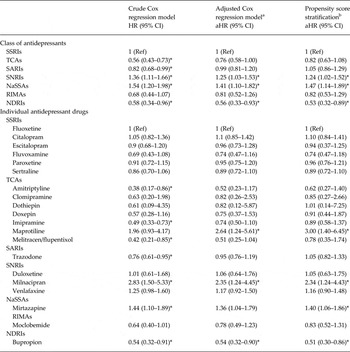
In the model using propensity-score stratification (Table 4), SNRIs [adjusted hazard ratio (aHR) = 1.24, 95% CI 1.02–1.52] and NaSSAs (aHR = 1.47, 95% CI 1.14–1.89) were associated with increased risk of self-harm hospitalization compared with SSRIs. However, NDRIs were associated with decreased risk (aHR = 0.53, 95% CI 0.32–0.89) compared with SSRIs. The results using multivariate Cox regression model with adjustment for covariates were consistent with those using propensity-score stratification (Table 4). Compared with fluoxetine, there was no statistical evidence for a difference in the risk of self-harm hospitalization associated with most individual antidepressants, including other SSRIs (citalopram, escitalopram, fluvoxamine, paroxetine and sertraline). However, maprotiline (aHR = 3.00, 95% CI 1.40–6.45), milnacipran (aHR = 2.34, 95% CI 1.24–4.43) and mirtazapine (aHR = 1.40, 95% CI 1.06–1.86) were associated with a greater self-harm hospitalization risk than fluoxetine. In contrast, the risk of self-harm hospitalization was lower for bupropion (aHR = 0.51, 95% CI 0.30–0.86) than fluoxetine (Table 4).
Associations of antidepressant use with risk of self-harm hospitalization in depressive disorder patients

HR, Hazard ratio; CI, confidence interval; aHR, adjusted HR; SSRIs, selective serotonin reuptake inhibitors; TCAs, tricyclic or tetracyclic antidepressants; SARIs: antagonist and reuptake inhibitors; SNRIs, serotonin norepinephrine reuptake inhibitors; NaSSAs, noradrenergic and specific serotonergic antidepressants; RIMAs, reversible inhibitors of monoamine oxidase A; NDRIs, norepinephrine dopamine reuptake inhibitors.
a Adjusted covariates included the demographic variables (age groups and gender), medical and psychiatric co-morbid conditions (dementia, anxiety disorder, organic brain syndrome, personality disorder, substance use disorder, cerebrovascular disease, chronic pulmonary disease, coronary heart disease, diabetes mellitus, hypertension, heart failure, malignant neoplasm, peripheral vascular disease, dyslipidemia and epilepsy), concomitant medications (angiotensin-converting enzyme inhibitors and angiotensin receptor blockers, anticoagulants, antidiabetic agents, β-blockers, benzodiazepines, calcium-channel blockers, diuretics, other antihypertensives, antipsychotics and mood stabilizers) and health care utilization (number of psychiatric and non-psychiatric hospitalizations, and psychiatric and non-psychiatric out-patient visits in the preceding year).
b Calculated by multiple conditional logistic regression with adjustment for propensity score deciles.
* p < 0.05.
In the sensitivity analyses, the results were grossly consistent with our primary analyses with the only exception that the self-harm hospitalization risk for TCAs was significantly lowered than SSRIs (aHR = 0.60, 95% CI 0.42–0.85) in the analysis including hospitalization with self-inflicted injury or poisoning only; and the risk of SNRIs compared with SSRIs did not reach statistical significance (aHR = 1.23, 95% CI 0.98–1.53) in the sensitivity analysis excluding patients with concomitant antipsychotic treatment and censoring for antipsychotic augmentation (online Supplementary Tables S2–S5).
The incidence rate (per 1000 person-years) of self-harm hospitalization varied across different age groups; the youngest group (aged 11–19 years) had the highest incidence rate (11.0, 95% CI 8.8–13.5), following by 7.1 (95% CI 6.6–7.6) in those aged 20–64 years, and 5.1 (95% CI 4.2–6.0) in those aged 65 years or over. However, in the analyses stratified by age, there was no statistical evidence for age difference in the association of self-harm hospitalization with each antidepressant class (all p values for age–antidepressant interaction >0.2).
Discussion
Main findings
Using data from a population-based cohort of patients with depressive disorder, we found variations in the risk of hospitalization due to self-harm following the initiation of treatment using different antidepressants. Compared with SSRIs, the use of SNRIs and NaSSAs was associated with a 24 and 47% increased risk of self-harm hospitalization, respectively, while the use of NDRIs was associated with a 47% decreased risk. Compared with fluoxetine, maprotiline (a TCA), milnacipran (an SNRI) and mirtazapine (an NaSSA) were associated with 200, 134 and 40% increased risk of self-harm hospitalization while bupropion (an NDRI) was associated with 49% reduced risk, and other studied SSRIs (citalopram, escitalopram, fluvoxamine, paroxetine and sertraline) showed a similar level of risk to that of fluoxetine.
Comparisons with previous studies
Our estimate of the overall incidence rate of self-harm hospitalization in patients with depressive disorders (6.9 per 1000 or 690 per 100 000 person-years) was comparable with those reported in several previous studies (Valuck et al. Reference Valuck, Libby, Sills, Giese and Allen2004; Schneeweiss et al. 2010b; Gibbons et al. Reference Gibbons, Coca Perraillon, Hur, Conti, Valuck and Brent2015) but somewhat lower than those in some other studies (Martinez et al. Reference Martinez, Rietbrock, Wise, Ashby, Chick, Moseley, Evans and Gunnell2005; Tiihonen et al. Reference Tiihonen, Lonnqvist, Wahlbeck, Klaukka, Tanskanen and Haukka2006; Rubino et al. Reference Rubino, Roskell, Tennis, Mines, Weich and Andrews2007; Schneeweiss et al. Reference Schneeweiss, Patrick, Solomon, Dormuth, Miller, Mehta, Lee and Wang2010a ). We have restricted our analysis to severe self-harms that required hospitalization and this may have contributed to a relatively low estimate of self-harm incidence rate. Our finding of the association of self-harm with a range of factors such as personality disorder, substance use disorder, the use of benzodiazepines or antipsychotics, and a history of hospitalization was generally consistent with previous studies (Rihmer, Reference Rihmer2007).
Previous studies showed various findings regarding variations in the risk of self-harm across different antidepressant agents. The US FDA has announced black-box warnings for all antidepressant use for children, adolescents and young adults aged less than 25 years. One large-scale meta-analysis based on data from 372 clinical trials among adults found marked variations in the risk of suicidal behavior; the odds ratios ranged from 0.49 for clomipramine to 2.44 for escitalopram (Stone et al. Reference Stone, Laughren, Jones, Levenson, Holland, Hughes, Hammad, Temple and Rochester2009). Another meta-analysis of antidepressant clinical trials among pediatric patients with major depressive disorder also found that the risk varied substantially, from an increase of 1.37-fold for citalopram to 4.97-fold for venlafaxine (Hammad et al. Reference Hammad, Laughren and Racoosin2006).
However, previous meta-analyses of clinical trials were limited in the small number of suicidal events and thus rendered it difficult to conduct analyses for head-to-head comparisons among various individual antidepressant drugs. Several previous observational studies found no statistical evidence for a difference in the risk of suicidal attempts or self-harm across antidepressants (Jick et al. Reference Jick, Kaye and Jick2004; Schneeweiss et al. Reference Schneeweiss, Patrick, Solomon, Dormuth, Miller, Mehta, Lee and Wang2010a , Reference Schneeweiss, Patrick, Solomon, Mehta, Dormuth, Miller, Lee and Wang b ; Cooper et al. Reference Cooper, Callahan, Shintani, Fuchs, Shelton, Dudley, Graves and Ray2014; Miller et al. Reference Miller, Pate, Swanson, Azrael, White and Sturmer2014; Cheung et al. Reference Cheung, Aarts, Noordam, van Blijderveen, Sturkenboom, Ruiter, Visser and Stricker2015). In contrast, there were also some previous studies showing that the suicide risk might differ by antidepressants (Tiihonen et al. Reference Tiihonen, Lonnqvist, Wahlbeck, Klaukka, Tanskanen and Haukka2006; Rubino et al. Reference Rubino, Roskell, Tennis, Mines, Weich and Andrews2007; Valuck et al. Reference Valuck, Orton and Libby2009; Valenstein et al. Reference Valenstein, Kim, Ganoczy, Eisenberg, Pfeiffer, Downing, Hoggatt, Ilgen, Austin, Zivin, Blow and McCarthy2012; Coupland et al. Reference Coupland, Hill, Morriss, Arthur, Moore and Hippisley-Cox2015). One of the antidepressants most frequently reported to be associated with self-harm risk is venlafaxine, one of the most common prescribed SNRIs. Three observational studies showed that SNRIs might carry a higher risk than the non-exposed group or other antidepressants among adult patients (Rubino et al. Reference Rubino, Roskell, Tennis, Mines, Weich and Andrews2007; Valuck et al. Reference Valuck, Orton and Libby2009; Coupland et al. Reference Coupland, Hill, Morriss, Arthur, Moore and Hippisley-Cox2015). One meta-analysis of observational studies found that venlafaxine and paroxetine, an SSRI, were associated with an increased risk of suicidal behavior among the adolescents compared with the non-exposure group (Barbui et al. Reference Barbui, Esposito and Cipriani2009). In this study, we found that SNRIs were associated with an increased risk of self-harm compared with SSRIs; however, the difference was mainly attributable to milnacipran rather than venlafaxine. Milnacipran was approved for treating major depressive disorder in Taiwan and other countries, but not in the USA. It should be noted that milnacipran is not a frequently prescribed antidepressant. The proportion of psychiatric hospitalizations in the preceding year among milnacipran users was 2.8%, higher than those for other antidepressant users (online Supplementary Table S1). Thus, milnacipran might be prescribed for patients with severe symptoms or refractory response to other antidepressant treatments. The possibility of residual confounding by disease severity could not be completely excluded although our analysis has adjusted for previous psychiatric hospitalization or using the propensity-score stratification approach. No previous report for the risk of self-harm in milnacipran users was noted. The observed findings warrant further investigation.
In addition, our study showed that mirtazapine was associated with higher self-harm risk than fluoxetine. This finding was in line with one UK study using the Qresearch database (Coupland et al. Reference Coupland, Hill, Morriss, Arthur, Moore and Hippisley-Cox2015). In addition, one US study using data from the Department of Veterans Affairs Health System also showed that mirtazapine might carry a higher risk than some SSRIs or bupropion in some analytic models (Valenstein et al. Reference Valenstein, Kim, Ganoczy, Eisenberg, Pfeiffer, Downing, Hoggatt, Ilgen, Austin, Zivin, Blow and McCarthy2012). Furthermore, one Swedish study using a forensic database found that mirtazapine, rather than most SSRIs or TCAs, was associated with suicide (Isacsson et al. Reference Isacsson, Holmgren and Ahlner2005). However, there were also several studies showing no significant difference between mirtazapine and other antidepressants (Tiihonen et al. Reference Tiihonen, Lonnqvist, Wahlbeck, Klaukka, Tanskanen and Haukka2006; Schneeweiss et al. Reference Schneeweiss, Patrick, Solomon, Dormuth, Miller, Mehta, Lee and Wang2010a , Reference Schneeweiss, Patrick, Solomon, Mehta, Dormuth, Miller, Lee and Wang b ). In this study, we found that patients prescribed with mirtazapine had the highest prevalence of substance use disorder and personality disorder, which were risk factors of self-harm. We have adjusted for these factors in the analysis but the possibility of residual confounding remains. Both maprotiline and mirtazapine are tetracyclic antidepressants and might share similar pharmacological profiles. Further investigations into the underlying mechanisms explaining the possible associations are merited.
Our data showed that bupropion was associated with lower risk of self-harm than fluoxetine. One US study using data from the Veterans Affairs Health System found that bupropion was associated with lower suicide risk than citalopram in analyses using the traditional Cox regression model or propensity-score adjusted models; but the statistical evidence for the association was limited in analyses using the marginal structural model, although the point estimate did not change markedly (Valenstein et al. Reference Valenstein, Kim, Ganoczy, Eisenberg, Pfeiffer, Downing, Hoggatt, Ilgen, Austin, Zivin, Blow and McCarthy2012). One observational study assessing suicide risk for smoking cessation drugs found comparable risk of self-harm for bupropion use to nicotine replacement therapy (Thomas et al. Reference Thomas, Martin, Davies, Metcalfe, Windmeijer and Gunnell2013). In addition, one meta-analysis of clinical trials for bupropion among adults found no statistical evidence for a difference in suicide or suicidal behaviors between bupropion and placebo (Wightman et al. Reference Wightman, Foster, Krishen, Richard and Modell2010). However, most previous observational studies did not include bupropion in the analysis, which might be due to that fact that bupropion was also used for smoking cessation (Jick et al. Reference Jick, Kaye and Jick2004; Martinez et al. Reference Martinez, Rietbrock, Wise, Ashby, Chick, Moseley, Evans and Gunnell2005; Olfson et al. Reference Olfson, Marcus and Shaffer2006; Tiihonen et al. Reference Tiihonen, Lonnqvist, Wahlbeck, Klaukka, Tanskanen and Haukka2006; Rubino et al. Reference Rubino, Roskell, Tennis, Mines, Weich and Andrews2007; Sondergard et al. Reference Sondergard, Lopez, Andersen and Kessing2007; Schneeweiss et al. Reference Schneeweiss, Patrick, Solomon, Dormuth, Miller, Mehta, Lee and Wang2010a , Reference Schneeweiss, Patrick, Solomon, Mehta, Dormuth, Miller, Lee and Wang b ; Cooper et al. Reference Cooper, Callahan, Shintani, Fuchs, Shelton, Dudley, Graves and Ray2014; Miller et al. Reference Miller, Pate, Swanson, Azrael, White and Sturmer2014; Cheung et al. Reference Cheung, Aarts, Noordam, van Blijderveen, Sturkenboom, Ruiter, Visser and Stricker2015; Coupland et al. Reference Coupland, Hill, Morriss, Arthur, Moore and Hippisley-Cox2015). In Taiwan, bupropion was not reimbursed for smoking cessation, and all its prescription records in the NHIRD were for treating depression. Whether bupropion would show a safer profile in suicide risk compared with other antidepressants warrants further evaluation.
The results in sensitivity analyses were consistent with our primary analyses, with the only exception that SNRIs were no longer statistically significantly associated with a higher self-harm risk than SSRIs after excluding patients with concomitant antipsychotic treatment and censoring for antipsychotic augmentation. This change might be due to a reduction in sample size. Another discrepant finding was that the self-harm hospitalization risk for TCA use was significantly lowered than that for SSRI use in the sensitivity analysis including hospitalization due to self-inflicted injury or poisoning only.
Strength and limitations
To the best of our knowledge, this is the first study comprehensively exploring the comparative risk of self-harm associated with the use of different antidepressants in an Asian population. The strengths of this study include the use of a nationwide, population-based sample, a very large sample, incident antidepressant users with a diagnosis of depressive disorder, a well-defined algorithm for identifying hospitalization due to self-harm, detailed data on the prescription of antidepressants and other medications, and the propensity-score stratification approach to adjust for confounding factors in the analysis.
On the other hand, our study has several limitations. First, we included only hospitalization due to self-harm; exacerbation of suicidal ideation or self-harm presentations to emergency departments was not included due to unavailable or unreliable data (Lu, Reference Lu2012). In addition, we could not include suicide death (i.e. fatal self-harm) as an outcome in this study as the data that were provided were not linked to death registry data. However, suicide is relatively rare, even in patients with depressive disorders, and most previous studies found no statistical evidence for an association of antidepressant use with suicide due to limited statistical power (Martinez et al. Reference Martinez, Rietbrock, Wise, Ashby, Chick, Moseley, Evans and Gunnell2005; Sondergard et al. Reference Sondergard, Lopez, Andersen and Kessing2007; Schneeweiss et al. Reference Schneeweiss, Patrick, Solomon, Dormuth, Miller, Mehta, Lee and Wang2010a , Reference Schneeweiss, Patrick, Solomon, Mehta, Dormuth, Miller, Lee and Wang b ; Cooper et al. Reference Cooper, Callahan, Shintani, Fuchs, Shelton, Dudley, Graves and Ray2014; Cheung et al. Reference Cheung, Aarts, Noordam, van Blijderveen, Sturkenboom, Ruiter, Visser and Stricker2015). Some self-harm events might be misclassified as other injuries such as accidents. However, such misclassification would be undifferential across different antidepressant agents and lead to bias towards the null. Furthermore, we have included injury of undetermined intent to address potential under-reporting of self-harm. Second, detailed information about the severity of depression was not available in the NHIRD. TCAs have relatively higher fatality for overdose and might not be prescribed for patients with high suicide risk. In addition, some newer antidepressants may be preserved for patients who did not respond to older antidepressants. In the analysis we adjusted for several proxy measures for depression severity, such as concomitant psychotropic agents, the history of psychiatric hospitalization, and co-morbid psychiatric disorders, although there could remain the possibility of residual confounding. Third, in this study, we did not include patients with depressive disorders who were not prescribed antidepressants; these patients could be quite different from those who received antidepressant treatment in terms of symptoms severity and patient characteristics, which were associated with self-harm risk. Therefore, we could not estimate the base rate of self-harm hospitalization among patients with drug-naive depressive disorders. We also could not explore whether or not antidepressant treatment would change the risk of self-harm. Fourth, we used data from antidepressant prescription records and prescribed antidepressants may not be necessarily taken by the patients. Finally, information was not available for some important social and treatment factors related to self-harm risk such as social support, socio-economic status, and concurrent psychosocial interventions and could not be adjusted in the analysis. However, there is no strong reason to believe that these factors differed among patients using different antidepressants.
Conclusions
We found that SNRIs (particularly milnacipran) and NaSSAs (particularly mirtazapine) were associated with increased self-harm risk compared with SSRIs; in contrast, NDRIs (particularly bupropion) were associated with decreased risk. This study adds to the literature regarding various possible associations of self-harm risk with different antidepressants in an Asian population. Further investigations are needed to replicate these findings, examine the associations with various suicidal behaviors, and explore underlying mechanisms for the observed association between antidepressants and suicide.
Supplementary material
The supplementary material for this article can be found at http://dx.doi.org/10.1017/S0033291716002257
Acknowledgements
This study is based in part on data from the NHIRD provided by the Bureau of National Health Insurance of the Department of Health, Taiwan, and managed by National Health Research Institutes, Taiwan. The interpretation and conclusions contained in this article do not represent those of the Bureau of National Health Insurance, the Department of Health or the National Health Research Institutes.
This work was supported by grants from National Taiwan University Hospital (principal investigator: C.-S.W, NTUH-105-N3221) and National Health Research Institutes, Taiwan (principal investigator: H.-J.T., PH-104-PP-14, PH-104-SP-05 and PH-104-SP-16). The National Taiwan University Hospital and National Health Research Institutes had no role in the design and conduct of the study; in the collection, analysis and interpretation of the data; or in the preparation, review or approval of the manuscript.
Declaration of Interest
None.