I
The financial sector in Norway before 1914 has traditionally been viewed as relatively underdeveloped compared with Sweden and Denmark. This has been particularly emphasised with regard to commercial banking, which on the eve of the Great War still lagged behind the strong savings bank sector in the competition for deposits. Banks were numerous, unit banking dominated and out-of-city branching was shunned. No bank with countrywide ambitions emerged and institutional credit displayed a profoundly local bias. This scattered pattern gave rise to more than 120 commercial banks, many of them quite small. In 1913, half of the commercial banks had assets of less than one million kroner and only 12 had assets of more than 20 million kroner (₤1 = 18.16 kroner). In comparison, Sweden, with roughly twice the population of Norway, had 11 commercial banks with assets above 100 million kroner and only three with assets below one million kroner.Footnote 2 Only two Norwegian banks, Den Norske Creditbank and Centralbanken for Norge, had assets above 100 million kroner.
The assumption of relative backwardness still enjoys a prominent place in the domestic literature. Backwardness has been explained as reflecting the particular strength of the savings banks, a strong local financial bias, and competition with the central bank (Hofstad Reference Hofstad1928, p. 128; Egge Reference Egge1983; Sejersted Reference Sejersted1968; Hodne Reference Hodne1981, pp. 373–410). A major weakness of these explanations is their exogenous nature: the state of commercial banking is viewed as the residual of structural observations without taking into account the strategies pursued by the banks and the nature of their business. A more comprehensive understanding can only be reached by moving beyond the assumption of backwardness and the alleged structural constraints. The key to new insights lies in carefully examining the experience and record of early Norwegian commercial banks in their own right.
In this article, I address one important question hitherto overlooked for understanding the commercials banks, namely their dividend policy, which is at the very heart of banking strategy. Dividend policy is closely entangled with key questions about corporate governance, rapport with financial markets and shareholder expectations. Moreover, examining dividend policy and its corresponding item, the strategies for retaining earnings from operations, helps enlighten our understanding of how banks thought about growth and how they perceived the future. As such, dividend policy serves as a point of departure for gaining new insights beyond the strict confines of the object under study.
Examining data for all banks from 1882 to 1913 together with data for six older banks, I find a strong dividend bias in banking strategies. This bias is expressed both through institutional arrangements, such as bank by-laws, contemporary writings and dividend decisions. In the three decades following 1882, average annual dividend payments constituted 70 per cent of net earnings. Retained earnings from operations play only a minor role in bank growth strategies, which strongly relied on issuing new shares to enhance funding. Moreover, an important element in the bias was a preference for stable dividends. In consequence, retained earnings became a balancing item displaying a distinct cyclical volatility. With the economic instabilities of the late 1870s and the 1880s, retained earnings were negligible for a number of years.
I argue that the origins of the dividend bias are found in the institutional arrangements for the first commercial banks in Norway, established from around 1850 onwards. In the by-laws of the first bank, shareholders were given the right as a first-order principle to a 5 per cent dividend on the paid-up capital before any consideration for retained earnings. Of the remaining net income, up to 50 per cent was to be retained as reserves. Such an institutional arrangement would, of course, itself imply that only a fraction was retained, given that the average annual net income as a proportion of paid-up capital in 1883–1913 was 9 per cent. When commercial banking expanded over the next decades, new entrants by and large adopted these principles. Dividend bias thus became institutionalised.
In the early banks, the functions of retained earnings or reserves were to smooth dividends and provide a cover for future losses. Often, as this study will reveal, the reserves set aside were insufficient even for these purposes, with banks in times of economic turmoil seeing their reserves strongly depleted or in some cases even exhausted altogether. To cite a case in point: in 1887, after 40 years in business, the reserves of Christiania Bank og Kreditkasse (CBK) stood at a mere 103,000 kroner, while over the years, the bank had paid more than 4.8 million kroner in dividends. Retaining earnings did not form part of a strategy for growth. This might reflect the fact that the early bank founders had a rather stationary outlook and did not envision the formidable expansion in deposits and banking activity that lay ahead. With retained earnings having no long-term function beyond serving as reserves to smooth business-cycle fluctuations, the room for high dividends increased.
Closely associated with the dividend bias, I find, is the bias for high gearing. Put simply, the prevailing perception was that it was easier to secure a decent return on equity, and thereby high dividends, on relatively low rather than high paid-up capital. Although comfortable by the standards of today, the equity position of Norwegian banks was clearly inferior to the situation in other countries at the time. Comfortable dividends were an instrument to secure banks against becoming overcapitalised. Dividend biases must also be understood, I argue, in the light of shareholder expectations. From the outset, shareholders became accustomed to solid dividends and this shaped their expectations. Outlooks were even further strengthened by the fact that given the underdeveloped market for securities in Norway before 1914, dividends were among the most reliable ways of getting a return on your investments.
The article is structured in the following way: a brief sketch introduces the readers to Norwegian banking in the long nineteenth century. The sketch is followed by a concise note on the quantitative data utilised before I move on to examine dividend policy, first based on the sample of banks found before 1882, second for all banks in the period 1882–1913, third through an assessment of how well shareholding fared compared with other forms of financial savings. The last part of the article is a thorough discussion of how the dividend bias came about and how dividend strategies might shed light on banking strategies before the Great War.
II
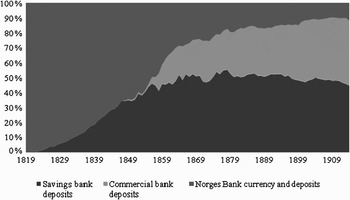
Norges Bank was chartered as the country's first bank in 1816 to restore monetary stability after the Napoleonic wars and long enjoyed a dominant position. Until 1858, the currency and deposits of Norges Bank exceeded the combined deposits of all other banks. Only in the late 1860s did the deposits of the commercial banking sector outgrow its liabilities. Like many other note issuers at the time, Norges Bank operated more in the manner of a private bank.
The first commercial bank, Christiania Bank og Kreditkasse, was established in response to the financial calamities of 1848. At that time, Norway already had an emerging savings bank sector with some 80 banks. The first savings bank was set up in Christiania in 1822 and the other major cities soon followed. From the outset these had been established as benevolent institutions promoting saving among the lower classes, but before long they turned into general-purpose banks. In particular, the major town savings banks ventured into commercial banking (Nordvik Reference Nordvik1993). From urban areas, the savings banks spread to the countryside leaving barely any hamlet behind. The strength of the saving banks is shown in Figure 1, which displays the contribution of the savings banks, the commercial banks and Norges Bank to the money stock. The importance of the former increased rapidly until the level of its deposits reached 50 per cent of the money stock by the 1860s.
Contribution to the money stock by source

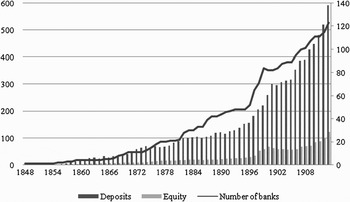
In the early years, the expansion of commercial banking was modest, as seen in Figure 2. By 1865, only four banks had been set up in addition to CBK. Among them were Den Norske Creditbank and two major regional banks, Bergens Privatbank (1856) and Privatbanken i Trondhjem (1859). From the mid 1860s, the number swelled as commercial banking went beyond the confines of the major cities and became a countrywide phenomenon. In the 1890s, commercial banking entered a frenetic phase which nearly doubled the number of banks, only to be arrested by the 1899 Christiania crisis and following recession. With the turn of the business cycle from 1905 onwards, the market share of commercial banks again increased strongly, but only a number of smaller new banks were established.
Number of commercial banks, commercial bank equity and deposits (in million kroner), 1848–1913

Knutsen argues that the years from 1870 to 1914 must be seen as the formative period in which the structure of Norwegian banking was shaped (Knutsen Reference Knutsen, Forsyth and Verdier2003, p. 148). In the formative years, certain distinct features were developed. One of the most important was how the local bias in credit centred on unit banks was segmented. The major commercial banks like Christiania Bank og Kreditkasse and Den Nordenfjeldske Kreditbank which had ventured into out-of-city branching retreated to their home turf. By 1914, the five biggest banks in the country operated a total of only two branches. Only one medium-sized bank, Skiensfjordens Kreditbank, operated a regional network of branches. Thus, expansion for both the savings and the commercial bank sectors took the form of new unit banks. In consequence, many became quite modest affairs. Moreover, new banks were not only established in places which had not previously been served by an institutional intermediary. Many medium-sized towns had two commercial banks in addition to their savings bank. By 1914, Trondhjem, the third largest city, was served by five commercial banks and three savings banks for a population of around 50,000. Such a magnitude reflected not only localism, but also the fact that different strata in society wanted ‘their’ own bank. In Christiania, even a bank for teetotallers was established to provide sober finance. A number of rural municipalities had two banks, often reflecting a geographical divide or competing local elites. No attempt at structural rationalisation was undertaken and the profoundly locally oriented structure remained intact well into the post-World War II era.
In the literature on Norwegian commercial banking the question of backwardness has enjoyed a prominent place. This emphasis may, however, have been misleading. In the backwardness thesis there is a strong normative underpinning of how a financial structure ought to have looked. For those associating localism, unit banking and a lack of investment banks with retarding structural factors, the unnamed ideal with which they compare the past seems to be some kind of major countrywide commercial bank which efficiently allocates resources between areas and sectors thereby providing economic leadership (Egge Reference Egge1983; Hofstad Reference Hofstad1928, p. 125). Embedded in this view is arguably a particular interpretation of the interplay between financial development and economic growth, with a strong causal link from development to growth (Hodne 1918, pp. 373–410; Sejersted Reference Sejersted1968). Assumptions of ‘proper’ patterns of development might be valuable as theoretical benchmarks, but entail a risk of losing sight of the particular historical context and might end up with little insight beyond a measure of distance from the ideal structure.
In moving beyond backwardness, I agree with Nordvik that the emergence of the Norwegian financial sector before 1914 above all reflected fundamental real economic development (Nordvik Reference Nordvik1993). In short, no ideal financial architecture exists and over time the financial sector will adapt to real economy changes and demand. In terms of ideal structures, Knutsen argues that Norway developed a hybrid model, somewhere between English deposit banking and German universal banking (Knutsen Reference Knutsen, Forsyth and Verdier2003, pp. 155–6). I think Knutsen is right in his claim that Norway answered to no archetype, but I believe Norway was rather more close to deposit banking. A weak equity position – with an average equity to assets ratio in 1900–13 of 12.6 per cent – made Norwegian commercial banks strongly dependent on deposits. Such dependence obviously had ramifications for the lending profile of banks, i.e. a bias for short-term commercial credit in order to avoid a potential liquidity trap. In comparison, the commercial banks in Denmark and Sweden enjoyed equity to assets ratios of 21.6 and 22.9 per cent respectively.Footnote 3 In consequence, for both countries, commercial banking leaned more towards investment banking. In particular, Sweden has often been seen as an exponent of universal banking with the major banks assuming command posts in the economy (Gasslander Reference Gasslander1960; Lindgren and Sjøgren Reference Lindgren, Sjøgren, Forsyth and Verdier2003, p. 140). Danish banks, in particular the three main banks, also kept close links to industry and operated in a manner which resembled universal banking (Hansen and Mørch Reference Hansen and Mørch1997, pp. 71–82).
Knutsen further argues that the particular localism reflected more profound features of Norwegian society and economy rather than backwardness. His line of argument draws on Verdier's application of the centre–periphery approach of Rokkan to the financial market: the degree of centralisation in a country was the outcome of the nineteenth-century process of state formation where the centre fought for control and the periphery for autonomy. According to Verdier, variations in national banking structures reflect variations in state formation, with the degree of centralisation as the critical variable. In Norway, as Knutsen argues, the outcome was substantial autonomy for local governments. Banking structures reflected this bias and the periphery displayed persistence in hindering legislation or institutions that would have helped promote nationwide finance (Knutsen Reference Knutsen, Forsyth and Verdier2003, p. 146). Moreover, I would like to add that while Norway was obviously a nation state by 1870, the country did not form an integrated economic entity during the formative years of the financial structure. For many districts, the economic linkages with foreign markets were vastly more important than the linkage with the national economy. In this respect, a local bias in banking merely reflects the less than integrated national economy.
III
The sources for the quantitative data used in this article vary. For the period 1900–13 Statistics Norway published a yearly study, Private Joint-Stock Banks, which included end-of-year balance data and annual accounts in a summarised form for all commercial banks. All major banks were included in the series by the first or second year of operation. Some smaller banks were not included for years after chartering. However, their overall weight is insignificant. For the period 1882–99 Statistics Norway included data on all commercial banks in their yearbook. These data are not as comprehensive as for the later period, but include the necessary information with regard to dividends, retained earnings, assets and equity. For the six banks included before 1882, I have used anniversary accounts, annual reports or published balance sheets. For share quotations 1900–13 for CBK, Den Norske Creditbank, Bergens Privatbank, Den Nordenfjeldske Kreditbank, Drammen Privatbank, Drammens og Opland Kreditbank, Skiensfjorden Kreditbank, Trondhjem Handelsbank and Stavanger Privatbank, I have used the Stock Brokers' Joint List until 1907, and thereafter, the official List of Securities traded on the Christiania Exchange, both published in the financial weekly Farmand. However, note that the first list does not necessarily represent actual share trading, but rather the brokers' assessment of fair value.
IV
By 1882, there were 28 commercial banks in Norway. To get an impression of dividend policies for the earlier period I have used data for six banks. Three of these – Den Norske Creditbank (DNC, established 1857), Bergens Privatbank (1855) and CBK (1848) – were the largest in the country in terms of assets before 1882. The others – Privatbanken i Trondhjem, Nordenfjeldske Kreditbank (1868) and Drammen Privatbank (1868) – were among the largest eight banks. Altogether, the six accounted for 74 per cent of all commercial banking assets.
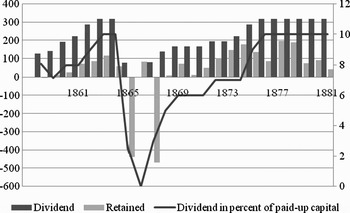
The examination found indication of a clear dividend bias in four of the banks examined. In particular, for the two major Christiania-based institutions, CBK and DNC, the bias is quite striking. Over a period of 34 and 24 years respectively the two banks paid out as dividends 88 and 84 per cent of accumulated net earnings. Although both in ‘normal’ years retained between a quarter and one-third of income, the bad years had a tendency to wipe out the reserves built up earlier. In the 1860s, DNC was hard hit by a real-estate bubble. Over two years, the bank had to reduce reserves in the magnitude of two-thirds of retained earnings for the whole 1870s. In consequence of this crisis, the bank, envisioned by the founders as the Norwegian crédit mobilier, i.e. as the central credit hub receiving deposits from all over the country and lending accordingly, had to settle for less lofty ambitions (Seip Reference Seip1971, pp. 176–86). Thereafter the bank, as Figure 3 indicates, gave priority to increasing the dividend upwards to the desired 10 per cent of paid-up capital.
Den Norske Creditbank: dividends and retained earnings in thousand kroner and dividends as percentage of paid-up capital, 1858–81

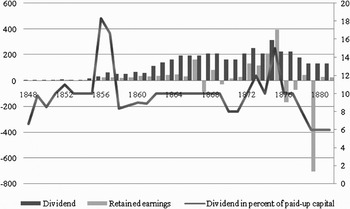
While DNC managed to avoid major setbacks in the course of the turbulent 1870s, its leading competitor CBK fared much worse. Already from the early 1850s, as seen in Figure 4, a 10 per cent dividend became the standard return to the shareholders, albeit with some variations in both directions. Notably both 1856–7 and the early 1870s represented periods of dividend payments above this level. When the economic downturn associated with the long depression hit the bank in the late 1870s, the dividend level was curtailed. In five of the operational years, reserves were bled to maintain the dividend level. In 1879, the only year the bank's books actually went into the red by more than 500,000 kroner, the bank still paid dividends.
CBK: dividends and retained earnings in thousand kroner and dividends as percentage of paid-up capital, 1848–81

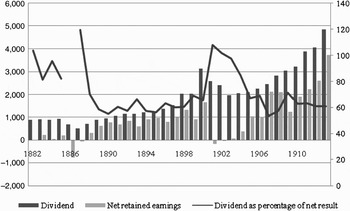
Commercial banks – dividends and retained earnings in thousand kroner and dividends as percentage of net result

Outside the capital, the two banks in Trondhjem also displayed a dividend bias. In its first full financial year (1859), Privatbanken i Trondhjem paid 13.5 per cent in dividends on the paid-up capital and retained only 10 per cent of net result. Due to a lacuna in the data for 1873–5 and a somewhat arbitrary accounting practice, the balance sheet of this bank is difficult to diagnose. Based on the data available and some caution, the average level of retained earning seems to be been somewhat above 20 per cent. The bank regularly paid a dividend of around 10 per cent on the paid-up capital and in some years all net income was distributed as dividends. Moreover, unlike CBK and DNC, Privatbanken i Trondhjem did not record any major setbacks in this period, thus making their high dividend preference even more pronounced. The bias was also found in Den Nordenfjeldske Kreditbank (1868), the second commercial bank to be established in Trondhjem. Over the first 12 years in business, close to three-quarters of net income was allocated to dividends. By the early 1870s, a dividend level of between 8 and 10 per cent of paid-up capital was established as the normal rate. However, the last years of the 1870s witnessed a remarkable shift. From a peak of 12 per cent in 1877, dividends in 1879–81 were maintained at the minimum level required by the bank's by-laws, 5 per cent. In both 1879 and 1880, dividends were paid in excess of net income, thereby reducing bank reserves. The bad performance in these years was closely connected with out-of-city branching. The branch in the northern town of Tromsø was liquidated after having incurred a loss of 215,000 kroner – or approximately four times the average annual dividend for the period 1876–8.
Two banks in our sample stand out in the sense that they had rather strong levels of retained earnings over time compared with the four examined earlier. By 1882, Bergens Privatbank, established in 1855, had become the second largest bank in the country and the largest outside the capital. Over the whole period, the bank retained 44 per cent of the net profits. However, this record did not reflect a more cautious dividend policy than the two major Christiania banks. While the average annual dividend as a proportion of paid-up capital for CBK in 1856–81 was 10.0 per cent and for DNC in 1858–81, 7.5 per cent, Bergens Privatbank paid 10.4 per cent in the same period. The explanations for the higher level of retained incomes are twofold. The bank was actually somewhat more profitable and, most importantly, managed to avoid the massive setbacks that the Christiania banks experienced. The books were never in the red and only in one year, 1861, did the bank make use of its reserves in order to meet dividend ‘expectations’.
Drammen Privatbank was organised in its present form in 1867. Of the banks examined here, this institution clearly displayed the most cautious dividend policy. For the whole period retained earnings represented 55 per cent of net income and bank dividends did not exceed 8 per cent in any year. Moreover, contrary to other establishments, Drammen Privatbank did not yield to the temptation of increasing dividends during the economic peaks of 1873–4 and 1877–8. Having created a buffer, the bank could maintain dividends at the previous levels even in the downturn of 1879. The reason for the cautious policy must be found in how the bank was founded. As in most other banks, the shareowners had paid up only a fraction of the subscribed capital and were personally responsible for the outstanding amount. How this was practised varied between banks. In some, the outstanding capital was just left as a guarantee on the books of the bank, in others, new instalments were called up on a regular or ad hoc basis, and finally, some banks reduced their shareholders' outstanding commitments by transferring retained earnings to paid-up share capital. In the case of Drammen Privatbank, the paid-up capital in 1869 constituted only 25 per cent of pledged capital – a markedly lower level than for most banks. Around two-thirds of retained earnings in 1869–81 were transferred to share capital, thereby reducing the outstanding commitment of shareholders from 75 to 45 per cent of the subscribed capital. Such a transfer freed up tied resources as shareholders had to put up collateral for their outstanding commitments. That this was a result of a conscious policy present from the commencement of the bank to strengthen equity is supported by data for the next decades. Having reached a paid-up capital ratio of above 50 per cent of subscribed capital, the dividend policy of the bank became closer to the average. For 1882–1907, 74 per cent of net income was distributed to shareholders and from 1895 the bank maintained a 10 per cent dividend on paid-up capital even in the face of major losses.
Four of the banks examined represent clear-cut examples of dividend bias. In particular, the two Christiania banks retained little. Over time, Bergens Privatbank paid higher dividends than the two Christiania banks, but due to profitability and lack of major setbacks clearly outpaced these two in terms of retained income. The cautious dividend policy of Drammen Privatbank must be understood in the light of a conscious strategy to reduce the outstanding commitments of shareholders, which from the outset in relative terms were clearly higher than in other banks. When this asymmetry was removed, the dividend policy came to reflect the main trend. Moreover, the examination shows how most banks were exposed to the dramatic changes in business fortunes in the late 1870s. The reserves retained in the fat years were insufficient to take the strain in the lean ones. Some banks, even in situations where overall reserves were all but exhausted, still continued to meet shareholder expectations by paying out dividends from non-existing profits.
V
For the whole period (1882–1913), the average annual dividends distributed by commercial banks constituted 70 per cent of net earnings. Over these decades, out of a net increase in bank equity of 104.4 million kroner, retained earnings represented only 29.1 million kroner. Moreover, two-thirds of retained earnings stemmed from the strong growth period from 1905 onwards. Thus, share issuing was clearly the most important source of bank equity. However, new share issues and the entry of new banks typically occurred in waves associated with booming economic conditions.
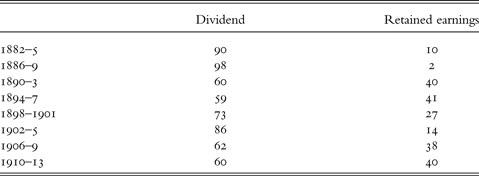
The dividend level varied considerably across time and to a lesser extent among individual banks. In Table 1, the relative distribution between dividends and retained earnings for each four-year period is displayed for the commercial banking sector.
All commercial banks: distribution between dividend and retained earnings as percentage of net income by period, 1882–1913
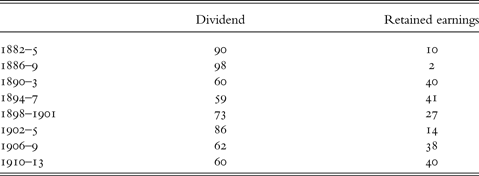
In general, the distribution followed the business cycle. In the 1880s, a period characterised by both strong cyclical volatility and discouraging losses, the level of retained earnings was very low. In three out of eight years, commercial banks as a group even reduced reserve equity in order to sustain the dividend level. The low point in that respect was 1886, when total equity fell by 5 per cent. Although reduced somewhat in the late 1880s, dividends were given priority over strengthening the financial position of the banks. To take a few examples: Tønsberg Privatbank, a small establishment with an equity of 278,000 kroner, displayed a deficit of 16,000 kroner in 1886 but still paid dividends of 12,000 kroner, thereby reducing equity by 10 per cent. In 1886, Bergens Privatbank, which previously had steered clear of major crisis, recorded a net loss of 168,000 kroner and paid dividends of 72,000 kroner, thereby depreciating the equity of the bank by 11 per cent and reducing reserve equity by one-third. The three following years, the bank recorded net income exactly equal to the dividends paid. This is a tendency found in the records of several banks in the period. For instance, in 1884, Privatbanken i Trondhjem recorded a net income of minus 95,000 kroner, and paid dividends of 25,000 kroner. For the following five years, net income equalled the dividends paid. Bank records for this period are troublesome and the banks had many opportunities for creative bookkeeping. This particular practice probably indicates hidden losses. Privatbanken i Trondhjem never managed to get on top of the situation and the hidden losses reappeared with a vengeance; in 1906 the ‘old’ equity was all but wiped out in a major reorganisation. Moreover, these examples illustrate both the willingness of banks to meet the owners' expectations of steady dividend payments and how reserves de facto were used to shelter dividends from business-cycle variations in earnings.
The 1880s became a decade of bank failures. In 1886, Arendal Privatbank, as the first private bank in Norway, went bankrupt, with shareholders losing everything and depositors 66 per cent. As in other troubled banks, the major problem was insider lending and a manager who used the bank as cash till for his own business ventures (Rygg Reference Rygg1954, pp. 185–6). The manager was allegedly arrested on the quay waiting for the boat to England. The local savings bank and a local savings institution for artisans followed suit into bankruptcy proceedings. In Stavanger, both Stavanger Kreditbank and the local savings bank went bankrupt, while the local branch of Norges Bank suffered substantial losses. The failures were a combination of depressed business conditions and bad banking. In the Kreditbank, the manager had lent 300,000 kroner – roughly one-sixth of bank assets, two-thirds of equity – to himself to fund undertakings that subsequently tumbled. Moreover, the Stavanger crisis exemplifies a pre-war characteristic of unit banking in small and medium-sized cities, namely, how local elites through kinship and mutual guarantees constituted credit networks where the stumbling of one brought down the others. The key player whose failure initiated the local banking crisis, Consul Sømme, was a member of the management of the city branch of Norges Bank and a director in the Kreditbank, while a son of his was a director in the savings bank (Rygg Reference Rygg1954, pp. 176–8).
With the improved business conditions in the 1890s, banks were able to distribute relatively more to retained earnings, while at the same time dividends in absolute terms increased as well. The decade, and in particular the last years, turned out be something of a banking bonanza.
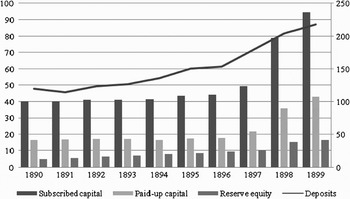
Although the 1880s witnessed a doubling of the number of commercial banks, the new entrants in general were smaller and medium-sized establishments. Paid-up share capital only increased by 28 per cent and although deposits went up by 45 per cent, two-thirds of this originated with banks already in business at the beginning of the decade. However, from the mid 1890s, Norwegian commercial banking entered a frenetic phase, as seen in Figure 6. From 1895 to 1899 the number of banks increased from 48 to 89, while equity and deposits increased by 126 and 45 per cent respectively. Although new entrants accounted for two-thirds of the increase in share capital, only a third of new deposits went to these banks.
Banking expansion in the 1890s (in million kroner)

The banking frenzy had two faces. Outside Christiania, banks were established in towns that previously had no commercial banks, pretty much intensifying the countrywide expansion of commercial banking. In Christiania, the frenzy was closely related to the prevailing real-estate and property boom. In 1897–8, fuelled by the prospects of ever increasing returns, six new banks were established in a city which was already served by five commercial banks. In addition, both Christiania Realkreditbank and Christiania Handelsbank undertook large share issues. From 1894 to 1899 the paid-up bank capital in Christiania more than trebled, increasing by 17.6 million kroner from a base just below 7.5 million kroner. Moreover, some 1.5 million kroner was paid as premium in connection with share issues in old and new banks. The new shareholders also vouched for an additional 13.5 million kroner in subscribed shares where the liability was not fully paid-up. In retrospect, but also seen by some contemporary observers, these new banks were typical ‘jobbing’ institutions (Sundt Reference Sundt1901). They specialised in financing real-estate speculations and development, were strongly exposed to individual entrepreneurs and displayed a tendency to fund their long-term commitments by way of short-term foreign credit. When the bottom fell out of the boom with the collapse of the house of the major entrepreneur Chr. Christophersen in the summer of 1899, one bank went immediately into receivership, signalling mounting troubles for the rest. In the course of the next few years, all the newly established banks, as well as Christiania Handelsbank, went either bankrupt or into liquidation. Christiania Realkreditbank had a narrow escape, losing more than half of the paid-up equity (Hofstad Reference Hofstad1928, pp. 171ff.)
In terms of dividend policy, the 1890s was a consolidation period with retained earnings at a stable level around 40 per cent of net income. This held true even for the troubled years 1899 and 1900, with the latter year in absolute terms representing an all-time high both for retained earnings and dividends. However, the Christiana bust and the following prolonged recession made a strong impact with stagnating deposit levels and reduced profitability. While in the 1890s commercial banks had conquered market shares at the expense of the savings banks, the tide had now turned with respect to the competition for both deposits and lending. In this situation, rather than strengthening reserves, retained earnings became close to negligible for the commercial banking community as a whole. For the period 1901-4, more than 9 million kroner was paid in dividends while only 189,000 kroner was retained. Although dividend payments decreased from 3.1 million kroner in 1900 to 2 million kroner in 1904, it is evident that bankers were strongly inclined to protect the dividend level over the financial strength of their banks. In this period, the situation differed substantially among banks. If we exclude the banks that were liquidated in the course of this period from the data, the level of retained earnings was probably somewhat below one million kroner. Among the survivors, the results also differed. A number of banks avoided the worst impact of the recession and continued the distribution of net income along the patterns of the 1890s. One example of such banks is CBK, which was probably the most conservative Christiania bank during the boom. CBK maintained a 10 per cent dividend and paid out roughly two-thirds of net income as dividends in 1901-4. Its main competitor, DNC, fared much worse. For the whole period 1899–1904, the bank had a net income of 2.2 million kroner and paid dividends of 3.1 million kroner. In both 1900 and 1901, dividends at 640,000 kroner equalled net income, while in the subsequent years, the bank reduced reserves by 512,000 and 256,000 kroner respectively in order to pay dividends.
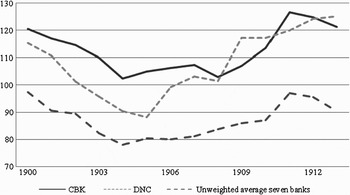
Figure 7, displaying the end-of-year quotations for the shares of CBK and DNC as percentage of book value as well as the unweighted average for a group of seven other banks, illustrates how the financial market perceived the banking crisis. From an average quotation just below book value in 1900, the group's shares were traded at a substantial discount for the next decade with a trough in 1904 with an average discount above 20 per cent. Both the major Christiania banks were constantly traded above this average quotation, but in the years of losses and reduced dividends, DNC was traded markedly below its main competitor. CBK, albeit feeling the impact of the recession, was the only bank in the sample which continuously commanded a premium on the book value; a reasonable market response given that the bank went through the crisis unscathed and maintained its 10 per cent dividend.
Stock market quotations (end of year) as percentage of book value of some major banks, 1900–13

With banks going out of business and few new entrants, the number of banks actually decreased for some years. Only one Norwegian bank of note was established in the first five years of the new century. Centralbanken for Norge was established in 1900 by some 40 regional and local banks to serve as their correspondent in the capital. By 1913, this bank had become the largest bank in the country in terms of assets. In its first decade of operations, Centralbanken displayed a conservative approach to dividend payments, paying out only one-third of net earnings to their shareholders. This policy might reflect the particular ownership structure.
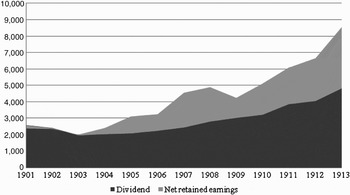
The year of the dissolution of the union with Sweden, 1905, became the starting point for an unprecedented boom in the Norwegian economy; fuelled by capital imports and investments in hydro-electrical power and power-intensive industry. The boom coincided with a strong expansion in commercial banking: from 1905 to 1913 the deposits of commercial banks increased by 96 per cent. With the arrival of more prosperous times, the economic fortunes of the commercial banking sector improved. From a low of 2 million kroner in 1903, by 1913 net earnings had reached 8.6 million kroner. While close to no income had been retained in the banks in the first four years displayed in Figure 8, the internally generated funds increased strongly in the years before the war. In relation to net income, average retained earnings were on a level with the 1890s at around 40 per cent. The renewed perception of strength is also present in our stock market sample presented above.
Commercial banks: dividend and retained earnings in thousand kroner, 1901–13

The last decade before the war witnessed the creation of some 35 new banks. Most of the new banks were minor institutions set up in rural hamlets and smaller towns. In Christiania, the transformation of a former private banker to a joint-stock company (Andresens Bank, 1913) and a special-purpose bank for long-term shipping credit were the only new entrants of note. Despite increased numbers, the paid-up capital of the commercial banks did not reach the pre-crisis level until 1910. However, from 1909 to 1913, the paid-up capital increased from 42.9 to 70.1 million kroner, while other equity increased from 29.4 to 52.8 million kroner. Around half the latter increase stemmed from premiums paid on new share issues. Altogether, 38.8 million kroner was thus raised through the stock market in the course of four years. With the notable exception of Andresens Bank, the overwhelming part of the capital raised went to increase the equity of existing banks.
This examination ends with five years of strong expansion. Fuelled by the booming conditions, existing banks issued new shares and retained income thereby strengthening equity in an unprecedented manner. Banking had seemingly entered a more mature phase, at least with respect to the emphasis on solidity. Had history, like our examination, stopped with the coming of the Great War, this image heralds certain truths. History, of course, does not end. The boom continued throughout the war fuelled by easy money and lulled by an atmosphere of ever increasing prosperity. The boom changed character from older banks consolidating their position, to a wave of new entrants, mirroring the late 1890s. Nothing lasts forever. With the coming of peace, the jobbing atmosphere gave way to deflation, a major recession and a substantial bank crisis that made 1899 pale in comparison.
VI
An important element hitherto not examined is the actual return on shares and how dividends fared in comparison to other investment opportunities. Given the state of the market for securities, which I will return to at length in the next section, I have not attempted to estimate potential capital gains. The lack of comprehensive data for stock market quotations, moreover, has led me to apply bank equity as proxy for market values of shares. This is not without potential pitfalls, notably the tendency to exaggerate the impact of shifts in nominal dividends on actual returns to investors. I have counterbalanced this by making a limited analysis for a nine major banks where trading data is available for the period 1900–13. As a benchmark I have applied the interest earned on three-month savings deposits, by far the most popular instrument of financial saving in pre-war Norway.
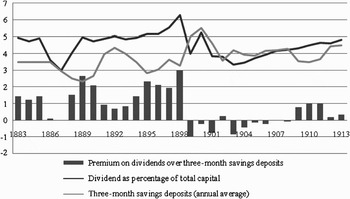
For the three decades in question, the annual average dividend as a proportion of total bank equity for all banks was 4.5 per cent compared to 3.75 per cent for three-month deposits, thus indicating an average, weighted premium for shareholders of three-quarters of a percentage point over bank saving. However, as Figure 9 makes robustly clear, this premium varied strongly over time. Roughly speaking, the period can be divided in two: before the crash of 1899 and thereafter. With the exception of the late 1880s, dividends gave a return on total equity around 5 per cent or above until the crash. With the loose money market and low interest rates prevailing in most of this period, dividends at times commanded a very strong premium, notably so for the periods 1888–90 and 1894–8. Although the real premium in lieu of market prices for shares was in all likelihood lower, this level of return obviously made banking look attractive and provided a strong impetus for the banking boom of the 1890s.
Bank dividends compared with three-month savings deposits, 1883–1913

After the crash, a combination of falling nominal dividends and an increase in interest rates removed the premium on shares. Not until 1909 did dividend in percentage of total equity again show a premium over deposits. The annual average premium for the period is as low as 0.04 per cent. However, this picture is modified when total bank equity is replaced by market values. I have calculated the return to owners by way of dividend payments on investment in shares for the nine banks for 1900–13, finding an unweighted average annual premium of three-quarters of a percentage point over deposits.
VII
The examination in the sections above demonstrates that commercial banks in Norway harboured a dividend bias. Over time, 70 per cent of annual average net result was distributed as dividends. A major bank like DNC paid dividends in the order of 82 per cent of annual average net result before 1882 and 88 per cent thereafter. In some periods associated with business-cycle downturns or severe economic crisis, literally nothing was retained while banks seemingly attempted to maintain dividend payments. In this section, we move beyond the quantitative examination in order to seek a fuller understanding of dividend policy in the formative years of commercial banking.
A company, or in this particular case a bank, which generates a profit can in principle make use of the net earnings after taxes in two ways: retain earnings or pay dividends. By retaining earnings a company might improve the balance between debts and equity, fund future investments or just create a buffer for rainier days. By paying dividends, a company secures an income flow for the owner, sends a message of strength to the market and avoids becoming overcapitalised. Studies demonstrate that financial markets are sensitive to changes in dividends (Pettit Reference Pettit1972). Thus, the choice between dividend and retained earnings reflects company strategies and outlook.
The first indications of how Norwegian bankers thought about dividends are found in the by-laws of the early banks. The original by-law of CBK from 1848 is edifying with regard to how to employ the net result. In order of preference: (1) A 5 per cent dividend on the paid-up capital. (2) The remaining profits were to be equally divided between dividend payments and reserves. Any losses should be carried before (2), but after (1). Moreover, only when the reserves were completely exhausted, might the bank refrain from the commitment to pay the 5 per cent dividend. The purpose of the reserves was threefold: to provide ample cover for future losses, maintain dividends at a steady level and ensure that equity increased in tandem with deposits. The by-laws further stated that deposits should not exceed ten times the combined equity of the bank. As in most early banks, the shares of CBK were only partly paid-up with the outstanding amount accounted for as pledged capital. Whenever the reserves reached a certain level, 5 per cent of nominal share capital, the amount might be transferred to paid-share capital, thereby reducing the outstanding commitment of shareholders. When share capital was fully paid-up, by way of transfer from reserves or calls upon the shareholders, the bank had no obligation to increase reserves as long the tenfold relationship between equity and deposits was not violated.Footnote 4 In the by-laws of DNC, established in 1857, the tenfold principle and the priority of the 5 per cent dividend are the same as for its main competitor in the capital. However, of the exceeding net earnings, 10 per cent should be given as bonus to the manager and directors, at least 10 per cent should be retained as reserves, while the rest should be distributed as dividends. The only limitation was that as long as the shares were not fully paid-up, the dividends should not exceed 10 per cent of paid-up capital. Provisions were made for all reserves to be gradually transferred to paid-up share capital.Footnote 5 Bergens Privatbank, incorporated in 1856, applied the same formula as CBK with respect to making use of the net income. However, when the reserves were equal to the paid-up capital, shareholders were freed from further obligations, their documents of collateral were to be returned and ‘as long as the reserves were unabated at this level, the whole net income is to be distributed to shareholders'.Footnote 6 In the by-laws of Nordenfjeldske Kreditbank, established in 1868, the same principles as in the earlier examples are retained: first a 5 per cent dividend on the paid-up capital, of the outstanding net result up to, but not exceeding, 50 per cent to the reserves and the rest for additional dividends. The function of the reserves was to secure against losses and smooth dividend payments, i.e. maintain the basic 5 per cent level even in times of weak performance (Gierløff Reference Gierløff1943, pp.70–4).
These by-laws are instructive. By 1914, the first three banks in question were all among the four biggest commercial banks, while Nordenfjeldske was the leading bank north of Dovrefjell. Moreover, there is a strong tendency for new entrants to copy – in their entirety or partly – the by-laws of existing banks. As such they served to institutionalise – by way of transmission – a certain way of thinking to the emerging commercial banking sector. Most striking here is of course the first-order principle that shareholders should receive a fair return before any measures were taken to retain income or even cover losses. The 5 per cent dividend level – more or less explicitly guaranteed – might be understood more as a sort of basic compensation for putting your capital at the disposal of the bank than a risk premium. One bank, DNC, even applied the term interest rate rather than dividends on this part of the return to shareholders. Reading the by-laws, it is obvious that retained earnings is not an important part of a growth strategy. Reserves should above all priority be built up to smooth-out dividends, protect against losses and reduce the amount of unpaid share capital still outstanding. In some banks, a certain minimum relationship was set between equity and liabilities, normally one-to-ten. However, in practice, new issues of shares rather than retaining earnings became the preferred strategy for replenishing equity in order to maintain this minimum relationship.
The skewed relationship between dividends and retained earnings might also be understood in light of the underdeveloped character of the domestic security market. Shareholders invest in order to get a return on their money. In principle they can obtain this in two ways; either in the form of dividends or by making a capital gain when selling the shares. In isolation, the preference between the two reflects the time horizon of the investor. The long-term investors dependent on a steady revenue stream, i.e. the classical rentiers and ‘old widows’, will have a preference for stable dividends at a high level. A capital gain, on the other hand is necessarily more important for the short-term investor. Realising such a gain, however, depends on an efficient and liquid stock market. Evidence indicates that the stock market in Norway was slow to mature. Shares and bonds were not quoted on the Christiania Exchange until 1881. Even after that the market seems to have been of only limited value. In 1892 only four banks – all based in the capital – were quoted.Footnote 7 Before 1897 the quotations took place monthly, from then on biweekly until weekly quotations were introduced in 1908 (Thon and Due Reference Thon and Due1919). Published lists from stockbrokers also indicate a limited over-the-counter market.Footnote 8 During the stock market bonanza in the late 1890s, much of the trading took place on the curb, i.e. outside the institutionalised market.
The widespread practice of partially paid-up shares further reduced market efficiency in two ways. Firstly, as the investor for a small initial amount bought a potentially huge liability, the information asymmetry between insiders and outsider increased. As banks went bankrupt during the Christiania crash of 1899, this proved to be a disastrous trap for many shareholders. Secondly, shareowners had to put up collateral for the unpaid share capital either through a mortgage deed or by way of sufficient personal guarantee. Thus, a sale of shares depended on the Board of Directors of the bank in question accepting the collateral offered. After the crash, this practice was gradually abandoned. While paid-up capital for all banks had stood at only 46 per cent of the subscribed capital in 1899, the figure had reached 68 per cent by 1913.
Thus, the strong preference for high and stable dividends in the by-laws testifies to the underdeveloped security market. When the first banks were established in the 1850s no organised market for securities existed and investors necessarily had to take a long-term view. Healthy dividends, at minimum in line with the return on ‘safe’ investments like real-estate mortgages and government guaranteed bonds, but with a potential for an even higher upside, became the standardised way of attracting capital. In turn, dividend policy became institutionalised and shaped investor expectations. Even after the embryonic rise of organised markets, this continued to be the case. It is reasonable to argue that in place of an efficient market, shareholders adopted much of the outlook of long-term bond holders.
Retained earnings at best played only a marginal role in the growth strategies of banks. In consequence, banks became more dependent on issuing new shares to strengthen funding and accommodate growth. Given an optimal capital market, raising funds through share issuing should in theory be as efficient as relying on retained earnings (Miller and Modigliani Reference Miller and Modigliani1961). As the examination above makes clear, the domestic capital market was far from optimal. Rather, it was institutionally immature and subject to rather volatile booms and bust. The evidence also suggests quite strongly that both the creation of new banks and in particular new share issues were associated with booming economic conditions. The prelude to the severe banking crisis of 1899 was a boom in new banking enterprises. All the six banks newly established in the capital, as well as the older bank Christiania Handelsbank, which had substantially increased its share issue, went bankrupt or were put into liquidation. In downturns, very few new issues took place. Given the discount on the book value that bank shares traded at during the recession, this is not very surprising: new issuing in such a climate would necessarily have involved diluting existing shareholder values. Thus, the market for new equity functioned rather cyclically and was not a reliable source of funding. In retrospect, the underdeveloped market for securities constituted a sort of double jeopardy. The state of the market helped shape a dividend policy that made banks dependent on share issuing while at the same time making the marketing of the new shares uncertain.
With the financial crisis of the last few years close in mind, the one-to-ten ratio between equity and liabilities indicated in some of the early by-laws examined seems pretty solid. However, applying the standards of today as benchmarks would be rather ahistorical. Clearly the equity demand was much higher a hundred years ago, reflecting the perceived improvement in risk management. Moreover, what constitutes sufficient solidity will vary between different types of banking and banking structures. Unit banking, and hence a potential for limited risk diversification, would be an argument for a high equity level. Correspondingly, investment banking would also typically need higher equity than deposit banking, in order to match the more long-term character of its portfolio. Bank solidity in Norway seemed rather weak in comparison with the situation in Denmark and Sweden, with 40 per cent lower equity ratio. Moreover, both the banking data and contemporary sources indicate a certain preference for high gearing. In his Socialøkonomik, the standard textbook in economics used before the war, Professor Aschehoug discussed the question of dividends and share capital. He argued that it was easier to earn a solid dividend on a relatively small share capital than on a large one, which made the former rather attractive. Although safety called for a strong equity position, too much equity might easily lure the bank into frivolous and risky investments in order to maintain high dividends. However, too high a level of dividends would lead to competitors entering the market (Aschehoug Reference Aschehoug1904, p. 213). In writing this, the learned professor did not only rely on academic theory, but also reflected his strong practical experience. Aschehoug had been one of the original members of the Board of Directors in Den Norske Creditbank in 1857 and continued to serve in this capacity until his death in 1909.
DNC illustrates the perceived double-edged nature of high equity which led to a preference for high gearing. In the last stage of the boom, just ahead of the burst of the Christiania bubble of 1899, DNC had doubled the paid-up share capital by way of new share issues. With the economic crisis and severe losses, maintaining the 10 per cent dividend which had become the norm in the 1890s became difficult. The years 1902 and 1903 saw dividends fall to 8 and 4 per cent respectively, all paid out of reserves. Not until 1910 did the bank return to what it believed to be its ‘normal’ dividend rate (Petersen Reference Petersen1957, pp. 89ff). Skiensfjorden Kreditbank, a leading bank in south-east Norway, also faced ‘difficulties earning the normal dividend’ on the enlarged share capital when the cycles turned (Østvedt Reference Østvedt1951). A number of older and new banks that raised new capital during the course of the frenzy of the late 1890s faced the same problems. When the prospects of growth failed to materialise, some of these turned out to be heavily overcapitalised. Ten years after the bust, at least four of these banks laboured with equity-to-assets ratios ranging from 28 to 40 per cent and faced problems meeting dividend expectations.
The dividend preference was not a rarity observed only for Norway. In the case of Denmark, the available data indicate even less retained earnings from operations than in Norway.Footnote 9 From 1900 to 1913, Danish banks paid dividends in the order of 151 million kroner, while overall reserves only increased by 33 million kroner. The latter figure also includes premiums paid on new share issues. Average annual dividends as a proportion of total equity for all Danish banks in this period were 5.6 per cent compared to only 4.2 per cent in Norway. The same pattern is found for Sweden's two major banks. Skandinaviska Banken distributed 95 per cent of declared net income as dividends on average for 1900–13 (Søderlund Reference Søderlund1964, p. 380). As a proportion of total funds, dividends paid constituted a striking 7.9 per cent annual average. However, the numbers must be treated with some caution. The historical account of the bank refers to a tendency present for building up hidden reserves. Almost all increase in the reserves stemmed from premiums paid on new share issues. On the eve of the war, the second largest bank, Stockholm Enskilda Bank, retained one-third of net income on average for the period 1900-13 (Gasslander Reference Gasslander1960, p. 42). Thus, the difference between banks in Norway and in neighbouring countries is not dividend policy, but rather solidity expressed through the equity-to-assets ratio. Swedish and Danish banks were better funded in the first place and better equipped or more willing to raise additional funds in the more efficient stock market in Copenhagen and Stockholm. In the last fifteen years up to 1913, the three major Norwegian commercial banks, DNC, CBK and Bergens Privatbank each issued new shares just once. For the major banks across the border and the Skagerrak, issuing new shares had become a regular way of increasing funds. The three main Danish banks in this period on average issued new shares four times while Skandinaviska and SEB did so on four and five occasions respectively.Footnote 10 Contrary to the situation in Norway, these banks could maintain a high dividend preference and at the same time be reasonably assured that new equity might be called upon through public offerings. In the Norwegian case, the capital market was not a reliable place for raising new capital. Banks issued new shares through the capital market in two major waves, the late 1890s and the last few years before the war: the former was a classical bubble that burst; the latter more robustly founded, but turned unhealthy when the banking boom continued into the war years.
In its formative period, Norwegian commercial banking remained within the framework of unit banking, deposit taking and commercial lending. There were few signs that the Norwegians would follow the path of the Swedes and enter into a major structural rationalisation. Some of the banks had ventured into out-of-city branches in their earlier years, got burnt and either sold their branch to local interests or just liquidated the enterprise. Thus, no countrywide bank came into operation. In fact, the origins of the bank closest to the idea of a countywide ambition, Centralbanken for Norge, underline the importance of the local character of Norwegian banking. The bank was established by local financial institutions that believed that the Christiania banks drained the country of deposits without giving anything back.
As discussed earlier, the banking structures were primarily formed in response to real economic demand reflecting the decentralised nature of the Norwegian economy. Dividend policy had little impact on banking structures, but the banking structures allowed for a dividend bias. An alternative banking structure in tune with the neighbouring countries, i.e. with stronger concentration, nationwide aspirations and ambitions to undertake long-term industrial investments, would have had important implications for dividend policy. Growth in either scale or scope would have necessitated a call for a stronger equity position to fund long-term commitments. Under such a scenario, banks would either have had to use the capital market more actively through new issuing of shares or retain more income. Given the nature of the market for securities, a relatively higher portion of new equity would in all likelihood have had to stem from operations than actually was the case in the neighbouring countries. This, however, belongs to the realm of the contrafactual. The probable contenders for becoming a countrywide or universal bank did not aspire in this direction. The Norwegian economy did not necessitate expansion in scale and scope for banks to grow. For most, doing more of the same was sufficient. Only with the increased centralisation of the domestic economy, particularly after World War II, did a fundamentally new type of bank emerge.
VIII
The examination demonstrates that commercial banks attached great weight to providing their owners with high and stable dividends over time. The dividend bias reflected institutional set-up, shareholder preferences, weak financial market structures and a tendency for high gearing. These elements all worked in the same direction, giving a financial structure which in comparison with the neighbouring countries was characterised by weak solidity. Although there is a certain tendency towards a stronger awareness of the need for bank solidity in the aftermath of the banking busts of 1899, banks still continued to honour shareholder expectations. Only with the strongly improved fortunes of the economy and the financial sector after 1905 did the banks start in earnest to build up reserves generated from operations.