INTRODUCTION
Morphosyntactic impairments are present across a variety of developmental disorders (Rice, Warren & Betz, Reference Rice, Warren and Betz2005). More specifically, omission of the English morphemes for tense (i.e. grammatical forms indicating location in time; e.g. past -ed) and/or aspect (i.e. grammatical forms indicating how an event is viewed, such as complete or ongoing; e.g. progressive -ing) have been reported in children with specific language impairment (SLI; Rice & Wexler, Reference Rice and Wexler1996), autism spectrum disorder (ASD; Bartolucci, Pierce & Streiner, Reference Bartolucci, Pierce and Streiner1980; Roberts, Rice & Tager-Flusberg, Reference Roberts, Rice and Tager–Flusberg2004), and those identified as language delayed/late talkers (LD; Paul & Alforde, Reference Paul and Alforde1993; Rescorla & Roberts, Reference Rescorla and Roberts2002). Interestingly, presentations of tense/aspect impairment appear to vary across these disorders, with some (e.g. SLI) manifesting more frequent and developmentally sustained omissions than others (e.g. LD, ASD). If true, such variability could shed light on whether these developmental disorders should be viewed as distinct disorders, where sources of the impairments are distinct (e.g. extended optional infinitive for SLI; Rice, Wexler & Hershberger, Reference Rice, Wexler and Hershberger1998, and social/pragmatic difficulties for ASD; Tager-Flusberg, Reference Tager-Flusberg and Dawson1989), or falling within a continuum, where the potential source of impairment lies in a general mechanism (e.g. working memory) found across the disorders (Tomblin, Reference Tomblin, Bavin and Naigles2015). However, cross-disorder comparison, as well as comparison with typical development, requires accurate tools and multiple measures, neither of which has been utilized consistently in extant literature. Critically, previous studies on tense/aspect use in these populations have relied on short samples of (semi-structured) spontaneous speech for analysis; many have also examined only one aspect of tense/aspect use (e.g. correct uses; Leonard, Caselli, Bortolini, McGregor & Sabbadini, Reference Leonard, Caselli, Bortolini, McGregor and Sabbadini1992; Paul & Alforde, Reference Paul and Alforde1993; Tek, Mesite, Fein & Naigles, Reference Tek, Mesite, Fein and Naigles2014). Sparse sampling and single-measure analysis may each result in missed or accentuated developmental differences (Lieven & Behrens, Reference Lieven, Behrens and Hoff2012; Naigles, Reference Naigles and Hoff2012).
The current study sought to overcome these limitations by exploiting a new technology – the Speechome Recorder – that enables dense video and audio data collection in home settings. Using this technology, we collected a large corpus of speech from one child with a history of ASD diagnosis, but at the time of the study presented only with a language delay, and one sex-matched typically developing (TD) child, allowing us to compare the tense/aspect component of grammatical development between the two speakers in unprecedented detail. In what follows, we review current literature on the development of tense and aspect in developmental disorders, then discuss a number of methodological and measurement-based gaps in the field, and conclude with a prospectus of how the current study addresses these gaps.
Tense/aspect usage in developmental disorders
References to time are prevalent in discourse, and are typically captured in grammar as tense and/or aspect markers across languages. Languages do not always mark both features grammatically; for example, only aspect is marked in Chinese, while in English both aspectual and tense markers are present. Additionally, grammatical marking of tense/aspect can differ widely from language to language, with some languages using particles (e.g. Mandarin Chinese) and others auxiliaries (e.g. Bamileke-Dschang: Comrie, Reference Comrie1985; Wagner, Reference Wagner and Binnick2012). Children acquiring their native language, then, must learn which markers refer to which time-relevant functions. Moreover, in languages such as English, there can be overlap between aspect and tense morphology (e.g. the -ed morpheme marks past tense as in I baked a cake, and completed aspect in I had baked a cake); thus, the morphemes do not map onto meanings in a one-to-one fashion. Despite these potential challenges, TD children begin to acquire tense/aspect morphology around two to two-and-a-half years old, first producing the progressive -ing marker and later the regular past -ed marker, both of which are provided in 90% of obligatory contexts by approximately four to five years of age (Brown, Reference Brown1973; de Villiers & de Villiers, Reference de Villiers and de Villiers1973; Rice et al., Reference Rice, Wexler and Hershberger1998; Wagner, Swensen & Naigles, Reference Wagner, Swensen and Naigles2009).
Children with SLI
The acquisition of tense seems much more challenging for children with SLI. In particular, preschoolers and early school-age children with SLI often omit tense markers, including the third person present singular (3PS) -s as well as regular -ed and irregular forms of past tense (Leonard et al., Reference Leonard, Caselli, Bortolini, McGregor and Sabbadini1992; Rice & Wexler, Reference Rice and Wexler1996; Rice et al., Reference Rice, Wexler and Hershberger1998; Rice, Wexler, Marquis & Hershberger, Reference Rice, Wexler, Marquis and Hershberger2000). Rice et al. (Reference Rice, Wexler and Hershberger1998) examined the development of tense in children with SLI across three-and-a-half years at six-month intervals (children's age ranging between four to eight years old across the study) using productions from spontaneous samples as well as experimental probes. Children with SLI exhibited a protracted development for tense, supplying the correct tense morphemes in less than 90% of obligatory contexts even at eight years of age. Utilizing a grammatical judgment task with the same population, Rice, Wexler, and Redmond (Reference Rice, Wexler and Redmond1999) found that, while children with SLI accepted errors involving tense, they nonetheless were able to correctly reject errors involving the progressive -ing, suggesting that production of tense but not aspectual morphology is impaired in this population.
Children with LD
This protracted difficulty with tense in children with SLI contrasts with what has been observed in children who present with language delay at age two, but who eventually achieve general expressive language skills that meet age expectations (e.g. producing utterances at similar lengths to same-age peers; Paul & Alforde, Reference Paul and Alforde1993; Rescorla, Reference Rescorla, Rescorla and Dale2013; Rescorla & Roberts, Reference Rescorla and Roberts2002; Rescorla & Turner, Reference Rescorla and Turner2015). These children lag behind TD peers in their acquisition of vocabulary (i.e. producing fewer than 50 words on the Language Development Survey; Rescorla, Reference Rescorla1989) and syntax (i.e. not producing multiple word combinations; Rice, Taylor & Zubrick, Reference Rice, Taylor and Zubrick2008) between 24 and 34 months of age. Some research suggests that late talkers demonstrate morphological and syntactic difficulties in toddlerhood (Paul and Alforde, Reference Paul and Alforde1993; Rescorla, Dahlsgaard & Roberts, Reference Rescorla, Dahlsgaard and Roberts2000), some of which may resolve by the preschool years.
Paul and Alforde (Reference Paul and Alforde1993) found that, compared to TD age-matched controls, children with LD demonstrated mastery of fewer morphemes at four years of age, even among those who were producing utterances at age-appropriate lengths. They replicated reports that TD children provide correct morphemes for the progressive -ing, regular past -ed, and 3PS -s in more than 90% of obligatory cases in spontaneous productions; however, children with LD in their sample who caught up in MLU still omitted the 3PS -s with some frequency (producing the morpheme in 77% of obligatory contexts), while children with LD who showed continued language delays frequently omitted both 3PS -s and regular past -ed.
In contrast, Rescorla and Roberts (Reference Rescorla and Roberts2002) reported that while three-year-olds with a history of LD demonstrated difficulty with the 3PS, four-year-olds with LD produced similar rates of verbal morphemes in obligatory contexts when compared to utterance length matched TD controls. Rescorla and Turner (Reference Rescorla and Turner2015) also found that, with the exception of the 3PS -s, five-year-olds with a history of LD did not differ from age-matched TD peers in their frequency of spontaneous productions of tense morphemes. Moreover, when the children were further divided into those who produced utterances at age-appropriate levels and those who showed continued delays, only the latter group demonstrated a significantly lower rate in producing 3PS -s in obligatory contexts compared to controls. Thus, despite early expressive language delays, children with LD appear to show some recovery at least with regard to their tense use (see Rescorla, Reference Rescorla, Rescorla and Dale2013, for discussion on continued impairments in other areas of language).
Children with ASD
While studies suggest that difficulties with tense are persistent in children with SLI, but somewhat resolved in children with early language delay, findings from research on the development of tense and aspect in children with ASD produce mixed results. Early research examining spontaneous speech of school-age children with ASD report deficits, with these individuals omitting more tense morphemes, and/or acquiring them in a different order, than TD children (Bartolucci et al., Reference Bartolucci, Pierce and Streiner1980; Howlin, Reference Howlin1984). In contrast, Waterhouse and Fein (Reference Waterhouse and Fein1982) found that older children with ASD, when matched with TD children on utterance length, did not differ in the frequency of their spontaneous use of present progressive, past irregular, and past regular markers. Moreover, Tek et al. (Reference Tek, Mesite, Fein and Naigles2014) examined the frequency of Brown's (Reference Brown1973) fourteen grammatical morphemes in younger (two- to four-year-old) children's spontaneous speech, and reported that a high-verbal subgroup of children with ASD produced tense/aspect morphology at growth rates – based on frequency of use – comparable to TD children matched on initial language level (see also Park, Yelland, Taffe & Gray, Reference Park, Yelland, Taffe and Gray2012; Tager-Flusberg, Calkins, Nolin, Baumberger, Anderson & Cadwick-Dias, Reference Tager-Flusberg, Calkins, Nolin, Baumberger, Anderson and Chadwick-Dias1990, for similar findings). Importantly, Tek et al.’s (Reference Tek, Mesite, Fein and Naigles2014) speech sample size was much larger (e.g. corpus between 157 and 227 utterances for high-verbal group) than that collected by Bartolucci et al. (Reference Bartolucci, Pierce and Streiner1980; corpus of 50 utterances).
Measuring tense/aspect acquisition
At least two different patterns of tense/aspect impairment seem to be manifested by these three developmental disorders; namely, developmentally sustained impairment in SLI and early impairment/delayed onset, which may later reach TD levels, in some samples of LD and ASD. However, the findings from the three disorders are not always comparable, as similar measures are not always employed. For example, studies of children with LD, and especially ASD, have primarily examined frequency of use; however, successful acquisition entails more than sufficient frequency of use; it also involves the ability to use the forms correctly, productively, and consistently (Hoff, Reference Hoff2012). Thus, including additional measures of acquisition beyond frequency may provide additional insight to the deficits found in tense/aspect morphology in children with ASD and children with LD.
High frequency of tense/aspect use does not automatically entail that all uses are correct. Children can make commission errors with markers (e.g. you gives ; you is going). If these occur frequently, they may indicate atypical development, because TD children rarely make consistent commission errors (Snyder, Reference Snyder, Danis, Mesh and Sung2011), unlike children with Williams Syndrome (Capirci, Sabbadini & Volterra, Reference Capirci, Sabbadini and Volterra1996; Clahsen & Almazan, Reference Clahsen and Almazan2001; Volterra, Caselli, Capirci, Tonucci & Vicari Reference Volterra, Caselli, Capirci, Tonucci and Vicari2003).
Another measure of tense/aspect acquisition is productivity. Productivity is a core characteristic of grammatical knowledge in TD children and refers to the ability to use grammatical constructions in creative ways (Chomsky, Reference Chomsky1959; Tomasello, Reference Tomasello2000). It is usually demonstrated in TD individuals by: (a) using a grammatical construction with multiple lexical items (the convention is five or more; Rispoli, Hadley & Holt, Reference Rispoli, Hadley and Holt2009; Shirai, Reference Shirai1998); (b) employing a grammatical construction with novel lexical items (Akhtar & Tomasello, Reference Akhtar and Tomasello1997; Chomsky, Reference Chomsky1959); and/or (c) overgeneralizing a grammatical construction such that it is used with incorrect lexical items (e.g. errors of commission such as He goed; Marcus, Pinker, Ullman, Hollander, Rosen & Xu, Reference Marcus, Pinker, Ullman, Hollander, Rosen and Xu1992).
Acquisition of tense/aspect morphology can also be captured by children's consistency of use. Brown (Reference Brown1973) reported initial variation in the rates at which TD children provided a given morphological marking in obligatory contexts (e.g. providing markers in 60% of obligatory contexts in one session but 30% the next). For each morpheme Brown studied, a period emerged when the children began supplying the marker at or above 90% of obligatory contexts; after this, they continued to provide the marker at highly consistent levels (e.g. in ⩾90% of obligatory contexts across multiple sessions). This may reflect a change in children's grammatical system, from one where marking for tense, for example, may be optional to one that requires such marking (see Rice et al., Reference Rice, Wexler and Hershberger1998; Wexler, Reference Wexler and Rice1996, for more discussion). Thus, TD children initially show individual variations in their rate of providing morphological markers in obligatory contexts; after the period of acquisition, there appears to be less variation as children largely and consistently provide the markers in the majority (i.e. ⩾90%) of obligatory contexts.
To what extent are correct use/errors, productivity, and consistency manifested in children with developmental disorders? Of the disorders discussed here, SLI appears to be the most fully – albeit not completely – characterized with these measures. For example, multiple studies have examined the types of errors children with SLI produce and have found errors of commission to be rare (Leonard et al., Reference Leonard, Caselli, Bortolini, McGregor and Sabbadini1992; Rice et al., Reference Rice, Warren and Betz2005; Rice, Wexler & Cleave, Reference Rice, Wexler and Cleave1995). Using an elicitation paradigm, Leonard et al. (Reference Leonard, Caselli, Bortolini, McGregor and Sabbadini1992) found that three- to five-year-olds with SLI produced no commission errors with the regular past -ed. Errors with the 3PS -s were found but they were produced at low rates (i.e. 8% of 3PS -s productions), similar to that of utterance-matched TD controls (i.e. 7·5% of 3PS -s productions). Experimental studies using elicitation paradigms have also found that children with SLI are limited in their productivity with tense markers (Oetting & Horohov, Reference Oetting and Horohov1997; Rice et al., Reference Rice, Wexler and Cleave1995). Rice et al. (Reference Rice, Wexler and Cleave1995) examined the ability of five-year-olds with SLI to provide appropriate 3PS -s and regular past -ed markers to multiple familiar verbs (i.e. more than the common productivity criterion of five verbs) using elicitation probes. Compared to both age-matched and utterance-length-matched TD groups, children with SLI provided correct tense morphemes at significantly lower rates (e.g. 26–27% compared to 38–50% for utterance-matched controls). Children with SLI have also been shown to make overgeneralization errors with the past tense (e.g. goed), which is another measure of productivity. Using a similar elicitation paradigm to Rice et al. (Reference Rice, Wexler and Cleave1995), Oetting and Horohov (Reference Oetting and Horohov1997) found that, while children with SLI made overgeneralization errors, they nonetheless made fewer errors of this form (e.g. marking 34% of irregular verbs with -ed) compared to TD controls (e.g. marking 61% of irregular verbs with -ed; see also Oetting & Hadley, Reference Oetting, Hadley and Schwartz2008).
Whether children with SLI demonstrate TD patterns of tense/aspect acquisition with regard to their consistency of use is less clear. The children with SLI in Rice et al.’s (Reference Rice, Wexler and Hershberger1998) longitudinal study did not meet the 90% criterion, even by the end of the study (when the children were eight years old). Whether the children with SLI will demonstrate consistent or inconsistent use of the markers after their acquisition is unknown.
With regard to children with LD, measures of error, productivity, and consistency have been less explored. Examining the spontaneous speech of five-year-olds with LD revealed that errors of commission with grammatical morphemes were rarely produced (i.e. mean ranging between 0·68 to 1·1 number of tokens across the different morphemes) and did not differ from age-matched TD controls (Rescorla & Turner, Reference Rescorla and Turner2015). However, this is at an age wherein difficulties with tense/aspect morphology are somewhat resolved. Whether commission errors are absent during the emergence of these forms is unclear. Productivity and consistency measures are largely absent in the language delay literature.
Examinations of errors, productivity, and consistency of children with ASD's tense/aspect use are also limited. Given previous reports emphasizing rote and inflexible properties of speech in children with ASD (Kanner, Reference Kanner1946; Tager-Flusberg & Calkins, Reference Tager-Flusberg and Calkins1990), it may be expected that their use of tense/aspect morphemes will be less or even non-productive. However, experimental studies yield mixed findings regarding children with ASD's productivity. Roberts et al. (Reference Roberts, Rice and Tager–Flusberg2004) used elicitation probes to determine whether school-age children could use past (irregular and regular) and present (3PS) tense markers across multiple familiar verbs (i.e. >5 verbs), and found that five- to fifteen-year-olds with ASD provided correct tense markers with fewer verbs compared to age- and language-matched TD children. However, further investigation of their errors revealed that children with ASD were more likely to respond with verbs other than the target (e.g. producing “he's a hero” when asked what a cowboy does), or produce echolalic responses, rather than omit the tense morphemes themselves (Williams, Botting & Boucher, Reference Williams, Botting and Boucher2008). Thus, it is unclear whether their ability to extend tense morphemes to multiple verbs was indeed impaired or whether poorer performance on the task was due to other (e.g. pragmatic) difficulties. Park et al. (Reference Park, Yelland, Taffe and Gray2012) found that younger children with ASD (i.e. three- to six-year-olds) were able to produce past tense marking with novel verbs (e.g. jeg); however, they supplied the -ed marker with fewer novel items than TD controls (i.e. 2% of verbs compared to 40%). Similarly, there is limited evidence of productivity in the form of overgeneralization errors of the past tense in children with ASD, as such errors have not been reported in the ASD literature. Whether children with ASD do not make such errors, and thus do not demonstrate rule-based usage, or whether such errors have simply not been captured in previous studies due to limited speech samples, is unknown. Lastly, commission errors and consistency measures have not been investigated in the previous ASD literature; thus, to what extent these children demonstrate typical or atypical acquisition of tense/aspect is unknown.
In sum, the literature on tense/aspect morphology in special populations remains limited in its ability to provide a comprehensive description of children's acquisition of these forms. One purpose of the current study was to examine how the use of multiple measures may provide additional insight into the acquisition of tense/aspect morphology in developmental disorders, in this case, on LD in a child previously diagnosed with ASD.
Sampling limitations for tense/aspect acquisition
Previous studies examining spontaneous production of tense/aspect in children with developmental disorders are also limited in part due to the short samples (e.g. 30 minutes or less) collected for analysis (Bartolucci et al., Reference Bartolucci, Pierce and Streiner1980; Eigsti et al., Reference Eigsti, Bennetto and Dadlani2007; Howlin, Reference Howlin1984; Oetting & Horohov, Reference Oetting and Horohov1997; Paul & Alforde, Reference Paul and Alforde1993; Park et al., Reference Park, Yelland, Taffe and Gray2012; Rescorla & Roberts, Reference Rescorla and Roberts2002; Rescorla & Turner, Reference Rescorla and Turner2015; Rice et al., Reference Rice, Wexler and Hershberger1998; Tek et al., Reference Tek, Mesite, Fein and Naigles2014). The sensitivity of measures of tense/aspect correctness, productivity, and consistency suffers from short samples (Lieven & Behrens, Reference Lieven, Behrens and Hoff2012; Tommerdahl & Kilpatrick, Reference Tommerdahl and Kilpatrick2013). That is, the prevalence of tense markers may be over- or under-estimated if there are few references overall to the past or future, and short samples may limit these references to just a few episodes. Moreover, with short samples, productivity may be difficult to measure, as the contexts may not afford use of multiple lexical items for a given construction; for example, to reach the criterion of five verbs used with the past marker, five different past events (or aspects of events) need to be referenced. Eigsti et al. (Reference Eigsti, Bennetto and Dadlani2007) found that despite being as talkative as controls, children with ASD were less likely to mention non-present events. Thus, fewer verbs used with the past marker might simply be attributable to fewer episodes of talking about the past. Similarly, for errors, overgeneralizations are infrequent even among TD children, and so are less likely to occur in small samples (Marcus et al., Reference Marcus, Pinker, Ullman, Hollander, Rosen and Xu1992; Maslen, Theakston, Lieven & Tomasello, Reference Maslen, Theakston, Lieven and Tomasello2004). Lastly, small samples may not appropriately track consistent use over time. Tracking omission errors longitudinally with small samples can yield large variability in performance (Brown, Reference Brown1973). For example, a single omission error in a small sample could accentuate the error rate and, when compared to previous sessions, result in what appears to be a larger change in performance. Thus, to accurately assess correct use/error types, productivity, and consistency of tense/aspect use over time, both longer samples and those that take longitudinal measurements are needed. In the current study, we introduce a new method that enables dense longitudinal recordings of children's spontaneous speech, and focus analyses on tense/aspect use over time in a child with language delay and a sex-matched TD control.
Future tense: an understudied component of the English tense/aspect system
Almost all previous research concerning children with developmental disorders' acquisition of the English tense/aspect system has focused on present and past tense development; therefore, little is known regarding how these children acquire and use morphemes that indicate the future. Research with TD children has found they can distinguish the tense marker will from a past tense form (e.g. did), and can map the constructions be + going to to future events with familiar verbs by the beginning of the third year of life (Valian, Reference Valian2006; Wagner, Reference Wagner2001). Because the acquisition of future referencing forms will and going to require focused attention to items in a sentence's auxiliary position, children with developmental disorders (i.e. SLI, ASD, and LD) may be challenged since they have been reported to omit auxiliaries when producing verbs in the present and/or past tense (e.g. “He fixing the teeth” as cited in Roberts et al., Reference Roberts, Rice and Tager–Flusberg2004, p. 441; see also Bartolucci et al., Reference Bartolucci, Pierce and Streiner1980; Rescorla & Roberts, Reference Rescorla and Roberts2002; Rice et al., Reference Rice, Wexler and Hershberger1998). One expectation is that these omissions might also occur in the future tense. Moreover, future tense affords an additional avenue to investigate correct vs. erroneous uses and productivity in special populations.
Finally, previous work has found that TD children's initial use of tense/aspect morphology is influenced by the lexical telicity of verbs (Shirai & Andersen, Reference Shirai and Andersen1995). Telicity refers to the completeness of an event expressed through a verb or verb phrase, while atelicity refers to the incompleteness or ongoing property of an event (Comrie, Reference Comrie1976). Shirai and Andersen (Reference Shirai and Andersen1995) found that the progressive -ing, expressing ongoing action, is typically used more with atelic verbs while the past tense -ed is more frequently used with telic verbs in children's early productions of tense/aspect morphology. Whether telicity influences their use of future constructions in a similar matter, and to what extent this is found in children with developmental disorders, is unknown. For example, given that going to ___ contains a progressive element, these constructions might appear more frequently with atelic verbs, while will ___ constructions might appear more frequently with telic verbs.
Aims of the current study
The present study sought to address the gaps in previous research on grammatical development in children with developmental disorders by (a) collecting a dense dataset of spontaneous speech and (b) analyzing multiple measures of present, past, and future marker use. To do this, we compared use of tense and aspect markers in spontaneous speech by a child with delayed language development [Audrey] and a sex-matched TD child [Cleo] longitudinally, over the course of approximately four months. In order to obtain this larger and denser sample of speech data, the current study deployed the Speechome Recorder (SR), a novel recording device developed by Deb Roy and the Cognitive Machines group at the MIT Media Lab (Roy et al., Reference Roy, Patel, DeCamp, Kubat, Fleischman, Roy and Gorniak2006; Vosoughi, Goodwin, Washabaugh & Roy, Reference Vosoughi, Goodwin, Washabaugh and Roy2012).
The SR allows for continuous audio-video recording in a child's home, thereby collecting dense samples of naturalistic spontaneous speech of child–caregiver interactions. We sought use of the SR under the belief that it would allow us to capture possible subtle atypicalities that might not have been found when ‘sparser’ corpora (Lieven & Behrens, Reference Lieven, Behrens and Hoff2012, p. 239) are used. Thus, we aimed to investigate the following four questions in the study: (1) whether Audrey and Cleo were correct in their tense/aspect usage (comparing errors of both omission and commission); (2) whether they were productive (e.g. using verbs and overgeneralizations as measures); and (3) whether they were consistent in their use (e.g. by measuring proportion of correct uses in obligatory contexts). For these questions, we focused on present and past tense. Additionally, as future tense has not been examined in the special populations literature, we also investigated (4) the extent to which Audrey's uses of future tense/constructions were similar to that of Cleo in terms of frequency, correctness, productivity, and telicity. Our general predictions are that Audrey, as language delayed, would be less productive and show continued inconsistency, even after a period of acquisition (i.e. supplying a morpheme in ⩾90% of obligatory contexts across three sessions), in all of her tense uses.
A more comprehensive profile of the development of tense/aspect across developmental disorders will provide insight as to whether particular disorders lie along a continuum or form discrete groups. In particular, if distinct features of tense/aspect impairments are found (e.g. different frequencies and/or consistencies of omission errors between SLI vs. ASD populations), this would suggest that those errors emerge from different mechanisms. For example, a comprehensive profile might reveal that children with SLI make more omission errors but are nonetheless consistent with their omissions, while children with ASD make less omission errors but are inconsistent. This in turn might suggest that underlying sources for difficulties in tense/aspect acquisition differs between SLI (e.g. extended optional infinitive period; Rice et al., Reference Rice, Wexler and Hershberger1998) and ASD (e.g. social/pragmatic difficulties; Tager-Flusberg, Reference Tager-Flusberg and Dawson1989). On the other hand, similarity in profiles (e.g. if both SLI and ASD are characterized by both higher omission errors and developmental inconsistency) might suggest that difficulties with tense morphology are driven by the same underlying mechanisms (e.g. general impaired working memory; Leonard, Reference Leonard, Bavin and Naigles2015).
METHODS
Participants
We installed SRs in two families' homes. To ensure confidentiality of the participants, their pseudonyms are used here. In one family, the target child was ‘Audrey’, who was recorded between the ages of 2;9 and 3;2. Audrey received a clinical diagnosis of ASD as well as met the cut-off for abnormality of development prior to 2;6 on the Autism Diagnostic Interview–Revised (ADI-R; Rutter, LeCouteur & Lord, Reference Rutter, LeCouteur and Lord2003) with a score of 4 (cut-off = 1). According to her parents' report, examples of her autistic symptoms consisted of limited expressions of emotions, a delay in pointing, and having an unusual interest in fans and lights. When the current study began at 2;9, however, Audrey did not meet ASD criteria, with an Autism Diagnostic Observation Scale score of zero (Lord et al., Reference Lord, Rutter, Goode, Heemsbergen, Jordan, Mawhood and Schopler1989) and a Mullen Early Learning Composite (standard score) of 103 (Mullen, Reference Mullen1995). While Audrey's diagnostic status vis-à-vis ASD was ambiguous at the time of the study, she presented with language delay, as her spontaneous speech productions were of a length and vocabulary comparable to TD children who were six months younger (discussed further below). Moreover, while any observations of potential atypicalities might be limited in their generalizability to a specific developmental disorder, we believe that this may nonetheless be a useful case study for demonstrating the utility of dense data sampling and of the use of multiple measures to investigate tense/aspect acquisition in special populations more broadly.
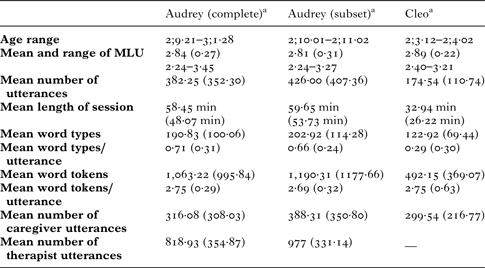
The SR was installed in the playroom in her home for approximately four months. Over this period of time, 35·07 hours were recorded, with one session approximately every 4 days (M = 3·47 days, SD = 5·92 between recordings; Table 1), for a total of thirty-six sessions. Almost two-thirds of the sessions were recorded with family members (n = 22) present; the others were recorded during therapy sessions (n = 14) with an in-home therapist. No activities during the therapy sessions targeted tense/aspect use specifically; activities appeared to target social interaction difficulties (e.g. following eye-gaze) and more general linguistic knowledge (e.g. labeling groups of pictures as belonging to different noun categories such as furniture or food). All sessions typically involved interactions between the child and the therapist/caregiver(s). That is, the majority of interactions captured were not ones in which caregiver(s) and therapist were conversing with other adults. We present Audrey's language use from all thirty-six sessions.
Comparison of Cleo and Audrey across the subset of thirteen sessions and Audrey's complete dataset.

notes: a Means refer to mean per session; standard deviations are presented in parentheses.
Our second child, ‘Cleo’, was a TD child who had never exhibited symptoms of ASD or LD prior to the start of the study. Cleo was recorded between the ages of 2;0·06–2;4·02. Testing during infancy yielded a standard score of 106 on the Mullen Early Learning Composite (Mullen, Reference Mullen1995) and of 35 on the Ages and Stages, Personal-Social section, Domain raw score (i.e. on schedule; Squires & Bricker, Reference Squires and Bricker2009). Cleo thus served as a sex-matched TD control to Audrey. A sex-matched control was selected as sex differences in early language development have been previously reported (Gleason & Ely, Reference Gleason, Ely, De Lisi and De Lisi2002), and we wanted to ensure that any differences found were not simply influenced by the sex of the children. The SR was installed in the family's playroom for four months. Over this period of time, a total of 40·53 hours was recorded over the course of sixty-six sessions. Sessions primarily consisted of free play with the mother and/or father, with a few sessions in which a babysitter was also present. Again, the majority of interactions captured involved the child.
From the start of Audrey's participation in the study (at 2;9), she was relatively verbal, with a mean length of utterance (MLU) of 2·73 in her first session. Because Cleo's recordings began at a younger age (2;0·06), her initial MLUs was shorter than Audrey's (i.e. typically lower than 2·00 per session). Cleo's utterances reached a length similar to Audrey's initial MLU only towards the end of her participation. Previous work has shown that utterance length rather than age per se was a better correlate to tense/aspect acquisition (de Villiers & de Villiers, Reference de Villiers and de Villiers1973). Therefore, to make comparisons between the two children at similar language levels, we present Cleo's language development across the thirteen sessions during which her MLU could be matched to Audrey's (Table 1). The sessions were selected by matching range as well as average MLU of the two children. It should be noted that for the thirteen sessions matched on MLU, Cleo (M = 2;3·22, SD = 8 days) was younger than Audrey (M = 2;10·10, SD = 9 days) in chronological age. Thus, we made comparisons between Cleo and Audrey's use of tense/aspect based on similar language levels and not age.
Speechome Recorder
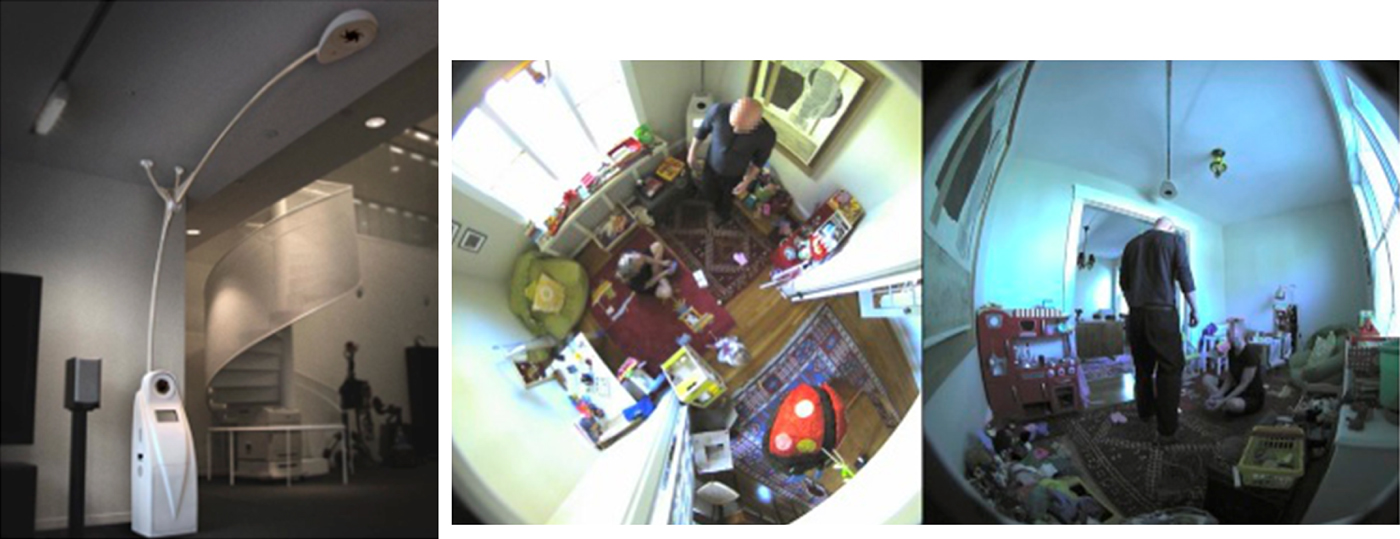
Spontaneous speech samples were collected through the SR (Vosoughi et al., Reference Vosoughi, Goodwin, Washabaugh and Roy2012), a portable version of the original Speechome (Roy et al., Reference Roy, Patel, DeCamp, Kubat, Fleischman, Roy and Gorniak2006) that allowed for synchronized audio and video recording (Figure 1) in a single room of a family's home (Naigles, Reference Naigles and Hoff2012; Vosoughi et al., Reference Vosoughi, Goodwin, Washabaugh and Roy2012). The SR has two wide-angle, fish-eye cameras, one placed overhead and one facing the front. This allowed us to capture a wide, general view of the room; thereby recording activities that took place across a large area with multiple participants, as well as a more specific view for activities that involved just the child and caregiver (Figure 1). While the SR was installed in only one room in the home, a variety of interactions involving different speakers and activities were captured, thereby providing measures of the children's language production across different situation types. No on-site experimenter was needed as the SR was maintained remotely (see Vosoughi et al., Reference Vosoughi, Goodwin, Washabaugh and Roy2012, for details), thereby capturing naturalistic interactions in a less obtrusive way than sending a videographer into the home.
The Speechome Recorder (left) and different views from the overhead (middle) and frontal (right) cameras.

In order to ensure the privacy of the families, caregivers were allowed to turn the SR on and off as desired as well as to review and delete any videos before sharing with the research team. Across the duration of the study, Audrey's family deleted one recording (out of 36) and Cleo's family deleted three recordings (out of 66). This suggests that the samples collected reflected typical caregiver–child interactions rather than simply optimal interactions selected by the caregivers. All videos were checked to ensure that only participants who had provided informed consent were recorded. All reviews of the audio/video content revealed only consented participants. Institutional Review Boards at the Massachusetts Institute of Technology and University of Connecticut approved these procedures.
Transcription
A software tool called ‘Blitzscribe’ (see Vosoughi et al., Reference Vosoughi, Goodwin, Washabaugh and Roy2012, for more information) was employed to organize and transcribe the immense amount of speech data collected by the SR. Blitzscribe differs from traditional transcription methods in that non-speech noises are automatically removed using pattern classifiers prior to the transcription process, i.e. only segments marked as human speech are extracted for human transcription. Three individuals transcribed recordings obtained in this study. Pairwise reliability of word-to-word matching (including grammatical morphemes as well as word roots) for 10% of each child's corpus, randomly selected, ranged from 90·4% to 91·2% between the three transcribers.
After utterances were transcribed with Blitzscribe, they were compiled by session and converted into CHAT format (MacWhinney, Reference MacWhinney2000). A final pass of the transcriptions, performed while also viewing accompanying time-synchronized videos, was made by the first author to correct for any errors, insert missing utterances, and make notes about the contexts in which the interactions occurred.
General speech analyses
Using CLAN's analysis tools (MacWhinney, Reference MacWhinney2000), MLU and frequency counts of types and tokens for each session were calculated. All verbs were then extracted and coded for whether they included tense information (i.e. present, past, or future) or not (i.e. modals and infinitives; e.g. “She can fall” and “I want to walk”, respectively; see Table 2 for further subdivisions). When a verb was produced in its stem form (e.g. “I sleep in it”), either the context (e.g. child had been lying on the couch or blanket on ground and gets up) or confirmation from parent/caregiver utterances (e.g. “well you mean you used to sleep in your crib”) was used to determine whether tense information should have been provided. If tense needed to be marked, the context was again scrutinized to categorize the appropriate tense of the verb (following Brown, Reference Brown1973). The aspectual marker -ing was also coded, as it is a temporally relevant morpheme acquired early in development (Brown, Reference Brown1973; de Villiers & de Villiers, Reference de Villiers and de Villiers1973). Following most reports on early tense development (Brown, Reference Brown1973; de Villiers & de Villiers, Reference de Villiers and de Villiers1973), the copula was not included in our analyses.
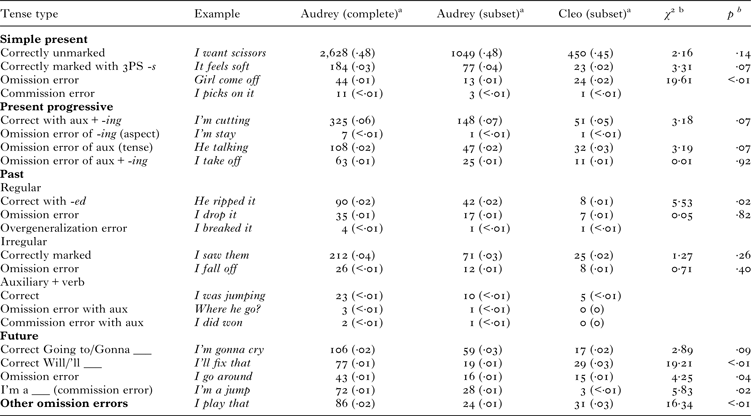
Token frequency of Audrey and Cleo's production of tense and aspect markers (in parentheses are proportions out of the total number of verb tokens). Chi-squared analyses comparing tense/aspect use between Audrey (subset) and Cleo (subset) are also presented.

notes: a Not included in this table but counted towards the total number of verb tokens are modals, infinitives, and unclear tokens; b blank cells indicate that there were not enough tokens of the particular tense/aspect type to run a χ 2 analysis.
When a verb was produced in an incomplete or partially transcribed utterance, whose meaning was indeterminable, the verb was labeled as un-codeable and was excluded from further analyses (301 verb tokens, 5·53% of all verb tokens for Audrey; 101 (10·08%) of verb tokens for Cleo). Frozen forms or phrases (i.e. forms and phrases learned as a whole rather than by their combinatorial parts, such as producing “clean up” while singing the ‘clean up’ song) and repetitions were also excluded. A verb produced by the child was counted as a repetition when it mirrored the adult form within three utterances following the original.
For each child, two coders coded 20% of the total verb tokens, randomly selected, to determine the reliability of categorizing verbs into their tense/aspect categories (e.g. present, first person) and correctness of verb markings. A Cohen's κ analysis was used. Inter-rater reliability for categorization of verbs was ·76 for Audrey and ·77 for Cleo. Inter-rater reliability for verb marking correctness was ·81 for Audrey and ·70 for Cleo. A Cohen's κ between ·61 and ·80 is considered good agreement (Altman, Reference Altman1991).
Coding categories
Frequency of use
Verb tokens were scored for whether obligatory tense morphemes were correctly produced (e.g. -ed for an utterance that referred to the past). For each tense/aspect marker, the number of correct tokens was tallied to determine the raw frequency with which these forms were used correctly. As future tense does not involve the marking of the verb, the frequency with which verbs were used with the future constructions going to ___ and will ___ was calculated instead. For all tense/aspect forms, proportion of correct use was calculated by dividing the number of instances in which the morpheme/construction was correctly supplied by the total number of instances in which the morpheme was obligatory.
Errors
Tokens that omitted an obligatory morpheme were treated as omission errors. Instances in which the tense marking was required, but the context itself could not distinguish the exact obligatory marker (e.g. as in “I get bigger”, where it was unclear whether the child meant she will get bigger or she is getting bigger), were treated as errors of omission but categorized separately as ‘other omission errors’, For future tense, all omission errors (i.e. not using either going to ____ or will ____ to refer to future events) were grouped into one general ‘omission error’ category, as it was difficult to determine which construction the child would have used.
Tokens that included an erroneous morpheme (e.g. “I gets a baby”) were categorized as commission errors. A non-canonical future construction for Standard American English, I'm a ___ (e.g. “I'm a jump”; Green, Reference Green2002), was also treated as a commission error. Utterances in this construction were produced immediately preceding the actions they described (e.g. shortly after she produced “I'm a put one, all them in”, Audrey began putting individual game pieces into a mini basket, or after she produced “I'm a take these socks off”, Audrey sat down on the couch and kicked her socks off); therefore, we coded these utterances as expressing futurity.
Productivity
Our first measure of productivity applied to all tense/aspect morphemes; namely, the number of different verbs used with each was counted for each session as well as for the whole corpus (Rispoli et al., Reference Rispoli, Hadley and Holt2009; Shirai, Reference Shirai1998).
Our second measure of productivity applied only to the past tense morpheme; that is, the use of the -ed morpheme on an irregular verb stem (e.g. breaked) was coded as a (productive) overgeneralization (i.e. treated separately from all other types of commission errors).
Consistency criterion
To investigate developmental changes in which tense/aspect markers were used, Brown's (Reference Brown1973) 90% criterion was adopted. Under this criterion, a grammatical morpheme was treated as acquired when it was supplied in 90% or more of its obligatory contexts (i.e. proportion of correct use when required was ·90 or greater) across three consecutive sessions. Analysis for consistency was not performed for future tense/construction use because Brown's (Reference Brown1973) analyses did not include modals (e.g. will) or the construction going to; thus, we did not have a priori predictions of whether a pattern found with morphemes would necessarily be mirrored with constructions. Additionally, it was difficult to determine the proportion of correct use (out of all obligatory contexts) for each individual future construction, as the specific privileges of occurrence for going to vs. will are not mutually exclusive.
Analysis plan
First, we describe Audrey's uses of tense and aspect across all sessions. Second, to ascertain whether Audrey's use of these grammatical morphemes was typical, we present comparisons between her uses of different tense/aspect markings to that of Cleo's for the thirteen sessions when their MLUs were comparable. Following this, we report on follow-up analyses of Audrey's future tense use.
Due to the small n (in terms of participant sample size), non-parametric statistics were employed. In particular, to evaluate potential differences, a chi-square test for equality of proportions (Newcombe, Reference Newcombe1998) was performed for each type of tense and aspect marker. The test evaluates whether the proportion of a particular dimension of interest is the same/equal among groups. For example, the proportion of 3PS omission errors out of all 3PS errors made by Audrey was compared to that of Cleo to investigate whether a child with language delay made 3PS omission errors at a higher rate than a TD child.
RESULTS
Audrey's use of tense/aspect markers (all 36 sessions)
Audrey produced utterances with an average MLU of 2·84 (ranged between 2·24 to 3·45) over the 4·20 months of the study. Across all sessions, 5,440 verb tokens (196 verbs) were produced. Out of all verb tokens, 770 (14·15%) tokens were in the infinitive form and 220 (4·04%) tokens involved a modal. Because these do not involve tense, they will not be discussed further.
Frequency of use and errors
Out of all verb tokens, 3,370 (61·95%) referred to the present and 395 (7·26%) referred to the past. Two hundred and fifty-three tokens (4·69%) referred to the future using a future construction. An additional 43 expressions did not involve use of a future construction, but were produced by Audrey before she performed the action (e.g. “I go around” and then proceeded to move around the couch) or were confirmed by the parent's subsequent utterances to have a future meaning. As it is unclear which future construction Audrey might have intended to use, these expressions were not included in the subsequent analysis. Table 2 presents the frequencies of use of each morpheme and construction, both correct and incorrect uses. Note that the incorrect future form, I'm a ___, was produced by Audrey 72 times across her entire corpus.
Productivity
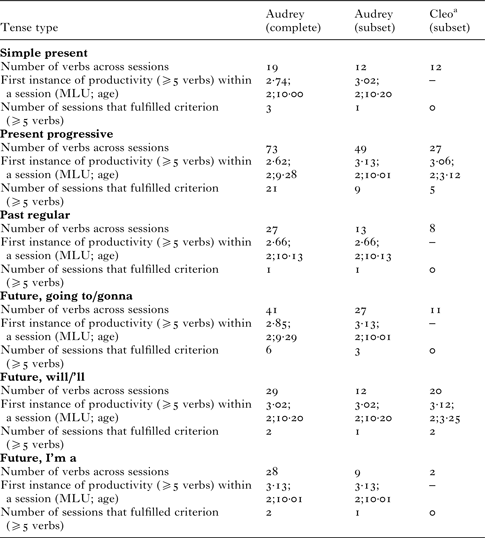
Audrey's number of verbs used with each tense and aspect marker is presented in Table 3. Clearly, across the four months during which she was recorded, she used each one productively, with ⩾5 verbs. Within session, productivity (i.e. using ⩾5 verbs within the same session) was similarly found for all tense/aspect markers. Productivity within a session was found earliest in development for the progressive (-ing) at 2;9·28, and latest in development for the future construction will ___ at 2;10·20. We also point out that there was considerable overlap in verbs used across future constructions. Nine verbs were used in all three future constructions and an additional nine verbs were shared between the going to ___ and I'm a ___ constructions.
Audrey and Cleo's productivity with tense and aspect markers (number of types).

notes: a ‘—’ indicates that the criterion for productivity (within a particular session) was not fulfilled for any of the thirteen sessions.
Audrey also demonstrated productivity via overgeneralizations of the past tense, four of which were produced across the entire corpus (i.e. breaked and throwed at 2;9·24, dided at 2;10·13, and broked at 3;0·01).
Consistency across sessions
With the 3PS -s, Audrey fulfilled Brown's (Reference Brown1973) 90% criterion at session 33 (age = 3;0·24, MLU = 2·73). With the progressive aspect -ing, Audrey fulfilled this criterion by session 14 (2;10·06, MLU = 2·85); however, variable performance (60–100%) continued until her last session. Audrey did not fulfill the 90% criterion for marking present tense on the auxiliary even by the last session (3;1·28, MLU = 3·12). With the irregular past, Audrey fulfilled the 90% criterion for this form at session 7 (2;9·29, MLU = 2·41), but sessions of her supplying the marker in fewer than 90% of obligatory contexts continued until session 33 (3;0·24, MLU = 2·97). With the regular past, Audrey fulfilled the 90% criterion by session 24 (2;11·11, MLU = 3·32), but variable performance (33–100%) continued until session 34 (3;0·26, MLU = 2·72). Again, no consistency analysis was performed for the future forms/constructions, as they were not included in Brown's study and the determination of ‘obligatory contexts’ for each construction was unclear.
In sum, across these four months, Audrey demonstrated substantial and increasing use of tense and aspect morphology. However, without comparisons to a TD child, it remained unclear whether her pattern of acquisition was typical in terms of frequency, error patterns, productivity, and consistency. Therefore, we compared Audrey's use of these grammatical morphemes to that of Cleo.
Comparison of present, past, and future construction use by Audrey and Cleo
We compared Audrey and Cleo only during sessions in which their MLUs were matched. This included 13 of Audrey's sessions (9 to 21) in which her mean MLU was 2·81 (range = 2·24–3·27; Table 1). During Cleo's 13 sessions, her mean MLU was 2·89 (range = 2·40–3·21). Audrey produced more utterances per session compared to Cleo, possibly because Audrey's caregivers/therapists talked more than that of Cleo's caregivers (Table 1), leading to a more ‘conversational’ context and more speech (e.g. elaborations) from Audrey. A Mann–Whitney test indicated that the MLUs for Cleo's 13 sessions (Mdn = 2·89) did not statistically significantly differ from Audrey's (Mdn = 2·86) (U = 73·5, n 1 = n2 = 13, p = ·59).
Frequency of correct use and errors
Comparisons between the 26 sessions revealed that Audrey and Cleo were comparable in their frequency of tense and aspect use with the majority of the morphemes (Table 2). With the exception of the regular past, Audrey and Cleo did not statistically significantly differ in their use of present and past tense/aspect markers in terms of frequency (ps > · 05). For the regular past, however, Audrey used the marker correctly at a statistically significantly higher proportion than Cleo (χ 2 (1, N = 3201) = 5·53, p < ·05). Comparison of Cleo and Audrey's errors with tense and aspect marking similarly revealed few differences. With the exception of omission errors with the 3PS, Audrey and Cleo made comparable number of errors for each tense/aspect subtype (ps > ·05). For 3PS omission errors, interestingly, Audrey produced a statistically significantly lower proportion of such errors compared to Cleo (χ 2 (1, N = 3201) = 19·61, p < ·01). With regard to omission errors that did not privilege a specific tense, Audrey also produced a statistically significantly lower proportion of such errors compared to Cleo (χ 2 (1, N = 3201) = 16·34, p < ·01).
More differences emerged with regard to the future constructions. When talking about future events, Audrey used the construction going to ____ (55·66% of future tokens) statistically significantly more than Cleo (34·69%; χ 2 (1, N = 155) = 5·89, p < 0·05; cf. no statistically significant difference was found when comparing Audrey's and Cleo's proportion of going to ___ out of all verb tokens, as reported in Table 2). Cleo, on the other hand, used will ___ (59·18% of future tokens) statistically significantly more frequently than Audrey (17·92%; χ 2 (1, N = 155) = 26·68, p < ·001).
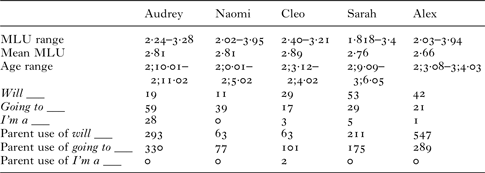
Cleo's future tense uses were rare; therefore, additional comparisons were performed with three other TD children from the CHILDES database (MacWhinney & Snow, Reference MacWhinney and Snow1990) during the period when their MLUs matched Audrey's (see Table 4): Sarah (Brown, Reference Brown1973), Naomi (Sachs, Reference Sachs and Nelson1983), and Alex (Demuth, Culbertson & Alter, Reference Demuth, Culbertson and Alter2006). A Kruskal–Wallis test revealed no statistically significant differences in MLU among the five children (H(4) = 5·37, p = ·25).
Comparison of Audrey and TD children's use of future constructions (tokens).

As Table 4 shows, children varied within the TD group: some used going to more frequently when referring to future events and others used will more frequently. Naomi falls into the former category, showing Audrey's pattern. A 2 × 2 chi-square test of independence revealed no statistically significant differences in the proportion of will and going to constructions used by Naomi and Audrey (χ 2 (1, N = 128) = 0·01, p = ·92). Alex and Sarah patterned similarly to Cleo, preferring to use will constructions rather than going to. A 2 × 3 chi-square test of independence revealed no statistically significant differences in the proportion of will and going to constructions used by Alex, Sarah, and Cleo (χ 2 (2, N = 191) = 1·66, p = ·44).
With the incorrect I'm a ___ construction, however, statistically significant differences by diagnosis emerged. Four out of the five children produced this construction: Audrey, Cleo, Sarah, and Alex. The frequency with which Audrey used this construction (26·41% of future tokens) was statistically significantly higher than Cleo's (6·12%, χ 2 (1, N = 155) = 7·40, p < ·01), Sarah's (5·75% of future tokens, χ 2 (1, N = 193) = 12·98, p < ·01), and Alex's (1·56%, χ 2 (1, N = 170) = 12·98, p < ·001).
Productivity
Audrey used more verbs (135) than Cleo (107). Across sessions, as shown in Table 3, both children used 12 unique verbs with the 3PS. With the progressive -ing, Audrey used 49 types while Cleo used 27 types. For past tense, Audrey used 13 types with the regular -ed while Cleo used 8 verbs. For future forms, Audrey used 27 verbs with going to ___, 12 with will ___, and 9 with I'm a ___, while Cleo used 11 verbs with going to ___, 20 with will ___, and 2 with I'm a ___. Within sessions, Audrey fulfilled the productivity criterion (i.e. using ⩾ 5 verbs within a session) for all tense/aspect markers. However, Cleo only fulfilled the criterion for the progressive (-ing) and the future construction, will ___. Lastly, even with these smaller samples, both Audrey and Cleo produced one overgeneralization of the past tense marker; i.e. Audrey produced dided at 2;10·13 and Cleo produced drawed at 2;3·29.
Consistency across sessions
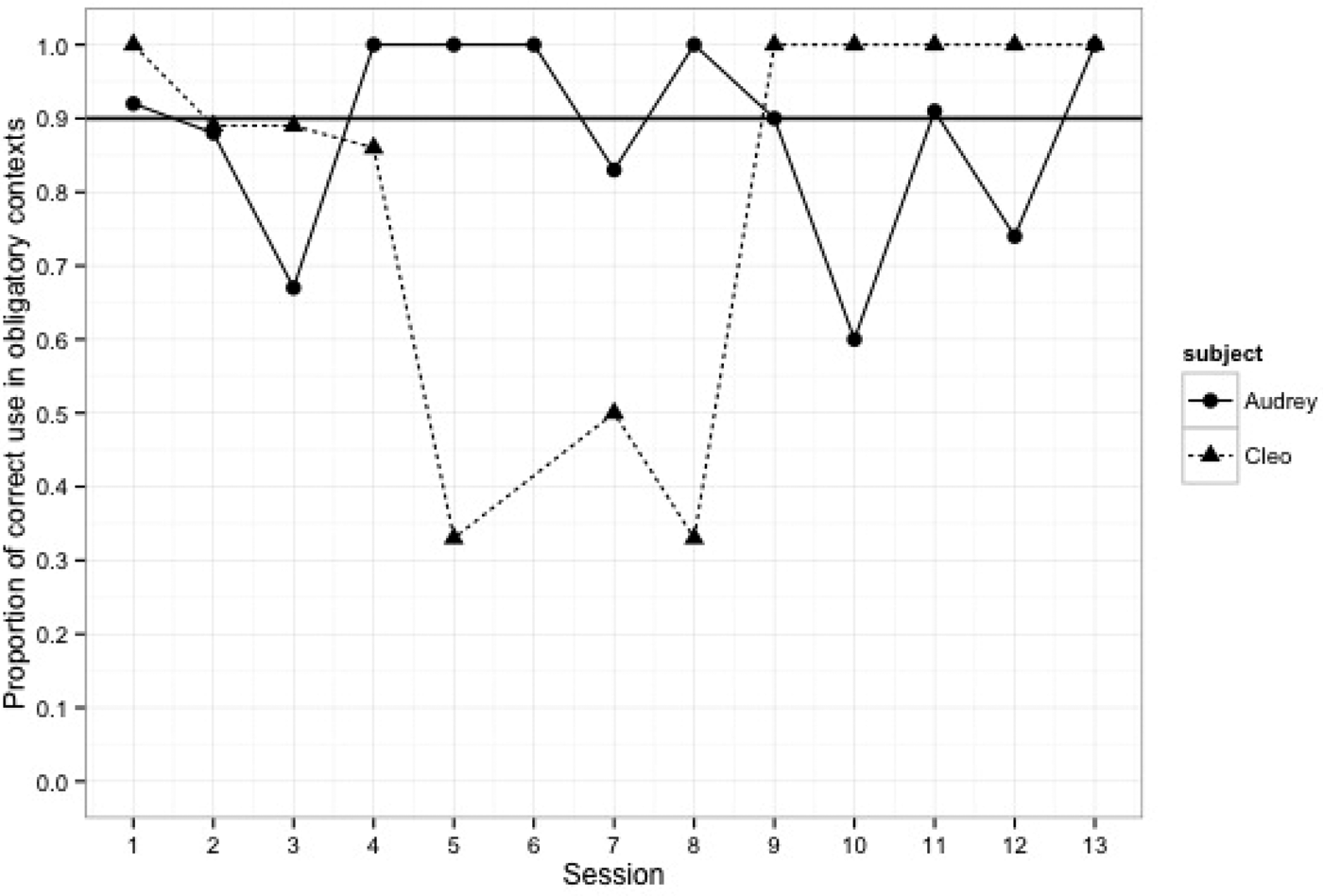
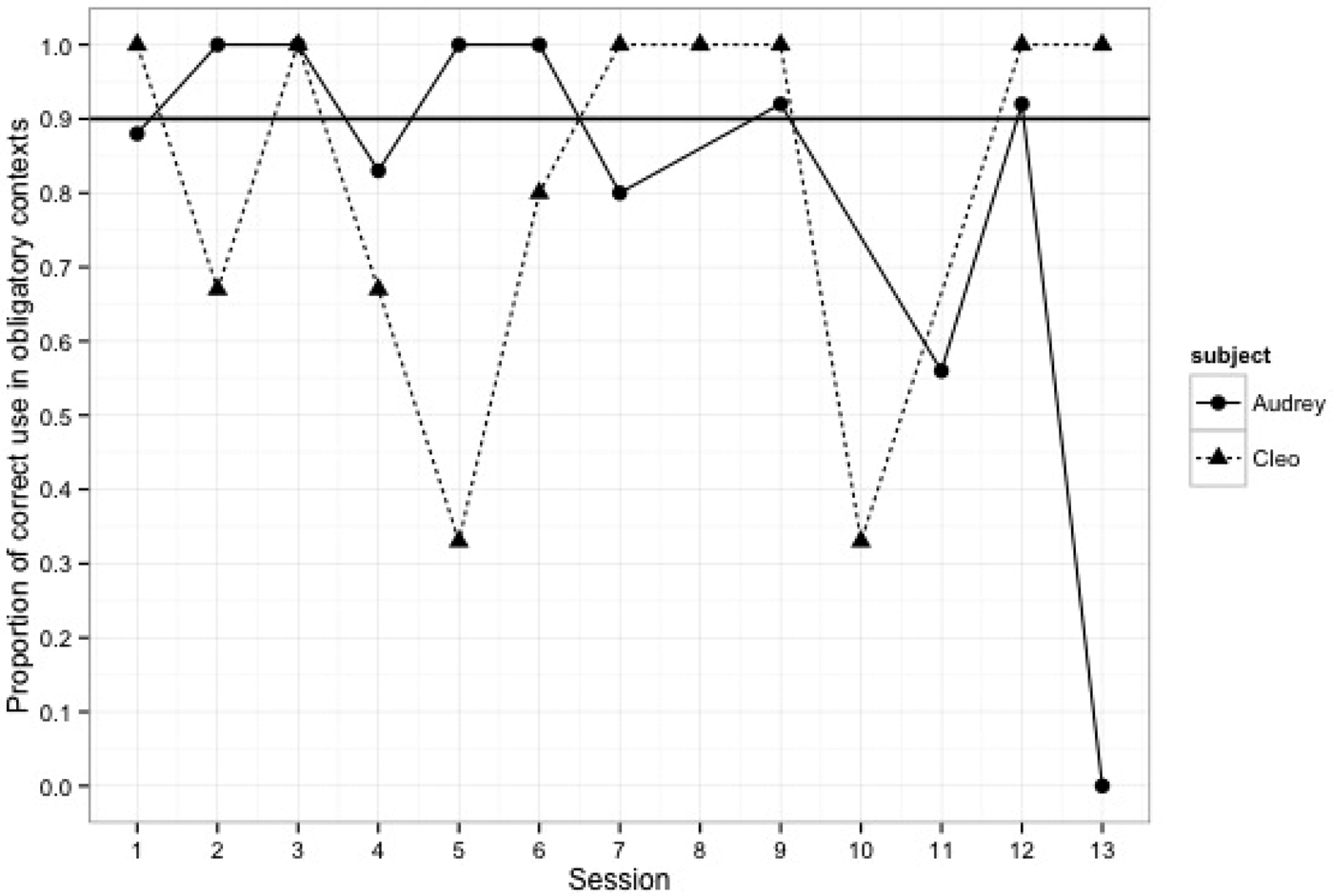
Additional statistically significant differences between Audrey and Cleo emerged when analyzing consistency patterns across sessions. For present tense, neither Cleo nor Audrey reached the 90% criterion for either 3PS or tense marking on auxiliary for the present progressive. With the progressive -ing aspect marker, both children reached criterion (Audrey: 2;10·06, MLU = 2·85; Cleo: 2;3·29, MLU = 3·00). However, while Cleo maintained performance above 90% for her remaining sessions, Audrey did not (Figure 2). With the regular past tense marker, performance for both children was variable (between 0 and 100%), and neither reached criterion. With the irregular past tense, Audrey did not reach criterion within these 13 sessions. Cleo's usage did (2;3·29; MLU = 2·80); however, her performance plummeted to 33% before returning to 100% (Figure 3).
Proportion of progressive ‘-ing’ markings used by Cleo and Audrey in obligatory contexts across sessions of comparable MLU.

Proportion of irregular verbs correctly marked for the past by Cleo and Audrey in obligatory contexts across sessions of comparable MLU.

Atypicalities in Audrey's future tense use
While Audrey's frequency in using going to and will to refer to future tense appeared typical (i.e. similar to at least one other TD child), her frequent use of the I'm a ___ construction compared to the other TD children was not. We thus conducted additional analyses to investigate possible source(s) for Audrey's frequent use of this particular construction.
Input
We evaluated the possibility that Audrey's highly frequent use of I'm a ___ matched that of her input by extracting and tallying the verbs that occurred with each of the three future construction types in Audrey's caregivers' and therapists' speech. Indeed, Audrey's caregivers/therapists used going to ___ (330 tokens) to refer to future events more than will ___ (293 tokens); therefore, Audrey's relative use of going to ___ compared to will ___ matched that of her input (Table 4). However, zero instances of I'm a ___ were found in the speech of Audrey's caregivers and therapists.
Telicity
It is possible that I'm a is a shortened form of I'm going to/gonna (Green, Reference Green2002). Given our earlier predictions on how telicity might influence the use of going to ___ and will ___, with the former construction being used with more atelic verbs and the latter with more telic verbs, we might extend such predictions to I'm a ___. If I'm a ___ is indeed a shortened form of I'm going to/gonna ___, the former should display the same telicity pattern as the latter. We investigated this by coding the verbs used in all three future constructions for telicity. For example, stay is an atelic verb (e.g. “I'm gonna stay here for a while”), lacking an inherent end-state goal or terminal point, while get (e.g. “I'll get my water”) is a telic verb, with an inherent endpoint or goal. Verbs that were used iteratively in specific contexts (e.g. “I'll jump [on the trampoline]”) were coded as atelic.
A sign test revealed that will ___ constructions appeared with statistically significantly more telic verbs (49) than atelic verbs (28) across sessions (p < ·05). Although not statistically significant, going to ___ constructions appeared with numerically more atelic (62) versus telic (44) verbs (p = ·10). The I'm a ___ construction appeared with statistically significantly more atelic (50) than telic (22) verbs (p < ·01). Thus, I'm a ___ patterned more similarly to going to ___ than will ___ in Audrey's speech.
Length of verb phrase
Finally, we considered the hypothesis that Audrey's use of the I'm a ___ construction was related to processing constraints. For example, several researchers have proposed that producing longer utterances requires more cognitive resources for young language learners; specifically, longer verb phrases (VPs) should co-occur with shorter preverbal phrases (e.g. pronominal or omitted subjects; L. Bloom, Reference Bloom1970; P. Bloom Reference Bloom1990). Additionally, Eigsti and Bennetto (Reference Eigsti and Bennetto2009) found that longer sentences negatively impact detection of grammatical errors in adults with ASD. Thus, we examined the length of the VP of each first person future tense utterance (I'm a ___ only appeared in the first person). Length was measured by the number of preverbal morphemes (Brown, Reference Brown1973; Hyams & Wexler, Reference Hyams and Wexler1993); future forms with will contain two morphemes (I'll and I will); those with going to/gonna contain five morphemes (I'm going to/gonna); and those with I'm a contain three morphemes. If Audrey's use of the I'm a ___ construction was a function of processing constraints, then I'm a should co-occur with longer post-verbal VPs than going to/gonna (i.e. trying to produce especially long post-verbal VPs might result in truncated pre-verbal forms) but co-occur with shorter post-verbal VPs than will/’ll. Thus, we predicted an ordering of post-verbal VP length from longest to shortest, as: (tied for 1st) I'll ___ and I will ___, (3rd) I'm a ___, (4th) I'm gonna ___, and (5th) I'm going to ___.
The number of morphemes that followed the main verb for each utterance was counted and then averaged across utterances for each construction type. Contracted forms (e.g. I'll ___ compared to I will ___) were analyzed separately. The observed ordering was inconsistent with our prediction (r s = ·13, p = ·83). On average, the following pattern was observed, from longest to shortest VP length: (tied for 1st) I'll ___ (M = 2·71, SD = 0·98) and I'm going ___ (M = 2·71, SD = 1·03), (3rd) I will ___ (M = 2·64, SD = 0·97), (4th) I'm a ___ (M = 2·53, SD = 1·06), and (5th) I'm gonna ___ (M = 2·34, SD = 0·95). Thus, no consistent pattern reflecting a processing limitation was found.
DISCUSSION
This study addresses four gaps regarding the literature on the development of tense and aspect use in children with developmental disorders: (a) correct use/errors; (b) productivity and (c) consistency in the use of tense/aspect markers; and (d) acquisition and use of future constructions. The goal was to determine whether inclusion of these additional measures of tense/aspect acquisition in conjunction with dense sampling would reveal finer differences (or similarities) that provide insight to how the language profile of one child with LD might diverge (or converge) from that of one TD child. To achieve this, we examined densely collected, longitudinal, spontaneous speech productions of two sex-matched children: Audrey, who had been previously diagnosed with ASD but at the time of the study exhibited only language delay, and Cleo, a TD child who served as the MLU-matched control. Our findings were fourfold. First, Audrey's usage of most tense/aspect forms was predominantly correct, producing similar levels of omission and commission errors to Cleo. Second, Audrey was productive with all the tense/aspect markers and future constructions we investigated; with some of these forms, she actually seemed more productive than Cleo. Third, Audrey's use of several tense/aspect markers was less consistent than Cleo's. Fourth, Audrey's development of the future constructions will ___ and going to ____ was similar to that of TD children; however, she also produced an unattested future frame, I'm a _____, at much higher rates than the other TD children. Thus, while a common measure used previously in the acquisition literature (e.g. frequency) suggested typicality in Audrey, additional measures (e.g. consistency) revealed differences in her development of tense/aspect. Moreover, with the use of dense sampling, productive use of an atypical construction was captured, further revealing atypicalities that would not have been found with reliance on traditional sampling intervals.
Similarities and differences in TD and developmental disorders' language profiles
Across her entire corpus, Audrey supplied tense and aspect markers in a majority of their obligatory contexts. Comparisons with Cleo on a subset of data in which they were comparable in utterance length revealed a similar pattern, with Audrey producing tense and aspect markings at rates comparable to Cleo. Notably, it was Cleo who made statistically significantly more omission errors than Audrey – specifically, those that involved the 3PS and those that required a tense marker where the context itself did not privilege a specific one. Additionally, both Audrey and Cleo produced relatively few commission errors, a pattern demonstrated previously in TD children (Snyder, Reference Snyder, Danis, Mesh and Sung2011). Taken together, Audrey's frequency of tense/aspect marking production appears typical, albeit with a delay as Audrey's chronological age was older than Cleo's.
What might account for Audrey's fewer omission errors with the 3PS and those where the context did not privilege a specific tense marker compared to Cleo? Audrey's omission errors with the 3PS were found uniformly across verbs. That is, out of the 9 verbs with which Audrey made 3PS omission errors, only 2 verbs individually accounted for more than one 3PS omission error (i.e. three errors with the verbs go and need each). In contrast, out of the 11 verbs with which Cleo made 3PS omissions, 4 verbs individually accounted for more than 1 3PS omission error (i.e. 2 errors with fit, 3 with go, 4 with want, and 8 for hurt). A similar pattern emerged with omission errors that did not privilege a specific tense type. In particular, for Audrey, only 4 out of 14 verbs produced with that particular error individually accounted for more than one omission error. For Cleo, 9 out of 19 verbs individually accounted for more than 1 omission error. Thus, unlike Audrey, Cleo's higher rate of omission errors with the 3PS and with those that did not privilege a specific tense marker was driven by a few verbs she had particular difficulty with.
Audrey also demonstrated productivity with her tense/aspect markers. Across her entire corpus, the number of verbs used with tense and aspect markers was well above previous productivity criteria (e.g. Rispoli et al., Reference Rispoli, Hadley and Holt2009; Shirai, Reference Shirai1998). In particular, across the thirty-six sessions, Audrey used all tense/aspect markers with 5 or more different verbs. Similarly, we found evidence of productivity within sessions (e.g. ⩾5 different verbs used with a tense/aspect morpheme within a single session). Further evidence for productivity was found in the four overgeneralizations produced by Audrey across the duration of the study. Comparisons with Cleo revealed that both children demonstrated productivity with past and present tense markings across sessions. Within session, Audrey appeared more productive, meeting the criterion for all tense/aspect types, while Cleo only met the criterion for the progressive -ing and will ___ construction.
It should be noted that some of Audrey's speech samples were drawn from her therapy sessions, where there was a larger variety of activities/contexts made available (e.g. dressing oneself, learning to follow a particular series of directions, learning different facial expressions, etc.) compared to Cleo, who engaged in fewer different types of play contexts (e.g. playing with dolls, drawing, etc.). The additional play contexts gave Audrey more opportunities to use tense/aspect markers with a larger set of verbs. As such, we speculate that Audrey's fulfilling the productivity criterion for a greater number of tense markers compared to Cleo is attributable to the more varied contexts made available during her therapy sessions and does not suggest atypicality in Cleo.
With future constructions, although the relative frequency of the use of will ___ and going to ___ differed between Cleo and Audrey, comparisons with the other TD children suggest this difference in preference may be observed across the TD population and is perhaps idiosyncratic in nature. Thus, Audrey's frequency of use appeared to be typical with these two constructions. Additionally, use of different verbs across the study suggests that Audrey, similar to her use of present and past tense markings, was using these two future forms productively.
With frequency of use and productivity measures, then, Audrey's acquisition of these grammatical forms appeared typical. However, two atypicalities were revealed through our dense sampling methodology. First, her consistency of use of present/past markers appeared atypical. With the exception of the 3PS and present marking on the auxiliary, Audrey demonstrated continued variable use of tense and aspect markers despite fulfilling the acquisition criterion (i.e. providing markers in 90% of obligatory contexts across 3 consecutive sessions), as established by Brown (Reference Brown1973). This variability was again seen with the progressive -ing in the subset of data where Audrey and Cleo were comparable in MLU. While Cleo also demonstrated similar variability with the irregular past tense (Figure 3), her drop in performance (before returning to supplying markings at a rate of 100%) can be attributed to the few irregular past tense markers used overall in that particular session (i.e. 3 instances). That is, when there are few tokens, omission of a marker in one instance can accentuate the error rate (Brown, Reference Brown1973). However, this explanation is not applicable to Audrey's variable performance, as low rates were found even for sessions containing more than five tokens of the particular tense/aspect type, and for the progressive -ing (Figure 2), which has been found to be an early-acquired morpheme in TD children (Brown, Reference Brown1973; de Villiers & de Villiers, Reference de Villiers and de Villiers1973). Audrey thus differs from TD children, who tend to become more consistent in their use of these tense markings, supplying them in almost all obligatory contexts after having acquired the forms (Brown, Reference Brown1973). In this regard, Audrey showed atypicalities in her present/past tense and aspect use.
Second, atypicalities were also found when examining Audrey's use of the (non-standard) future construction, I'm a ___ . Audrey produced I'm a ___ at a much higher frequency compared to all TD children who also produced this frame (i.e. 26% vs. <7% of future tokens). Moreover, this frame was productive for Audrey (i.e. she used it with multiple verbs both within and across sessions). Parental input did not seem responsible for Audrey's higher use of this frame; it was unattested in her input across the entire corpus. Further investigations of the possible origins of this frame suggested that it patterned similarly to going to ___, but not will ___, in the types of verbs it was used with (i.e. atelic verbs). Thus, I'm a ___ may be used by Audrey as a variant of going to ___. Moreover, this demonstrated Audrey's sensitivity to how telicity influences the use of different future frames, a pattern consistent with what has been previously found with progressive/past morphology and verb types (e.g. using atelic verbs with a progressive element and telic verbs with non-progressive element; Shirai & Andersen, Reference Shirai and Andersen1995). However, given that she had access to the conventional future constructions will ___ and going to ___ during the same time periods, why would she use the I'm a ___ frame? We considered the possibility that Audrey's usage was related to processing constraints; however, verb phrase length was not predictive of her productions of I'm a ___. TD children rarely produce such a high frequency of commission errors (Snyder, Reference Snyder, Danis, Mesh and Sung2011). For example, in the past -ed overgeneralization literature, production of such errors in TD children are low (i.e. average of 4·2% of irregular tokens; Marcus et al., Reference Marcus, Pinker, Ullman, Hollander, Rosen and Xu1992). We must conclude, then, that Audrey's frequent use of this construction is an indication of atypical development.
These analyses demonstrate the importance of employing multiple measures when comparing the language acquisition of children with different etiologies. For example, the frequency and productivity measures revealed a typical, albeit delayed trajectory for Audrey. Differences were revealed, though, when the consistency measure was considered. Moreover, the importance of using a dense corpus should also be noted. With the complete dataset, Audrey's use of the I'm a ___ construction accounted for 1% of all verb tokens and was revealed to be atypical in frequency and origins.
Similarities and differences across developmental disorders
To what extent is Audrey's tense/aspect development comparable to the language profiles seen in other developmental disorders? Given that Audrey no longer met diagnostic criteria for ASD at the beginning of the study but continued to show language delays, we consider here how she might be comparable to the literature on children with LD. In particular, Audrey's similarities in correct use, error rates, and productivity with past/present morphology to a younger TD child with a similar MLU is consistent with the LD literature, which has found that while children with LD differ from age-matched peers, their tense/aspect use is comparable to TD peers matched on MLU (Rescorla & Robert, Reference Rescorla and Roberts2002; Rescorla & Turner, Reference Rescorla and Turner2015). Audrey also presented atypical development with regard to her inconsistent use of tense morphology and frequent use of an unattested future construction, aspects which need to be examined in the future to determine whether this pattern is characteristic of LD more broadly.
If it is the case that atypicalities in consistency and future constructions are indeed a feature of LD, this might be a pattern that distinguishes LD from other developmental disorders such as ASD and SLI. To an extent, SLI already appears distinct from LD in that the former shows a protracted development of tense (Rice et al., Reference Rice, Wexler and Hershberger1998), while the latter does not (Rescorla & Turner, Reference Rescorla and Turner2015). However, differences with consistency (after the period of acquisition) and use of future constructions may provide additional features that distinguish these two disorders. While a subgroup of children with ASD show a similar pattern to children with LD (typical but delayed development, with the children with ASD ‘catching up’ to TD children by 2;6·29 and children with LD by four years old; Rescorla & Roberts, Reference Rescorla and Roberts2002; Tek et al., Reference Tek, Mesite, Fein and Naigles2014), investigations as to whether children with ASD also demonstrate these two atypicalities will provide insight to what extent LD and ASD may be differentiated. This might help reveal shared or different underlying sources responsible for the impairments.
To what extent other features beyond that of frequency of omission errors are present across these developmental disorders will also provide insight to what those possible sources of deficits are. In particular, if only one distinct feature is present, this might suggest that a specific impairment might be the underlying cause. For example, it has been proposed that the protracted development of tense found is SLI is a result of an immature linguistic system that allows for optional infinitives longer than TD children (Rice et al., Reference Rice, Wexler and Hershberger1998). If this is the case, while we expect children with SLI to produce tense morphology at a lower rate than TD children, we might not expect them to show inconsistency after acquisition per se, given that the linguistic system would not show this type of non-uniformity after maturation. Deficits in several key features to acquisition (e.g. high frequency of errors and inconsistency) might suggest a more general mechanism (e.g. working memory) that might impact language processing in a broader way (Leonard, Reference Leonard, Bavin and Naigles2015).
Limitations and conclusions
An obvious limitation of the current study is the nature of our sample. While unprecedented in terms of datapoints available for analysis, the number of children under observation was very small. Moreover, given Audrey's previous diagnosis with ASD, her pattern of typical and atypical use of tense and aspect morphology might not necessarily be generalizable to other children with LD. This will need to be further investigated with a larger sample of children with a clear history of only LD. It should be noted, however, that one of the goals in this study was to demonstrate, through dense data collection, that a more comprehensive understanding of children's language profiles could be captured. Therefore, despite this limitation, the argument for the use of dense data collection is nonetheless supported.
Another limitation relates to the timing of when spontaneous speech samples were collected. By the start of the study, Audrey had already begun to produce tense and aspect markers. The extent to which her earliest acquisition of these forms appeared typical, therefore, remains unclear. Future studies should aim to collect spontaneous speech samples in advance of children with developmental disorders using tense/aspect morphology to capture a more complete description of their acquisition trajectory of these grammatical forms, starting from their earliest occurrence.
It should also be noted that neither coder was blind to the participants' status; blind coding was impossible because some of Audrey's sessions involved her interactions with her therapist. However, one coder was blind to the specific questions and hypotheses of the study. Reliable coding between the two coders suggests that the one coder's knowledge of the study aims did not influence the general coding of the speech samples.
In sum, this study contributes to the understanding of grammatical development, more specifically tense and aspect development, in children with developmental disorders in several ways. First, this study was innovative in investigating the overall tendency wherein a child with LD may use grammatical morphemes after having begun using the forms, rather than just focusing generally on the frequency of correct uses (Tek et al., Reference Tek, Mesite, Fein and Naigles2014) – and here, atypical usage (‘consistent inconsistency’) was observed. Second, this study is the first to examine future tense/construction use in a child with LD, demonstrating both typical (e.g. productive) and atypical (e.g. a non-canonical form) development. Moreover, it should be noted that the atypicality in Audrey's future tense use would not have been revealed if only correct uses were examined. That is, focusing on just correct uses of the two canonical future forms (i.e. will ___ and going to ___) would have suggested typical development in Audrey's future tense. However, by examining possible errors, more specifically commission errors, Audrey's productive use of an unattested future form was found. Third, we were able to demonstrate that if only frequency and productivity had been assessed, Audrey's atypicalities would have been missed. Finally, none of these contributions might have been observed without the SR or a comparable dense, synchronized video and audio data collection system. By examining more densely collected speech samples, we have provided a more complete understanding of the development of tense/aspect in a child with LD, suggesting that devices like the SR are important tools for better understanding of language development in both typical and atypical children.