INTRODUCTION
Broad scale mapping projects enable regional characterization of seabed habitats, their biological communities and provide resources that help improve the management of marine activities. This is achieved through a multidisciplinary approach using physical and biological sampling techniques over large areas of seabed. These surveys not only provide important habitat and biotope information but also new records of nationally scarce species. These data help to further characterize the distribution of scarce species and enhance our knowledge of their ecology.
The mantis shrimp, Rissoides desmaresti (Risso, 1816) (formerly Meiosquilla desmaresti; see Manning & Lewinsohn, Reference Manning and Lewinsohn1982), is a stomatopod crustacean that is scarce around the UK. However, R. desmaresti is widely reported off southern European coasts including the Mediterranean (Lewinsohn & Manning, Reference Lewinsohn and Manning1980; Kocataş, Reference Kocataş1981; Abellò et al., Reference Abellò, Pretus and Corbera1993). Specimens have previously been recorded from the south and west of the UK (Holme, Reference Holme1961, Reference Holme1966; Clark, Reference Clark1985; Herbert, Reference Herbert2001), the mouth of the Thames (Bell, Reference Bell1902) and more recently off the Suffolk coast (Ellis et al., Reference Ellis, Warr, Cooper and De Boois2006) and Tremadog Bay, North Wales (Ramsay & Holt, Reference Ramsay and Holt2001). The larvae of this species have also been frequently recorded in the North Sea (van der Baan & Holthius, Reference van der Baan and Holthius1966; Verwey, Reference Verwey1966), English Channel and off the west coast of Ireland during summer months (Mauchline, Reference Mauchline1984). Although most previous records have been of single specimens and reviewed in Clark (Reference Clark1985), there have been no recent updates on the species distribution in the North Atlantic. Little information exists in relation to the species ecology and preferred habitat in the UK although there have been earlier suggestions of an association with Zostera (eel grass) beds (Clark, Reference Clark1985). More recent studies in North Wales (Ramsay & Holt, Reference Ramsay and Holt2001) and the Solent (Herbert, in press) have also indicated preferences for mud, sand and muddy gravel sediments away from Zostera beds.
This paper reports new recordings of 33 specimens taken during 4 of 5 broad scale mapping projects that include the most northern recording of this species off the coast of the UK to date. These projects included 4 Regional Environmental Characterization (REC) surveys of the Humber, Thames, south and east coasts along with a marine habitat mapping survey of the eastern English Channel all carried out in 2006–2009. In addition, new records from the south coast of England and particularly the Solent area are reported from surveys between 2003 and 2009.
MATERIALS AND METHODS
From September 2006 to June 2009 various benthic and epibenthic sampling surveys were performed as part of 4 REC surveys (James et al., Reference James, Coggan, Blyth-Skyrme, Morando, Birchenough, Bee, Limpenny, Verling, Vanstaen, Johnston, Rocks, Philpott and Rees2007, Reference James, Pearce, Coggan, Arnott, Clark, Plim, Barrio Fró'jan, Pinnion, Gardiner, Morando, Baggaley, Scott and Bigourdan2010; Sturt et al., Reference Sturt, Dix and EMU2009; Tappin et al., Reference Tappin, Pearce, Fitch, Dove, Geary, Hill, Chambers, Bates, Pinnion, Green, Gallyot, Georgiou, Brutto, Marzialetti, Hopla, Ramsay and Fielding2011) that involved the analysis of 655 grab samples obtained using 0.1 m2 Hamon grabs, 251 2 m beam trawls and seabed imagery obtained from 312 camera deployments. Specimens were collected from the Solent and south coast of England from fishermen engaged in a survey of R. desmaresti between 2003 and 2007 (see Herbert, in press for further details). Subsequent records provided by fishermen and other workers have also been included.
RESULTS
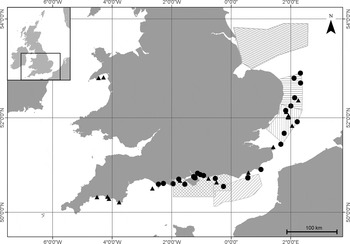
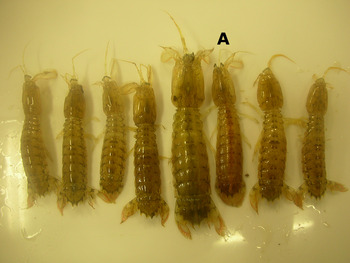
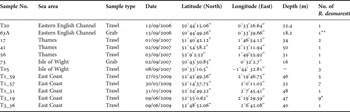
During the REC surveys, a total of 33 R. desmaresti individuals were sampled from 12 separate stations from 4 of the 5 regions studied around the UK (Figure 1). Thirty R. desmaresti were recorded in the trawls, 2 from the grabs and a whole specimen was later identified in the stomach of a bull rout, Myoxocephalus scorpius (180 mm 114 g), retained in the east coast REC (depths 22.4–50 m). Over 300 specimens were recorded from the Solent and south coast survey, mainly as by-catch from oyster dredging. However, no specimens were sampled in the 135 grab and 30 trawl samples collected during the Humber REC. Figure 2 shows 8 specimens sampled in T3_19 (Norfolk coast) at least 1 of which (A) is a female showing ovarian development. Four specimens were retained for reference: (1) a juvenile measuring 3 mm carapace length (CL), 11 mm total length (TL) (1.02 gWW); (2) a male measuring 14 mm CL, 52 mm TL (2.12 gWW); (3) a male measuring 15 mm CL, 54 mm TL (2.11 gWW); and (4) a male measuring 15 mm CL, 58 mm TL (1.98 gWW). Sex was determined by the presence of either the male copulatory organ protruding from the base of the third pair of pereopods or the female spermathecum located ventrally in the sixth thoracic segment (Mauchline, Reference Mauchline1984).
The distribution of Rissoides desmaresti around British coasts. •, Present studies, 2003–2009; ▴, previous recordings; Humber REC; east coast REC; Thames REC; eastern English Channel Marine Habitat Map; south coast REC and the Solent and south coast survey.

Eight adult Rissoides desmaresti sampled in trawl T3_19 from the east coast region (Norfolk coast) of the UK. (A) Female mantis shrimp with ripening ovaries, indicated by red stripe visible dorsally.

DISSCUSSION
As a southern species, the new recordings off the Norfolk coast may well have been the result of recent colonization caused by rising average sea temperatures. Yet, it is also possible that the species has been considerably under-recorded owing to its burrowing habit.
There is a close latitudinal coincidence with these new records and the most northerly recording off the Welsh coast (Ramsay & Holt, Reference Ramsay and Holt2001) (Figure 1). The individual taken at 50 m in the River Thames (Table 1), along with a recent recording reported off the Suffolk coast (Ellis et al., Reference Ellis, Warr, Cooper and De Boois2006) at 52 m, represent the deepest records of this species off British coasts, previously documented at 42 m near the ‘Kentish Knock’ lightship (outer Thames) (51°39'N 1.41°'E) (Bell, Reference Bell1902) (Figure 1).
Details of samples with Rissoides desmaresti present, taken between September 2006 and June 2009. *, one adult identified in the stomach of a bull rout, Myoxocephalus scorpius (180 mm 114 g) taken in corresponding trawl; **, juvenile specimen.

The female caught in June 2009 (Figure 2) showed ripening ovarian development, something not previously observed in specimens caught between May and October from shallow water (<20 m) on the south coast of England (Herbert, in press). Here spawning is suspected to occur between April and May with recruitment in August–October (Herbert, in press) but the specimen sampled in the North Sea during June 2009 had yet to spawn. The juvenile of 11 mm (TL) caught in the North Sea in June was almost certainly O-class and may provide further evidence of later spawning and recruitment compared to the south coast, where likely O-class specimens of 20–30 mm have been recorded in December (Herbert, in press).
In conclusion, these 5 recent broad scale mapping projects and other survey work have provided new recordings of R. desmaresti off the east coast as well as additional records from the south coast. These recordings have helped to clarify the present distribution of R. desmaresti and help to further the limited understanding of its ecology. Clearly, much more is yet to be learned about the distribution and biology of this species.
ACKNOWLEDGEMENTS
Thanks to the Marine Aggregate Levy Sustainability Fund (MALSF) in light of its financial support for the Regional Environmental Characterization (REC) projects (Humber REC MEPF 08/03, East Coast REC MEPF 08/04, South Coast REC MEPF 08/02, Thames REC MEPF 07/01 and Eastern English Channel Marine Habitat Map MEPF 04/01) and Solent & South Coast Mantis Shrimp Survey (Project PP3) during which the presented recordings were taken. Thanks also to Lisa Chilton and Jolyon Chesworth (Hampshire & Isle of Wight Wildlife Trust), Dr Ken Collins and Jenny Mallinson (National Oceanography Centre, Southampton), Lisa Grubb (Marine Ecological Surveys Limited, Bath) and staff at the Medina Valley Centre for environmental and outdoor education, Isle of Wight.