Introduction
Parasites represent approximately 40% of global biodiversity and play fundamental roles in ecosystem structure and function (Dobson et al. Reference Dobson, Lafferty, Kuris, Hechinger and Jetz2008; Lafferty Reference Lafferty2009). Beyond their traditional perception as mere pathogens, helminths regulate host populations, modulate food web dynamics, and serve as sensitive indicators of environmental health (Hudson et al. Reference Hudson, Dobson and Lafferty2006; Marcogliese Reference Marcogliese2005). Severe climate changes can have immediate effects on parasitism rates by affecting parasite survival in the environment, or it can have delayed effects by affecting intermediate or paratenic host susceptibility to parasites (Shearer and Ezenwa Reference Shearer and Ezenwa2020) as well understanding how multiple parasite species coexist within individual hosts remains a central question in community ecology, with niche partitioning, spatial, trophic, or temporal, emerging as a key mechanism (Bush and Holmes Reference Bush and Holmes1986; Holmes Reference Holmes1973; Hutchinson Reference Hutchinson1957; Poulin Reference Poulin2007).
Temporal partitioning may be significant in seasonally variable environments. In such systems, fluctuations in temperature, precipitation, and intermediate host availability can favour different parasite species at different times, potentially increasing community resilience to environmental disturbances (Altizer et al. Reference Altizer, Dobson, Hosseini, Hudson, Pascual and Rohani2006; Cattadori et al. Reference Cattadori, Haydon and Hudson2005). This is especially relevant for helminths, whose complex life cycles, involving multiple hosts and free-living stages, make them vulnerable to environmental conditions (Anderson and May Reference Anderson and May1991; Poulin Reference Poulin2006). The alternation between wet and dry seasons in tropical regions can dramatically affect transmission dynamics by influencing larval survival, intermediate-host density, definitive-host foraging behaviour, and host immune function (Cizauskas et al. Reference Cizauskas, Turner, Wagner, Küsters, Vance and Getz2014).
Freshwater chelonians are excellent models for studying the ecology of parasite-host interactions. Their longevity, site fidelity, and broad dietary range make them valuable sentinel species for assessing the health of aquatic ecosystems (Gibbons et al. Reference Gibbons, Scott, Ryan, Buhlmann, Tuberville, Metts, Greene, Mills, Leiden, Poppy and Winne2000; Santoro et al. Reference Santoro, Mattiucci, Work, Cimmaruta, Nardi, Cipriani, Bellini and Nascetti2013). Moreover, as ectothermic vertebrates, their physiology and immune responses are tightly linked to environmental temperature and hydrological cycles (Zimmerman et al. Reference Zimmerman, Vogel and Bowden2010). Kinosternon scorpioides (locally known as “muçuã”) is a small kinosternid turtle widely distributed across South and Central America, inhabiting freshwater bodies, including seasonally flooded areas (Iverson Reference Iverson1992; Vogt and Guzmán Reference Vogt and Guzmán2008). During dry periods, individuals may burrow into moist substrates to avoid desiccation, reducing movement and possibly altering their exposure to intermediate hosts (de Souza and Vogt Reference de Souza and Vogt1994). Its omnivorous-carnivorous diet exposes individuals to diverse parasites with heteroxenous cycles. Previous studies have documented the presence of some gastrointestinal nematodes, including Serpinema and Spiroxys (Alho Reference Alho1964, Reference Alho1965; Viana et al. Reference Viana, Rodrigues, Madelaire, Clara, Santos and Sousa2016; Mascarenhas and Müller Reference Mascarenhas and Müller2021). However, the ecological dynamics of these parasite communities, particularly responses to climatic seasonality, remain poorly characterized.
This knowledge gap is critical given the ongoing climate change in the Amazon. The region is experiencing altered precipitation patterns, more frequent extreme weather events, and rising temperatures (IPCC 2021; Marengo and Espinoza Reference Marengo and Espinoza2016). These shifts can profoundly affect parasite transmission dynamics and destabilize complex helminth life cycles (Altizer et al. Reference Altizer, Ostfeld, Johnson, Kutz and Harvell2013; Lafferty Reference Lafferty2009). Marajó Island, at the mouth of the Amazon River, experiences one of the most dramatic flood pulses in the basin, with water-level variations of several meters between seasons (Costa et al. Reference Costa, Souza-Filho, Ribeiro, Asp, Siegle and Silva2018; Moraes et al. Reference Moraes, Costa, Costa and Costa2005). This extreme hydrological regime creates contrasting ecological conditions that may differentially affect parasite species with distinct life-cycle requirements. Understanding these seasonal dynamics is essential both for advancing ecological theory on parasite community structure and for informing conservation management of wild chelonian populations under global environmental change (Brooks and Hoberg Reference Brooks and Hoberg2007; Rhodin et al. Reference Rhodin, Stanford, Dijk, Eisemberg, Luiselli, Mittermeier, Hudson, Horne, Goode, Kuchling, Walde, Baard, Berry, Bertolero, Blanck, Bour, Buhlmann, Cayot, Collett and Vogt2018).
Studies of helminth communities in tropical freshwater turtles have documented high parasite diversity, often with considerable geographic and seasonal variation. For example, research on Podocnemis unifilis in the Amazon Basin has revealed diverse trematode and nematode communities, with prevalence rates that vary widely by location and environmental conditions (Ribeiro et al. Reference Ribeiro, Santana, Souza, Oliveira, Magalhães, Malvasio and Silva2023). Similarly, studies on Peltocephalus dumerilianus and other Amazonian turtles have reported fluctuations in helminth abundance and composition, potentially linked to seasonal hydrological changes (Menegaldo et al. Reference Menegaldo, Arias-Pacheco, Perin, Tebaldi and Hoppe2024). However, most available studies focus on prevalence and intensity metrics, with limited attention to community-level dynamics such as species turnover or temporal niche partitioning. Furthermore, there is a notable lack of research on turtle parasite communities in systems with extreme hydrological variability, such as large river floodplains, where water level fluctuations can exceed 10 meters annually. Understanding helminth community responses in these environments is increasingly important as climate change intensifies hydrological variability globally (IPCC 2021).
Here, we identified the gastrointestinal helminth fauna of K. scorpioides from Marajó Island and evaluated seasonal effects on parasite community dynamics. We assessed: (i) overall infection parameters (prevalence, mean intensity, mean abundance), (ii) seasonal shifts in helminth composition and diversity, and (iii) species-specific patterns and co-infection dynamics. We hypothesized that Marajó Island marked hydrological seasonality would influence both overall infection levels and community structure, with species exhibiting distinct seasonal patterns reflecting differences in life cycles and intermediate host ecology.
Material and methods
In the Animal Pathology Laboratory of the Institute of Animal Health and Production, Federal Rural University of the Amazon, in Belém, Pará. During the rainy season (December to May) and dry season (June to November), gastrointestinal organs of 30 specimens of muçuã (Kinosternon scorpioides) were analyzed for sanitary diagnosis. A total of 20 individuals were collected from the dry period and 10 individuals from the rainy period from three locations from Marajó Island: Six specimens (two females and four males) were collected at Fazenda Arari, in the Municipality of Cachoeira do Arari (1° 00′ 39″ S, 48° 57′ 46″ W); 14 specimens (eight females and six males) were collected at Fazenda Guajarás, in the Municipality of Santa Cruz do Arari (0° 39′ 50″ S, 49° 09′ 46″ W; and 10 specimens (seven females and three males) were collected at Fazenda Guia, in the Municipality of Ponta de Pedras (1° 23′ 24″ S, 48° 52′ 15″ W) on Marajó Island, Pará State. The three collection areas are nearby, preserved localities, and the natural distribution of K. scorpioides. However, site and season were not fully independent due to logistical constraints of field sampling. Samples from the rainy season were obtained exclusively from Ponta de Pedras, whereas dry-season samples were collected only from Cachoeira do Arari and Santa Cruz do Arari. As a result, site and season effects could not be fully disentangled statistically. The climate on Marajo Island is classified as humid subtropical, according to the Köppen classification (Medeiros Reference Medeiros2020). Mean temperatures and precipitation in the collection rainy seasons were 26.3°C and 310.3 mm, and mean temperatures and precipitation in the collection dry periods were 27.4°C and 84.0 mm (INMET: Instituto Nacional de Meteorologia).
The animals were collected manually in both periods. During the dry season, an additional wooden instrument, made by local collectors, was used. This instrument is inserted into the dry soil, where the animals remain until they identify individuals by the sound of their shells with wood (Pereira et al. Reference Pereira, Sousa, Cutrim and Moreira2007). After collection, the animals were transported to the laboratory, anesthetized with xylazine hydrochloride (4 mg/kg) and ketamine hydrochloride (80 mg/kg), and euthanized by intracoelomic administration of 2.5% sodium thiopental (60 mg/kg). Subsequently, the organs of the gastrointestinal tract were separated (stomach, intestine, cecum) and their contents were examined under a stereomicroscope, using fine brushes and forceps to collect adult helminths and larvae found in the serous membranes, encysted, or within the organs, following the protocol of Knoff and Gomes (Reference Knoff, Gomes, Moreira, Giese and Gomes2012). The parasites were washed, then fixed in an AFA solution (alcohol, formaldehyde, and acetic acid), and subsequently transferred to vials containing 70% alcohol. The analysis and study of the helminths was performed using optical microscopy with a Zeiss Primo Star microscope (4×, 10×, and 40× objectives). The identification of the parasites was based on Silva et al. (Reference Silva, Jesus, Santos, Nandyara, Willkens, Santos and Melo2023) and Moravec (Reference Moravec1998). Parasitological parameters of prevalence (P%), mean abundance (MA), and mean intensity of infection (MII) were calculated in agreement with Bush et al. (Reference Bush, Lafferty, Lotz and Shostak1997). The research was authorized by the system of authorization and information on biodiversity under number 57885-2 and was certified by the committee on ethics in the use of animals (CEUA) of UFRA under protocol numbers: 012/2017-CEUA.
Statistical analysis
Standard parasitological parameters were calculated following Bush et al. (Reference Bush, Lafferty, Lotz and Shostak1997): prevalence (P, percentage of infected hosts), mean intensity (MI, mean parasites per infected host), mean abundance (MA, mean parasites per examined host), and total number of parasites (TNP). These metrics were calculated overall and by season (rainy vs. dry) for each helminth species.
Infection parameters: Overall prevalence between seasons was compared using Fisher’s exact test. To assess seasonal differences in total helminth load, we fitted a negative binomial generalized linear model (GLM) with season as the predictor variable using the MASS package (Venables and Ripley Reference Venables and Ripley2002). The negative binomial distribution was selected over Poisson regression to account for overdispersion in parasite counts, with the dispersion parameter (θ) indicating the degree of parasite aggregation. Model coefficients were exponentiated to obtain incidence rate ratios (IRR), which represent the multiplicative change in expected helminth load between seasons. Species-specific abundances were conducted for all helminth taxa identified in the study. Because the helminth community comprised a small number of well-characterized taxa, no minimum prevalence or host-occurrence thresholds were applied. All taxa occurred in more than one host individual and contributed meaningfully to the overall parasite load. Abundance was quantified as mean abundance including uninfected hosts, following standard parasitological definitions (Bush et al. Reference Bush, Lafferty, Lotz and Shostak1997). The aggregated distribution of parasites was explicitly accounted for using non-parametric tests and negative binomial models, which are robust to zero inflation and unequal occurrence among hosts.
Community diversity and structure: For helminth species richness, Shannon diversity index (emphasizing evenness), and Simpson’s index (emphasizing dominance) were calculated at the host level and compared between seasons using Mann-Whitney U tests. The relative abundance of each helminth genus was calculated as a percentage contribution to the total helminth count. Parasite aggregation, an important ecological indicator of transmission dynamics, was assessed by fitting a negative binomial GLM to total helminth load (MASS package); the dispersion parameter (θ) indicates aggregation intensity.
Community composition: To test for seasonal differences in helminth assemblage structure, we performed permutational multivariate analysis of variance (PERMANOVA) using Bray-Curtis dissimilarity with 999 permutations (vegan package; McArdle and Anderson, Reference McArdle and Anderson2001). This analysis was restricted to infected hosts to evaluate compositional shifts independent of differences in prevalence. The R2 statistic represents the proportion of compositional variance explained by season.
Co-infection patterns and species interactions: Hosts were classified as uninfected, monoinfected (single species), or co-infected (≥2 species). The frequency of infection types was compared between seasons using Fishers exact test. To assess potential facilitative or competitive interactions among helminth species, we evaluated the relationship between species richness and total parasite burden using Spearman’s rank correlation.
Results
Helminth fauna and overall infection parameters
A total of 30 K. scorpioides specimens (17 females, 13 males) from Marajó Island were examined for gastrointestinal helminths. Overall, 73.3% (22/30) of the individuals were infected with at least one helminth species. Of the locally sampled individuals, 2/6 infected were in Cachoeira do Arari; 8/10 in Ponta de Pedras, and 12/14 in Santa Cruz do Arari. Four helminth species were identified: three nematodes, Serpinema pelliculatus (Camallanidae), Spiroxys figueiredoi (Gnathostomatidae), and Falcaustra sanjuanensis (Kathlaniidae), and one digenean trematode, Nematophila grandis (Diplodiscidae). Helminths were recovered from the small intestine and stomach (nematodes), and from the large intestine and cecum (trematodes). During the collection of parasites, the gastrointestinal organs of animals from the dry period were observed to be empty, only containing parasites. In contrast, the stomachs of animals from the rainy period contained crustaceans, plant material, and parasites.
Serpinema pelliculatus was the most common species, making up 60.8% of all helminths found (n = 45), followed by N. grandis (16.2%, n = 12), S. figueiredoi (13.5%, n = 10), and F. sanjuanensis (9.5%, n = 7) (Supplementary Table S1). Most infected hosts (68.2%, 15/22) carried only one helminth species (monoinfection), while 31.8% (7/22) had co-infections with two or more species. Female turtles had a higher infection rate (82.4%, 14/17) than males (61.5%, 8/13), but this difference was not statistically significant (Fisher’s exact test, p = 0.23).
Seasonal patterns in infection parameters
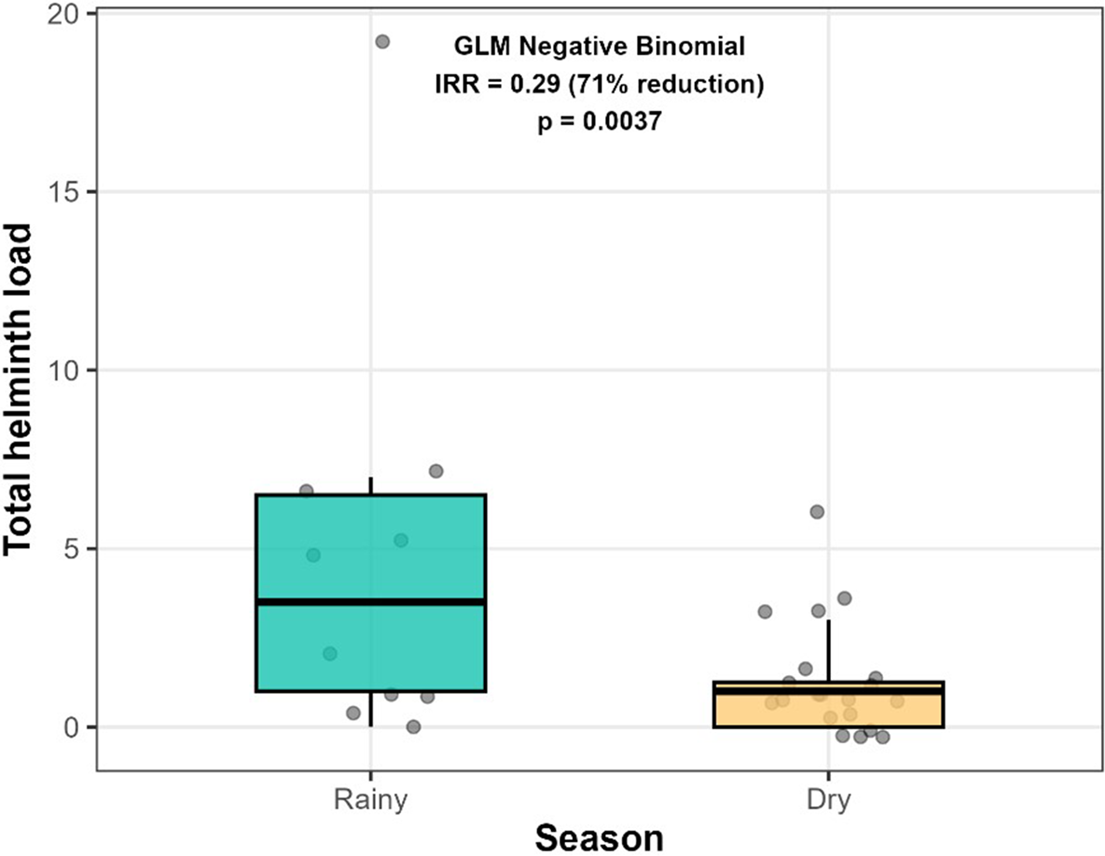
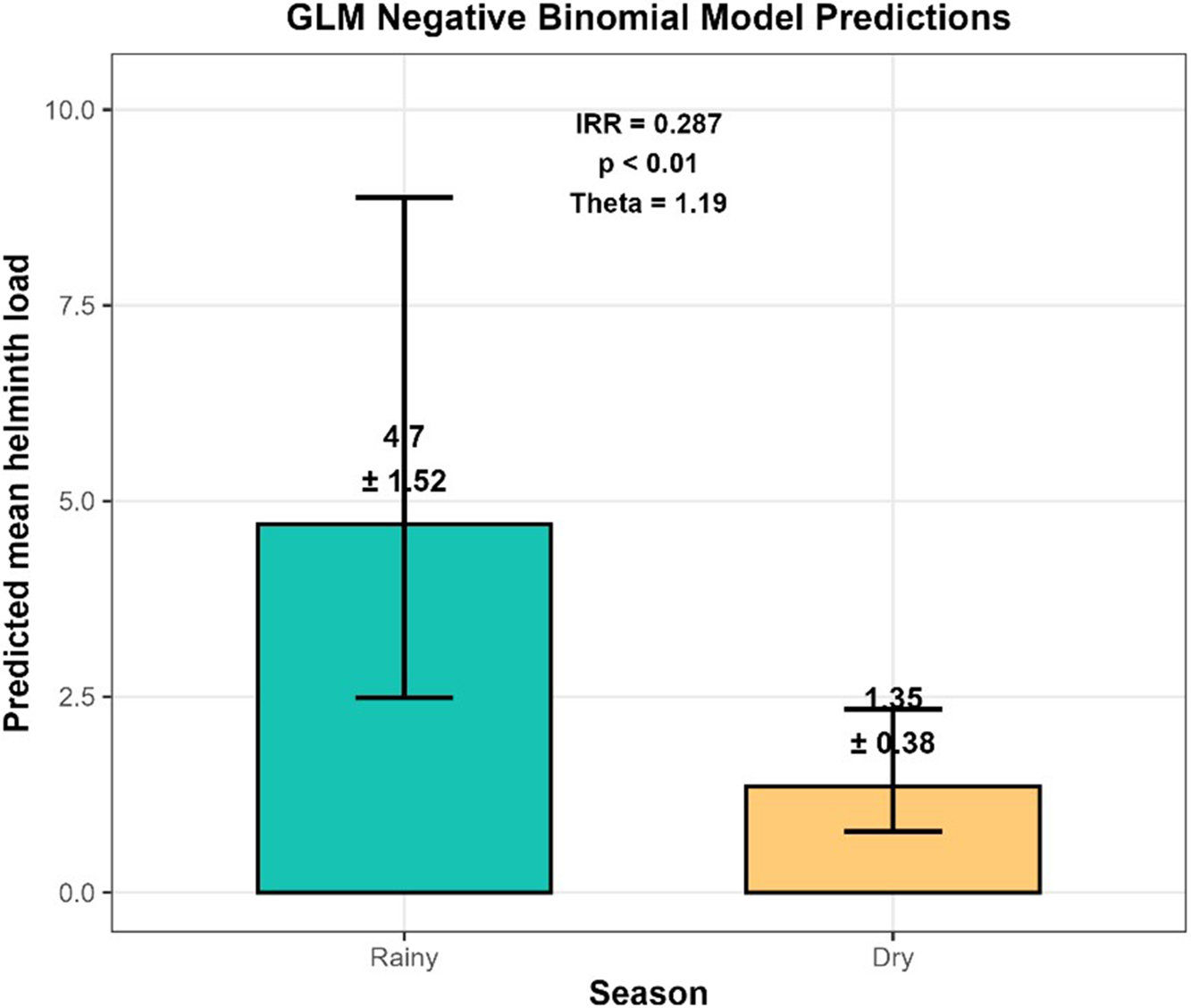
Overall helminth prevalence remained high in both rainy (80%, 8/10) and dry (70%, 14/20) seasons, with no significant difference between periods (Fisher’s exact test, p = 0.66) (Supplementary Table S2). However, negative binomial generalized linear model (GLM) analysis revealed a significant seasonal effect on total helminth load (p = 0.004). Hosts sampled during the dry season harboured significantly fewer parasites compared to those from the rainy season (IRR = 0.29, 95% CI: 0.12–0.65), representing a 71% reduction in expected parasite load during the dry season (Figures 2 and 3, Supplementary Table S2).
The mean intensity of infection was 4.7 ± 5.72 helminths during the rainy season, compared to 1.35 ± 1.57 in the dry season, representing a threefold difference. The median helminth load was 3.5 parasites per host during the rainy season, compared to 1.0 during the dry season. The dispersion parameter from the negative binomial model (θ = 1.19) indicated moderate parasite aggregation within the host population, a pattern typical of helminth communities in freshwater ecosystems. Notably, one individual captured during the rainy season exhibited an extremely high parasite burden (n = 18 helminths) (Figure 3).
Parasite community composition and diversity
Helminth species richness ranged from 0 to 3 species per host (mean ± SD: 1.0 ± 0.77). Although mean richness was slightly higher during the rainy season (1.2 ± 0.92) compared to the dry season (0.8 ± 0.62), this difference was not statistically significant (Mann-Whitney U, W = 130, p = 0.247) (Supplementary Figure S2).
Shannon diversity index values were low overall (range: 0–0.69), reflecting the numerical dominance of S. pelliculatus and the relatively low species evenness in the helminth assemblage. Mean Shannon diversity showed no significant seasonal variation (rainy: 0.177 ± 0.294; dry: 0.066 ± 0.205; p = 0.21) (Supplementary Figure S1), suggesting that while species composition changed between seasons (see below), overall diversity metrics remained stable.
Despite the absence of significant differences in richness and diversity indices, permutational multivariate analysis of variance (PERMANOVA) revealed significant seasonal differences in helminth community composition (F = 4.60, R2 = 0.19, p = 0.017). This indicates that while the number of species present remained similar, the identities and relative abundances of species in the assemblage differed substantially between the rainy and dry seasons (Supplementary Table S3). The Mean species richness values did not differ significantly between rainy and dry periods (p = 0.247).
Seasonal shifts in helminth assemblages: evidence for temporal niche partitioning
Individual helminth species exhibited markedly different seasonal patterns, suggesting temporal niche partitioning within the parasite community (Figure 1, Supplementary Figure S3). The most striking pattern was observed for S. figueiredoi, which was exclusively present during the rainy season (prevalence: 40%, 4/10; mean abundance: 1.0 ± 1.49) and completely absent from all hosts sampled during the dry season (prevalence: 0%; Mann-Whitney U with FDR correction, p = 0.013).
Temporal niche partitioning in the helminth community of Kinosternon scorpioides. The upper panel shows prevalence (%) and lower panel shows mean abundance for each helminth genus across rainy and dry seasons. Note the contrasting patterns: Spiroxys figueiredoi exclusive to rainy season, Nematophila grandis peaking in dry season, and Serpinema pelliculatus showing intermediate pattern.

Predicted mean helminth load from negative binomial generalized linear model. Bars represent model-predicted mean parasite abundance for each season, with error bars indicating 95% confidence intervals. Hosts sampled during the dry season are predicted to harbour significantly fewer helminths than those from the rainy season (IRR = 0.29, p < 0.01), representing a 71% reduction. Dispersion parameter θ = 1.19 indicates moderate parasite aggregation.

Total helminth load in Kinosternon scorpioides across rainy and dry seasons. Box plots show median (horizontal line), interquartile range (box), whiskers (1.5× IQR), and individual data points (jitter). Negative binomial generalized linear model revealed a significant 71% reduction in parasite load during the dry season (incidence rate ratio = 0.29, 95% CI: 0.12–0.65, p = 0.004).

In contrast, Nematophila grandis showed an inverse seasonal pattern, with significantly higher prevalence during the dry season (50%, 10/20) compared to the rainy season (10%, 1/10) (p = 0.037 before FDR correction, though this did not remain significant after multiple testing adjustment). Mean abundance of N. grandis increased fivefold from 0.1 ± 0.32 in the rainy season to 0.55 ± 0.69 in the dry season (Supplementary Figure S3).
Serpinema pelliculatus, the dominant parasite overall, showed higher prevalence and abundance during the rainy season (prevalence: 50%, 5/10; mean abundance: 3.2 ± 4.96) compared to the dry season (prevalence: 20%, 4/20; mean abundance: 0.65 ± 1.90), though this difference did not reach statistical significance after FDR correction (p = 0.077). F. sanjuanensis exhibited no clear seasonal pattern, with similar prevalence in both rainy (20%, 2/10) and dry (10%, 2/20) seasons (p = 0.456) and low mean abundances in both periods (rainy: 0.4 ± 0.97; dry: 0.15 ± 0.49) (Supplementary Table S3).
Co-infection patterns and ecological relationships
Co-infection patterns differed markedly between seasons. During the rainy season, 37.5% (3/8) of infected hosts harboured multiple helminth species and 62.5% (5/8) of monoinfection, compared to only 14.3% (2/14) and 85.7% (8/14) of monoinfection during the dry season. Also, a strong positive correlation was observed between helminth species richness and total parasite load (Spearman ρ = 0.874, p < 0.0001) (Supplementary Figure S4), indicating that hosts harbouring multiple species also tended to have higher overall parasite burdens. This pattern was consistent across both seasons, though the relationship was particularly pronounced during the rainy season when both richness and abundance were elevated. This correlation suggests that individual host susceptibility or exposure levels may influence both the diversity and intensity of infections.
Parasite aggregation, assessed through negative binomial modelling, revealed moderate levels of parasite clustering (dispersion parameter θ = 1.19). This indicates that helminth parasites were moderately aggregated within the host population, with some individuals harbouring disproportionately high parasite loads while others remained uninfected or lightly infected.
Discussion
Infection prevalence in our sample was high (73.3%), with four helminth species identified. This finding is consistent with previous reports on K. scorpioides in Amazonian environments (Viana et al. Reference Viana, Rodrigues, Madelaire, Clara, Santos and Sousa2016) and with infection levels documented for other tropical freshwater turtles (Mascarenhas and Müller Reference Mascarenhas and Müller2021; Santoro et al. Reference Santoro, Mattiucci, Work, Cimmaruta, Nardi, Cipriani, Bellini and Nascetti2013). In contrast, populations in temperate regions usually show markedly lower parasite prevalence due to prolonged cold periods and reduced host activity, which interrupt transmission (Roca and Hornero Reference Roca and Hornero1994). However, prevalence alone tells only part of the story. The seasonal shift was dramatic. Total parasite load dropped by 71% in the dry season. Even more striking, community composition changed completely. S. figueiredoi vanished entirely during low water months. N. grandis showed the opposite pattern, five-fold higher in the dry season. S. pelliculatus dominated numerically (60.8% of all helminths) but showed less pronounced seasonal variation. These patterns support our hypothesis that hydrological seasonality would structure parasite communities. They also reveal something more interesting: temporal niche partitioning among species with fundamentally different ecological requirements.
The complete absence of S. figueiredoi during the dry season stands out. This is not just a reduced abundance; we found zero individuals across 20 turtles sampled during the dry period. The most parsimonious explanation involves its intermediate hosts. Spiroxys figueiredoi species require copepods for transmission (Cárdenas-Callirgos et al. Reference Cárdenas-Callirgos, Tantalean and Hechinger2009). When water bodies contract during the dry season, copepod populations collapse or become unavailable, as well as fish and amphibians that act as paratenic hosts. The absence of intermediate hosts cuts off the parasite’s transmission pathway, leading to the collapse of its life cycle. This makes S. figueiredoi a potential indicator species of aquatic connectivity, reflecting the integrity of seasonal flood dynamics. Its presence signals adequate flooding; its absence suggests disrupted hydrological cycles. In Várzea systems experiencing altered flood regimes, monitoring this parasite could provide early warning of ecosystem change.
Nematophila grandis behaved oppositely. Prevalence jumped from 10% (rainy season) to 55% (dry season). As a diplodiscid trematode, it depends on gastropod mollusks as intermediate hosts (Salízar and Sánchez Reference Salizar and Sanchez2004). Two mechanisms probably drive this pattern. First, both mollusks and turtles concentrate in shrinking water bodies during the dry season. Higher density means more encounters and, consequently, more infections. Second, the turtle’s diet may shift seasonally. When floods recede and other prey become scarce, K. scorpioides might consume more mollusks simply because they are available (Vogt and Guzman, Reference Vogt and Guzmán2008). Another contributing factor might be cercariae shedding rate during hot-dry seasons (Kiatsopit et al. Reference Kiatsopit, Sithithaworn, Kopolrat, Andrews and Petney2014). We cannot distinguish between these mechanisms with our data, and these may operate simultaneously.
Serpinema pelliculatus showed intermediate behaviour. Abundance was higher during floods, but the difference did not reach statistical significance after multiple-comparison correction. This suggests either greater ecological flexibility or transmission pathways less dependent on extreme flooding. The numerical dominance of this genus across both seasons indicates strong adaptation to Amazonian wetland conditions (Mascarenhas and Müller Reference Mascarenhas and Müller2021). Although the life cycle of the genus Serpinema is unknown, it is suspected to be associated with the presence of copepods that can be ingested by paratenic hosts such as fish, amphibians, and aquatic snails (Silva et al. Reference Silva, Jesus, Santos, Nandyara, Willkens, Santos and Melo2023). An interesting pattern emerged from our diversity analyses. Shannon diversity and species richness remained statistically similar between seasons. This seems contradictory given the massive shifts in parasite load and composition. However, it is actually informative. The number of species present remained constant; their identities and relative abundances changed. The community restructured rather than simply losing diversity. This has implications for how we think about seasonal effects on parasite assemblages.
Our findings of substantial seasonal restructuring in turtle helminth communities align with patterns documented in other Neotropical systems, though the magnitude of change appears particularly pronounced in our study. For example, studies of Chelonia mydas populations along the Brazilian coast report seasonal variation in helminth abundance and composition, but with less dramatic shifts than those observed for N. grandis (Binoti et al. Reference Binoti, Gomes, Júnior, Werneck, Martins and Boeloni2016; Gomes et al. Reference Gomes, Martins, Werneck and Pavanelli2017). Similarly, research on freshwater turtles such as Phrynops geoffroanus and Mesoclemmys tuberculata in Brazil demonstrates significant differences in helminth infection levels between dry and rainy seasons, influenced by habitat and biome (Santana et al. Reference Santana, Teixeira, Araujo-Filho, Teles, Pereira, Brito, Almeida and Mesquita2023). However, most studies report that parasite communities maintain most species year-round, and complete seasonal disappearance of particular helminths, as observed for S. figueiredoi in our study, is unusual and may reflect the extreme hydrological conditions of Marajó Island or similar floodplain systems (Rosas et al. Reference Rosas, Moreira-Turcq, Cochonneau, Santini and Guyot2022; Santana et al. Reference Santana, Teixeira, Araujo-Filho, Teles, Pereira, Brito, Almeida and Mesquita2023). This suggests that the drivers and magnitude of seasonal effects on parasite communities may scale with the intensity of environmental seasonality, a hypothesis that warrants further comparative studies across hydrological gradients.
Parasite aggregation was moderate, typical of freshwater helminth communities (Shaw et al. Reference Shaw, Grenfell and Dobson1998). Some turtles harboured disproportionately high loads while others had few or no parasites. This heterogeneity matters for transmission dynamics. “Super-host” individuals likely contribute more to maintaining parasite populations than average hosts (Streicker et al. Reference Streicker, Fenton and Pedersen2013). The strong correlation between species richness and total parasite load suggests a standard underlying driver. Whatever factors determine infection, immune function, foraging behaviour, and microhabitat use operate across the entire helminth community rather than affecting species independently. Co-infections were more frequent during the rainy season. This can be due to the presence of water, which provides more opportunities for transmission and greater overlap among species’ temporal niches (Santana et al. Reference Santana, Teixeira, Araujo-Filho, Teles, Pereira, Brito, Almeida and Mesquita2023). On the other hand, the absence of gastric food content observed in animals during the dry period may indicate some degree of stress that can influence the parasite load; whether this affects turtle health is unclear (Suzán et al. Reference Suzán, Galindo and Ceballos2000). Parasite interactions can be synergistic or antagonistic (Mathews et al. Reference Mathews, Moro, Strachan, Gelling and Buller2006), but we did not measure host condition or fitness proxies.
Our results should be interpreted in light of limited spatial replication and an unbalanced sampling design. Because site and season were partially confounded, we were not able to fully disentangle seasonal effects from site-specific characteristics. As a consequence, the site was not included as a random effect, because the small number of sites and their strong association with season would have yielded unreliable variance estimates. The total sample size (n = 30) was sufficient to detect significant differences in parasite load, but had limited power to detect rare species. Additionally, the even seasonal sampling (n = 10 rainy, n = 20 dry) reflects logistical constraints inherent to fieldwork in remote Amazonian environments. Although our statistical approach accounts for unequal sample sizes, a more balanced design would be preferable in future studies.
Our analyses were restricted to a single locality; therefore, the extent to which these patterns generalize to other populations of K. scorpioides or to other Amazonian turtle species remains uncertain. Multi-year and multi-site sampling would be particularly valuable for separating seasonal from interannual variation and for enabling explicit modelling of site-level random effects. Finally, future work integrating host body condition and immune markers would help establish stronger links between parasite load and host fitness.
Conservation implications
These findings matter beyond parasite ecology. The Amazon Basin is undergoing rapid transformations in its hydrological and climatic systems. Reduce flood duration, altered rainfall patterns, and dam construction are fragmenting wetland connectivity (Davidson et al. Reference Davidson, de Araújo, Artaxo, Balch, Brown, Mercedes, Bustamente, Coe, Defries, Keller, Longo, Munger, Shroeder, Soares, Souza and Wofsy2012; Marengo and Espinoza, Reference Marengo and Espinoza2016). Our results indicate that such changes can restructure parasite communities, selectively impacting species with narrow ecological niches or specific intermediate hosts. For example, shorter floods or reduced inundation extent could locally eliminate S. figueiredoi. Conversely, prolonged low-water periods may favour N. grandis by extending the season when hosts and intermediate hosts are concentrated. This has implications beyond the loss of parasite diversity, although that is important. Parasites regulate host populations, transfer energy through food webs, and modify behaviour (Lafferty et al. Reference Lafferty, Allesina, Arim, Briggs, De Leo, Dobson, Dunne, Johnson, Kuris, Marcogliese, Martinez, Memmott, Marquet, McLaughlin, Mordecai, Pascual, Poulin and Thieltges2008). Losing them has cascading effects. Nevertheless, environmental change will also restructure parasite communities in unpredictable ways. Species with flexible transmission pathways may thrive while specialists decline. K. scorpioides, and its parasites function as sentinels. Monitoring helminth community composition could complement traditional biodiversity surveys by providing early warning signals of hydrological disruption and habitat degradation (Marcogliese Reference Marcogliese2005). Given their longevity and site fidelity, freshwater turtles offer an ideal host system for long-term parasitological monitoring within an integrated “One Health” framework that links wildlife, environmental, and human health (Thompson et al. Reference Thompson, Lymbery and Smith2010).
Conclusion
Extreme hydrological seasonality on Marajó Island drives pronounced temporal niche partitioning in the helminth community of K. scorpioides, with specialist parasites showing complete seasonal turnover while generalists persist. These patterns reveal how flood-pulse alterations will restructure parasite communities in predictable ways based on transmission requirements, knowledge critical for anticipating the cascading effects of dams and climate change on Amazonian wetland biodiversity. Long-term parasitological monitoring of K. scorpioides populations offers a sensitive, mechanistic tool for detecting early signs of hydrological degradation before impacts manifest in host populations.
Supplementary material
The supplementary material for this article can be found at http://doi.org/10.1017/S0022149X25101132.
Acknowledgements
We thank the Federal Rural University of the Amazon (UFRA), the National Council for Scientific and Technological Development (CNPq), and the Scholarship (PIBIC) of Jaqueline H. Costa and Dr. James Lee Crainey for reviewing the English version of this manuscript.
Competing interests
The authors declare no potential conflicts of interest with respect to the research, authorship, and/or publication of this article.