Quotative be like, exemplified in (1), is a vigorous change in contemporary English. Among Canadians in their twenties, it has risen from an incipient phase of 13% in 1995 (Tagliamonte & Hudson, 1999) to accounting for 58% of all quotatives in 2002 (Tagliamonte & D'Arcy, 2004:501, Table 2).

Examples from the Toronto corpora, housed in the Sociolinguistics Laboratory at the University of Toronto, are identified by corpus, followed by the individual speaker's code, sex, and age. The corpora are coded as follows: 2> = ROP 2002, 3 = ROP 2003, I = IN-TO-VATION 2003, N = IN-TO-VATION 2004, S = Story-telling 2002, $ = Story-telling 2003.
The sheer rate of change makes it plausible that this might be the upswing of the classic S-curve of linguistic change (Bailey, 1973; Weinreich, Labov, & Herzog, 1968). If so, we have an opportunity to investigate the incrementation problem, “the mechanism by which changes advance in a stepwise fashion” (Labov, 2001:446).
Real time data provides the best material for tracking the progression of change, yet Cukor-Avila (2002), which follows three African American speakers, and Ferrara and Bell (1995), which includes a trend component, are the only real time studies of the quotative system of which we are aware. Lacking this type of data, the apparent time construct provides the next best tool, and is most effective when the speakers under consideration share the same background. Thus, Chambers and Trudgill (1998:151) wrote:
Studying the diffusion of innovations in apparent time involves surveying the differences between the speech of people of different ages in the same community, while controlling the other variables such as sex, social class and ethnicity.
To this point, there has been ample research on be like, but none has been based on a large-scale socially stratified sample from a single, cohesive, speech community. Consider Figure 1. The earliest study, Blyth, Recktenwald, and Wang (1990:216), included the full spectrum of the adult population, but there are just 30 speakers from a range of backgrounds; most were affiliated with Cornell University in “some capacity.” Ferrara and Bell (1995) was primarily a real time study, but the distribution by age also enabled an apparent time comparison of quotative use in each of their three corpora, collected in 1990, 1992, and 1994. However, the corpora represent assorted speech communities. Corpus Two, for example, came from a “diverse population” in Texas, including Dallas, Houston, San Antonio, and their suburbs (1995:273; fn.10, 277). Moreover, there is no way to recuperate ethnicity or other social factors. The data presented in Dailey-O'Cain (2000:64) spanned a broad age range, 14–69, but in this case the sample was relatively small: 30 speakers. Singler (2001) has been the most ambitious effort to date. His corpus totalled nearly 6,000 quotatives from speakers between the ages of 9 and 51, but there were “no geographic limitations as to where in the United States the speakers came from” (2001:259). Cukor-Avila (2002:6) included an apparent time study, but it was based on a modest 14 speakers in Texas, aged 14–89. Buchstaller (2004:Appendix 1, 296–297) is a comprehensive cross-variety comparison. However, here too there is a mix between broad-based sampling and/or restricted age distributions. In sum, these works are either too narrowly circumscribed (number of speakers) or too broad to be representative (regionality). Other studies, such as Tagliamonte and Hudson (1999), Tagliamonte and D'Arcy (2004), and D'Arcy (2004), worked with tightly defined regional varieties, but focused uniquely on younger members of the population. Thus, despite the wealth of investigations focusing on the quotative system and those on be like in particular, there remains little information regarding its diffusion at the community level.

Details of apparent time studies of the quotative system.
Critical to the exploration we undertake here are the issues surrounding different types of linguistic change, namely age-grading versus generational change versus communal change. These are approachable most felicitously with the perspective of a speech community as a whole, so that the regularities of the variation within can be viewed as with a microscope (see Labov, 2001:39).
Consider Labov's definitions in (2).

Age-grading refers to the association of some feature with a particular life stage that repeats in every generation. This is the type of change that is often associated with adolescents. Whenever novel linguistic features are reported in this population, they tend to be considered age related and are expected to recede as speakers age, yet it is important to bear in mind that very few changes of this type have been reported (Chambers, 2003:206). Generational change is the standard type of linguistic change in which we observe incremental shifts in the frequency of forms from one age group to another. Generational change is based on the assumption that once stabilized, an individual's linguistic usage does not change over the course of his or her lifetime (Labov, 2001:454; Milroy & Gordon, 2003:36). Finally, there is communal change. This is when individuals themselves shift the frequency of linguistic features over their lifetimes alongside incremental change from one age group to another. Labov (2001:447) hinted that the assumption of stability, particularly for young adults, may have to be revised. Indeed, there is building evidence that young adults continue to advance ongoing linguistic changes well into adulthood (Nordberg & Sundgren, 1998; Nevalainen & Raumolin-Brunberg, 2003). In other words, the most recent research on linguistic change suggests that generational change and communal change can progress simultaneously. As we shall see, we believe that there are subtle differences that distinguish the progression of these types of change among the adult population.
Our points of departure in this analysis are: (1) to attempt to uncover the origins of be like; (2) to consider its developmental trajectory and the underlying mechanisms that may be guiding its pathway; and (3) to explore whether or not we can use the diffusion of be like to understand how the proposed types of linguistic change unfold in the community. A different way to frame this query, perhaps, is to think about when individuals in a community begin participating in a linguistic change and when—indeed if—they stop.
METHOD
To explore these issues, we performed a quantitative analysis of the quotative system in the Toronto English Corpus. This 1.5 million-word archive is comprised of sociolinguistic interviews collected using a combination of quota-based random sampling and social networking.2
For discussion of the sampling methodology for the Toronto sociolinguistic projects, see Tagliamonte and D'Arcy (2004:497), Tagliamonte (2006), and Tagliamonte (2003–2005).
Tagliamonte and D'Arcy (2004) focused on 10–19-year-olds only and at that time, the data comprised 44 speakers and a total of 2,058 tokens. In contrast, this age group in the current analysis is represented by a substantially larger data set: 87 speakers and 3,097 tokens. The heightened numbers in the 17–29-year-old age group is due to the inclusion of two corpora which were collected independently as part of course work for HUM199Y, The Linguistics of Story-telling, in 2002 and 2003. These data represent considerable speaker numbers, but smaller total tokens per speaker.
The Toronto quotative corpus

Each token was coded for the operation of internal and external constraints. The two linguistic factors that have received the most attention in quotative analyses are grammatical person and pragmatic content. The grammatical person constraint operates so that be like is favored with first person subjects, as in (3). The consistency of this effect across studies (e.g., Blyth et al., 1990; Cukor-Avila, 2002; Ferrara & Bell, 1995; Tagliamonte & Hudson, 1999) led Tagliamonte and D'Arcy (2004:509) to suggest that it is a defining characteristic of be like.

The content of the quote has also been a fundamental aspect of be like, which seems to have originated as a marker of internal dialogue and nonlexicalized sounds, as in (4) (Butters, 1982; Tannen, 1986). However, where previously the strongest constraint on be like (e.g., Cukor-Avila, 2002; Tagliamonte & Hudson, 1999), recent results have revealed that the pragmatic effect is the lowest ranked constraint among 17–19 year olds, suggesting that this effect may be weakening (Tagliamonte & D'Arcy, 2004:507).

In addition to the classic factors of grammatical person and content of the quote, we consider two other characteristics of the grammar: (1) surface morphology and (2) temporal reference. The correlation of be like with present tense has been noted since the earliest research on this quotative form. Both Blyth et al. (1990) and Romaine and Lange (1991) reported that be like is more likely to occur in the present tense than in the past tense. More recently, Singler (2001:272–273) tested for a tense effect and found that tense was statistically significant with present tense favoring be like. However, occurrences of the present tense in his corpora were “almost always” instances of Historical Present (HP). The HP has a number of stylistic functions in narrative structure that are independent of the variation that concerns us here (see Schiffrin, 1981; Wolfson, 1978, 1979). The relevant point for this analysis is simply that the HP is a specific and highly circumscribed construction in which surface morphology is present tense but the context of temporal reference is past tense. An analysis based solely on the HP is not sufficient for disentangling which underlying factor—tense or specifically HP—is contributing to the choice of forms. In other words, a contrasting comparative context is necessary. The Toronto materials provided sufficient data to test for a three-way distinction, enabling us to disambiguate the effects of tense and temporal reference. Consequently, data were coded for past morphology with past temporal reference (5a), present tense with present temporal reference (5b), and finally, present morphology with past temporal reference, the HP (5c).

In summary, the state of research on quotative be like provides a number of solid foundations on which to base a large-scale community study. With these in mind, we turn to the data.
RESULTS
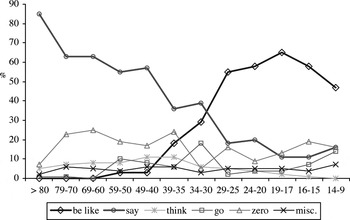
Figure 2 displays the frequency of each of the main quotatives according to speaker age. This graphic representation of the Toronto speech community reveals a dramatic division in the existing population. Be like overshadows all other forms among speakers under age 30, with the predicted “adolescent peak” appearing among the 17–19-year-olds (Labov, 2001:517). Conversely, say is by far the front runner among those over 40, but in the younger age groups its use steadily declines. This is where be like is supreme. Taking a broad view, observe the cross-over as one form appears to replace the other. In the middle, among the 30-year-olds, we find a generation in flux where the frequency of be like is virtually equal to that of say. This is the only group of speakers for whom this is the case.

Overall distribution of quotatives across the generations in Toronto English.
Putting these findings in context with earlier research (Blyth et al., 1990; Cukor-Avila, 2002; Ferrara & Bell, 1995; Romaine & Lange, 1991; Singler, 2001; Tagliamonte & D'Arcy, 2004; Tagliamonte & Hudson, 1999), be like was in its incipient phase in the early 1980s (Buchstaller, 2004; Butters, 1982; Tannen, 1986). At that time the 30-year-olds in the Toronto corpus were teenagers. We would like to suggest that this group may well be the first generation of native users of be like. Observe the catastrophic shift between speakers in their 30s and 40s; we will return to this later.
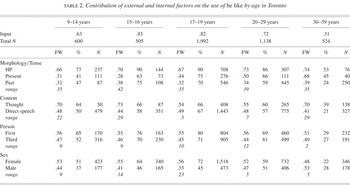
The next question is, “Do these Torontonians share the same grammar for be like?” To explore this issue, we tested for the operation of the constraints discussed earlier. Table 2 provides a consistent variable rule analysis for each age group for whom be like is robust: the 9–14-year-olds, the 15–16-year-olds, the 17–19-year-olds, the 20–29-year-olds, and the 30–39-year-olds.4
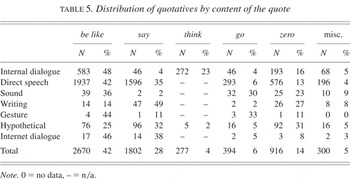
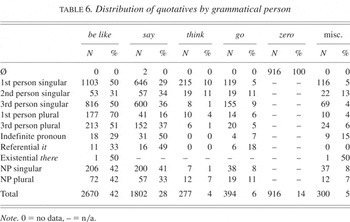
In Table 2, the number of tokens within each factor group does not add up to the total number of tokens for each age group. Due to our focus on the major constraints on be like, we have abstracted away from a number of other nuances in the system, necessitating a number of exclusions. First, within the content of the quote factor group, all hypothetical, written, internet dialogue, gestures, and nonlexicalized sounds have been excluded. Second, within the grammatical person factor group all tokens of existential there, zero, and second person singular subjects were excluded. Third, within the morphology/tense factor group, less frequent tense and aspectual constructions were excluded (e.g., progressives, habituals, futures, etc.). The influence of all these categories on the use of be like certainly bears investigation. There is a growing range of quotation types, and a contrast between full noun phrases (NPs) and pronouns has been in evidence throughout our research. To facilitate ongoing study we have included a comparison of marginals of these distributions in Tables 5, 6, and 7 in the Appendix. We also note that co-occurring adverbs (particularly just, but also all, so, etc.) overwhelmingly occur with be like. However, all such adverbs combined represent only 3.7% of all tokens (N = 235/6364) and only 8.8% of all be like (N = 234/2670) tokens in these data.
Contribution of external and internal factors on the use of be like by age in Toronto

Let us simply consider the statistical significance of factors. All the constraints are in place and they are all significant. Moreover, for each factor group that has previously been studied the direction of effects is as predicted. Internal dialogue consistently favors be like over direct speech.5
As far as we are aware, the only time this direction of effect has not appeared is among the 17–19-year-old cohort in Tagliamonte and D'Arcy (2004), in which a moderate effect in the opposite direction was in evidence. Furthermore, it must be noted that Table 4 in Tagliamonte and D'Arcy (2004:504) contains an error. There were 667 tokens of direct speech and 214 tokens of internal dialogue, not the other way around, as reported.
The consistency in statistical significance of factors, as well as in the constraint hierarchies for each age group, indicates remarkable stability across the population of be like users, suggesting that be like is firmly entrenched in their community grammar. Observe also that this form is used well into adulthood (the 30-year-olds), although Figure 2 clearly corroborates earlier research heralding that this as an under-40s phenomenon (Ferrara & Bell, 1995:286).
Going beyond these initial observations, let us probe the constraints in more detail to increase our understanding of the underlying system. First, we consider morphology/tense. Earlier research, relying largely on HP contexts, suggested that present tense constrains the use of be like (Blyth et al., 1990; Singler, 2001). Blyth et al. (1990:218) interpreted this to suggest that be like may serve an evaluative function, heightening the dramatic effect of complicating action sequences. Singler (2001:273–274), on the other hand, proposed that the HP and be like co-occur because both are “characteristically informal and colloquial.” This assumes that the use of be like falls out from the use of an informal stylistic option (D'Arcy, 2004:328), more like a chance coincidence than part of a systematic pattern. However, this prediction does not account for the full range of variability observable in the data. In Tagliamonte and Hudson (1999: cf. 158,166), for example, the rates of HP do not correlate with the rates of be like. A comparison between the British and Canadian narrative data revealed that where the use of the HP is more frequent, the use of be like is less frequent, and vice versa. Thus, a more elaborated test is necessary to capture the regular tendency of be like to appear in the present tense (see also D'Arcy, 2004:329).
In Table 2, where a clear distinction is made between present tense and HP, be like is not favored for present tense for any of the speakers under 20. In contrast, among the 30-year-olds, be like is favored for both the HP and present tense morphology; in other words, all cases of present tense. The 20-year-olds are hovering in between. Here, the overarching correlation with present morphology does not exist. In fact, present tense contexts are precisely on the median, at .50. In short, the factor group morphology/tense splits the population. The present tense effect has shifted towards favoring for the 20–29-year-olds and is the prevailing effect among the 30–39-year-olds, but for the younger speakers, it is clearly HP.
Next, we consider the content of the quote. While the correlation with inner thought is stable across the board, its strength differs depending on speaker age. It stands as a clear second ranked constraint for the 9–14 and 15–16 years olds, with ranges of 22 and 29, respectively. It is also one of the top-ranked constraints among the 30-year-olds. In fact, with a range of 29, its strength is nearly equal to that of morphology/tense. But, among the 17–19-year-olds and the 20–29-year-olds its effect is very weak. We return to this observation later when we discuss the possible grammar-internal mechanism behind the rise of be like.
There is little to add about the first versus third person constraint, except to note that it is quite weak, particularly among the 30-year-olds, who barely have it.
Finally, we consider the sex effect. It peaks in strength among the 17–19-year-olds, where it is second only to the strong correlation with HP. Interestingly, among the 30–39-year-olds, it operates in the opposite direction, albeit weakly; males, not females, favor be like.
In sum, despite the apparent stability of be like in terms of the significance of factors, the detailed evidence from the constraint rankings and their relative strength shows us that there are subtle changes going on in the system. At this point, a model of what the underlying mechanism of this system is might be needed. Recall that based on age and frequency, we hypothesize that the 30-year-olds were the first generation of be like users. If so, then the speakers in their 20s represent the second generation. These age groups can be positioned in the model as Stage 1 and Stage 2. Labov's (1994, 2001:447) account of sound change sets the age of stabilization for phonological features at about 17. In these data, not only do the 17–19-year-olds have the highest frequency for be like, but they are also the group where the sex effect is strongest, an indication that this feature has developed vital social differentiation. We therefore take them to represent Stage 3.
Table 3 reconfigures the results from Table 2, grouping the data into the three developmental stages that we have just outlined.
Contribution of external and internal factors on the use of be like in Toronto English: Three stages [c. 2004]

At Stage 1, be like introduces inner thought. In fact, most studies concur that be like entered the quotative system carrying with it this strong pragmatic correlation. Our evidence supports this perspective because the content of the quote is strongest among the 30-year-olds, the early adopters of be like in the 1980s. If so, then we would expect the pragmatic constraint to be salient for them, and it is.
The correlation of be like with first person is likely a by-product of the primordial semantic/pragmatic effect, narrators quoting themselves, that is, first person. Our evidence in support of this position is that the grammatical person constraint reaches statistical significance for every age group. It too is present from the beginning, and is somewhat stronger at Stage 2 and beyond.
As far as the sex effect is concerned, we believe that it must have started out quite minor. This may explain why early studies were inconsistent in their findings for sex (cf. Blyth et al., 1990; Dailey-O'Cain, 2000; Ferrara & Bell, 1995; Tagliamonte & Hudson, 1999) and makes us unwilling to attribute much importance in the marginal effect for males that shows up here among the 30-year-olds. Furthermore, as be like rises in frequency, it begins to develop a correlation with female speakers, until this becomes one of the strongest constraints on its use. This is precisely what we would predict, if, as Labov (2001:308) suggested, sociolinguistic variation is parasitic on foundational linguistic variation. Indeed, the pattern observed for the sex effect falls directly in line with Labov's (2001:307–308) discussion regarding the development of gender asymmetry. Once a change becomes associated with a particular gender (i.e. Stage 2 in our model), what Labov calls gender specialization, men either retreat from or resist the change (i.e. Stage 3 in our model), causing a gender split.
However, it is the association of be like with morphology/tense which presents the most interesting nuance for the incrementation problem. The evidence from this constraint suggests that be like is associated with the HP, as pointed out by Singler (2001:272–273), although this observation was made without the added perspective of present tense more generally. Discussed earlier, be like may be lexicalized with present tense morphology regardless of orientation in time. Our data suggest that developmentally, a distinction between morphology and temporal reference is critical. Be like initially carries present tense morphology, but this more general pattern is localized to the 30-year-olds in Toronto, that is, Stage 1. At Stage 2, however, the correlation with the simple present weakens and the HP begins to break away until it stands apart as the favoring factor at .67. This developmental path for be like is summarized in Figure 3.

Developmental trajectory for be like.
DISCUSSION
We have presented an account of how be like has developed in Toronto based on a series of regularities interpreted in a sociocultural context. It now remains to offer our explanation as to why these changes have taken place. The benefit of data from many generations within the same community provides insight into the elusive actuation problem (Weinreich et al., 1968). Recall Figure 2, which displays the frequency of quotatives across all age groups. This trajectory looks very much like weak complementarity (Sankoff & Thibault, 1981; Sankoff, 1982), with be like replacing say. However, the results reported in Tables 2 and 3 revealed subtle shifts in the constraint rankings and relative strength of factors across age groups that hint at reorganization of the system. We therefore hypothesize that be like is more than simply a new lexical item within the English quotative cohort. If this were true, then we would expect that the constraints on be like, which seem to be pervasive across all the speakers who use it, will differ from the underlying organization of the system that existed previously.
Table 4 shows two independent multivariate analyses of our corpus, split at the watershed: the under 40 year-olds, in contrast to the over 40 year-olds.6
Recall that the nonapplication contexts in both runs are virtually the same (see Figure 2).
It is not simply that be like appears where say is disfavored. An obvious contradiction to this is the effect of speaker sex, since both be like and say are (significantly) disfavored among males. It is important to bear in mind that these forms are just two of numerous quotative choices, each of which possesses its own profile with respect to conditions on use. Within the repertoire, say is not unique in having constraints which pattern in opposition to those on be like. However, Table 4 contrasts these two forms in order to demonstrate that despite their weak complementarity in apparent time (Figure 2), be like is not replacing say. Thus, even though say has receded dramatically in these data, be like is not stepping into the niche that say is leaving behind. In other words, the rise of be like is not due to lexical replacement.
Factors on the use of be like in speakers under 40 years old and say in speakers over 40 years old

The pointed question then becomes, “What happened that would have led to this remarkable exchange of form and reorganization of function?” Among the constraints that figure in the development of be like, it is the pragmatic effect contrasting thought with direct speech that is most baffling. When did narrators begin telling stories by regaling their audience to a running stream of their own inner thought processes? Consider the examples in (6), typical passages from the under 20 year-olds in our corpus,8
An interesting aspect of be like is its perceived tendency to encode routinized expressions (e.g., Oh my God, okay, oh, whatever) in putatively “performative” dialogue. However, these “highly conventionalized exclamation[s],” which have been a part of the be like repertoire since its inception and characterize an early stage in its use (Ferrara & Bell, 1995:283), account for a negligible proportion of instances of be like overall (6.5%; N = 2,670). In fact, the particular collocation of be like + Oh my God—without further elaboration within the quotation frame, as in (6a)—comprises just 1% (28/2,670) of the data for be like.

In fact, according to our data, this is quite a recent phenomenon and one that has undergone a dramatic increase over the past 65 years.
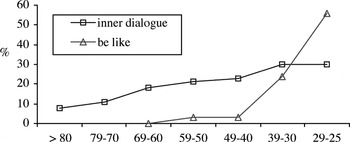
Figure 4 plots the overall proportion of quotations that are internal dialogue, beginning with the oldest speakers in our sample and tracking them down to the early adopters of be like. Among speakers in their 80s, quoted thought represents just 8% of all direct quotations (N = 363). However, this proportion increases steadily in apparent time and peaks among the 30-year-olds. In other words, Figure 4 captures a change in how narrators construct their stories. Notably, this development immediately precedes the acceleration of be like among the 30-year-olds. The explanation we would like to offer is that the rising stylistic option of inner monologue in narratives of personal experience was expanding before be like entered the system, setting the scene for a new development. Thus, be like filled a niche that already existed, only later specializing into a device to grandstand the narrator as a participant in his or her own stories.9
We wonder why the extant form think was not recycled for the rising option of quoting inner monologue. As Figure 2 demonstrates, however, think has always been a marginal contender in the quotative system, at least in Toronto. We leave this issue for future research.
Such qualitative changes may simply reflect the fact that people of different ages tell stories in diverse ways. This notwithstanding, if the ongoing change in the rates of inner monologue were simply age-related behavior then we might not expect the regular, step-wise progression seen in Figure 4. That is, even though apparent time distributions are not sufficient for disentangling age-grading and generational change (Labov, 1994:84), age-graded phenomena are typically associated with a distinct developmental stage (Chambers, 2003:206), most often adolescence, and as far as we are aware, are not generally thought of as gradient, spanning the full life cycle. Moreover, prototypical age-grading pertains to aspects of language that involve a high degree of social awareness and as such, would be “more readily available for conscious manipulation” (Milroy & Gordon, 2003:36–37). This is not the profile of a feature like inner monologue. Nevertheless, there is much that could be done with a more qualitative analysis of narrative structure across the life span.

Proportion of inner dialogue and be like across the generations in Toronto English.
Interestingly, this developmental reshuffling may be reconstructed from the multivariate results in Table 2. As we have noted, be like is associated with first persons from the outset, Stage 1, in the 30–39-year-olds. Its specialization as a narrative marker occurs at Stages 2 and 3, among the 20–29-year-olds and the 17–19-year-olds. These are also the two groups where the content of the quote constraint is most weakened. In Stage 1, this factor is the second ranked constraint on be like. In Stage 2, where the effect of the present tense first weakens, the relative weight of content of the quote drops to third. In Stage 3, where the present tense begins to disfavor, the content constraint again drops in the rankings, this time becoming the weakest of the four. It is only among the subsequent generations—the 9–16-year-olds—that the variable grammar stabilizes and the effect of content of the quote is again eminent in the system. We suggest that these correspondences between the factor groups morphology/tense and the content of the quote are not coincidental. We propose the following scenario. Be like entered the quotative paradigm marking morphologically present internal dialogue. This is consistent with the view that it was filling a niche in the grammar, that is, speaker thought processing. Crucially, be like was not restricted to this context, nor is it now. However, once it had a foothold in the system it was then free to specialize. This is where the rising stylistic option of internal dialogue becomes pivotal in the further development of be like. A defining property of the narrative is that it retells some event that occurred in the past, yet many complicating action clauses are encoded with the HP (Schiffrin, 1981; Wolfson, 1978, 1979), present tense morphology to refer to past actions and, more and more frequently, past thoughts about those actions, as well. Thrust into narrative by its initial association with monologue, be like then latches on to the archetypal narrative device: the HP. During this period, the correlation with internal dialogue weakens due to the increasing importance of the HP. However, once entrenched as a narrative marker, the correlation of be like with internal dialogue, always present, again comes to the fore.
The issue remains, however, as to what catapulted be like into the adolescent vernaculars of the 1980s. Labov (2001:462) observed that the “acceleration of linguistic change logically begins when the incipient change is attached to or is associated with a particular style or social group: A social category like burnout or a neighborhood like Kensington.” In this case, we would like to suggest that the associated social category was Valley Girl and the place was California. Indeed, such an association is part of the received wisdom surrounding be like (see, e.g., Blyth et al., 1990:224; Dailey-O'Cain, 2000:76). As part of the “preppie” movement of the 1980s, be like gained prestige as a trendy and socially desirable way to voice a speaker's inner experience. In other words, linguistic change begins with a hospitable grammatical environment, but requires a social force to drive it forward.
CONCLUSION
A recurrent topic in the literature is whether be like represents age-grading or generational linguistic change (e.g., Cukor-Avila, 2002; Ferrara & Bell, 1995; Tagliamonte & D'Arcy, 2004). In Toronto, the adolescent peak makes it appear as though be like is age-graded. However, such a peak is predicted by the logistic model of linguistic change proposed by Labov (2001). Indeed, the perspective from the community as a whole reveals the classic S-curve of linguistic change. Interpreting the crossroads in the contemporary population of Toronto is made more complex by the fact that be like was only incipient in the system prior to the 1980s. Speakers over the age of 40 never had it in the first place because the point at which their grammar stabilized either predated or coincided with the introduction of be like to the quotative repertoire. The 30-year-olds are on the frontier, and from that point onward there is ongoing generational change. There is simply too much stability across the population for be like to be a passing fancy. However, is there evidence for communal change as well?
The central assumption of the apparent time construct is that once out of their teens, speakers no longer participate in the advancement of change (Labov, 2001:454). The relevant implication here is that the 30-year-olds have continued to use be like at the same rate throughout their lifetimes, after initially adopting it in the 1980s. However, there are indications that these frontliners have also been participants in ongoing change. Recall that the 30-year-olds are using be like a full third of the time. It is unlikely that they had this rate in their late teens. Instead, it is more probable that they have increased their use over the last fifteen years. Support for this conjecture comes from a comparison with data from Canadian English in 1995 in which the frequency of be like was 13% (Tagliamonte & Hudson, 1999). These speakers would now be between the ages of 25 and 34. If we compare the 1995 rate of be like with these two age groups in our corpus, their frequencies of be like are 58% and 31%, respectively. This is well beyond the 13% of 7 years ago.11
Interestingly, in a study conducted by students of Shana Poplack in Ottawa in the autumn of 2004, the 18–35-year-old age group had a rate of be like of 41% (N = 1,607/3,940) (Dion & Poplack, 2005), a remarkably comparable result to our 25–34-year-olds.
Discussed at the outset, a growing body of work suggests that individuals do not cease to participate in linguistic change post-adolescence, but may indeed contribute to its advancement into adulthood (e.g., Nevalainen & Raumolin-Brunberg, 2003; Nordberg & Sundgren, 1998). The Toronto results thus lend support to Labov's (2001:447) observation that adults may not be as stable as previously thought. Yet the 30-year-olds, while evidently augmenting the rate at which they use be like since their adolescence, do not exhibit the advanced stages of development with regard to the constraints (Table 2). Instead, it appears that speakers can enhance their use of an incoming feature by increasing its frequency, but they do not show signs of the more advanced state of the variable grammar. In other words, it seems that what it means to ‘participate’ in a linguistic change requires elaboration. Is frequency sufficient, or does participation in a change require the full composite of constraints? Our findings suggest that adult frequencies of linguistic forms are labile (Labov 2001:447), but the grammar underlying them is not. This observation provides us with a tantalizing starting point for future research.
APPENDIX
Distribution of quotatives by content of the quote

Distribution of quotatives by grammatical person

Distribution of quotatives by tense and aspect