The Trichoptera are an order of insects with approximately 15,000 extant and about 700 known fossil species (Morse Reference Morse2016). They are small moth-like insects, having two pairs of hairy membranous wings. They are closely related to Lepidoptera and together they constitute the superorder Amphiesmenoptera. Trichopteran have aquatic larvae, where many species use silk to make protective cases of gravel, sand, or other debris.
The Cretaceous is one of the most interesting and important periods in the history of life on Earth. It is largely admitted that the angiosperms appeared and radiated during this critical period, which witnesses the emergence of most of the recent insect families. Amber is famous for being a superb material for the preservation of biological inclusions in minute three-dimensional detail. The oldest amber containing diverse biological inclusions is Lebanese amber. More than 400 localities have recently been discovered, including 23 that have yielded a high diversity of biological inclusions. Until now, more than 15,000 biological inclusions (mainly insects) have been found in the amber from the different localities, with more than 190 species distributed in nearly 150 families. The age of Lebanese amber ranges from Late Jurassic (Azar et al. Reference Azar, Gèze, El-Samrani, Maalouly and Nel2010; Nohra et al. Reference Nohra, Azar, Gèze, Maksoud, El-Samrani and Perrichot2013) to Albian. Information about the age of the fossiliferous amber outcrops in Lebanon has been updated recently (Maksoud et al. Reference Maksoud, Granier, Azar, Gèze, Paicheler and Moreno-Bedmar2014, Reference Maksoud, Azar, Granier and Gèze2016), and they are now considered to be early Barremian in age (Granier et al. Reference Granier, Toland, Gèze, Azar and Maksoud2016). Herein, we describe Phylocentropus succinolebanensis n. sp. and Ecnomus cretacia n. sp., the first two Trichoptera species from Lebanese amber, belonging respectively to Dipseudopsidae and Ecnomidae. These fossils constitute the earliest representatives of both families.
1. Material and methods
The Ecnomus specimen was cut, ground and polished, then placed between two cover slips using Canada balsam as a medium, as described by Azar et al. (Reference Azar, Perrichot, Neraudeau and Nel2003). The Phylocentropus specimen is in a small and very fractured piece of amber, but as a precaution was embedded in synthetic resin, as described by Hoffeins (Reference Hoffeins2001).
The specimens were examined under a Leica M5 or MZ12.5 dissecting microscope (Leica, Wetzlar, Germany). Photographs were taken using a Leica stereomicroscope M 420 Apozoom in combination with Canon EOS 600D, EOS utility software and the Zerene Stacker software; incident and transmitted light were used simultaneously. All images were edited with Adobe Photoshop CS4.
The studied material was collected from the Hammana Mdeirij amber outcrop, Baabda District, Mount Lebanon Governerate, Central Lebanon. The specimens were deposited in the Natural History Museum of the Lebanese University, Faculty of Sciences II, Fanar, Lebanon.
2. Systematic palaeontology
Order Trichoptera Kirby, Reference Kirby1815
Suborder Annulipalpia Martynov, Reference Martynov1924
Family Ecnomidae Ulmer, Reference Ulmer1903
Genus: Ecnomus McLachlan, Reference McLachlan1864
Type species. Philopotamus tenellus Rambur, Reference Rambur1842.
Diagnosis (modified from Botosaneanu Reference Botosaneanu1992). Small or medium-sized extant insects and very small fossil insects. Maxillary palps five-segmented, first segment very short, second and fourth longer and similar, third longer again, fifth as long as second, third and fourth together, fifth terminal segment secondarily annulated and flexible. In forewings, R1 forked; apical forks I, II, III, IV, and V present; discoidal, median and thyridial cells present. In hindwings, R1 unbranched, forks II and V present; discoidal, median and thyridial cells absent. Tibial spurs 3/4/4, but in some species 2/4/4. Some African species belong to the natalensis-group of Ecnomus, which possesses inferior appendages (claspers) with an apical finger-like lobe and does not possess preapical spurs of the tibial prolegs: tibial spurs 2/4/4 (Scott Reference Scott1968; Barnard & Clark Reference Barnard and Clark1986).
Remarks. Ecnomus is the largest of eight genera in the Family Ecnomidae (Johanson & Espeland Reference Johanson and Espeland2010), including the extinct genus Archaeotinodes Ulmer, Reference Ulmer1912 from Eocene Baltic amber. Ecnomus is represented by more than 275 species worldwide, distributed in the Oceanian/Australian (61 species), Afrotropical (68), Oriental (135) and Palearctic (15) regions, except in the New World (Johanson & Espeland Reference Johanson and Espeland2010). The larvae of Ecnomus construct tubes of silk and fine sand grains and live in running and standing water on rocks and submerged vegetation.
Ecnomus cretacia n. sp.
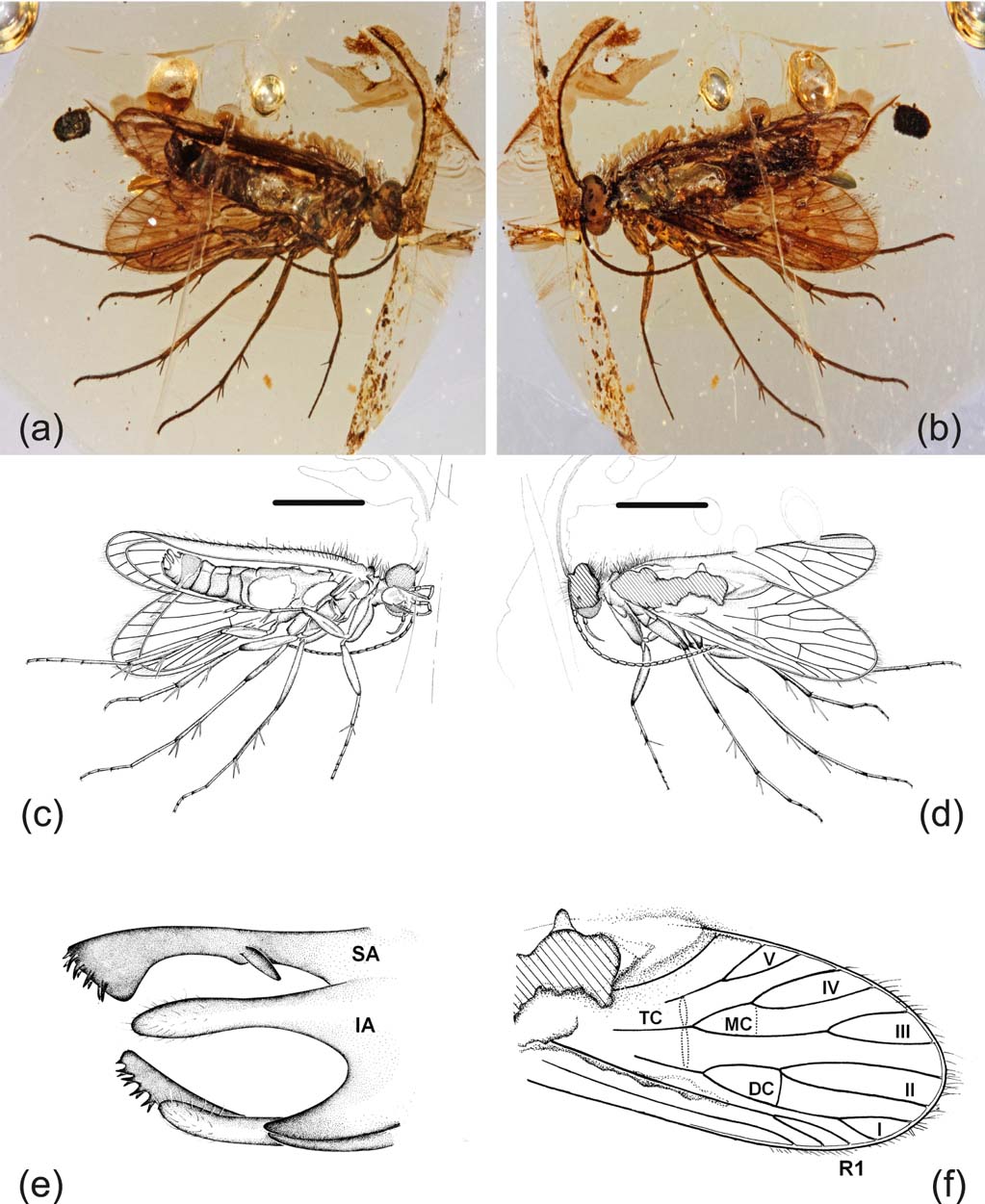
(Fig. 1)
Ecnomus cretacia n. sp.: (a) male, laterovental view, forewing length 3 mm; (b) male in dorsal view; (c) male, drawing in vental view; (d) male, drawing in dorsal view; (c) male genitalia, drawing in ventrolateral view; (f) left forewing, upside down. Scale bars = 1 mm.

Etymology. The species cretacia is named after the geological age (Cretaceous) of Lebanese amber.
Holotype. Male, in Lebanese amber, from the Azar collection (no. 574-C), deposited in the Natural History Museum of the Lebanese University.
Diagnosis. The new fossil species belongs to the natalensis-group of Ecnomus, indicated by the absence of preapical spurs of the tibial prolegs (tibial spurs: 2/4/4) and by the presence of the paired inferior appendages, each with an apical finger-like lobe in male genitalia. The extinct species differs from the extant species of the natalensis-group by the male genitalia. The superior appendages bear a small mesal projection and the basoventral process of the inferior appendages is subtriangular-shaped.
Description. Small caddisfly with forewing length of 3 mm. Ocelli absent. Antennae consisting of 23 flagellomeres plus scapus and pedicellus, not reaching the lengths of the forewings. Maxillary palps five-segmented, basal segment shorter than all others; its second segment longer than first but shorter than third and fourth; third segment originates from the apex of second segment; terminal fifth segment longest, about as long as all other segments together, secondarily annulated and flexible. Labial palps three3-segmented; basal first segment slightly longer than second segment and shorter than terminal segment. Third labial segment annulated and flexible. The dorsal part of head damaged, as well as the thorax and the basal part of the wings. However, the apical forewings well preserved, with R1 typically subdivided into two branches near wing margin, with the small and petiolate fork I, fork II sessile, fork III petiolate, as long as the stem, fork IV sessile, and fork V petiolate. The cross-veins closing the slightly elongated discoidal cell; cross-vein m closing the median cell, not well preserved, and cross-vein m–cu closing the thyridial cell indicated by a light oval mark. The hindwings covered dorsally by the forewings; ventrally the apical hindwings indicate the absence of the discoidal cell and the loss of fork I, III and IV, but the presence of forks II and V. In ventral view, all six legs well preserved; each tibiae of the legs bearing a pair of apical spurs and, additionally, tibiae of middle and hind legs bearing two additonal preapical spurs (spurs formula: 2/4/4). Male genitalia solely visible in ventrolateral view allows a tentative description. Superior appendages (SA) long and slender, with a small mesal projection and a field of spiny setae restricted to the dilated apex. Inferior appendages (IA) with two branches, the lateral one elongate, finger-like lobe, apex rounded, the shorter ventral one (basoventral process) subtriangular, apically tapered and slightly curved mediad.
Remarks. Ecnomus cretacia n. sp. belongs to the African natalensis-group of Ecnomus, as indicated by the tibial spurs (2/4/4) and in male genitalia by inferior appendages (claspers) with an apical elongate finger-like lobe. The natalensis-group of Ecnomus includes more than 23 extant species (Barnard & Clark Reference Barnard and Clark1986), ranging from South Africa (e.g., E. forbesi Scott, Reference Scott1968) via central Africa (e.g., E. mennellli Barnard & Clark, Reference Barnard and Clark1986) to the Ethiopian region and northwards up to Palestine, and to the Galilee of northern Israel, where E. galilaeus Tjeder, Reference Tjeder1946 occurs (Botosaneanu Reference Botosaneanu1992). Ecnomus galilaeus is probably an endemic element of the Levantine fauna (Botosaneanu Reference Botosaneanu1992), but lives relatively close to the location where the extinct Ecnomus cretacia was found.
Family Dipseudopsidae Ulmer, Reference Ulmer1904
Genus: Phylocentropus Banks, Reference Banks1907
Type species. Holocentropus placidus Banks, Reference Banks1905 (original designation) and Polycentropus lucidus Hagen, Reference Hagen1861 included.
Diagnosis (modified from Ross Reference Ross1965; Schuster & Hamilton Reference Schuster, Hamilton and Morse1984). Medium-sized extant insects and small fossil insects. Ocelli absent. Antennae about as long as forewings. Maxillary palps five-segmented; first and second segments short, third segment originating from the apex of second segment; third segment longer than the first and second segments together, fourth segment shorter than third, terminal fifth segment longest, secondarily annulated and flexible. Labial palps three-segmented; first segment slightly longer than second and shorter than terminal segment; third terminal labial segment annulated and flexible. Forewings with complete wing venation, the discoidal, median and thyridial cells closed, the apical forks I, II, III, IV and V present; in hindwing fork IV absent, discoidal and thyridial cells closed. Fork I and II sessile or subsessile in both wings. Tibial spurs: 3/4/4.
Remarks. Betten (Reference Betten1934) placed Phylocentropus in the subfamily Polycentropodinae of the family Polycentropodidae. Ross (Reference Ross1965) suggested that Phylocentropus was “an extremely archaic member of the subfamily Polycentropodinae.” Ross & Gibbs (Reference Ross and Gibbs1973) placed Phylocentropus in the polycentropodid subfamily Dipseudopsinae, indicated by some larval characters. The Dispeudopsinae was given family status by Weaver & Morse (Reference Weaver and Morse1986) and Frania & Wiggins (Reference Frania and Wiggins1997). Kjer et al. (Reference Kjer, Blahnik and Holzenthal2001) suggested that Dipseudopsidae are closely related to Polycentropodidae and Ecnomidae. Dipseudopsidae is a relatively small family, with five genera and about 120 species (Holzenthal et al. Reference Holzenthal, Morse and Kjer2010). Extant species of Phylocentropus are found in eastern North America, southeast Asia and Japan. Extinct species were described from Cretaceous New Jersey amber (Wichard & Bölling Reference Wichard, Bölling and Grimaldi2000; Wichard & Luer Reference Wichard and Luer2003) and Eocene Baltic amber (Ulmer Reference Ulmer1912). The new extinct species described below belongs to the genus Phylocentropus Banks, Reference Banks1907, which differs from the closely-related Polycentropodidae by the sessil fork I in the fore- and hindwings (Ross Reference Ross1965; Schuster & Hamilton Reference Schuster, Hamilton and Morse1984).
Phylocentropus succinolebanensis n. sp.
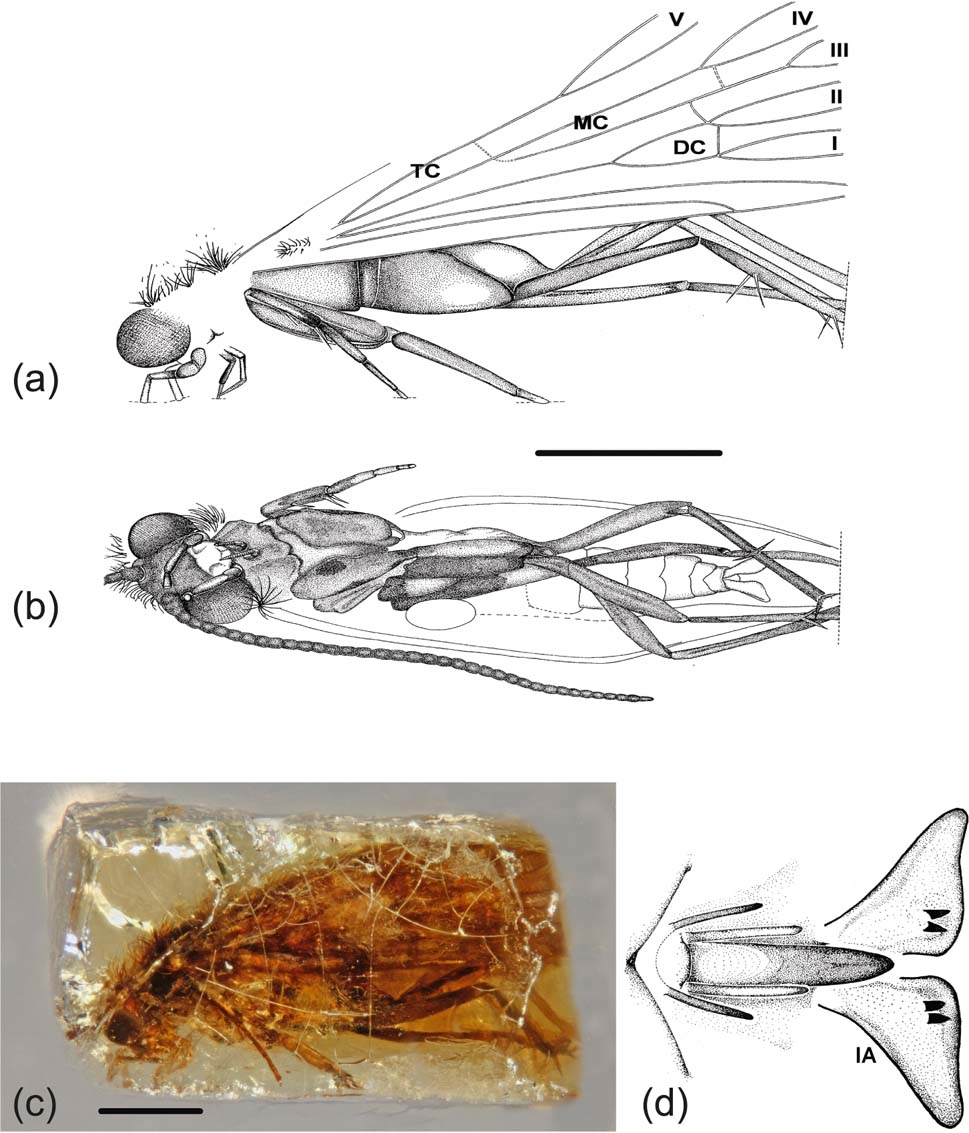
(Fig. 2)
Phylocentropus succinolebanensis n. sp.: (a) male, drawing in lateral view, preserved forewing, length 4 mm; (b) male, drawing in vental view; (c) male in fractured amber; (d) male genitalia, drawing in posterior view. Scale bars = 1 mm.

Etymology. The species succinolebanensis is named after the amber (= succinum (lat.)) of Lebanon.
Holotype. Male, in Lebanese amber, from the Azar collection (no. 500), deposited in the Natural History Museum of the Lebanese University.
Diagnosis. Phylocentropus succinolebanensis n. sp. differs from the other extinct species by the structures of the outer male genitalia. Inferior appendage one-segmented, sclerotised, in ventral view triangular, slightly elongated and slightly rotated, its inside area bearing two dark strong spiny setae.
Description. Male embedded in a small amber piece. Apical parts of the wings, of the legs and of maxillary palps preserved incomplete. Adult with forewing length probably 4 mm. Antennae consisting of 35 flagellomeres plus scapus and pedicellus, not reaching the lengths of the forewings. Maxillary palps probably five-segmented, terminal segment absent; labial palps three-segmented, terminal segment secondarily annulated, little longer than first and second segment together. The forewing venation complete, fork I and fork II sessile, fork III petiolate, probably as long as the stem, fork IV sessile, and fork V petiolate. Discoidal cells closed and small; median and thyridial cells closed, longer than the discoidal cells, crossveins adelomorphic. Hindwings not visible, covered by forewings. Legs apically cut, but tibial spurs reconstructed: 3/4/4. Male genitalia so far as visible in ventral view and from behind. Inferior appendage (IA) one-segmented, sclerotised, in ventral view triangular, slightly elongated and slightly rotated, its inside area bearing two dark strong spiny setae. Preanal appendages (?) elongate filiform in posterior views. Phallic apparatus simple, aedeagus membranous at base, probably accompanied by two filiform parameres.
3. Discussion
The first two Trichoptera species are herein described from Lower Cretaceous Lebanese Amber: Phylocentropus succinolebanensis n. sp. and Ecnomus cretacia n. sp. They represent the earliest evidence of the families Dipseudopsidae and Ecnomidae. Both families belong to the superfamily Psychomyoidea, which probably originated in the Early/Middle Jurassic (Ivanov & Sukatsheva Reference Ivanov, Sukatcheva, Rasnitsyn and Quicke2002).
The origin of the family Ecnomidae was proposed as Middle/Late Jurassic (Ivanov & Sukatsheva Reference Ivanov, Sukatcheva, Rasnitsyn and Quicke2002; Grimaldi & Engel Reference Grimaldi and Engel2005). Previously, the oldest records of this family were known from Eocene Baltic amber. Ulmer (Reference Ulmer1912) erected the extinct genus Archaeotinodes (forewings with R1 simple and apical forks IV absent, in hindwings fork III present) and described 13 fossil species; further species were described by Melinitsky & Ivanov (2013) and Melinitsky (2009, 2013). The new species from Lebanese amber, belonging to the extant genus Ecnomus, is about 80 Ma older than extinct Archaeotinodes and thus greatly extends the known geological range of this family.
Fossil species of genus Phylocentropus are known from Eocene Baltic amber. Ulmer (Reference Ulmer1912) described four species: P. antiquus, P. ligulatus, P. simplex and P. spiniger. Three further species are known from Upper Cretaceous (Turonian) amber of New Jersey: Phylocentropus cretaceous and P. swolenskyi, as well as Veteropsyche gelhausi Botosaneanu, Johnson & Dillon, Reference Botosaneanu, Johnson and Dillon1998, which was transferred to the genus Phylocentropus (Wichard & Luer Reference Wichard and Luer2003). The newly described Phylocentropus succinolebanensis n. sp. from Lebanese amber is the oldest known Phylocentropus species so far, with an age of about 130 Ma.
Sukatsheva (Reference Sukatsheva1993) described the “oldest Polycentropodidae (Trichoptera) from Mongolia”, dating to the Upper Jurassic–Lower Cretaceous, and established two fossil genera Eoclipsis (type species E. mongolica) and Plectrocentropus (type species P. sulis). The descriptions, based on compression fossils of a forewing (Eoclipsis) and of fore- and hindwings (Plectrocentropus), are unfortunately without any other necessary characters for a convincing placement in the family Polycentropodidae, so their placement is tentative. The forewing venation of Eoclipsis conforms to the forewing venation of Phylocentropus with the sessile forks I and II and differs only by sessile fork III, instead of petiolate fork III in Phylocentropus. The fore- and hindwing venations of Plectrocentropus and Phylocentropus are largely similar, but differ in the presence (Plectrocentropus) and absence (Phylocentropus) of fork IV in the hindwing. If the presence of sessile or subsessile forks I and II in fore- and hindwings are significant (apomorphic) and predominant characters of Phylocentropus Banks, Reference Banks1907, then Eoclipsis Sukatsheva, Reference Sukatsheva1993 and Plectrocentropus Sukatsheva, Reference Sukatsheva1993 belong to Phylocentropus (or to narrowly related taxa) within the family Dipseudopsidae. Old fossil material of insects preserved as compression fossils consisting only of wings, without any other necessary characters, can lead to misinterpretations (Wichard Reference Wichard2016).