Savalia (=Gerardia) savaglia (Bertoloni, 1819) is an uncommon circalittoral zoanthid (Cnidaria: Anthozoa: Zoantharia) with a complicated taxonomic history (see Roche & Tixier Durivault, Reference Roche and Tixier Durivault1951). There has been doubt in the past as to its position within one or other order of Anthozoa (Johnson, Reference Johnson1899 as Savaglia lamarcki (Haime, 1849)), principally due to its capacity of producing a horny axis similar to that of the Antipatharia order, with which it was formerly grouped. The anatomy of the polyps and the cnidome indicate that it must be placed within the Zoantharia, although according to Roche & Tixier Durivault (Reference Roche and Tixier Durivault1951), the biochemical composition of the axis is closely related to that of Cirripathes Blainville, 1834 (Antipatharia). The taxonomic confusion was enhanced by the use of the junior synonym Gerardia Lacaze-Duthiers, Reference Lacaze-Duthiers1864 instead of Savalia Nardo, 1844.
Although known from the Aegean Sea and the Adriatic, it is better documented from the western basin of the Mediterranean Sea (Schmidt, Reference Schmidt1972; Zibrowius, Reference Zibrowius1985a, Reference Zibrowiusb). Rossi (Reference Rossi1958) presented it as a poorly known and very localized species, and Häussermann (Reference Häussermann and Hofrichter2003) still considered it as rare. Records from the Iberian Peninsula are few and include the area of the Strait of Gibraltar (see Barrajón Domenech et al., Reference Barrajón Domenech, Moreno Lampreave, Arroyo Tenorio, López-González, Barea-Azcón, Ballesteros-Dupéron and Moreno2008). Since it is easily recognizable with colonies that may exceed one metre in height at depths accessible to divers, the scarcity of records seems to reflect its relative rareness.
Savalia savaglia was thought to be present also in the Macaronesian archipelagos, with records from Madeira (Johnson, Reference Johnson1899 as Savaglia lamarcki), the Canary Islands (Brito, Reference Brito1983; Ocaña et al., Reference Ocaña, Brito, Núñez and Bacallado1995) and Cape Verde (Ocaña et al., Reference Ocaña, Brito, Núñez and Bacallado1995). There are also records (name only in a species list) by Rioja y Martín & Alaejos (Reference Rioja y Martín and Alaejos1906) and Rodríguez Rosillo (Reference Rodríguez Rosillo1914) (both as Gerardia lamarcki) from Santander (northern Spain) in the southern sector of the Bay of Biscay, that have been overlooked in the literature. In addition, Barreiro (Reference Barreiro1917) mentioned ‘live specimens of the genus Gerardia in the Santander aquarium’ but provided no data on their origin. There have been no further records from the Bay of Biscay, and its possible presence in the north of Spain passed unnoticed. The interpretation changed when Ocaña & Brito (Reference Ocaña and Brito2004), studying material from a wide range of Mediterranean and Atlantic localities, concluded that Macaronesian (Atlantic) records corresponded to a new species, Gerardia macaronesica Ocaña & Brito, Reference Ocaña and Brito2004, and that S. savaglia (as Gerardia) was confined to the Mediterranean Sea. Nevertheless, further sampling from the Canary Islands and re-examination of the morphological characters showed that both species co-occur in this area (Ocaña et al., Reference Ocaña, Brito and González2007). Consequently, S. savaglia is also an Atlantic species. Lately, essentially based on molecular data, G. macaronesica was made the type species of the new genus Antipathozoanthus (Sinniger et al., Reference Sinniger, Reimer and Pawlowski2010), and named accordingly (A. macaronesicus).
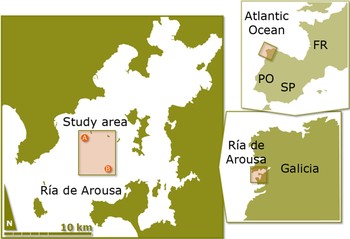
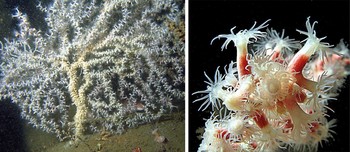
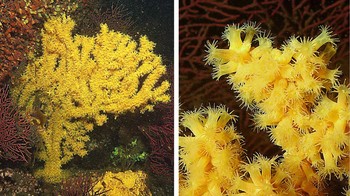
During dives in the Atlantic Ría de Arousa (Galicia, north-western Spain, 42°30′40.2″N–08°56′30.7″W, 42°32′47.1″N–08°57′26.3″W) (Figure 1), one yellow (60–70 cm high), and three white-pinkish (15–60 cm high) colonies of arborescent zoanthids, all strongly ramified in one plane, were found at 26–29 m depth (Figures 2 & 3). Small pieces from colonies of both colours were taken for their study, and the species was identified as Savalia savaglia. They have an internal black axis of horny material in concentric layers that is an essential character of the genus Savalia (Lacaze Duthiers, 1864; Roche & Tixier Durivault, Reference Roche and Tixier Durivault1951; Rossi, Reference Rossi1958, all as Gerardia). Savalia savaglia commonly uses gorgonians as substrate (Rossi, Reference Rossi1958; Zibrowius, Reference Zibrowius1985b). The substrate should not be confused with the proper skeleton of Savalia, which frequently overgrows them. This is a significant difference to other zoanthids. In the Mediterranean, Zibrowius (Reference Zibrowius1985b) showed that S. savaglia is capable of causing necrosis in the gorgonian Paramuricea clavata (Risso, 1826), and then to overgrow the cleared axis. Hence, its resulting colonies have the same type of ramification as the former gorgonian colonies. As for the Ría de Arousa colonies, the ramification pattern of one of the white colonies (Figure 2) is very similar to the pattern of Paramuricea grayi (Johnson, 1861), a common species in that environment. This similarity suggests that a gorgonian axis may underlay the Savalia colony.
Map showing the study area. Station A, 29 m depth, 42°32′47.1″N–08°57′26.3″W; Station B, 26 m depth, 42°30′40.2″N–08°56′30.7″W.

Savalia savaglia (Bertoloni, 1819), Station A. Compare polyps with larger zoanthid Epizoanthus sp., near lower right of fan-shaped colony.

Savalia savaglia (Bertoloni, 1819), Station B.

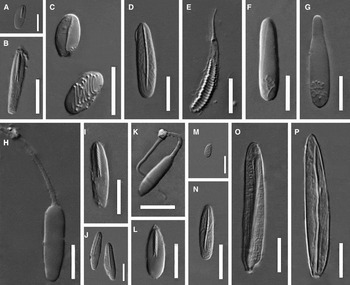
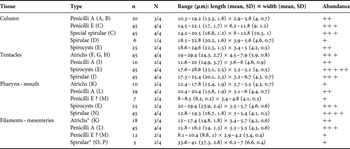
Savalia savaglia polyps are small, and once preserved they are more or less cylindrical, 0.3–0.5 cm high and 0.2–0.4 cm wide. They are closely set on the axis, and have 21–26 tentacles in two circles, while Antipathozoanthus macaronesicus has a mean of 42 tentacles (Ocaña & Brito, Reference Ocaña and Brito2004). We studied the cnidome of a white-pinkish colony 50 cm high (Figure 4; Table 1). In the older literature, data on the cnidome of S. savaglia are scarce (see Schmidt, Reference Schmidt1974; Gili et al., Reference Gili, Pagès and Barangé1987). Although it was carefully described by Ocaña & Brito (Reference Ocaña and Brito2004) from two Mediterranean locations, variability between colonies is little known. Differences regarding the presence, absence, and abundance of certain categories of cnidae are documented for specimens from distant locations in A. macaronesicus (Ocaña & Brito, Reference Ocaña and Brito2004), and might occur in S. savaglia as well. In fact, there are some divergences between the cnidome described by Ocaña & Brito (Reference Ocaña and Brito2004) and that of the Galician colonies. The main categories that characterize the species, for instance the oviform special spirulae, occur in our specimens (Figure 4C). Nevertheless, there are differences in the size of some cnidae, two categories of atrichs (Figure 4F–H, K), and big spirulae in the mesenteries (Figure 4O, P) here mentioned from the species for the first time. Further, the special spirulae are more elongate. Knowledge about cnidome variations in relation with ecology or life cycle is still limited, and we consider these divergences as due to normal fluctuations between populations. Cnidome analyses have not been proven useful at species levels in Zoantharia (Sinniger & Häussermann, Reference Sinniger and Häussermann2009), and studies like the one by Terrón-Sigler & López-González (Reference Terrón-Sigler and López-González2005) with two species of scleractinian corals, following the criteria suggested by Ryland & Lancaster (Reference Ryland and Lancaster2004) for the zoanthids, are needed.

Savalia savaglia (Bertoloni, 1819). Cnidome from the colony in Figure 2. Nomenclature following Ocaña & Brito (Reference Ocaña and Brito2004).

n, number of measured capsules; N, ratio of the number of polyps having a type of cnida to the total number examined. All the polyps belonged to the same branch tip. Abundance: +, present; ++ + ++ , very abundant. SD, standard deviation. Letters in parentheses correspond to cnidae in Figure 4. *, only in the mesenteries.
Regarding colour, there seems to be no significant difference between the two areas. Mediterranean colonies are often reported as yellow, but there are white and pink specimens as well (Schmidt, Reference Schmidt1972). Yellow and white-pinkish colonies occur also in Galicia (Figures 2 & 3). Only the lower part of the polyps is pinkish, a colour that could perhaps be due to the development of the gonads. If so, yearly colour changes should be expected, but a white-pinkish colony had the same colour in December and August (Figure 2).
DNA study was complementary to the morphological approach. DNA has been obtained from two colonies (both colour variations) following methods by Sinniger et al. (Reference Sinniger, Chevaldonné and Pawlowski2007). The usual mitochondrial markers used in zoanthid taxonomy (mt16S rDNA and COI) were sequenced complementing the nuclear 18S rDNA. The sequences obtained (Accession numbers HQ110947–HQ110949) represented a total of 3729 bp (793 (COI), 1181 (16S) and 1755 bp (18S)), and were identical to sequences obtained for Savalia savaglia from the Mediterranean Sea (Sinniger et al., Reference Sinniger, Chevaldonné and Pawlowski2007). As mentioned in Sinniger et al. (Reference Sinniger, Reimer and Pawlowski2008), identical sequences can be shared by closely related species. However, according to current zoanthid taxonomy, and based on the combination of morphological and molecular characters, the two colonies from Galicia can be identified as S. savaglia.
In Galicia, Savalia savaglia was observed at 26–29 m depth. Only four colonies were seen during many years of diving in the area (over 450 dives). Given that the species is known to have a larger depth-range of 12–100 m (Barrajón Domenech et al., Reference Barrajón Domenech, Moreno Lampreave, Arroyo Tenorio, López-González, Barea-Azcón, Ballesteros-Dupéron and Moreno2008), it cannot be disregarded that more specimens occur deeper in the Ría de Arousa, especially considering that suitable hard bottoms exist at 40–60 m depth. In Galicia, the species has been seen on rocky bottoms covered with sediment, almost devoid of algae, but rich in anthozoans and sponges. The Anthozoa community associated with these rare S. savaglia colonies comprises Alcyonium glomeratum (Hassall, 1841), Alcyonium palmatum Pallas, 1766, Eunicella gazella Studer, 1901, Eunicella verrucosa (Pallas, 1766), Leptogorgia sp., Paramuricea grayi (Johnson, 1861), Spinimuricea atlantica (Johnson, 1862), Swiftia dubia (Thomson, 1929), Corynactis viridis Allman, 1846 and Epizoanthus sp. We did not find other organisms living on S. savaglia, whereas such a situation is known in the Mediterranean Sea (Lacaze-Duthiers, Reference Lacaze-Duthiers1864; Zibrowius, Reference Zibrowius1985a). Dissection of some polyps revealed partially digested copepods in the coelenteron. Copepods may thus be a regular part of the diet of S. savaglia.
All species of Savalia are probably very slow-growing organisms (see Druffel et al., Reference Druffel, Griffin, Witter, Nelson, Southon, Kashgarian and Vogel1995). Accordingly, S. savaglia should not be considered a newcomer to the area. The lack of previous records may surprise, as the Ría de Arousa is an area of intensive aquaculture and commercial fishing and has been the subject of benthos research. Nevertheless, the anthozoan fauna of certain circalittoral hard-bottom communities is still poorly investigated. For instance, we found the scleractinian Monomyces pygmaea (Risso, 1826) and the gorgonians Eunicella gazella, white colonies of Leptogorgia sp. and Paramuricea grayi, all of them previously unknown from the area. Paramuricea grayi is very abundant at a depth of only 20 m, the shallowest record in European seas. This species co-occurs with Antipathozoanthus macaronesicus in the Canary Islands (see Ocaña & Brito, Reference Ocaña and Brito2004). All these species are of southern affinity, S. savaglia being just one case more. Surprisingly, the coastal ecosystem of Galicia is considered as particularly ‘northern’ within the Iberian Peninsula and several typical boreal species live in its littoral area (Fischer-Piette, Reference Fischer-Piette1963). Based on measurements taken in situ during 30 dives from January 2006 to May 2010, yearly temperature range in the sampling stations is 12–20°C, although meaningful fluctuations occur in short time lapses.
The discovery of Savalia savaglia in north-western Spain is remarkable, the species having a wider distribution than previously thought. Given that S. savaglia lives in the north-west of the Iberian Peninsula, it cannot be disregarded that it might also thrive further north and east into the Bay of Biscay. For this reason, the overlooked records from Santander (northern Spain) by Rioja y Martín & Alaejos (Reference Rioja y Martín and Alaejos1906) and Rodríguez Rosillo (1914) could be reliable. In any case, the small population in Ría de Arousa, an area subject to intensive bottom trawling, would deserve protection. The major threat to S. savaglia is physical damage by fishing gear. The described colonies live in a particular, somehow protected, small rocky environment surrounded by areas of bottom trawling. Nevertheless, fishing nets are entangled in the nearby rocks, as well as anywhere in similar close habitats. Another danger is that divers may be tempted to collect them as souvenirs as they occasionally do with gorgonians (see Zibrowius, Reference Zibrowius1985a, Reference Zibrowiusb). As a rare species, S. savaglia is also endangered in southern Spain (Barrajón Domenech et al., Reference Barrajón Domenech, Moreno Lampreave, Arroyo Tenorio, López-González, Barea-Azcón, Ballesteros-Dupéron and Moreno2008). It is considered vulnerable in some Mediterranean countries, and some authors suggest that it needs maximal protection (Oceana, Reference Oceana2007; Cerrano et al., Reference Cerrano, Danovaro, Gambi, Pusceddu, Riva and Schiaparelli2010). Even more so in Ría de Arousa, where the presently northernmost colonies of the species are known to occur. Savalia savaglia should be included as an endangered species in the local government legislation (Consellería de Medio Ambiente y Desarrollo Sostenible, 2007), to guarantee a sustainable population.
ACKNOWLEDGEMENTS
We are indebted to Jacinto Pérez (GEMM) for his underwater pictures and his cooperation in hundreds of dives in the ‘Rías’. Thanks are due to Helmut Zibrowius for his help with the literature and critical reading of the manuscript, to Dusty Long and Juan Pías for correcting the English text, and to the anonymous referees for their valuable suggestions. Molecular research has been kindly supported by Dr Amy Baco.